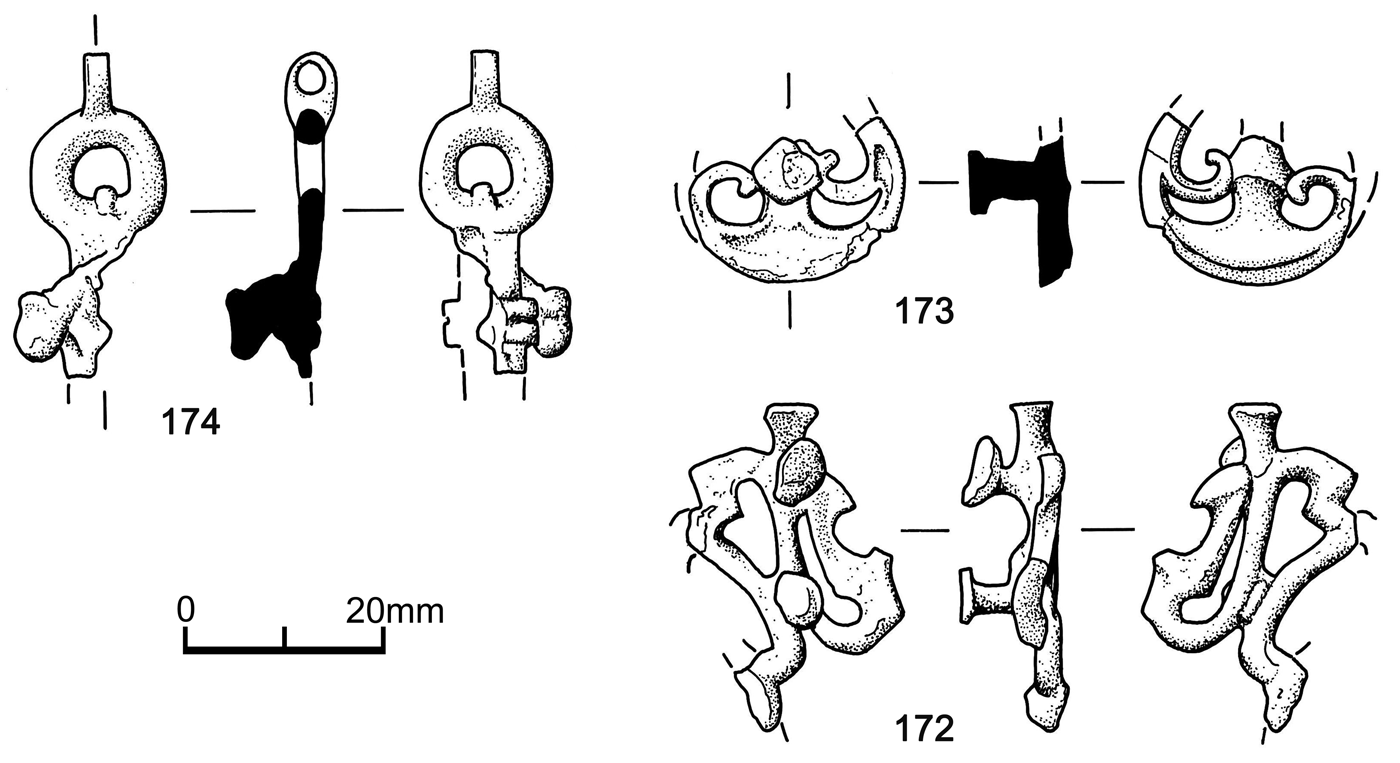
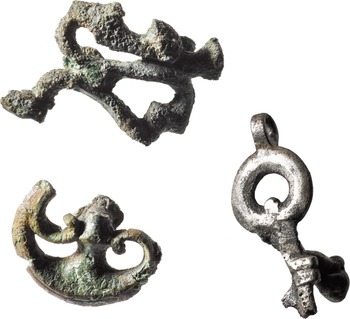
The Roman fort at Cramond (near Edinburgh) was built in the a.d. 140s to defend the coastal fringes of the Antonine Wall frontier. It was probably abandoned in the a.d. 160s, but was re-occupied as a supply base during the Severan invasions in the early third century.Footnote 67 An interesting pit group discovered in 1985 in the fort's annexe is only now being prepared for publication. It contained two Trompetenmuster mounts and an exceptional silver belt-fitting which is the subject of this note ( figs 10–11). These seem to have been part of a hoard; eight denarii were also recovered from the pit, ending with a coin of Caracalla (a.d. 206–9).
The silver belt-pendant and copper-alloy Trompetenmuster mounts. Dimensions: find 172, 33.5 × 21 × 9 mm, 2.96 g; find 173, 22 × 17.5 × 10 mm, 2.94 g; find 174, L 32, W 13, T 9 mm, 4.08 g. (Drawing: Alan Braby)

The silver belt-pendant and copper-alloy Trompetenmuster mounts. (Photo: Neil McLean, © Trustees of National Museums Scotland)

The fragmentary silver item is the first Scottish example of a well-known series of miniature weapon pendants from military belts ( fig. 12). Despite being damaged and distorted by heat, it can be identified as a ring-pommel sword.Footnote 68 The distribution of such pendants concentrates overwhelmingly in Upper Germany ( fig. 13).Footnote 69 Most have a suspension fitting in the plane of the pommel and were attached to a strap end in the form of a beneficiarius lance.Footnote 70 Ring-pommel swords and beneficiarius lances co-occur in other depictionsFootnote 71 and Jürgen OldensteinFootnote 72 has argued that these pendants were intended to mark out beneficiarii, troops on special service with the provincial governor. While the full-size lances were the equipment of beneficiarii, ring-pommel swords were not so restricted; Christian MiksFootnote 73 has suggested that they were chosen for pendants because they remained recognisable when rendered in miniature.
Intact examples of a ring-pommel sword belt-hanger and beneficiarius lance strap end from Zugmantel. (From Raddatz 1953, Abb. 1)

Distribution of pendants in the form of ring-pommel swords and strap ends in the form of beneficiarius lances. 1. Cramond (Edinburgh/UK); 2. Silchester (Hampshire/UK); 3. Thamusida (Kénitra/Morocco); 4. Baracs (Kom. Fejér/Hungary); 5. Kösching (Bavaria/D); 6. Butzbach (Hessen/D); 7. Feldberg (Hessen/D); 8. Frankfurt-Heddernheim (Hessen/D); 9. Mainz (Rheinland-Pfalz/D); 10. Niederbieber (Rheinland-Pfalz/D); 11. Osterburken (Baden-Württemberg/D); 12. Saalburg (Hessen/D); 13. Stammheim tower 4/96 (Hessen/D); 14. Stockstadt (Hessen/D); 15. Zugmantel (Hessen/D). (Map: author, based on references in note 3)

The concentrated distribution suggests that the pendants were specific to Upper Germany; there is an analogous category of miniature lance pendants from Dacia with a similarly restricted distribution.Footnote 74 This makes the four pendants and one lance-shaped strap end found outside Germania Superior of particular interest. Apart from Cramond, there is one further British example, from the town of Silchester,Footnote 75 one Raetian example from the fort of Körsching (Germany),Footnote 76 one Pannonian find from the fort of Baracs (Hungary),Footnote 77 and one from the fort of Thamusida in Mauretania Tingitana (Morocco).Footnote 78 These must be connected to the movement of individual troops from Upper Germany.Footnote 79 However, it is worth noting that three of the four pendants are unusual in having a small suspension loop set transversely to the pommel rather than in the same plane (only Silchester matches the German ones); in contrast, only one of the German finds, from Mainz, has such a fitting.Footnote 80 These small loops could not articulate with the lancehead strap terminals and must either have been held by wire or used rather differently. They may have been replacements for broken elements which were made locally, or represent local copies of items inspired by Upper German pendants. In the latter case they may not necessarily have had a link to beneficiarii, but the connection to Upper Germany remains strong given the close similarities in form.
The three other non-German examples lack any detailed context, though Silchester has produced another piece of beneficiarius insignia in the form of an openwork baldric terminal incorporating a lancehead design.Footnote 81 This makes Cramond's contextual information all the more interesting. Coins from the pit date it to the Severan period (with a terminus post quem for deposition of a.d. 206–9), when the fort was used during the imperial expeditionFootnote 82 and members of the governor's or emperor's service would be passing through. It is likely that the invasion army included legions or vexillations from the Rhine and Danube armies.Footnote 83 Epigraphic evidence indicates the Germanies were a regular source of troops for British campaigns: vexillations or individuals from the Upper German legions VIII Augusta and XXII Primigenia are recorded in northern Britain in the second and early third centuries, including a beneficiarius tribuni from Piercebridge.Footnote 84
The other unusual feature of the Cramond find is its use of silver. All other known examples are of copper alloy, though some have a white metal coating intended to emulate silver.Footnote 85 It is no surprise that such a prestigious emblem would be in a precious metal; George Boon noted related sword belt plates from Vechten (NL) and Silchester in silver and tinned bronze or base silver respectively,Footnote 86 while an unprovenanced silver brooch and dagger sheath terminal shared similar beneficiarius iconography.Footnote 87 These items were clearly intended to impress.
It seems unlikely that the mounts and pendant came from the same belt given the mixing of silver and copper alloy. The pendant had clearly seen use as the suspension loop shows wear, while heat-damage suggests attempts had been made to recycle it.
This sword-pendant from Cramond, while melted and outwardly unimpressive, is thus a significant find which highlights the wide-ranging connections of the Roman army and throws fresh light on the troops involved in the Severan expedition.
ACKNOWLEDGEMENTS
I am grateful to AOC Archaeology for the opportunity to work on this material, which was part of a project funded by City of Edinburgh Council through the good offices of John Lawson. David Breeze, Nick Hodgson, Lawrence Keppie and Boris Rankov provided very useful comments on an earlier draft.