INTRODUCTION
The genus Acantholaimus Allgén, Reference Allgén1933 is considered to be one of the most species-rich deep-sea nematode genera. Twelve Acantholaimus species were found in the deep Tropical West Pacific (Tietjen, Reference Tietjen1989). Twenty morphotypes of this genus were distinguished by Bussau (Reference Bussau1993) in the Peru Basin (Atlantic) at a depth of about 4200 m. Muthumbi & Vincx (Reference Muthumbi and Vincx1997) found 37 Acantholaimus morphotypes from the Indian Ocean off Kenya (depth of 500–2179 m). Lambshead et al. (Reference Lambshead, Brown, Ferrero, Hawkins, Smith and Mitchell2003) recognized 7 morphotypes of Acantholaimus among nematodes from the Clarion–Clipperton Fracture Zone (Pacific) and 8 morphotypes in the Porcupine Abyssal Plain (Atlantic). De Mesel et al. (Reference De Mesel, Lee, Vanhove, Vincx and Vanreusel2006) found 55 Acantholaimus morphotypes in samples from four areas of Antarctic seas at a depth of 182–2009 m. Thirty-three morphotypes of this species were reported from the Clarion–Clipperton Fracture Zone (Pacific) at a depth of about 5000 m (Miljutina et al., Reference Miljutina, Miljutin, Mahatma and Galéron2010). Nineteen morphotypes were distinguished in one sample from the Angola Basin (present work).
Several publications indicate a high abundance of this genus in deep-sea nematode assemblages; it is often one of dominating genera (Bussau, Reference Bussau1993; Soetaert & Heip, Reference Soetaert and Heip1995; Soetaert et al., Reference Soetaert, Vincx and Heip1995; Vanaverbeke et al., Reference Vanaverbeke, Soetaert, Heip and Vanreusel1997; Vanreusel et al., Reference Vanreusel, Clough, Jacobsen, Ambrose, Jivaluk, Ryheul, Herman and Vincx2000; Sebastian et al., Reference Sebastian, Raes, De Mesel and Vanreusel2007; Miljutina et al., Reference Miljutina, Miljutin, Mahatma and Galéron2010). Some Acantholaimus species were also in a dominating species complex (Bussau, Reference Bussau1993; Miljutin et al., 2010).
The analysis of morphological traits important for Acantholaimus systematics was made by De Mesel et al. (Reference De Mesel, Lee, Vanhove, Vincx and Vanreusel2006). Among them are: shape of a head; size and location of an amphid; length of outer labial setae; position, length and arrangement of cervical setae; length and thickness of cephalic setae; arrangement of a cuticle ornamentation; and shape and length of a tail.
Forty-five Acantholaimus species are described up to date (including 2 new ones described in the present paper). Of them, 29 species are known from the Atlantic, 21 species from the Pacific, and 7 species from the Indian Ocean (some species were found in several oceans). Of 46 possible cosmopolitan deep-sea nematode species (i.e. species recorded at least in two different oceans), 7 species belonged to the Acantholaimus genus (Miljutin et al., 2010).
The present study is a result of examination of nematodes of the genus Acantholaimus found in one sample from the DIVA-I expedition (RV ‘Meteor'), which took place in summer 2000, in the Angola Basin. It was a part of the global deep-sea biodiversity programme Census of the Diversity of Abyssal Marine Life (CeDAMar). A number of species have been already described using the material of the DIVA-I expedition (e.g. Malyutina et al., Reference Malyutina, Wägele and Brenke2001; Gad, Reference Gad2003; Mursch et al., Reference Mursch, Brenke and Wägelle2008; Willen, Reference Willen2008). One paper with descriptions of three new nematode species has been also published (Tchesunov, Reference Tchesunov2008).
In total, 189 individuals of the Acantholaimus genus (15.8% of all examined nematode individuals) were found in the sample. 19 morphotypes were distinguished, but only 7 of them possessed enough adult individuals of both sexes (for making qualitative taxonomic descriptions of new species) or, at least one adult specimen (for descriptions of new findings of known species).
MATERIALS AND METHODS
General data on the Angola Basin site and sample methods used in the DIVA-I expedition are published by Kröncke & Türkay (Reference Kröncke and Türkay2003) and Rose et al. (Reference Rose, Seifried, Willen, George, Veit-Köhler, Bröhldick, Drewes, Moura, Martínez Arbizu and Schminke2005). The value of total organic carbon in the sampling site was 0.62%, chlorophyll-a content 1.67 µg/g and mud content 95.23%.
Samples were taken with aid of a Barnett's multicorer. Tubes of multicorer had an inner diameter of 9.6 cm (the surface of each core amounted to 72.4 cm2). Each sample represented the upper 5-cm-thick layer of sediment of the volume of about 362 cm3. Samples were fixed with 5% formaldehyde solution on-board. In the laboratory, meiobenthic organisms were separated from sediments using Levasil®-kaolin medium (McIntyre & Warwick, Reference McIntyre, Warwick, Holme and McIntyre1984) with the following triple-time centrifugation at 4000 rpm for 6 minutes. After the centrifugation, the upper fraction containing meiobenthic organisms was sieved using a mesh size of 40 µm and washed with fresh water.
For the present study, 1193 nematode specimens were extracted from the single sample (core) from station No. 346 (16°17.0′S 005°27.0′E; depth 5389 m) and examined. Then nematodes were sorted out, processed in glycerin using the method of slow evaporation (Seinhorst, Reference Seinhorst1959), and permanently mounted on glycerin–paraffin slides. The nematodes were examined under a Leica DM 2500 light microscope equipped with Nomarski optics and a drawing apparatus. For preliminary species identification, the NeMys web database (Deprez et al., Reference Deprez2005) was used.
After preliminary identification, nematodes of the genus Acantholaimus were studied in detail, measured, and described. Measurements of stoma and male spicules were made as described by Miljutina & Miljutin (Reference Miljutina and Miljutin2011).
Slides with type specimens of the new species were deposited in the collection of Senckenberg Gesellschaft für Naturforschung (Senckenberganlage 25, 60325 Frankfurt, Germany).
List of abbreviations used in this paper:
- –,
parameter absent;
- a,
ratio ‘body length/maximum body diameter';
- a′,
ratio ‘body length without tail/maximum body diameter';
- b,
ratio ‘body length/length of pharynx';
- b′,
ratio ‘body length without tail/length of pharynx';
- c,
ratio ‘body length/length of tail';
- c',
ratio ‘length of tail/body diameter at anus';
- c.b.d.,
corresponding body diameter;
- f,
female;
- i,
intersex;
- L,
total body length;
- L′,
body length without tail;
- m,
male;
- n.a.,
not available for measuring because of poor position or condition of specimen, broken tail or inverted head;
- V,
ratio ‘distance from anterior end to vulva/total body length' (%);
- V′,
ratio ‘distance from anterior end to vulva/body length without tail' (%).
SYSTEMATICS
Order CHROMADORIDA Chitwood, 1933
Family CHROMADORIDAE Filipjev, 1917
Genus Acantholaimus Allgén, Reference Allgén1933
Acantholaimus angustus Bussau, Reference Bussau1993
(Figure 1; Table 1)
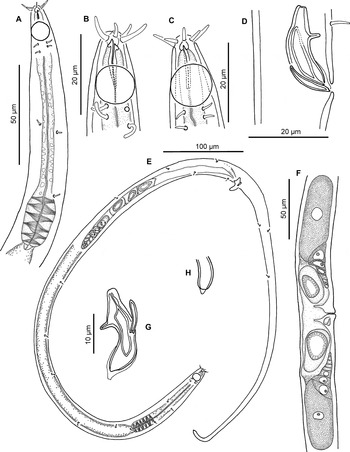
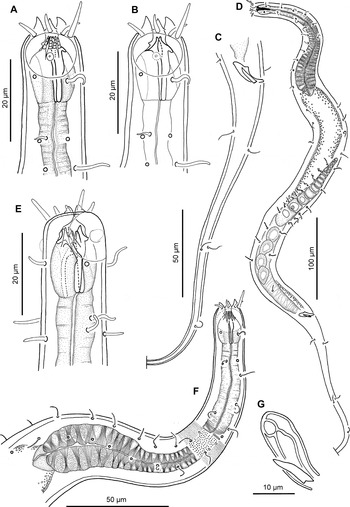
Acantholaimus angustus Bussau, Reference Bussau1993: (A) specimen No. 1, male, anterior end; (B) specimen No. 2, intersex, head; (C) specimen No. 1, head; (D) specimen No. 2, spicule region; (E) specimen No. 1, total view; (F) specimen No. 2, female reproductive system; (G) specimen No. 1, spicule; (H) specimen No. 1, caudal tip.

MATERIAL EXAMINED
Two males and 1 intersex (possessing well developed female reproductive system and male spicules with gubernaculum but without testis and vas deferens) (Table 1).
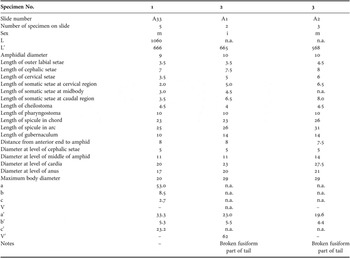
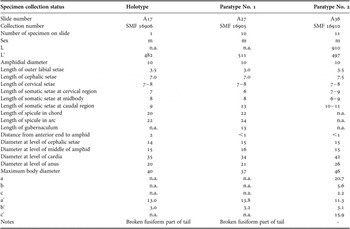
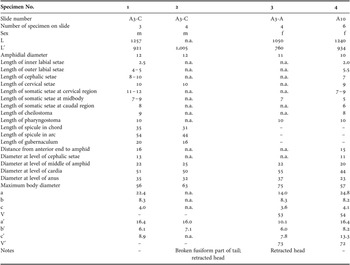
Acantholaimus angustus Bussau, Reference Bussau1993. Measurements (in µm) and body indices.

n.a., not available.
DESCRIPTION
Measurements are given in Table 1. Body slightly spindle-shaped, with narrowed anterior end and filiform posterior end. Somatic setae 2–8 µm long, numerous, situated along entire body in 4 sublateral rows. In postanal region, somatic setae clavate, i.e. with widened distal end; on rest of body, setae cylindrical or clavate. Cuticle densely dotted (dots arranged in transverse rows), with lateral fields consisting of larger dots. Lateral fields beginning at posterior border of amphideal fovea and extending along entire body length except filiform part of tail. Cuticle about 1.0–1.5 µm thick along entire body length except at level of cephalic setae, where it is thinner (0.3–0.5 µm), and except level of amphids, where it is thicker (~2 µm). Lips not visible. Two rings of head sensilla visible: 6 outer labial setae 3.5–4.5 µm long, and 4 submedian cephalic setae 7–8 µm long. Amphideal fovea large (about 1 c.b.d. in width in males), ventrally coiled, single-spiral, in form of longitudinally oriented oval or round, 9–10 µm width in males situated in 0.55–0.65 midamphideal c.b.d. from anterior end. Two pairs (latero-subdorsal and latero-subventral) of cervical setae 4–6 µm long, located close to posterior part of amphideal fovea. In latero-subventral pair of cervical setae, the distance between anterior and posterior setae is approximately twice the distance between setae of latero-subdorsal pair. Stoma consisting of wide, barrel-shaped cheilostoma and narrow pharyngostoma. At least two small sclerotized onchia ~1 µm long (presumably, dorsal and subventral) visible at anterior end of pharyngostoma. Pharyngostoma ~10 µm long. Pharynx muscular, relatively thin and cylindrical in anterior 3/4 of its length, posterior 1/4 of pharynx widened and containing large, regularly alternating plasmatic inclusions. Nerve ring and renette cell not visible. Cardia small, surrounded by intestine. Tail consisting of proximal conical part and long terminal filiform cylindrical part constituting ~70% of entire tail length.
Male reproductive system monorchic. Testis directed anteriorly, outstretched, lying to the right of intestine, occupying 40–50% of total body length. Spermatozoa oval, large (~48 × 16 µm), with clearly visible, oblong nuclei. Curved spicules possessing complex cuticular sculpture with thickened cuticular areas in form of longitudinal ridges. Gubernaculum shaped as curved stick with edged proximal end and bifurcated distal end. Supplementary organs not found.
Female reproductive system was examined in intersex only. It consisted of two antidromous ovaries (anterior ovary lying to right of intestine, and posterior one lying to left of intestine). Total length of female reproductive system constituting ~36% of preanal body length. Length of ovaries 85–96 µm. Each ovary containing one mature oocyte, 57 × 22 µm in size. Two spermatozoa ~36 × 17 µm in size visible in uterus.
ABUNDANCE
Ten specimens were found (about 0.8% of all nematodes examined in the sample).
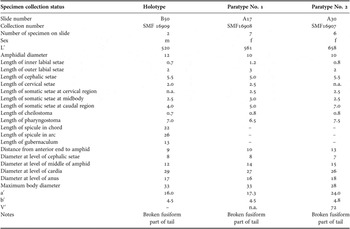
RE-EXAMINATION OF HOLOTYPE
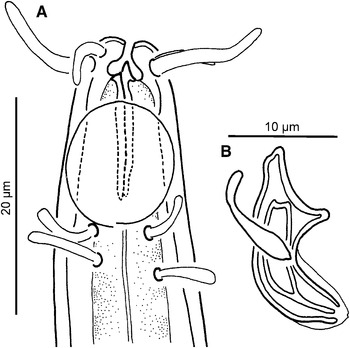
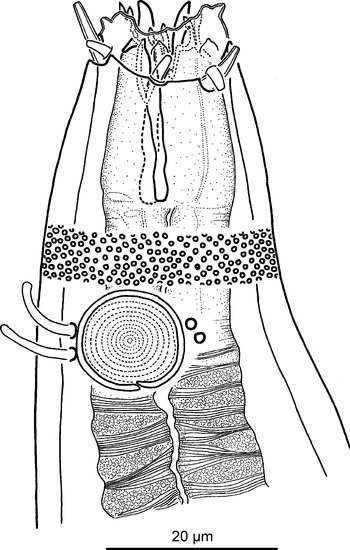
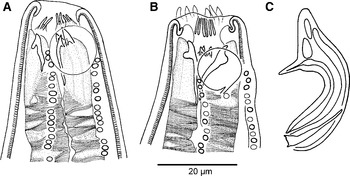
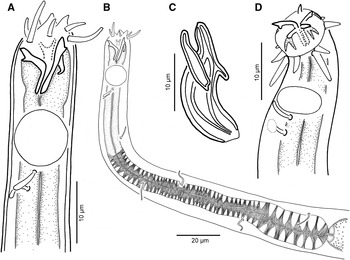
The holotype of A. angustus was re-examined (Figure 2). This re-examination revealed some inaccuracies in the original description. The length of cephalic setae is 11 µm instead of 15 µm in the original description. The cuticle is distinctly thickened at a level of the amphideal fovea, whereas it was described by Bussau (Reference Bussau1993) as possessing the same thickness as at more anterior and more posterior regions of the body. Left and right gubernacula vary in their form in the holotype (one of them is curved, the other one has a form of a tortuous stick), whereas only tortuous gubernaculum was described by Bussau (Reference Bussau1993). Labial, cephalic, and cervical setae are cylindrical or clavate versus conical with rounded edge in the original description. The spicule length in arc was 26 µm versus 16 µm in the original description (it can be caused by differences in methods of spicule measuring).
Acantholaimus angustus Bussau, Reference Bussau1993, re-drawing of holotype male: (A) head; (B) spicule.

REMARKS
Acantholaimus angustus was previously described from the Pacific only (Bussau, Reference Bussau1993; Miljutina & Miljutin, Reference Miljutina and Miljutin2011). The newfound specimens were therefore found about 13,000 km apart from the nearest previous location of finding (through the Drake Passage).
The newfound specimens correspond well with type individuals in their general appearance; size, location of amphideal fovae; number, location, and size of cervical setae; shape and size of spicules; and the arrangement of the stoma.
The newfound individuals are longer than type specimens (L′ = 568–666 µm versus 471–570 µm, respectively). The tail is longer in new specimens (c = 2.7 in only specimen with non-broken tail versus 4.7–5.5 in type specimens). However, the tail length can vary a lot in Acantholaimus genus. For instance, in A. angustus found in the Clarion–Clipperton Fracture Zone, Pacific (Miljutina & Miljutin, Reference Miljutina and Miljutin2011), the ‘c' parameter varied 2.3 to 4.1. The cephalic setae are shorter in new specimens (7–8 µm versus 11 µm in re-examined holotype). All these differences can be explained by interpopulation variability.
DISTRIBUTION
South-eastern Pacific, Peru Basin, nodule fields, 4157 m depth, 4159 m (Bussau, Reference Bussau1993); north-eastern tropical Pacific, Clarion–Clipperton Fracture Zone, nodule fields, abyssal plain without nodules, 4800–5042 m depth, ooze (Miljutina & Miljutin, Reference Miljutina and Miljutin2011); south-eastern Atlantic, Angola Basin, 5450 m depth (present report).
Acantholaimus akvavitus Gerlach, Schrage & Riemann, Reference Gerlach, Schrage and Riemann1979
(Figures 3–4, 5A, B, 6A; Table 2)
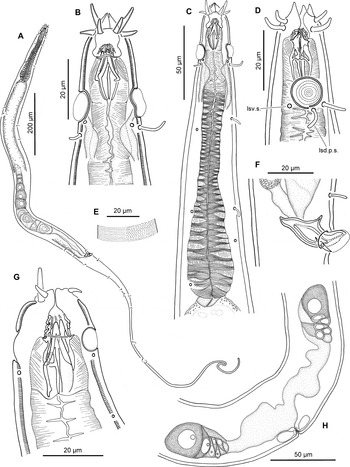
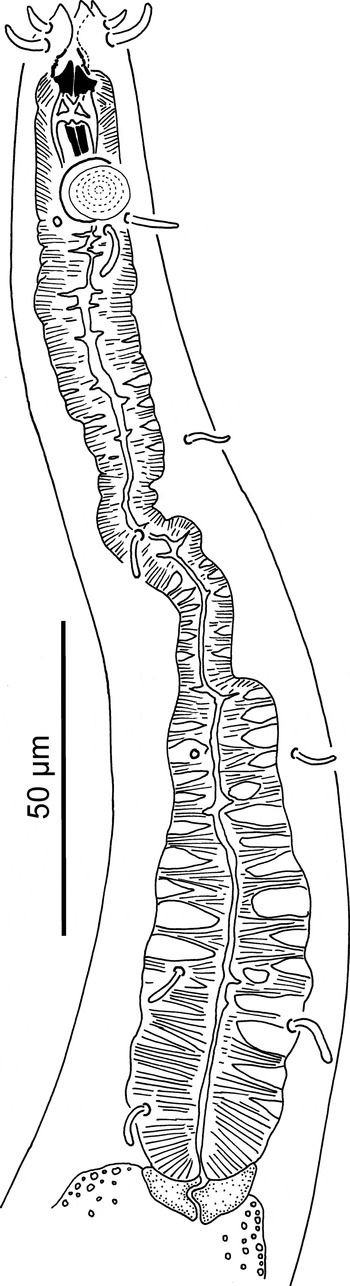
Acantholaimus akvavitus Gerlach et al., Reference Gerlach, Schrage and Riemann1979: (A) specimen No. 1, male, total view; (B) specimen No. 1, head; (C) specimen No. 1, anterior end; (D) specimen No. 3, female, head; (E) specimen No. 1, lateral view of cuticle surface at midbody; (F) specimen No. 1, spicule region; (G) specimen No. 2, male, head; (H) specimen No. 3, reproductive system. Abbreviations: lsd.p.s., laterosubdorsal pair of cervical setae; lsv.s., pit for single laterosubventral cervical seta (seta itself is lost).

Acantholaimus akvavitus Gerlach et al., Reference Gerlach, Schrage and Riemann1979, specimen No.3, female, anterior region.

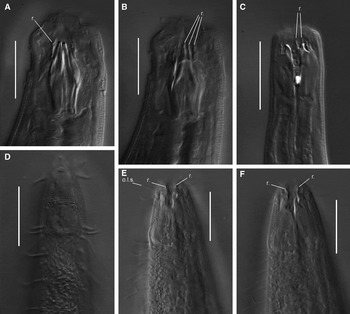
Heads of Acantholaimus species, micrographs: (A, B) A. akvavitus Gerlach et al., Reference Gerlach, Schrage and Riemann1979; (C) A. formosus sp. nov.; (D–F) A. quintus Gerlach et al., Reference Gerlach, Schrage and Riemann1979.

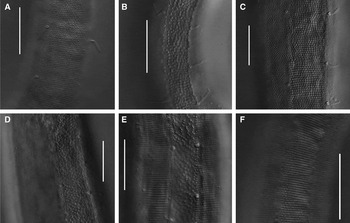
View of cuticular lateral fields of Acantholaimus species, micrographs: (A) A. akvavitus Gerlach et al., Reference Gerlach, Schrage and Riemann1979; (B) A. formosus sp. nov.; (C) A. iubilus Gerlach et al., Reference Gerlach, Schrage and Riemann1979; (D) A. quintus Gerlach et al., Reference Gerlach, Schrage and Riemann1979; (E, F) A. skukinae sp. nov.

MATERIAL EXAMINED
Two males, one female. One male is a little bit flattened between the object and cover glasses.
DESCRIPTION
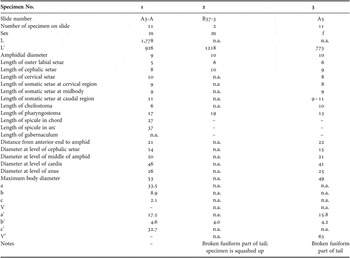
Measurements are given in Table 2. Body spindle-shaped, with strongly narrowed anterior end and filiform posterior one. Cuticle dotted densely with lateral differentiation, with beginning posterior amphideal fovea and lasting along whole body length except filiform part of tail. Width of lateral fields ~15 µm at level of pharynx and ~20 µm at midbody. Dots of lateral fields being bigger and situated sparser than ones outside lateral fields. At both lateral fields and outside lateral fields, dots arranged in more or less regular transversal rows. Cuticle thickness 0.5–1.0 µm at head tip, 2.0–2.5 µm at pharyngeal region, 1.5–2.0 µm at midbody, and 2–3 µm at caudal region. Somatic setae cylindrical or clavate, present along the whole body posterior amphideal fovea, arranged in 4 sublateral rows situated on each side of lateral fields, 7–8 µm long at pharyngeal region, 8–9 µm long at midbody, 9–11 µm at caudal region. Six triangle-shaped, very large lips ~7 µm long visible. Inner labial sensilla invisible. Six outer labial setae 5–6 µm long and 4 submedian cephalic setae 8–10 µm long, located close to each other, and lying at almost the same level. Amphideal fovea round, single-spiral, with fine concentric striation visible inside. Amphideal fovea situated in ~1 c.b.d. behind anterior end. Arrangement of cervical setae not clear because of lack of many of them. Possibly, a laterosubdorsal pair of setae located distant from each other and one laterosubventral setae present behind each amphideal fovea. Their length 8–10 µm. Stoma consisting of cup-shaped cheilostoma (6–10 µm long) and narrow, funnel-shaped pharyngostoma (13–19 µm long). Cheilostoma possessing 6 pairs of rod-shaped, many-jointed and tortuous cuticular rugae. Rugae laying deep in cheilostoma, at level of tips of onchia. Pharyngostoma containing 4 sclerotized onchia: dorsal and subventral ones 3.5–6.5 µm long (in different specimens), and 2 smaller ones 2.0–2.5 µm long. Walls of pharyngostoma, being a prolongation of onchia, looking very thick and possessing a complicated construction. Pharynx regularly muscular, gradually widening to its posterior end. Anterior part of pharynx at level of esophasoma looking as detached from rest pharynx by small junction. Posteriormost 3/4 of pharynx containing numerous, regularly arranged plasmatic inclusions. Nerve ring and renette cell not found. Cardia triangular. Tail consisting of proximal conical part and long terminal filiform cylindrical part constituting ~80% of whole tail length.
Acantholaimus akvavitus Gerlach et al., 1979. Measurements (in µm) and body indices.

n.a., not available.
Male reproductive system. Single testis directed anteriorly, outstretched, lying to the left of intestine (in both examined males), however spermaduct lying to the right of intestine. Curved funnel-shaped paired spicules possessing cuticular sculpture with thickened cuticular areas in shape of longitudinal or transversal ridges. Construction of spicules and shape of gubernacula not well seen because of their bad position. Total length of male reproductive system ~45% of precloacal body length. Size of spermatozoa ~45 × 33 µm.
Female reproductive system consisting of two antidromous ovaries 40–50 µm long (anterior one lying to the right of intestine, and posterior one lying to the left of intestine), and short oviducts. Total length of female reproductive system ~27% of preanal body length. Vulvar glands surrounding short vulva seen.
ABUNDANCE
Three specimens were found (0.25% of all nematodes examined in the sample).
REMARKS
The newfound specimens of A. akvavitus show good resemblance with the original description in their general appearance, the body parameters, the length and the arrangement of head and somatic setae, the character of lateral fields. A very characteristic feature is the arrangement of cervical setae (a laterosubdorsal pair of setae and a single laterosubventral seta), that have been still described in A. akvavitus only.
Newfound specimens of A. akvavitus differ from all other known Acantholaimus species by the construction of its onchia, which looks much more complicated than in other Acantholaimus species. This construction of onchia was not highlighted in the original description, however the similar constructions are discernible on the original figures of this species. The unusual position of testis was also noted by Gerlach et al. (Reference Gerlach, Schrage and Riemann1979).
DISTRIBUTION
South-eastern Pacific, Chile–Peru Trench, 4526–4925 m depth (Gerlach et al., Reference Gerlach, Schrage and Riemann1979); north-western Atlantic, Bay of Biscay, 4700 m depth (Vivier, Reference Vivier, Laubier and Monniot1985); south-eastern Atlantic, Angola Basin, 5450 m depth (present report).
Acantholaimus formosus sp. nov. (Figures 5C, 6B, 7; Table 3)
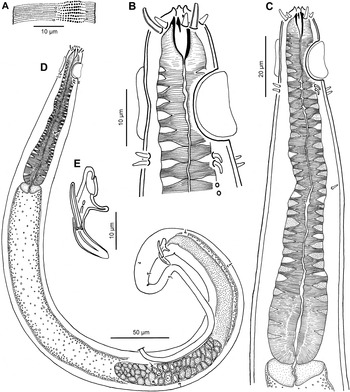
Acantholaimus formosus sp. nov.: (A, B) holotype, male, head; (C) holotype, posterior region; (D) holotype, total view; (E) paratype No. 1, male, head; (F) holotype, anterior end; (G) Paratype No. 1, spicule.

TYPE MATERIAL
Holotype: one male. Paratypes: 2 males.
ETYMOLOGY
Latin formosus (= beautiful).
DESCRIPTION
Measurements are given in Table 3. Only males were found. Body spindle-shaped, with strongly narrowed anterior end and filiform posterior one. Cuticle dotted densely with lateral differentiation, with beginning posterior to amphideal fovea and lasting along whole body length except filiform part of tail. Width of lateral fields 10–12 µm. Dots of lateral fields being bigger and situated sparser than ones outside lateral fields. Dots arranged in more or less regular transversal rows. At the optical cut-section of the cuticle the dots are discernible as tiny radial struts. Cuticle ~1 µm thick at level of head tip; ~1.5 thick at level of entire body except caudal region, where it is 2.5 µm. Head of paratypes slightly inverted. Somatic setae cylindrical, sometimes with slightly widened tips. Somatic setae sparse, cylindrical in form, 6–9 µm long at preanal body region and 10–13 µm long at caudal region, present along the whole body, arranged in 4 submedian rows situated on each side of lateral fields. Numerous pores (~1 µm in diameter) visible also between somatic setae in those 4 submedian rows. There are 6 triangle-shaped lips with edged anterior tips. Inner labial sensilla invisible. 6 outer labial setae 3.0–3.5 µm long and 4 submedian cephalic setae 7.0–7.5 µm long locating close to each other and lying at same level. Amphideal fovea round or in shape of transversally oriented oval, very weakly visible, without cuticular edging. Central spot of amphideal fovea visible better than its boundary. Amphideal fovea situated close to head end. Two cervical setae 7–8 µm long (laterosubdorsal one and laterosubventral one) located at a short distance from posterior end of every amphideal fovea. Stoma consisting of cup-shaped cheilostoma (3.5–7.5 µm long) and narrow, funnel-shaped esophagostoma (13.5–16.0 µm long). Cheilostoma possessing 6 pairs of teeth-like jointed cuticular rugae. Esophagostoma with 2 massive sclerotized onchia. Rugae and onchia situated at same level, therefore discernible hard. Pharynx enlarged at level of esophastoma. Anterior third of pharynx regularly muscular, remaining part of pharynx containing numerous and large plasmatic inclusions. Middle third of pharynx slightly but noticeably narrowed. Last third of pharynx gradually widening without formation of distinct bulbus. Nerve ring and renette cell not found. Cardia large, triangular. Tail consisting of proximal conical part and long terminal filiform cylindrical part constituting 79% of whole tail length.
Acantholaimus formosus sp. nov. Measurements (in µm) and body indices.

n.a., not available.
Male reproductive system. Single testis directed anteriorly, outstretched, lying to the right of intestine. Curved funnel-shaped paired spicules possessing cuticular sculpture with thickened cuticular areas in shape of longitudinal or transversal ridges. Gubernaculum in shape of wide plate with edged distal end and toothed proximal end. Supplementary organs not found. Size of mature spermatozoa ~40 × 32 µm.
DIFFERENTIAL DIAGNOSIS
Acantholaimus formosus sp. nov. is characterized by its spindle-shaped body with strongly narrowed anterior end; large, amphideal fovea with hard visible amphideal rim but with well noticeable central spot; the position of its amphideal fovea (situated very close to head end); and massive sclerotized onchia.
The new species shares with A. coruscus Bussau, Reference Bussau1993, A. elegans Jensen, Reference Jensen1988, A. heipi Muthumbi & Vincx, Reference Muthumbi and Vincx1997 and A. verscheldi Muthumbi & Vincx, Reference Muthumbi and Vincx1997 a small body length (L′ = 300–500 µm), a large amphideal fovea, a long pharynx (b = 4–6), thin anterior part of the body (till at least the middle of the pharynx) and big robust onchia. New species differs from all these species by the location of amphideal fovea (on the apical tip of the body versus 8–15 µm behind apical end). Besides this feature, A. formosus sp. nov. differs from these four species by below mentioned characteristics.
Acantholaimus formosus sp. nov. distinctly differs from A. coruscus by the length of cephalic setae (7 µm versus 17 µm); by the position of cervical setae (almost on the same level just posterior amphideal fovae versus one behind other on a visible distance from amphideal fovea) and the quantity of teeth (2 versus 3).
The new species differs from A. verscheldi by spindle shaped body with strongly narrowed anterior end versus cylindrical body with weakly narrowed anterior end; by the quantity of teeth (2 versus 3) and by the length of spicules (22–24 µm versus 14–18 µm).
The new species differs from A. heipi by thicker spindle shaped body with strongly narrowed anterior end versus thinner cylindrical body with weakly narrowed anterior end (a = 21 versus a = 31–44); by the length of spicules (22–24 µm versus 14–18 µm); by the length of cephalic setae (7 µm versus 11–13 µm) and the quantity of teeth (2 versus 3).
The new species is more close to A. elegans according to the shape and the length of the body and length of outer labial and cephalic setae. New species differs from A. elegans by the presence of lateral differentiation of cuticle; by the location of cervical setae (almost on the same level just posterior amphideal fovae versus one behind other on a visible distance from amphideal fovea); by the quantity of teeth (2 versus 4) and by the presence of 12 massive ragae.
ABUNDANCE
Three specimens were found (0.25% of all nematode individuals examined in the sample).
Acantholaimus iubilus Gerlach, Schrage & Riemann, Reference Gerlach, Schrage and Riemann1979
(Figures 6C, 8)
Acantholaimus iubilus Gerlach et al., Reference Gerlach, Schrage and Riemann1979, female, head.

MATERIAL EXAMINED
One female.
DESCRIPTION
Measurements: L′ = 946 µm; a′ = 13.7; b′ = 4.5. Body diameter at level of: amphid = 26 µm; cardia = 53 µm; anus = 28 µm. Maximum body diameter = 69 µm.
The fusiform part of the tail is broken in examined specimen. Body cylindrical, with narrowed anterior end and filiform tail. Somatic setae cylindrical or clavate, 7 µm long at pre-anal body, 8–9 µm long at tail, arranged in 4 submedian longitudinal rows (except filiform part of tail). Cuticle dotted. At pre-amphidial region, dots arranged irregularly, lateral fields absent. At post-amphidial body, dots arranged in transverse rows; lateral fields present. Size of dots very small at anterior part of pre-amphideal body; dots much larger and looking like rings at posterior part of pre-amphidial body. Posterior from amphideal fovea, dots looking smaller. In lateral fields, dots larger than between lateral fields. Width of lateral fields 15 µm at level of pharynx; 32 µm at midbody. At tail region, lateral fields absent; dots getting larger again and fused together in transverse rows. Cuticle ~0.5 µm at level of head tip; 3 µm thick at level of pharynx; 1.3 µm at level of midbody; 3.5 µm at level of anus. Six inner labial thick papillae ~1.5 µm long, 6 outer labial short setae 3 µm long, and 4 straight thick cephalic setae 9 µm long visible. Amphideal fovea single-spiral, round, with fine concentric striation, ~12 µm wide, ~1.2 amphidial c.b.d. from anterior end. Two pairs (latero-subdorsal and latero-subventral) of cervical setae 10–12 µm long located at level of a middle of amphideal fovea. Stoma consisting of wide, cup-shaped cheilostoma ~9 µm long and narrow, funnel-shaped pharyngostoma ~21 µm long, with thicker cuticular walls. Cheilostoma containing 6 pairs of large, well discernible cylindrical rugae ~3 µm long. Two long, very robust sclerotized onchia ~10 µm long visible in cheilostoma. Basal parts of onchia situated in anterior part of pharyngostoma, and their apical parts protruding outside mouth opening. Pharynx thin at its anterior part, gradually widening to its posterior end, with large plasmatic interruptions along its entire length. Cardia flattened in direction of main body axis. Nerve ring not visible. Renette cell not visible. Intestine filled with fine and coarse (up to 9 µm long) particles of irregular shape. Tail gradually narrowed into filiform, cylindrical terminal part. No caudal glands visible. Female reproductive system consisting of two antidromous, uniformly sized ovaries (anterior ovary lying to right of intestine, and posterior one lying to left of intestine).
REMARKS
Our individual closely resembles the type specimens in its general appearance; in its body length; in the size and position of the amphideal fovea; in the number and position of the cervical setae; in the shape of head (truncated cone); and in the length and position of setae of all rings of head sensilla.
Our specimen differs from the type specimens by the number of onchia (only 2 onchia were found). Various authors described different numbers of onchia in this species. Gerlach et al. (Reference Gerlach, Schrage and Riemann1979) found, presumably, 5 onchia in the type description. Gourbault & Vincx (Reference Gourbault and Vincx1985) and Miljutina & Miljutin (Reference Miljutina and Miljutin2011) described 3 onchia. Not all onchia can be visible because of bad position of a head or because of presence of foreign particles in a stoma.
ABUNDANCE
One specimen of A. iubilus was found.
DISTRIBUTION
South-eastern Pacific, Chile–Peru Trench, 3086–6313 m depth, fine silt (Gerlach et al., Reference Gerlach, Schrage and Riemann1979); north-eastern Atlantic, Bay of Biscay, 4725 m depth (Vivier, Reference Vivier, Laubier and Monniot1985); south-eastern Atlantic, 2063–4308 m depth (Gourbault & Vincx, Reference Gourbault and Vincx1985); North Atlantic, Norway Sea, 970–3294 m depth (Jensen, Reference Jensen1988); central-western Atlantic, Hatteras plain, 5411 m depth and Puerto Rico Trench, 7460–8380 m depth (Tietjen, Reference Tietjen1989); north-eastern tropical Pacific, Clarion–Clipperton Fracture Zone, nodule fields and area without nodules, 5000–5035 m depth (Milutina & Miljutin, 2011); south-eastern Atlantic, Angola Basin, 5450 m depth (present report).
Acantholaimus quintus Gerlach, Schrage & Riemann, Reference Gerlach, Schrage and Riemann1979
(Figures 5D–F, 6D, 9–10; Table 4)
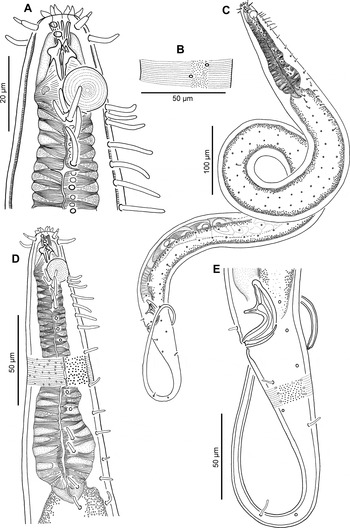
Acantholaimus quintus Gerlach et al., Reference Gerlach, Schrage and Riemann1979, specimen No. 1, male: (A) head; (B) lateral view of cuticle surface at midbody; (C) total view; (D) anterior end; (E) posterior end.

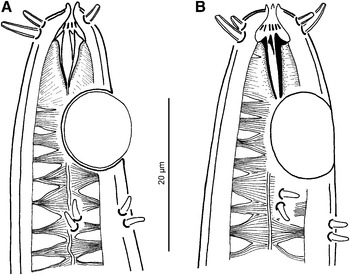
Acantholaimus quintus Gerlach et al., Reference Gerlach, Schrage and Riemann1979: (A) specimen No. 3, female, head; (B) specimen No. 2, male, head; (C) specimen No. 2, spicule.

MATERIAL EXAMINED
Two males, 2 females.
DESCRIPTION
Measurements are given in Table 4. Body slightly spindle-shaped, with narrowed anterior end and filiform posterior end. Somatic setae cylindrical, 5–12 µm long, situated along entire body in 4 submedian rows, very numerous at pharyngeal region. Cuticular pores 1.0–1.5 µm in diameter possessing distinct rim also visible in these 4 submedian rows and, possibly, indicating places of lost setae. Cuticle densely dotted, with lateral fields, beginning posterior to amphideal fovea and continuing along entire body length, except filiform part of tail. Width of lateral fields 14–15 µm at level of pharynx, 9–12 µm at midbody, and 12–15 µm at caudal region. Dots of lateral fields larger and arranged irregularly and more sparsely than dots outside lateral fields. Outside lateral fields, cuticular dots arranged in transverse rows along whole body. Except dots, numerous small pores ~1 µm in diameter, lacking distinct rim, visible outside lateral fields. Usually, these pores arranged irregularly, except level of pharynx, where they form longitudinal rows of 1 pore at borders of lateral fields. Cuticle about ~0.5 µm thick at level of head tip, 1.5–2.5 µm at rest of body (except filiform part of tail, where their thickness is less than 1 µm). Lips not visible. Three rings of head sensilla visible: 6 short and thick inner labial setae, 2.0–2.5 µm long; 6 outer 2-jointed labial setae 4.0–5.5 µm long; and 4 longer submedian cephalic setae 8–10 µm long. Amphideal fovea situated at level of pharyngostoma, at 0.7–1.0 c.b.d. from the anterior end, round, ventrally coiled, single-spiral, 10–11.5 µm in diameter, located in 15–16 µm from anterior tip. Two triplets (latero-subdorsal and latero-subventral ones) of cervical setae, 9–10 µm long, situated very close to each other and located at same level close to posterior part of each amphideal fovea. In addition, a group of several somatic setae (usually 4–6 setae in each of 4 latero-median rows) located just posterior to cervical setae, these somatic setae set more closely than other somatic setae. Of this group, anterior 3–4 setae being 10–12 µm long, and posterior 7–8 µm long. Rest of somatic setae 7–8 µm long and arranged relatively sparse. Cheilostoma cup-shaped, 8–9 µm long, possessing 12 thin, elongated rugae. Pharyngostoma narrow, funnel-shaped, ~10 µm long, with thick cuticular walls and 5 sclerotized onchia: dorsal and subventral ones ~7 µm long, and other three onchia 3–4 µm long. Basal parts of onchia situated in anterior part of pharyngostoma, and their apical parts intruding into cheilostoma. Pharynx muscular, with numerous plasmatic inclusions, gradually widening to its posterior end. Pharynx slightly enlarged at level of pharyngostoma (evidently, this swelling consisting of muscles operating onchia, plasmatic inclusions absent in this part). Nerve ring and renette cell not visible. Cardia triangular. Tail consisting of proximal conical part, and long terminal filiform cylindrical part constituting ~70% of entire tail length.
Acantholaimus quintus Gerlach et al., 1979. Measurements (in µm) and body indices.

n.a., not available.
Male reproductive system monorchic. Testis directed anteriorly, outstretched, lying to right of intestine. Spermatozoa oval, very large (53 × 20 µm in specimen No.1 and 78 × 20 µm in specimen No. 2), with clearly visible, oblong nuclei. Curved, funnel-shaped spicules possessing complex cuticular sculpture. Gubernaculum with edged proximal end and bifurcated distal end. Supplementary organs not visible.
Female reproductive system possessing two antidromous ovaries (anterior ovary lying to right of intestine, and posterior one lying to left of intestine).
REMARKS
Our individuals closely resemble the type specimens in most body measurements and parameters. However, there are several small distinctions. Outer labial setae are 2-jointed in newfound specimens; this fact was, however, not mentioned clearly in type description. It was therefore noted here that these setae possess thinner distal part and thicker basal part. This construction may be interpreted as a sign of two-jointing of these setae. Two bigger and three smaller onchia were found in newfound specimens, whereas three bigger onchia and several smaller ones were described in type specimens. However, the arrangement of onchia can be quite complicated in the Acantholaimus genus, and it is sometimes impossible to distinguish real number and arrangement of onchia in some individuals or species. Therefore, these distinctions in number and size of onchia could be caused by the different position of examined specimens on the slide, by different quality of microscopes used for the examination, and some other reasons.
This species was previously reported from the Angola Basin by Gourbault & Vincx (Reference Gourbault and Vincx1985); however the description of this species was given very briefly.
ABUNDANCE
Eleven specimens were found (about 0.9% of all nematodes examined in the sample).
DISTRIBUTION
South-eastern Pacific, Chile–Peru Trench, 5986–6134 m depth (Gerlach et al., Reference Gerlach, Schrage and Riemann1979); north-western Atlantic, Bay of Biscay, 1960 m depth (Vivier, Reference Vivier, Laubier and Monniot1985); south-eastern Atlantic, Cape Basin, 2992–4180 m depth (Gourbault & Vincx, Reference Gourbault and Vincx1985); south-eastern Atlantic, Angola Basin, 2063–4308 m depth (Gourbault & Vincx, Reference Gourbault and Vincx1985); south-eastern Atlantic, Angola Basin, 5450 m depth (present report).
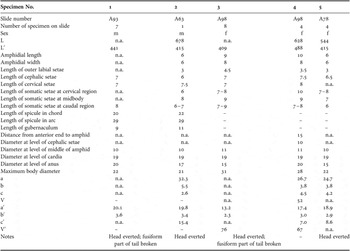
Acantholaimus skukinae sp. nov.
(Figures 6E, F, 11–12; Table 5)
Acantholaimus skukunae sp. nov., holotype, male: (A) lateral view of cuticle surface at midbody; (B) head; (C) anterior end; (D) total view; (E) spicule.

Acantholaimus skukunae sp. nov., females: (A) paratype No. 2, head; (B) paratype No. 3, head.

TYPE MATERIAL
Holotype: one male. Paratypes: 2 females.
ETYMOLOGY
In honour of Elena Skukina (Russian Federal Institute of Fisheries and Oceanography, Moscow, Russia).
DESCRIPTION
Measurements are given in Table 5. Body mainly cylindrical, with slightly narrowed anterior end and filiform posterior end. Somatic setae sparse, cylindrical in form, 2.5–3.0 µm long at preanal body region and 4–7 µm long at caudal region, situated along entire body in 4 sublateral rows. Cuticle ~0.5 µm thick at head tip; 1.0–1.5 µm thick at pharyngeal region; 0.7–1.2 µm thick at rest body. Cuticle densely dotted (dots arranged in transverse rows), with lateral fields consisting of larger dots. Lateral fields beginning at posterior border of amphideal fovea and extending along entire body length except filiform part of tail. A row of small pores ~1 µm in diameter situated along borders of lateral fields. Similar pores arranged irregularly visible also outside lateral fields. Lips not developed. Three rings of head sensilla visible: 6 inner labial conical papillae 0.7–1.2 µm long; 6 outer labial setae 2–3 µm long, and 4 submedian cephalic setae 5.0–5.5 µm long. Setae of second and third ring situated very close to each other. Amphideal fovea large, 10–12 µm in diameter (representing 0.7–0.8 c.b.d. in width), round, ventrally coiled, single-spiral, situated in 9–13 µm from anterior end. Two pairs (latero-subdorsal and latero-subventral) of cervical setae 2.0–2.5 µm long, located in 3–5 µm posterior to amphideal fovea. Stoma consisting of wide, barrel-shaped cheilostoma 2–4 µm long and narrow pharyngostoma 6–8 µm long. Small rod-shaped rugae visible in cheilostoma. Two sclerotized onchia ~1.5 µm long (dorsal and subventral ones) and one smaller one ~0.8 µm long (subventral) visible at anterior end of pharyngostoma. Pharynx muscular, cylindrical in its anterior half, slightly widening to its posterior end, containing numerous and regularly arranged plasmatic inclusions. Nerve ring and renette cell not visible. Cardia large, rounded, surrounded by intestine. Tail consisting of proximal conical part and long terminal filiform cylindrical part.
Acantholaimus skukinae sp. nov. Measurements (in µm) and body indices.

n.a., not available.
Male reproductive system monorchic. Testis directed anteriorly, outstretched, lying to the right of intestine, occupying ~40% of preanal body length. Curved spicules possessing complex cuticular sculpture with thickened cuticular areas in form of longitudinal ridges. Gubernaculum shaped as curved or almost outstretched stick with bifurcated distal end. Supplementary organs not found.
Female reproductive system consisting of two antidromous ovaries. Total length of female reproductive system constituting ~25% of preanal body length. Mature oocyte 40 × 19 µm in size.
DIFFERENTIAL DIAGNOSIS
Acantholaimus skukinae sp. nov. is characterized by its cylindrical body shape; short outer labial and cephalic, cervical, and somatic setae; large amphideal fovea; the position of its amphideal fovea (situated relatively far from the head end); and relatively small onchia.
The new species resembles A. obviatus Vivier, Reference Vivier, Laubier and Monniot1985 with its general appearance; body length; shape of the head; and length and position of cervical setae. It differs from the latter one by larger amphideal fovea (10–12 µm in diameter versus 6 µm, respectively); by the position of an amphideal fovea (9–13 µm from the anterior end versus 5 µm, respectively); by the arrangement of head sensilla (outer labial setae and cephalic setae are close to each other, whereas they separated from each other distinctly in A. obviatus); by the length of stoma (8–11 µm versus 5 µm, respectively).
The new species resembles A. incomptus Vivier, Reference Vivier, Laubier and Monniot1985 with its general appearance and head shape; size and arrangement of its stoma; position of the amphideal fovea. The new species differs from the latter one by its longer body (L′= 520–658 µm versus 349–403 µm, respectively); larger amphid (10–12 µm in diameter versus 4.5 µm, respectively); by shorter outer labial setae (2–3 µm versus 4 µm, respectively); and by its shorter cephalic setae (5–6 µm versus 9 µm, respectively).
The new species resembles A. minutus Vitiello, Reference Vitiello1970 with its general appearance; size and arrangement of labial, cephalic, and cervical setae. The new species differs from the latter one by its longer body (L′= 520–658 µm versus 301–393 µm, respectively); larger amphideal fovea (10–12 µm in diameter versus 4.5 µm, respectively).
The new species resembles A. vermeuleni Mithumbi & Vincx, 1997 with its general appearance; short head sensilla; and large amphideal fovea. The new species differs from the latter one by its longer body (L′= 520–658 µm versus 209–423 µm, respectively); by the location of the amphideal fovea (situated in 9–13 µm from the head end versus 3–5 µm, respectively); by more robust (a′ = 16–24 versus 30) and thicker (maximum body diameter is 28–38 µm versus 10–11 µm) body.
ABUNDANCE
Four specimens were found (about 0.3% of all nematodes examined in the sample).
Acantholaimus verscheldi Muthumbi & Vincx, Reference Muthumbi and Vincx1997
(Figure 13; Table 6)
Acantholaimus verscheldi Muthumbi & Vincx, Reference Muthumbi and Vincx1997: (A) specimen No. 4, female, head; (B) specimen No. 4, anterior end; (C) specimen No. 1, male, spicule; (D) specimen No. 2, male, head.

MATERIAL EXAMINED
Two males, 3 females.
DESCRIPTION
Measurements are given in Table 6. Body thin, cylindrical, with a long pharyngeal region. Somatic setae cylindrical, 6–9 µm long, arranged very sparse along body, arranged in 4 sublateral rows. Lateral fields indistinct. Dots usually arranged more or less in transverse rows. Cuticle very thin along whole body, ~0.5 µm thick. There are 6 triangular lips with edged anterior tips. Inner labial sensilla not visible. Six outer labial setae 3.0–4.5 µm long and 4 submedian cephalic setae 6.0–7.5 µm long, appearing confluent and lying at almost same level. Amphideal fovea ventrally coiled, single-spiral, round, with indistinct borders, 6–10 µm in diameter, situated at 15 µm from anterior end. One pair of cervical setae 7–8 µm long located at a short distance posterior to each amphideal fovea. Stoma consisting of cup-shaped cheilostoma ~4 µm long and funnel-shaped pharyngostoma ~8 µm long. Cheilostoma possessing 6 pairs of poor discernible rugae. Number of onchia hard to detect; 5 onchia visible in specimens with everted head, whereas only 2–3 onchia, biggest and smallest of which 2–3 µm and ~1.5 µm long, respectively, detectable in specimens with non-everted head. Pharynx regularly muscular, almost cylindrical, with slightly widening posterior end. Anterior third of pharynx containing no plasmatic interruptions. Nerve ring and renette cell not visible. Cardia triangular. In some specimens, anterior part of pharynx everted and protruding outside, including onchia. Tail consisting of proximal conical part and long terminal filiform cylindrical part constituting 55–80% of entire tail length.
Acantholaimus verscheldi Muthumbi & Vincx, Reference Muthumbi and Vincx1997. Measurements (in µm) and body indices.

n.a., not available.
Male reproductive system constituting ~50% of preanal body length. Single testis directed anteriorly, outstretched, lying to right of intestine. Spermatozoa oval, ~20 × 11 µm, with clearly visible, oblong nuclei. Spicules funnel shaped. Gubernaculum in shape of slightly curved stick with rounded proximal end and bifurcated distal end. Supplementary organs not found.
Female reproductive system consisting of two antidromous ovaries (anterior ovary lying to right of intestine, and posterior one lying to left of intestine), and short oviducts, constituting ~50% of preanal body length. Length of ovaries 40–70 µm. Each ovary containing one mature ovocyte ~53 × 23 µm in size. Uterus not defined. Three pairs of vulvar glands with granular content surrounding short vagina.
REMARKS
Our individuals closely resemble the type specimens in most body measurements and parameters. However, there are several small distinctions. Type specimens are more slender than newfound ones (maximum body diameter 13–16 µm versus 21–31 µm, respectively). In type specimens, spicules are 11–15 µm long versus 20–22 µm in newfound individuals. Besides amphideal fovea is larger in our individuals (6–10 µm versus 4–7 µm). As type specimens were described from the Indian Ocean (i.e. very far from the new location of finding), it can be explained by some interpopulation variations. In addition, the distinction in spicule measurements could be caused by difference in methods of spicule measuring.
The type location of A. verscheldi is the Kenyan coast of the Indian Ocean (Muthumbi & Vincx, Reference Muthumbi and Vincx1997). New specimens were found about 8000 km apart from the type location.
ABUNDANCE
Five specimens were found (about 0.4% of all nematodes examined in the sample).
DISTRIBUTION
Western Indian Ocean, off the Kenyan coast, 520–2179 m depth (Muthumbi & Vincx, Reference Muthumbi and Vincx1997); south-eastern Atlantic, Angola Basin, 5450 m depth (present report).
DISCUSSION
In the present investigation, we found 5 known Acantholaimus species. Of them, A. verscheldi Muthumbi & Vincx, Reference Muthumbi and Vincx1997 was previously known from the Indian Ocean only. Acantholaimus angustus Bussau, Reference Bussau1993 was described from the Peru Basin (Pacific) and later found in the Clarion–Clipperton Fracture Zone (Pacific), about 5200 km apart from the type location (Miljutina & Miljutin, Reference Miljutina and Miljutin2011). Acantholaimus iubilus Gerlach et al., Reference Gerlach, Schrage and Riemann1979 was initially described from the Pacific and found later in the other very distant Pacific region (Miljutina & Miljutin, Reference Miljutina and Miljutin2011) and in four different Atlantic regions (Gourbault & Vincx, Reference Gourbault and Vincx1985; Vivier, Reference Vivier, Laubier and Monniot1985; Jensen, Reference Jensen1988; Tietjen, Reference Tietjen1989). Acantholaimus akvavitus Gerlach et al., Reference Gerlach, Schrage and Riemann1979 was also initially described from the Pacific, but later recorded in the Atlantic (Vivier, Reference Vivier, Laubier and Monniot1985). Except its type location in the Pacific, A. quintus Gerlach et al., Reference Gerlach, Schrage and Riemann1979 was found also in three different Atlantic regions (Gourbault & Vincx, Reference Gourbault and Vincx1985; Vivier, Reference Vivier, Laubier and Monniot1985).
Therefore, based on morphological descriptions (unfortunately, there are still no data on molecular taxonomy of this genus), we can conclude, that many Acantholaimus species are widespread in the World's oceans. Many species of Acantholaimus seem to be cosmopolitan. It is already known, that, according to morphological and genetic arguments, some marine nematode species are cosmopolitan or very widespread (Decraemer et al., Reference Decraemer, Gourbault and Helléouet2001; Bhadury et al., Reference Bhadury, Austen, Bilton, Lambshead, Rogers and Smerdon2008; Bik et al., Reference Bik, Thomas, Lunt and Lambshaed2010). Cosmopolitan species were found also among other meiobenthic groups: foraminiferans (Lecroq et al., Reference Lecroq, Gooday and Pawlowski2009) and harpacticoids (Menzel et al., Reference Menzel, George and Martinez Arbizu2011).
Whereas Acantholaimus species are mainly deep-sea and, therefore, have not been able to use shallow-water facilities for their dispersal, e.g. strong near-shore currents, transportation by the way of adhering to birds or floating materials, dispersal using of ballast water or sand from commercial vessels, etc. (Gerlach, Reference Gerlach1977; Palmer, Reference Palmer1988), the fact of a wide distribution of them can indicate a very longstanding age of these species.
The other assumption is that, in spite of very high local and regional species diversity of this genus, the total number of Acantholaimus species could be not too large. This assumption is based on the fact of a very wide distribution of many Acantholaimus species. The different combinations of the same species could form the species diversity of this genus in different localities and regions. It is highly likely that natural habitats of different Acantholaimus species will be extended as new deep-sea areas of the world's ocean will be studied.
ACKNOWLEGEMENTS
The authors thank Professor Dr Michael Türkay (Senckenberg Gesellschaft für Naturforschung, Senckenberg Forschungsinstitut und Naturmuseum, Frankfurt-am-Main, Germany), a chief-scientist of the DIVA-I expedition, for the collected material. A.T. thanks Professor Dr P. Martinez Arbizu and Dr G. Gad for many-sided help while staying in DZMB and sorting DIVA-I nematodes. We also express our gratitude to two anonymous referees and Dr Tom Moens for valuable remarks. The study was financially supported by CeDAMar and CoML.