Introduction
The genus known as Cryptolechia A. Massal. was instated in its current sense by Vězda (Reference Vězda1969) under the name Gyalectina Vězda, based on Parmelia carneolutea Turner. Vězda included eight species: G. carneolutea (Turner) Vězda, G. myriadella (Nyl.) Vězda, G. nana (Tuck.) Vězda, G. plurilocularis (Vain.) Vězda, G. saxatilis Vězda, G. stellaris (Müll. Arg.) Vězda, G. subincolorella (Nyl.) Vězda and G. versicolor (Müll. Arg.) Vězda. In the protologue, Vězda (Reference Vězda1969) gave a Latin description of the genus but no diagnosis to distinguish it from other genera in Gyalectaceae, particularly Gyalecta Ach. and Pachyphiale Lönnr. Since Vězda listed Biatorinopsis sect. Polyphragma Müll. Arg. as a synonym, and Müller (Reference Müller1894) had defined that section as having 8–16 ascospores per ascus, it is probable that Vězda (Reference Vězda1969) considered the number of ascospores the principal diagnostic feature, then separating Gyalectina from Gyalecta by polyspored asci and from Pachyphiale in having more than eight but a maximum of 16 ascospores per ascus.
Hawksworth (Reference Hawksworth1972) pointed out that the type of Gyalectina, Parmelia carneolutea, had previously been placed in the monospecific genus Cryptolechia by Massalongo (Reference Massalongo1853). According to Hawksworth (Reference Hawksworth1972), Vězda had been aware of this but had argued that Massalongo (Reference Massalongo1853) had derived his concept of Cryptolechia from a specimen erroneously identified as P. carneolutea but which actually represented Pertusaria carneopallida (Nyl.) Anzi ex Nyl. (currently a synonym of P. protuberans (Sommerf.) Th. Fr.). This had led Zahlbruckner (Reference Zahlbruckner, Engler and Prantl1907) to include Cryptolechia as a synonym of Ochrolechia A. Massal., before he changed his mind and listed the name as a synonym of Gyalecta (Zahlbruckner Reference Zahlbruckner1924). When Vězda (Reference Vězda1969) established Gyalectina, the Code was ambiguous as to the correct typification of a generic name when the name of the type species had been misapplied, and so he did not adopt Cryptolechia but considered it a synonym of Pertusaria (Vězda, in Ainsworth et al. Reference Ainsworth, James and Hawksworth1971: 631). Subsequently, a provision was added to the Code to fix the typification of a generic name to the name of its type, not the specimen to which the name had been misapplied (Turland et al. Reference Turland, Wiersema, Barrie, Greuter, Hawksworth, Herendeen, Knapp, Kusber, Li and Marhold2018: Art. 7.3). As a result, Hawksworth & Dibben (Reference Hawksworth and Dibben1982) adopted Cryptolechia as the correct name for Gyalectina and provided the necessary combinations for the species previously placed in Gyalectina.
Prior to molecular phylogenetic studies, most workers accepted Belonia Körb., Coenogonium Ehrenb., Cryptolechia, Dimerella Trevis., Gyalecta, Pachyphiale and Ramonia Stizenb. as genera in Gyalectaceae (Poelt Reference Poelt1969; Purvis et al. Reference Purvis, Coppins, Hawksworth, James and Moore1992; Andrés Reference Andrés2003). In addition to Belonia (ascomata perithecioid) and Coenogonium (thallus filamentous), pre-molecular concepts separated these genera as follows:
– ascospores 1-septate, ≤ 8 per ascus = Dimerella
– ascospores 1-septate, > 8 per ascus = Ramonia
– ascospores 3- to multiseptate or muriform, ≤ 8 per ascus = Gyalecta
– ascospores 3- to multiseptate, > 8 per ascus = Cryptolechia, Pachyphiale.
While Dimerella was synonymized with Coenogonium and excluded from Gyalectaceae (Lücking & Kalb Reference Lücking and Kalb2000; Kauff & Lutzoni Reference Kauff and Lutzoni2002; Rivas Plata et al. Reference Rivas Plata, Lücking, Aptroot, Sipman, Umaña, Chaves and Lizano2006), both Cryptolechia and Ramonia later also accommodated species with 8-spored asci (Kalb Reference Kalb2007; Aptroot et al. Reference Aptroot, Sobreira and Cáceres2015), rendering the traditional separation from Gyalecta difficult. The phylogenetic position of Ramonia within Gyalectaceae is uncertain; the available sequences have variously been identified as Ramonia sp. and Xerotrema sp., and their identity is unclear (Lücking et al. Reference Lücking, Stuart and Lumbsch2004; Schmitt et al. Reference Schmitt, Mueller and Lumbsch2005; Wedin et al. Reference Wedin, Wiklund, Crewe, Döring, Ekman, Nyberg, Schmitt and Lumbsch2005; Miadlikowska et al. Reference Miadlikowska, Kauff, Högnabba, Oliver, Molnár, Fraker, Gaya, Hafellner, Hofstetter and Gueidan2014). The separation of Cryptolechia from Pachyphiale was obscure from the beginning. Zahlbruckner (Reference Zahlbruckner, Engler and Prantl1907) considered Cryptolechia to be based on Lecanora (i.e. Pertusaria) carneopallida, and so in Gyalectaceae he only distinguished Pachyphiale with polysporous asci and more than 1-septate ascospores, but gave the number of ascospores for that genus as 12 or more. The species of Pachyphiale accepted by Zahlbruckner at the time (i.e. P. carneola (Ach.) Arnold, P. corticola Lönnr. and P. fagicola (Arnold) Zwackh) had (8–)24–48 spores per ascus but, for unknown reasons, Zahlbruckner did not consider Parmelia carneolutea as belonging here. The latter was later included in Pachyphiale by Sampaio (Reference Sampaio1921) and in Gyalecta by Zahlbruckner (Reference Zahlbruckner1924).
When Vězda (Reference Vězda1969) erected Gyalectina, he apparently intended to separate species with ≤ 8 spores per ascus (Gyalecta), (8–)12–16 spores per ascus (Gyalectina) and (8–)24–48 spores per ascus (Pachyphiale). This is supported by his combination of Gyalecta geoicoides Vain., a species with 24–48-spored asci, into Pachyphiale in the same work, but contradicted by his acceptance of Lecidea subincolorella Nyl., a species with 8-spored asci, in Gyalectina. Vězda's concept was nevertheless broadly accepted, although modified in subsequent works. Poelt (Reference Poelt1969) distinguished the three genera as follows:
– Gyalecta: asci 8-spored, (transversely septate to) muriform; apothecia variously coloured
– Gyalectina: asci (8–)12(–16)-spored, transversely septate; apothecia yellowish
– Pachyphiale: asci (8–)16(–48)-spored, transversely septate; apothecia reddish brown.
Poelt (Reference Poelt1969) thus added apothecial colour as an additional diagnostic feature to separate Gyalectina from Pachyphiale. This concept was adopted by Purvis et al. (Reference Purvis, Coppins, Hawksworth, James and Moore1992) and Smith et al. (Reference Smith, Aptroot, Coppins, Fletcher, Gilbert, James and Wolseley2009) for Cryptolechia, although a similar range of colour variation, from pale yellowish to red-brown, was accepted within the single genus Gyalecta. Other authors, such as Sipman (Reference Sipman2005), relied solely on ascospore number. Kalb (Reference Kalb2007) was the first to present a key to the species accepted in Cryptolechia at the time; however, the already weak separation between Gyalecta, Cryptolechia and Pachyphiale was further challenged by Kalb's (Reference Kalb2007) combination of Pachyphiale geoicoides (Vain.) Vězda (with 24–48-spored asci) into Cryptolechia, and by accepting a second species with 8-spored asci in that genus besides C. subincolorella, namely C. caudata Kalb. While Kalb (Reference Kalb2007) did not discuss Pachyphiale, he realized the problem of generic concepts by stating: ‘Cryptolechia has its closest generic connections with Gyalecta, and there are indeed species, e.g. C. geoicoides, which are habitually not distinguishable from species of Gyalecta. In these cases, I have used the spore number per ascus as the discriminating character as is also done in the literature […]. Further results based on molecular genetic studies may reveal that Cryptolechia is only a later synonym of Gyalecta …’ (Kalb Reference Kalb2007: 308). Van den Boom & Vězda (Reference van den Boom and Vězda2005) further added to the confusion when describing the new species Gyalecta canariensis van den Boom & Vězda, with (8–)12–16-spored asci, in the genus Gyalecta, not even discussing Cryptolechia carneolutea as a possibly similar taxon. Notably, G. canariensis was subsequently synonymized with that species (van den Boom Reference van den Boom2010; but see below).
From the above considerations, it becomes obvious that there are no grounds to maintain the separation of Cryptolechia and Pachyphiale from Gyalecta using the number of ascospores per ascus or characters such as ascoma colour. This view is supported by molecular evidence: Baloch et al. (Reference Baloch, Lücking, Lumbsch and Wedin2010) found the genera Belonia and Pachyphiale nested within Gyalecta and subsequently both were formally synonymized with the latter (Baloch et al. Reference Baloch, Lumbsch, Lücking and Wedin2013). At that time, it seemed logical to also subsume Cryptolechia within Gyalecta, but the only sequences then available, from a specimen identified as Cryptolechia sp. from Kenya (Mangold et al. Reference Mangold, Martín, Lücking and Lumbsch2008) and later labelled C. nana (Rivas Plata et al. Reference Rivas Plata, Parnmen, Staiger, Mangold, Frisch, Weerakoon, Hernández, Cáceres, Kalb and Sipman2013), either clustered with the genus Lepra Scop. (mtSSU: EU075572) or represented a contaminant in Dothideomycetes (nuLSU: EU075620). To finally shed light on this conundrum, we generated sequence data for the mitochondrial small subunit rDNA (mtSSU) from recent collections of the type species, C. carneolutea. These collections were from a rich population on a tree recently blown over by a storm, c. 250 km west of the five localities in Sussex from which it was first described and illustrated (Turner Reference Turner1808).
Material and Methods
Target species and studied material
Cryptolechia carneolutea is a rare but possibly widespread species, occurring in Ireland, England, France, Portugal (including the original material of its synonym, Pachyphiale lecanorina J. Steiner 1918), Italy, Macaronesia and Algeria, with scattered and perhaps doubtful records from Canada, the Caribbean, India and New Zealand (Watson et al. Reference Watson, Hawksworth and Rose1988; Wong & Brodo Reference Wong and Brodo1990; Purvis et al. Reference Purvis, Coppins, Hawksworth, James and Moore1992; Hafellner Reference Hafellner1995; Coppins & Coppins Reference Coppins and Coppins2002; Sparrius et al. Reference Sparrius, Diederich, Signoret and Sérusiaux2002; Boom et al. Reference Boom, Buck, Gracie and Tulig2009; Seaward Reference Seaward2010; Roux Reference Roux2012; Balaji & Hariharan Reference Balaji and Hariharan2013; Ait Hammou et al. Reference Ait Hammou, Miara, Rebbas, Slimani, Ravera and Hamer El Ain2014; Aptroot & Stech Reference Aptroot and Stech2018). Gyalecta canariensis from the Canary Islands (see above) has been considered to be another synonym (van den Boom Reference van den Boom2010), but the orange-brown apothecial disc of the type material suggests it could represent a different taxon. The New Zealand material (Berggren 136 (S-L34083)) was annotated as questionable by Frank Kauff.
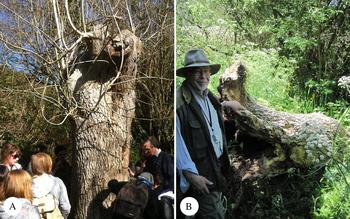
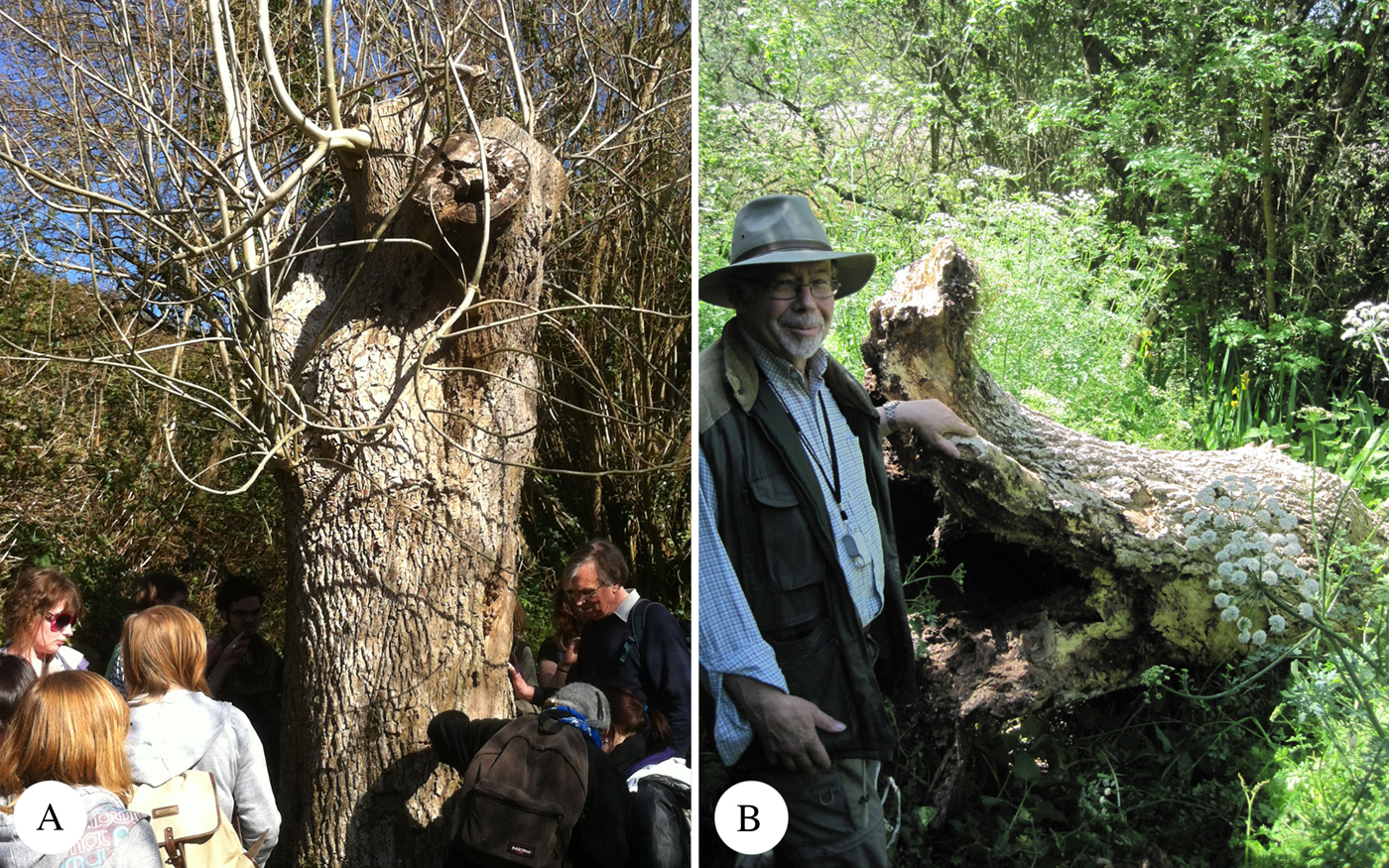
In the UK, C. carneolutea is classified as endangered, having experienced a size reduction of more than 50% over the last ten years, at least 20% within five years, and a continued decline is expected with fewer than 250 colonies (Woods & Coppins Reference Woods and Coppins2012). It was formerly more widespread on Ulmus trees but, following their loss due to Dutch elm disease (Ophiostoma novo-ulmi) in the 1970s, is now largely confined to ancient and mature Fraxinus trees that persist in the same localities (Watson et al. Reference Watson, Hawksworth and Rose1988). One of the strongholds of C. carneolutea is the Slapton Ley National Nature Reserve in Devon, where the species was particularly abundant on one ancient Fraxinus tree (Fig. 1A); this was the source tree from which the material used by Letrouit-Galinou (Reference Letrouit-Galinou1973, Reference Letrouit-Galinou1974), to study the ontogeny of the species, was collected in 1971 on an excursion during the First International Mycological Congress (IMC1) based in Exeter. Chicita F. Culberson also collected a piece on the same excursion and found an unidentified substance, possibly a depside, by TLC (Hawksworth Reference Hawksworth1972). Unfortunately, that same tree was blown over in a storm in April 2017 (Fig. 1B), evidently weakened by the wood-rotting bracket fungus Rigidoporus ulmarius, a basidiome of which was found on the base of the fallen trunk on 13 April 2019. The third author (DLH) was, however, able to rescue some material from the fallen tree with the permission of Natural England and under the supervision of the Field Studies Council warden of the reserve, to serve as voucher for this molecular study: United Kingdom: England: South Devon (V.C. 3), Stokenham Parish, Slapton, Slapton Ley National Nature Reserve, northern margin of Slapton Ley east of The Causeway, SX(20)/822.441, alt. c. 2 m, on bark of fallen Fraxinus, 22 May 2017, D. L. Hawksworth s. n. (B 60 0300001, K(M) 251532). Further pieces of bark from the fallen tree were selected for transplanting the species to younger Fraxinus trees further along Marsh Lane, leading from The Causeway to Deer Bridge, also within the National Nature Reserve. The locality lies 244–266 km west of the five localities in Sussex from which the species was first described and illustrated (Turner Reference Turner1808). Material from the same Fraxinus, or an almost adjacent Fraxinus that had already been lost in the 1980s, and collected by DLH and Peter W. James in 1970, is distributed in Vězda, Lich. Sel. Exs. no. 981 (1971).
Fraxinus tree at Slapton Ley National Nature Reserve in Devon, source of Cryptolechia carneolutea specimens (B 60 0300001, K(M) 251532). A, the Fraxinus tree still standing, with David Streeter and students (April 2013; photograph courtesy of Andy Pratt); B, the fallen trunk, with DLH in the foreground (May 2017; photograph by Thomas Pinches). In colour online.
Molecular phylogenetic analysis
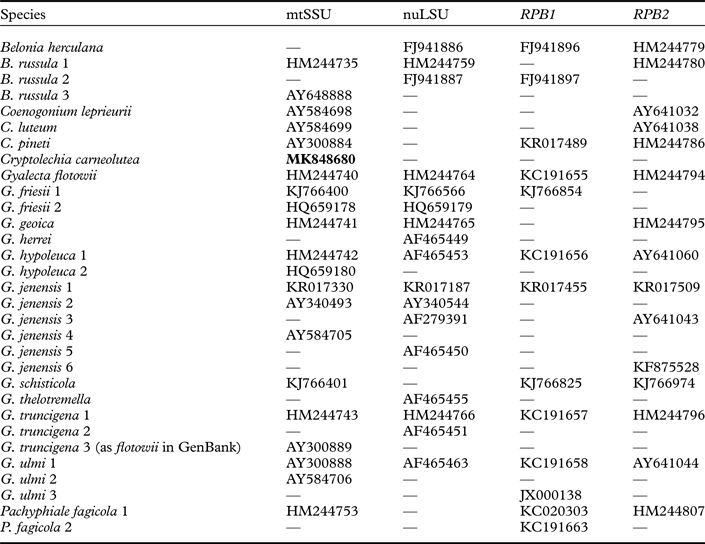
Sequence data for the mitochondrial small subunit rDNA (mtSSU) were generated from the material using the Sigma REDExtract-N-Amp Plant PCR Kit (St Louis, Missouri, USA) for DNA isolation, following the manufacturer's instructions, except that 40 μl of extraction buffer and 40 μl dilution buffer were used. The mtSSU was amplified using the SSU1R and SSU3R primers (Zoller et al. Reference Zoller, Scheidegger and Sperisen1999). The PCR reactions consisted of 6 μl distilled water, 0·1 μl of each PCR primer (10 μM), 3·5 μl of SIGMA REDExtract-N-Amp™ PCR ReadyMix (Sigma-Aldrich) and 2 μl genomic DNA. The PCR cycling conditions were as follows: 95 °C for 5 min, followed by 94 °C for 45 s, 50 °C for 1 min, 72 °C for 1 min 30 s (35 cycles), and a single 72 °C final extension for 10 min. Attempts to generate nuLSU (nuclear large subunit rRNA gene) and RPB2 (the second largest subunit of nuclear RNA polymerase II) sequences were unsuccessful. PCR samples were visualized on a 1% ethidium bromide-stained agarose gel under UV light and bands were gel-extracted, heated at 70 °C for 5 min, cooled to 45 °C for 10 min, treated with 1 μl GELase (Epicentre Biotechnologies, Madison, WI, USA) and incubated at 45 °C for at least 24 h. Samples were sequenced bi-directionally with the relevant PCR primers at Macrogen Inc. (Korea), and sequences were assembled in DNASTAR SeqMan 4.03 and submitted to GenBank (Table 1).
GenBank Accession numbers of sequences used for the phylogenetic analysis. Voucher information for Cryptolechia carneolutea (in bold) is presented in the Material and Methods section.

The mtSSU data obtained were first analyzed within a broad data set representing all families within Ostropomycetes, to elucidate the placement of Cryptolechia relative to Gyalectaceae. For this purpose, we assembled the new sequence (MK848680) with 728 selected sequences downloaded from GenBank (for Accession numbers see Supplementary Material S1 & S2, available online) in BIOEDIT 7.09 (Hall Reference Hall1999), then subjected the data to automated alignment with MAFFT 7.244 (Katoh & Standley Reference Katoh and Standley2013) and subsequent manual inspection (Supplementary Material S1, available online). The phylogenetic tree was reconstructed by means of maximum likelihood, with 100 bootstrap pseudoreplicates, using RAxML 8.2.0 (Stamatakis Reference Stamatakis2015). After confirming that Cryptolechia carneolutea was placed in Gyalectaceae with support (see Supplementary Material S2, available online), we placed the newly generated mtSSU sequence in the context of a 4-gene phylogenetic framework of Gyalectaceae, using the additional markers nuLSU, RPB1 and RPB2 from sequences obtained from GenBank, with Coenogonium as an outgroup (Table 1). All sequences were again assembled in BIOEDIT 7.09 (Hall Reference Hall1999) and the individual markers were first aligned separately using MAFFT 7.244 (Katoh & Standley Reference Katoh and Standley2013) and subsequently combined, after manually checking for topological conflict. Phylogenetic trees were again built by means of maximum likelihood (ML), with 1000 bootstrap pseudoreplicates each, using RAxML 8.2.0 (Stamatakis Reference Stamatakis2015).
Results and Discussion
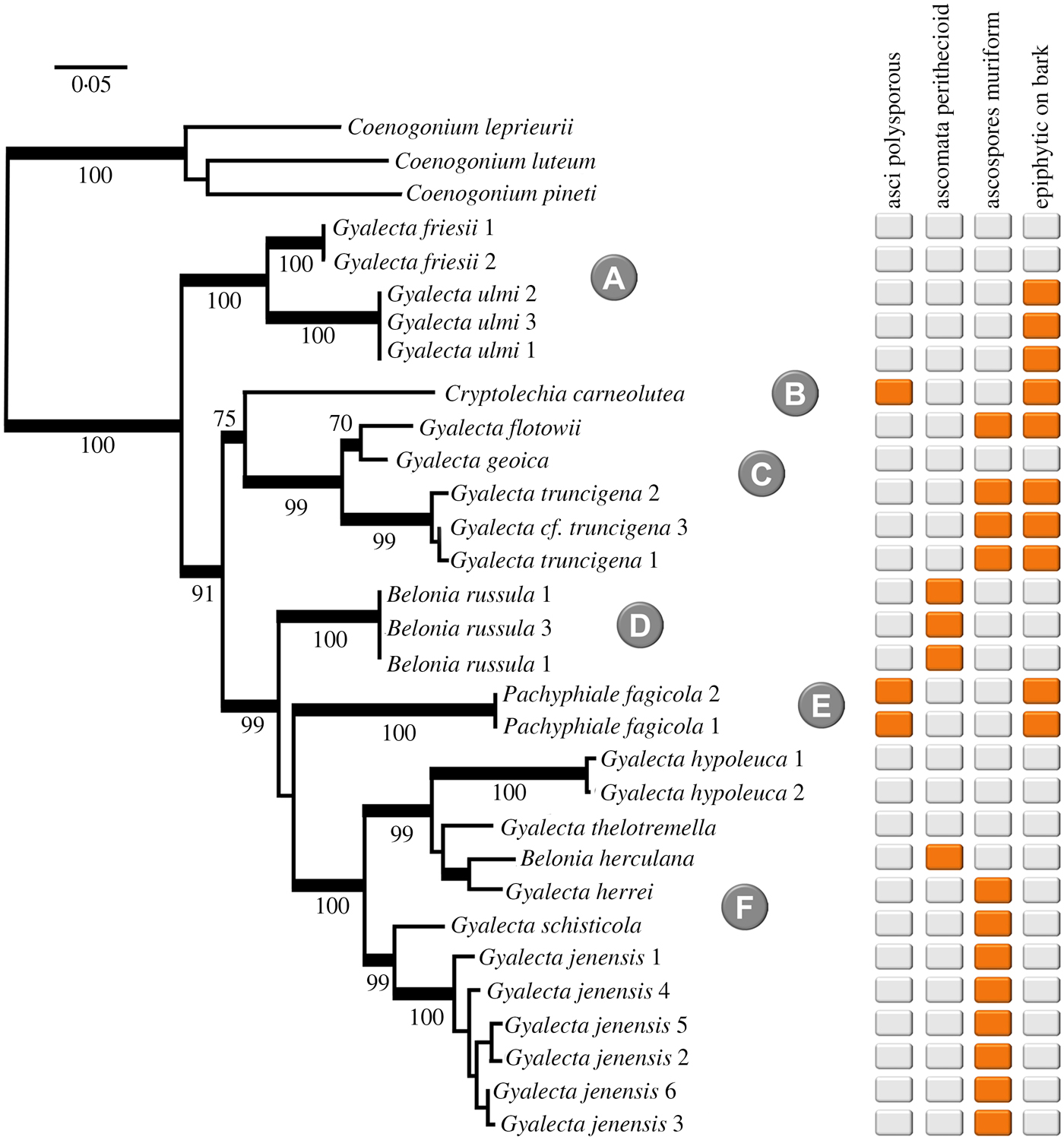
Our analysis resulted in six clades (A–F) within Gyalectaceae, with good to strong clade and backbone support (Fig. 2). The earliest diverging clade (A) included Gyalecta friesii and G. ulmi, followed by Cryptolechia carneolutea (B) as supported sister to a clade including Gyalecta flotowii, G. geoica and G. truncigena (C). The next two clades corresponded to Belonia russula (D) and Pachyphiale fagicola (E), followed by the last, strongly supported clade (F), which included Gyalecta herrei, G. hypoleuca, G. jenensis (type species), G. schisticola, G. thelotremella and Belonia herculana (Fig. 2). Thus, three strongly supported yet unrelated clades (A, C & F) represented taxa consistently classified in Gyalecta, and Cryptolechia carneolutea appeared nested within the latter, in a similar way to Belonia and Pachyphiale (Baloch et al. Reference Baloch, Lücking, Lumbsch and Wedin2010, Reference Baloch, Lumbsch, Lücking and Wedin2013).
Best-scoring maximum likelihood tree of Gyalectaceae based on four markers (mtSSU, nuLSU, RPB1, RPB2). Supported branches (≥ 70%) are thickened and bootstrap support values are given. Four main characters are mapped on the tree and clades under discussion are indicated (A–F). Coenogonium is used as an outgroup. GenBank Accession numbers for sequences are given in Table 1. In colour online.

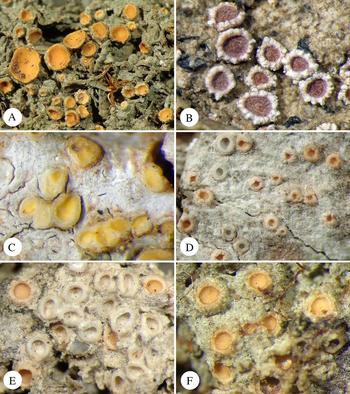
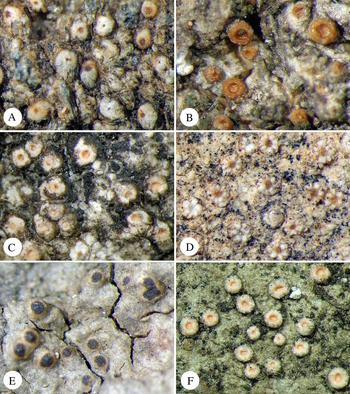
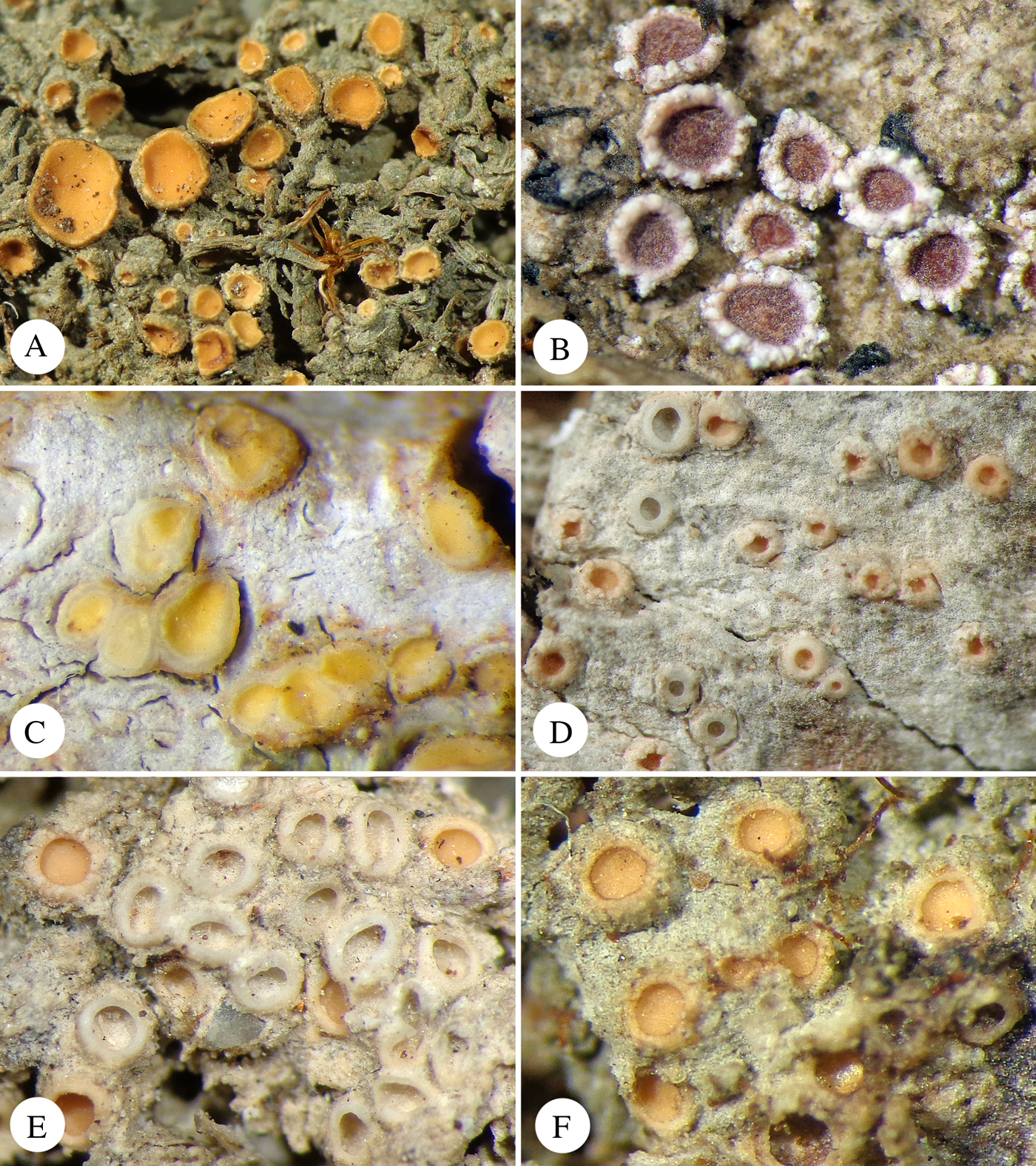
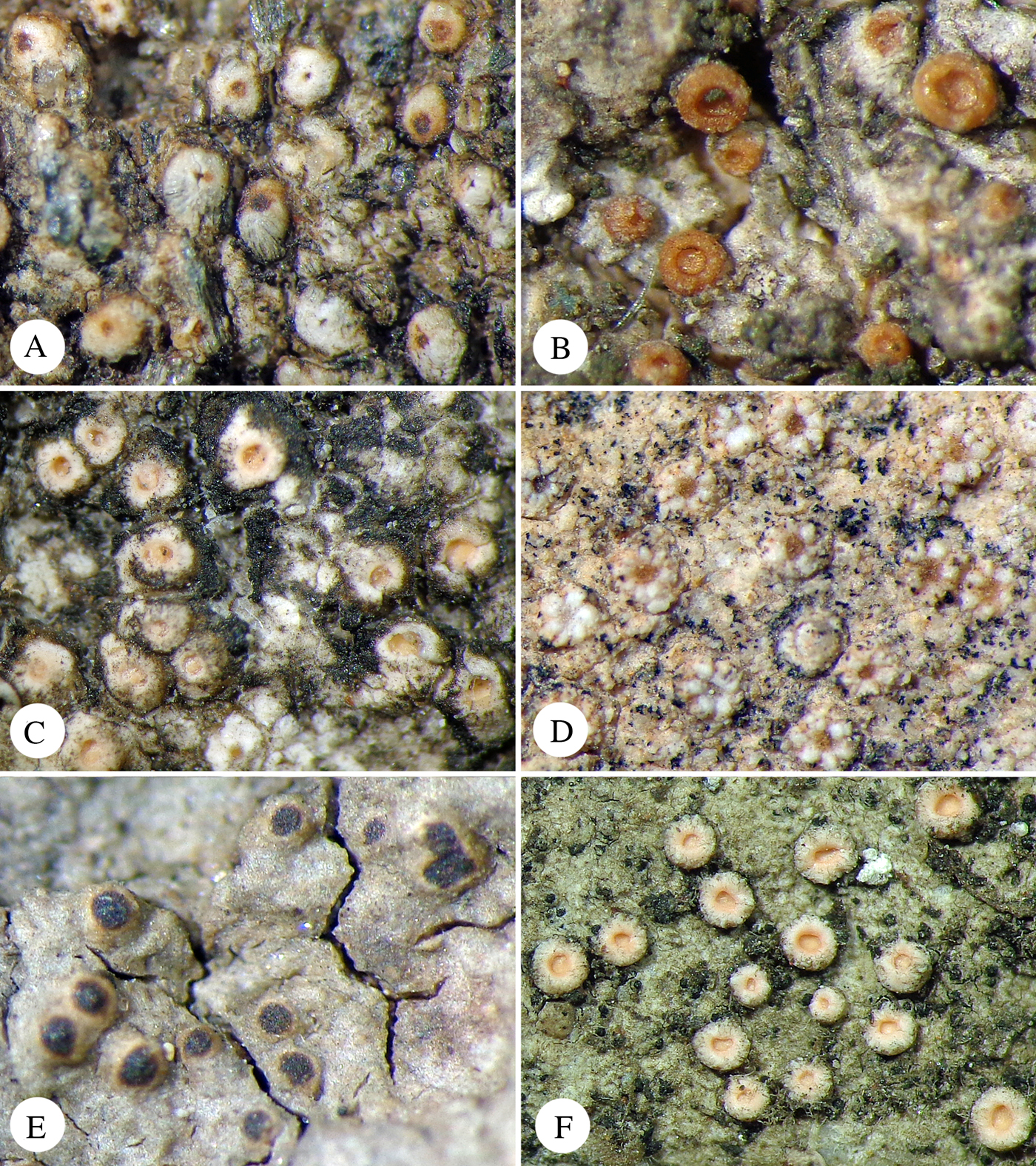
Given the rather well-supported topology with rather long stem branches, we considered the possibility of recognizing more than one genus in this constellation while at the same time applying traditional taxonomic concepts, i.e. separation of genera based on ascoma type (apothecioid vs. perithecioid) and ascospore number per ascus. In order to retain Belonia (D), Cryptolechia (B) and Pachyphiale (E) as separate genera, Gyalecta in its current sense would have to be split into at least three genera (A, C & F). Given the phenotypic variation in the three clades, this is currently difficult to justify as the species in the G. truncigena (C) and G. jenensis (F) clades in particular are highly similar overall (Figs 3 & 4). The clade formed by G. friesii and G. ulmi (A) deviates in the large apothecia compared to the other species (Figs 3 & 4), but that is hardly a character deserving recognition at the rank of genus; in other morphological characters, the two species are quite disparate. In addition, the features on which the separation of Belonia, Cryptolechia and Pachyphiale from Gyalecta was originally based, namely polysporous asci or perithecioid ascomata, evolved independently several times in the family (Fig. 2). Considering that the characters used to define the various genera do not form coherent phylogenetic entities, and that Cryptolechia was circumscribed as including species with 8-, 12–16- and 24–48-spored asci (Kalb Reference Kalb2007), it is obvious that generic classification in Gyalectaceae cannot be based on these characters; Cryptolechia cannot be separated from Gyalecta and Pachyphiale on account of the number of ascospores per ascus. Furthermore, asci can develop more than eight spores by different methods (Hawksworth Reference Hawksworth, Rayner, Brasier and Moore1987) and it cannot be assumed without critical investigations that similar numbers of ascospores are produced through the same ontogenetic process.
Morphological variation in Gyalectaceae (clades A–C from Fig. 2). A, Gyalecta friesii (Greenland, Alstrup s. n., Lich. Groenl. Exs. 239, B); B, G. ulmi (Germany, s. col., s. n., B); C, Cryptolechia carneolutea (England, Hawksworth s. n., B); D, Gyalecta flotowii (Belgium, Sérusiaux & Rose 4948, B); E, G. geoica (Sweden, Malme s. n., Lich. Suec. Exs. 686, B); F, G. truncigena (France, Sipman 22777, B). In colour online.
Morphological variation in Gyalectaceae (clades D–F from Fig. 2). A, Belonia russula (Norway, Norman s. n., B); B, Pachyphiale fagicola (Sweden, Malme s. n., Lich. Suec. Exs. 147, B); C, Gyalecta hypoleuca (Hungary, Lojka s. n., Lich. Regni Hung. Exs. 156, B); D, G. thelotremella (Italy, Puntillo s. n., Lich. Sel. Exs. 2485, B); E, Belonia herculana (Slovakia, Vězda s. n., Crypt. Exs. Mus. Hist. Nat. Vindob. 4760, B); F, Gyalecta jenensis (France, Mies s. n., B). In colour online.
It might be possible in the future to revise the generic classification in the family using characters other than those traditionally applied, such as the internal anatomy and ontogeny of the ascomata (Letrouit-Galinou Reference Letrouit-Galinou1973, Reference Letrouit-Galinou1974, Reference Letrouit-Galinou1977; Ryan & Nimis Reference Ryan, Nimis, Nash, Ryan, Diederich, Gries and Bungartz2004; Kauff & Büdel Reference Kauff and Büdel2005), combined with substratum ecology. A promising feature may be the nature of the paraphyses, which in Gyalecta flotowii, G. geoica (type species) and G. truncigena (clade C) are apically thickened and in G. herrei and G. jenensis (clade F) remain thin but extend substantially beyond the asci (Ryan & Nimis Reference Ryan, Nimis, Nash, Ryan, Diederich, Gries and Bungartz2004). There are also correlations between ascoma size, ascospore septation and substratum ecology and the clades in the tree; for instance, clade A features large apothecia, clades D–F are uniform in their substratum preferences, and muriform ascospores are concentrated in clades C, D and F (Fig. 2).
However, these correlations are mostly partial and it is difficult to predict where non-sequenced species will cluster in the phylogeny. Gyalecta s. lat. (including Cryptolechia) contains more than 60 taxa (Lücking et al. Reference Lücking, Hodkinson and Leavitt2017), of which 75% have not yet been sequenced. Species traditionally classified in either Gyalecta or Belonia do not form monophyletic clades and given the heterogeneous assemblage of species treated in Cryptolechia (Kalb Reference Kalb2007) and Pachyphiale (Baloch et al. Reference Baloch, Lumbsch, Lücking and Wedin2013), it is unlikely that these will cluster phylogenetically with the only currently sequenced taxa, C. carneolutea and P. fagicola. Anatomical and ontogenetic studies by Kauff & Büdel (Reference Kauff and Büdel2005), which included Belonia herculana, B. russula, Cryptolechia carneolutea, C. subincolorella, Gyalecta ulmi, G. jenensis, G. hypoleuca, G. thelotremella, Pachyphiale carneola and P. fagicola, provide few characters that would correlate with phylogenetically defined clades. For example, the degree of ascoma opening was stated by these authors to be similar between G. friesii (clade A) and C. carneolutea (clade B), as well as between the two Belonia species (clades D & F). The lateral paraphyses (periphysoids) remain distinct in G. jenensis (part of clade F) but become reduced in G. ulmi (clade A), C. carneolutea (clade B) and P. fagicola (clade E). All species have a two-layered exciple (Kauff & Büdel Reference Kauff and Büdel2005).
Comparison with the closely related family Porinaceae suggests that a broadly defined Gyalecta would not be conceptually different from a broadly defined Porina (McCarthy & Malcolm Reference McCarthy and Malcolm1997). In the latter case, a much broader taxon sampling now allows the recognition of several genera based on characters previously not considered for generic delimitation (Sobreira et al. Reference Sobreira, Cáceres, Maia and Lücking2018). On the other hand, well-defined, monophyletic genera in the revised Graphidaceae, such as Graphis s. str. (Lücking & Kalb Reference Lücking and Kalb2018), Ocellularia s. str. (Rivas Plata et al. Reference Rivas Plata, Mason-Gamer, Ashley, Lücking and Lumbsch2012) and Thelotrema s. str. (Rivas Plata et al. Reference Rivas Plata, Lücking, Sipman, Mangold, Kalb and Lumbsch2010), encompass phenotypic variation that is comparable with or even larger than that in a broadly defined Gyalecta. These genera all include species with exposed to completely concealed discs (analogous to Gyalecta vs. Belonia) and with 1- to 8-spored asci (not polysporous but somewhat analogous to Cryptolechia and Pachyphiale vs. Gyalecta). Furthermore, other characters such as exciple carbonization (Graphis, Ocellularia) and ascospore amyloidity (Thelotrema) also vary. With between 100 and 400 species (Lücking et al. Reference Lücking, Hodkinson and Leavitt2017), these genera are also much larger than a broadly defined Gyalecta, so there is no cogent argument as to why the latter genus should not be treated in a broad sense.
The most crucial taxon regarding generic concepts in Gyalectaceae is not Cryptolechia carneolutea, which agrees in many aspects with Gyalecta s. lat. (Kauff & Büdel Reference Kauff and Büdel2005; Kalb Reference Kalb2007), but Pachyphiale fagicola. The latter forms the longest branch in the tree (clade E) although is nested with strong support between clades D and F (Gyalecta s. lat.). However, besides Belonia, it has the most deviating features in the family, including a much reduced thalline margin and apically hooked paraphyses (Itturiaga & Hawksworth Reference Iturriaga and Hawksworth2004; Kauff & Büdel Reference Kauff and Büdel2005; Smith et al. Reference Smith, Aptroot, Coppins, Fletcher, Gilbert, James and Wolseley2009). Accepting this lineage in a broadly defined Gyalecta would render it logically consistent to accept Cryptolechia and Belonia also, whereas recognition of Pachyphiale as a separate entity would require a complete reassessment of Gyalectaceae and the recognition of at least six genera, almost none in line with traditionally defined genera.
The limited data available at present prevent the elaboration of a stable classification within Gyalectaceae that would recognize more than one genus. Therefore, we prefer to be consistent with the recent treatment that includes Belonia and Pachyphiale in a broadly defined Gyalecta (Baloch et al. Reference Baloch, Lumbsch, Lücking and Wedin2013), and also subsume Cryptolechia into the synonymy of Gyalecta. However, we encourage further work on this family based on a broader taxon sampling and would certainly not be opposed to a more refined generic concept being developed in the future, should a much expanded data set justify this.
In order to synonymize Cryptolechia with Gyalecta today, the following eight names have to be transferred back into Gyalecta:
Gyalecta carneolutea (Turner) H. Olivier
Basionym: Parmelia carneolutea Turner, Trans. Linn. Soc. Lond. 9: 145 (1808).
Synonyms: Cryptolechia carneolutea (Turner) A. Massal; Lecania carneolutea (Turner) Mudd
Type: UK, Sussex, sine loc., 1805, W. Borrer (BM 000006709—holotype).
Note. This is the single specimen used by Turner to prepare the published plate and it agrees with the Slapton material. It seems probable that the localities in Sussex named in the original paper were given to him by Borrer, either in a letter or verbally when Borrer was invited to visit Turner in Great Yarmouth in 1805–1806 (Hawksworth & Seaward Reference Hawksworth, Seaward, Turner and Borrer1978). There is also an undated specimen noted just with ‘Anglia’ in S evidently sent by Turner to Acharius, which Vězda (Reference Vězda1969) considered a lectotype, but there is no evidence that this material was used by Turner in preparing the original account and so it cannot be assumed to be ‘original material’. In addition, there is a single sheet of this taxon in Borrer's herbarium in K (K(M) 136156), labelled in Borrer's hand as ‘Lecania carneolutea (Turner)’, a combination not published until 1861 (Mudd Reference Mudd1861: 140), the year before Borrer's death. The sheet has five specimens ‘on elm’, but with no locality or date or evidence they were ever seen by Turner. Vězda does not appear to have been aware of either the BM or the K specimens when preparing his account of this taxon.
Gyalecta carneoluteola Tuck.
Synonym: Cryptolechia carneoluteola (Tuck.) Kalb
Gyalecta geoicoides Vain.
Synonym: Cryptolechia geoicoides (Vain.) Kalb
Gyalecta myriadella (Nyl.) Hellb.
Synonym: Cryptolechia myriadella (Nyl.) D. Hawksw. & Dibben
Gyalecta nana Tuck.
Synonym: Cryptolechia nana (Tuck.) D. Hawksw. & Dibben
Gyalecta plurilocularis Vain.
Synonym: Cryptolechia plurilocularis (Vain.) D. Hawksw. & Dibben
Gyalecta subincolorella (Nyl.) Zahlbr.
Synonym: Cryptolechia subincolorella (Nyl.) D. Hawksw. & Dibben
Gyalecta versicolor (Müll. Arg.) Zahlbr.
Synonym: Cryptolechia versicolor (Müll. Arg.) D. Hawksw. & Dibben
For the remaining five names, we provide the new combinations also required in Gyalecta:
Gyalecta bicellulata (Kalb) D. Hawksw. & Lücking comb. nov.
MycoBank No.: MB 830755
Basionym: Cryptolechia bicellulata Kalb, Sauteria 15: 240 (2008).
Gyalecta caudata (Kalb) D. Hawksw. & Lücking comb. nov.
MycoBank No.: MB 830756
Basionym: Cryptolechia caudata Kalb, Biblioth. Lichenol. 95: 309 (2007).
Gyalecta pittieriana (Kalb et al.) D. Hawksw. & Lücking comb. nov.
MycoBank No.: MB 830757
Basionym: Cryptolechia pittieriana Kalb et al., Phytotaxa 42: 39 (2012).
Gyalecta saxatilis (Vězda) D. Hawksw. & Lücking comb. nov.
MycoBank No. MB 830758
Basionym: Gyalectina saxatilis Vězda, Folia Geobotanica Phytotax. 4: 445 (1969).
Synonym: Cryptolechia saxatilis (Vězda) D. Hawksw. & Dibben, Lichenologist 14: 100 (1982).
Gyalecta stellaris (Müll. Arg.) D. Hawksw. & Lücking comb. nov.
MycoBank No. MB 830759
Basionym: Patellaria stellaris Müll. Arg., Bot. Jahrb. 20: 274 (1894).
Synonym: Cryptolechia stellaris (Müll. Arg.) D. Hawksw. & Dibben, Lichenologist 14: 100 (1982).
We are grateful to Andy Pratt (Director of Studies, Slapton Ley Field Centre) for alerting us to the fallen tree, to Jon Grimes (Natural England) for allowing us to collect material and select other samples for translocation, and Thomas Pinches (Warden, Slapton Ley National Nature Reserve) for supervising the collection of material. We also thank two anonymous reviewers who helped to improve the manuscript.
Supplementary Material
For supplementary material accompanying this paper visit https://doi.org/10.1017/S0024282919000240