INTRODUCTION
Grouper fisheries in India have been studied extensively, resulting in much knowledge concerning the distribution, biology, and management of these species (James et al., Reference James, Sriramachandra Murty, Nammalwar, Arreguin-Sanchez, Munro, Balgos and Pauly1996; Mathew et al., Reference Mathew, Nammalwar, Chakraborty, Livingston, Philippose, Ameer Hamsa, Pillai and Menon2000). However, results of these studies have been based upon fisheries-dependent data usually carried out in deeper water where mechanized vessels fish, rather than in shallow shelf areas where traditional artisanal fisheries occur. This study reports on the first known survey of grouper resources on the west coast of India using underwater visual censuses. We examine grouper diversity and report on two new records from this coastline. Additionally, we comment on the cross-shelf distribution of Epinephelus faveatus (Valenciennes, 1828).
MATERIALS AND METHODS
Underwater visual censuses were conducted to determine grouper relative abundance and diversity at nine sites on the west coast of India, January–April, 2002 and September–December, 2002 (Figure 1). At least three 45-minute timed transects were conducted at each site. Sample size estimates were calculated based upon sampling at two sites (Vizhinjam N = 6 transects and Muttom outside N = 4 transects). One observer (R.D.S.) identified all groupers to species on each transect. A search area of 5 m on each side of the observer was delineated visually by estimation after training using a measured distance. Timed swims were used rather than the conventional strip transects or point counts because groupers are relatively rare and mobile (Russ, Reference Russ1984a, Reference Russb; Newman et al., Reference Newman, Williams and Russ1997; R.S., personal observation). One site (Melekkel) was much deeper than the others (Table 1) and it was necessary to limit two of the transects to 22.5 minutes each. This yielded grouper relative abundance and diversity by site.
Map of study region. Muttom outside sites consisted of two small rocky outcrops. Melekkel was a rocky outcrop in deeper water.

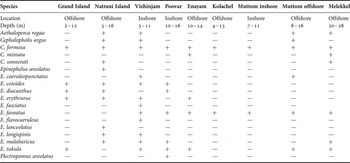
Grouper biodiversity by site. Sites are presented from north to south as on Figure 1. —, indicates not observed, +, indicates observed at site.

RESULTS
Eighteen grouper species were identified from the study area (Table 1). Two of these species appear to be new records for the west coast of India: Aethaloperca rogaa (Forsskål, 1775) and Plectropomus areolatus Rüppell, 1830. Two to nine species were observed at individual sites. The most abundant grouper at each site was C. formosa (8.8–24.7 individuals per 45 minute transect) usually followed by E. faveatus (0.3–7.7 individuals per 45 minute transect). The lower range of abundance for this species was observed at inshore sites. Epinephelus faveatus was over four times more abundant at inshore sites than offshore sites. Other grouper species when observed at a site were usually in lower abundance (range 0.2–2.6). The exceptions were Epinephelus malabaricus at Melekel and Epinephelus coiodes at Natrani which had relative abundances of 4.7 and 7.6, respectively.
DISCUSSION
The shallow-water grouper fauna of the west coast of India is dominated by species that are most abundant along continental land masses. These species include Cephalopholis formosa, Epinephelus coioides (Hamilton, 1822), E. erythrurus (Valenciennes, 1828), E. faveatus, and E. malabaricus (Bloch & Schneider, 1801). All of the most abundant species are found throughout their ranges in silty habitats and in some cases estuaries (Heemstra & Randall, 1993). Of these species, the two largest, E. coioides and E. malabaricus, reach total lengths of up to 1 m. Both species are also the most widely distributed with ranges from eastern Africa to the South Pacific. Large-sized species were generally in low abundance along the west coast of India (Table 1). However, one deeper site (Melekkel) had a much higher abundance of those species which reach up to 1 m total length. This may be due to ontogenetic movements as many grouper species show patterns whereby larvae settle closer to shore and then move offshore with age (Eggleston, Reference Eggleston1995). It could also result from less fishing pressure at this site. This site was farther from shore and appeared to attract fewer fishermen than were seen at other sites further inshore. Epinephelus coioides was particularly abundant at Natrani, Karnataka. This offshore island had a maximum depth of 16 m. During our survey time the water was particularly cool (21°C) and numerous larger individuals were observed but there was no evidence of spawning activity. One approximately 2 m sized E. lanceolatus (Bloch, 1792) was observed at Natrani Island.
The most restricted range of the species observed was E. faveatus, which to date has been reported only from southern India, Sri Lanka and a few islands in Indonesia, although its distribution is likely continuous throughout this region (Heemstra & Randall, Reference Heemstra and Randall1993). The bottom along the west coast of India is silty with considerable sediment input from estuaries. Heemstra & Randall (Reference Heemstra and Randall1993) recorded the northern most extent of this species' range as Vizhinjam, which we confirm. This species was not observed farther north. However, this species was over four times more abundant on inshore sites and the two northern sites were offshore islands. Surveys inshore may reveal its presence along the entire coastline. The main biological difference between inshore and offshore reefs was the relative abundance of turf algae and benthic invertebrates, especially barnacles and mussels (Sluka, Mary & Lazarus, unpublished data). Mussels were the predominant invertebrate on inshore reefs. The inshore sites are also subject to higher wave action than offshore sites and thus higher sedimentation. This species may be more successful than other species in this higher turbulence area.
The remaining grouper species found on the Indian west coast are widespread, with ranges throughout the Indo-West Pacific. The exception to this is E. diacanthus (Valenciennes, 1828) which ‘occurs on the continental shelf of the northern Indian Ocean from the Gulf of Aden to Sri Lanka and Madras, India’ and is ‘not known from the Persian Gulf or the Red Sea’ (Heemstra & Randall, 1993). Additionally, E. flavocaeruleus (Lacépède, 1802) is limited to the Indian Ocean. Several species that reside primarily in coral reef habitat (Heemstra & Randall, Reference Heemstra and Randall1993) were observed in low abundance along the west coast. These include Aethaloperca rogaa, Cephalopholis argus Bloch & Schneider, 1801, C. miniata (Bleeker, 1852), C. sonnerati (Valenciennes, 1828), Epinephelus coeruleopunctatus (Bloch, 1790), E. flavocaeruleus, and Plectropomus areolatus. Heemstra & Randall (Reference Heemstra and Randall1993) indicated that these species have not been observed along India's west coast. However, Jones & Kumaran (Reference Jones and Kumaran1980) indicated that C. argus and C. miniata have been recorded on India's coasts, although they do not state which coast. Descriptions from Day (1875–1878) also suggest that E. coeruleopunctatus and E. flavocaeruleus have been caught on India's west coast. Talwar & Kacker (Reference Talwar and Kacker1984) give a Malayalam (language of Kerala State on India's west coast) name for C. sonnerati that suggests that this species has also been recorded on India's west coast. Plectropomus areolatus was observed only once at one site and thus it is unknown whether or not it was a vagrant arriving as larvae (e.g. from Lakshadweep or the Gulf of Mannar where it has been observed previously (Heemstra & Randall, Reference Heemstra and Randall1993)) or part of an established population. The aforementioned species are all present in both Lakshadweep and the Gulf of Mannar (except C. sonnerati which has not been observed in the Gulf of Mannar or Sri Lanka) (Heemstra & Randall, Reference Heemstra and Randall1993).
Visual surveys provide fishery-independent records of fish diversity and are generally lacking from the Indian subcontinent. Our studies along the west coast of India have discovered two new grouper records (this study), three new Labrid records from these same study sites (Sluka & Lazarus, Reference Sluka and Lazarus2004) and two grouper, one anthias and two Labrid first records from nearby Minicoy Island, Lakshadweep (Sluka & Lazarus, Reference Sluka and Lazarus2006). We recommend that significant effort be directed towards comprehensive underwater biodiversity studies in this region.
ACKNOWLEDGEMENTS
We appreciate the help in the field from Mr Sunish Thomas and Dr Anita Mary. Venkat Charloo of Barracuda Diving Services, Goa assisted with diving operations in Karnataka and Goa. The authors would like to thank the Committee for Research and Exploration, National Geographic Society (R.D.S., grant number 7094-01) for funding this study. Loren Kellogg and two anonymous referees made many helpful comments on earlier versions of this manuscript.