Tetralogy of Fallot is a relatively rare congenital heart defect, occurring in ~3% of foetuses with congenital heart disease.Reference Tennstedt, Chaoui, Korner and Dietel 1 The diagnosis of tetralogy of Fallot by foetal echocardiography is straightforward.Reference Yoo, Lee and Kim 2
Although this defect is rare, the adult congenital heart population largely comprises tetralogy of Fallot patients’ post-surgical repair.Reference Hickey, Veldtman and Bradley 3 , Reference Apitz, Webb and Redington 4 It is well recognised that the presence of severe right ventricular outflow tract obstruction and hypoplasia of the pulmonary valve, along with abnormal bidirectional or retrograde flow in the ductus arteriosus, is associated with the need for prostaglandins at birth and earlier intervention than those foetuses with milder right outflow obstruction and normal right-to-left flow across the patent ductus arteriosus.Reference Hornberger, Sanders and Sahn 5 , Reference Hirji, Bernasconi and McCrindle 6
In 2011, we identified two cases of tetralogy of Fallot in which the ductus arteriosus was not identified on any serial foetal echocardiograms. These foetuses were born with severe right ventricular outflow obstruction and hypoplastic branch pulmonary arteries, were cyanotic, and required urgent catheter intervention at birth. One foetus died before complete repair.
The aim of the current study was to determine whether foetuses with simple tetralogy of Fallot and no identifiable ductus arteriosus have poorer perinatal outcomes as compared with foetuses with tetralogy of Fallot with a patent ductus arteriosus.
Materials and methods
This study was conducted as a single-centre retrospective case–control study at The Hospital for Sick Children, Toronto, Canada. The study was approved by the hospital’s Research Ethics Board; requirement for individual patient consent was waived for a retrospective study.
Inclusion criteria
All prenatally diagnosed cases of tetralogy of Fallot between 1 January, 2000 and 1 January, 2012 were identified from the hospital database. Cases were defined as having no identifiable ductus arteriosus at the first prenatal diagnostic foetal echocardiogram, and confirmed by its absence during the first postnatal echocardiogram. Controls were defined by a diagnosis of tetralogy of Fallot and were matched to cases by gestational age at first diagnostic echocardiography in a 2:1 ratio. Controls were required to have an identifiable ductus arteriosus at the first foetal echocardiogram. Both cases and controls were required to have a full diagnostic postnatal echocardiogram at the Hospital for Sick Children in the first few days of life.
Exclusion criteria
For both cases and controls, all diagnoses of tetralogy of Fallot that resulted in termination of pregnancy were excluded. Concomitant diagnoses of atrioventricular septal defect, pulmonary atresia, or absent pulmonary valve were excluded.
Echocardiographic data
Two-dimensional serial foetal echocardiograms and the first postnatal echocardiogram were reviewed by a single investigator blinded to clinical outcome. All first foetal echocardiograms and first postnatal echocardiograms were reviewed in detail offline. All foetal echocardiographic reports were reviewed. If any follow-up foetal echocardiogram report discussed the presence or suspicion of a ductus arteriosus, that foetal echocardiogram was reviewed by L.N. in detail – no cases demonstrated a ductus arteriosus on follow-up foetal echocardiograms. All first foetal echocardiograms of the cases of tetralogy of Fallot and no identifiable ductus arteriosus were also reviewed by a second investigator (L.M.) blinded to whether this was a case or control. An additional five cases of tetralogy of Fallot with a ductus arteriosus – blinded and randomly selected – were included with the 11 cases to review. Digital echocardiograms were reviewed using SyngoDynamics version 3.1 (Siemens Medical Solutions, Malvern, Pennsylvania, United States of America). Archived videotapes – all echocardiograms between 2000 and 2004 – were reviewed using the Vingmed System Vivid-7 (GE Medical Systems, GE Vingmed Ultrasound AS, Horten, Norway).
Foetal echocardiographic measurements were obtained as per previous published protocols.Reference Hirji, Bernasconi and McCrindle 6 Two-dimensional measurements were taken for the aortic, pulmonary, tricuspid, and mitral valves, as well as proximal left and right pulmonary arteries. Both foetal and postnatal z-scores were calculated using standardised methods.Reference Schneider, McCrindle, Carvalho, Hornberger, McCarthy and Daubeney 7 , Reference Pettersen, Du, Skeens and Humes 8 Doppler flow measurements and direction of flow across the pulmonic valve and patent ductus arteriosus were recorded. A peak gradient⩾100 cm/second was considered clinically important.Reference Huhta, Moise, Fisher, Sharif, Wasserstrum and Martin 9 Valvular regurgitation was qualitatively defined as none, mild, or moderate-to-severe. Ventricular function was qualitatively defined as normal, mildly reduced, or moderate-to-severely reduced, using the 2D four chamber and sagittal views. Uniform global myocardial shortening in both views for the right and left ventricles defined normal ventricular function. Doppler flow patterns across the tricuspid valve (biphasic or monophasic), ductus venosus (normal, increased a-wave reversal), umbilical artery (normal, absent end diastolic flow), and umbilical vein (normal, pulsations) were recorded when available. Foetal hydrops was defined as two or more collections of fluid in the pericardial, pleural, and/or abdominal cavities.
The first postnatal echocardiogram was also reviewed to measure valve and branch pulmonary artery dimensions and z-scores, degree of right ventricular outflow tract obstruction and pulmonary insufficiency, degree of tricuspid regurgitation, and ventricular function. M-mode measurements of chamber sizes were recorded. Additional abnormalities, such as multiple ventricular septal defects, multiple aorto-pulmonary collaterals, mitral valve abnormalities, and coronary abnormalities were also recorded.
Demographic and clinical data
Maternal and postnatal medical charts were reviewed to determine diagnoses and clinical outcomes. Clinical status at most recent follow-up was obtained, if available. Patients’ referring physicians were contacted by mail for supplemental information, if not available within hospital records.
Prenatal records were reviewed for maternal health, previous pregnancies, and prenatal testing – including chromosomal analysis and diagnostic imaging. Foetal outcome, including gestational age at birth, gender, and birth weight were recorded. Cause of intrauterine death was documented, when applicable. Postnatal data were collected to evaluate primary and secondary outcomes. Postnatal information was obtained from the hospital chart and included: cyanosis at birth (oxygen saturation <75% in room air), use of prostaglandins and/or mechanical ventilation, and admission to the intensive care unit versus the cardiac ward.
Primary outcomes
Primary outcomes included the need for early intervention or surgery, length of postoperative intensive care stay, full repair before 4 months of age that is “early”, major morbidity – including stroke, cardiac failure, extracorporeal membrane oxygenation requirement, or major arrhythmia – or death.
Optimal outcome
Optimal outcome was defined as full anatomic repair – ventricular septal defect patch closure with pulmonary valve-sparing – with no residual atrial or ventricular septal defect, and no more than mild right ventricular outflow tract obstruction (peak gradient <25 mmHg).Reference Van Arsdell and Maharaj 10 Indicators of clinical status at most recent follow-up were documented.
Statistical analysis
Data are presented as mean with standard deviation, medians with interquartile range, or frequencies, as appropriate. Comparisons between cases and controls were made using Student’s t-test and Fisher’s exact χ2 analysis. All statistical analyses were performed using SAS v9.3 (The SAS Institute, Cary, North Carolina, United States of America).
Results
Maternal and foetal data
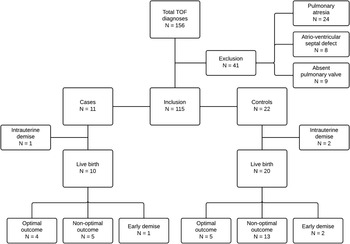
A total of 156 cases were diagnosed with tetralogy of Fallot during the study period. Of these, 41 foetuses were excluded on the basis of concomitant congenital heart disease diagnoses (Fig 1). Of the remaining 115 foetuses, 11 (9%) did not have a ductus arteriosus on first foetal echo or on first postnatal echo. Of those foetal cases, seven were excluded following identification of a patent ductus arteriosus at first postnatal echo. Of those, five had a right aortic arch. One of the cases with a right arch had the patent ductus arteriosus coming off the innominate artery, and one had bilateral superior vena cavae. The two cases with a left arch had the usual patent ductus arteriosus from the left. One case was excluded as the infant arrived on day 1 of life in cardiac arrest and died. The echo showed tetralogy of Fallot, severely decreased ventricular function, and an intramural coronary artery.
Flowchart of included and excluded cases of tetralogy of Fallot identified in The Hospital for Sick Children’s database.

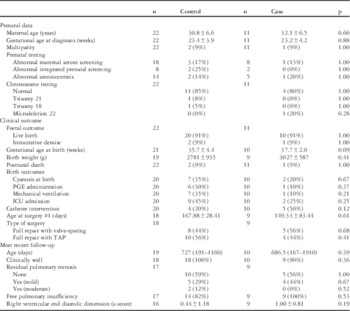
Mean gestational age at diagnosis was 23.2±4.2 weeks for cases, and 23.4±3.9 weeks for controls (Table 1). Most foetuses (85%) were referred for foetal echocardiography following a suspicion of congenital heart disease on anatomic ultrasound. No significant differences were identified between cases and controls for maternal age, maternal health, previous pregnancies, multiparity, or use of fertility agents. There were three twin pregnancies – one case, two controls. Fertility agents included: clomiphene (one case), in vitro fertilisation (one case), and intrauterine implantation (one control). None of the mothers were using any medications associated with premature closure of the ductus arteriosus – for example non-steroidal anti-inflammatory drugs.
Clinical and demographic data.

PGE=prostaglandin E; TAP=transannular patch
Amniocentesis was conducted in 5 (45%) cases and 14 (64%) controls. Prenatal chromosome testing did not identify any differences in occurrence of genetic abnormalities. Of the controls, two were found to have two separate genetic abnormalities (trisomy 18, trisomy 21), whereas one case was diagnosed with microdeletion 22q11.2. No controls were diagnosed with microdeletion 22q11.2. No significant differences were identified for renal abnormalities (0% of cases versus 5% of controls, p=1.00) or neurological abnormalities (27% of cases versus 14% of controls, p=0.38). Additional birth defects were diagnosed in one case (esophageal atresia) and two controls (cleft palate, omphalocele). There was no difference between the groups in terms of clinical status at birth.
Foetal cardiac diagnoses and demise
All foetuses had levocardia. The incidence of right aortic arch was higher for cases than controls (64% versus 14%, p<0.001). One case and four controls had a double-outlet right ventricle (tetralogy-type), and one case had a left superior vena cava. Intrauterine demise occurred in one case – gestational age 26 weeks, associated esophageal atresia – and two controls – gestational age 23 weeks, other gestational age unknown with trisomy 18. The cause of intrauterine demise was unknown for all three foetuses.
Clinical outcomes
A total of 10 cases (91%) and 20 controls (91%) were live births. Clinical outcomes after birth are described in Table 1. Postnatal death occurred in one case (103 days old) and two controls (ages 134 and 154 days old). The case was palliative owing to the presence of central nervous system malformations – chromosome 1p deletion, with agenesis of corpus callosum and microcephaly – although the cause of death was not recorded. Of the controls, one died of respiratory failure and one died of liver failure.
There was no significant difference in the immediate perinatal period between the cases and controls in terms of cyanosis, need for intensive care or prostaglandins, or mechanical ventilation (Table 1).
Age at surgical repair was 4.9±2.9 months for cases and 5.5±0.9 months for controls. Early repair (<4 months old) occurred in two (18%) cases and one (5%) control. The types of surgical procedures and data regarding subsequent surgical procedures are detailed in Table 1. A total of five cases (56%) and eight controls (44%) underwent full repair with valve-sparing surgery (p=0.68). No significant differences were identified for postoperative complications.
Catheter intervention occurred in 50% of cases and 20% of controls (p=0.12). Of these, right ventricular outflow stenting was performed in three cases (days 2, 21, and 25) and two controls (day 4 and 61) because of cyanosis. The other two controls required balloon dilatation of the right outflow tract with a patent ductus arteriosus stent in one (day 10) and left pulmonary artery stent in the other (day 5). A late catheter intervention occurred for branch pulmonary artery stenoses in two cases at days 174 and 341. No controls required a late intervention.
Foetal echocardiography
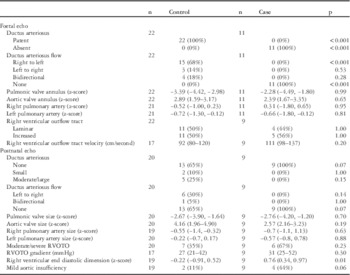
Foetal echocardiography data are described in Table 2. None of the cases of tetralogy of Fallot without a ductus arteriosus demonstrated a ductus by colour or Doppler on follow-up foetal echocardiograms. Notably, no significant differences were identified between cases and controls for pulmonic valve annulus z-score, aortic valve annulus z-score, or pulmonic valve to aortic valve ratio. In addition, the left pulmonary artery and right pulmonary artery z-scores were similar between groups. Mean pulmonary valve to aortic valve ratio was 0.62±0.18 for cases and 0.60±0.15 for controls (p=0.69).
Foetal and postnatal echocardiographic data.

RVOTO=right ventricular outflow tract obstruction
Postnatal echocardiography
The first postnatal echocardiography was conducted within 48 hours for six cases (range 0–19 days) and for 16 controls (range 0–23 days) (Table 2). Among those that occurred >48 hours, three occurred within 96 hours. The remainder were born at local community hospitals with paediatric cardiologist coverage, and had their first postnatal echocardiogram at the 2–3 weeks of age, with the exception of one case born at our centre who did not receive an immediate echocardiogram because of an initial “do not resuscitate” status. That infant had a prenatally diagnosed severe brain abnormality and the family had elected for compassionate care. However, this child ultimately had a full repair at 6 months of age and was stable from a cardiac standpoint at 9 years of age.
At first postnatal echocardiogram, closure of the ductus arteriosus had occurred in 13 controls (65%), whereas two controls (10%) had a small patent ductus arteriosus and five controls (25%) had a moderate-to-large patent ductus arteriosus. All echocardiograms for controls with a patent ductus arteriosus had occurred within 24 hours. Of those with a patent ductus arteriosus, six demonstrated left-to-right flow, and only one demonstrated bidirectional flow.
No significant differences were identified between cases and controls for sizes of the pulmonary valve, aortic valve, right pulmonary artery, or left pulmonary artery. In addition, rates of pulmonary artery hypoplasia or stenosis were similar between groups. No significant differences were identified for either absent or mild right ventricular outflow tract obstruction. Cases demonstrated an increase in right ventricular end diastolic dimension (1.18±0.18 cm versus 0.94±0.26 cm, p<0.001), with z-scores of 0.76 (0.34, 0.97) and −0.22 (−0.91, 0.52), respectively (p=0.01). Left ventricular ejection fraction and ventricular function were similar between groups. None of the infants had mitral regurgitation, and rates of tricuspid regurgitation were similar between groups.
Clinical follow-up data
Most recent follow-up was conducted at ~23 months (range 5–64) for cases and 17 months (range 8–38) for controls (Table 1). No significant differences were identified between groups regarding physician assessment of clinical status being overall well (90% of cases versus 100% of controls, p=0.36), use of cardiac medication (20% of cases versus 11% of controls, p=0.60), or occurrence of developmental delay (17% of cases versus 22% of controls, p=1.00).
Echocardiography carried out at most recent follow-up did not indicate any differences in the occurrence of residual pulmonary stenosis, occurrence of residual septal defects, right or left pulmonary artery size, right ventricular end diastolic dimension, or ventricular function.
Optimal outcome was found to occur in 36% of cases and 24% of controls (p=0.68).
Discussion
In the 12-year period of 2000–2012, there were 115 cases of simple tetralogy of Fallot diagnosed at this institution. The overall prevalence of foetuses with no identifiable ductus arteriosus was 9%. This subgroup of foetuses who do not have a ductus arteriosus has been intermittently described in the form of case reports,Reference Pahl, Muster, Ilbawi and DeLeon 11 , Reference Peres, Bekhit and Johki 12 but the prevalence has, to the best of our knowledge, not been previously reported in a large tetralogy of Fallot cohort. This is more common than would have been anticipated.
Our original hypothesis was that this subgroup would be more clinically unstable at birth, with a higher incidence of cyanosis and smaller branch pulmonary arteries, and thus potentially require more urgent intervention. We hypothesised that the treatment at birth would be limited, as prostaglandins would have no effect. Interestingly, our study demonstrated the opposite findings. This led to alternate explanations.
In tetralogy of Fallot, the agenesis of a ductus arteriosus would presumably occur early in gestation, which would thus allow for the foetus to adapt to this physiology. The other two physiological foetal shunts – patent foramen ovale and ductus venosus – plus the large ventricular septal defect would be able to modify flow across the right ventricle and into the pulmonary artery branches, and the presence of a degree of right outflow obstruction would also mediate flow to the pulmonary arteries, thereby ensuring normal growth of the pulmonary vascular bed.
It has been estimated in the lamb foetuses that ~57% of the right ventricular output shunts across the ductus arteriosus in the human foetus, with only 8% diverted into the pulmonary vasculature.Reference Rudolph 13 The balance of ductal flow and pulmonary flow is felt to be dependent on the intrinsic higher resistance in the pulmonary vascular bed, and has been recently demonstrated in the human foetuses by foetal MRI.Reference Seed, van Amerom and Al Nafisi 14 This steady physiological state is in distinct contrast to foetuses with tetralogy of Fallot and absent pulmonary valve syndrome and no ductus arteriosus, who develop severely dilated branch pulmonary arteries and bronchial compression.Reference Ettedgui, Sharland, Chita, Cook, Fagg and Allan 15 – Reference Kohler 19 The absence of a ductus arteriosus in the absent pulmonary valve group is hypothesised to be caused from either a failure of the development of the 6th branchial arch in early gestation, the involution of the immature ductus in later gestation, or secondary to the decreased diastolic pressure owing to the absent pulmonary valve combined with a large ventricular septal defect.Reference Bergwerff, DeRuiter and Gittenberger-de Groot 20 , Reference Ettedgui, Sharland, Chita, Cook, Fagg and Allan 21 We could thus postulate that an absent ductus arteriosus in simple tetralogy of Fallot could be secondary to the first two hypotheses. It is interesting that a small proportion of cases with absent pulmonary valve do have a ductus arteriosus (~16–25%), usually, but not always, in the setting of an intact ventricular septum or tricuspid atresia.Reference Galindo, Gutiérrez-Larraya and Martinez 17 , Reference Wertaschnigg, Jaeggi and Chitayat 18
A second group of foetuses with an absent ductus arteriosus are those who develop premature closure of the ductus arteriosus.Reference Becker, Schmitz, Guschmann, Wegner, Stiemer and Entezami 22 – Reference Leal, Cavallé-Garrido, Ryan, Farine, Heilbut and Smallhorn 24 This has been shown to occur in the setting of maternal administration of non-steroidal anti-inflammatory medications – for example indomethacin, aspirin – or glucocorticoids.Reference Trevett and Cotton 25 , Reference Waffarn, Siassi, Cabal and Schmidt 26 Those foetuses develop severe right-sided heart failure, tricuspid regurgitation, and are at significant risk for in utero demise. The treatment of this lesion is delivery. In this setting, the ductus arteriosus closes in the third trimester, and thus the pulmonary vasculature is already well formed, and presumably less amenable to adaptation. In our series, none of the cases developed hydrops or tricuspid regurgitation, implying that the pathogenesis of an absent ductus ateriosus in tetralogy of Fallot is very different from either the tetralogy of Fallot absent pulmonary valve or the premature ductus arteriosus closure groups.
The incidence of a right aortic arch in previous foetal series is approximately one-quarter to one-third of cases.Reference Hirji, Bernasconi and McCrindle 6 , Reference Moise, Huhta and Sharif 27 , Reference Rao, Anderson and Edwards 28 Our group of foetuses with no identifiable ductus arteriosus had a right arch in two-thirds of the cases, compared with one-third of controls. This could partly be explained by the fact that visualisation of the ductus arteriosus in the setting of a right arch is more technically difficult. The ductus arteriosus can arise from the brachiocephalic artery as opposed to the aortic isthmus, and in the foetus, this area would be superimposed on the transverse arch.Reference Gentile, Stevenson, Dooley, Franklin, Kawabori and Pearlman 29 The ductal arch view in a sagittal plane is difficult to obtain in patients where the foetal spine is up or anterior, and distinguishing the two arches can be a challenge. Our group routinely will additionally obtain a high three-vessel view – high tracheal view – to identify both the arches. In this view, the two arches are distinct and form a “V” shape. Therefore, it is more reliable, and, if the ductus arteriosus were absent, there would only be one vessel joining the descending aorta. Of the cases without a patent ductus arteriosus on first foetal echo, seven were later found to have a patent ductus arteriosus postnatally, and of these, five had a right arch. Of the seven cases, six were performed before 2005, at the time of transition to digital imaging from videotapes that significantly improved the quality of our foetal echo imaging and offline analysis.
Though not statistically significant, our study did identify a higher rate of early catheter intervention – within 1 month of birth – among neonates born without a ductus arteriosus (3/10 versus 1/20). In each of these cases, intervention was required for right ventricular outflow tract stenting. This may have approached significance in a larger series of cases. In addition, it is possible that the more severe forms of tetralogy of Fallot without a patent ductus arteriosus may demise in utero earlier in gestation, given that the timing of a foetal echocardiogram is usually between 18 and 20 weeks’ gestation.
This study was limited by its retrospective nature and small patient numbers. Before 2004, all studies were stored on videotape, and therefore offline analysis was more limited. Not all foetal echocardiograms had obtained a clear three-vessel view or high three-vessel view to image the ductal arch. All foetal echocardiograms had a sagittal view in 2D and colour, but some images were not clear. The ductus arteriosus was therefore not identified but could have still been present. To offset this limitation, all 11 cases plus another five randomly selected controls were reviewed by two independent staff foetal cardiologists to determine whether a ductus arteriosus was present or not. The inclusion criteria required that each case have a postnatal echocardiogram to confirm no ductus arteriosus at initial assessment. It is well recognised that up to 50% of arterial ducts are not detected by 24 hours after birth, and 90% are not detected by 48 hours.Reference Gentile, Stevenson, Dooley, Franklin, Kawabori and Pearlman 29 To strengthen any findings of the study, we elected to use a 2:1 ratio of cases to controls. As case–control pairs were not selected on the basis of pertinent confounders, a matched–paired analysis was not utilised.
In conclusion, the presence or absence of a ductus arteriosus does not appear to have an impact on clinical outcome in foetuses with tetralogy of Fallot. Clinical and echocardiographic indices are similar, both prenatally and postnatally. This is likely explained by early haemodynamic adaptations in the foetus, allowing for redistribution of pulmonary blood flow, and consequently, enabling normal growth of the pulmonary vasculature. Therefore, our results do not support a need for increased vigilance surrounding delivery of foetuses with an absent ductus arteriosus. However, in consideration of the limited sample size of the study, further assessment across a larger number of cases is needed to strengthen our conclusion.
Acknowledgements
None.
Financial Support
This research received no specific grant from any funding agency, commercial or not-for-profit sectors.
Conflicts of Interest
None.