Introduction
Nurses comprise the largest health professional discipline providing palliative and end-of-life care (Singer et al., Reference Singer, Goebel and Kim2016). In 2018, in Australia there were 3,528 palliative care nurses compared to 271 palliative medicine physicians (12.2 full-time equivalent (FTE)/100,000 population and 1.0 FTE/100,000, respectively) (Australian Institute of Health Welfare, 2020). Palliative care nursing workforce numbers may be underestimated as palliative care training is not mandated by health professional registration boards in Australia, but recommended for nurses working in specialist palliative care services [Australian College of Nursing (ACN), 2019]. In rural areas, where there are limited specialist palliative care services, many palliative care services are provided in community and home-based care, through community health and hospital in the home programs (Luckett et al., Reference Luckett, Phillips and Agar2014). Demand for community-based palliative care will continue to increase, as more palliative care clients are preferring to die at home (Broad et al., Reference Broad, Gott and Kim2013; Gomes et al., Reference Gomes, Calanzani and Gysels2013). This will require rural community-based nurses to have the necessary competencies to deal with symptom burden and also address psychosocial and supportive care issues for clients and carers in the home. Data from the Palliative Care Outcomes Collaboration (PCOC) indicate that patient-reported outcomes in community-based care do not meet national benchmarks for anticipatory and responsive care for clients’ pain, fatigue, and family and carer problems (Connolly et al., Reference Connolly, Burns and Allingham2019). Eriksson et al. (Reference Eriksson, Bergstedt and Melin-Johansson2015) found gaps in rural nurses’ self-reported competency in addressing social, spiritual, and existential issues. Carers in rural areas also experience unmet needs for access to respite care, financial supports and services to assist in the home, often putting the needs of the client before their own well-being (Brazil et al., Reference Brazil, Kaasalainen and Williams2014; Kirby et al., Reference Kirby, Barlow and Saurman2016; Pidgeon et al., Reference Pidgeon, Johnson and Lester2018). Yet a study by Kaasalainen et al. (Reference Kaasalainen, Brazil and Willison2011), which compared practice issues between rural and urban nurses in community-based settings, found that rural nurses are significantly more confident about communicating with the team and engaging in the management of client issues.
For community palliative care services in rural areas, identifying workforce strengths and gaps can facilitate targeted education, training, and support while informing ongoing workplace policy and planning. Studies by Eriksson et al. (Reference Eriksson, Bergstedt and Melin-Johansson2015) and Kaasalainen et al. (Reference Kaasalainen, Brazil and Willison2011) found 40% of rural nurses in Sweden and Canada lacked formal palliative care education or training. An integrative review by Phillips et al. (Reference Phillips, Piza and Ingham2012) found continuing professional development programs for rural nurses increased clinical knowledge and confidence in supportive care issues such as palliative care practice, family care, end-of-life issues, and attitudes to death and dying. A study by Pesut et al. (Reference Pesut, Potter and Stajduhar2015) found that, after completing an educational intervention, rural Canadian nurses’ self-perceived knowledge of a palliative approach to care improved in the areas of spiritual needs, ethical and legal issues, and personal and professional issues related to nursing care. A systematic review of palliative care education and training programs for health practitioners in rural settings by Bakitas et al. (Reference Bakitas, Elk and Astin2015) found improved practitioner knowledge, confidence, and attitudes in palliative care.
Rural palliative care services also need to have the assessment tools to identify nursing workforce strengths and gaps. While there are some palliative care nursing competency tools developed for general palliative care and home-based care, no such tools have been developed with rural nurses (Desbiens and Fillion, Reference Desbiens and Fillion2011; Slåtten et al., Reference Slåtten, Hatlevik and Fagerström2014; Shimizu et al., Reference Shimizu, Nishimura and Ishii2016; Sawatzky et al., Reference Sawatzky, Roberts and Russell2021). We developed a Palliative Care Skills Matrix for Palliative Care and District Nurses (Skills Matrix) in community-based palliative care (Khalil et al., Reference Khalil, Byrne and Ristevski2019). The Skills Matrix comprises of a questionnaire where nurses self-rate their knowledge and skills against a series of questions based on Australian national palliative care standards, national health service standards in safety and quality, and a number of palliative care screening and assessment tools (Australian Commission on Safety and Quality in Health Care, 2015; Palliative Care Australia, 2018). The questionnaire was developed and tested for face and content validity within a rural nursing community of practice (Khalil et al., Reference Khalil, Byrne and Ristevski2019).
The primary objective of this study was to use the Skills Matrix to examine strengths and gaps in self-reported clinical knowledge and skills in the provision of psychosocial and supportive care of community-based nurses in a rural region of Victoria, Australia. We further sought to determine correlates of knowledge gaps to inform workforce education and planning, as well as approaches undertaken by nurses to improve their practice.
Methods
Participants and recruitment
A survey of community-based nurses in the rural/regional area of Gippsland, Victoria, Australia was undertaken. Nurses were eligible to participate if they provided home-based care to palliative care clients and carers. Health service managers (N = 19) distributed a link to an electronic questionnaire to eligible staff (N = 165). Participants indicated consent after reviewing a written description of the risks and benefits of study participation. All study procedures were approved by Monash University Human Research Ethics Committee (Project ID: 14172).
Data collection
The Skills Matrix is a 123-item electronic questionnaire used to record nurses’ self-rated knowledge and skills on a five-point assessment scale: (1) No experience, (2) Basic knowledge, (3) Can do skill with supervision, (4) Can perform independently, and (5) Can teach others. Benner's (Reference Benner1982) stages of clinical competence informed the development and interpretation of the scale.
The following sections are included in the Skills Matrix:
1. Demographic: age, gender, role, years of experience in palliative care, years of experience in current role, palliative care education, and training.
2. Clinical practice supports: self-care tools, scope of practice, clinical supervision modalities, local and national practice frameworks, and guidelines.
3. Screening and assessment tools.
4. Standards of practice:
-
o Standard 1: Assessment of Needs
-
o Standard 2: Developing a Care Plan
-
o Standard 3: Caring for Carers
-
o Standard 4: Providing Care — Care of the Dying Person
-
o Standard 5: Transition within and between Services
-
o Standard 6: Grief Support.
-
This paper reports on the 67 psychosocial and supportive care items under screening and assessment tools (N = 10) and standards of practice (N = 57) sections, in addition to demographic and clinical practice support items.
Data analysis
Demographic and clinical practice supports were analyzed by calculating the frequency and percentage. To examine participants’ self-rated knowledge and skills, we calculated the frequency and percentage for each item. We also used a set of rules to classify nurses’ self-reported knowledge into Strengths, Consolidations, or Gaps:
• If >25% of participants rated their capability on a question as “no knowledge” or “basic knowledge,” these questions were classified as “Gaps.” These gaps should be the main focus for professional development.
• If >25% of participants rated their capability on a question as “can do skill with supervision” and the question has not been identified as a “Gap,” these were identified as a “Consolidation.” These areas can be improved upon and should also be a focus for professional development.
• If >50% of participants rated their capability on a question as “can perform independently” or “can teach others” and the question has not been identified as a “Gap” or “Consolidation,” these were identified as “Strengths.” No immediate professional development is required although advanced learning opportunities may be beneficial (Table 1).
Assessment scale and interpretation

We also used binary logistic regression (BLR) to examine associations between nurses’ characteristics and knowledge gaps and consolidations. For each item classified as a practice gap or consolidation, self-reported knowledge was reclassified into a binary variable with categories of “no or basic knowledge” (code: 1) and “can do with supervision, can perform independently or can teach others” (code: 0). This led to a set of binary outcome variables indicating whether nurses possessed little or no knowledge of each item. First, univariate BLR models were fit. Subsequently, for each binary knowledge outcome (Hosmer et al., Reference Hosmer, Lemeshow and May2008), the purposeful selection method was used to build a parsimonious multivariate BLR model adjusted for one or more potential confounding factors, with age retained in models irrespective of significance. The univariate and multivariate modeling involved the calculation of univariate odds ratios (UORs) and multivariate odds ratios (MORs), respectively, as well as corresponding 95% confidence intervals (CIs). If the 95% CI around a UOR or MOR excluded the null value of 1.00, then the association between the given nurse characteristic and no or basic knowledge of the particular palliative care standard was deemed statistically significant at the 5% level (p < 0.05). All statistical analyses were undertaken using SPSS Version 25 (SPSS Inc., Chicago, IL, USA).
Results
Demographic and practice variables
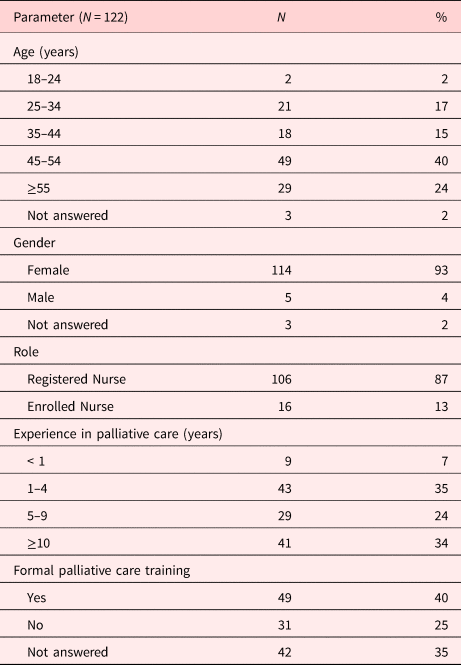
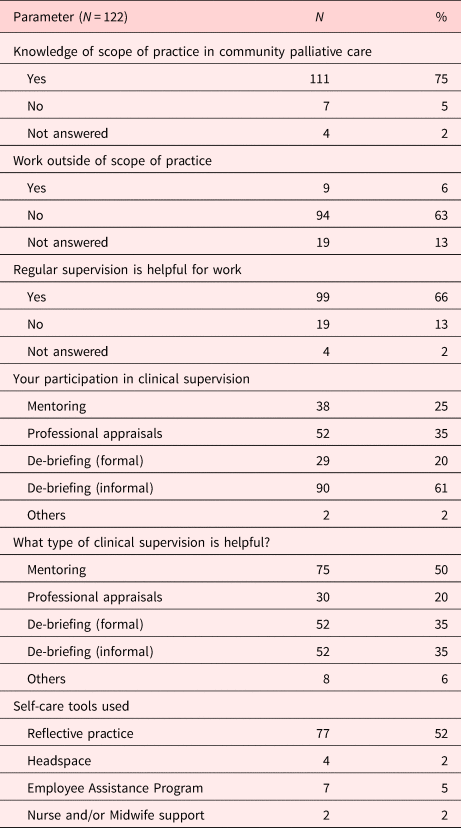
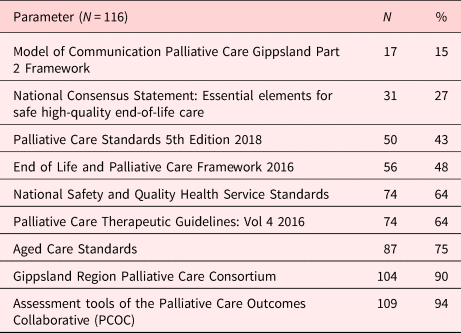
A total of 17 of 19 health services offering community nursing services participated in the survey. Of these services, 24% were classified as large (>10 staff), 29% were medium (5–10 staff), and 47% were small (<5 staff). A total of 122 of 165 (response rate = 74%) nurses completed the survey. Two-thirds of participants were aged 45 years and over, the majority were female (93%) and worked as Registered Nurses (87%). Over half (58%) of participants had 5 or more years of experience in delivering community palliative care and 40% had formal palliative care training (Table 2). Most participants knew and worked within their scope of practice (75 and 63%, respectively) and rated regular supervision as useful (66%). While in-formal debriefing (61%) was used commonly, many preferred mentoring (50%) and used reflective practice (52%) as a self-care tool (Table 3). While less than 50% of participants knew about the Palliative Care Standards and End of Life and Palliative Care Framework, nearly all (94%) knew about the assessment tools of the PCOC, which are used in clinical practice, and the Aged Care Standards (75%) (Table 4).
Participant demographics

Clinical practice supports

Awareness of practice frameworks and policies

Clinical practice standards and tools
Strengths
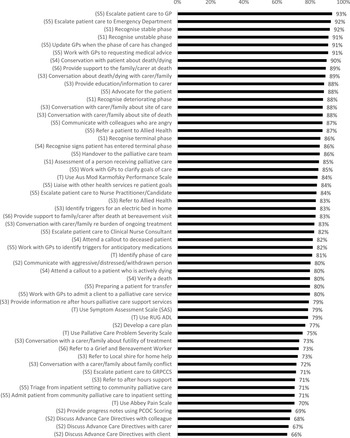
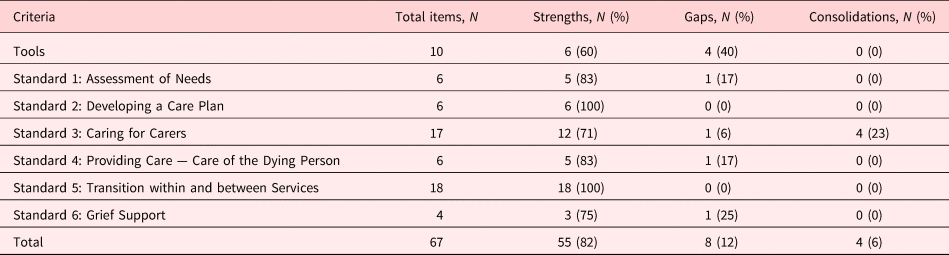
The majority of items in the standards and screening and assessment tools were identified strengths (55/67, 82%) (Figure 1). All items in Standard 2 (Developing a Care Plan) and Standard 5 (Transition within and between Services) were rated as strengths (Table 5). Strengths with the highest percentage related to topics around working with General Practitioners (GPs), escalating emergencies, recognizing the stable and unstable phases, conversations about death and dying with patients, carers, and family, and advocating for the patient. Items at the lower end of strengths list related to discussing Advance Care Directives, after-hours support and triage, admissions to inpatient services, and referrals to specialist palliative care consultancy services (Figure 1).
Strengths by percentage.

Number of items reported as strengths, gaps, and areas of consolidation

Gaps and consolidations
Of the 12 items emerging as gaps (N = 8, 12%) and consolidations (N = 4, 4%), most were about using tools and Standard 3 (Caring for Carers) (Table 5).
Screening assessment tools
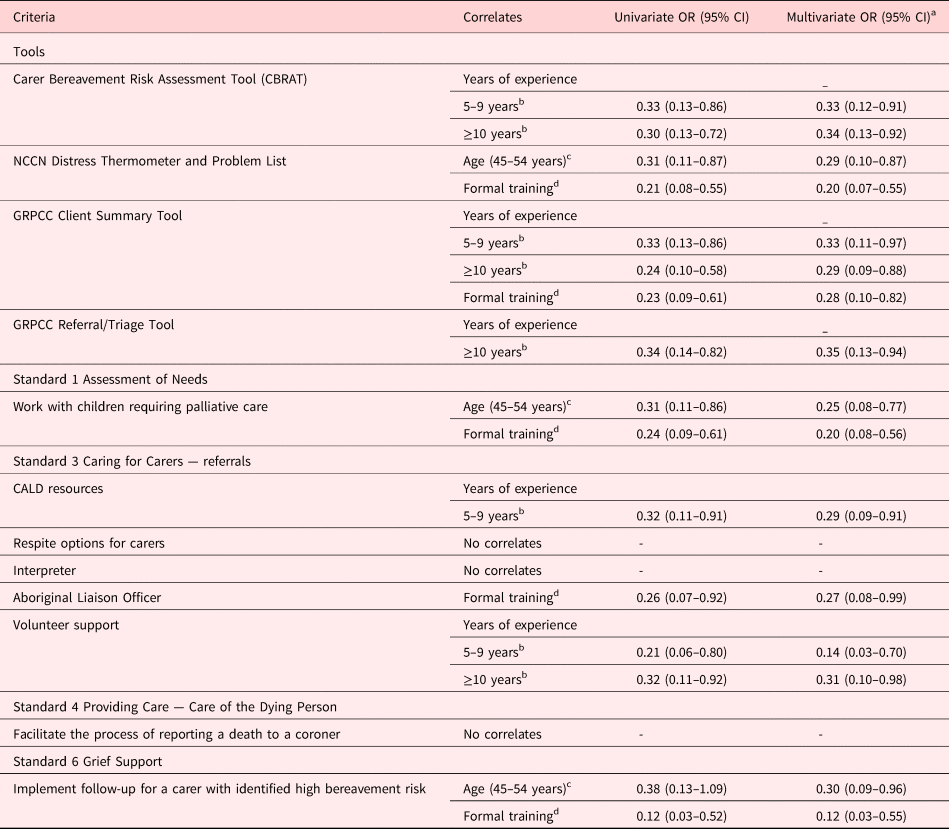
Of the 10 assessment tools, four were reported as gaps: Carer Bereavement Tool (CBRAT), NCCN Distress Thermometer and Problem List, GRPCC client summary tool, and the GRPCC referral/triage tool.
Greater knowledge in the use of the CBRAT was associated with 5–9 years and ≥10 years of palliative care experience. This association remained significant when adjusted for age. Significant correlates of knowledge regarding the use of the NCCN Distress Thermometer and Problem List were age (45–54 years) and formal training, with formal training remaining significant when adjusted for age, and age remaining significant when adjusted for formal training. Knowledge of the GRPCC Client Summary Tool was significantly associated with 5–9 years and ≥10 years of palliative care experience as well as formal palliative care training. Finally, knowledge of the GRPCC Referral/Triage Tool was associated with ≥10 years of experience within palliative care. This remained significant when adjusted for age (Table 6).
Correlates of practice gaps and areas of consolidation at the 5% level of significance (p < 0.05)

CI, confidence interval; NCCN, National Comprehensive Cancer Network; GRPCC, Gippsland Regional Palliative Care Consortium; CALD, Culturally and Linguistically Diverse.
a Adjusted for age and/or other correlates listed for the same knowledge outcome.
b Reference group: <5 years.
c Reference group: 18–34 years.
d Reference group: No formal training.
Assessment of Needs
Only “working with children requiring palliative care” in Standard 1 (Assessment of Needs) was reported as a knowledge gap. Increased clinical knowledge of this items was associated with age (44–54 years) and formal training (Table 6).
Caring for Carers
Of the 17 practice areas in Standard 3 (Caring for Carers), one gap (referrals for CALD resources) and four areas requiring consolidation were reported: referral to an Aboriginal Liaison Officer, seeking volunteer support, sourcing respite options for carers’ and “accessing an interpreter.”
Knowledge of referrals for culturally and linguistically diverse (CALD) resources was a gap and predicted by 5–9 years of experience. Referral to an Aboriginal Liaison Officer was an area of consolidation and knowledge of this skill was associated with formal training on multivariate analysis when adjusted for age. Ability to seek volunteer support was also an area for consolidation. Individuals with 5–9 years and ≥10 years of palliative care experience had lower odds of no or basic knowledge in ability to seek volunteer support. No factors were found to be significantly associated with knowledge of “sourcing respite options for carers” and “accessing an interpreter” (Table 6).
Providing Care — Care of the Dying Person
One of the six items in “Care of the Dying Person” was found to be a knowledge gap: “facilitating the process of reporting a death to the coroner.” No factors were found to be significantly associated with this variable on multivariate analysis with adjustment for age (Table 6).
Grief Support
“Implementing appropriate follow-up for a carer with a high bereavement risk” was the only gap to emerge among the four items in Standard 6 (Grief Support). Knowledge of this items was significantly predicted by age (45–54 years) and formal training (Table 6).
Discussion
This study found the majority of practice areas in psychosocial care and supportive care were strengths for rural nurses working in community-based palliative and end-of-life care. Gaps and areas of consolidation were in the use of carer and client assessment tools, the care of specific populations such as children, supporting carers with appropriate referrals/resources, and grief support, and facilitating the processes of reporting a death to the coroner. Formal training and years of experience were found to be associated with many of these gaps.
Gaps in knowledge in using screening and assessment tools was linked to greater years of clinical experience and formal training. Greater knowledge of tools such as the “GRPCC Client Summary Tool” and the “GRPCC Referral/Triage tool,” which are used in referring and triaging patients, likely reflects the nurse's awareness of the tool and use within their current practice. The Client Summary Tool integrates other clinical assessment tools, such as patient's Phase of Illness, Karmofsky Performance Score, and Palliative Care Problem Severity Scale Score. These clinical tools were rated as strengths by participants in other sections of the questionnaire. This suggests a lack of awareness of the Client Summary and Triage/Referral Tools, rather than a deficit in ability to complete the tools.
In our study, the use of the NCCN Distress Thermometer and Problem List was associated with both older age and formal training. Gaps in nurses’ knowledge and practice in screening for distress in cancer patients has also been identified in other studies with rural nurses (Ristevski et al., Reference Ristevski, Breen and Regan2011; Mitchell, Reference Mitchell2013; Ristevski et al., Reference Ristevski, Regan and Jones2015). Whilst simple to administer, the clinical actions and discussions may be difficult to implement due to a lack of knowledge and/or the availability of services and/or resources for patient referrals, particularly for younger nurses who may not have the clinical experience and knowledge of services in the region. Individuals lacking formal palliative care training may be unfamiliar with the tool and how it is administered.
Nurses with more experience within palliative care reported greater knowledge in the use of the Carer Bereavement Risk Assessment Tool (CBRAT), suggesting that clinical experience is associated with familiarity with the tool. Previous studies have demonstrated that Australian community nurses support and understand the need for ongoing bereavement care, however, did not feel supported or were under-educated within their service to act within this role (Redshaw et al., Reference Redshaw, Harrison and Johnson2013). The use of standardized assessment tools has been found to improve the accuracy of carer assessment and to be superior to clinical judgment alone (Rose et al., Reference Rose, Wainwright and Downing2011). The development of protocols and educational materials to instruct and empower community palliative care nurses in providing bereavement care has been found to be beneficial (Redshaw et al., Reference Redshaw, Harrison and Johnson2013). Ongoing evidence has demonstrated that carers are at risk of developing prolonged and complex bereavement problems (Boerner and Schulz, Reference Boerner and Schulz2009). Furthermore, studies have shown that carers most in need of support are less likely to actively seek it from the community and palliative care clinicians (Rose et al., Reference Rose, Wainwright and Downing2011). It is therefore imperative that accurate and consistent assessment of carer bereavement risk be completed and support be provided.
Lack of knowledge surrounding referral to carer support services, including respite and volunteer services, also emerged in our study. No factors predicted knowledge surrounding respite referral, suggesting a generalized knowledge deficit within the cohort surveyed. Within the regional area, there has been a demonstrated lack of accessible respite services, with most services only available in residential aged care, which also requires further assessment by external services including the Aged Care Assessment Service (Byrne et al., Reference Byrne, Barbeler and Earwicker2019). In comparison, knowledge in referring to volunteer services was associated with more clinical experience, suggesting that senior clinicians may be more aware of the availability of these services, though more qualitative research is required to evaluate this further.
Culturally appropriate and safe practices are crucial in the provision of palliative and end-of-life care (Periyakoil et al., Reference Periyakoil, Neri and Kraemer2016; Shahid et al., Reference Shahid, Taylor and Cheetham2018). Inability to effectively communicate due to linguistic diversity is a barrier to effective psychological and symptom management (Silva et al., Reference Silva, Genoff and Zaballa2016; Green et al., Reference Green, Jerzmanowska and Thristiawati2019). Our study found gaps in knowledge in how to refer to resources for CALD populations, as well as how to refer to an interpreter. Increased knowledge was associated with clinical experience, likely reflecting increased familiarity within the palliative care service and the services available for CALD patients. It may be that clinicians are unfamiliar with these services, as they have not needed to utilize them in the past. In the region, only 6.5% of households do not speak English as their first language (Australian Bureau of Statistics, 2017). Further training may be required to facilitate the use of these referral services.
By contrast, the region has a significant population of people who identify as Aboriginal and/or Torres Strait Islander (Australian Bureau of Statistics, 2017), yet clinicians reported reduced ability to refer to Aboriginal Liaison Officers to aid in the care of Indigenous patients. Increased knowledge was associated with formal training, reflecting the need for further education of the palliative care workforce with regard to the role of Indigenous support services, a finding echoed in many studies on the provision of palliative and end-of-life care for Indigenous and First Nations peoples (Johnston et al., Reference Johnston, Vukic and Parker2013; Caxaj et al., Reference Caxaj, Schill and Janke2018; Schill and Caxaj, Reference Schill and Caxaj2019; IPEPA Project Team, 2020).
In Australia, the majority of pediatric patients are cared for in specialist and tertiary settings (Monterosso et al., Reference Monterosso, Kristjanson and Phillips2009). It is therefore rare for community nurses to provide palliative care to children, particularly in rural areas. It is unsurprising to find a lack of clinical knowledge regarding the care of children requiring palliation, as reported in other studies (Contro et al., Reference Contro, Larson and Scofield2004; Kaye et al., Reference Kaye, Applegarth and Gattas2020). This is likely due to the unique skills and knowledge required to care for both the complex psychological and social needs of a family caring for a child with a life-threatening illness, as well as unfamiliarity with working with children. Research by Cole and Foito (Reference Cole and Foito2019) found increased confidence regarding pediatric end-of-life scenarios in nursing students educated using simulated learning. Furthermore, the association between formal training and confidence in providing care of children suggests that ongoing palliative care education plays a key role in the preparation of health professionals in primary care settings for caring for pediatric patients (Slater et al., Reference Slater, Herbert and Baggio2018; Friedrichsdorf et al., Reference Friedrichsdorf, Remke and Hauser2019).
Facilitating the processes of reporting a death to the coroner was the only gap in knowledge in Standard 6 (Grief Support). Within the state of Victoria, Australia, deaths are required to be reported to the coroner if they are unexpected, violent, or unnatural, result from accident or injury, occur during a medical procedure in which a patient is expected to survive the procedure, the patient identity is unknown, or the death occurred in custody or care (Coroners Court of Victoria, 2019). This knowledge deficit is unsurprising as a large proportion of patients cared for by community nurses are within the terminal phase of their illness. Therefore, community nurses may be unlikely to care for an individual whose death is considered reportable.
We acknowledge a self-rating methodology may be prone to individuals over- or under-rating their knowledge and skills (Kruger and Dunnin, Reference Kruger and Dunning1999). However, reflective practice and evaluation form part of nursing registration practice and are supported by the National Palliative Care Standards. Australian Nursing and Midwifery registration boards expect 20 points of annual professional development relevant to the area of professional practice annually, and requiring a plan for practice development to be presented to the Manager. A lack of congruence between self-rated knowledge and a perception by the manager is an area that opens up discussion and opportunity for improvement. Using validated self-rating tools, which identified gaps, consolidations, and strengths for general nurses providing palliative, can provide valuable reflective feedback for the individual. It can also provide a structured framework for nurses and managers to discuss future learning and professional development needs and opportunities aligned with the survey results, as in the case of the Skills Matrix. (Desbiens and Fillion, Reference Desbiens and Fillion2011; Slåtten et al., Reference Slåtten, Hatlevik and Fagerström2014; Shimizu et al., Reference Shimizu, Nishimura and Ishii2016; Sawatzky et al., Reference Sawatzky, Roberts and Russell2021)
Conclusion
Our study found formal training and increasing years of experience were most often associated with the absence of knowledge gaps. Further research should be undertaken to determine the best educational strategies for upskilling rural nurses and to measure the effectiveness of these interventions on palliative care and end-of-life clients’ outcomes. The Palliative Care Skills Matrix tool provides an evidence-based approach to assist nurses and managers to examine their current practice strengths and determine future learning needs to reduce gaps and consolidations in practice. It also provides managers and health service administrators with systematic data to examine their workforce and infrastructure needs to ensure that nurses can meet the needs of palliative care and end-of-life clients and carers.
Funding
Dr Ristevski and Dr Khalil received part funding to conduct this work from the Gippsland Region Palliative Care Consortium.
Conflict of interest
There are no conflicts of interest.