


A nutritious diet is key to optimal health and well-being, and plays an important role in the prevention of many chronic conditions. The combination of energy-dense, nutrient-poor diets and more sedentary lifestyles is contributing to the growing obesity issue in Australia and worldwide( 1 ). For example, Australian data show a disturbing upward trend in overweight and obesity rates in children over the last 20 years. For girls, rates have risen from 12 % in 1985 to 26 % in 2007, while for boys levels have increased from 11 % in 1985 to 24 % in 2007( 2 ). A similar case exists on a global scale. In 1995, there were an estimated 200 million obese adults worldwide and another 18 million children under the age of 5 years classified as overweight. As of 2000, the number of obese adults had increased to over 300 million. It is interesting to note the obesity epidemic is not restricted to industrialized societies; in developing countries, it is estimated that over 115 million people suffer from obesity-related problems( 3 ).
Combating the obesity issue represents one of the greatest public health challenges faced at both a national and global level( 4 ). While a range of behaviour change tools exist (e.g. education, legislation and social marketing) to redress the growing overweight problem, the magnitude of action underway may not reflect the enormity of the problem, suggesting there is a need for a greater sense of urgency( 2 ). Further, the efficacy of behaviour change tools including social marketing could be challenged by critics on the basis of the sustained growth in overweight and obesity. The current study was undertaken to identify both the ingredients for success and the potential impediments to social marketing effectiveness, focusing on studies conducted over the last 10 years. Its aim was to highlight deficiencies in the current literature.
Social marketing is a technique used to analyse, plan, execute and evaluate programmes to influence the behaviour of target audiences in order to improve their personal welfare or that of society( Reference Andreasen and Herzberg 5 ). Many definitions of social marketing have been proposed since the term was first used in the early 1970s, but the general consensus is that it is a strategic or planning process, or systematic application of techniques, used for the benefit of individuals or society rather than commercial gain( Reference Kotler and Lee 6 – Reference Stead, Hastings and McDermott 8 ). Social marketing brings from its commercial roots the concepts of consumer orientation, exchange theory, audience segmentation, competition, a marketing mix and continuous monitoring( Reference Andreasen 9 – Reference Grier and Bryant 11 ).
Some have put forth operational criteria, such as the six criteria set down by Andreasen( Reference Andreasen 9 ). These criteria, when first penned, aimed to give social marketing a clear structure, to distinguish it from other approaches (e.g. public health) and to help propel social marketing into another phase of development. Most importantly the six criteria identified by Andreasen( Reference Andreasen 9 ) act as a check that an intervention has a consumer focus, as each criterion redirects the focus back to the goals of both the programme sponsor and the consumers the intervention seeks to influence. A behavioural objective reminds social marketers that their goal is to change behaviour, not just educate or inform. Additionally, audience segmentation requires clear thoughts about who the efforts are aimed towards while formative research helps ensure an understanding of the consumer and orientation of the intervention towards them. Next, creating an exchange requires consideration of what has to be given up by the target audience in order for them to undertake the desired behaviour while the marketing mix pushes social marketers to present holistic solutions that are attractive and valuable, assisting to induce both trial and repeat behaviour. Finally, consideration of the competition creates an awareness of the competing pressures faced by consumers (many of which are far more appealing than the behaviour social marketers are attempting to change) and how social marketers might be instrumental in reducing some of those pressures in favour of the behaviour they are trying to influence. Others have articulated similar aspects or elements of social marketing( Reference Lefebvre and Flora 12 , Reference Walsh, Rudd and Moeykens 13 ) which have great similarity but different emphasis on consumer orientation and evaluation. Andreasen's six criteria have previously been used to assess social marketing health interventions( Reference Gordon, McDermott and Stead 14 , Reference Stead, Gordon and Angus 15 ), and this framework was adopted for the current study.
While social marketing has been used successfully to create positive change across a variety of settings, populations and for a variety of healthy eating goals( Reference Gordon, McDermott and Stead 14 ), failures have also been evident( Reference O'Loughlin, Paradis and Gray-Donald 16 – Reference Story, Sherwood and Obarzanek 19 ). There is an ongoing requirement for programmes that encourage healthy eating, and it is important for the practitioner and research community to understand the factors that enhance success and limit failure. The present review updates the evidence base for social marketing interventions for healthy eating, extending earlier reviews( Reference Gordon, McDermott and Stead 14 ). The aim of the current paper was to locate empirical studies that evaluate the effectiveness of social marketing interventions to identify the core issues of effectiveness.
Methods
Search strategy
Using systematic review procedures, the literature was reviewed to examine healthy eating social marketing interventions. Seventeen databases (MEDLINE; PsycINFO; CINAHL; Web of Science; Emerald; Business Source Complete; EconLit; Sociological Abstracts; ERIC; IBSS; Proquest Central; Physical Education Index; SPORTDiscus; Ebsco e-journals; Inspec; NTIS; Sciencedirect) were searched using a combination of terms (diet* or healthy eating or food habits or food choice* or obesity or fruit* or vegetable* AND intervention* or Randomi#ed Controlled Trial or evaluation or trial or campaign* or program* or study or studies AND social marketing), limiting results to records published post 2000.
Exclusion criteria
Results were collated, duplicates removed, and titles and abstracts of the remaining papers reviewed. The exclusion criteria were: (i) papers not in English; (ii) studies treating diseased/medically diagnosed populations; (iii) studies with a non-nutrition/non-healthy eating focus; (iv) papers detailing formative or methodological research; (v) review and conceptual papers (e.g. non-empirical); and (vi) studies that did not state the use of social marketing (e.g. those that mentioned social marketing as a tool, but did not claim to use it in the study). Backward searching from reference lists and forward searching using author and study names were conducted to find other papers related to those studies uncovered during the search. These related papers were used to obtain further detail not reported in the original papers.
Study approach
The empirical studies were analysed to determine whether the authors presented evidence of each of Andreasen's( Reference Andreasen 9 ) six social marketing benchmark criteria: i.e. (i) behaviour change was the objective; (ii) consumer/formative research was conducted; (iii) segmentation/targeting/tailoring was used to select a group and during design of the intervention; (iv) design focused on the creation of attractive and motivational exchanges with the target group; (v) a traditional marketing mix was used, not just advertising or communications; and (vi) competition faced by the desired behaviour was considered and strategies were employed to minimize competition. A coding system was used by the investigators to classify aspects of the study to the relevant benchmark criteria and studies were discussed to ensure consensus between the investigators.
Studies were next analysed to determine the effect of the intervention on healthy eating behaviour. Due to the variation in outcome measures, standard meta-analytical methods could not be applied. Analysis was limited to answering the question of whether there was any evidence of an effect, without determining the size of the effect. A coding process was employed to record whether changes were reported on any behavioural measures. Some studies reported measures of behavioural precursors (awareness, knowledge, attitudes or beliefs) or physiological results of behaviour changes (BMI or weight change) without reporting a measure of behaviour change in healthy eating. These studies were assigned ‘not reported’ for a behaviour outcome. Based on insights gained during analysis, studies were classified by the investigators into two subsets with full consensus gained. Studies were classified based on reporting of key distinguishing features. Distinguishing features were the use of a social marketing process to produce an intervention. Studies in subset 1 (typically) commenced with consumer-oriented research to produce an intervention involving a full marketing mix, in contrast to studies that were not consumer-oriented (subset 2). Studies in subset 2 developed their intervention through other means, often starting with a needs assessment and erroneously viewing social marketing as social advertising/health promotion. While aspects of Andreasen's( Reference Andreasen 9 ) social marketing benchmark criteria could be applied to studies in this subset, the reality is that audience research was restricted to message testing and a consumer-oriented approach was not evident in the development of a marketing mix.
Data analysis
Data were entered into SPSS for the studies retained for analysis. Data analysis centred upon the number of benchmark criteria used, effectiveness (e.g. observed behaviour change) and the subset. The independent-samples t test (assuming unequal variance) was used to assess whether a difference existed between the subsets in the number of social marketing benchmark criteria used. Fisher's exact test was used to assess whether a difference existed between the subsets in effectiveness. Statistical analyses were performed using the statistical software package SPSS Statistics Version 19.
Results
Populations and groups studied
A total of 673 records were obtained from the search. After removal of duplicates and application of exclusion criteria, a total of thirty-four empirical studies remained. The final thirty-four studies were healthy eating studies published from 2000 onwards that self-identified as social marketing and were focused on examining behavioural change (see Fig. 1). Of these studies only one( Reference McDermott, Berends and McCormack Brown 20 ) listed Andreasen's criteria( Reference Andreasen 9 ).
Flowchart of the literature search process

Of the remaining studies, sixteen targeted children (aged up to 11 years) in school and child-care settings, three targeted adolescents (aged 11–19 years), seven targeted adults, two targeted the elderly (aged ≥55 years) and six targeted communities. Studies focused on changing behaviour in a number of areas: eighteen focused on increasing fruit and vegetable intake, fourteen focused on the consumption of healthy choices (e.g. snack or meal alternatives with lower fat, energy, salt, sugar or higher fibre), three focused on low-fat choices and eleven focused on other behaviours (policy making, whole grains intake, variety, novel foods, fibre intake, low sodium intake, consuming healthy breakfasts, healthy school lunches). Six studies targeted multiple behaviours.
Social marketing interventions were categorized into two subsets. The results for each subset are detailed next.
Subset 1: social marketing as a planned consumer-oriented process
Subset 1 described social marketing as a planning process to guide the development and staging of components of their intervention, consistent with definitions of social marketing made by Andreasen and Herzberg( Reference Andreasen and Herzberg 5 ) and others( Reference Kotler and Lee 6 , Reference French and Blair-Stevens 7 ). The distinguishing features of these studies was the use of a social marketing process that frequently commenced with consumer-oriented research to produce an intervention involving a full marketing mix. A total of sixteen (47 %) studies were classified into subset 1. Studies in this subset were characterized by a strong consumer and external (e.g. competition) focus which often involved competitive and environmental analysis to inform the development of the social marketing intervention. For example, the current activities, preferences and values of office workers were examined, along with their perceived barriers to change, prior to creating and delivering an intervention that incorporated individual and social activities (e.g. recipe contests and tasting events, bring your own healthy picnic, individual and groups rewards for healthy eating and physical activity), as well as policy and cafeteria changes( Reference Neiger, Thackeray and Merrill 21 ).
Subset 2: social advertising not social marketing
Studies in subset 2 identified themselves as social marketing but a clear marketing orientation was not apparent. The distinguishing feature of these studies was the use of the social marketing process (to varying degrees) to produce promotion, communication or advertising materials. A total of eighteen (53 %) studies were classified into subset 2. For example, social marketing techniques were used in the HEALTHY study( Reference Siega-Riz, El Ghormli and Mobley 22 ) to develop communications and promotion materials such as posters, banners, T-shirts and messages. Such studies serve to confuse the policy maker, practitioner and research community, with too many continuing to view such attempts as social marketing when in actual case they are social advertising( Reference Grier and Bryant 11 , Reference Walsh, Rudd and Moeykens 13 , Reference Smith 23 ).
Examination against Andreasen's (2002) benchmarking criteria
Table 1 shows the results of the assessment of each of the studies against the six social marketing benchmark criteria.
Assessment of thirty-four studies reporting the use of social marketing to address healthy eating against Andreasen's six social marketing benchmark criteria( Reference Andreasen 9 )
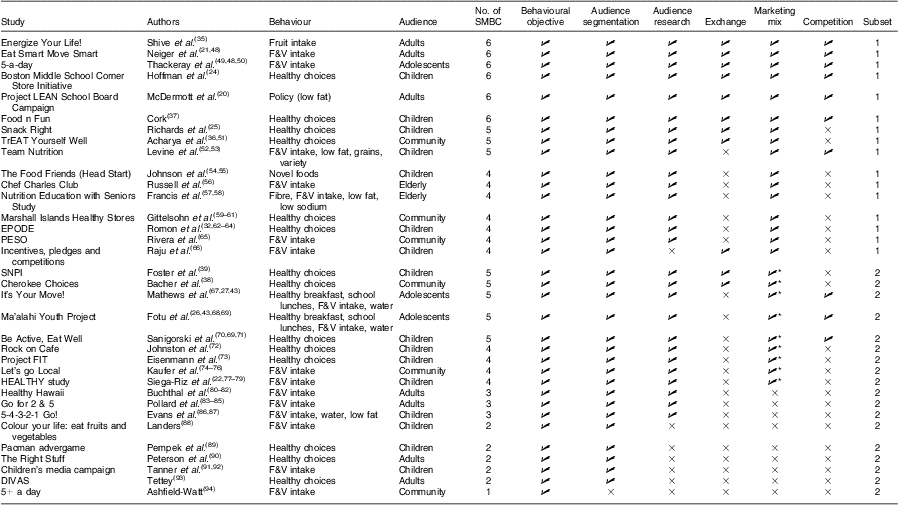
SMBC, social marketing benchmark criteria; F&V, fruit and vegetable; ✓, criterion met; ×, criterion not met; ✓*, multifaceted intervention, with social marketing used to describe the advertising and promotion.
Of the thirty-four studies, six gave evidence that they addressed all six criteria( Reference Andreasen 9 ). All studies reported a behaviour objective, all but one targeted a specific audience (audience segmentation), twenty-seven studies reported conducting formative research, eleven studies showed evidence of the concept of exchange, twenty-five studies produced interventions that utilized a marketing mix (more than advertising and communications) and ten studies reported any evidence of consideration of competition. Subset 1 reported using significantly more criteria (sixteen studies, mean = 5 criteria used) than subset 2 (eighteen studies, mean = 3 criteria used; t = 3·96, P = 0·0004).
Changing healthy eating
The effectiveness of social marketing to change eating behaviour was next analysed to gain insights into factors that may enhance social marketing intervention success. The effectiveness of the social marketing interventions is reported in Table 2.
Summary of behaviour change findings from thirty-four studies reporting the use of social marketing to address healthy eating
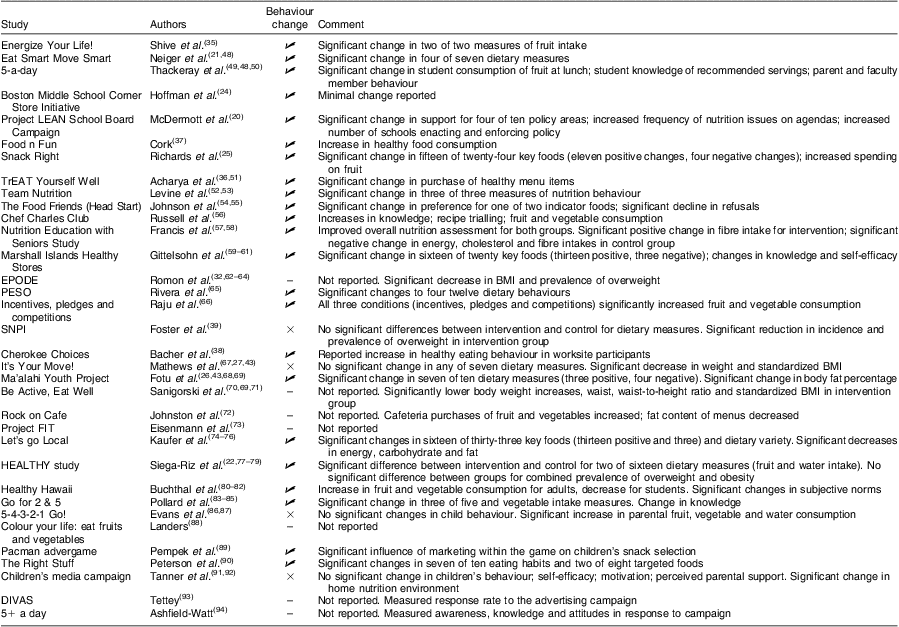
✓, behaviour change achieved; –, behaviour change not reported; ×, behaviour change not achieved.
Most studies reported some positive changes to healthy eating behaviour, although some acknowledged that these changes were small, mixed or did not follow a clear pattern( Reference Siega-Riz, El Ghormli and Mobley 22 , Reference Hoffman, Morris and Cook 24 – Reference Millar, Kremer and de Silva-Sanigorski 27 ). Of the thirty-four studies, four reported no changes and twenty-three reported positive changes to at least some behaviour measures. Seven studies had measured either behaviour precursors or physiological changes, and behaviour changes were ‘not reported’.
Subset 1 (sixteen studies) contained one study that did not assess behaviour change (‘not reported’), while the remaining fifteen reported positive changes on at least some behaviour measures. Subset 2 (eighteen studies) contained six studies that did not assess behaviour change (‘not reported’), eight that reported positive change to at least some behaviour measures and four that reported no change. The proportion of studies that found change on at least some measures was higher in subset 1 than subset 2 (100 % v. 67 %, respectively; P = 0·04).
Discussion
The current review of the social marketing healthy eating intervention literature indicates that the evidence base is presently directed towards children and adolescents, with relatively few interventions targeting adults. This is consistent with targeted populations identified in earlier reviews( Reference Gordon, McDermott and Stead 14 , Reference Cismaru and Lavack 28 ) and nutrition programmes where a focus on children is common( Reference Worsley 29 ). The empirical evidence evaluated in the review suggests that social marketing is largely effective in encouraging a variety of healthy eating behaviours. Given ongoing growth in overweight and obesity it is crucial to direct effort to improving eating behaviour, and it is suggested that more social marketing efforts are warranted. The present literature review examined interventions that self-identified as ‘social marketing’, yielding three contributions to the body of knowledge. First, the term ‘social marketing’ is often used to describe activities better labelled as social advertising. Second, the six benchmarking criteria described by Andreasen( Reference Andreasen 9 ) were not always clearly reported in the studies reviewed. Nor were other social marketing benchmark criteria frameworks( Reference Lefebvre and Flora 12 , Reference French and Blair-Stevens 30 ) reported. Those studies which described social marketing as a planned, consumer-oriented process (consistent with accepted definitions of social marketing) and which utilized this social marketing process to produce interventions that employed a full marketing mix, typically used more of the benchmarking criteria. Third and most importantly, these studies also reported behaviour change more often than the ‘social advertisers’. Taken together, these results suggest evidence that the application of Andreasen's six benchmark criteria in social marketing can change healthy eating behaviour(s).
The aim of the current study was to locate empirical studies that evaluate the effectiveness of social marketing interventions to identify the core issues relating to effectiveness. The factors that enhance success and limit failure are discussed in order of Andreasen's social marketing benchmark criteria. The keys to increasing healthy eating using social marketing are summarized in Table 3.
Keys to increasing healthy eating using social marketing

Behavioural objective
All interventions declared a behavioural objective. Interventions targeted a number of healthy eating behaviours, the most common being increased fruit and vegetable intake and selection of healthy choices. When planning interventions to encourage healthy eating, choosing which behaviour to tackle can be daunting. Consider the recently revised draft Australian dietary guidelines which list sixteen guidelines (at the simplest level) to adhere to each day( 31 ), making it difficult for researchers to determine which behaviour to tackle. Clearly healthy eating is multifaceted, suggesting there may be a need to evaluate efficacy using multiple behaviours. Most of the studies in the present review focused on one behaviour, which gives the intervention focus and specificity possibly at the expense of overall healthy eating behaviour. An alternative model that may be worthy of consideration is to tackle specific behaviours serially over time as has been done in the EPODE programmes in Europe( Reference Borys, Le Bodo and Henauw 32 ) and the OPAL programme in Australia( Reference Weir and Williams 33 ).
Audience segmentation
With the exception of one study, all studies reviewed defined their target audience. Although most studies were focused on a fairly broad group (e.g. adults at a worksite, children at a particular school, a community in a certain region), a narrow target group gives a specific reference point for formative research and intervention design. Marketers assume heterogeneity in the marketplace, and many marketing programmes identify different groups and tailor solutions accordingly. The assumption in marketing is that ‘one size does not fit all’ and the development of solutions that are attractive to each group (for either sequential or simultaneous presentation) is the ideal.
Formative research
About one-fifth of studies did not conduct or provide evidence demonstrating the use of formative research to inform their interventions. Some reported investigative work that could be described as ‘needs analysis’ and ‘problem definition’, which, although providing useful information, does not help to clearly establish that a consumer orientation was employed in the study. Typically, the formative research conducted in the more effective studies (those in subset 1) could be described as listening: understanding the behaviours involved, the barriers and motivators concerned, the preferences of the audience being considered and the audience's readiness to change. This information was then used to inform intervention development. When formative research had been conducted in the less effective subset (subset 2), it had a larger focus on shaping intervention strategies that were predetermined. For example, formative research was focused on pretesting messages, refining delivery mechanisms and ensuring the appropriateness of the information being delivered rather than conducting research to understand the target behaviour through the eyes of the target audience. Most would agree( Reference Andreasen 9 , Reference Lefebvre and Flora 12 , Reference Donovan 34 ) that the most important characteristic social marketing brings from its commercial roots is a consumer orientation, and indeed this is what sets social marketing apart from traditional expert-driven, top-down approaches that characterize health education and health communication.
Exchange
Evidence of exchange was difficult to detect in many studies. Incentives in the form of product trials, rewards and prizes were offered for trial or repeat behaviour( Reference Neiger, Thackeray and Merrill 21 , Reference Hoffman, Morris and Cook 24 , Reference Shive and Neyman Morris 35 , Reference Acharya, Patterson and Hill 36 ). An exchange between two parties (the marketer and the consumer) is an important concept in the social marketing framework, and to be effective the consumer must believe that he/she will get as much or more than he/she gives( Reference French and Blair-Stevens 7 ). This area is challenging as the benefits (better health via healthy eating) are temporally distant, which may devalue it in comparison to a competing or habitualized behaviour offering immediate satisfaction or reward. Studies in the current review with clear examples of exchange offered immediate benefits in the form of food samples( Reference Shive and Neyman Morris 35 , Reference Cork 37 ), coupons( Reference Acharya, Patterson and Hill 36 ), vouchers( Reference Hoffman, Morris and Cook 24 ), prizes( Reference Hoffman, Morris and Cook 24 , Reference Bachar, Lefler and Reed 38 , Reference Foster, Sherman and Borradaile 39 ) through to extra time off( Reference Neiger, Thackeray and Merrill 21 ).
Marketing mix
Utilization of a full marketing mix was low; about a third of the studies described solutions that relied solely on information, advertising or promotion. Another quarter were multifaceted interventions that used the term ‘social marketing’ to describe a narrow part of their programme – the advertising or communication activities. These studies were based on models and while a solid intervention development process was evident, the label of ‘social marketing’ was used to describe what would more legitimately be termed ‘advertising’ or ‘social communication’. Other studies that did adopt a marketing philosophy in the preparative stages did not use a full marketing mix, and remained educational or information based. The development of these information-based programmes appeared much like message testing, rather than attempts to use the full set of tools in the social marketing process to effect behavioural change. An examination of other reviews of social marketing in the nutrition space show a similar issue of an over-reliance on the use of information-based strategies in programmes designed to change nutrition behaviour( Reference Cismaru and Lavack 28 , Reference Alcalay and Bell 40 ), suggesting this issue is hardly new.
A worrying outcome of the sustained emphasis on communication is that many outside the marketing field confuse social marketing with advertising( Reference Grier and Bryant 11 , Reference Walsh, Rudd and Moeykens 13 , Reference Siega-Riz, El Ghormli and Mobley 22 ), and as the present review suggests many who term their work social marketing do not utilize more than advertising or communication. This is likely compounded by the fact that: ‘Too few social marketing efforts expand beyond 1P marketing efforts that favour communication tactics and vehicles – public service announcements, posters, pamphlets, public relations, entertainment-education, social and mobile media’ as so eloquently stated by Lefebvre( Reference Lefebvre 41 ), but also noted by others( Reference Grier and Bryant 11 ). In his discussion of the importance of each criterion, Andreasen also stresses the need to move beyond advertising, where ‘the power of the approach is manifested’( Reference Andreasen 9 ). Alden et al.( Reference Alden, Basil and Deshpande 42 ) go even further suggesting that although it is vital for consumers to receive consistent information and messages, information provision and education may be best left to public health and education, and that marketing efforts may be better directed at initiating new behaviour and encouraging repeat behaviours. In spite of our knowledge that advertising alone is less effective than interventions involving a full marketing mix, it is concerning to see the degree to which communication only (1P) interventions are continuing to be applied in the healthy eating space. Commercial marketers use a multitude of techniques that extend beyond communication (e.g. pricing, sensory appeal, product bundling, promotions, package size and retail displays) to influence eating choices. The number of marketing mix elements used by commercial marketers significantly outguns social marketing efforts that are restricted to communication.
Competition
Evidence of competitive analysis was also lacking, with only a quarter of the studies demonstrating any form of competitive analysis. Those who did examine or recognize competition viewed it from the perspective of competing health programmes( Reference Cork 37 ); competing unhealthy foods( Reference Shive and Neyman Morris 35 ) or unhealthy drinks( Reference Smith 23 ); or competing demands( Reference McDermott, Berends and McCormack Brown 20 ). Another example of a type of competitive analysis comes from the ANGELO framework where researchers looked at the environment to determine what is available and what is not available both in terms of foods (too many high-fat snacks available, mainly high-fat, low-vegetable meals, too many high-sugar drinks at home, junk food for lunch-boxes) and the economic, policy and sociocultural influences present( Reference Simmons, Mavoa and Bell 43 ). In Australia $AUD 400 million is spent on food advertising per year, one-third of which is advertising for confectionery, ice cream, biscuits and snacks( 44 ). Competitive analysis is instrumental to understanding how efforts might be directed towards removing some of these pressures, and also understanding what competes for the time and attention of the audience( Reference French and Blair-Stevens 30 ).
Taken together, the results of the current study suggest that the full application of Andreasen's( Reference Andreasen 9 ) six benchmark criteria is likely to ensure social marketers achieve their desired behavioural objectives. It is apparent from the literature review that much of the work claiming to be social marketing is not social marketing. Social marketing is an externally oriented process that starts and ends with the target audience and is further balanced with a broader understanding of stakeholders. Commercial marketers understand that consumer behaviour can be manipulated through a broad range of tactics (marketing mix) that deliver value to the consumer (exchange). These are key ingredients for success that must underpin all healthy eating social marketing interventions. Going forward, healthy eating social marketing interventions need to understand how they can improve the availability, affordability and convenience of healthy eating options to deliver alternatives that will be desired by the target audience.
Limitations and future directions
There were limitations to the present review, namely the use of the search term ‘social marketing’. This restriction may exclude studies that are in essence social marketing but do not clearly self-identify as such. A possible extension to this work would be to assess other nutrition interventions not termed social marketing against Andreasen's( Reference Andreasen 9 ) criteria. Given that there is some similarity between social marketing and other behavioural change tools including health promotion( Reference Neiger, Thackeray and Barnes 45 ), this raises the question of whether interventions not borne of the marketing philosophy are actually marketing. However, a philosophical debate is beyond the scope of the current study.
Another extension would be to classify studies using another framework – for example that of Lefebvre( Reference Lefebvre and Flora 12 ). While the frameworks have similarities, Lefebvre's places more emphasis on channel analysis, process tracking and management, some of which is implied by Andreasen. At the time of writing, the International Social Marketing Association and the European Social Marketing Association were conducting an open and iterative review of social marketing principles, with the aim of reaching a consensus definition and set of principles. This is expected to advance their previous work to consolidate and expand the framework initially proposed by Andreasen (and used in the present study). Once complete, it may be timely to revisit the social marketing literature, reviewing studies against this new framework.
Many papers reported formative research and methodological research for studies still to be developed and implemented. These papers were not included in the current analysis, and may add more knowledge in time. As noted by French( Reference French 46 ), the social marketing discipline is currently witnessing the development of a truly inclusive transtheoretical, multidisciplinary applied field of practice, namely social marketing. Systematic reviews are strongly encouraged going forward to allow researchers to reflect, drawing on all relevant sources of understanding and knowledge to create social programmes that are both effective and efficient in enacting social change.
In the interventions reviewed, the focus was squarely on influencing individual behaviour, consistent with more traditional definitions of social marketing. However, there have been calls for more programme developers to consider what can be done to modify environmental or social influences, commonly termed ‘moving midstream and upstream’( Reference Donovan 34 , Reference Lefebvre 41 , Reference Wymer 47 ). Few examples were found during the present review, suggesting that a considerable opportunity exists for future research. Examples of midstream and upstream activities identified in the review include modification at the environmental or upstream level (introducing new foods in canteens and vending machines( Reference Shive and Neyman Morris 35 )) and at the midstream or social level (influencing group culture of better nutrition and physical activity( Reference Neiger, Thackeray and Merrill 21 )).
Conclusion
The present paper sought to examine the social marketing healthy eating evidence base to identify weaknesses and impediments with a view to understanding how future interventions can be improved. The effectiveness of social marketing as a systematic process to change healthy eating can be enhanced. First, a number of behaviours contribute to healthy eating, and care must be taken to select which behaviour to address. Next, social marketing incorporates a mix of strategies, and relying heavily on advertising or communication should be avoided due to limited efficacy of this approach when compared with programmes utilizing more of the marketing mix. Finally, consideration must be given to the changes that can be made to social and environmental influences on behaviour as part of an integrated social marketing programme.
Acknowledgements
Sources of funding: The Defence Science and Technology Organisation (DSTO) provided funding and in-kind support for this study. Conflicts of interest: Neither author declares any competing interests. Ethical approval: Not required. Authors’ contributions: The study was designed by J.E.C., with support from S.R.R.-T. Analyses were conducted by J.E.C. and S.R.R.-T. Both co-authors contributed to the writing of the drafts and agreed to the form of the final paper. Acknowledgements: The authors wish to thank DSTO for funding and in-kind support; also the following people for their suggestions and assistance with early drafts of the manuscript: Professor Simone Pettigrew, Dr Justin Fidock and Professor David Weaver. Finally the authors wish to thank the blind reviewers for their time and suggestions.



