1. Introduction
It has often been pointed out that, in German, -s plurals do not usually occur within noun+noun compounds (for example, *Auto-s-berg ‘heap of cars'), whereas other types of plural marker do (for example, Kind-er-party ‘children's party', Frau-en-laden ‘women's centre'). The explanations for the non-occurrence of plural -s on the first noun (often referred to in the literature as the non-head of the compound) differ significantly. Some linguists (for example, Marcus et al. Reference Marcus, Ursula, Harald, Richard and Steven1995 and Clahsen et al. Reference Clahsen, Gary, Susanne, Richard, Booij and Jaap1996) see this constraint as evidence for the special morphological status of -s as the one “regular” plural marker in German, and they argue that the outputs of regular inflectional rules cannot serve as input to word formation processes such as compounding. By contrast, Wegener (Reference Wegener1999, Reference Wegener2003) claims that the unacceptability of forms such as *Autosbahn has nothing to do with the interaction of regular inflection and word formation, but is a consequence of specific phonotactic constraints on the occurrence of -s within compounds. For instance, -s is blocked from occurring after a long vowel, but it can occur after certain consonants (for example, Clown-s-parade ‘parade of clowns').
Unfortunately, Wegener is unable to provide many examples of plural -s within compounds because the -s plural marker is relatively infrequent in standard German. Where it does occur is mainly after long vowels (for example, Autos ‘cars', Muttis 'mums'), but after consonant-final words it is very restricted, being mainly used with loanwords from English and French (see Durrell Reference Durrell1992:153). In fact, the -s plural is sometimes frowned upon as “un-German” in more formal registers, and attempts have been made to replace it with alternative plural suffixes: for example, die Parke ‘the parks’ instead of die Parks (Durrell Reference Durrell2002:21; see also Durrell Reference Durrell1992:153 for further discussion of this register difference).
Therefore, if one intends to test whether the (non)-occurrence of -s in compounds is morphologically or phonologically determined, more examples have to be found, of consonant-final and vowel-final nouns, that would be likely candidates to enter into productive compounding as plural non-heads. As shown in section 4 below, such examples can be found in colloquial German, specifically in northern varieties where -s is used more widely than in the standard language. That is to say, it is used in more consonant-final environments than in standard German, and its usage is less constrained by prescriptive considerations of correctness than in the standard language. For these reasons, it is suggested that colloquial northern German may provide more robust data for the investigation of -s plurals within compounds, and their theoretical consequences, than the standard German language.
2. The Notion of Default Rules
German has five plural suffixes: -(e)n, -er, -e, zero, and -s (three of which, -e, -er, and zero, can also occur with umlaut of the root vowel). Consider the examples in 1, taken from Durrell (Reference Durrell2002:16–21).
- (1)
a.

b.
c.
d.
e.

The distribution of these suffixes is largely a case of lexical conditioning. Apart from a few clearly observable tendencies based on the gender and phonology of the noun (for example, masculine and neuter nouns ending in -el, -en, -er usually take a zero suffix, see 1d), German speakers must learn the plural formation of each noun separately. This appears to be very different from the situation in English, which has one regular plural marker that applies to most nouns, namely -s affixation, and a number of clearly defined exceptions to this rule (for example, man, men; foot, feet). In German, the notion of regular versus irregular plurals does not appear to be as clear-cut.
Having said that, some linguists argue that German does have one regular plural marker and, in contrast to English, it is the one that is the least commonly used. The first advocates of this approach within generative linguistics were Marcus et al. (Reference Marcus, Ursula, Harald, Richard and Steven1995), who argued that the regular noun plural marker in German is -s, since it is the one that has default status. In other words, it is the one that is used as an “emergency plural” when a noun has a non-canonical root, or when a noun is used as a title, a personal name or has some other special status (see Marcus et al. Reference Marcus, Ursula, Harald, Richard and Steven1995:239–230). Some examples are provided in 2.
- (2)
a.
b.
c.
d.
e.
In order to test the default theory, Marcus et al. (Reference Marcus, Ursula, Harald, Richard and Steven1995) carried out a psycholinguistic experiment in which adult German speakers had to make grammaticality judgments on alternative plural forms of nonce words. Results showed that the speakers appeared to apply the regular -s plural and the irregular plural forms in different ways. If a novel noun was learned as a root that was similar to other German roots, its plural was often formed by analogy to the plural forms of similar nouns. If, however, the novel roots were more unusual sounding, or were designated as proper names, memory-based generalization did not apply, and -s tended to be used throughout. Thus, native speakers of German appear to use -s as the default plural marker, which is particularly interesting because, being the least frequent plural suffix, it does not conform to the traditional notion of regularity. This suggests that the default application of a rule cannot simply be linked to type frequency.
On the basis of this evidence, Marcus et al. (Reference Marcus, Ursula, Harald, Richard and Steven1995) advocate an approach in which -s plurals are derived by the operation of a symbolic rule (that is, a rule that accesses a mental symbol for a grammatical category), whereas the other plural forms are stored items in the mental lexicon, which block the application of the default rule. This strict separation of regular and irregular morphology is commonly known as the Dual Mechanism (henceforth DM) approach, which sees the mechanisms underlying regular and irregular morphology as fundamentally different: that is, rule-based versus storage-based respectively.Footnote 1
Naturally, such an approach makes important predictions regarding the interaction of regular and irregular morphology. One important premise of DM is that the only forms that can serve as input to derivational processes such as compounding are stored forms, not forms that have been generated by a default rule. This premise has been based on observations of grammaticality in a number of languages (see Pinker Reference Pinker1999 for examples). For German, Marcus et al. (Reference Marcus, Ursula, Harald, Richard and Steven1995:230) provide evidence for the DM model in the form of compound nouns with a plural first element (that is, non-head):
- (3)
a.
b.
Here, a clear difference can be observed between the relatively frequent and perfectly acceptable occurrence of the irregular plurals in -e, -er, and -en, on the one hand (3a), and the non-occurrence of regular -s plurals, on the other (3b). If, with Marcus et al., we assume that regular forms are not stored in the mental lexicon and are therefore unavailable as input to further derivation, we would not expect to find any examples of compounds with an -s plural in the non-head position.Footnote 2 This argument has been further supported by data from experiments with German-speaking children, who also avoid the use of plural -s within novel compounds (see Clahsen et al. Reference Clahsen, Gary, Susanne, Richard, Booij and Jaap1996).
3. Phonological Factors
In a counterargument to the DM approach, Wegener (Reference Wegener1999, Reference Wegener2003) shows that -s plurals inside compounds do indeed exist in German, although they are rare. On the basis of Google web searches and consultation with native speaker informants, she gives the following examples (2003:433–434):
(4)
She also gives the examples Schrimpscocktail ‘prawn cocktail', Chipstüte ‘bag of crisps’ and Pumpsabsatz ‘court shoe heel', although she notes that these words are different in that the non-head noun is plural dominant (that is, the plural form is much more frequently used than the singular), which indicates that these plurals are likely to be lexically stored in any case.Footnote 3
What is significant for Wegener is that the examples in which -s plurals occur within compounds are of words ending in a consonant. When -s follows a long vowel, which is the most common phonological environment for the use of the -s plural in standard German, it is blocked from appearing as the non-head of a compound: for example, Autos ‘cars', but not *Autosbahn ‘motorway'; Taxis 'taxis', but not *Taxis-stand ‘taxi rank'. Thus, according to Wegener, the reason for -s plurals appearing very rarely inside compounds is a phonological, not a morphological one, namely that a heavy syllable with a long vowel followed by an extrasyllabic -s is a marked final syllable in German, and it is this markedness of the final syllable that accounts for why plural -s is not realized on the non-head of compounds. In other words, when German children learn not to use -s plurals inside compounds it has nothing to do with regular inflection being unavailable to compounding, as Marcus et al. (Reference Marcus, Ursula, Harald, Richard and Steven1995) claim, but it is rather a result of the children learning the phonotactic constraints on the position of specific complex syllables in German. Therefore, the lack of plural -s inside German compounds cannot be used as evidence for a DM model of morphology.
Proponents of a DM approach could object that many of Wegener's examples are not unambiguous plural forms. For instance, Kuckuck and Leutnant are words which appear in compounds with -s as a linking element, irrespective of whether they have plural meaning or not (for example, Kuckucksei ‘cuckoo's egg’ is singular). This suggests that -s has to be lexically specified for these stems. Wegener (Reference Wegener2003:450) argues, however, that the morphological status of -s is irrelevant. The significant point is that -s, be it as a plural marker or a lexical linking element, can only occur in specific phonological environments in German. She points out that there are various phonological and functional explanations for the occurrence versus non-occurrence of linking -s in general: for instance, its function at syllable boundaries (for example, Leutnant-s-uniform, not *Leutnan-tuniform) and, following Aronoff & Fuhrop (Reference Aronoff and Nanna2002:461–464), its function after certain derivational stems to ‘reopen’ them to further morphological processes (for example, Versicherung-s-vertreter ‘insurance salesman'). Thus, the constraints on the occurrence versus non-occurrence of plural -s within compounds are merely a consequence of these more general constraints. They account for the acceptability of words such as Kuckuckspaar ‘pair of cuckoos’ versus the unacceptability of words such as *Uhuspaar ‘pair of owls’ without the need to specify whether the -s is a regular plural or not.
Nevertheless, one could object that a phonological approach does not account for the fact that -s plurals are still very rare within compounds, even in those whose non-heads have a phonological structure that would normally permit -s. It might simply be that, as most -s plurals end in a long vowel, there are relatively few examples of appropriate consonant-final -s plurals available to enter into compounding. This begs the question as to whether an increase in post-consonantal -s plurals (for example, due to a large influx of loanwords) would lead to more instances of such plurals within compounds, provided that their phonological structure would permit this.
4. -s Plurals within Compounds in Colloquial German
Discussions on the use of noun plurals in the non-head position of compounds have, to date, concentrated on standard German usage, and we have seen that, in standard German, -s is relatively infrequent as a plural marker. If we consider register and regional variation, however, we find that the -s plural marker is more widely used in colloquial speech, specifically in areas of northern Germany, where the suffix has spread from Low German dialects into more general colloquial usage (Schirmunski 1962:424–425). As in the dialects, the northern -s plural is commonly used with nouns denoting human beings, and with nouns ending in a schwa syllable, whereas the southern German varieties tend to favour other markers, for instance -n after a schwa syllable: for example, northern Onkels versus southern Onkeln ‘uncles’ (Wegener Reference Wegener, Delbecque, van der Auwera and Geeraerts2005:218). Consider the examples in 5 from Durrell Reference Durrell2002:21, where the use of northern -s is contrasted with standard German usage (standard forms in brackets):
(5)
In addition to these northern forms, there are also supraregional colloquial forms that have an -s plural because they are English loanwords or end in a long vowel (see Glück & Sauer Reference Glück, Wolfgang and Stevenson1995:110 for further discussion). The following examples in 6 are taken from the Duden Deutsches Universalwörterbuch.Footnote 5
(6)
Thus, in view of the fact that in colloquial German, particularly in northern areas, the -s plural marker is used more widely than in the standard language, the question arises as to whether the colloquial plurals would be more likely to enter into compounding than the standard German -s plurals. A DM approach would argue that the type frequency of the plural marker is irrelevant. As in the standard language, -s occurs in default environments in colloquial northern usage (see 2 above), which indicates that it is also “regular” in this variety of German and would therefore be blocked from appearing within compounds. On the other hand, a phonological approach would predict that -s would be blocked from appearing after the examples ending in long vowels but would be permitted after the consonant-final words. Particularly words ending in -el permit -s as a linking element (for example, Teufel-s-kreis ‘vicious circle'); therefore, phonotactically speaking, plural -s should be just as acceptable in this environment.
In order to ascertain to what extent and in which phonological environments speakers of northern German accept plural -s within compounds, twenty adult native speakers of German from the areas of Lower Saxony and North-Rhine Westphalia were asked to make grammaticality judgements on possible compounds with plural -s as the non-head. The speakers were chosen on the basis of having been born and raised in northern Germany and having speech patterns that reflected northern German usage.
In order to eliminate the possibility of -s being interpreted as a genitive or linking element, specific compound heads were selected to force a plural interpretation of the non-head (for example, -treff ‘meeting', -club ‘club', -party ‘party'). Care was taken to choose compounds that were characteristic of colloquial speech, and it was made clear to the speakers that these words were not listed in dictionaries and it was not a matter of a “correct” versus an “incorrect” form. Standard German words such as Auto- ‘car', Foto- ‘photo’ were not included, in order to avoid possible analogical effects from highly frequent established compounds such as Autobahn ‘motorway', Fotoalbum ‘photo album', etc.
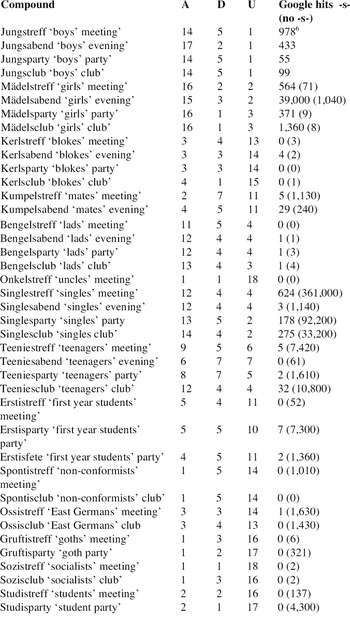
A mixture of consonant-final and vowel-final non-heads was chosen. Speakers were asked to judge, by filling in a questionnaire, whether they found a form “acceptable” (A), defined as meaning that they would probably use it themselves, “dispreferred” (D), meaning that they would not use it themselves but could imagine it being used by others, or “unacceptable” (U), which meant that it sounded incorrect and they could not imagine it being used. It was made clear to the participants that what was required were grammaticality judgements on the acceptability of the -s plural, and not evaluations of whether the word itself was pragmatically or sociolinguistically acceptable (for example, whether an Onkel(s)treff ‘uncles’ meeting’ is a likely scenario, or whether Kerl ‘bloke’ is thought to be pejorative). The results are shown in table 1 below.
Use of -s in colloquial compounds.

In addition to the grammaticality judgements, frequency data were also collected using a Google advanced search, and these are shown in the right-hand column of table 1. The numbers represent the number of hits for each compound with -s, and the numbers in brackets represent the equivalent compounds without -s (for example, Bengelstreff versus Bengeltreff). For the sake of consistency, only compounds written as one word were entered into the search, and they were also presented as one word to the native speakers.
5. Results and Discussion
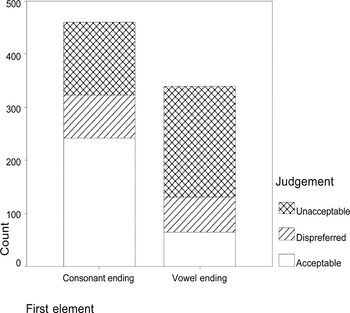
Results of a chi-squared test show that among the non-heads there was a significant difference in acceptability, χ2 = 102.242, p < 0.001, with non-heads ending in a consonant being more acceptable as an environment for the use of plural -s than those ending in a vowel.Footnote 7 This difference is illustrated in the bar chart below, where “first element” refers to the non-head.
Acceptability of consonant-final versus vowel final non-heads.

Indeed, the Google search results show that Mädels- is used even more often in the plural than in the singular when in the non-head position of a compound (see table 1).
Although there is a certain amount of variation from word to word, the choice of head noun does not make a significant difference to the acceptability versus non-acceptability of the non-head. That is to say, no pattern emerges in which, for example -abend is regularly preceded by -s but -club is not.
As the DM model treats -s as the regular plural marker that is generated outside the lexicon, non-heads such as Jungs-, Mädels-, Bengels-, Singles-, etc. appear to violate the model. On closer inspection, however, this might not be the case. If one considers the behaviour of the nouns when not part of a compound, there might be arguments for lexical storage of the plural form. Firstly, the plural Jungs, despite the -s suffix, is an irregular plural form; that is to say, as the singular is Junge and not *Jung, it involves a stem change in addition to the affixation of -s. As for Mädels and Singles, it appears that these words occur more frequently in the plural than in the singular. Frequency results from the Hamburg sub-corpus of the COSMAS German language corpus list 225 hits for the plural form Mädels as opposed to only 23 for the singular Mädel, and 110 hits for Singles, as opposed to 65 for Single.Footnote 8 Similarly, it could be argued that Bengels is also a word often used in the plural form. The corpus data do not support this (16 hits in the singular and 6 in the -s plural form), but this could be due to the relatively infrequent occurrence of the word in either the singular or plural in the corpus, making the overall figures less robust.
It has often been pointed out that DM models that do not allow any storage of regular forms are too restrictive, as a number of psycholinguistic experiments have shown that speakers access frequent regular forms more quickly than less frequent regular ones (see, for example, Baayen et al. Reference Baayen, Ton Dijkstra and Robert1997). This idea has been taken up and developed in more recent versions of DM, namely in “parallel-race” models such as that of Pinker & Ullman (Reference Pinker and Michael T.2002), which argue for at least some lexical storage of regular forms, depending on their token frequency. The colloquial German data appear to be compatible with this less restrictive version of the DM model, which allows for frequent plurals such as Mädels, Singles, etc. to occur inside compounds.
With regard to the vowel-final non-heads, there appears to be a strong preference for the singular form in almost every case. The frequency argument that we used for the consonant-final non-heads does not appear to be relevant here. Many of these vowel-final -s plurals are more frequent than their corresponding singulars, yet these frequency effects are not mirrored in the preference for -s within the compound. A general COSMAS search produced the following results: 408 hits for Teenie and 1,438 for Teenies; 14 hits for Ersti and 94 for Erstis; 62 hits for Sponti and 65 for Spontis, 150 hits for Ossi and 827 for Ossis; 75 hits for Grufti and 80 for Gruftis; 251 hits for Sozi and 430 for Sozis; 23 hits for Studi and 475 for Studis.Footnote 9 Thus, these preference ratings, taken together with the Google results, provide strong evidence for a phonologically-based analysis, in which the use of -s in the non-head is avoided after vowels, irrespective of token frequency, but is permissible after consonants.
These results must be treated with some caution, however, because there are well-recognised difficulties surrounding the use of Google and native speaker grammaticality judgements for the collection of data. Firstly, one cannot always be sure that the Google data represent native speaker usage or, in this case, one cannot be certain that the speakers are all of northern origin. Secondly, one of the major limitations of grammaticality judgements is that there is an acknowledged lack of congruence between what people claim is unacceptable and what they actually do in spontaneous speech (see Labov 1972:111; and for a more recent discussion of the research on grammaticality judgements, Schütze Reference Schütze1996).
Moreover, as Schütze (Reference Schütze1996:190) points out, one major difficulty with using questionnaires to elicit grammaticality judgement data is that it is not always clear what the participants’ motivations are for rejecting a particular form. Their reasons for disliking a word might be completely unrelated to the grammatical question under investigation, and not all speakers can articulate this in their response. In the present study, only a handful of the participants provided explanatory comments. For instance, one speaker reported that the word Mädels, being of southern origin, was not a “proper northern” word, and therefore rejected it as a non-head. Another speaker disfavoured the word because, for her, it had Nazi connotations, reminding her of the Bund Deutscher Mädel, the girls' wing of the Hitler youth movement.
Similarly, the non-heads Kerls- and Onkels- had low acceptability ratings, despite being consonant-final. It is not clear, however, whether the reason for this is a grammatical one, or whether it has to do with the fact that the word Kerl is often used pejoratively and is therefore avoided by some speakers. The unacceptability of Onkels- is probably due to the fact that, from a pragmatic point of view, this word does not naturally form a compound. Despite having explained to the participants in advance that their judgements should be based purely on grammar and nothing else, the results show that this is not what native speakers do, and that it was misguided to think that semantic/pragmatic considerations could be divorced from the grammaticality judgements.
Finally, there is also the question of whether the word is perceived by the speaker to be a loanword or not. One speaker commented that Teenies- sounded plausible because it was an “English word” and indeed this plural form was consistently judged more acceptable as a non-head than the other vowel-final plurals, which were abbreviations of German words.Footnote 10 As there appears to be no phonological or frequency-based explanation for the acceptability of Teenies- relative to the other vowel-final non-heads, the loanword explanation warrants further investigation.
6. Conclusion
The use of plural -s in the non-head position of compounds in colloquial Northern German is a complex issue determined by a number of factors: phonology, frequency and, possibly, the perceived origin of the word. On the whole, the results provide stronger evidence for a phonological account, supporting the findings of Wegener (Reference Wegener2003), than for a DM analysis. German speakers are less willing to accept a plural -s after a vowel-final noun than after a consonant-final one. The frequency of the noun plural form with respect to its corresponding singular appears to play a significant role in the consonant-final nouns, in that there is a tendency to accept frequent plurals as non-heads of compounds, but if the noun is vowel-final, the frequency of the plural form appears to be irrelevant. Thus, if one were to use frequency as an argument for the lexical storage of regular forms, one would still need to explain why the frequent plural Mädels is acceptable as a non-head but the frequent (and therefore equally likely to be stored) plural Studis is not. This could probably be accounted for more adequately using a single-mechanism approach which identifies a hierarchy of phonological and frequency-based constraints on stored forms (ranking the phonological constraints higher than the frequency-based ones).
7. Further Research
In addition to the general distinction between vowel-final versus consonant-final non-heads, there might be further sub-categories of words that are relevant to the question of the acceptability of the –s plural within compounds. Syllable structure has also been shown to play a role in the occurrence of -s (see Wegener Reference Wegener2003 for the constraints on the lexical linking -s). Thus, a comparison of, for example, monosyllabic non-heads such as Kerls- with schwa-syllable final non-heads such as Bengels- might prove to be fruitful.
Moreover, the present study restricted itself to -s plural non-heads denoting human beings, as these were characteristic of colloquial speech. However, a broader investigation could include a balance of animate and inanimate -s plural non-heads in order to ascertain to what extent animacy plays a role in the acceptability of plural -s within compounds.
Finally, some of the results of this study suggest that one needs to consider the fact that non-heads that are perceived by native speakers to be loanwords might not be subject to the same constraints as native (or nativized) words. This could be investigated empirically by eliciting -s acceptability judgements on a balance of recent English loanword non-heads versus more established Romance loans or native German non-heads.