Introduction
Transoral rigid laryngoscopy with videostroboscopy is a clinic-based procedure carried out after applying topical anaesthesia. Video documentation of laryngeal anatomy along with its mechanical function has developed as the most practical technique for clinical evaluation of the visco-elastic properties of the phonatory mucosa. Laryngoscopy with stroboscopy substantially improves the diagnostic sensitivity for more subtle laryngeal disorders, and is essential for specialist management of human voice disorders. In addition to playing a role in the management of voice problems, rigid laryngoscopy has enabled the development of other tests and treatments, such as evaluation of swallowing, removal of foreign bodies, biopsy and vocal fold injection.Reference Moorthy, Gupta, Laurent and Weisberger 1 , Reference Sulica and Blitzer 2
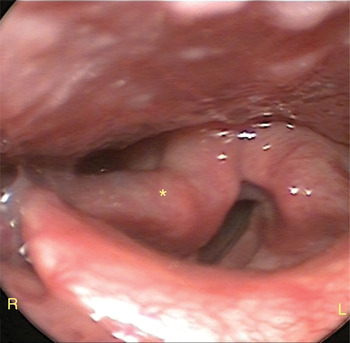
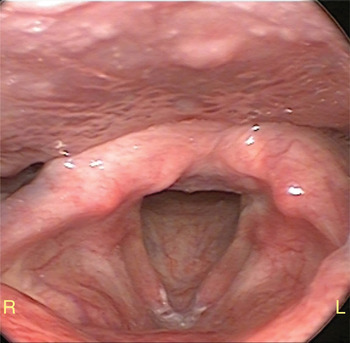
Unproblematic rigid laryngoscopy requires adequate patient co-operation, and this is aided by the administration of effective topical anaesthesia. On one occasion, we examined a nervous patient with transoral rigid laryngoscopy, and observed right vocal fold paralysis with an elevated right arytenoid cartilage; the right vocal fold was fixed and unable to abduct (Figure 1). Transoral rigid laryngoscopy was then repeated to check results, with the patient receiving stronger topical anaesthesia, and normal, symmetrical, full abduction of both vocal folds was observed (Figure 2). Sometimes, patients are unable to complete an examination, or the examination quality significantly deteriorates, due to patient discomfort and agitation.
Transoral rigid laryngoscopic view showing pseudo-paralysis of the right vocal fold in a nervous patient. The right arytenoid cartilage (asterisk) was slightly more elevated than the left one. The right vocal fold was fixed and unable to abduct. R = right; L = left

View from repeated transoral rigid laryngoscopy in the same patient shown in Figure 1, showing normal, symmetrical, full abduction of both vocal folds, following administration of stronger topical anaesthesia. R = right; L = left

Many studies have reported the use of topical nasal anaesthesia during transnasal flexible laryngoscopy,Reference Cheung, Goodman, Bailey, Fedorak, Morse and Millan 3 – Reference Simpson, Amin and Postma 7 but few have investigated topical pharyngeal anaesthesia for transoral rigid laryngoscopy. The optimal topical pharyngeal anaesthetic agent for transoral rigid laryngoscopy has not yet been established. In our experience, rigid laryngoscopy is a very convenient means of visualising the vocal apparatus, and has simpler disinfection requirements and greater cost-efficiency than flexible laryngoscopy. Rigid laryngoscopy also carries less risk of epistaxis than flexible laryngoscopy.Reference Cheung, Goodman, Bailey, Fedorak, Morse and Millan 3 However, the quality of rigid laryngeal endoscopy is greatly dependent upon effective topical anaesthesia.
In the present study, we evaluated the effect of topical anaesthesia with regard to patient comfort and the quality of endoscopic visualisation, during transoral rigid laryngoscopy.
Materials and methods
We conducted a prospective, endoscopist-blinded, cross-over study, between January 2010 and June 2011, involving 10 volunteer patients with laryngeal diseases and without severe cardiac or pulmonary disease. Patients underwent repeated laryngoscopy to follow up their existing laryngeal disease.
Two patients were diagnosed as having work-related vocal nodules and received nebulisation and pronunciation training; these patients underwent regular laryngoscopy to evaluate the effects of conservative treatment and to determine whether surgery was needed. One patient was diagnosed as having laryngeal syphilis, with a chancre on the epiglottis,Reference Ma, Zhu and Wang 8 while another was diagnosed with laryngeal tuberculosis; both received conservative treatment and local follow up. Six patients were diagnosed with laryngeal neoplasms such as leukoplakia, papilloma or atypical hyperplasia after suspension microlaryngoscopic surgery; these patients received laryngoscopy as part of close follow up.
Patients underwent five laryngoscopies each, with an interval of three months between procedures.
The study was approved by the institutional review board of Tongji University School of Medicine, Shanghai. Informed consent was obtained from each study participant for five examinations with laryngoscopy plus videostroboscopy.
All procedures were carried out by the same, experienced doctor. There were two parts to the study.
In the first part, each patient received standard rigid laryngoscopy on three separate occasions. On each occasion, the patient received either 10.0 g of 2 per cent lidocaine gel, 5.0 g of 1 per cent tetracaine gel or 1.0 ml of 1 per cent tetracaine solution, topically administered 10 minutes before laryngoscopy with videostroboscopy. At the first laryngoscopy, the anaesthetic agent was randomly selected; at the second and third laryngoscopies, the two, unused agents were applied in turn. For better anaesthetic effect, half the dose was applied to the palate, tongue base and posterior pharynx, gargled twice in the pharynx, then swallowed. The second half of the dose was applied in the same way but held in the oral cavity for 60 seconds before being swallowed. Lidocaine gel and tetracaine gel were both applied using single-use, syringe-like, plastic containers; tetracaine solution was sprayed from an automatic spray gun (MedStar, Seoul, South Korea) in the ENT treatment unit (spray gun handles were removed for sterilisation after each use).
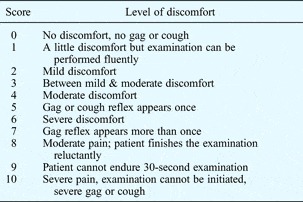
Transoral rigid laryngoscopy (using a 70°, 8 mm diameter, 185 mm long laryngoscope; MedStar) with videostroboscopy was performed for 30 seconds each time, if tolerated by the patient. For the purposes of this study, the primary outcome was the patient's subjective level of discomfort for the overall procedure, reported using a validated, 10-point visual analogue scale (VAS; 0 = no discomfort, 10 = severe discomfort) which had been used in similar studies in the past.Reference Johnson, Belafsky and Postma 4 , Reference Singh, Brockbank and Todd 6 , Reference Stolz, Chhajed, Leuppi, Pflimlin and Tamm 9 This scoring system is shown in Table I. The endoscopist used a VAS to grade the patient's co-operation and the examination quality (0 = best co-operation and examination quality, 10 = worst co-operation and examination quality). The endoscopist was blinded to the topical anaesthetic used.
Rigid laryngoscopy discomfort vasReference Singh, Brockbank and Todd 6

VAS = visual analogue scale
In the second part of the study, we selected the topical anaesthetic agent that minimised each patient's procedural discomfort, according to which agent had given the lowest mean VAS discomfort score, in order to investigate the optimal timing of topical anaesthetic application. Each of the 10 patients then received this agent either 5, 10 or 15 minutes before laryngoscopy, the timing being selected at random. After the procedure, the patient rated their discomfort and the endoscopist rated patient co-operation and examination quality, both using a 10-point VAS. The examiner was blinded to the timing of anaesthetic application.
Data were recorded using the Excel 2007 software program (Microsoft, Redmond, Washington, USA). The mean and 95 per cent confidence interval (CI) for each anaesthetic agent and each application timing were analysed using the Statistical Package for the Social Sciences version 10.0 software program (SPSS Inc, Chicago, Illinois, USA). Data for the 5 groups (i.e. lidocaine gel, tetracaine gel and tetracaine solution at 10 minutes’ application, plus tetracaine solution at 5 and 15 minutes’ application) were compared using the paired t-test. A two-tailed p value of less than 0.05 was considered statistically significant.
Results and analysis
Ten patients (6 men and 4 women; age range, 20–55 years) were enrolled in the study. The mean age of participants was 39 years.
The mean and 95 per cent CI for patients’ procedure discomfort VAS scores for lidocaine gel, tetracaine gel and tetracaine solution were respectively 6.4 ± 4.5, 3.8 ± 3.7 and 2.3 ± 2.3 (Table II). The mean and 95 per cent CI for the endoscopist's co-operation VAS scores for lidocaine gel, tetracaine gel and tetracaine solution were respectively 6.0 ± 4.8, 3.5 ± 3.4 and 2.2 ± 2.0 (Table II). Independent comparisons with lidocaine gel and tetracaine gel anaesthesia indicated that laryngoscopy with topical tetracaine solution anaesthesia appeared to provide better comfort (p < 0.01) and facilitate better co-operation (p < 0.01) (Table II).
Discomfort and co-Operation scores by anaesthetic agent

* 10 minute application. SD = standard deviation
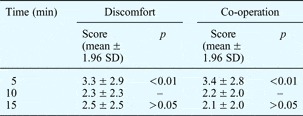
Using topical tetracaine solution anaesthesia, the mean and 95 per cent CI for patients’ VAS discomfort scores for 5, 10 and 15 minute anaesthesia application were respectively 3.3 ± 2.9, 2.3 ± 2.3 and 2.5 ± 2.5 (Table III). Using the same anaesthesia, the mean and 95 per cent CI for the endoscopist's VAS co-operation scores for the 3 timing groups were respectively 3.4 ± 2.8, 2.2 ± 2.0 and 2.1 ± 2.0 (Table III). There was a statistically significant difference in discomfort scores (p < 0.01) and co-operation scores (p < 0.01) between the 5 and 10 minute application groups, but no significant difference in discomfort scores (p > 0.05) or co-operation scores (p > 0.05) between the 10 and 15 minute groups (Table III).
Discomfort and co-operation scores by anaesthetic* application time

* Tetracaine solution.
Discussion
The present study findings indicate that patients undergoing transoral rigid laryngoscopy experienced less oropharyngeal discomfort and displayed greater co-operation when they were administered tetracaine solution as topical anaesthetic either 10 or 15 minutes before the procedure. Administration of more effective topical anaesthesia made it easier for patients to tolerate rigid endoscopy. Although this finding might seem intuitive, few previous studies have investigated anaesthesia for transoral rigid laryngoscopy.
In our experience, the effect of agents used for transoral rigid laryngoscopy topical anaesthesia can be improved (without increasing the dosage) by prolonging the time of application of the agent to the basal tongue and pharynx, and by applying the agent in fractionated dosing. Therefore, in our study, topical anaesthetics were gargled and delivered as two sequential, half-dosage applications, for better clinical effect. This is especially important for tetracaine because of its relatively narrow safety profile: although allergic, toxic or idiosyncratic reactions to tetracaine are rare, fatalities have been reported.Reference Scharfe 10
Our study findings indicate that the dosage form of the anaesthetic agent also played a specific role. Clearly, tetracaine solution was more effective, at much lower doses, than tetracaine gel in our study (i.e. 10 mg tetracaine as 1.0 ml of 1 per cent tetracaine solution, versus 50 mg tetracaine as 5.0 g of 1 per cent tetracaine gel). Anaesthetic gel is applied for transnasal flexible laryngoscopy, gastroscopy and cystoscopy, for lubrication. Our results suggested that tetracaine solution should be preferred for transoral rigid laryngoscopy anaesthesia, as the solution form has a stronger topical effect than the gel form, and as transoral rigid laryngoscopy does not require lubrication.
Nebulised anaesthetics are usually given before transnasal flexible laryngoscopy and bronchoscopy.Reference Christoforidis, Tomashefski and Mitchell 11 The vagus nerve (the Xth cranial nerve) innervates the pharynx, larynx, oesophagus and trachea. Irritation of the pharynx mainly induces nausea and gagging, while agitation of the larynx and trachea leads to a persistent, choking cough. Nebulised lidocaine is suitable for flexible laryngoscopy and bronchoscopy as the anaesthetic vapour is drawn into the larynx, trachea and bronchi. In transoral rigid laryngoscopy, buccal administration of tetracaine solution is more helpful, with the anaesthetic solution being held in the oropharynx. In addition, nebulised, aerosolised anaesthetic can be more easily absorbed into the blood stream than anaesthetic administered buccally and by swallowing, and the side effects of the latter may be diminished by hepatic first-pass elimination. A combination of nebulised anaesthetic agent, gargled anaesthetic agent and even bilateral superior laryngeal nerve blockReference Sulica and Blitzer 2 may be required before surgery and other treatment involving unsedated rigid laryngoscopy.
Many authors have suggested that the addition of a nasal decongestant to topical anaesthesia before transnasal flexible laryngoscopy improves patient comfort and reduces procedure time.Reference Cheung, Goodman, Bailey, Fedorak, Morse and Millan 3 , Reference Singh, Brockbank and Todd 6 , Reference Jonas, Visser, Oomen, Albertyn, van Dijk and Prescott 12 Would this also help rigid laryngoscopy? Adrenaline, atropine and scopolamine diminish salivary and bronchial secretions. They also delay the absorption of anaesthetic agents and thus minimise the danger of toxic reactions and prolong the anaesthetic effect. It has been questioned whether this combination delays the onset of effect of topical anaesthesia. Cocaine was widely used in the past for naso-pharyngo-bronchial anaesthesia because of its vasoconstrictive and narcotic properties.Reference Festic, Johnson and Leventhal 13 However, due to this drug's scheduled status, its use is very limited today. We did not study the combination of adrenaline and topical anaesthesia in the current study, but we suggest that this would be an interesting line of investigation.
Some patients have a hyperactive gagging reflex, or a very short lingual frenulum making it is difficult to protrude their tongue. Such patients may not be comfortable with rigid laryngoscopy, and the flexible method should therefore be used.
-
• This study assessed different topical anaesthetics for rigid laryngoscopy with videostroboscopy
-
• Effective topical anaesthesia facilitated comfortable, high quality examination
-
• One per cent tetracaine solution to the pharyngeal mucosa 10–15 minutes pre-procedure was best
-
• Gargling and fractionated dosing enabled optimum anaesthesia
Avoidance of cross-infection is also a concern during administration of topical anaesthesia for rigid laryngoscopy. We believe that there is no need to test for hepatitis B or C viruses or human immunodeficiency virus, etc., prior to the procedure. Many kinds of hospital-acquired infection can be prevented in the endoscopy room by following standard disinfection procedures. 14 For better control of endoscopy-related infection, single-use agents or sterile spray nozzles are preferred.
Further studies evaluating the optimal regimen, dosage forms and application timing of topical anaesthesia for rigid laryngoscopy are still required.
Acknowledgements
This study was funded by the Young Medical Core Professionals Training Program of Pudong Health Bureau, Shanghai, China.