While viral illness is a frequent cause for hospitalization, particularly in vulnerable populations at the extremes of age or the immunocompromised, healthcare-associated viral infections (HAVIs) are an often-underappreciated cause of patient harm.Reference Matias, Taylor, Haguinet, Schuck-Pain, Lustig and Shinde 1 – Reference Payne, Vinjé and Szilagyi 3 Hospitalized children who develop a HAVI often experience prolonged hospitalization, higher readmission rates, and increased morbidity such as escalation of respiratory support.Reference Valentini, Ianiro and Di Bartolo 4 – Reference Weedon, Rupp and Heffron 10 Neonates and immunocompromised children may experience significant clinical deterioration and even death.Reference Fisher, Danziger-Isakov and Sweet 8 , Reference Yi, Sederdahl and Wahl 11 , Reference Simon, Muller and Khurana 12 Also, HAVIs result in increased healthcare costs through their associated morbidity, initiation of response measures to outbreaks, and potential loss of working days for parents and/or furloughed employees.Reference Valentini, Ianiro and Di Bartolo 4
The prevention of HAVIs is challenging. Unlike other healthcare-associated infections (HAIs), viral pathogens can affect patients regardless of presence of indwelling devices. Viruses can also survive for prolonged periods on environmental surfaces, leading to fomite transmission.Reference Kramer, Schwebke and Kampf 13 – Reference Barclay, Park and Vega 15 Asymptomatic shedding following viral infection is particularly problematic and can occur both prior to symptom onset and after symptom resolution.
Pediatric facilities have unique elements and dynamics that make preventing HAVIs difficult. A recent study evaluating the prevalence of respiratory viruses in a population of hospitalized children found that 8% of infected children were asymptomatic,Reference Milstone, Perl and Valsamakis 16 indicating a substantial in-hospital reservoir. Additional challenges in pediatric hospitals include frequent visitors (often siblings or other children) who may shed viruses, hospital playrooms, and shared toys that may be transported between patient rooms. Pediatric patients also engage in developmentally appropriate behaviors that may increase risk for self-inoculation, such as mouthing objects.
Despite easy and widespread transmission, little is known about pediatric HAVIs outside of published case series and outbreak reports. National benchmarking data is lacking, likely due to a limited number of states that mandate HAVI reporting and variability in viral testing. A retrospective analysis of HAI surveillance at 2 children’s hospitals reported higher incidence rates of healthcare-associated respiratory infections compared to bloodstream infections,Reference Quach, Shah and Rubin 17 suggesting that HAVIs comprise a significant proportion of pediatric HAIs. Still, the epidemiology of pediatric HAVI is not fully characterized, and a standard approach to prevention is lacking.
In this study, HAVIs were the most frequent HAI type detected by routine surveillance at our children’s hospital. We embarked on a multiyear quality improvement (QI) initiative aimed at reducing HAVIs by creating and sustaining a comprehensive bundle of standard prevention practices. Below, we describe our approach and outcomes focused on the prevention of pediatric HAVI.
Methods
Setting and study design
This QI initiative took place at Children’s Hospital of Philadelphia (CHOP), a 546-bed freestanding children’s hospital that serves both as a quaternary care center for the tristate area as well as the neighborhood hospital for West Philadelphia. CHOP has ~29,500 admissions per year; 40% of beds are intensive care.
The certified infection preventionists (IPs) in the CHOP Department of Infection Prevention and Control (IP&C) perform housewide HAI surveillance using National Healthcare Safety Network (NHSN) definitions per mandatory state reporting requirements. Potential HAVIs are identified through review of clinical virology specimens (respiratory or stool) that test positive by polymerase chain reaction on or after day 3 of admission or within 1 calendar day of discharge. An IP reviews the electronic health record (EHR) for each potential HAVI and applies standardized NHSN surveillance criteria for upper respiratory infections (URIs), pneumonia, or gastroenteritis. 18 All acute infections are attributed to units using preidentified incubation periods based on known averages per pathogen (Appendix A).Reference Kimberlin, Brady, Jackson and Long 19
In this study, QI and statistical process control (SPC) analyses were used in a retrospective observational analysis of HAVI data from July 2012 through June 2016. Lower respiratory infections, removed from NHSN in 2014, were excluded. 18 In this QI initiative, we utilized existing data; the study was deemed exempt from institutional review board oversight at CHOP. This article was prepared using SQUIRE (Standards for Quality Improvement Reporting Excellence) 2.0 guidelines.Reference Ogrinc, Davies, Goodman, Batalden, Davidoff and Stevens 20
HAVI prevention journey
While infection prevention measures aimed at reducing viral transmission had been in place for years, review of existing surveillance data revealed that HAVIs continued to represent a high proportion of all identified HAIs in 2010. In response, a formalized, multidisciplinary HAVI Prevention Team was established. The team’s mission was to elevate HAVI awareness to embed prevention into the organization’s existing culture of safety. The HAVI Prevention Team was comprised of stakeholders from diverse clinical departments and spheres of influence (Table 1). Members were responsible for establishing aims of the work and methods for achieving measurable outcomes. As interventions were developed, this team was also responsible for promoting accountability with bedside staff.
Healthcare-Associated Viral Infection (HAVI) Prevention Team Roles and Responsibilities

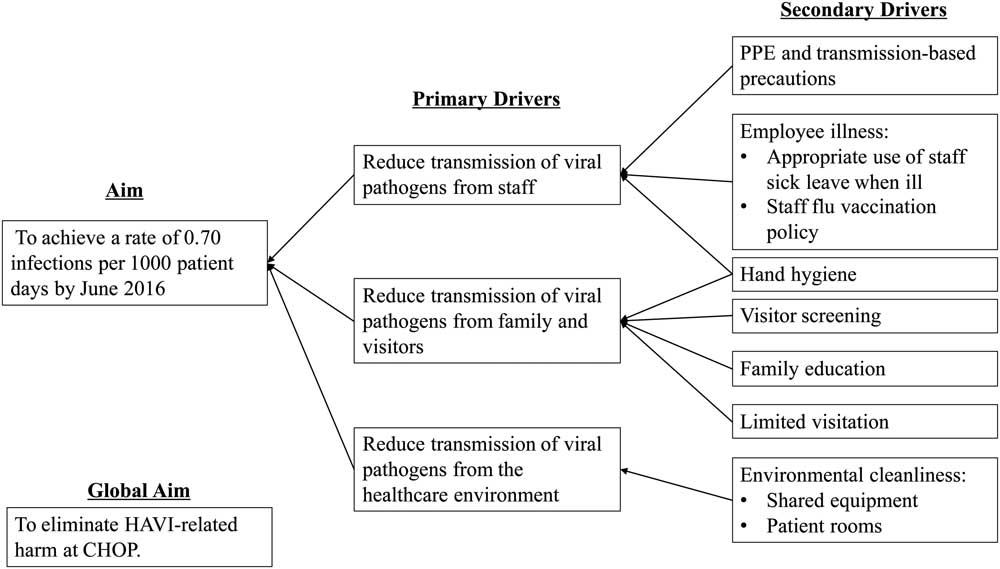
A group charter was developed to set the scope and goals of the project, and a driver diagram (Figure 1) was created to outline the causes of HAVIs and to guide the team’s improvement process over time. Utilizing the Institute for Healthcare Improvement’s Plan, Do, Study, Act (PDSA) methodology,Reference Langley, Moen, Nolan, Nolan, Norman and Provost 21 members were responsible for planning interventions, monitoring progress, and identifying barriers or challenges.
Key driver diagram. A key driver diagram was utilized to demonstrate change concepts. Primary drivers were identified as having significant potential impact on the aim; secondary drivers as having potential impact on primary drivers.

Timeline of interventions
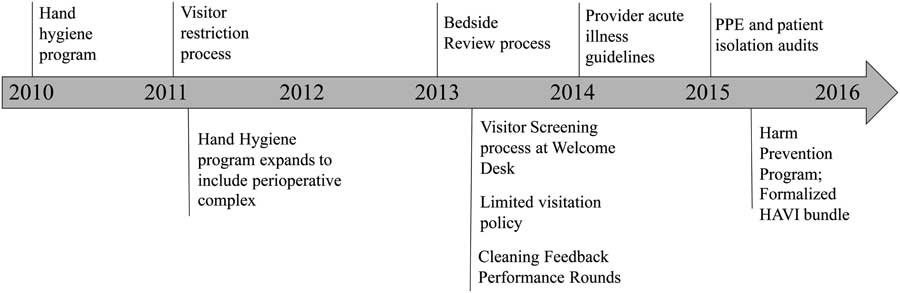
Using PDSA cycles, key interventions were designed and implemented at both at the unit level and hospital-wide across all inpatient areas (Figure 2).
Timeline. Bundle element implementation over time.

Hand hygiene
A hand hygiene observation program was developed in 2010 and expanded in 2011 to additional procedural areas including the perioperative complex. Trained observers provided direct feedback to staff who missed hand hygiene moments as defined by the World Health Organization.Reference Sax, Allegranzi, Uckay, Larson, Boyce and Pittet 22 Compliance was reported at both the unit level and the hospital level on a monthly basis. At the time of this analysis, ~1,600 observations are completed per month across 26 units and procedural areas.
Visitor screening
An acute-illness screening process was developed to minimize the risk of pathogen transmission from sick visitors to patients. Visitors were asked by Welcome Desk staff for any signs or symptoms of viral illness within the last 48 hours, including fever, cough, vomiting, and/or diarrhea. Healthy visitors received a sticker to indicate that they had been screened; visitors who reported symptoms were counseled not to return until symptoms resolved. This practice occurred year-round, 24 hours a day, at all points of access to the inpatient facility. Additionally, inpatient clerks, nursing, and ancillary staff were educated to perform on-unit visitor screening if a visitor had not been screened for illness upon hospital entry. Staff utilized a scripted tool to complete this screening (see Appendix B).
Limited visitation
A limited visitation procedure was developed to address the higher community burden of both symptomatic and asymptomatic viral illness during the winter. Through iterative PDSA cycles, this procedure was refined by January 2013 to limit visitation to healthy siblings plus 4 healthy adult visitors per admitted patient throughout the winter viral season (beginning December 1). “Limited visitors” were designated by the parent/legal guardian upon admission and were entered in the patient’s EHR. Limited visitation remained in effect until the end of viral season (typically March 31), with total duration subject to review by the hospital epidemiologist. Bedside clinicians were encouraged to emphasize the importance of limiting visitors with patients and families.
Learning from events
To promote responsive learning from HAVIs, a bedside review process was developed in 2013. After confirmation by IP&C, a multidisciplinary team comprised of nurses, physicians, IPs, QI advisors, and ancillary staff used a structured questionnaire to identify potential causes of infection (Appendix C). Bedside review themes were tracked over time and were used to target improvement opportunities.
Employee illness
Knowing that clinicians are reported to work while sick,Reference Jena, Baldwin, Daugherty, Meltzer and Arora 23 , Reference Mitchell and Vayalumkal 24 we sought to address this challenge. In 2012, presenteeism guidelines were clarified in the hospital’s Human Resources sick leave policy and were enforced for nursing staff. Thus, new efforts were focused on physicians and advanced practice providers (APPs). Internal survey findings indicated that >80% of physicians and APPs reported working while sick.Reference Szymczak, Smathers, Hoegg, Klieger, Coffin and Sammons 25 In response, the team developed and implemented acute-illness guidelines within the Department of Pediatrics and the APP group. Guidelines included an identified key contact per division who could be called when a provider was sick, thereby removing the sick provider’s need to arrange coverage. Another guideline specified that acute absences <2 days should be excused without a need to make up time.
Appropriate use of personal protective equipment (PPE)
Audits of PPE were historically performed on each unit to assess appropriate donning and doffing practices as well as correct usage of PPE as indicated by patient-specific transmission-based precautions (ie, droplet and/or contact precautions). Audit findings were reported at monthly HAVI Prevention Committee meetings; in 2015, data collection was formally transitioned to IP&C staff to increase data reliability.
Direct feedback was provided to healthcare workers in the moment and/or reported to unit leadership for follow-up. The IP&C staff also audited appropriate application of isolation procedures by comparing documentation in the EHR to compliance with display of the corresponding isolation sign on a patient’s door.
Improving environmental cleanliness
Regular quality control checks using adenosine triphosphate testing of high-touch areas were implemented to monitor environmental cleanliness over time.Reference Boyce, Havill, Dumigan, Golebiewski, Balogun and Rizvani 26 – Reference Huang, Chen and Chen 28 Testing was performed during cleaning performance feedback rounds, and any deficient items were remediated immediately. All data collected were tracked longitudinally to identify themes and to allow the team to target specific local-level interventions. Accumulation of patient and family belongings was identified as a barrier to effective environmental cleaning, especially for patients with prolonged lengths of stay (>14 days). In partnership with Environmental Services and our Family Advisory Board, the team developed a process for terminal room cleaning every 14 days for long-stay patients. Patient belongings were consolidated, and rooms were thoroughly cleaned as if the patient had been discharged. Families were also educated upon admission around the importance of room tidiness and cleanliness.
Comprehensive HAVI bundle
In 2015, harm prevention efforts, including those to reduce HAI and other healthcare-associated conditions, were centralized under a global Harm Prevention Program to further standardize the improvement approach across the hospital. Thus, HAVI prevention was included in this umbrella program.
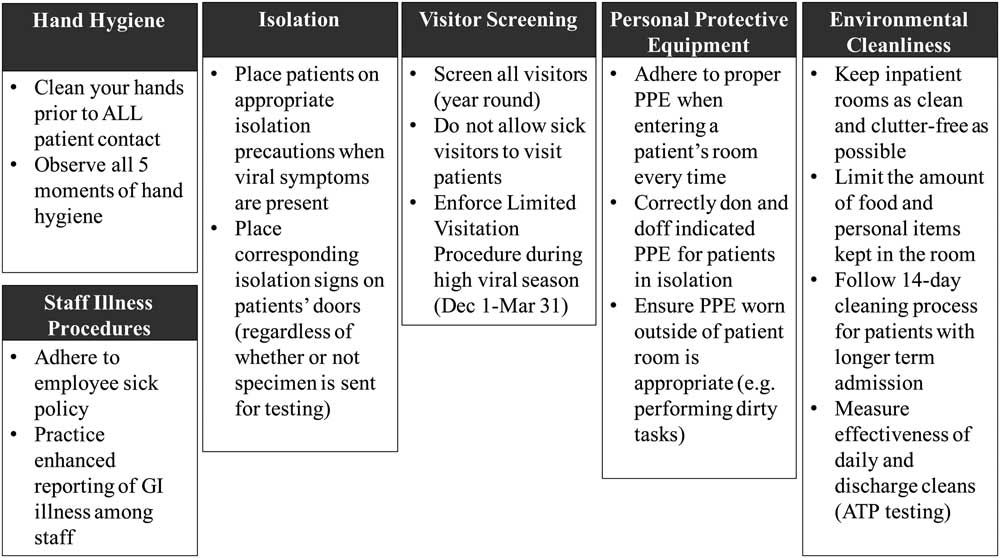
One of the first actions of the Harm Prevention Program was to formalize the use of standard prevention practices, or “bundles,” across the hospital. Unlike many of the other harm indicators, HAVI did not have any national benchmarking nor an evidence-based bundle described in the literature. The HAVI Prevention Team’s work over the preceding 5 years had already established a set of best practices that were in place hospital-wide. In July 2015, these practices were codified as a “HAVI Prevention Bundle” and brought under the Harm Prevention Program umbrella. The 6 elements included in the bundle are displayed in Figure 3.
Healthcare-Associated viral infection (HAVI) prevention bundle. Elements of the HAVI bundle, codified in 2015.

Assessing the intervention
Outcome measures
The primary outcome measure was the overall hospital HAVI rate, defined as the number of HAVIs per 1,000 patient days. Our goal was to reduce the hospital’s HAVI rate to less than 0.70 infections per 1,000 patient days by the end of fiscal year 2016 (June 2016). This goal was set to provide an achievable improvement from hospital performance over previous years. An SPC u-chart was used to plot the HAVI rate between July 2012 and June 2016. A baseline period of 20 months was used to calculate the initial centerline and upper and lower control limits. Established rules for setting a baseline period and identifying special cause variation were applied.Reference Wheeler and Chambers 29 , Reference Provost and Murray 30 In addition, nonparametric trend analyses on outcome measures by fiscal year were performed with STATA SE 12.1. 31
Process measures
Process measures were defined and collected for 5 of the 6 HAVI bundle elements after the HAVI Prevention Committee formed in 2010. However, a centralized data repository and reporting structure was not established until 2012. Audits were performed on each inpatient unit by trained evaluators through a combination of direct observations and chart review. Process measure data were collected using standardized surveys designed using REDCap.Reference Harris, Taylor, Thielke, Payne, Gonzalez and Conde 32
Results
Epidemiology of HAVI events and impact of the QI initiative
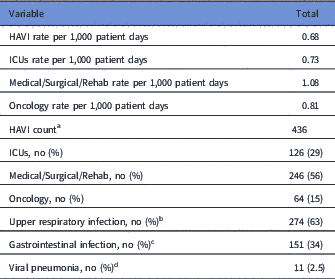
In the 4-year surveillance period, the mean monthly HAVI rate was 0.68 infections per 1,000 patient days (range: 0.22–1.60). Of the 436 HAVIs identified, 63% were URIs, 34% were gastrointestinal, and 2.5% were viral pneumonias (Table 2). The most frequent pathogens were rhinovirus (n=171) and norovirus (n=83). One-third of all HAVIs occurred in intensive care units (ICUs); however, the average annual rate of HAVI was lower in ICUs (0.73) than in the oncology (1.08) and medical-surgical (0.81) units.
Frequency and Patient Location of Healthcare-Associated Viral Infections (HAVIs), July 2012 to June 2016

NOTE. ICU, intensive care unit.
a HAVI Count includes polymicrobial infections.
b Upper Respiratory infections caused by rhinovirus (n=168), respiratory syncytial virus (rsv, n=33), parainfluenza (n=28), influenza (n=28), adenovirus (n=21), human metapneumovirus (n= 12), and enterovirus (n=1).
c Gastrointestinal infections caused by norovirus (n=83), rotavirus (n=34), astrovirus (n=17), adenovirus (n=16), sapovirus (n=10).
d Viral Pneumonia Infections caused by RSV (n=5), parainfluenza (n=3), rhinovirus (n=3), influenza (n=1), adenovirus (n=1), human metapneumovirus (n=1).
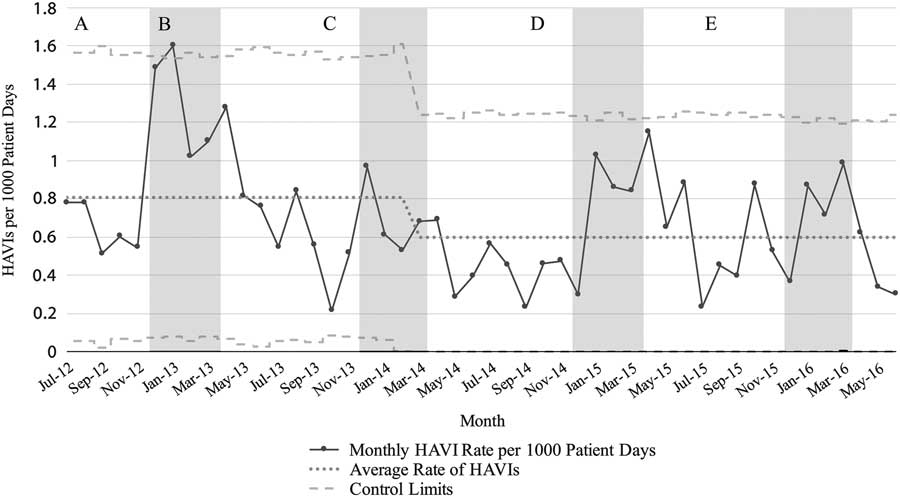
A centerline shift occurred in March 2014, as indicated by a run of 10 consecutive points below the baseline mean. The monthly average reduced from 0.81 infections per 1,000 patient days to 0.60 infections per 1,000 patient days (Figure 4). Additional nonparametric testing also demonstrated a statistically significant reduction in rate (P=.026). Hand hygiene (P=.001) and visitor screening (P<.001) compliance were both shown to increase over time (Appendix D); robust process metric data collection for other bundle elements did not begin until 2015.
Statistical process control chart. Standard infection control measures were in place prior to 2012; control chart annotated with milestones in the bundle refinement process. Areas shaded indicate peak viral seasons. (A) Personal protection equipment (PPE) audits are reported at the healthcare-acquired viral infection (HAVI) committee. (B) Limited visitation and bedside reviews begin. (C) Cleaning feedback performance rounds begin. (D) Provider acute-illness guidelines are developed and implemented. (E) Harm Prevention Program forms and formalized HAVI bundle is developed.

Patient characteristics and outcomes
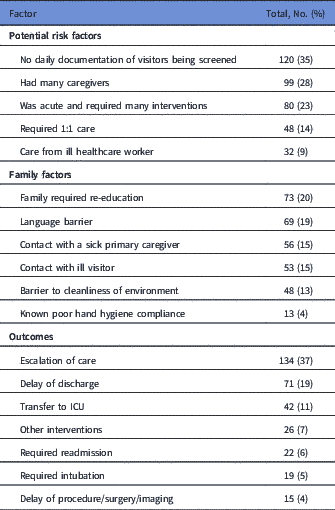
The median patient age was 1.5 years (interquartile range [IQR], 7 months to 4.8 years). The median length of stay prior to infection was 22 days (IQR, 10–71 days). Of the 436 infections included in this analysis, 369 underwent bedside reviews (85% completion rate). One-third of all bedside reviews reported a lack of daily documentation of visitor screening (Table 3). Contact with a sick primary caregiver was observed in 15% of reviews, and contact with a sick visitor was also observed in 15% of reviews. Care performed by sick healthcare workers within 4 days prior to illness onset was identified in 9% of reviews. Patient outcomes included escalation of care (37%), transfer to ICU (11%), delayed discharge (19%), and readmission (6%). See Appendix C for operational definitions of risk factors.
Bedside Review–Identified Exposure Factors and Outcomes, January 2013 to June 2016 (n=369)

NOTE. ICU, intensive care unit.
Discussion
We developed and implemented a comprehensive HAVI prevention bundle, and we investigated the epidemiology of HAVIs in a quaternary-care children’s hospital. Our QI initiative found that the iterative addition and refinement of targeted prevention practices was associated with a statistically significant reduction in HAVI at our hospital by 2014. This standardized HAVI prevention bundle applies to the prevention of viral illnesses regardless of virus type or mode of transmission. To our knowledge, this is the first comprehensive HAVI bundle described in the literature and has implications for ongoing improvement efforts aimed at reducing pediatric viral infections.
Most of the HAVIs identified were URIs, and these results align with those in other published reports.Reference Spaeder and Fackler 9 , Reference Weedon, Rupp and Heffron 10 , Reference Milstone, Perl and Valsamakis 16 , Reference Quach, Shah and Rubin 17 However, ~33% of HAVI were gastrointestinal (primarily norovirus). In addition, HAVIs were identified year-round and across ICU and medical/surgical units, underscoring the importance of a comprehensive prevention bundle aimed at reducing spread of both respiratory and gastrointestinal viral infections throughout the year.
Systematic event reviews provided important details about potential HAVI exposures and helped to identify opportunities for targeted interventions. Efforts to limit visitors or screen visitors for illness are typically described in response to viral outbreaks.Reference Hall, Weinberg and Blumkin 2 , Reference Weedon, Rupp and Heffron 10 , Reference Quach, Shah and Rubin 17 , Reference Banach, Bearman, Morgan and Munoz-Price 33 , Reference Munoz-Price, Banach and Bearman 34 However, our data illustrate the importance of year-round visitor screening in comprehensive efforts to reduce HAVIs. Exposure to sick primary caregivers, visitors, or healthcare workers was observed in ~33% of all HAVI reviews. While we are unable to infer causality from these data, our findings highlight important opportunities for systems-level interventions around visitor screening practices and employee sick policies to reduce transmission potential. Our future directions include conducting a prospective study to identify independent factors that are associated with an increased risk of acquiring a HAVI during hospitalization.
Like others,Reference Valentini, Ianiro and Di Bartolo 4 – Reference Fisher, Danziger-Isakov and Sweet 8 , Reference Yi, Sederdahl and Wahl 11 , Reference Simon, Muller and Khurana 12 we observed that patients with HAVIs often experienced adverse outcomes, including escalation of respiratory support, delayed discharge, and transfer to ICU. Nevertheless, there remains a lack of awareness and urgency around the potential severity of HAVIs in the pediatric setting, suggesting the need for additional efforts to emphasize these adverse events similarly to other well-established patient safety initiatives. While the implementation of bundled interventions to reduce pediatric HAI, particularly device-related infections, are well described,Reference Edwards, Herzig and Liu 35 – Reference Davis, Colebaugh and Eithun 37 published data on the prevention of HAVI outside of outbreaks are limited.Reference Mitchell, Meredith, Richardson, Greengross and Smith 38 Our HAVI prevention bundle provides a framework for systemwide, unit-level, and patient-level interventions that can be applied year-round across all inpatient areas.
As part of our efforts to reduce the HAVI rate, we utilized multiple PDSA cycles to improve compliance with each bundle element. We have sustained improvement in hand hygiene and visitor screening compliance (Appendix D) following formalization of the HAVI bundle. More recent work has included the development of formal auditing processes to track compliance around the other bundle elements (insufficient data to show at this time). Our continued efforts focus on the quality of these interventions, utilizing a data-driven approach to target improvement work. We believe that sustained application of the bundle and efforts to increase compliance will result in further reduction of our hospital’s overall HAVI rate.
Our study has several limitations. The seasonality of many viral infections as well as variable community burden may influence HAVI rates annually. In addition, our outcome measure is dependent upon the application of surveillance definitions, which may exclude clinically significant infections or asymptomatic cases, potentially leading to an artificially lower HAVI rate. However, NHSN definitions were applied consistently across the duration of the study period. From 2012 to 2016, NHSN definitions for URI and gastroenteritis underwent minimal changes regarding hypothermia in infants <1 year old and acceptable specimens. The largest definition change was the removal of lower respiratory infection in 2014, which was excluded from this QI analysis. Also, HAVI identification relies upon clinicians’ decisions to perform viral testing and is sometimes regarded as an unnecessary cost with little clinical impact, which may have limited our ability to identify all pediatric HAVI. However, during this QI initiative, our respiratory and GI viral panels expanded, which may have increased our overall HAVI rate from year to year.
Hospitalized children are at risk for HAVI, yet little is known about pediatric HAVI or its prevention. By elevating HAVI prevention in our organization and by embedding a series of standard practices, we were successful in reducing rates of HAVI over time. Our initiative provides an important framework for both patient and systems-level interventions that can be applied year-round and across inpatient areas. Future studies should include prospective evaluation of pediatric HAVI to identify additional modifiable risk factors.
Supplementary materials
To view supplementary material for this article, please visit https://doi.org/10.1017/ice.2018.149
Acknowledgments
We would like to recognize previous HAVI Prevention Team leaders Christine Correale, Janine Cockerham, Stephanie Powell, Cara Jefferies, and Terrel Falligan; members of the Office of Safety and Medical Operations Cheryl Gebeline-Myers, Cindy Hoegg, and Kimberly Wilson; and members of the Infectious Diseases Diagnostics laboratory for all their efforts and support of this project. We would also like to extend gratitude to bedside staff at CHOP for their diligent application of the HAVI bundle and for their tireless efforts to keep our patients safe.
Financial support
Drs Sammons and Coffin have received support through a CDC Cooperative Agreement (FOA#CK16-004) with the Epicenters for the Prevention of Healthcare Associated Infections. The other authors have no financial relationships to disclose. This project was completed with no specific source of funding.
Potential conflicts of interest
All authors report no conflicts of interest relevant to this article.