Introduction
Non-verbal signals are of great importance for social interactions. Among these, facial expressions play a major role in communication (Frith, Reference Frith2009). Even unconscious perceptions of facial emotional expressions lead to behavioral and emotional contagion in the observer. These perceptions can act as one very basal mechanism for inferring the mental states of others (Dimberg et al. Reference Dimberg, Thunberg and Elmehed2000; Frith, Reference Frith2009). Adequate perception of the emotional and mental states of others in addition to the expression of one's own emotions contributes to successful social interactions and consequently to the quality of interpersonal relationships.
Disturbances in social interactional behavior are characteristic of various mental disorders and are highly relevant for borderline personality disorder (BPD), which is characterized by a pervasive pattern of unstable interpersonal relationships. BPD is a severe mental disorder and heavily impairs affected individuals in multiple domains (e.g. Zanarini et al. Reference Zanarini, Frankenburg, Hennen, Reich and Silk2005). The symptoms of the disorder are grouped into three clusters: affective dysregulation, impulsivity, and the described disturbed relatedness (Sanislow et al. Reference Sanislow, Morey, Grilo, Gunderson, Shea, Skodol, Stout, Zanarini and McGlashan2002).
Affective dysregulation and impulsivity have been identified repeatedly as phenotypic traits of BPD in longitudinal studies (Zanarini et al. Reference Zanarini, Frankenburg, Hennen, Reich and Silk2005), behavioral experiment and brain imaging studies (Domes et al. Reference Domes, Schulze and Herpertz2009). Although the interactional style of BPD has been suggested to be the best discriminator for diagnosis (Gunderson, Reference Gunderson2007), disturbed relatedness in BPD has been analyzed only in a limited number of studies so far (Hill et al. Reference Hill, Pilkonis, Morse, Feske, Reynolds, Hope, Charest and Broyden2008; King-Casas et al. Reference King-Casas, Sharp, Lomax-Bream, Lohrenz, Fonagy and Montague2008; Seres et al. Reference Seres, Unoka and Keri2009; Preissler et al. Reference Preissler, Dziobek, Ritter, Heekeren and Roepke2010; Ruocco et al. Reference Ruocco, Medaglia, Tinker, Ayaz, Forman, Newman, Williams, Hillary, Platek, Onaral and Chute2010).
Referring to facial emotional expression and recognition of facial emotional expressions, empirical studies in BPD research to date have mainly focused on conscious recognition of emotional expressions in faces (e.g. by using static images, such as Ekman faces or morphing pictures; Lynch et al. Reference Lynch, Rosenthal, Kosson, Cheavens, Lejuez and Blair2006; Domes et al. Reference Domes, Czieschnek, Weidler, Berger, Fast and Herpertz2008). The results of these studies are not entirely consistent; in some studies patients with BPD were able to identify emotional facial expressions correctly, at times even more accurately than healthy controls (Wagner & Linehan, Reference Wagner and Linehan1999; Lynch et al. Reference Lynch, Rosenthal, Kosson, Cheavens, Lejuez and Blair2006). In one study, neutral facial expressions were interpreted more negatively (Wagner & Linehan, Reference Wagner and Linehan1999). In another study, Domes et al. (Reference Domes, Czieschnek, Weidler, Berger, Fast and Herpertz2008) examined the ratings of pictures of faces displaying two basic emotions at the same time (i.e. a blend), morphing from one emotion to the other. BPD patients showed a bias toward the perception of anger (Domes et al. Reference Domes, Czieschnek, Weidler, Berger, Fast and Herpertz2008). The authors interpreted these results as an anticipation of rejection in social situations. Furthermore, patients with BPD showed increased error rates in facial emotional recognition tasks when more complex situations were applied, for example by setting time limits for recognizing emotions in faces (Dyck et al. Reference Dyck, Habel, Slodczyk, Schlummer, Backes, Schneider and Reske2009) or with additional prosodic information (Minzenberg et al. Reference Minzenberg, Poole and Vinogradov2006). Taken together, patients with BPD demonstrated an impaired recognition only when ecologically more complex tasks were used, and they showed a bias for perceiving ambiguous expressions as more negative and rejecting.
Compared to facial expression recognition, few empirical studies have examined deviant non-verbal expression in BPD. Flury et al. (Reference Flury, Ickes and Schweinle2008) assessed empathic accuracy in interacting dyads. Their results indicated that thoughts and feelings of students with high BPD features are more difficult to infer compared to their counterparts with low BPD features. Only two previous studies have examined facial emotional expression in patients with BPD (Herpertz et al. Reference Herpertz, Werth, Lucas, Qunaibi, Schuerkens, Kunert, Freese, Flesch, Mueller-Isberner, Osterheider and Sass2001; Renneberg et al. Reference Renneberg, Heyn, Gebhard and Bachmann2005a). In the first study, male criminal offenders with BPD showed little facial response to pleasant and unpleasant stimuli (Herpertz et al. Reference Herpertz, Werth, Lucas, Qunaibi, Schuerkens, Kunert, Freese, Flesch, Mueller-Isberner, Osterheider and Sass2001). In the second study, frequency and intensity of facial emotional expressions in female patients with BPD were assessed while participants watched film sequences of positive or negative emotional valence (Renneberg et al. Reference Renneberg, Heyn, Gebhard and Bachmann2005a). In line with the results of Herpertz et al. (Reference Herpertz, Werth, Lucas, Qunaibi, Schuerkens, Kunert, Freese, Flesch, Mueller-Isberner, Osterheider and Sass2001), patients with BPD reacted in the same manner as depressed patients with reduced facial activity compared to controls. Both studies point to aberrations in facial emotional reactions in BPD. However, the studies did not assess facial reactions to relevant interpersonal situations such as social exclusion. Social exclusion has been repeatedly shown to induce strong negative emotional reactions (for a review, see Williams, Reference Williams2007).
Consequently, the aim of the present study was to assess facial emotional expressions in response to social inclusion and exclusion and advance the knowledge of non-verbal expression of emotions in BPD. We used an emotionally strong and socially relevant stimulus by applying Cyberball, a well-established paradigm of social exclusion (Williams & Jarvis, Reference Williams and Jarvis2006). To obtain a more complete assessment, subjective emotional responses and the perception of social participation were also examined.
Method
Participants
Thirty-five women with the diagnosis of BPD according to DSM-IV (APA, 2000) criteria and 33 healthy women matched for age and IQ participated in the study. All patients were admitted to an in-patient treatment program for BPD at the Department of Psychiatry, Charité – Universitätsmedizin Berlin, Germany, during which they were consecutively recruited into the study. Prior to hospital admission, all of the women were on a waiting list and none of them were admitted for acute care.
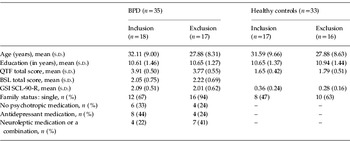
Axis II diagnoses were confirmed with the German version of the Structured Clinical Interview for DSM-IV (SCID-II; First et al. Reference First, Spitzer, Smith, Gibbon and Williams1997; Fydrich et al. Reference Fydrich, Renneberg, Schmitz and Wittchen1997), and Axis I diagnoses were assessed with the German version of the Mini-International Neuropsychiatric Interview (MINI; Sheehan et al. Reference Sheehan, Lecrubier, Sheehan, Amorim, Janavs, Weiller, Hergueta, Baker and Dunbar1998). Exclusion criteria for the patients included acute psychotic symptoms, a history of bipolar disorder, current substance abuse/dependency, mental retardation, and age <18 years. Nineteen BPD patients (54%) fulfilled lifetime diagnostic criteria for a depressive disorder, 13 (37%) of lifetime diagnosis of any substance abuse/dependency, and seven (20%) of current post-traumatic stress disorder (PTSD). Medications for participants with BPD are listed in Table 1. Differences in medication in BPD subgroups in the inclusion and exclusion situation were not significant (all p's>0.23).
Sociodemographic and psychometric characteristics of participants

BPD, Borderline personality disorder; QTF, Questionnaire of Thoughts and Feelings; BSL, Borderline Symptom List; GSI, General Symptom Index; SCL-90-R, Symptom Checklist-90 Revised; s.d., standard deviation.
None of the control participants took psychotropic medication or reported a history of mental disorders. Furthermore, control participants were excluded if they scored above 1 on the Global Severity Index (GSI) of the Symptom Checklist-90 – Revised (SCL-90-R) (see measures). Sociodemographic and clinical characteristics of patients and controls are presented in Table 1. The study was approved by the ethics committee of the Charité – Universitätsmedizin Berlin. All participants provided written informed consent after having received information about the study. Patients were not reimbursed for study participation. Healthy controls were recruited through media advertisements and reimbursed for participation (€15).
Measures
The GSI score of the SCL-90-R was used to assess current subjective experience of general psychopathological symptoms (German version; Franke, Reference Franke1995). Reliability for the GSI has been shown to be very good: Cronbach's α=0.98 (Franke, Reference Franke1995).
The severity of BPD was assessed with the Borderline Symptom List (BSL), a dimensional self-report measure developed specifically to quantify borderline symptomatology (Bohus et al. Reference Bohus, Limberger, Frank, Chapman, Kühler and Stieglitz2007). The scale has high internal consistency (Cronbach's α=0.97), test–retest reliability (r=0.84), and good validity (Bohus et al. Reference Bohus, Limberger, Frank, Chapman, Kühler and Stieglitz2007). The BSL-95 contains a list of 95 subjective complaints and impairments often reported by patients with BPD.
To assess feelings, strategic cognitions and assumptions that are characteristic of BPD, we applied the 34-item self-report inventory Questionnaire of Thoughts and Feelings (QTF; Renneberg et al. Reference Renneberg, Schmidt-Rathjens, Hippin, Backenstrass and Fydrich2005b). Internal consistency of the scale has been shown to be very good: Cronbach's α=0.91. One-week test–retest reliability was also high, r tt=0.81 (Renneberg et al. Reference Renneberg, Schmidt-Rathjens, Hippin, Backenstrass and Fydrich2005b). The QTF has very good discriminant validity (Renneberg et al. Reference Renneberg, Schmidt-Rathjens, Hippin, Backenstrass and Fydrich2005b) and good convergent validity (r QTF/BSL=0.71, p<0.01; Renneberg & Seehausen, Reference Renneberg and Seehausen2010). The QTF total score of participants with BPD in the present sample (mean=3.84, see also Table 1) is similar to scores of other BPD samples (mean between 3.40 and 3.88; Renneberg et al. Reference Renneberg, Schmidt-Rathjens, Hippin, Backenstrass and Fydrich2005b).
To evaluate current emotional state, the Emotion Scale, a 14-item self-report inventory, was applied (Staebler et al. Reference Staebler, Gebhard, Barnett and Renneberg2009). The scale consists of the following items: amusement, affection, contentment, surprise, loneliness, hurt, despair, sadness, fear, contempt, anger, resentment, pride, and boredom. Subjects were asked to indicate on a seven-point scale from 1 (not at all) to 7 (very strongly) how much they were experiencing the feeling at that moment. Three subscales labeled ‘positive emotions’ (highest loadings: affection, amusement, pride), ‘self-focused negative emotions’ (highest loadings: sadness, despair, loneliness), and ‘other-focused negative emotions’ (highest loadings: contempt, resentment, anger) were derived through varimax rotated principal component factor analyses. For the current study, the three factors had eigenvalues >1 and accounted for 63% of the variance of the data in the control group (70% in the BPD group). Cronbach's α for the scales ranged between 0.74 and 0.80 in the control group and between 0.74 and 0.92 in the BPD group.
Stimulus material: Cyberball
Participants played the computer game ‘Cyberball3’ (www.frodis.com/Cyberball). Cyberball (Williams & Jarvis, Reference Williams and Jarvis2006) is a ball-tossing game in which unknown others ostracize individuals in cyberspace by excluding the participant from playing the game (experimental condition). Participants were led to believe that they were logged on simultaneously with two others and were told that to practice their mental visualization skills they would take part in a virtual ball-tossing game. They were asked to imagine the whole tossing situation. In fact, participants were assigned randomly to the ‘exclusion’ or ‘inclusion’ situation and the other players were computer generated. In the inclusion situation, the participant received the ball 33% of the time. In the exclusion situation, participants received the ball four times during the first 10 ball-throws, and after that they were excluded and could only watch the others playing. In each condition the total number of throws was 30. The total playing time including the instructions lasted about 5 min.
Assessment of facial emotional expressions
Facial emotional expressions were analyzed by applying the Emotional Facial Action Coding System (EMFACS; Ekman et al. Reference Ekman, Irwin and Rosenberg1994). EMFACS is based on the Facial Action Coding System (FACS; Ekman et al. Reference Ekman, Friesen and Hager2002b), an objective, standardized and well-established system for coding facial expressions based on the anatomy of facial movements. Each distinguishable visible action of facial muscles is assigned to a single action unit (AU). Thus, facial behavior can be described by 44 AUs, which account for every facial behavior singly or in combination. In comparison to FACS, EMFACS only registers AUs or predefined AU combinations associated with emotions. In a second step, the interpretation of EMFACS coding was carried out by a computer program (originally developed by Friesen in 1988). Thus, facial events can be assigned to specific emotion categories: negative emotional expressions (contempt, disgust, anger, sadness, and fear), positive emotional expressions (unfelt happiness/social smile, felt happiness/Duchenne smile, and surprise), and mixed emotional expressions (blends and masking). The mixture of at least two facial emotional expressions is called a blend. Blends are expressions of two basic emotions of positive, negative or mixed valence. Masking means covering a negative emotion by smiling.
The video material for the present study (recorded by the Sony DCR-DVD105 camcorder) was coded by two certified FACS experts (mean ratio in the FACS final test >0.75 initiated by Ekman et al. Reference Ekman, Friesen and Hager2002a). Raters were unaware of the participant's group membership and of the experimental condition. Ten randomly selected video tapes were analyzed independently by both coders. An overall agreement of 81% was achieved.
Procedure
After completion of the self-report inventories and the Emotion Scale, participants played Cyberball. They were randomly assigned to the inclusion or exclusion condition. In a third step participants were asked to complete the Emotion Scale again. To check whether the manipulation was successful, participants were asked to rate three statements (‘I was excluded’, ‘I was ignored’ and ‘estimated percentage of ball receipt’) on a five-point scale of the Needs-Threat Scale (Williams et al. Reference Williams, Cheung and Choi2000) after they had played Cyberball. While playing the game, the faces of the participants were videotaped. Immediately following the inclusion or exclusion experience, the Emotion Scale was completed once again and participants were debriefed.
Statistical analysis
Videos of four participants could not be included in the analyses for technical reasons. Exploratory analyses revealed that the videotaped sections used for the EMFACS analyses differed significantly in length. It took patients with BPD (mean=119.38 s, s.d.=13.58) longer to play the game than healthy controls (mean=110.50 s, s.d.=5.99, t 43.201=−3.364, p=0.002, Cohen's d=1.20). Thus, we decided to use a fixed time of 1 min 38 s (the shortest playing time) after the tenth ball-throw to analyze facial reactions.
Unless stated otherwise, 2 (group: BPD, healthy controls)×2 (situation: inclusion, exclusion) ANOVAs were conducted. Whenever repeated assessment took place, 2×2 ANOVAs with repeated measures (time: pre/post) were executed. Because of the randomization, participants in the exclusion and inclusion conditions unintentionally tended to differ in age (p=0.071). Therefore, an ANCOVA with age as a covariate was conducted to control for the influence of age. Because the pattern of results did not change, ANOVAs are reported. All analyses were executed using PASW Statistics, version 18.0.1 (SPSS Inc., USA), and the significance level was p<0.05.
Results
Manipulation check
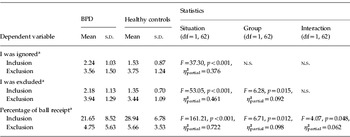
To test whether participants perceived the manipulation as expected, a MANOVA was conducted (see Table 2) using the factors of group (BPD, controls) and situation (inclusion, exclusion). The three ratings of the manipulation check (‘I was excluded’, ‘I was ignored’ and ‘estimated percentage of ball receipt’) served as dependent variables. The results showed a significant main effect of situation (F 3,60=52.85, p<0.001, partial η2=0.725), indicating that exclusion was induced successfully. Furthermore, the overall group effect of the MANOVA was significant (F 3,60=4.217, p=0.009, partial η2=0.174), indicating that perception of participation differed between BPD patients and controls. The situation×group interaction did not reach significance (F 3,60=2.060, p=0.115, partial η2=0.093). Further univariate analyses revealed significant differences between the exclusion and inclusion conditions for ‘percentage of ball tosses received’ and ratings of ‘I was ignored’ and ‘I was excluded’ (see Table 2). Simple effects analysis revealed that the group difference for ‘percentage of ball tosses received’ was significant for the inclusion situation (F 1,62=10.956, p=0.002, partial η2=0.150), indicating a lower percentage rating in the BPD group compared to the control group. This difference was not significant for the exclusion situation (F 1,62=0.159, p=0.691, partial η2=0.003; see Table 2). Participants with BPD reported after the inclusion that they had received the ball 21.65% of the time on average. This answer was also significantly different from the correct answer of 33% (t 17=5.235, p<0.001, Cohen's d=2.468). Of note, these results indicate that patients with BPD felt excluded when they were included objectively.
Manipulation check

BPD, Borderline personality disorder; s.d., standard deviation; n.s., not significant; df, degrees of freedom.
a Manipulation check ratings from the Needs-Threat Scale; situation=inclusion/exclusion.
Subjective emotional responses
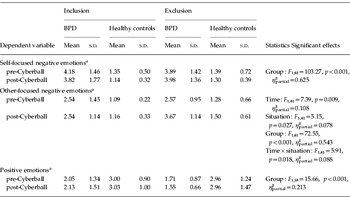
To investigate how emotional state was influenced by inclusion and exclusion, three 2 (time: pre/post)×2 (group: BPD/control)×2 (situation: inclusion/exclusion) mixed-model ANOVAs were conducted with the subscales of the Emotion Scale: ‘self-focused negative emotions’, ‘other-focused negative emotions’ and ‘positive emotions’ as dependent variables (see Table 3). Time (pre/post) served as a within-subjects factor, and situation (inclusion/exclusion) and group (BPD/controls) served as between-subjects factors. A Bonferroni correction was applied for the significance levels of the three ANOVAs (p=0.017).
Analyses of self-reported emotions pre- and post-Cyberball for inclusion and exclusion conditions

BPD, Borderline personality disorder; s.d., standard deviation.
a Subscales of the Emotion Scale.
For the subscale ‘self-focused negative emotions’, a significant main effect for group (F 1,62=103.27, p<0.001, partial η2=0.625) emerged, indicating that BPD patients felt more self-focused negative emotions than controls before (F 1,62=92.56, p<0.001, partial η2=0.559) and after (F 1,62=86.45, p<0.001, partial η2=0.582) playing Cyberball. Neither the main effect for situation nor the interaction was significant for ‘self-focused negative emotions’.
Groups also differed significantly in their experience of ‘other-focused negative emotions’. Here, effects for situation, time, and the interaction of situation×time were significant (see Table 3). Simple effects analysis showed that BPD patients' other-focused negative emotions increased significantly after being excluded (F 1,61=17.084, p<0.001, partial η2=0.219) but control participants' other-focused negative emotions did not (p=0.399).
The BPD group reported significantly fewer positive emotions than controls (F 1,58=15.656, p<0.001, partial η2=0.213) but no significant effect of time, situation, or interaction of time×situation was found for positive emotions.
These results indicate that the exclusion situation mainly influenced the ‘other-focused’ negative emotional state (contempt, resentment, anger) in patients with BPD.
Facial emotional reactions
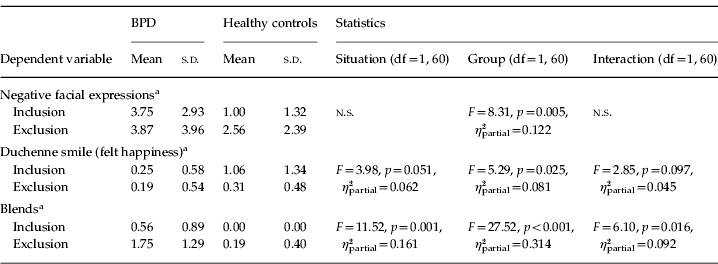
A MANOVA with the three EMFACS categories ‘negative emotional expressions’, ‘positive emotional expressions’ and ‘mixed emotional expressions’ as dependent variables revealed a significant group effect (F 3,58=9.06, p<0.001, partial η2=0.319; see Table 4). Emotional facial expressions also tended to differ between the inclusion and exclusion conditions (F 3,58=2.687, p=0.055, partial η2=0.122). Detailed results for the EMFACS categories are reported below. In the group of BPD patients, neuroleptic medication had no significant effect on EMFACS interpretable events (all p's >0.22). Furthermore, BPD patients with a concurrent diagnosis of depression did not differ from patients without a depressive disorder in their facial emotional reactions (all p's>0.39).
Analyses of emotional facial expressions for inclusion and exclusion conditions
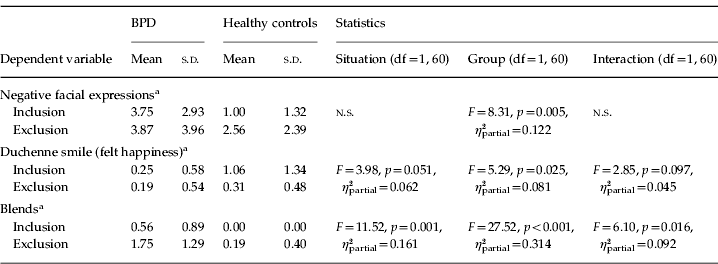
BPD, Borderline personality disorder; s.d., standard deviation; n.s., not significant; df, degrees of freedom.
a Facial emotion expression analyzed applying the Emotional Facial Action Coding System (EMFACS).
Negative facial emotional expressions
BPD patients showed significantly more negative facial emotional expressions than control participants (F 1,60=8.309, p=0.005, partial η2=0.122; see Table 4). Simple effects analyses revealed that neither control participants nor patients with BPD displayed more negative facial expressions while excluded compared to included (controls: F 1,60=2.458, p=0.122, partial η2=0.039; BPD: F 1,60=0.016, p=0.901, partial η2 <0.001).
Positive facial emotional expressions
Control participants showed more positive emotional expressions overall than patients with BPD (F 1,60=12.923, p=0.001, partial η2=0.177). Healthy participants also showed more unfelt happiness/social smile expressions (a subcategory of positive expressions) than the BPD group (F 1,60=10.282, p=0.002, η2=0.146). There was a significant effect of group for felt happiness/Duchenne smile but only a trend was identified for situation and the interaction (see Table 4). Simple effect analyses revealed that control participants displayed significantly more felt happiness/Duchenne smiles during inclusion compared to exclusion (F 1,60=6.782, p=0.012, partial η2=0.102). This was not the case for patients with BPD (p=0.829).
Mixed emotional facial expressions
Overall, patients with BPD displayed more mixed emotional expressions than controls (F 1,60=5.217, p=0.026, η2=0.080; Table 4). All participants showed more mixed facial expressions when excluded (F 1,60=6.516, p=0.013, partial η2=0.098) compared to included. In addition, when excluded, BPD patients showed more mixed facial expressions than controls (F 1,60=4.368, p=0.041, partial η2=0.068); but during inclusion, this effect was not significant (F 1,60=1.300, p=0.259, partial η2=0.021). Furthermore, the group with BPD showed significantly more mixed emotional expressions during exclusion compared to inclusion (F 1,60=5.199, p=0.026, partial η2=0.080).
Mixed emotional expressions consist of blends and masks. In the BPD group, 74% of all mixed expressions were blends whereas in the control group only 18% of mixed expressions were blends (i.e. two emotional expressions displayed at the same time). Regarding these blends, group differences were very prominent (see Table 4). Simple effects analysis revealed that BPD patients showed significantly more blends during exclusion than inclusion (F 1,60=17.190, p<0.001, partial η2=0.223). This effect was not significant for the controls (p=0.515). Compared to healthy controls, BPD patients reacted with significantly more blends to exclusion (F 1,60=29.762, p<0.001, partial η2=0.332) but not to inclusion (F 1,60=3.857, p=0.054, partial η2=0.060).
Discussion
To our knowledge, the present study is the first to assess facial emotional reactions induced by social exclusion in patients with BPD. Two main findings emerged. First, patients with BPD felt excluded when they were included objectively. Second, they showed a higher proportion of mixed facial emotional expressions (especially blends) than control participants in this experimental situation. Blends consist of the expression of two different emotions at the same time. In BPD, blends were especially prominent after social exclusion, but were also present in the inclusion situation compared to healthy controls. By contrast, healthy controls reacted with more positive facial emotion expression in the inclusion situation compared to the exclusion situation. The present results indicate that the non-verbal signs of facial emotion expression induced by social stimuli are deviant in BPD patients compared to controls. This deviance could play an important role in the described disturbed social interactions of patients with BPD.
Perception of exclusion and emotional reaction
In line with previous results (for a review, see Williams, Reference Williams2007), Cyberball induced social exclusion in the present study. Furthermore, by using an independent sample, we replicated our earlier finding that BPD patients perceived themselves to be significantly more excluded than controls (Renneberg et al., unpublished observations). Specifically, BPD patients underestimated the percentage of time they received the ball during the Cyberball game in the inclusion condition, indicating a negative perception of social participation. This result complements previous reports of the bias to perceive facial expressions of others as more negative and rejecting (Domes et al. Reference Domes, Schulze and Herpertz2009). The findings that BPD patients feel more easily excluded despite being objectively included may be a consequence of typical cognitions, as BPD patients describe themselves consistently as vulnerable and unacceptable (Arntz et al. Reference Arntz, Dietzel and Dreessen1999; Renneberg et al. Reference Renneberg, Schmidt-Rathjens, Hippin, Backenstrass and Fydrich2005b).
In contrast to other studies applying the Cyberball paradigm, we assessed subjective emotional reactions before and after playing the game to account for the overall heightened level of self-reported negative affect in BPD. In line with previous findings of more unpleasantly valenced affect in individuals with BPD (Conklin et al. Reference Conklin, Bradley and Westen2006; Russell et al. Reference Russell, Moskowitz, Zuroff, Sookman and Paris2007; Jacob et al. Reference Jacob, Guenzler, Zimmermann, Scheel, Rusch, Leonhart, Nerb and Lieb2008; Staebler et al. Reference Staebler, Gebhard, Barnett and Renneberg2009), our sample of patients with BPD reported higher scores of negative emotions even before starting the Cyberball game compared to controls.
Playing Cyberball did not influence positive and self-focused negative emotions (e.g. sadness, loneliness) in BPD. In the BPD group, the most prominent effect was the increase of other-focused negative emotions (e.g. anger, resentment, contempt) after experiencing exclusion. Social exclusion led more readily to negative emotions toward others in BPD than in control participants (Renneberg et al., unpublished observations) and thus may be an important trigger for anger and impulsive behaviors in interpersonal relationships.
Facial emotional expression
The focus of the present study was to empirically assess non-verbal emotional expressions in BPD, specifically facial emotional expression. Overall, BPD patients showed more negative facial expressions than healthy control participants while playing Cyberball. This finding is somewhat contradictory to our previous results of fewer negative facial expressions in response to film stimuli in BPD patients compared to controls (Renneberg et al. Reference Renneberg, Heyn, Gebhard and Bachmann2005a). The higher personal relevance and a stronger engagement in the social interaction paradigm may account for this discrepancy. Concurring with the notion of disturbed relatedness as a key feature of BPD (Gunderson, Reference Gunderson2007), more personal relevant social stimuli seem to affect patients with BPD more strongly.
Regarding positive emotional expressions, including unfelt happiness expressions and felt happiness expressions (Duchenne smiles), healthy control participants were facially more active than BPD patients. This result was expected and supports previous investigations in which decreased positive facial emotional reaction in response to film stimuli in patients with BPD was found (Renneberg et al. Reference Renneberg, Heyn, Gebhard and Bachmann2005a). In addition, healthy control participants showed more Duchenne smiles when included than when excluded. This reflects the differentiated reactions to the two situations by healthy persons: exclusion leads to reduced frequency of true smiling.
We tested the impact of a co-morbid diagnosis of depression on facial reactions in the present BPD sample. Patients with and without a co-morbid diagnosis of depression did not differ significantly in their facial emotional reactions. This result is in line with a growing body of research indicating that the quality of depressive experience in BPD is different from those experienced in major depression (for a review, see Silk, Reference Silk2010).
Of note, BPD patients had a high percentage of mixed emotional expressions whereas healthy controls displayed almost none. The most prominent result was that, in contrast to the control participants, who displayed almost no blends, patients with BPD reacted with significantly more blends in both situations, but particularly during exclusion. These mixed emotional expressions are a category in EMFACS that is not often referred to, and only a few empirical studies have reported results for blends. In future studies, a more fine-grained analysis of blends in BPD should be undertaken. Nevertheless, we hypothesize that ambiguous facial expressions of patients with BPD could reflect an inconclusive emotional state such as a blend (e.g. sadness and anger expressed at the same time). It has often been stated (e.g. Linehan, Reference Linehan1993) that, because of the invalidating environment they grew up in, patients with BPD have difficulties in appraising, labeling and trusting their own emotional states. In line with this, others have reported pronounced difficulties in the identification of a person's own emotions in BPD patients (Wolff et al. Reference Wolff, Stiglmayr, Bretz, Lammers and Auckenthaler2007). Thus, not only subjective reports but also facial emotional expressions are difficult to interpret by the patients themselves. Furthermore, these mixed emotional expressions are difficult to read and to interpret by others in social interactions. Consequently, these ambiguous emotional expressions, potentially hampering social interactions in general, should be taken into account and, if necessary, they should be explicitly addressed in single and group psychotherapeutic settings.
Limitations
As we did not include a clinical comparison group, conclusions cannot be drawn as to whether these results are specific to BPD patients. Although none of the patients were admitted for acute care, and in-patient treatment of BPD is a common procedure in Germany (Bohus et al. Reference Bohus, Haaf, Stiglmayr, Pohl, Böhme and Linehan2000; Kleindienst et al. Reference Kleindienst, Limberger, Schmahl, Steil, Ebner-Priemer and Bohus2008), our results are limited to in-patients and should be replicated with out-patient samples. As only women with BPD were included, the results are limited to females. Only about one-third of patients with BPD received no psychotropic medication. Although statistical analysis of the influence of medication revealed no significant impact, further analyses are necessary.
Summary
The aim of the present study was an empirical investigation of the subjective responses and emotional facial reactions to a strong social stimulus in BPD patients. The results show that, compared to controls, BPD patients showed a biased perception of inclusion, in the sense that they felt more easily excluded despite a balanced social participation. They furthermore reported an increase of other-focused negative emotions (resentment, anger and contempt) when excluded. Most importantly, they reacted with more mixed facial emotional expressions, especially blends (the expression of at least two emotions at the same time), to social exclusion induced by Cyberball. As ambiguous facial expressions may hamper social interactions, our findings contribute to the understanding of disturbed relatedness in BPD.
Acknowledgments
This research was supported by a stipend to K.S. by the ‘Studienstiftung des Deutschen Volkes’.
Declaration of Interest
None.