Introduction
Personality and bilingualism: an overview
“Do you feel like a different person sometimes when you use your different languages?” Pavlenko (Reference Pavlenko and Pavlenko2006) presented this question to 1039 bilinguals and multilinguals. 65% of participants answered affirmatively: for some of them to speak a language different from their mother tongue (L1) meant to assume a different cultural perspective, and to behave according to the cultural norms of the spoken language. Others perceived L1 as more natural and real, while languages learned later were perceived as artificial and performative. The feeling of higher naturalness of L1 in comparison to languages learned later may be related to a higher mastery of the native language, or to different emotionality perceived when speaking the different languages (Pavlenko, Reference Pavlenko and Pavlenko2006).
A few past studies directly investigated shifts in personality in bilinguals. Ervin (Reference Ervin1964) tested adult French bilinguals employing the Thematic Apperception Test (TAT; Cramer, Reference Cramer2004), a projective test used to investigate individuals’ personality through the analysis of the narratives created from some picture stimuli. Participants were asked to tell TAT stories about the same pictures on two different sessions, one in French and one in English. Content differences in the two languages were found: women presented more achievement themes in English stories, while verbal aggression against peers, autonomy and withdrawal from others were more common in French stories. More recently, Hull (Reference Hull, Slobin, Gerhardt, Kyratzis and Guo1996) administered the California psychological personality inventory (Gough, Reference Gough1956) to Mexican, Chinese and Korean Americans who completed the inventory both in their L1 and in English; results showed different scores depending on the language used. Ramírez-Esparza, Gosling, Benet-Martínez, Potter and Pennebaker (Reference Ramírez-Esparza, Gosling, Benet-Martínez, Potter and Pennebaker2006) assessed Spanish–English bilinguals’ personality in the light of Cultural Frame Switching (CFS; Hong, Morris, Chiu & Benet-Martinez, Reference Hong, Morris, Chiu and Benet-Martinez2000), which refers to the phenomenon of shifting from one cultural identity to another as due to exposure to a cultural cue that may include language. The authors employed the Big Five Inventory, which was administered to participants once in English and once in Spanish. When using English, participants described themselves in a more “American manner”, i.e., as more extraverted, agreeable and conscientious, and less neurotic than when answering in Spanish (Ramírez-Esparza et al., Reference Ramírez-Esparza, Gosling, Benet-Martínez, Potter and Pennebaker2006; see Veltkamp, Recio, Jacobs & Conrad, Reference Veltkamp, Recio, Jacobs and Conrad2013, for similar results on German–Spanish late bilinguals). Also Rosselli, Velez-Uribe and Ardila (Reference Rosselli, Velez-Uribe, Ardila, Ardila, Cieślicka, Heredia and Rosselli2017) found differences in personality traits when personality inventories were administered in Spanish or English to a group of bilinguals; as in the study by Ramírez-Esparza and colleagues, participants to the study of Rosselli et al. scored higher in extraversion, agreeableness and conscientiousness when using English, and higher in neuroticism when using Spanish. In addition, participants scored also higher in openness to experience when answering in English relative to Spanish.
Consistently with the claim that different languages can activate different mental frames, associated with specific cultures, Luna, Ringberg and Peracchio (Reference Luna, Ringberg and Peracchio2008) found that only bicultural bilinguals showed a frame switching, while monocultural bilinguals presented no differences in self-perception across languages. Moreover, Chen and Bond (Reference Chen and Bond2010) investigated personality changes in Hong Kong Chinese–English bilinguals. In this study, participants were perceived, by two Chinese–English bilingual observers, as more extraverted and assertive when speaking in English than in Chinese (with Chinese interviewers) and when conversing with Caucasian interviewers than with Chinese ones. These findings were held to reflect participants’ perceptions of prototypic traits about Chinese and western cultures.
As far as most recent works are concerned, a study by Dewaele (Reference Dewaele2016) – involving 1005 adult bilinguals and multilinguals from the age of 16 – revealed that the perception of feeling different when using different languages is not significantly related to age of language acquisition nor to self-reported proficiency in the foreign language, nor to frequency of use of the foreign language. Bilinguals’ perceptions of feeling different was rather positively related to education levels and age of the participants. Moreover, many participants reporting feeling different when using different languages also reported using their languages in different environments and with different interlocutors. Thus, this study suggested that the contexts in which languages are used may be important in understanding the differences in self-perception that may emerge when using them.
Studies have thus supported the observation that languages can influence bilinguals’ self-concepts (see also Kouwenhoven & Van Mulken, Reference Kouwenhoven, Van Mulken, de Jong, Juffermans, Keijzer and Rasier2012). Cultural factors seem important in personality switching; learning different languages may indeed imply looking at the world in different ways. Nevertheless, other perspectives should also be taken into account, considering language and culture as two distinct dimensions, although interconnected (Zlatev & Blomberg, Reference Zlatev and Blomberg2015). According to the hypothesis of Benjamin Lee Whorf (Whorf, Reference Whorf and Carroll1940), the grammar and semantics of each language contribute to shaping one's ideas, leading to certain ways of thinking and interpreting reality (Deutscher, Reference Deutscher2010). Recent studies have shown that language may actually affect cognition also in bilinguals, for example in domains such as motion perception (Athanasopoulos, Reference Athanasopoulos and Pavlenko2011; Athanasopoulos, Bylund, Montero-Melis, Damjanovic, Schartner, Kibbe, Riches & Thierry, Reference Athanasopoulos, Bylund, Montero-Melis, Damjanovic, Schartner, Kibbe, Riches and Thierry2015).
From another perspective, studies on bilinguals with neuropsychiatric disorders contributed to shedding further light on the bilingual selves. It has been observed that bilingual schizophrenics can manifest different psychotic symptoms depending on the language they speak; e.g., polyglot psychotics can manifest greater psychopathology in their L1 or second language (L2) (Paradis, Reference Paradis2008). According to Paradis, while L1, acquired from birth, is sustained by implicit, procedural memory, a L2 learned later in life is largely related to declarative memory, and requires more conscious control. On the contrary, when both languages are acquired early, implicit linguistic competence for each of them is internalized (Paradis, Reference Paradis2004). Language dissociations in psychoses could be explained by this model, although other factors such as the emotional involvement and the cultural traits connected to languages may also play relevant roles (Paradis, Reference Paradis2008; Ullman, Reference Ullman2004).
The Friulian bilingual context. Linguistic and sociolinguistic aspects of Friulian
In line with the studies mentioned above, the present work further explored the issue concerning personality in bilinguals. This was done both in adults and in children within a peculiar Italian regional context in which a minority language (Friulian) is spoken beside the language of the state (Italian). Friulian is a Rhaeto-Romance language spoken in Friuli (Friuli-Venezia Giulia region), in the north-eastern part of Italy (Benincà & Vanelli, Reference Benincà, Vanelli, Ledgeway and Maiden2016; Fabbro & Crescentini, Reference Fabbro and Crescentini2015; Fabbro & Frau, Reference Fabbro and Frau2001; Mucignat, Reference Mucignat and Mucignat2014; Vicario, Reference Vicario2011). The distance between the Friulian and the Italian languages is similar to the difference between French and Italian; in fact, Friulian is not intelligible by Italian speakers who have never heard it before. Linguistically, Friulian presents some peculiarities. As concerns phonetics, some characteristics of Friulian language are: the presence of a double series of short and long vowels, the palatalization of the velar occlusive consonant before –a (ka > k'a, ga > g'a), and the conservation of the Latin ending –s in plural nouns and in the verbal conjugation of the second personal singular. As far as peculiarities in morphosyntax, Friulian, like other Romance languages covering the area from Northern Italy to France, developed a system of subject clitic pronouns, which are obligatorily required in sentences. As far as lexicon, most of Friulian words comes from Latin. Within this lexicon, some elements are typical of the Latin of Aquileia, which in ancient times was the Latin spoken in Friuli. Other Friulian words have Celtic, German and Slavic origins (the Friuli-Venezia Giulia region borders in fact with Austria and Slovenia).
Several dialects of Friulian are spoken in different areas of Friuli, which are mutually intelligible (Fabbro & Crescentini, Reference Fabbro and Crescentini2015). Until the 1960s, Friulian was the first language for most of the Friulian people; children spoke Friulian at home and learned Italian at school (Fari, Reference Fari2000; Fabbro & Crescentini, Reference Fabbro and Crescentini2015). In the last decades of the twentieth century, Friuli underwent a huge reduction of Friulian speakers; Italian started to be acquired within families, and affirmed through television and media. Nowadays, Friulian is spoken generally by the elderly population, which tends to present low or middle levels of education. It is spoken above all in the mountain, piedmont, hilly and rural areas (Vicario, Reference Vicario2011).
According to a sociolinguistic study carried out in 2014 by the Regional agency for the Friulian language (ARLeF), in collaboration with the University of Udine, regular Friulian speakers in the Friulian-speaking provinces of Udine, Gorizia and Pordenone are 420.000 (57,6%, 25,9% and 21,5% of the population living in these provinces respectively), while occasional Friulian speakers are 180.000 (19,6%, 15% and 18,5% of the population respectively). In the last two decades, different language policy measures have been introduced to encourage the public use of Friulian, aiming to tackle the gradual disappearance of this language and trying to enhance its sociolinguistic status (Vicario, Reference Vicario2011; see the regional Law 15 of the 1996, the Italian state Law 482 of the 1999, and the regional Law 29 of the 2007). Thanks to these policies, an official writing of Friulian language, based on a Friulian variety, has been defined and adopted, and Friulian has been officially recognized as a minority language of the Italian State (together with Sardinian Language). Legislation has thus introduced Friulian in radio and television programs (even if the use of Friulian in radio and television, as well as in printed media, remains limited), as well as in school (the teaching of Friulian language is provided in kindergarten and primary schools), in the public administration and in road signs.
Friulan is primarily a spoken language, while it tends not to be used in writing (when it is informally used in writing, it tends to be written “as it is spoken”, rather than according to the official spelling). This does not mean that Friulian has not a literary tradition. On the contrary, poems written in Friulian date back to the second half of the 14th century. Moreover, many authors, in the last two decades, have published literary works in Friulian.
Nowadays, Friulian is generally spoken in familiar and informal contexts. Italian, on the other hand, is used in reading and writing (Picco, Reference Picco2001), in formal and public communications, and in education in every school order. At this regard, not all teachers know Friulian or are Friulian bilinguals.
Aims of the present investigation
The Friulian context appears interesting for exploring personality in bilinguals. Both Friulian and Italian languages are acquired early in life and employed daily in communication within the same regional cultural context. Participants for the present research were recruited in an area of Friuli called Carnia. Carnia is the Alpine territory in the north of Friuli, where Carnic Friulian, the most conservative Friulian macro-variety, is spoken (Benincà & Vanelli, Reference Benincà, Vanelli, Ledgeway and Maiden2016; Fabbro & Crescentini, Reference Fabbro and Crescentini2015). In Carnia, Friulian is still the first language for most of the population.
The aim of the present study was to further investigate personality in bilingual adults, as done by previous studies, and also to preliminary explore the same issue in bilingual children. A self-report questionnaire was administered to participants in both their languages: Friulian and Italian. In particular, the Temperament and Character Inventory (TCI; Cloninger, Przybeck, Svrakic & Wetzel, Reference Cloninger, Przybeck, Svrakic and Wetzel1994) was chosen in order to assess two distinct components of personality: temperament and character. In the TCI, temperament is defined as a system of (early-acquired) automatic responses (behavioral activation, maintenance or inhibition) to specific classes of stimuli, while character concerns individual differences in higher-order self-concepts, personal goals, and intentional values. Four temperamental traits are described in the TCI: novelty seeking is related to exploratory excitability, impulsiveness, extravagance and disorderliness; persistence encompasses industriousness and resistance to frustration and fatigue; reward dependence refers to sentimentality, attachment and dependence; harm avoidance encompasses anticipatory worry and pessimism, fear of uncertainty, shyness with strangers and fatigability. In the TCI, character comprehends three dimensions: self-directedness (encompassing aspects as self-efficacy, self-esteem, purposefulness), cooperativeness (referring to traits including empathy, compassion and helpfulness) and self-transcendence (involving the dimensions of spirituality and creativity).
As concerns our expectations, we hypothesized that Friulian–Italian bilinguals could show differences in self-perception when assessed in their two languages, maybe likely involving character dimensions (i.e., self-concepts).
Outlining a general profile of people living in Carnia, it is important to refer to an anthropological study carried out by Heady (Reference Heady1999) between the ‘80s and the ‘90s. He observed that people living in this area of Friuli tended to represent themselves as more simple and reserved, less good at talking and less educated, but also more determined, less superficially friendly and more honest than “other Italians”. These self-perceptions may, in fact, reflect real differences between mountain people and people of the plain (Heady, Reference Heady1999). In this respect, in the present exploratory study, we tested whether similar self-representations related to a Carnic (Friulian) identity may also emerge in our sample of adults and children participants. In particular, one possibility is that our participants disclose increased self-directedness and cooperativeness scores when Friulian language is activated with respect to Italian.
Nonetheless, we may need to also take into consideration the possibly different contexts in which Friulian and Italian languages are used. In particular, Italian is the language of education and literacy; thus self-directedness could be higher in participants when using this language with respect to Friulian. In this study, we tried to address these complex issues in both children and adults bilinguals.
Method
Participants
Participants to the present study were Friulian–Italian bilinguals who lived in the Carnic area of Paularo, which is located approximately 10 km from Austria and 40 km from Slovenia. We recruited two groups of bilinguals: a group of adults, who were informed through word of mouth in the Paularo area, and a group of children, who were recruited in the Paularo primary and middle schools. No participant was rewarded or compensated in any way for participating in the study. Participants were asked to write in a form their age, profession, residence, qualification, and any eventual neurologic or psychiatric problem. They were also asked to indicate their languages, specifying which was their first language, the context in which they acquired these languages and how many hours a day they used to speak each language at the time of the research assessment. Adult participants were 25 and resided in Paularo. One male participant was excluded from the study because he was Italian–Slovenian bilingual and Friulian was his third language. The other participants indicated that Friulian was their first language and Italian their second language. One participant indicated that Italian was his first language and Friulian his second language, but he also declared to have acquired Friulian at home and to speak it more often than Italian; this participant was thus not excluded from the analyses. The final group of adult participants was composed of 24 Friulian–Italian bilinguals, 11 males and 13 females (mean age: 34.5 ± 10.93 years, range: 20–55; years of education: 12.91 ± 3.34). Generally, most participants declared to have explicitly acquired Italian at the kindergarten (4 participants) or at primary school (13 participants) (i.e., from 3 or 6 years of age). Four more individuals declared to have acquired Italian both at home and at school while 3 participants indicated they acquired Italian at home. Besides these declarations, it should be noted that it is likely that all participants had implicitly been exposed, to some extent, to Italian in the familiar context before starting school because this language is anyway present in the cultural fabric of Italy (e.g., through television). Overall, our participants were highly proficient in both Friulian and Italian languages. In general, 83.3% of the participants declared to use more the Friulian language (average of 8.94 hours per day, SD = 3.28) than the Italian language in everyday life (average of 3.17 hours per day, SD = 1.90; one participant did not answer).
Young participants were 36 children attending the fifth year of primary school and the first year of middle school in Paularo. The teachers in this specific school context are mainly bilinguals and children generally speak both Friulian and Italian with peers. From the sample, the following were excluded: 6 children for whom Friulian was the second or third language; 2 students who did not complete all the questionnaires, 3 students who had learning disabilities. The final group was thus composed of 25 Friulian–Italian bilinguals, 12 males and 13 females (mean age: 10.84 ± .80 years, range: 10–12), who were highly proficient in both languages. Fifteen participants declared to have acquired Italian at the kindergarten, 6 at home, 2 at primary school, 1 both at home and at school, while one child did not give information. In general, 84% of the participants declared to use more the Friulian language (average of 11 hours per day, SD = 3.08) than the Italian language (average of 4.64 hours per day, SD = 1.70).
Informed consent for research assessment was obtained from adult participants and from the parents of the children. The procedures were approved by the local Ethics of the University of Udine and were in accordance with the Helsinki Declaration guidelines.
Procedure and measures
Both adults and children participants were randomly divided into two subgroups. Half the participants in both groups completed a personality questionnaire (TCI for adults, junior TCI, jTCI, for children) first in Italian and after 2 weeks in Friulian. The other half of participants in both groups were administered the same questionnaire first in Friulian and then in Italian. The adult version of the TCI requires participants to answer “true” or “false” to 240 items, referring to the temperament and character scales described in the introduction. In the present study, the Italian adaptation of the adult TCI was used (Battaglia & Bajo, Reference Battaglia, Bajo and Conti2000; see also Urgesi, Aglioti, Skrap & Fabbro, Reference Urgesi, Aglioti, Skrap and Fabbro2010). Regarding the Friulian version, the TCI was translated independently from Italian by two Friulian–Italian bilinguals; the two versions were then compared and discussed in order to resolve differences in meaning. The resulting Friulian version was finally back-translated into Italian to check the similarity between the original questionnaire and the back-translated one. The fourth author was the administrator. She is a Friulian–Italian bilingual living in the same area as the participants and speaking the same Friulian variety as them (she was also one of the two translators). Adult participants completed the questionnaires individually in their homes while in the presence of the administrator, who read the TCI items one by one to each participant, both in the Friulian and Italian sessions. The participants had to mark with a cross the answer to each question within a paper-based answer grid containing a list of 240 “true-false” answers (Friulian: VÊR/FALS; Italian: VERO/FALSO).
The Junior Temperament and Character Inventory (jTCI; Luby, Svrakic, McCallum, Przybeck & Cloninger, Reference Luby, Svrakic, McCallum, Przybeck and Cloninger1999) comprehends 108 items again mapping to the same temperament and character scales discussed above. As the TCI, the jTCI requires participants to answer “true” or “false”. In the present study, we employed the Italian adaptation provided by Urgesi, Romanò, Fornasari, Brambilla and Fabbro (Reference Urgesi, Romanò, Fornasari, Brambilla and Fabbro2012). The jTCI was translated into Friulian language following the same procedure applied for the adult TCI. Children completed the questionnaires individually at school, within the same hall; the administrator (i.e., the fourth author) read aloud the items to the group of participants, both in the Friulian and Italian sessions, and children answered “true” or “false” to each question using a grid similar to that employed with the adult participants.
With regard to the internal reliability of the TCI and jTCI questionnaires, the persistence scale was associated with low values in both samples (adults and children) and in both versions (Italian and Friulian), with the reliability coefficients (Cronbach's alpha) ranging from .04 (Italian jTCI) to .38 (Italian TCI). Overall, the other six TCI and jTCI scales were associated with better reliability coefficients. For the Italian version of the adult TCI, the coefficients ranged between .77 (self-transcendence) and .90 (cooperativeness) and the mean value for the six scales was .82. Reliability coefficients of the Friulian version of the adult TCI ranged between .69 (reward dependence) and .87 (cooperativeness) and the mean value for the six scales was .75. With regards to the jTCI, the reliability coefficients were in general lower than those referring to the adult versions. For the Italian jTCI, the coefficients ranged between .47 (self-directedness) and .67 (cooperativeness) and the mean value for the six scales was .58. Finally, for the Friulian jTCI, the coefficients ranged between .24 (self-directedness) and .77 (harm-avoidance) and the mean value for the six scales was .51. Overall, the mean values of the reliability coefficients obtained in our sample of children for the two jTCI versions were in line with the normative data reported by Urgesi et al. (Reference Urgesi, Romanò, Fornasari, Brambilla and Fabbro2012) for the Italian version of the jTCI (M = .59, age range: 9/12 years).
Results
To investigate if different self-perceived personalities were associated to Italian and Friulian, adult and children participants’ raw scores were analyzed through t tests for dependent samples, considering the scores obtained by each participant in the two administrations of the TCI and jTCI. Because of the explorative nature of this study, p-value was set at .05 for the seven dependent-sample t-tests executed (the four temperament and the three character scales) for the adult TCI. Nevertheless, we adopted a more conservative threshold (p = .01) to investigate at the subscales level the significant effects obtained at the level of the global scales.
Moreover, considering that the age range of the adult sample was quite large, we also tested whether age could significantly influence results. We performed a median split of the adults’ data to create two groups of 12 individuals: a young adults group (mean age: 25.1 ± 3.34 years, range: 20–33) and an older adults group (mean age: 43.9 ± 6.73 years, range: 34–55). We then tested for both groups of adults the significant effects obtained in the whole group at both the subscale and global TCI levels.
For the jTCI, which does not include subscales, the alpha-level was initially set to .01 in order to avoid alpha-inflation. Age range for children was narrow – hence we did not perform supplemental analyses on this factor. In all analyses, Cohen's d was used as a measure of effect sizes. Effect sizes were considered small (d = .20), medium (d = .50), and large (d = .80).
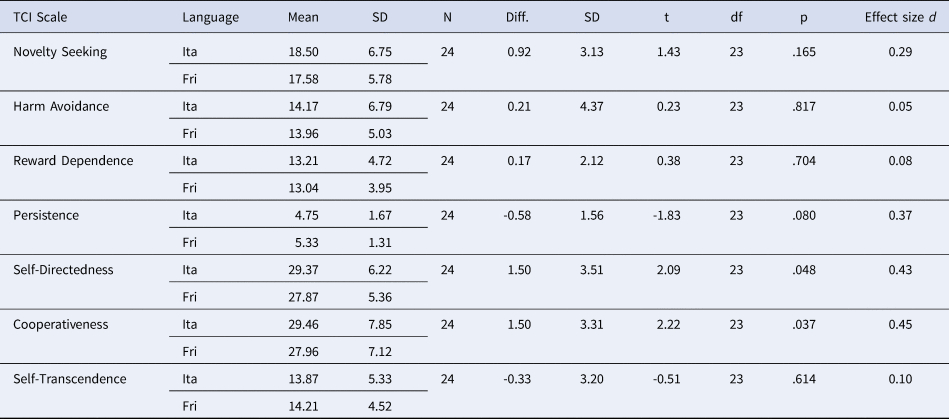
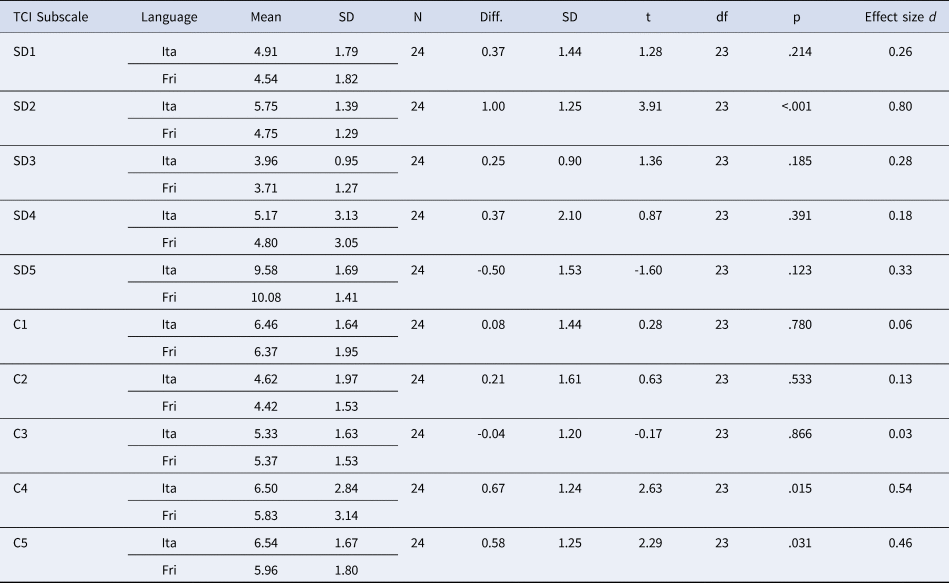
With regards to results, in the adults’ group, statistically significant differences were found for two character scales – namely, self-directedness (SD) and cooperativeness (C) – where participants reported higher scores in Italian vs Friulian (Table 1). These effects elicited close to medium effect sizes. As regards the related subscales (Table 2), a significant difference, associated with a large effect size, was found for a subscale of self-directedness: namely, purposefulness vs lack of goal direction (SD2; p < .001). This subscale describes individuals’ tendency to be goal-oriented and determined. Individuals high on purposefulness are able to achieve long term goals delaying gratifications and having a clear meaning in their lives. No other significant effects were found for the other SD or C subscales.
TCI raw scores in Italian and Friulian: means (SD) and differences (Italian minus Friulian) in bilingual adults.

Notes. Ita = Italian; Fri = Friulian; Diff. = difference.
Self-Directedness (SD) and Cooperativeness (C) subscales raw scores in Italian and Friulian: means (SD) and differences (Italian minus Friulian) in bilingual adults.

Notes. Ita = Italian; Fri = Friulian; Diff. = difference; SD1 = responsibility vs blaming; SD2 = purposefulness vs lack of goal direction; SD3 = resourcefulness vs inertia; SD4 = self-acceptance vs self-striving; SD5 = congruent second nature vs bad habits; C1 = social acceptance vs social intolerance; C2 = empathy vs social disinterest; C3 = helpfulness vs unhelpfulness; C4 = compassion vs revengefulness; C5 = integrated conscience vs self-serving advantage.
Furthermore, the analyses on the two subgroups of adult participants (young adults and older adults) showed that the global effects on the character – and in particular on SD, which appeared to be stronger when the whole group of adult participants was tested in Italian than in Friulian – were due to the subgroup of young adults. Nevertheless, the effect on the SD2 subscale was significant (Italian > Friulian) for both subgroups of adults (Young adults: SD: raw score Italian/Friulian = 28.58 ± 6.81/25.91 ± 5.53, t(11) = 2.34, p = .038; C: raw score Italian/Friulian = 30.33 ± 10.29/28.41 ± 9.26, t(11) = 2.12, p = .056; SD2: raw score Italian/Friulian = 5.83 ± 1.64/5.00 ± 1.27, t(11) = 2.80, p = .017) (Older adults: SD: raw score Italian/Friulian = 30.16 ± 5.74/29.83 ± 4.58, t(11) = 0.42, p = .678; C: raw score Italian/Friulian = 28.58 ± 4.60/27.50 ± 4.44, t(11) = 1.04, p = .316; SD2: raw score Italian/Friulian = 5.66 ± 1.15/4.50 ± 1.31, t(11) = 2.75, p = .018).
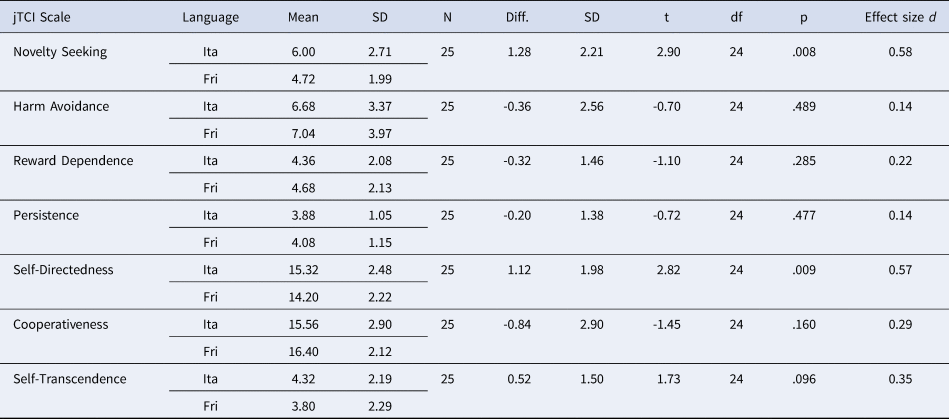
In the children group, significant differences were found for the novelty seeking temperament scale and for the self-directedness character scale; in both scales, children scored higher in Italian vs Friulian. These effects elicited medium effect sizes (Table 3).
jTCI scales raw scores in Italian and Friulian: means (SD) and differences (Italian minus Friulian) in bilingual children.

Notes. Ita = Italian; Fri = Friulian; Diff. = difference.
Discussion
The aim of this study was to investigate changes in self-representation in bilinguals depending on the languages used to describe themselves. This subject was investigated in both Friulian–Italian adults and Friulian–Italian children bilinguals using the age-appropriate versions of the Temperament and Character Inventory (TCI; Cloninger et al., Reference Cloninger, Przybeck, Svrakic and Wetzel1994).
In line with previous studies, our research highlighted differences in bilinguals’ self-representations depending on language. In general, adult participants, and in particular young adults, perceived themselves as more self-reliant, constructive and mature when using the second language: namely, Italian (self-directedness). In particular, in Italian they perceived a higher sense of meaning and purpose in their lives, goal-orientation and determination (i.e., the purposefulness vs lack of goal direction subscale of self-directedness). Moreover, when using Italian, adult participants generally described themselves as more empathetic and forgiving, honest towards the others and guided by fair principles than when using Friulian (cooperativeness).
As regards children, they perceived themselves as more impulsive and transgressive (novelty seeking) and more determined, autonomous and self-confident (self-directedness) when using Italian than Friulian.
Previous studies highlighted the role of culture in personality switching across languages (Chen & Bond, Reference Chen and Bond2010; Luna et al., Reference Luna, Ringberg and Peracchio2008; Ramírez-Esparza et al., Reference Ramírez-Esparza, Gosling, Benet-Martínez, Potter and Pennebaker2006; Veltkamp et al., Reference Veltkamp, Recio, Jacobs and Conrad2013). Regarding the context of our research, we may distinguish between a “local culture” expressed by Friulian and a “general culture” conveyed by Italian, although ‘cultural’ boundaries appear to be fuzzy in the Friuli region where the study was conducted. Furthermore, one-to-one correlation between language and identity is questioned for its monolingual and monocultural bias, “which conceives of individuals as members of homogeneous, uniform, and bounded ethnolinguistic communities” (Pavlenko & Blackledge, Reference Pavlenko, Blackledge, Pavlenko and Blackledge2004, p.5).
In the introduction, we outlined a general psychological profile of people living in Carnia basing on an anthropological study by Heady (Reference Heady1999). The self-description of Friulian people that emerges from the study of Heady, however, does not seem to coincide with the temperament and character features that emerged in our bilingual sample of Friulian–Italian participants. Indeed, our participants felt more determined and self-reliant when answering in Italian, not in Friulian, as one could predict based on the study by Heady (Reference Heady1999). Adults also perceived themselves as more honest in Italian than in Friulian.
Otherwise, one should consider the social contexts in which each language is generally used, supposing that languages can activate networks of meanings, emotions and memories related to these contexts. In this respect, Italian is the language used at school and University and thus conveys semantic knowledge; it is also the language of mass media, and allows individuals to communicate and to get ahead outside the boundaries of the local and familiar community. In fact, Heady (Reference Heady1999) also observes that Italian is the language of the affirmation of individual identity. In the light of these considerations, it may not be surprising that both children and adults – in particular, younger adults – in our study scored higher in self-directedness when presenting themselves in Italian, and higher in novelty seeking (children) than when using Friulian. Moreover, we should bear in mind that participants involved in our study acquired Italian early in life, at home or at school (kindergarten and primary school), where Italian is actively and daily used, in learning, communication and socialization. As we know, age of language acquisition and language exposure, as also context of language acquisition (informal acquisition or formal learning), are relevant factors in language usage since they can also lead to different representations of languages in the memory systems (Consonni, Cafiero, Marin, Tettamanti, Iadanza, Fabbro & Perani, Reference Consonni, Cafiero, Marin, Tettamanti, Iadanza, Fabbro and Perani2013; Fabbro, Reference Fabbro2004; Fabbro & Crescentini, Reference Fabbro and Crescentini2015; Paradis, Reference Paradis2009; Ullman, Reference Ullman2004).
Moreover, as concern the regional Friulian context, it may be possible that the high exposure to Italian during learning at school, but also at work and in the daily use of technological devices (e.g., computers, mobile phones, social networks), contributes to make Italian a more salient language when judging personal experiences relating to specific temperament and, more particularly, character features. In contrast, Friulian could be more likely used in familiar contexts and could thus be more “the language of emotion”. Nevertheless, it should be noted that, in Carnia, not only Italian but also Friulian is quite represented outside the familiar boundaries (e.g., in workplaces, public places). Future studies may shed further light on how personality can shift in bilinguals speaking daily different languages in different contexts.
We finally recognize some limitation in our study that can suggest further directions in this field of research. First, the sample of participants was quite restricted. Therefore, the present results should be replicated in future works with larger samples. Moreover, two limitations concern the instrument that we used to assess personality. First of all, the TCI version used in the current study did not allow for degrees of opinion but forced participants to choose between true or false responses. In this regard, the revised version of the TCI (TCI-R; Fossati, Cloninger, Villa, Borroni, Grazioli, Giarolli, Battaglia & Maffei, Reference Fossati, Cloninger, Villa, Borroni, Grazioli, Giarolli, Battaglia and Maffei2007), which presents a 5-point Likert scale format, could be employed by future research addressing the issue of the relations between personality and bilingualism. Another limitation concerns the reliability of self-report questionnaires, which can depend on individuals’ self-awareness and honesty. When expressing in Friulian, individuals might tend to be more genuine and authentic. Collecting participants’ descriptions about how they usually feel when using their two languages (Pavlenko, Reference Pavlenko and Pavlenko2006), after the administration of the questionnaires, would have helped to better understand the overall data: did participants feel more spontaneous when using Friulian (Heady, Reference Heady1999)? Was Italian perceived as a more artificial language? In other words, could it be possible that participants were more inclined to be truthful when using Friulian than Italian (Dor, Reference Dor2017)?
Furthermore, another question should be investigated: is Friulian perceived as an “inferior” language, with a more uncertain future, in comparison to Italian? An Implicit Association Test (Greenwald & Farnham, Reference Greenwald and Farnham2000) – to implicitly assess self-esteem or prejudice against or in favour of different languages – could shed further light on the origins of the differences disclosed by bilinguals, in crucial aspects of personality and character (such as self-directedness, which the present study has highlighted). This question appears to be quite relevant, especially in regard to those areas in which minority languages, possibly perceived as having a lower sociolinguistic status, seem destined to disappear, replaced by national or global languages.
Our results, together with the mentioned limitations, may suggest further pathways for future research in bilingualism. First of all, still relating with the regional Friulian context, it should be important to study personality in bilinguals in different areas of Friuli, where Friulian is less or differently represented and used than in Carnia; this would allow deepening our knowledge on how social aspects (that are connected with language use) interact with personality and self-representation. Moreover, future studies on personality and bilingualism may focus on other geographical areas of different cultures in which two distinct languages are early acquired and spoken by people in their daily life (for example, English and Welsh in Wales). Such studies may allow to further investigate personality in bilinguals with respect to possibly different social and psychosocial (e.g., emotional) factors. Furthermore, the issue of the relations between personality and bilingualism may also be addressed with respect to different types of bilinguals and bilingualism: for example, comparing groups of early and late bilingual immigrants of different cultures.
Conclusions
Our exploratory research gives continuity to previous studies on personality in bilinguals, and adds further contributions; involving both adult and young bilinguals, it showed that variations in self-representation occur in bilinguals also in middle childhood. Furthermore, it concerned two languages that coexist within the same territory, Italian and Friulian. Similar contexts, in which local languages or dialects are spoken beside the language of the State, are frequent in many countries over the world. Our research suggests that major attention should be placed on such types of bilingualism, which may contribute to shed further light on the effects that cognitive, emotional and socio-cultural factors may have on the verbal self-expression and self-representation of bilinguals.