This article zooms in on and explores the dynamics shaping the revival, as well as the changing spatial organization, of İstanbul’s film industry since the mid-1990s. To achieve this, a path-dependence perspective is used, emphasizing history-friendly theorizing and identifying key events, agents, activities, and choices over time, as well as critical junctures. The analysis conducted reveals the specifics of the roles played by the advertising and television sectors in the revival of the industry. Regarding the industry’s spatial organization, the article shows that, following the dissolution of Yeşilçam (the historical center of İstanbul’s film industry), two new clusters have emerged, one located in the vicinity of the old center (Beyoğlu) and the other in a rising commercial district (Levent).
The existing empirical evidence suggests that the main factors triggering the emergence of clustersFootnote 1 might be diverse, ranging from the presence of “special inputs” in a particular locale to pure “historical accidents.”Footnote 2 Several studies have also emphasized how the beginnings of a geographic cluster can often be traced to an unusually “sophisticated local demand,” to the prior existence of “related industries,” and/or to one or two “innovative companies.”Footnote 3 On the other hand, a recent study focusing on Italian industrial districts has revealed that “the role of ancient craft traditions,” “the existence of certain resource endowments,” and “the role of leader firms, both at the local level (anchor firms) and due to the entry of external firms (MNEs)” are the key triggering factors associated with the genesis of clusters.Footnote 4
We know that, as an economic activity, the film industry tends to be concentrated geographically, and there is a limited but steadily growing literature on the emergence of film clusters.Footnote 5 One recurrent theme in this literature relates to the prominence of sociospatial networks in film industries, which reinforces their tendency to concentrate geographically. According to Storper and Venables, face-to-face contact is important in situations where information is rapidly changing and not easily codified, which are in turn key features of many creative industries.Footnote 6 Several scholars have, on the other hand, also underlined the impact of governments,Footnote 7 transnational corporations,Footnote 8 and technological breakthroughs and other external shocksFootnote 9 on the emergence and subsequent evolution of film clusters. It should also be noted that many studies do, in fact, tend to emphasize the necessity of the simultaneous presence and dynamic interaction of various factors.Footnote 10 This is in line with the stance of the co-evolutionary approach, which was applied to Hollywood by Jones to document the early years of this cluster.Footnote 11
In fact, the debate in the literature as to the specifics of how Hollywood emerged provides interesting insights. It has been argued that the principle reasons moviemakers were initially drawn to the Los Angeles area about one hundred years ago include California’s warmer climate, the diversity in its topography, and certain economic concerns (e.g., inexpensive land).Footnote 12 Given that southern California does not have a monopoly on sunshine and varied landscapes,Footnote 13 however, the explanatory power of such accounts remains rather limited. The path-dependence perspectiveFootnote 14 might be of help in this regard. According to this perspective, we first need to explain how and why a path-dependent process shaped by self-reinforcing sequences emerged in Hollywood rather than elsewhere. In a path-dependent process, three distinct phases are defined: the preformation phase, the formation phase, and the lock-in phase.Footnote 15 Phase I, the preformation phase, is characterized by a broad scope of action, where the choices made cannot be predicted by prior events and “innocent” decisions may set self-reinforcing processes into motion. In turn, the moment of entering into the dynamics of a self-reinforcing process marks a “critical juncture” that ends the preformation phase. Phase II, the formation phase, commences with this critical juncture and reflects the gradual emergence of the path, where the range of options increasingly narrows, thus making it progressively difficult to reverse the initial choice. Finally, in Phase III, the lock-in phase, we see a further constriction, one where the dominant pattern is persistently reproduced, consequently crowding out alternative solutions to such an extent that it gets locked in.
A distinctive literature on “regional” path dependence has flourished when path dependency is situated in a spatial context.Footnote 16 Based on his analysis of Hollywood, Scott illustrates the specifics of how one particular location can start to pull ahead of others, arguing that in order to fully understand how this happens, we need to analyze when and how a simple accumulation of production units begins to manifest signs of an endogenous developmental dynamic, which in turn raises the question of how to best study the process of emergence of a cluster on the ground with the help of the path-dependence perspective.Footnote 17 Since different sequences may produce different outcomes, when an event occurs may be of crucial importance in path dependence.Footnote 18 Attributing such importance to timing in path dependence has two significant implications: first, early events in the sequence are of particular importance inasmuch as they shape the formation phase;Footnote 19 and second, relatively small events, if they occur at the right moment, can have large and enduring consequences.Footnote 20 It follows that historical narrative offers an especially useful method for making sense of path dependence, since, with the aid of a narrative account, “the analyst can provide a scene by scene description of the particular causal paths through which an initial breakpoint leads to a final outcome”.Footnote 21 Equally important are “critical junctures,” which are critical because, once a particular option is chosen, it becomes progressively more difficult to return to the initial point where multiple alternatives were still available.Footnote 22 A thorough analysis of critical junctures should incorporate not only the decisions that were ultimately made, but also those that were considered and ultimately rejected. Studying such near misses is essential, as the outcome that follows a choice at a critical juncture may involve the restoration of the pre-critical juncture status quo, thereby revealing that change is not a necessary element of a critical juncture.Footnote 23 Here, the necessity of a detailed historical analysis is confirmed once again in that, borrowing from Polanyi, “time expands” in critical periods, and “so must our analysis.”Footnote 24
As a final note before proceeding to our analysis of the reemergence of İstanbul’s film sector since the mid-1990s, we need to underline that, in order to fully grasp the workings of path dependence, historical analysis must incorporate not only events, activities, firm capabilities, entrepreneurial careers, and choices over time, but also contextual conditions and institutional dynamics.Footnote 25 Such a co-evolutionary historical perspective in path dependence constitutes the main approach adopted here. To this end, a detailed historical analysis is carried out through examination of archival data and available statistical information on the sector, as well as by conducting in-depth interviews with the sector’s key actors. It should be noted that there is only limited statistical information on the sub-sectors of cultural industries in Turkey in general and the film industry in particular. We have thus compiled our data from the databases of professional associations in the sector, as well as from other sources, such as film journals, so as to produce our own tables, which contain the box office performances and address details of producers for all Turkish movies screened in 1996 (the year marking the start of the new take-off), in 2001 (an interim year), in 2006 (the year the share of Turkish movies in the box office exceeded 50 percent), in 2011 (an interim year), and in 2015 (the latest year for which we have data).Footnote 26
The revival of İstanbul’s film industry since the mid-1990s
Beginning in the 1910s, a condensed zone in and around Yeşilçam Street in the district of Beyoğlu, which was home to several of İstanbul’s very first cinematograph screenings, became the site of an accumulation of several large cinema halls. Over time, it also became the preferred site of producers and other cluster participants as a self-reinforcing dynamic attracted an even further concentration in the locale fed by the presence of established networks, information spillovers, specialized talent, and a whole range of related and supporting industries. Hence, the name of this street, which formed the core of this clustering, came to be synonymous with the Turkish film industry.Footnote 27 Yeşilçam had its golden years in the 1960s and early 1970s, with its popularity even crossing borders into some Middle Eastern countries.Footnote 28 The number of films produced annually, which had been less than a dozen prior to 1947 and averaged 54 in the 1950s, went beyond 200 in the mid-1960s, reaching its peak of 300 in 1972.Footnote 29 The box office figures for this period are sparse and discontinuous, but we do know that the number of spectators at Turkish movies screened in İstanbul was 28 million (vis-à-vis 22.6 million spectators for foreign movies) in 1967, and the total number of annual film spectators nationwide, for local and foreign films combined, reached an impressive 250 million in 1970.Footnote 30 The flourishing film sector in İstanbul would, however, begin to show signs of strain in the early 1970s, with the advent of television in Turkey, which marked the beginning of a long-term process that would ultimately lead to the dissolution of the Yeşilçam cluster. As predicted in the literature, firms remained loyal to their old routines “when confronted by radically different situations that would require adaptability and change.”Footnote 31 Furthermore, the advent of television in Turkey coincided with serious economic turmoil and political violence in the country, which financially and otherwise severely discouraged cinema attendance. What is more, in terms of raw materials and equipment, the industry was dependent on imports, and the profits earned by the industry players in Yeşilçam’s golden years were not invested back into the improvement of infrastructure.Footnote 32 A general lack of government regulation and support for the industry was an additional cause for concern. Under these circumstances, it was difficult for the cluster to recover from external shocks, and the downward spiral of Turkish cinema accelerated dramatically with the eventual near-extermination of local film production by the early 1990s, when the number of Turkish movies reaching screens each year decreased to around a dozen, and in some years even down to single-digit figures, as compared to the three-digit figures of the 1960s and the 1970s.Footnote 33
The industry: the main triggering factors of the revival
While the early 1990s marked the nadir of Turkish film production, the same decade eventually also saw a revival in the film industry, as will be recounted in this section. When considering the main triggering factors of the revival observable in the Turkish film industry in the 1990s, it must first of all be noted that throughout the 1980s the country had been going through a process of substantial economic liberalization. One outcome of this liberalization was the transformation of the culture industry, including the emergence of a booming art scene. As Keyder writes, with the advent of globalization and liberalization, culture industries experienced explosive growth in İstanbul, and “there was also a resurgence of the art scene, well integrated into global networks,”Footnote 34 a development in tune with several other cities around the globe.Footnote 35 The İstanbul Art and Culture Foundation (İstanbul Kültür Sanat Vakfı, İKSV) played a key role in this regard by funding classical music, jazz, theater, and film festivals, as well as art exhibitions and the İstanbul Biennial, and the foundation also acted as a coordinator during İstanbul’s application to the European Capital of Culture Program.Footnote 36
As discussed in the previous section, the path-dependence perspective requires going beyond visible system-wide changes, instead inviting us to dig into the specifics of the process so as to try to uncover the real dynamics; that is, which outcomes of the system-wide changes actually account for the case under study (in this case, the revival of the Turkish film industry). In the following pages, we will zoom in on the mid-1990s in order to do this, and we will observe that system-wide changes impacted the film industry via developments seen in the advertisement and television sectors, as well as with regards to foreign investments.
United States-based distribution networks (i.e., United International Pictures [UIP] and Warner Brothers [WB])—which were able to enter the Turkish market directly in the late 1980s due to a change in local lawsFootnote 37 —noticed not only the potential of television and video channels in Turkey, but also the sporadic box office success achieved by a few US productions—such as The Untouchables (1987, released in Turkey in 1989), Rain Man (1988, released in Turkey in 1989), and Basic Instinct (1992)—which confirmed their confidence about the potential for a profitable market in Turkey. Local producers also managed to obtain sizable returns from a few productions toward the mid-1990s, with one notable example being Amerikalı (The American, 1993). This comedy was produced by Filma-Cass, a company specializing in commercials. The aforementioned economic liberalization, as well as the increasing number of private television channel networks in Turkey at the time, had led to a boom in the advertising sector as well. Filma-Cass, which would become a key player in this boom, had been established in 1981 as an independent commercial film production company, the first of its kind in the country, since prior to this advertising firms in Turkey had typically had in-house commercial film production units. The company was owned and managed by a couple, Ömer and Mine Vargı, with the former having previously worked as an assistant director in Yeşilçam. The specifics of how Amerikalı came to be produced reveal the impact of the advertising sector on the revival of the Turkish film industry in general, and of Filma-Cass and Mine Vargı in particular, as they show how the cash generated, experience accumulated, and networks established, not to mention the direct benefits associated with expertise in marketing and advertising, were all transferred from advertising to film production.
In the early 1980s, at a time when the Turkish film industry had contracted considerably but was still on its feet, Ömer Vargı had accepted an offer from his friend, the renowned film director Şerif Gören,Footnote 38 to embark on making feature films. As a result of this deal, they made a few low-key movies together, but Mine Vargı showed no interest in filmmaking at the time, concentrating instead on commercials. In the year 1991, however, when Şerif Gören knocked at their door again, this time with a script called Amerikalı, Ömer Vargı stated that since he was too busy at the time his wife might instead produce the project if she was interested. Overcoming her initial hesitation and fear of doing “something similar but still different,” as she described it, she decided to give it a try.Footnote 39 She used her experience, competency, and the social and business networks she had established in the advertising sector over the years to finance and produce the movie: “There was a jacuzzi bath scene in the script. I had to find a way to make it happen. Conrad Hilton, a customer of ours in advertising, had a good one. I figured if we showed the hotel in the movie, it would be like an ad for them. I made this offer to them, and they let us use the location for free and provided catering for the crew.”Footnote 40 Mine Vargı managed to convince Warner Brothers, which had until then declined to distribute Turkish films, to distribute Amerikalı, and she arranged sponsors so as to make the film’s première a red-carpet event at the prestigious Emek theater, İstanbul’s largest and most fashionable “movie palace” at the time.Footnote 41
Amerikalı was a surprise success at the box office, attracting about 350,000 spectators, no doubt a modest figure but noteworthy in light of the dismal performances of Turkish films during those years; for comparison, none of the nine Turkish movies released in the previous year had received more than 150,000 spectators. More importantly, Amerikalı illustrated for the first time that a relatively big-budget movie could be profesionally made and promoted in Turkey in the post-Yeşilçam era when the national film business was in stagnation. However, there were some significant departures from Yeşilçam in terms of professional management and mindset. Mine Vargı, for instance, underlined how with Amerikalı they had introduced to the filmmaking sector such professional management practices as budgeting, insurance, and copyrights, all of which they had been applying in their advertisement business. “Differently from Yeşilçam’s producers,” she stated, “we knew that you had to spend money to make money; we knew this from our experience in advertising.”Footnote 42 She also underlined how expectations regarding working conditions differed by giving the example of the catering services provided on the set, which were standard in advertising but a pleasant surprise for those coming from Yeşilçam, who called this new experience “Hollywood-like.” A final point in this regard concerns investments, and this serves as yet another example of the disparities in terms of mindset: “Amerikalı earned well, and we invested what we earned back into the film sector. We established a firm specializing in renting out film equipment and cameras, for example. This was very different from the approach of Yeşilçam’s producers, as we heard they channeled what they earned from filmmaking into unrelated areas like construction for quick profits.”Footnote 43
A few years later, İstanbul Kanatlarımın Altında (1996)—a Eurimages-supported movie that was the first to be produced by the distribution company Umut Sanat—pulled close to half a million spectators, bettering Amerikalı’s performance. More significantly, another Turkish movie released toward the end of the same year, Eşkıya (The Bandit), surprisingly topped the box office with ticket sales eventually surpassing 2.5 million, marking the start of a new boom for İstanbul’s film industry. Mine Vargı of Filma-Cass also served as Eşkıya’s producer. She recollected that the eventual lead actor, Şener Şen, had visited her in 1994 to present her with the film’s script, a melodrama about an ex-bandit who gets out of prison and begins to look for his lost lover. Touched by the script, Vargı decided to produce the movie immediately, though production did not actually begin until the following year, as they could not find the required financing. Vargı had a plan: she would pre-sell the project to a private television channel, Star TV, and finance the film that way. Additional funding was secured from Eurimages and the Ministry of Culture.Footnote 44 Vargı again mobilized her networks to handle this film project. In fact, her reputation in the sector was so good that Warner Brothers agreed to distribute the project without even asking about the subject, and as a result, when they saw the finished product for the first time, WB representatives were initially disappointed that it was not a comedy, as Vargı and Şen’s previous successful collaboration, Amerikalı, had been.
Vargı said, “We wanted everything to be perfect in Eşkıya; we shot the film with sound, we used state-of-the-art editing programs,” which meant that costs increased enormously: “Ömer and I calculated the break-even point one night and were terrified to realize that a break-even was only possible if the film reached 750,000 spectators, which was unheard of [for Turkish movies since the height of the Yeşilçam era decades before],” she remembered, “But we thought about it and decided that we couldn’t give up. In fact, I like the feeling of taking a risk.”Footnote 45 She took another risk when she experimented with exporting the film to European markets, including Germany, which was home to a sizeable migrant Turkish population and attracted around 300,000 spectators.Footnote 46
In path-dependence terms, the immense success of Eşkıya at the box office marked a critical juncture with regard to the reemergence of the industry, triggering a revival of interest in Turkish movies and paving the way for the revitalization of the Turkish film industry.Footnote 47 The number of Turkish films to reach the screen slowly picked up, from nine movies in 1996 to 15 in 2000, and between 1998 and 2000 four Turkish movies each attracted more than one million spectators, with one of them, Kahpe Bizans (2000), even approaching Eşkıya’s record, selling about 2.5 million tickets. This trend was further reinforced by the success of Vizontele (2001), the first feature from the Beşiktaş Cultural Center (Beşiktaş Kültür Merkezi, BKM), a company that had previously concentrated on stage and television productions; the film proved an even bigger box office success than Eşkıya. Necati Akpınar, the film’s producer, said the following about the film’s release:
I […] knew that Eşkıya had drawn almost 2.6 million spectators to movie theaters. I knew that before investing in Vizontele. Thanks to Eşkıya, we saw that there were people out there, millions of them in fact, whom you could attract if you produced a good movie. We produced Vizontele, and they did indeed return to the movie theaters. In that sense, Eşkıya opened the door and Vizontele showed that the door could stay open and that we were not talking about a random success story.Footnote 48
As he saw it, Vizontele—which attracted 3.3 million spectators all told—had such an important impact on the sector that new movie theaters started to open up everywhere, as he explained: “Local cinemas in Anatolia congratulated us, they sent us letters expressing their gratitude, some sent us bottles of champagne!”Footnote 49 As such, the critical importance of Vizontele is twofold: first, mass audiences started to flock to cinemas once again, and even in greater numbers than they had for Eşkıya; and second, the film’s success confirmed and reinforced the message given by Eşkıya to local film producers—namely, that it was possible to make handsome profits by investing in the local film industry.
As is evident from the rationale of BKM’s decision to invest in the film industry in the year 2000, the criticisms in the literatureFootnote 50 concerning an overemphasis on chance events are well founded: “We had been warned at the very beginning when we decided to invest in the stage theater sector. ‘You’ll ruin yourselves,’ everybody said. The exact same thing occurred when we decided to enter into filmmaking. ‘Keep away,’ everybody advised.” But Akpınar also pointed out that one cannot do much if one submits to the limits already in place: “Do we have money? No. So we need to find some money to do what we want to do.” BKM borrowed money from a loan shark, since banks in Turkey refuse to finance risky projects like films: “There wouldn’t be a firm called BKM today if we hadn’t taken this risk,” Akpınar concluded.Footnote 51 BKM, which enjoys the leading position in Turkish cinema to date in terms of annual box office returns, effectively created its own chances, and it appears that, just as theorized in the literature, a triggering event (i.e., the success of Eşkıya) coupled with an entrepreneurial spark did indeed set a certain process in motion in this particular instance.Footnote 52 In relation to this, one should also note the contributions afforded by the television sector in this regard, both financially and otherwise. Specifically, BKM was able to partly finance Vizontele thanks to television revenues generated by BKM productions made specifically for the small screen. Furthermore, the fact that Yılmaz Erdoğan—the star of BKM’s hugely popular television series Bir Demet Tiyatro (1995–1998, 2000–2002)—also starred in, as well as codirecting, Vizontele no doubt contributed to the film’s box office success. To conclude, it can safely be argued that, while the producers of Amerikalı and Eşkıya successfully capitalized on their professional experience, expertise, networks, skills, and the cash generated from the advertising sector,Footnote 53 the producers of Vizontele transferred their experience and cash and spectators from the television sector into the film industry.
An additional, and more general, contribution of the television sector to the film industry was how some popular television series themselves came to be adapted into feature films, as spin-offs, beginning with Deli Yürek: Bumerang Cehennemi (2001). Casting in feature films actors and actresses who have already risen to fame in television series has also become a safe and reliable formula for box office success, one which was, as noted above, started with Yılmaz Erdoğan’s starring role in Vizontele. The contributions of the proliferation of television channels also extended to how such channels served to familiarize younger audiences with the classics of Yeşilçam, how they provided film crews with much needed jobs, how they acted as a major marketing and promotion medium for movies, and how they served to feed the growth pattern in the advertising sector.Footnote 54
Overall, the share of Turkish movies at the box office has steadily improved since the mid-1990s, with the annual total box office receipts of Turkish films surpassing those of foreign movies in 2006—the first time this had happened since 1986. At the same time, it should be noted that a highly disproportional weight of the Turkish cinema’s annual box office success is carried each year by just a few hit movies.Footnote 55 Not only has the market for Turkish movies grown immensely, but cinema attendance in general has also picked up, with annual ticket sales more than doubling in the past ten years alone. Increasing cinema attendance has also been associated with improvements in the theaters themselves. Ferhat Aslan, the Turkish representative of United International Pictures—which was the first American distributor to directly distribute its products in Turkey and which has since remained among the best performing distributors in the Turkish market—emphasized the impact of the increase in the quality of theaters, pointing especially to the newly established shopping malls, most of which house multiplex cinemasFootnote 56 perceived by audiences as much safer and more comfortable.Footnote 57 Aslan also stated that the conditions set out for theaters have also contributed to the rise in the quality of screening venues and, hence, to the rise in cinema attendance: “We ask them to have proper heating facilities if we are planning to launch the movie in the winter, or we warn that we cannot have them screen the movie if they do not have air conditioning, especially if the screening is planned for summertime.”Footnote 58
The place: the reemergence of film clusters in İstanbul
The revival observed in the Turkish film sector since the mid-1990s cannot be considered a rebirth of Yeşilçam. In fact, all that was left of Yeşilçam by the early 1990s was its past glory, as by that time almost all the major and minor companies from the golden years had either gone out of business or stopped production.Footnote 59 In fact, with the exception of Arzu Film, which went back into production in 1997 after a hiatus of almost ten years, most of the agents in the current revival are newcomers to the production scene. What we see today, in other words, is the emergence of an entirely new pattern of clustering, albeit in the same city, and as will be discussed below, this new geography is pointedly not concentrated in and around Yeşilçam Street, but relatively more dispersed around the European part of the metropolis.
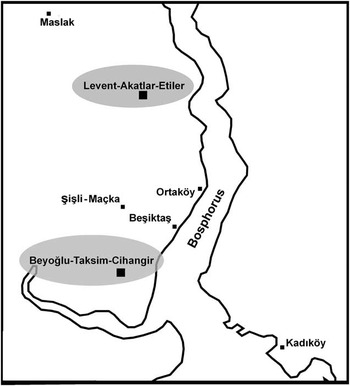
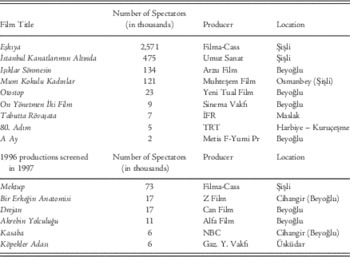
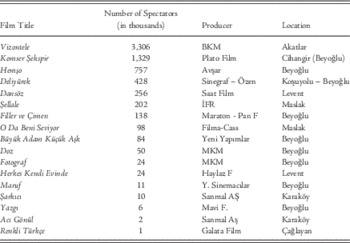
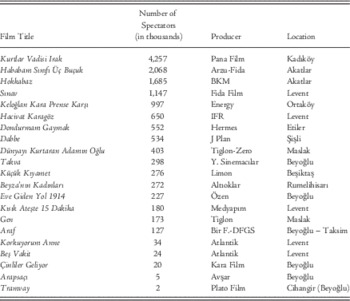
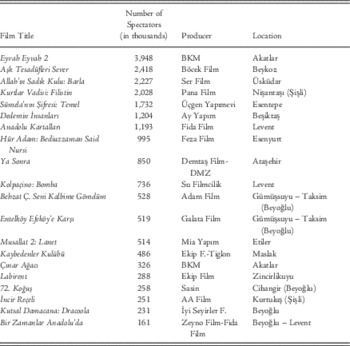
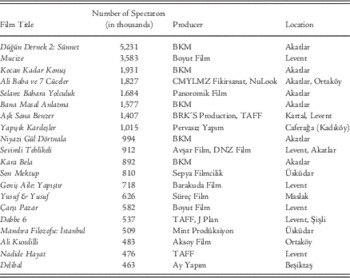
Table 1 provides an overview of the theatrically released Turkish movies produced in 1996. A total of fifteen 1996 films reached the screen, drawing about 3.5 million spectators. As can be seen in the table, about half of the companies that produced these fifteen movies were located, basically, in the Beyoğlu-Cihangir area. Tables documenting the situation in the years 2001, 2006, 2011, and 2015 (Table 2, 3, 4 and 5, respectively), however, show that the Levent-Akatlar area emerges and over time becomes established as another important cluster of filmmaking in İstanbul (see the map in Figure 1).Footnote 60 Importantly, the Levent clusterFootnote 61 hosts those production companies that took up film production from the late 1990s onwards, and in time they emerged as among the new “majors” of Turkish cinema. Those companies located in the Beyoğlu cluster, on the other hand, received on average much lower shares of the box office revenue as compared to the majors in Levent, and, notably, they either have roots in the Yeşilçam era or are new firms producing arthouse and/or independent movies, including several by internationally renowned filmmakers like Nuri Bilge Ceylan. Exceptions, of course, remain, with one example being Plato Film (located in Cihangir-Beyoğlu), which produced Berlin in Berlin (1993, 250,000 spectators) and Komiser Şekspir (2001, 1.3 million spectators).
Trends in location choice during the reemergence era. Source: Map prepared by Yeliz Günel

Turkish movies screened in 1996 and producers’ location choice.

Source: Compiled by the authors
Turkish movies screened in 2001 and producers’ location choice.

Source: Compiled by the authors
Turkish movies screened in 2006 and producers’ location choice.

Source: Compiled by the authors
Turkish movies screened in 2011 and producers’ location choice (top 20).

Source: Compiled by the authors
The increasing importance of the Levent-Akatlar area in terms of hosting the new majors of İstanbul’s film sector is particularly noteworthy. For example, of the top 10 Turkish movies (in terms of number of spectators) screened in 2015 (see Table 5), only one was produced by a company located outside of the Levent cluster—namely, in Kadıköy—whereas four were produced by BKM, which is located in Akatlar, and the remaining five were produced by companies also located in the Levent-Akatlar area (though two were made in partnership with firms located elsewhere; namely, Ortaköy and Kartal).
Turkish movies screened in 2015 and producers’ location choice (top 20).

Source: Compiled by the authors
While production and post-production companies are highly concentrated geographically in the Beyoğlu and Levent clusters, exhibition—the last stage of film business in the production-distribution-exhibition chain—is by its nature (i.e., being the stage where the end product, the film, finally reaches the customer, the spectator) dispersed rather than clustered. Some concentrations, however, are nonetheless observable within the overall dispersion, as the main avenue of Beyoğlu had hosted a significant concentration of cinemas during the Yeşilçam era, even when cinemas proliferated all around the city. In a similar vein, there is a concentration of cinemas observable today in Levent, at a time when cinemas have penetrated even the city’s distant suburbs.
The large-scale film studios and technical equipment rental firms are typically located on the outskirts of the city, mainly due to much lower rents as compared to those in the city center.Footnote 62 A more dispersed pattern is also seen on the distribution end. According to Aslan, UIP’s Turkish representative, “being near the producers is not essential for us since we work with the finished product.”Footnote 63 Other concerns—such as having lower rents, spacious offices, and parking spaces, as well as avoiding traffic jams—seem to be of determining importance for distributors as well, thus making them relatively more dispersed in the city: for example, UIP is in Kozyatağı, WB in Ortaköy, Pinema in Kavacık, and Bir Film in Altunizade. “In this way,” says Aslan, “our employees do not arrive tired, since most of them live here on the Asian side. Besides, you no longer need to have those face-to-face meetings and fancy dinners with producers; that was the old school.”Footnote 64 This pattern confirms Martin’s assertion that in many clusters, even those with a high degree of specialization, there may be a number of activities, each with its own evolutionary path.Footnote 65
The collapse of the historical film cluster in Yeşilçam coincided with an aggressive wave of urban transformation in İstanbul, one which has been on the agenda since the 1980s.Footnote 66 Many of İstanbul’s historic neighborhoods have been subject to extensive urban renewal projects, and Beyoğlu, too, has served as a target of urban transformers. In particular, the enactment of Law No. 5366 on the Conservation of Deteriorating Historic and Cultural Property through Renewal and Reuse (dated 2005 and known as the “Beyoğlu Law”) triggered a series of major urban renewal and regeneration projects.Footnote 67 “Neoliberal dreams” for Beyoğlu have envisaged opening touristic boutique hotels, high-class entertainment locales, and shopping malls in the district.Footnote 68
One result of this “quality upgrading” has been that the residents of the upgraded places, such as those who had made Beyoğlu their home for decades, are now being driven out as a result of such urban renewal projects. İstanbul’s historic film cluster, hosted by Beyoğlu for decades, had already began to dissolve for industry-related reasons outlined above when the final remnants of the Beyoğlu cluster became one of the targets and victims of this aggressive urban transformation aimed at gentrifying the district. A typical example is the project involving the demolition of the historic Emek Cinema theater and the construction of a luxurious shopping mall in its place. As a result, what remains in Beyoğlu from the former glory of the historical film cluster is not much, in relative terms. Even so, it is notable that Beyoğlu somehow managed to continue to host certain film-related businesses following the revival of İstanbul’s film industry, and it has also remained the main venue of İstanbul’s flourishing film festivals, since some of its few remaining cinemas host the larger part of the screenings at these events, even after the demolition of Emek, which used to host the International İstanbul Film Festival organized by İKSV.
The emergence of a new cluster in Levent, a rising commercial district of İstanbul, should be considered in connection with this. Levent is not a historic neighborhood, emerging only in the 1950s as the outcome of a project sponsored by a major bank to build a new residential area of villa-type housing on unpopulated lands on the city’s outskirts. Beginning in the late 1980s, this new high-income neighborhood started to witness the construction of several business centers. Indeed, one might argue that among the main factors explaining why İstanbul’s film industry ultimately reemerged in Levent are its current central location and ease of transportation. Levent is also seen as a prestigious neighborhood, as indicated by Necati Akpınar, who points out that “the reputation you create does matter in this sector.”Footnote 69 From the standpoint of the path-dependence perspective, however, these are all locational factors, and their presence might not be enough to account for the cluster formation, thus echoing the debate surrounding the emergence of Hollywood.Footnote 70 Therefore, we need to explain the emergence of the Levent cluster in terms of why and how self-reinforcing dynamics were instigated in Levent but not in other districts of İstanbul offering similar locational advantages, such as, for example, Kadıköy.
To fully grasp how this happened, we need to take a closer look at the early history of the Levent cluster. When such an analysis is conducted, it turns out that entrepreneurial initiatives were very influential in shaping the emergence of the cluster. As stated above, the box office success of Eşkıya was of crucial importance in triggering the revival of the film sector in the second half of the 1990s. Filma-Cass, the advertising company that produced Eşkıya, was located in Şişli—initially in Kazashan and later in Kocamansur—until the early 2000s, when it moved to Maslak mainly because more space was needed. Although, as stated by Mine Vargı, the advertising sector itself—which had previously been concentrated along the Taksim-Beyoğlu and Osmanbey-Şişli axes—has over time moved toward the Esentepe and Levent districts, it should be noted that, despite the unquestionably key role of Eşkıya and thus Filma-Cass in triggering the industry’s revival, it was in fact BKM, the producer of Vizontele, that pioneered the revival in terms of location; that is, in terms of starting the new cluster formation in Levent. Necati Akpınar describes BKM’s move to Levent as follows:
We were located in Beşiktaş. After the year 2001, after Vizontele, we decided that it might be a good idea to move to a new location that offered more space. As a quiet, professional neighborhood, Levent was a good alternative. We had a friend renting a place there that suited our needs well, and that’s how we moved to Akatlar in 2001. We were the first film production company to move here. In time other film producers followed suit. Now there are quite a number of film production companies located in Levent.Footnote 71
He further stated that two other possibilities were considered in addition to Levent: Cihangir in Beyoğlu and Akaretler in Beşiktaş. The building they found in Akaretler required significant maintenance and renovation, while for Cihangir it was decided that the large space needed was unlikely to be found, in addition to the fact that they saw Cihangir as hosting primarily the creative (writers, actors, actresses, etc.) rather than the production end of the sector. Moreover, as Akpınar has it, “Beyoğlu is very crowded, and offices are tiny there.” A film production company, they decided, would be better off in Levent, “a quiet and high-status neighborhood.”Footnote 72 Cihangir and Akaretler were thus alternatives that were “considered but ultimately rejected” in path-dependence terms, leaving open the question of what might have happened if BKM had chosen to move to one of those locations. In relation, this also means that the film cluster in Levent has emerged rather intentionally, adding to the debate in the literature as to “whether the path dependent process has been created unintentionally or by purposeful action.”Footnote 73 As Simmie suggests, knowledgeable agents may indeed set in motion the creation of new pathways by consciously deviating from the pastFootnote 74 —in this instance, by choosing to locate in Levent via a mindful deviation from the historical cluster in Beyoğlu. These dynamics, in turn, determined the shape of the path İstanbul’s film cluster took in these years of reemergence, and thus, to borrow from Storper, “history [was] produced,”Footnote 75 and in such a way that it locked this specific activity into Levent. As a result, the analysis of the Levent cluster reveals that the question of which of the potential locations ends up making use of the window of locational opportunity during the process of reemergence of path dependence invites not only a consideration of contextual and locational factors, but also of specific events and entrepreneurial initiatives.
As a final note, cluster participants agree that İstanbul’s advantages for this sector are unparalleled, and any attempts to relocate the industry to other cities would be destined to have only limited success.Footnote 76 In particular, the specialized inputs and talent present in İstanbul are unmatched elsewhere in the country, and the related and supporting industries are also strong and readily available. As Mine Vargı mentioned, “There is an established structure and a base for this sector in İstanbul. Besides, those shaping the creative end of the industry prefer to live in İstanbul.”Footnote 77 All this creates a self-reinforcing and magnetic clustering effect for İstanbul’s film industry. Overall, while the forces of globalization—such as improvements in transportation and communication technology—that lead toward a more scattered distribution of economic activity seem to have generated a degree of dispersion for the sector as compared to the Yeşilçam era, this has not changed the fact that the sector remains firmly in İstanbul and continues to show a clustered pattern.
Concluding Remarks
Our search for “what happened in the context of what could have happened” in the revival of İstanbul’s film industry has obliged us to zoom in on the specifics of the process of how exactly path development in this sector reemerged in terms of both the industry and location. The analysis conducted has documented the specifics of the roles played by the advertising and television sectors, which began to flourish during the course of the economic liberalization undergone by Turkey in the 1980s in particular. Meanwhile, the entry of international firms into the distribution end, demanding higher standards in cinemas, coincided with a wave of aggressive urban transformation, which resulted in a multitude of shopping malls opening in the city hosting well-equipped movie theaters. Cinema attendance increased, as did the share of Turkish movies at the box office.
The case of İstanbul’s film industry provides rich insights for a better understanding of the workings of cluster path evolution in general and the process of the reemergence of clusters in particular. By zooming in on the details of this sector’s reemergence, we have uncovered the specifics of the process hidden in the rebirth of a path (or rather paths) from the ashes of the old path. In the Beyoğlu cluster, the historical center of İstanbul’s film industry, the sector’s legacy continues in reduced form, as the new cluster there is no longer concentrated in and around Yeşilçam Street. Moreover, a second and entirely new cluster, one that hosts most of the major players in the industry, has emerged in a different commercial district, Levent. Thus, during the process of the reemergence of İstanbul’s film industry, history was produced in such a way that forces of agglomeration gave birth to “twin paths” via a branching processFootnote 78 —one path that remembered and transformed the past, and another path that initiated a new clustering in a novel destination.
Does all this imply that the answer to the question of whether “new paths [are] latent in old ones”Footnote 79 could be both yes and no simultaneously? When we zoomed in on the genesis of the film industry’s revival, we saw, on the one hand, that this revival was not only carried out by agents originating from the advertisement and television sectors, rather than from the old film industry, but also that these agents introduced skills, attitudes, and assets from those sectors that led to a wholly different production paradigm than that of the earlier Yeşilçam. And yet, on the other hand, it should not be forgotten that in the cases of both Amerikalı and Eşkıya, whose box office success triggered the revival, the initial idea of making the films was brought to the Vargıs by veterans of Yeşilçam; namely, Şerif Gören and Şener Şen, respectively. In other words, the Vargıs, who were advertisement moguls, did not themselves hatch the idea of entering the film business in the 1990s, but were rather approached for this purpose by figures from Yeşilçam. Furthermore, this contact was made possible precisely because they had had prior relations with these figures from the Yeşilçam cluster. Interestingly, although a film analysis is beyond the scope of this paper, it should nevertheless be pointed out that Eşkıya features a narrative that owes much to Yeşilçam movies in more than one aspect,Footnote 80 and more specifically, its plot, described above, plays on a reflection of how times have changed in Turkey over the past decades as well as on a nostalgia for a past which is recognized as unrecoverable. Hence, while the revival of the Turkish film industry in the 1990s entailed new agents and a new production paradigm markedly different from those of Yeşilçam, the legacy of Yeşilçam nonetheless contributed to this revival in several ways. Even so, as has been documented in this article, in terms of location the key players in the revival of the industry have played an exclusively instrumental role in initiating a new cluster formation in a novel destination via a mindful deviation from the historical cluster, as illustrated by the producer of Vizontele’s account of the move to Levent.