



1 Introduction
Trace formulas for perturbed operator functions in terms of a spectral shift have a long history in operator theory and related fields. The concept originated from physics research summarized in [Reference Lifšic21] and then developed to mathematical theory in the seminal works [Reference Kreĭn18, Reference Kreĭn19]. Initial trace formulas were derived for trace class perturbations V of self-adjoint or unitary operators
 $H_0$
and allowed to efficiently compute the perturbed operator function
 $f(H_0+V)$
in terms of the initial data, namely,
 $$ \begin{align} \operatorname{Tr}(f(H_0+V)-f(H_0))=\int f'(\lambda)\xi_{H_0,V}\,d\lambda. \end{align} $$
The first-order spectral shift function
 $\xi _{H_0,V}$
controls the noncommutativity of operators
 $H_0$
and V and is independent of the scalar function f. It is also closely related to important objects of perturbation theory, mathematical physics, and noncommutative geometry, including scattering phase, spectral flow, and spectral action (see, e.g., [Reference Birman and Pushnitski3, Reference Skripka and Tomskova38]). Those remarkable connections inspired search for generalizations of the spectral shift and extensions of the trace formulas to models involving non-trace class perturbations and/or nonnormal operators.
An extension of the result of [Reference Kreĭn18] to Schatten-von Neumann perturbations turned out to be a highly nontrivial task. In the self-adjoint case, the natural replacement of the left-hand side of (1.1) with an operator analog of a Taylor polynomial was successfully handled in [Reference Koplienko17] for Hilbert–Schmidt perturbations, but the general case required development of a more subtle noncommutative analysis due to the intricate structure of Taylor remainders and was finally resolved in [Reference Potapov, Skripka and Sukochev30]. Subsequent generalizations of trace formulas to Dirac and Schrödinger operators (see, e.g., [Reference Chattopadhyay, van Nuland and Pradhan6, Reference van Nuland and Skripka28, Reference Potapov, Skripka and Sukochev32]) had to overcome an extra challenge of noncompact perturbations while inclusions of unbounded dissipative and contractive operators had to circumvent limitations of the spectral theory of nonnormal operators. As an outcome of a many-decade investigation and further advancement of noncommutative analysis, we have trace formulas for non-trace class perturbations of self-adjoint and unitary operators as well as trace class perturbations of contractive and maximal dissipative operators (see, e.g., [Reference Skripka and Tomskova38] and references cited therein). The objective of this article is to establish trace formulas in the missing cases of non-trace class Schatten-von Neumann perturbations of contractive and resolvent comparable maximal dissipative operators.
We note that extensions to noncompact perturbations progressed concurrently with trace formulas for unitary operators due to an intrinsic connection between the two cases which was noted in [Reference Kreĭn19] and further developed in [Reference Neidhardt26, Reference Potapov, Skripka and Sukochev32, Reference Potapov, Skripka and Sukochev33, Reference Skripka37]. Trace formulas for pairs of unitaries with the trace class difference were derived in [Reference Kreĭn19] and for unitaries with the Hilbert–Schmidt difference in [Reference Gesztesy, Pushnitski and Simon14, Reference Neidhardt26]. The approach of [Reference Neidhardt26] involved differentiation along a multiplicative path of unitaries, while the approach of [Reference Gesztesy, Pushnitski and Simon14] was based on differentiation along the linear path of contractions joining a pair of unitaries, which reduced the class of admissible functions. Higher-order trace formulas were obtained in [Reference Potapov, Skripka and Sukochev33] for a pair of unitaries
 $U_0$
and
 $U_1=e^{iA}U_0$
, with
 $A=A^*$
an element of the nth Schatten-von Neumann ideal, correcting analogous formulas previously obtained in [Reference Peller29]. The sets of functions satisfying the respective trace formulas were substantially enlarged in [Reference Skripka37] to encompass all functions with the nth derivatives in the Wiener class except low degree polynomials. The aforementioned result of [Reference Skripka37] is a starting point for the main results of this article.
Let
 $\mathcal {H}$
denote a separable infinite-dimensional Hilbert space,
 $\mathcal {B}(\mathcal {H})$
the algebra of bounded linear operators on
 $\mathcal {H}$
,
 $\mathcal {B}_n(\mathcal {H})$
the nth Schatten-von Neumann ideal of compact operators on
 $\mathcal {H}$
(see, e.g., [Reference Gohberg and Krein15, Reference Simon35] for a detailed discussion of their properties), and
 $\text {Tr}$
the canonical trace on the trace class ideal
 $\mathcal {B}_1(\mathcal {H})$
. As usual,
 $\mathbb {N}$
,
 $\mathbb {Z}$
,
 $\mathbb {R}$
, and
 $\mathbb {C}$
represent the sets of natural, integer, real, and complex numbers, respectively;
 $\mathbb {D}$
stands for the open unit disk and
 $\mathbb {T}$
for the unit circle in
 $\mathbb {C}$
. Positive constants are denoted by
 $c, d, \tilde {d}$
with subscripts indicating their dependencies; for example,
 $c_k$
depends only on k. Let
 $C(\mathbb {T})$
denote the Banach space of all continuous functions on
 $\mathbb {T}$
equipped with the supremum norm,
 $C^n(\mathbb {T})$
the space of all n-times continuously differentiable functions on
 $\mathbb {T}$
, and
 $D^n(\mathbb {T})$
the space of all n-times differentiable functions on
 $\mathbb {T}$
. Let
 $\tau $
denote the normalized arc length measure on
 $\mathbb {T}$
. Let
 $\hat {f}(k)$
denote the kth Fourier coefficient of
 $f\in C(\mathbb {T})$
, that is,
 $$\begin{align*}\hat{f}(k)=\frac{1}{2\pi i}\int_{\mathbb{T}} f(z)\bar{z}^{k+1}dz,\quad k\in\mathbb{Z},\end{align*}$$
and set
 $$ \begin{align} \mathcal{F}_n(\mathbb{T}):=\Big\{f(z)=\sum_{k=-\infty}^{\infty}\hat{f}(k)z^k\in C^n(\mathbb{T}):\;\sum_{k=-\infty}^{\infty}|k|^n|\hat{f}(k)|<\infty \Big\}. \end{align} $$
The following result of [Reference Skripka37, Theorem 4.4] provides a generic nth-order trace formula for pairs of unitary operators in terms of the spectral shift function
 $\eta _n$
. When a perturbation is not compact, operators are not normal, or a class of admissible functions is extended, modifications of the approximating expressions and respective remainders can become necessary (see, e.g., [Reference Neidhardt26, Reference Skripka37] and results of this article).
Theorem 1.1 Let
 $n\in \mathbb {N},~n\geq 2$
. Let
 $U_0$
be a unitary operator,
 $A=A^*\in \mathcal {B}_n(\mathcal {H})$
and denote
 $U_s=e^{isA}U_0,~s\in [0,1]$
. Then, there exists a constant
 $c_n$
and a function
 $\eta _n=\eta _{n,U_0,A}\in L^1(\mathbb {T},\tau )$
satisfying
 $$ \begin{align*}\|\eta_n\|_1\leq c_n\|A\|_n^n\end{align*} $$
such that
 $$ \begin{align} \mathrm{Tr}\left(f(U_1)-f(U_0)-\sum_{k=1}^{n-1}\dfrac{1}{k!}\dfrac{d^k}{ds^k}\Big|_{s=0}f(U_s) \right)=\int_{\mathbb{T}}f^{(n)}(z)\eta_n(z)dz \end{align} $$
for every
 $f\in \mathcal {F}_n(\mathbb {T})$
with
 $\hat {f}(k)=0$
for
 $k=1,\dots ,n-1$
.
We note that the condition “
 $\hat {f}(k)=0$
for
 $k = 1,\ldots , n-1$
” was mistakenly not included in the statement of [Reference Skripka37, Theorem 4.4]. The result of [Reference Skripka37, Theorem 4.4] is extended to all functions
 $f\in \mathcal {F}_n(\mathbb {T})$
in Theorem 3.2 of this article by modifying the respective trace formulas and by handling the low-degree polynomials differently. The necessity of this new approach to the low-degree polynomials is explained in the proof of Theorem 3.2. We also note that the restriction “
 $\hat {f}(k)=0$
for
 $k = 1,\ldots , n-1$
” should be incorporated into the statement of [Reference Skripka37, Theorem 5.3] since that theorem relies on [Reference Skripka37, Theorem 4.4]. This restriction is no longer required in Theorem 4.2, where it is eliminated using Theorem 3.2. The condition “
 $\hat {f}(k)=0$
for
 $k = 1,\ldots , n-1$
” should also be assumed in the statement of [Reference Chattopadhyay and Pradhan7, Theorem 3.2], as it depends on [Reference Skripka37, Theorem 4.4], and incorporated into the statements of [Reference Chattopadhyay and Pradhan7, Theorems 4.1 and 5.2].
The study of the first-order trace formula and the associated spectral shift function on
 $\mathbb {T}$
for a pair of contractions
 $T_0,T_1$
with the trace class difference was initiated in [Reference Langer20, Reference Neidhardt27] and further developed in a series of papers (see, e.g., the list of references in [Reference Skripka and Tomskova38, Section 5.5.2]). In all those attempts, additional assumptions on the associated defect operators and/or on
 $T_0$
were imposed. Those restrictions were ultimately removed in [Reference Malamud, Neidhardt and Peller23]. Higher-order trace formulas (1.3) for contractions with difference in
 $\mathcal {B}_n(\mathcal {H})$
were established in [Reference Potapov and Sukochev34] for
 $n=2$
and in [Reference Potapov, Skripka and Sukochev31] for
 $n\ge 3$
, where the set of admissible functions f was constrained to polynomials. The set of admissible functions was enlarged in [Reference Chattopadhyay and Pradhan7, Reference Marcantognini and Morán22] at a price of imposing stringent assumptions on the kernel and defect operator of the contractions (as recalled in Section 3).
In Theorem 3.5 of this article, we significantly relax the assumptions on operators made in [Reference Chattopadhyay and Pradhan7, Reference Marcantognini and Morán22] and enlarge the set of admissible functions obtained in [Reference Skripka37, Theorem 4.4] (see Theorem 1.1) and [Reference Chattopadhyay and Pradhan7, Theorem 4.1]. More precisely, we establish a modification of (1.3) for contractions
 $U_0,U_1$
satisfying
 $U_1=e^{iA}U_0$
with
 $A=A^*\in \mathcal {B}_n(\mathcal {H})$
for every f in the set
 $\mathfrak {F}_{n}(\mathbb {T})$
(see Section 2) containing the Besov class
 $B^n_{\infty , 1}(\mathbb {T})$
. Moreover, all the spectral shift measures in Theorem 3.5 are absolutely continuous and the densities of those not appearing in (1.3) due to the assumption
 $\hat {f}(k)=0$
for
 $k=1,\dots ,n-1$
are trigonometric polynomials of degree at most
 $n-1$
. The latter result (in fact, its special case established in Theorem 3.2) also greatly refines the trace formula of [Reference Potapov, Skripka and Sukochev33, Remark 4.7(ii)] for unitaries, where the absolute continuity was not confirmed for some of the measures and the admissible class of functions was restricted to those f in
 $\mathcal {F}_n(\mathbb {T})$
for which
 $\hat {f}(k)=0$
,
 $k<0$
.
The generalization of the first-order trace formulas to pairs of maximal dissipative operators was initiated in [Reference Adamjan and Pavlov1] and subsequently investigated by several authors (see, e.g., the list of references in [Reference Skripka and Tomskova38, p. 164]). In full generality, the first-order trace formula for pairs of maximal dissipative operators with the trace class resolvent difference was established in [Reference Malamud, Neidhardt and Peller23]. Second-order trace formulas for pairs of maximal dissipative operators with some stringent assumptions (as recalled in Section 4) were obtained in [Reference Marcantognini and Morán22] and analogous results in the higher-order setting were obtained in [Reference Chattopadhyay and Pradhan7] for
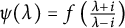 $\psi (\lambda )=f\left (\frac {\lambda +i}{\lambda -i}\right )$
such that
 $ f\in \mathcal {F}_n(\mathbb {T})$
with
 $\hat {f}(k)=0$
for
 $k=1,\dots ,n-1$
.
In Theorem 4.2, we significantly relax the assumptions on the maximal dissipative operators made in [Reference Chattopadhyay and Pradhan7, Reference Marcantognini and Morán22] and enlarge the set of admissible functions to
 $$ \begin{align*} \mathfrak{F}_{n}(\mathbb{R}):=&\left\{\psi(\lambda)=f\left(\frac{\lambda+i}{\lambda-i}\right):\; f\in \mathfrak{F}_{n}(\mathbb{T})\right\}, \end{align*} $$
which contains all rational functions bounded on
 $\mathbb {R}$
(see, e.g., [Reference Skripka37, Section 5]). The result of Theorem 4.2 also extends the trace formula of [Reference Chattopadhyay and Pradhan7, Theorem 5.2] for maximal dissipative operators and the trace formula of [Reference Skripka37, Theorem 5.3] for self-adjoint operators
 $H_0$
and
 $H_1$
satisfying
 $(H_1-iI)^{-1}-(H_0-iI)^{-1}\in \mathcal {B}_n(\mathcal {H})$
to include
 $$ \begin{align*}\text{span}\Big\{\mathbb{R}\ni\lambda\mapsto\frac{1}{a-\lambda}: \operatorname{Im}(a)>0\Big\}\end{align*} $$
and
 $\psi \in \mathfrak {F}_{n}(\mathbb {R})$
arising from
 $f\in \mathfrak {F}_{n}(\mathbb {T})\setminus \mathcal {F}_n(\mathbb {T})$
into the set of admissible functions.
A variant of the first-order trace formula for contractions with the integration going over
 $\mathbb {D}$
was obtained in [Reference Chattopadhyay and Sinha9]. The right-hand side of the latter formula resembles the one of the Helton–Howe formula (see, e.g., [Reference Chattopadhyay and Sinha8, Reference Helton and Howe16]). In Theorem 3.6, we obtain a higher-order analog of the Helton–Howe type trace formula [Reference Chattopadhyay and Sinha9].
In Theorem 5.2, we significantly simplify the higher-order trace formula (1.3) for unitary operators by replacing the left-hand side with an alternative approximation remainder, and in Theorem 5.4, we simplify the trace formula of [Reference Skripka37, Theorem 5.3] for resolvent-comparable self-adjoint operators. The new nth-order trace formula for unitaries holds for
 $f\in \mathfrak {F}_{n}(\mathbb {T})$
and the new nth-order trace formula for self-adjoints holds for
 $f\in \mathfrak {F}_{n}(\mathbb {R})$
, considerably enlarging the admissible function classes attained in the analogous results of [Reference Potapov, Skripka and Sukochev32, Theorems 2.6 and 3.5], respectively.
Our major tools include multilinear operator integration and Schäffer’s unitary matrix dilation of contractions. In particular, we utilize norm bounds, perturbation formulas, and change of variables techniques for multilinear operator integrals as well as dilate operator Taylor remainders from the case of contractions to the case of unitaries. The aforementioned methods are synthesized along a carefully selected path between the initial and perturbed operators to remove prior restrictive assumptions.
The article is organized as follows: preliminaries on multilinear operator integration and Schäffer’s unitary dilation are collected in Section 2, higher-order trace formulas for contractions are established in Section 3, higher-order trace formulas for maximal dissipative operators are derived in Section 4, and simplified higher-order trace formulas for unitaries and resolvent comparable self-adjoint operators are derived in Section 5.
2 Preliminaries
In this section, we recall necessary facts on multilinear operator integration and Schäffer’s unitary dilation technique.
The symbols of multiple operator integrals utilized in this article are constructed from divided differences. We recall that the zeroth-order divided difference of a function f is simply the function itself, denoted by
 $f^{[0]}:=f$
. Consider points
 $z_0, z_1, \ldots , z_n$
in
 $\mathbb {T}$
and let
 $f\in D^n(\mathbb {T})$
. The divided difference
 $f^{[n]}$
of order n is defined recursively as follows:
 $$ \begin{align*} f^{[n]}(z_0,z_1,\ldots,z_n):=\begin{cases} \frac{f^{[n-1]}(z_0,z_2,\ldots,z_n)-f^{[n-1]}(z_1,z_2,\ldots,z_n)}{z_0-z_1} & \text{if}\ z_0\neq z_1,\\ \frac{\partial}{\partial z_1}f^{[n-1]}(z_1,\ldots,z_n) &\text{if}\ z_0=z_1. \end{cases} \end{align*} $$
2.1 New function class
Let
 $n\in \mathbb {N}$
. Let
 $\mathfrak {F}_{n}(\mathbb {T})$
be the collection of all functions
 $f\in D^n(\mathbb {T})$
such that
 $f^{(n)}$
is bounded and
 $f^{[n]}$
can be expressed as
 $$ \begin{align} f^{[n]}(z_0,\ldots,z_n)=\int_{\Omega}\,a_0(z_0,\omega)\cdots a_n(z_n,\omega)\,d\nu(\omega), \end{align} $$
where
 $(\Omega , d\nu )$
is a
 $\sigma $
-finite measure space and
 $$\begin{align*}a_i(\cdot,\cdot):\;\mathbb{T}\times\Omega\to\mathbb{C},\quad i=0,\dots,n,\end{align*}$$
are bounded measurable functions satisfying
 $$ \begin{align} \int_{\Omega}\|a_0(z_0,\omega)\|_{\infty} \cdots \|a_n(z_n,\omega)\|_{\infty}\, d|\nu|(\omega)<\infty. \end{align} $$
Consider
 $$ \begin{align} \|f^{[n]}\|_{\mathfrak{F}_{n}}:=\inf \int_{\Omega}\|a_0(z_0,\omega)\|_{\infty} \cdots \|a_n(z_n,\omega)\|_{\infty}\, d|\nu|(\omega)<\infty, \end{align} $$
where the infimum is taken over all possible representations (2.1). More generally,
 $\|\cdot \|_{\mathfrak {F}_{n}}$
is a norm on the algebra of functions on
 $\mathbb {T}^{n+1}$
admitting the representation (2.1) (see, e.g., [Reference de Pagter and Sukochev13]).
Below we relate the newly introduced set
 $\mathfrak {F}_{n}(\mathbb {T})$
to function classes previously considered in the context of trace formulas on
 $\mathbb {T}$
. One of those classes is
 $\mathcal {F}_n(\mathbb {T})$
defined in (1.2) and the other is the Besov class
 $B^n_{\infty , 1}(\mathbb {T})$
defined as follows. Let w be an infinitely differentiable function on
 $\mathbb {R}$
such that
 $$ \begin{align*}w\ge 0, \ \ {\mathrm{supp}\,} w \subset\left[\frac12,2\right] , \ \ \text{and} \ \ w(x) = 1 - w \left(\frac{x}2\right) \ \ \text{for} \ \ x\in[1,2].\end{align*} $$
Consider the trigonometric polynomials
 $W_m$
and
 $W_m^\sharp $
defined on
 $\mathbb {T}$
by
 $$ \begin{align*}W_m(z)=\sum_{k\in\mathbb{Z}}w \left(\frac{k}{2^m}\right)z^k, \ \ m\ge 1, \ \ W_0(z)=\overline{z}+1+z, \ \ \text{and} \ \ W_m^\sharp(z)=\overline{W_m(z)}, \ \ m\ge 0.\end{align*} $$
Then, for each function
 $\varphi $
on
 $\mathbb {T}$
,
 $$ \begin{align*}\varphi=\sum_{m\ge 0}\varphi\ast W_m+\sum_{m\ge 1}\varphi\ast W_m^\sharp.\end{align*} $$
The Besov class
 $B_{\infty , 1}^n(\mathbb {T})$
consists of functions
 $\varphi $
on
 $\mathbb {T}$
such that
 $$ \begin{align*}\{\|2^{nm}\varphi\ast W_m\|_{\infty}\}_{m\ge 0}\in \ell_1 \ \ \text{and} \ \ \{\|2^{nm}\varphi\ast W_m^\sharp\|_{\infty}\}_{m\ge 1}\in \ell_1.\end{align*} $$
Proposition 2.1 Let
 $n\in \mathbb {N}$
. Then, the following inclusions hold.
-
(i)
 $B^n_{\infty ,1}(\mathbb {T})\subset \mathfrak {F}_{n}(\mathbb {T})$
.
-
(ii)
$\mathfrak {F}_{n}(\mathbb {T})\subset \mathcal {F}_{n-1}(\mathbb {T})$
. -
(iii)
$\mathfrak {F}_{n}(\mathbb {T}) = \bigcap _{k=1}^{n} \mathfrak {F}_{k}(\mathbb {T})$
.



Proof (i) Follows from [Reference Peller29, Theorem 4.4].
(ii) Let
 $f\in \mathfrak {F}_{n}(\mathbb {T})$
. Note that the Fourier series of
 $f^{(k)}$
is absolutely convergent for
 $0 \leq k \leq n-1$
. Indeed, we have
 $$ \begin{align*} \widehat{f^{(k)}}(l)=\frac{1}{2\pi i} \int_{\mathbb{T}} f^{(k)}(z)\bar{z}^{l+1} dz = \frac{1}{2\pi} \int_{0}^{2\pi} f^{(k)}(e^{i\theta}) e^{-il\theta} d\theta. \end{align*} $$
Integrating by parts yields
 $$ \begin{align*} \widehat{f^{(k)}}(l)=\frac{1}{2\pi i l} \int_{0}^{2\pi} f^{(k+1)}(e^{i\theta}) (i e^{i\theta}) e^{-il\theta} d\theta=\frac{1}{2\pi il} \int_{\mathbb{T}} f^{(k+1)}(z)\bar{z}^{l} dz,\quad l\neq 0. \end{align*} $$
Thus, we obtain
 $l\widehat {f^{(k)}}(l)=\widehat {f^{(k+1)}}(l-1)$
. Since
 $f^{(k+1)} \in L^{\infty }(\mathbb {T}) \subset L^2(\mathbb {T})$
, we have
 $$ \begin{align*} \sum_{l \in \mathbb{Z}\setminus\{0\}}\left| \widehat{f^{(k)}}(l) \right| &=\sum_{l \in \mathbb{Z}\setminus\{0\}} \frac{1}{|l|} \left| \widehat{f^{(k+1)}}(l-1) \right|\\ &\leq \Big( \sum_{l \in \mathbb{Z}\setminus\{0\}} \frac{1}{l^2}\Big)^{1/2} \Big( \sum_{l \in \mathbb{Z}\setminus\{0\}} \left| \widehat{f^{(k+1)}}(l-1) \right|{}^2 \Big)^{1/2} < \infty. \end{align*} $$
Consequently, for
 $n\ge 2$
,
 $$ \begin{align*} \sum_{l\in\mathbb{Z}\setminus\{0\}}|l|^{n-1}|\hat{f}(l)| &\le n^{n-1}\!\sum_{l\in\mathbb{Z}\setminus\{0\}}|l\cdots(l-n+2)|\,|\hat{f}(l)|\\ &=n^{n-1}\!\sum_{l \in \mathbb{Z}\setminus\{0\}} |(l+1)\cdots (l+n-1)|\, |\hat{f}(l+n-1)|\\ &=n^{n-1}\!\sum_{l\in\mathbb{Z}\setminus\{0\}}\left| \widehat{f^{(n-1)}}(l)\right|<\infty, \end{align*} $$
implying
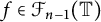 $f\in \mathcal {F}_{n-1}(\mathbb {T})$
.
(iii) It follows from (i) and (ii) that
 $f \in \mathfrak {F}_{k}(\mathbb {T})$
, implying the result.
2.2 Multilinear operator integration
The subsequent definition provides a simple yet widely applicable formulation of the multilinear operator integral, as outlined in [Reference Potapov, Skripka and Sukochev33, Reference Skripka37].
Definition 2.1 Let
 $f\in \mathfrak {F}_{n}(\mathbb {T})$
. Let
 $k\in \{1,\ldots ,n\}$
. Let
 $1 \leq \alpha , \alpha _i \leq \infty $
for
 $i = 1,\ldots , k$
be such that
 $\frac {1}{\alpha _1} + \cdots + \frac {1}{\alpha _k} = \frac {1}{\alpha }$
. Let
 $U_i$
,
 $i= 0, ..., k,$
be unitary operators on
 $\mathcal {H}$
. The mapping
 $$\begin{align*}T_{f^{[k]}}^{ U_0,\ldots,U_k}: \mathcal{B}_{\alpha_1}(\mathcal{H})\times\cdots\times\mathcal{B}_{\alpha_{k}}(\mathcal{H})\longrightarrow \mathcal{B}_{\alpha}(\mathcal{H})\end{align*}$$
defined by
 $$ \begin{align*} T_{f^{[k]}}^{ U_0,\ldots,U_k}(V_1,\ldots,V_k)=\int_\Omega a_0(U_0,\omega)V_1a_1(U_1,\omega)\cdots V_ka_k(U_k,m)\,d\nu(\omega) \end{align*} $$
where
 $(\Omega ,\nu )$
and
 $a_i(\cdot ,\cdot )$
satisfy (2.1) and (2.2), is called a multilinear operator integral with symbol
 $f^{[k]}$
. The mapping
 $T_{f^{[k]}}^{ U_0,\ldots ,U_k}$
is independent of the choice of
 $(\Omega ,\nu )$
,
 $a_i(\cdot ,\cdot )$
in the decomposition (2.1) and
 $\|T_{f^{[k]}}^{ U_0,\ldots ,U_k}\|\le \|f^{[k]}\|_{\mathfrak {F}_{k}}$
.
The following properties of multilinear operator integrals are essential in proving our results.
Theorem 2.2 Let
 $n\in \mathbb {N}$
, let
 $k\in \{1,\ldots ,n\}$
. Let
 $1 < \alpha , \widetilde \alpha , \alpha _i < \infty $
for
 $i = 1,\ldots , k$
be such that
 $\frac {1}{\alpha _1} + \cdots + \frac {1}{\alpha _k} = \frac {1}{\alpha }$
and
 $\frac {1}{\alpha _1} + \cdots + \frac {1}{\alpha _{k-1}} = \frac {1}{\widetilde \alpha }$
. Let
 $U_i$
,
 $i= 0, ..., k,$
be unitary operators on
 $\mathcal {H}$
and let
 $f\in \mathfrak {F}_{n}(\mathbb {T})$
. Then, the following assertions hold.
 $\mathrm{(i)}$
The transformation
 $T_{f^{[k]}}^{ U_0,\ldots ,U_k}: \mathcal {B}_{\alpha _1}(\mathcal {H})\times \cdots \times \mathcal {B}_{\alpha _{k}}(\mathcal {H})\longrightarrow \mathcal {B}_{\alpha }(\mathcal {H})$
is bounded and
 $$\begin{align*}\|T_{f^{[k]}}^{ U_0,\ldots,U_k}\|\leq c_{k,\alpha_1,\ldots, \alpha_k}\|f^{(k)}\|_\infty.\end{align*}$$
 $\mathrm{(ii)}$
Let
 $\phi _k(z_0,z_1,\ldots ,z_{k-1}):=f^{[k]}(z_0,z_1,\ldots ,z_{k-1},z_0)$
. The transformation
 $T_{\phi _k}^{ U_0,\ldots ,U_{k-1}}: \mathcal {B}_{\alpha _1}(\mathcal {H})\times \cdots \times \mathcal {B}_{\alpha _{k-1}}(\mathcal {H})\longrightarrow \mathcal {B}_{\widetilde \alpha }(\mathcal {H})$
is bounded and
 $$\begin{align*}\|T_{\phi_k}^{ U_0,\ldots,U_{k-1}}\|\leq c_{k,\alpha_1,\ldots, \alpha_{k-1}}\|f^{(k)}\|_\infty.\end{align*}$$
Proof The result follows from [Reference Coine, Le Merdy and Sukochev11, Proposition 7.4] and [Reference Coine10, Theorem 3.3] along with the fact that, for
 $2 \leq \alpha _i < \infty $
,
 $\mathcal {B}_2(\mathcal {H}) \cap \mathcal {B}_{\alpha _i}(\mathcal {H})$
is dense in
 $\mathcal {B}_{\alpha _i}(\mathcal {H})$
.
Corollary 2.3 Let
 $n\in \mathbb {N}$
and
 $f\in \mathfrak {F}_{n}(\mathbb {T})$
. Let
 $U_0, U_1$
be unitary operators on
 $\mathcal {H}$
and let
 $V_1,V_2,\ldots ,V_n\in \mathcal {B}_n(\mathcal {H})$
. Then, the following assertions hold.
-
(i) For
$n=1$
, and
$$\begin{align*}\operatorname{Tr}\left(T_{f^{[1]}}^{\,U_0,U_0}(V_1)\right)=\operatorname{Tr}\left(f'(U_0)V_1\right)\end{align*}$$
(2.4)
$$ \begin{align} \left|\operatorname{Tr}\left(T_{f^{[1]}}^{\,U_0,U_0}(V_1)\right)\right|\leq c_1\|f'\|_\infty\,\|V_1\|_1. \end{align} $$
-
(ii) For
$n\geq 2$
, where
$$\begin{align*}\operatorname{Tr}\left(T_{f^{[n]}}^{U_0,U_1,U_0,\ldots,U_0}(V_1,\ldots,V_n)\right) =\operatorname{Tr}\left(T_{\widetilde{f^{[n]}}}^{U_0,U_1,U_0,\ldots,U_0}(V_1,\ldots,V_{n-1})\, V_n\right)\end{align*}$$
$\widetilde {f^{[n]}}(z_0,\ldots ,z_{n-1})=f^{[n]}(z_0,\ldots ,z_{n-1},z_0)$
. Furthermore, (2.5)
$$ \begin{align} \left|\operatorname{Tr}\left(T_{f^{[n]}}^{U_0,U_1,U_0,\ldots,U_0}(V_1,\ldots,V_n)\right)\right|\leq c_n\|f^{(n)}\|_\infty\prod_{k=1}^{n}\|V_k\|_n. \end{align} $$




Proof If
 $n\geq 2$
, it follows from Definition 2.1, a minor adjustment of the argument in the proof of [Reference Azamov, Carey, Dodds and Sukochev2, Corollary 4.8], and cyclicity of the trace that
 $$ \begin{align*} &\operatorname{Tr}\left(T_{f^{[n]}}^{U_0,U_1,U_0,\ldots,U_0}(V_1,\ldots,V_n)\right)\\ =&\operatorname{Tr}\left(\int_\Omega a_0(U_0,\omega)\,V_1\,a_1(U_1,\omega)\cdots\, V_n\,a_n(U_0,\omega)\,d\nu(\omega)\right)\\ =&\operatorname{Tr}\left[\left(\int_\Omega a_n(U_0,\omega)a_0(U_0,\omega)\,V_1\,a_1(U_1,\omega)\cdots\, V_{n-1}\,a_{n-1}(U_0,\omega)\right)V_n\,d\nu(\omega)\right]\\ =&\operatorname{Tr}\left(T_{\widetilde{f^{[n]}}}^{U_0,U_1,U_0,\ldots,U_0}(V_1,\ldots,V_{n-1})\cdot V_n\right). \end{align*} $$
Similarly, we obtain
 $\operatorname {Tr}\left (T_{f^{[1]}}^{\,U_0,U_0}(V_1)\right )=\operatorname {Tr}\left (f'(U_0)V_1\right )$
. The estimates (2.4) and (2.5) follow from the application of Theorem 2.2 and Hölder’s inequality.
The following perturbation formulas follow from the proof of [Reference Potapov, Skripka and Sukochev33, Lemma 2.4(i)].
Lemma 2.4 Let
 $n\in \mathbb {N}$
and
 $f\in \mathfrak {F}_{n}(\mathbb {T})$
. Let
 $U_0, U_1, U_2$
be unitary operators on
 $\mathcal {H}$
and let
 $V_1,V_2,\ldots ,V_{n-1}\in \mathcal {B}(\mathcal {H})$
. Then,
-
(i)
$f(U_1)-f(U_0)=T_{f^{[1]}}^{U_1,U_0}(U_1-U_0)=T_{f^{[1]}}^{U_0,U_1}(U_1-U_0)$
, -
(ii) for
$n\geq 2$
,
$$ \begin{align*} T_{f^{[n-1]}}^{U_0,U_1,U_0,\ldots,U_0}(V_1,\ldots,V_{n-1})-T_{f^{[n-1]}}^{U_0,U_2,U_0,\ldots,U_0}(V_1,\ldots,V_{n-1})\\ =T_{f^{[n]}}^{U_0,U_1,U_2,U_0,\ldots,U_0}(V_1,U_1-U_2,V_2,\ldots,V_{n-1}). \end{align*} $$



The existence of the Gâteaux derivative in Theorem 2.5 below and the representation (2.6) are proved in [Reference Coine10, Theorem 5.1]. The continuity of the operator derivative under the assumption
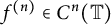 $f^{(n)}\in C^n(\mathbb {T})$
is due to [Reference Chattopadhyay, Coine, Giri and Pradhan5, Corollary 3.6]. The formula (2.7) follows from (2.6) and properties of the divided difference.
Theorem 2.5 Let
 $1<p<\infty $
. Let
 $A\in \mathcal {B}_p(\mathcal {H})$
be a self-adjoint operator,
 $U_0$
a unitary operator, and
 $ U_t=e^{itA}U_0$
. Let
 $n\in \mathbb {N}$
and
 $f\in \mathfrak {F}_{n}(\mathbb {T})$
. Then, the Gâteaux derivative
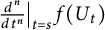 $\frac {d^n}{dt^n}\big |_{t=s}f( U_t)$
exists in the Schatten p-norm and admits the representation
 $$ \begin{align} \dfrac{d^n}{dt^n}\Big|_{t=s}f(U_t) =i^n\sum_{r=1}^{n}~\sum_{\substack{l_1+l_2+\cdots+l_{r}=n\\l_1,l_2,\ldots,l_{r}\geq 1}}~\dfrac{n!}{l_1!\cdots l_r!}\,T_{f^{[r]}}^{ U_s,\dots, U_s}\left(A^{l_1}U_s,\ldots, A^{l_r}U_s\right). \end{align} $$
Moreover if
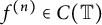 $f^{(n)}\in C(\mathbb {T})$
, then
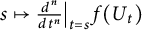 $s\mapsto \frac {d^n}{dt^n}\big |_{t=s}f( U_t)$
is continuous in the Schatten p-norm. In particular, for every
 $k\in \mathbb {N}$
,
 $$ \begin{align} \dfrac{d^n}{dt^n}\Big|_{t=s}U_t^k =\sum_{r=1}^{n}~\sum_{\substack{l_1+l_2+\cdots+l_{r}=n\\l_1,l_2,\ldots,l_{r}\geq 1}}~\dfrac{n!}{l_1!\cdots l_r!}\Bigg[\!\sum_{\substack{\alpha_0+\alpha_1+\cdots+\alpha_r=k\\\alpha_0\geq 0; \,\alpha_1,\ldots,\alpha_r\geq 1}}U_s^{\alpha_0}(iA)^{l_1}U_s^{\alpha_1}\cdots (iA)^{l_{r}}U_s^{\alpha_r} \!\Bigg]. \end{align} $$
We will also need the following estimate.
Lemma 2.6 Let
 $n\in \mathbb {N}$
. Let
 $A, B$
be two self-adjoint operators such that
 $A-B\in \mathcal {B}_n(\mathcal {H})$
. Then,
 $\|e^{iA}-e^{iB}\|_n \leq e^{\max \{\|A\|,\|B\|\}} \|A-B\|_n$
.
Proof By the power series expansions for
 $e^{iA}$
and
 $e^{iB}$
and by telescoping, we have
 $$ \begin{align*} \|e^{i A}-e^{iB}\|_n\leq \sum_{k=1}^{\infty}\sum_{ p=0}^{k-1}\frac{\|(iA)^p(iA-iB)(iB)^{k-1-p}\|_n}{k!} \leq e^{\max\{\|A\|,\|B\|\}}\,\|A-B\|_n. \end{align*} $$
Lemma 2.7 Let
 $n \in \mathbb {N}$
,
 $n\geq 2$
, and
 $ f\in \mathfrak {F}_{n}(\mathbb {T})$
. Let
 $A\in \mathcal {B}_n(\mathcal {H})$
be a self-adjoint operator,
 $U_0$
a unitary operator, and
 $U_t = e^{itA}U_0$
,
 $t\in [0,1]$
. Then,
 $$ \begin{align} f(U_1) - f(U_0) - \sum_{k=1}^{n-1} \frac{1}{k!} \frac{d^k}{ds^k} \Big|_{s=0} f(U_s) = \frac{1}{(n-1)!} \int_{0}^{1} (1-t)^{n-1} \, \frac{d^n}{ds^n} \Big|_{s=t} f(U_s) \, dt, \end{align} $$
where the integral on the right-hand side converges in the
 $\|\cdot \|_n$
-norm. Moreover, the following properties hold:
 $$ \begin{align} &\int_{0}^{1} (1-t)^{n-1} \, \frac{d^n}{ds^n} \Big|_{s=t} f(U_s) \, dt\in\mathcal{B}_1(\mathcal{H}), \end{align} $$
 $$ \begin{align} & t\mapsto(1-t)^{n-1} \, \operatorname{Tr}\left(\frac{d^n}{ds^n} \Big|_{s=t} f(U_s)\right) \text{is bounded and measurable on } [0,1], \end{align} $$
 $$ \begin{align} & \nonumber\operatorname{Tr}\Bigg(f(U_1) - f(U_0) - \sum_{k=1}^{n-1} \frac{1}{k!} \frac{d^k}{ds^k} \Big|_{s=0} f(U_s)\Bigg)\\ &\quad = \frac{1}{(n-1)!} \int_{0}^{1} (1-t)^{n-1} \, \operatorname{Tr}\left(\frac{d^n}{ds^n} \Big|_{s=t} f(U_s)\right) \, dt. \end{align} $$
Proof Let
 $f\in \mathfrak {F}_{n}(\mathbb {T})$
. For
 $t\in [0,1]$
, define
 $\Gamma (t)=f(U_t)-f(U_0)$
. By Lemma 2.4,
 $\Gamma (t)=T_{f^{[1]}}^{U_t, U_0}(U_t-U_0)$
, which along with observations made in Definition 2.1, Lemma 2.6, implies
 $$ \begin{align*} \|\Gamma(t)\|_n\leq \|f^{[1]}\|_{\mathfrak{F}_{1}} \|U_t-U_0\|_n=&\|f^{[1]}\|_{\mathfrak{F}_{1}} \|e^{itA}-I\|_n\leq \|f^{[1]}\|_{\mathfrak{F}_{1}}\,e^{\|A\|}\|A\|_n<\infty. \end{align*} $$
Therefore, by Theorem 2.5,
 $[0,1]\ni t\mapsto \Gamma (t)\in \mathcal {B}_n(\mathcal {H})$
is n-times differentiable in the norm
 $\|\cdot \|_n$
and
 $\frac {d^k}{ds^k}\big |_{s=t}\Gamma (s)=\frac {d^k}{ds^k}\big |_{s=t}f(U_s)$
for
 $k=1,\dots , n$
. Let
 $\psi \in (\mathcal {B}_n(\mathcal {H}))^*$
. Then,
 $[0,1]\ni t\mapsto \psi (\Gamma (t))$
is also n-times differentiable and
 $$ \begin{align*} \frac{d^k}{ds^k}\Big|_{s=t} \psi(\Gamma(s))= \psi\left( \frac{d^k}{ds^k}\Big|_{s=t}\Gamma(s)\right)=\psi\left( \frac{d^k}{ds^k}\Big|_{s=t}f(U_s)\right)\quad 1\leq k\leq n. \end{align*} $$
It follows from (2.6) and Definition 2.1 that
 $$ \begin{align*} \left\| (1-t)^{n-1}\frac{d^n}{ds^n} \Big|_{s=t} f(U_s) \right\|_n \leq d_n \max_{1\leq k \leq n}\|f^{[k]}\|_{\mathfrak{F}_{k}} \|A\|_n\,\|A\|^{n-1} \end{align*} $$
for some positive constant
 $d_n$
. Consequently,
 $$ \begin{align*} \left| (1-t)^{n-1}\frac{d^k}{ds^k}\Big|_{s=t} \psi(\Gamma(s)) \right| \leq d_n\, \|\psi\|\max_{1\leq k \leq n}\|f^{[k]}\|_{\mathfrak{F}_{k}} \|A\|_n\,\|A\|^{n-1}. \end{align*} $$
Applying the fundamental theorem of calculus to the function
 $[0,1]\ni t\mapsto \psi (\Gamma (t))$
and integrating by parts yields
 $$ \begin{align*} \psi\left(\Gamma(1)-\Gamma(0) - \sum_{k=1}^{n-1} \frac{1}{k!} \frac{d^k}{ds^k} \Big|_{s=0} \Gamma(s)\right) =\frac{1}{(n-1)!} \int_{0}^{1} (1-t)^{n-1}\,\frac{d^n}{ds^n}\Big|_{s=t}{\psi(\Gamma(s))}\,dt. \end{align*} $$
Consequently,
 $$ \begin{align} &\nonumber\psi\left(f(U_1) - f(U_0) - \sum_{k=1}^{n-1} \frac{1}{k!} \frac{d^k}{ds^k} \Big|_{s=0} f(U_s)\right)\\&\quad =\frac{1}{(n-1)!} \int_{0}^{1} (1-t)^{n-1} \, \psi\left(\frac{d^n}{ds^n} \Big|_{s=t} f(U_s)\right) \, dt. \end{align} $$
Observe that
 $[0,1]\ni t \mapsto (1-t)^{n-1}\frac {d^n}{ds^n} \big |_{s=t} f(U_s)\in \mathcal {B}_n(\mathcal {H})$
is strongly Borel-measurable (see [Reference Yosida39, Definition V.4.1 (p. 130)]). Therefore, by [Reference Yosida39, Theorem V.5.1 (p. 133)],
 $$ \begin{align*} \int_{0}^{1} (1-t)^{n-1} \, \frac{d^n}{ds^n} \Big|_{s=t} f(U_s) \, dt \end{align*} $$
exists in the
 $\|\cdot \|_n$
-norm and, consequently,
 $$ \begin{align*} & \psi\left(f(U_1) - f(U_0) - \sum_{k=1}^{n-1} \frac{1}{k!} \frac{d^k}{ds^k} \Big|_{s=0} f(U_s)\right)\\ & \quad = \frac{1}{(n-1)!}\psi\left( \int_{0}^{1} (1-t)^{n-1} \, \frac{d^n}{ds^n} \Big|_{s=t} f(U_s)\, dt\right) \end{align*} $$
for every
 $\psi \in (\mathcal {B}_n(\mathcal {H}))^*$
. The latter implies (2.8).
Applying the representation for the derivative (2.6) and Definition 2.1 implies
 $$ \begin{align*} \Big\| (1-t)^{n-1}\frac{d^n}{ds^n} \Big|_{s=t} f(U_s) \Big\|_1 \leq d_n \max_{1\leq k \leq n}\|f^{[k]}\|_{\mathfrak{F}_{k}} \|A\|_n^n. \end{align*} $$
By a reasoning similar to the one above,
 $t\mapsto \left \langle (1-t)^{n-1}\frac {d^n}{ds^n}\big |_{s=t} f(U_s)h_1,h_2\right \rangle $
is Borel measurable for all
 $h_1,h_2\in \mathcal {H}$
. The latter two properties along with [Reference Azamov, Carey, Dodds and Sukochev2, Proposition 3.2 and Lemma 3.10] imply (2.9) and (2.10) and
 $$ \begin{align*} \operatorname{Tr}\Big(\int_{0}^{1}(1-t)^{n-1}\,\frac{d^n}{ds^n}\Big|_{s=t}f(U_s)\,dt\Big) =\int_{0}^{1}(1-t)^{n-1}\,\operatorname{Tr}\Big(\frac{d^n}{ds^n}\Big|_{s=t}f(U_s)\Big)\,dt. \end{align*} $$
2.3 Schäffer’s unitary matrix dilation
Let
 $\mathcal {H}$
be a Hilbert space,
 $\ell _2(\mathcal {H})=\oplus _{1}^{\infty }\mathcal {H}$
, and let
 $\mathcal {K}$
be a Hilbert space containing
 $\mathcal {H}$
as a closed subspace. We recall that a power unitary dilation of a contraction
 ${T\in \mathcal {B}(\mathcal {H})}$
is a unitary
 $U\in \mathcal {B}(\mathcal {K})$
satisfying
 $T^n=P\,U^n\upharpoonright _{\mathcal {H}}$
for every
 $n\in \mathbb {N}$
, where P is the orthogonal projection from
 $\mathcal {K}$
onto
 $\mathcal {H}$
. We will use a power unitary dilation of a contraction explicitly constructed in [Reference Schäffer36] and summarized below.
Let
 $U_{T}$
be the unitary operator on
 $\ell _2(\mathcal {H})\oplus \mathcal {H}\oplus \ell _2(\mathcal {H})$
with block matrix representation

where S is the unilateral shift on
 $\ell _2(\mathcal {H})$
given by
 $$ \begin{align*}S(h_1, h_2, \ldots,)=(0,h_1, h_2, \ldots),\qquad h_i\in\mathcal{H} .\end{align*} $$
 $D_{T}=(1-T^*T)^{1/2}$
,
 $D_{T^*}=(1-TT^*)^{1/2}$
are the defect operators corresponding to the contractions T and
 $T^*$
, respectively, and
 $P_{\mathcal {H}}$
is the orthogonal projection from
 $\ell _2(\mathcal {H})$
onto
 $\mathcal {H}\oplus 0\oplus 0\oplus \cdots $
. Then,
 $U_T$
is a power unitary dilation of T, known as the Schäffer unitary matrix dilation of T.
Further details on dilation theory can be found in [Reference Sz.-Nagy, Foias, Bercovici and Kérchy25] and examples of its application in the derivation of trace formulas can be found in [Reference Chattopadhyay, Das and Pradhan4, Reference Dykema and Skripka12, Reference Marcantognini and Morán22, Reference Malamud, Neidhardt and Peller23].
3 Higher-order trace formulas for contractions
In this section, we establish higher-order trace formulas for functions of contractions
 $T_s$
without imposing the stringent assumptions of [Reference Chattopadhyay and Pradhan7, Theorem 4.1] that
 $\dim \ker (T_s)=\dim \ker (T_s^*)$
and that the defect operator of
 $T_s$
belongs to
 $\mathcal {B}_n(\mathcal {H})$
. The trace formulas in Theorem 3.5 involve integration over
 $\mathbb {T}$
and in Theorem 3.6 over
 $\mathbb {D}$
.
We start by broadening the set of admissible functions satisfying (1.3) to include the set
 $\mathcal {P}_n(\mathbb {T})$
of polynomials of degree at most
 $n-1$
and by establishing the absolute continuity of the spectral shift measures in [Reference Potapov, Skripka and Sukochev33, Remark 4.7(ii)]. Both goals are achieved in Theorem 3.2 below.
Notations 3.1 Let
 $n\in \mathbb {N}$
,
 $n\geq 2$
. Let
 $U_0$
be a unitary operator, A a bounded self-adjoint operator on
 $\mathcal {H}$
, and
 $$ \begin{align*}U_s=e^{isA}U_0,\quad s\in [0,1].\end{align*} $$
Define
 $$ \begin{align} \mathcal{R}_{n}^{\mathrm{Mult}}(U_0,A,f) :=f(U_1)-f(U_0)-\sum_{k=1}^{n-1}\dfrac{1}{k!}\dfrac{d^k}{ds^k}\Big|_{s=0}f(U_s). \end{align} $$
Theorem 3.2 Assume Notations 3.1 and assume that
 $A\in \mathcal {B}_n(\mathcal {H})$
. Then,
 $\mathcal {R}_{n}^{\mathrm {Mult}}(U_0,A,f)\in \mathcal {B}_1(\mathcal {H})$
for every
 $f\in \mathfrak {F}_{n}(\mathbb {T})$
. Furthermore, there exist a constant
 $d_{n}>0$
and functions
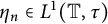 $\eta _n\in L^1(\mathbb {T},\tau )$
and
 $\eta _k\in \mathrm {span}\{ \overline {z},\dots ,\bar {z}^{\,n-k}\}$
,
 $k=1,\dots ,n-1$
, satisfying
 $$ \begin{align*}\|\eta_k\|_1\leq d_{n}\|A\|_n^n,\quad k=1,\dots,n,\end{align*} $$
such that
 $$ \begin{align} \operatorname{Tr}\left(\mathcal{R}_{n}^{\mathrm{Mult}}(U_0,A,f) \right)=\sum_{k=1}^{n}\int_{\mathbb{T}}f^{(k)}(z)\eta_k(z)dz \end{align} $$
for every
 $f\in \mathfrak {F}_{n}(\mathbb {T})$
. Moreover, if
 $\hat f(k)=0$
for
 $k=1,\dots ,n-1$
, then (3.2) holds with
 $\eta _k=0$
for
 $k=1,\dots ,n-1$
.
Proof Denote
 $$ \begin{align*}\widetilde{\mathfrak{F}}_{n}(\mathbb{T}):=\{f\in\mathfrak{F}_{n}(\mathbb{T}): \hat{f}(k)=0 \text{ for } k=1,\dots,n-1\}.\end{align*} $$
The representation (3.2) with
 $\eta _1=\dots =\eta _{n-1}=0$
for
 $f\in \widetilde {\mathfrak {F}}_{n}(\mathbb {T})$
can be established along the same lines as the proof of [Reference Skripka37, Theorem 4.4] by applying Theorem 2.2, Corollary 2.3, and the integral representation for the Taylor remainder (2.11).
We note that the proof of [Reference Skripka37, Theorem 4.4] follows the proof of [Reference Potapov, Skripka and Sukochev33, Theorem 4.1] and uses the representation [Reference Potapov, Skripka and Sukochev33, (4.12)] for functions
 $f\in \mathcal {F}_n(\mathbb {T})$
satisfying
 $\int _0^{2\pi }f^{(k)}(e^{it})\,dt=0$
for all
 $k=1,\dots ,n-1$
. The functions not satisfying the latter condition should be treated differently. Below we present the proof of (3.2) for
 $f\in \mathfrak {F}_{n}(\mathbb {T})$
.
Firstly, we establish
 $$ \begin{align} \operatorname{Tr}\left(\mathcal{R}_{n}^{\mathrm{Mult}}(U_0,A,f) \right) =\sum_{k=1}^{n-1}\int_{\mathbb{T}}\,f^{(k)}(z)\,\eta_k(z)\,dz \end{align} $$
for every
 $f\in \mathcal {P}_n(\mathbb {T})$
. For every
 $f\in \mathcal {P}_n(\mathbb {T})$
, by Lemma 2.7, we have the representations
 $$ \begin{align} \mathcal{R}_{n}^{\mathrm{Mult}}(U_0,A,f) =\dfrac{1}{(n-1)!}\int_{0}^{1}(1-t)^{ n-1}\,\dfrac{d^n}{ds^n}\Big|_{s=t}f(U_s)\,dt, \end{align} $$
and
 $$ \begin{align} \nonumber\operatorname{Tr}\left(\mathcal{R}_{n}^{\mathrm{Mult}}(U_0,A,f) \right) &=\dfrac{(i)^n}{(n-1)!}\int_{0}^{1}(1-t)^{ n-1}\,\sum_{k=1}^{n-1}\,\sum_{\substack{j_1+\cdots+j_k=n\\j_1,\ldots,j_k\geq 1}}\,\dfrac{n!}{j_1!\cdots j_k!} \\ &\quad \times \operatorname{Tr}\Big(T_{f^{[k]}}^{ U_t,\ldots,U_t}( A^{j_1}U_t,\ldots,A^{j_k}U_t)\Big)dt. \end{align} $$
For every
 $k=1,\dots ,n-1$
, consider the linear functional
 $T_k$
on
 $L^2(\mathbb {T},\tau )$
given by
 $$ \begin{align} \begin{cases} T_k((z^l)^{(k)})\\ =\dfrac{(i)^n}{(n-1)!}\int_0^1(1-t)^{ n-1}\!\sum\limits_{\substack{j_1+\cdots+j_k=n\\j_1,\ldots,j_k\geq 1}}\,\dfrac{n!}{j_1!\cdots j_k!}\operatorname{Tr}\Big(T_{(z^l)^{[k]}}^{U_t,\ldots, U_t}(A^{j_1}U_t,\ldots,A^{j_k}U_t)\Big)dt\\ \hspace{3in}\text{ for } l=k,\dots,n-1, \\[10pt] T_k(z^q)=0 \hspace{2in}\text{ for } q\in\mathbb{Z}\setminus\{0,\ldots,n-k-1\}. \end{cases} \end{align} $$
Let
 $p(z)$
be a polynomial of degree at most
 $n-1$
. By Corollary 2.3 and linearity of
 $T_k$
,
 $$ \begin{align} |T_k(p^{(k)})|\leq {\tilde{d}}_{k,n}\|p^{(k)}\|_{L^\infty(\mathbb{T})}\|A\|_n^n. \end{align} $$
Consider the trigonometric polynomial
 $\tilde {p}(\theta )=p^{(k)}(e^{i\theta })$
of degree at most
 $n-k-1$
. By Jackson’s inequality [Reference Milovanovic, Mitrinovic and Rassias24, Chapter 5, (3.1.1), p. 495],
 $\|\tilde p\|_{L^\infty [0,2\pi ]}\le 2\sqrt {n-k-1}\Big (\int _0^{2\pi }|p(\theta )|^2\,d\theta \Big )^{\frac 12}$
. Hence,
 $$ \begin{align} \|p^{(k)}\|_{L^\infty(\mathbb{T})}\le 2\sqrt{2\pi}\sqrt{n-k-1}\,\|p^{(k)}\|_{L^2(\mathbb{T},\tau)}. \end{align} $$
 $$ \begin{align} \|T_k\|\leq d_{k,n}\|A\|_n^n. \end{align} $$
Therefore, by the Riesz representation theorem for the functionals in
 $(L^2(\mathbb {T},\tau ))^*$
, it follows from (3.5), (3.6), and (3.9) that there exist functions
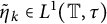 $\tilde {\eta }_k \in L^1(\mathbb {T},\tau )$
,
 $k=1,\dots ,n-1$
, satisfying
 $$\begin{align*}\|{\tilde{\eta}}_k\|_1\leq d_{k,n}\|A\|^n_n\end{align*}$$
and
 $$ \begin{align} \int_{\mathbb{T}}z^l\, \overline{z}\,{\tilde{\eta}}_k(z)\,dz=0 \end{align} $$
for all
 $l\in \mathbb {Z}\setminus \{0,\ldots , n-k-1\}$
and such that (3.3) holds for every
 $f\in \mathcal {P}_n(\mathbb {T})$
, where
 $$ \begin{align*} \eta_k(z)=\frac{1}{2\pi i}\,\bar{z}\,\tilde{\eta}_k(z),\quad k=1,\dots,n-1. \end{align*} $$
It follows from (3.10) that
 $$ \begin{align*} \tilde\eta_k\in\{\dots,z^{-n},\dots,z^{-n+k},z,\dots,z^n,\dots\}^\perp=\mathrm{span}\{1,\dots,\overline{z}^{\,n-k-1}\}. \end{align*} $$
Since
 $\mathfrak {F}_{n}(\mathbb {T})\subset \mathcal {F}_{n-1}(\mathbb {T})$
(see Proposition 2.1(ii)), we obtain
 $\mathfrak {F}_{n}(\mathbb {T})=\mathcal {P}_n(\mathbb {T})+\widetilde {\mathfrak {F}}_{n}(\mathbb {T})$
. Given
 $f\in \mathfrak {F}_{n}(\mathbb {T})$
, let
 $p\in \mathfrak {F}_{n}(\mathbb {T})$
and
 $g\in \widetilde {\mathfrak {F}}_{n}(\mathbb {T})$
be such that
 $f=p+g$
. It follows from equations (3.10) and (3.3) that
 $$ \begin{align} \operatorname{Tr}\left(\mathcal{R}_{n}^{\mathrm{Mult}}(U_0,A,p) \right) =\sum_{k=1}^{n-1}\int_{\mathbb{T}}\,p^{(k)}(z)\,\eta_k(z)\,dz =\sum_{k=1}^{n-1}\int_{\mathbb{T}}\,f^{(k)}(z)\,\eta_k(z)\,dz. \end{align} $$
By the linearity of the trace, from equations (1.3) and (3.11), we conclude that
 $$ \begin{align*} &\operatorname{Tr}\left(\mathcal{R}_{n}^{\mathrm{Mult}}(U_0,A,f) \right)\\ =&\operatorname{Tr}\left(\mathcal{R}_{n}^{\mathrm{Mult}}(U_0,A,p) \right)+\operatorname{Tr}\left(\mathcal{R}_{n}^{\mathrm{Mult}}(U_0,A,g) \right)\\ =&\sum_{k=1}^{n-1}\int_{\mathbb{T}}f^{(k)}(z)\eta_k(z)\,dz + \int_{\mathbb{T}}g^{(n)}(z)\eta_n(z)\,dz\\ =&\sum_{k=1}^{n-1}\int_{\mathbb{T}}f^{(k)}(z)\eta_k(z)\,dz + \int_{\mathbb{T}}f^{(n)}(z)\eta_n(z)\,dz \hspace{.5in}(\,\text{since } f^{(n)}=g^{(n)}), \end{align*} $$
completing the proof of (3.2).
Next, we extend the trace formula (3.2) to pairs of contractions by utilizing the result of Theorem 3.2, Schäffer unitary matrix dilation, and the following observation.
Lemma 3.3 Let
 $\mathcal {H}_i, i=1,2,3$
, be separable Hilbert spaces. Let
 $T\in \mathcal {B}_1(\mathcal {H}_1\oplus \mathcal {H}_2\oplus \mathcal {H}_3)$
have the block matrix representation of the form

where
 $P_{\mathcal {H}_1}, P_{\mathcal {H}_2}, P_{\mathcal {H}_3}$
are orthogonal projections of
 $\mathcal {H}_1\oplus \mathcal {H}_2\oplus \mathcal {H}_3$
onto
 $\mathcal {H}_1\oplus 0\oplus 0$
,
 $0\oplus \mathcal {H}_2\oplus 0$
, and
 $0\oplus 0\oplus \mathcal {H}_3$
, respectively. Then
 $$ \begin{align} \operatorname{Tr}(T)= \operatorname{Tr} \left( P_{\mathcal{H}_1}TP_{\mathcal{H}_1}\right)+\operatorname{Tr} \left( P_{\mathcal{H}_2}TP_{\mathcal{H}_2}\right)+ \operatorname{Tr} \left(P_{\mathcal{H}_3}TP_{\mathcal{H}_3}\right). \end{align} $$
Proof Since
 $\operatorname {Tr}(T)= \sum _{i,j=1}^{3}\operatorname {Tr} \left ( P_{\mathcal {H}_i}TP_{\mathcal {H}_j}\right )$
, (3.12) follows from the pairwise orthogonality of
 $P_{\mathcal {H}_i}$
and cyclicity of the trace.
Let
 $f\in \mathfrak {F}_{n}(\mathbb {T})$
and define
 $$ \begin{align*}f_{+}(e^{it}):=\sum\limits_{k=0}^{\infty}\hat{f}(k)e^{ikt}\, \text{ and }\; f_{-}(e^{it}):=\sum\limits_{k=1}^{\infty}\hat{f}(-k)e^{ikt},\end{align*} $$
where the series converges absolutely by Proposition 2.1(ii). Note that
 $f(e^{it})=f_{+}(e^{it})+f_{-}(e^{-it})$
. For a contraction T on
 $\mathcal {H}$
, we set
 $$ \begin{align} f_{+}(T):=\sum\limits_{k=0}^{\infty}\hat{f}(k)T^k,\quad f_{-}(T^*):=\sum\limits_{k=1}^{\infty}\hat{f}(-k){T^*}^k,\quad \text{and}\quad f(T):=f_{+}(T)+f_{-}(T^*). \end{align} $$
The functions of contractions given by (3.13) were initially considered in [Reference Neidhardt27].
Notations 3.4 Let
 $n\in \mathbb {N}$
,
 $n\geq 2$
. Let
 $T_0$
be a contraction and B a bounded self-adjoint operator on
 $\mathcal {H}$
. Define
 $$ \begin{align*}T_s=e^{isB}T_0,\quad s\in [0,1].\end{align*} $$
Given
 $f\in \mathfrak {F}_{n}(\mathbb {T})$
, define
 $f(T_s)$
by (3.13) and set
 $$ \begin{align} \mathcal{R}_{n}^{\mathrm{Mult}}(T_0,B,f) :=f(T_1)-f(T_0)-\sum_{k=1}^{n-1}\dfrac{1}{k!}\dfrac{d^k}{ds^k}\Big|_{s=0}f(T_s). \end{align} $$
Theorem 3.5 Assume Notations 3.4 and assume that
 $B\in \mathcal {B}_n(\mathcal {H})$
. Then,
 $\mathcal {R}_{n}^{\mathrm{Mult}}(T_0,B,f)\in \mathcal {B}_1(\mathcal {H})$
for every
 $f\in \mathfrak {F}_{n}(\mathbb {T})$
. Furthermore, there exists a constant
 $d_{n}>0$
and functions
 $\eta _1,\ldots \eta _n\in L^1(\mathbb {T},\tau )$
satisfying
 $$ \begin{align} \|\eta_k\|_1\leq d_{n}\|B\|_n^n,\quad k=1,\dots,n, \end{align} $$
such that
 $$ \begin{align} \operatorname{Tr}\left(\mathcal{R}_{n}^{\mathrm{Mult}}(T_0,B,f) \right)=\sum_{k=1}^{n}\int_{\mathbb{T}}f^{(k)}(z)\eta_k(z)\,dz, \end{align} $$
for every
 $f\in \mathfrak {F}_{n}(\mathbb {T})$
. Moreover, if
 $\hat f(k)=0$
for
 $k=1,\dots ,n-1$
, then (3.16) holds with
 $\eta _k=0$
for
 $k=1,\dots ,n-1$
.
Proof Let
 $U_0:=U_{T_0}$
be Schäffer’s unitary matrix dilation on
 $\ell _2(\mathcal {H})\oplus \mathcal {H}\oplus \ell _2(\mathcal {H})$
of
 $T_0$
whose block matrix representation is given by (2.13).
Let
 $U_s$
be the unitary dilation on
 $\ell _2(\mathcal {H})\oplus \mathcal {H}\oplus \ell _2(\mathcal {H})$
of
 $T_s$
whose block representation is given by
 $$ \begin{align} U_s=e^{isA}U_0=\begin{bmatrix} I& 0& 0 \\ 0& e^{isB}& 0 \\ 0& 0& I \end{bmatrix}\begin{bmatrix} S^*& 0& 0 \\ D_{T_0^*}P_{\mathcal{H}}& T_0& 0 \\ -T_0^*P_{\mathcal{H}}& D_{T_0}& S \end{bmatrix}=\begin{bmatrix} S^*& 0& 0 \\ e^{isB}D_{T_0^*}P_{\mathcal{H}}& T_s& 0 \\ -T_0^*P_{\mathcal{H}}& D_{T_0}& S \end{bmatrix}, \end{align} $$
where
 $A=\begin {bmatrix} 0& 0& 0 \\ 0& B& 0 \\ 0& 0& 0 \end {bmatrix}: \ell _2(\mathcal {H})\oplus \mathcal {H}\oplus \ell _2(\mathcal {H})\to \ell _2(\mathcal {H})\oplus \mathcal {H}\oplus \ell _2(\mathcal {H})$
is the self-adjoint extension of B. Note that
 $A\in \mathcal {B}_n(\ell _2(\mathcal {H})\oplus \mathcal {H}\oplus \ell _2(\mathcal {H}))$
and
 $U_0$
satisfy the hypothesis of Theorem 3.2 and that
 $$ \begin{align} \|A\|_n=\|B\|_n. \end{align} $$
Let
 $ k,l\in \mathbb {N}$
. By a straightforward computation similar to the one in (2.7),
 $$ \begin{align*} &\frac{d^l}{ds^l}\bigg|_{s=0}(U_s^*)^k=\left(\frac{d^l}{ds^l}\bigg|_{s=0}U_s^k\right)^*,\\ \nonumber &\frac{d}{ds}\Big|_{s=t}(T_s^*)^k=\lim_{h\to 0}\frac{(T_{t+h}^*)^k-(T_{t}^*)^k}{h}=\,\left(\lim_{h\to 0}\frac{T_{t+h}^k-T_{t}^k}{h}\right)^* =\left(\frac{d}{ds}\bigg|_{s=t}T_s^k\right)^*. \end{align*} $$
Therefore, it follows from the above identities and (3.1) that
 $$ \begin{align} \mathcal{R}_{n}^{\mathrm{Mult}}(U_0,A,z^{-k})=\, {U_1^*}^k-{U_0^*}^k-\sum_{l=1}^{n-1}\dfrac{1}{l!}\dfrac{d^l}{ds^l}\Big|_{s=0}{U_s^*}^k= \left(\mathcal{R}_{n}^{\mathrm{Mult}}(U_0,A,z^{k})\right)^*. \end{align} $$
Similarly,
 $$ \begin{align} \mathcal{R}_{n}^{\mathrm{Mult}}(T_0,B,z^{-k})=\left(\mathcal{R}_{n}^{\mathrm{Mult}}(T_0,B,z^{k})\right)^*. \end{align} $$
Following the computation of [Reference Skripka and Tomskova38, Theorem 5.3.4] for unitary operators, we obtain
 $$ \begin{align} \dfrac{d^l}{dt^l}\Big|_{t=s}T_{t}^k =\sum_{r=1}^{l}~\sum_{\substack{l_1+l_2+\cdots+l_{r}=l\\l_1,l_2,\ldots,l_{r}\geq 1}}~\dfrac{l!}{l_1!\cdots l_r!}\Bigg[\sum_{\substack{\alpha_0+\alpha_1+\cdots+\alpha_r=k\\\alpha_0\geq 0; \,\alpha_1,\ldots,\alpha_r\geq 1}}T_{s}^{\alpha_0}(iB)^{l_1}T_{s}^{\alpha_1}\cdots (iB)^{l_{r}}T_{s}^{\alpha_r}\Bigg] \end{align} $$
for
 $l,k\in \mathbb {N}$
. Recall that we also have a similar formula for the power of the unitary operator
 $U_s^k$
(see (2.7)). Consequently, there exists
 $c_l>0$
such that
 $$ \begin{align} \Big\|\dfrac{d^l}{dt^l}\Big|_{t=s}T_t^k \Big\|\leq \,c_l\,k^{l}\,\|B\|^l\; \text{ and }\; \Big\|\dfrac{d^l}{dt^l}\Big|_{t=s}U_t^k \Big\|\leq \,c_l\,k^{l}\,\|A\|^l \end{align} $$
for
 $l,k\in \mathbb {N}$
. We also have the representation
 $$\begin{align*}\dfrac{d^l}{dt^l}\Big|_{t=s_2}T_{t}^k-\dfrac{d^l}{dt^l}\Big|_{t=s_1}T_{t}^k =\int_{s_1}^{s_2}\dfrac{d^{l+1}}{dt^{l+1}}\Big|_{t=s}\, T_t^k\,ds,\end{align*}$$
for every
 $l\in \mathbb {N}\cup \{0\}$
and
 $k\in \mathbb {N}$
, which along with (3.22) implies
 $$\begin{align*}\left\|\dfrac{d^l}{dt^l}\Big|_{t=s_2}T_{t}^k-\dfrac{d^l}{dt^l}\Big|_{t=s_1}T_{t}^k \right\|\leq |s_2-s_1|\,c_{l+1}|k|^{l+1}\|B\|^{l+1}.\end{align*}$$
A completely analogous bound holds for
 $T^*_t$
in place of
 $T_t$
.
Let
 $f\in \mathfrak {F}_{n}(\mathbb {T})$
. Since
 $\sum _{k\in \mathbb {Z}}|k|^{n-1}|\hat {f}(k)|<\infty $
, the above estimates imply that
 $$ \begin{align*} \dfrac{d^l}{dt^l}\Big|_{t=0}f(T_t) =\sum_{k=0}^\infty\hat{f}(k)\,\dfrac{d^l}{dt^l}\Big|_{t=0}T_t^k +\sum_{k=1}^\infty\hat{f}(-k)\,\dfrac{d^l}{dt^l}\Big|_{t=0}(T_t^*)^k,\quad l=1,\dots,n-1, \end{align*} $$
where the series converges absolutely in the operator norm. Hence,
 $$ \begin{align*} \mathcal{R}_{n}^{\mathrm{Mult}}(T_0,B,f) &=f(T_1)-f(T_0)-\sum_{l=1}^{n-1}\dfrac{1}{l!}\dfrac{d^l}{ds^l}\Big|_{s=0} \Big(\sum_{k=0}^{\infty}\hat{f}(k)T_s^k+\sum_{k=1}^{\infty}\hat{f}(-k)(T_s^*)^k\Big)\\ &=\sum_{k=-\infty}^{\infty}\hat{f}(k)T_1^k-\sum_{k=-\infty}^{\infty}\hat{f}(k)T_0^k \\ &\quad -\sum_{l=1}^{n-1}\dfrac{1}{l!} \Big(\sum_{k=0}^{\infty}\hat{f}(k)\dfrac{d^l}{ds^l}\Big|_{s=0}T_s^k +\sum_{k=1}^{\infty}\hat{f}(-k)\dfrac{d^l}{ds^l}\Big|_{s=0}(T_s^*)^k\Big). \end{align*} $$
Since all the series on the right-hand side converge absolutely in the operator norm, we can rearrange the terms and obtain
 $$ \begin{align} \begin{aligned} &\mathcal{R}_{n}^{\mathrm{Mult}}(T_0,B,f)= \sum_{k=-\infty}^{\infty}\hat{f}( k)\mathcal{R}_{n}^{\mathrm{Mult}}(T_0,B,z^k)\;\text{ and, similarly,}\\ &\mathcal{R}_{n}^{\mathrm{Mult}}(U_0,A,f)= \sum_{k=-\infty}^{\infty}\hat{f}( k)\mathcal{R}_{n}^{\mathrm{Mult}}(U_0,A,z^k). \end{aligned} \end{align} $$
By examining the block matrix representations of
 $U_1^k-U_0^k$
and
 $\dfrac {d^l}{ds^l}\Big |_{s=0}U_s^k$
, below we confirm the block representation for the remainder

for every
 $k\in \mathbb {N}$
, where “
 $\#$
” denotes a non-zero entry of a matrix. Indeed,
 $$ \begin{align} &U_1^k-U_0^k=\sum_{j=0}^{k-1}U_1^j(U_1-U_0)U_0^{k-1-j}\nonumber \\ \nonumber &=\sum_{j=0}^{k-1}\begin{bmatrix} S^*& 0& 0 \\ e^{iB}D_{T_0^*}P_{\mathcal{H}}& T_1& 0 \\ -T_0^*P_{\mathcal{H}}& D_{T_0}& S \end{bmatrix}^j \begin{bmatrix} 0& 0& 0 \\ (e^{isB}-I)D_{T_0^*}P_{\mathcal{H}}& T_1-T_0& 0 \\ 0& 0& 0 \end{bmatrix} \\ \nonumber &\quad \times \begin{bmatrix} S^*& 0& 0 \\ D_{T_0^*}P_{\mathcal{H}}& T_0& 0 \\ -T_0^*P_{\mathcal{H}}& D_{T_0}& S \end{bmatrix}^{k-1-j}\\ \nonumber &=\sum_{j=0}^{k-1}\begin{bmatrix} {S^*}^j& 0& 0 \\ \#& T_1^j& 0 \\ \#& \#& S^j \end{bmatrix} \begin{bmatrix} 0& 0& 0 \\ (e^{isB}-I)D_{T_0^*}P_{\mathcal{H}}& T_1-T_0& 0 \\ 0& 0& 0 \end{bmatrix} \begin{bmatrix} {S^*}^{k-j-1}& 0& 0 \\ \#& T_0^{k-j-1}& 0 \\ \#& \#& S^{k-j-1} \end{bmatrix}\\ &=\begin{bmatrix} 0& 0& 0 \\ \#& T_1^k-T_0^k& 0 \\ \#& \#& 0 \end{bmatrix}. \end{align} $$
By Theorem 2.5,
 $$ \begin{align} \nonumber &\dfrac{d^l}{ds^l}\Big|_{s=0}U_s^k\\ \nonumber&\quad = \sum_{r=1}^{l}~\sum_{\substack{j_1+j_2+\cdots+j_{r}=l\\j_1,j_2,\ldots,j_{r}\geq 1}}~\dfrac{l!}{j_1!\cdots j_r!}\Bigg[\sum_{\substack{\alpha_0+\alpha_1+\cdots+\alpha_r=k\\\alpha_0\geq 0;\,\alpha_1,\ldots,\alpha_r\geq 1}}U_0^{\alpha_0}(iA)^{j_1}U_0^{\alpha_1}\cdots (iA)^{j_{r}}U_0^{\alpha_r}\Bigg]\\ \nonumber &\quad =\sum_{r=1}^{l}~\sum_{\substack{j_1+j_2+\cdots+j_{r}=l\\j_1,j_2,\ldots,j_{r}\geq 1}}~\dfrac{l!}{j_1!\cdots j_r!} \begin{bmatrix} {S^*}^{\alpha_0}& 0& 0 \\ \#& T_0^{\alpha_0}& 0 \\ \#& \#& S^{\alpha_0} \end{bmatrix}\begin{bmatrix} 0& 0& 0 \\ 0& (iB)^{j_1}& 0 \\ 0& 0& 0 \end{bmatrix}\times\cdots\\ \nonumber &\quad\times\begin{bmatrix} 0& 0& 0 \\ 0& (iB)^{j_r}& 0 \\ 0& 0& 0 \end{bmatrix} \begin{bmatrix} {S^*}^{\alpha_r}& 0& 0 \\ \#& T_0^{\alpha_0}& 0 \\ \#& \#& S^{\alpha_r} \end{bmatrix}\\ &\quad= \begin{bmatrix} 0& 0& 0 \\ \#& \dfrac{d^l}{ds^l}\Big|_{s=0}T_s^k& 0 \\ \#& \#& 0 \end{bmatrix}, \end{align} $$
where the last equality follows from (3.21). Thus, combining (3.25) and (3.26) yields (3.24).
The properties (3.19), (3.20), and (3.24) imply
 $$ \begin{align} \mathcal{R}_{n}^{\mathrm{Mult}}(T_0,B,z^k)=Q_{\mathcal{H}}\, \mathcal{R}_{n}^{\mathrm{Mult}}(U_0,A,z^k)\big|_{\mathcal{H}},\quad k\in\mathbb{Z}, \end{align} $$
where
 $Q_{\mathcal {H}}$
is the orthogonal projection of
 $\ell _2(\mathcal {H}) \oplus \mathcal {H} \oplus \ell _2(\mathcal {H})$
onto the subspace
 $0 \oplus \mathcal {H} \oplus 0$
. Combining (3.23) and (3.27) gives
 $$ \begin{align*} \mathcal{R}_{n}^{\mathrm{Mult}}(T_0,B,f) = Q_{\mathcal{H}} \, \mathcal{R}_{n}^{\mathrm{Mult}}(U_0,A,f) \big|_{\mathcal{H}}, \quad f \in \mathfrak{F}_{n}(\mathbb{T}). \end{align*} $$
Hence, by Theorem 3.2,
 $\mathcal {R}_{n}^{\mathrm{Mult}}(T_0,B,f)\in \mathcal {B}_1(\mathcal {H})$
for every
 $f\in \mathfrak {F}_{n}(\mathbb {T})$
.
It follows from (3.24) and (3.19) that the block matrix representation of
 $\mathcal {R}_{n}^{\mathrm{Mult}}(U_0,A,z^k)$
is given by
 $$ \begin{align*} \mathcal{R}_{n}^{\mathrm{Mult}}(U_0,A,z^k) = \begin{bmatrix} 0 & \# & \# \\ \# & \mathcal{R}_{n}^{\mathrm{Mult}}(T_0,B,z^k) & \# \\ \# & \# & 0 \end{bmatrix},\quad k\in\mathbb{Z}. \end{align*} $$
Hence, the block matrix representation of
 $\mathcal {R}_{n}^{\mathrm{Mult}}(U_0,A,f)$
is given by
 $$ \begin{align} \mathcal{R}_{n}^{\mathrm{Mult}}(U_0,A,f) = \begin{bmatrix} 0 & \# & \# \\ \# & \mathcal{R}_{n}^{\mathrm{Mult}}(T_0,B,f) & \# \\ \# & \# & 0 \end{bmatrix}. \end{align} $$
By Lemma 3.3, it follows from (3.28) that, for every
 $f\in \mathfrak {F}_{n}(\mathbb {T})$
,
 $$ \begin{align} \operatorname{Tr}\left(\mathcal{R}_{n}^{\mathrm{Mult}}(T_0,B,f)\right) =\operatorname{Tr}\left(\mathcal{R}_{n}^{\mathrm{Mult}}(U_0,A,f)\right). \end{align} $$
Applying (3.2) of Theorem 3.2 on the right-hand side of (3.29) completes the proof of (3.16). By Theorem 3.2 and (3.18), we obtain that the respective functions
 $\eta _k$
satisfy (3.15).
In Theorem 3.6 below, we extend the first-order trace formula of [Reference Chattopadhyay and Sinha9] to the higher-order case. Our main tools are the higher-order trace formula for contractions over
 $\mathbb {T}$
derived in Theorem 3.5 and the Poisson integral extension of a function from
 $\mathbb {T}$
to
 $\mathbb {D}$
.
3.1 Poisson integral
We recall that the Poisson integral
 $Pf$
of
 $f\in L^1(\mathbb {T})$
is defined by
 $$ \begin{align} (Pf)(z) = \frac{1}{2\pi}\int_0^{2\pi}\frac{1-|z|^2}{\left|\text{e}^{it}-z\right|{}^2} ~f(\text{e}^{it})\,dt,\quad z\in\mathbb{D}. \end{align} $$
By noting that
 $$ \begin{align*} \frac{1-|z|^2}{\left|\text{e}^{it}-z\right|{}^2} = 1 + \sum_{n=1}^{\infty} \bar{z}^n\text{e}^{int}+\sum_{n=1}^{\infty} z^n\text{e}^{-int},\quad z\in\mathbb{D}, \end{align*} $$
we obtain from (3.30) that
 $$ \begin{align} (Pf)(z) = \hat{f}(0) + \sum_{n=1}^{\infty} \hat{f}(-n)\bar{z}^n+\sum_{n=1}^{\infty} \hat{f}(n) z^n,\quad z\in \mathbb{D}. \end{align} $$
Let
 $f \in L^1(\mathbb {T})$
and define the extension
 $\widetilde {f}$
of f from
 $\mathbb {T}$
to
 $\overline {\mathbb {D}}=\mathbb {D}\cup \mathbb {T}$
by
 $$ \begin{align} \widetilde{f}(z,\bar{z}):= (Pf)(z) = \hat{f}(0) + \sum\limits_{n=1}^{\infty} \hat{f}(-n)\bar{z}^n+\sum\limits_{n=1}^{\infty} \hat{f}(n) z^n,\quad z\in\overline{\mathbb{D}}. \end{align} $$
Theorem 3.6 Assume Notations 3.4 and assume that
 $B\in \mathcal {B}_n(\mathcal {H})$
. Then,
 $\mathcal {R}_{n}^{\mathrm{Mult}}(T_0,B,f)\in \mathcal {B}_1(\mathcal {H})$
for
 $f\in \mathcal {F}_n(\mathbb {T})$
and
 $$ \begin{align} \text{Tr} \left(\mathcal{R}_{n}^{\mathrm{Mult}}(T_0,B,f)\right)= \sum_{k=1}^{n}\; \lim\limits_{R\,\uparrow 1} \int\limits_{\{z:\;|z|\leq R<1\}} \left(\frac{\partial \widetilde{\eta_k}}{\partial z}\frac{\partial \widetilde{f^{( k-1)}}}{\partial \bar{z}} -\frac{\partial \widetilde{f^{(k-1)}}}{\partial z}\frac{\partial \widetilde{\eta_k}}{\partial \bar{z}}\right) \,dz\wedge d\bar{z}, \end{align} $$
where
 $\widetilde {\eta _k}, \widetilde {f^{(k-1)}}$
are given by (3.32), the functions
 $\eta _k$
,
 $k=1,\dots ,n$
, are the spectral shift functions for the pair
 $(T_0, B)$
provided by Theorem 3.5, and
 $dz\wedge d\bar {z}$
is the Lebesgue measure on
 $\mathbb {D}$
.
Proof Let
 $f\in \mathcal {F}_n(\mathbb {T})$
. Then, by Theorem 3.5,
 $\mathcal {R}_{n}^{\mathrm{Mult}}(T_0, B,f)\in \mathcal {B}_1(\mathcal {H})$
and there exist
 $\eta _1,\ldots ,\eta _{n}$
in
 $L^{1}(\mathbb {T})$
such that
 $$ \begin{align} \operatorname{Tr} \left(\mathcal{R}_{n}^{\mathrm{Mult}}(T_0, B,f)\right)= \sum_{k=1}^{n}\int_{\mathbb{T}} f^{(k)}(z)\eta_k(z)\,dz. \end{align} $$
Since
 $f\in \mathcal {F}_n(\mathbb {T})$
, we obtain
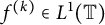 $f^{(k)}\in L^1(\mathbb {T})$
for
 $k=1,\dots ,n$
, and
 $$ \begin{align} \nonumber\int_{\mathbb{T}} f^{(k)}(z)\eta_k(z)~dz=&\int_{\mathbb{T}} \left(\sum_{l=-\infty}^{\infty} \widehat{f^{(k)}}(l)z^l\right)\eta_k(z)\,dz\\ \nonumber=&2\pi i\sum_{l=-\infty}^{\infty} \widehat{f^{(k)}}(l)\widehat{\eta}_k(-(l+1))\\ =&2 \pi i \sum_{l=-\infty}^{\infty}(l+1) \widehat{f^{(k-1)}}(l+1)\widehat{\eta}_k(-(l+1)). \end{align} $$
The final equality arises from the relationship
 $\widehat {f^{(k)}}(l) = (l+1)\widehat {f^{(k-1)}}(l+1)$
. By employing a computation akin to that in the proof of [Reference Chattopadhyay and Sinha9, (3.11)], we derive the representation for the integral
 $$ \begin{align} \nonumber\lim_{R\,\uparrow 1}\int_{\{z:\;|z|\leq R<1\}} \left(\frac{\partial \widetilde{\eta_k}}{\partial z}\frac{\partial \widetilde{f^{( k-1)}}}{\partial \bar{z}} -\frac{\partial \widetilde{f^{(k-1)}}}{\partial z}\frac{\partial \widetilde{\eta_k}}{\partial \bar{z}}\right)\,dz\wedge d\bar{z}\\ = 2\pi i \sum_{l=-\infty}^{\infty}\,l\,\widehat{f^{(k-1)}}(l)\,\hat{\eta_k}(-l) \end{align} $$
for each
 $k=1,\dots ,n$
. Combining equations (3.34)–(3.36) completes the proof of (3.33).
4 Higher-order trace formulas for maximal dissipative operators
In this section, we derive higher-order trace formulas for a pair of maximal dissipative operators
 $L_0,L_1$
without imposing the stringent assumptions of [Reference Chattopadhyay and Pradhan7, Theorem 5.3] that
 $\dim \ker (L_j+iI) = \dim \ker (L_j^*-iI)$
and
 ${\mathrm {Im}\,} L_j=\frac {1}{2i}(L_j-L_j^*)\in \mathcal {B}_{n/2}(\mathcal {H})$
,
 $j=0,1$
. Our result builds upon the trace formula for multiplicative paths of contractions established in Theorem 3.5.
We recall that a densely defined linear operator L (possibly unbounded) in
 $\mathcal {H}$
is called dissipative if
 ${\mathrm {Im}\,}\langle L\,\xi , \xi \rangle \le 0$
for all
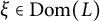 $\xi \in \text {Dom}(L)$
. A dissipative operator is called maximal dissipative if it does not have a proper dissipative extension.
The Cayley transform of the maximal dissipative operator L is defined by
 $$ \begin{align} T=(L+iI)(L-iI)^{-1}. \end{align} $$
It is well known that T is a contraction. Moreover, a contraction T is the Cayley transform of a maximal dissipative operator L if and only if
 $1$
is not an eigenvalue of T (see, e.g., [Reference Sz.-Nagy, Foias, Bercovici and Kérchy25, Theorem 4.1]). In the latter case, the inverse Cayley transform of T is given by
 $$ \begin{align} L=i(T+I)(T-I)^{-1}. \end{align} $$
For
 $\psi (\lambda )=\sum _{k\in \mathbb {Z}}a_k\left (\frac {\lambda +i}{\lambda -i}\right )^k\in \mathfrak {F}_{n}(\mathbb {R})$
, we define
 $$ \begin{align*} \psi(L):=&\sum_{k=0}^{\infty} a_k\big((L+iI)(L-iI)^{-1}\big)^k+\sum_{k=1}^{\infty} a_{-k}{\big((L+iI)(L-iI)^{-1}\big)^*}^k\\ =&\sum_{k=0}^{\infty}a_k T^k+\sum_{k=1}^{\infty}a_{-k} {T^*}^k. \end{align*} $$
Below we use the notation shortcut
 $\frac {L+iI}{L-iI}:=(L+iI)(L-iI)^{-1}$
.
Notations 4.1 Let
 $n \in \mathbb {N}$
,
 $n \geq 2$
. Let
 $L_0$
be a maximal dissipative operator in
 $\mathcal {H}$
and
 $T_0$
be its Cayley transform given by (4.1). Let
 $B = B^* \in \mathcal {B}_n(\mathcal {H})$
, set
 $T_1 := e^{iB} T_0$
, and let
 $L_1$
be the inverse Cayley transform of
 $T_1$
given by (4.2). Assume that
 $1$
is not an eigenvalue of
 $T_1$
.
Theorem 4.2 Assume Notations 4.1. Then, there exist a constant
 $c_n>0$
and
 $\gamma _k(\lambda ):=(\lambda -i)^{-2}\,\eta _{k}\left (\frac {\lambda +i}{\lambda -i}\right )$
with
 $\eta _k$
as in Theorem 3.2,
 $k=1,\dots ,n$
, satisfying
 $$\begin{align*}\|\eta_k\|_1\leq c_n \|(L_1-iI)^{-1}-(L_0-iI)^{-1}\|_n^n\end{align*}$$
and
 $$ \begin{align} \nonumber &\operatorname{Tr}\Bigg(\psi(L_1)-\psi(L_0)-\sum_{k\in\mathbb{Z}}a_k\sum_{l=1}^{n-1}\sum_{r=1}^{l}~\sum_{\substack{l_1+l_2+\cdots+l_{r}=l\\l_1,l_2,\ldots,l_{r}\geq 1}}~\dfrac{1}{l_1!\cdots l_r!}\\ \nonumber &\quad \times \Bigg[\sum_{\substack{\alpha_0+\alpha_1+\cdots+\alpha_r=k\\\alpha_0\geq 0; \,\alpha_1,\ldots,\alpha_r\geq 1}}\left(\frac{L_0+iI}{L_0-iI}\right)^{\alpha_0}(iB)^{l_1} \left(\frac{L_0+iI}{L_0-iI}\right)^{\alpha_1}\cdots (iB)^{l_{r}}\left(\frac{L_0+iI}{L_0-iI}\right)^{\alpha_r}\Bigg]\Bigg)\\ =&\sum_{k=1}^{n}\dfrac{i^{k-1}}{2^{k-1}}\int_{\mathbb{R}} (\lambda-i)^k\,\dfrac{d^{k-1}}{d\lambda^{k-1}} \left((\lambda-i)^k\psi'(\lambda)\right)\gamma_k(\lambda)\,d\lambda \end{align} $$
for every
 $\psi (\lambda )=\sum _{k\in \mathbb {Z}} a_k\left (\frac {\lambda +i}{\lambda -i}\right )^k\in \mathfrak {F}_{n}(\mathbb {R})$
. Moreover, if
 $a_k=0$
,
 $k=1,\dots ,n-1$
, then (4.3) holds with
 $\gamma _k=0$
for
 $k=1,\dots ,n-1$
.
5 Simplified higher-order trace formulas for unitaries and resolvent comparable self-adjoints
As evident from Theorems 2.5, 3.2, and 3.5, the left-hand sides of equations (3.2) and (3.16) exhibit a highly intricate structure. In Theorem 5.2 below, we derive an alternative trace formula for unitary operators that does not involve computation of the operator derivatives along multiplicative paths. As a consequence of the latter result, we obtain higher-order trace formulas for resolvent comparable self-adjoint perturbations, considerably simplifying the trace formulas in [Reference Skripka37, Theorem 5.3].
Notations 5.1 Let
 $n\in \mathbb {N}$
,
 $n\geq 2$
. Let
 $U_0,U_1$
be unitary operators on
 $\mathcal {H}$
and let
 $$ \begin{align*}U_s=U_0+s(U_1-U_0),\quad s\in[0,1].\end{align*} $$
For
 $f\in \mathfrak {F}_{n}(\mathbb {T})$
, consider the modified Taylor remainder
 $$ \begin{align*} \mathcal{R}_{n}^{\mathrm{Lin}}(U_1,U_0,f):= f(U_1)-f(U_0)-\sum_{k=1}^{n-1}T_{f^{[k]}}^{U_0,\ldots,U_0}(U_1-U_0,\ldots,U_1-U_0). \end{align*} $$
Theorem 5.2 Assume Notations 5.1 and assume
 $U_1-U_0\in \mathcal {B}_n(\mathcal {H})$
. Then,
 $\mathcal {R}_{n}^{\mathrm{Lin}}(U_1,U_0,f)\in \mathcal {B}_1(\mathcal {H})$
for every
 $f\in \mathfrak {F}_{n}(\mathbb {T})$
. Furthermore, there exist a constant
 $c_{n}>0$
and a function
 $\eta _n$
in
 $ L^1(\mathbb {T},\tau )$
, unique up to a polynomial of degree at most
 $n-1$
, satisfying
 $$ \begin{align} \|\eta_n\|_1\leq c_{n}\|U_1-U_0\|_n^n \end{align} $$
such that
 $$ \begin{align} \operatorname{Tr}\left(\mathcal{R}_{n}^{\mathrm{Lin}}(U_1,U_0,f)\right)=\int_{\mathbb{T}}f^{(n)}(z)\eta_n(z)\,dz \end{align} $$
for every
 $f\in \mathfrak {F}_{n}(\mathbb {T})$
.
Proof Let
 $f\in \mathfrak {F}_{n}(\mathbb {T})$
. A repeated application of Lemma 2.4 yields
 $$ \begin{align} \nonumber \mathcal{R}_{n}^{\mathrm{Lin}}(U_1,U_0,f) &=T_{f^{[1]}}^{U_0,U_1}(U_1-U_0) -\sum_{k=1}^{n-1}T_{f^{[k]}}^{U_0,\ldots,U_0}(U_1-U_0,\ldots,U_1-U_0)\\ &=T_{f^{[n]}}^{U_0,U_1,U_0,\ldots,U_0}(U_1-U_0,\ldots,U_1-U_0). \end{align} $$
It follows from Definition 2.1 that
 $T_{f^{[n]}}^{ U_0,U_1,U_0,\ldots ,U_0}(U_1-U_0,\ldots ,U_1-U_0)\in \mathcal {B}_1(\mathcal {H})$
and, hence,
 $\mathcal {R}_{n}^{\mathrm{Lin}}(U_1,U_0,f)\in \mathcal {B}_1(\mathcal {H})$
. By Corollary 2.3, we have
 $$ \begin{align*} \left|\operatorname{Tr}\left(\mathcal{R}_{n}^{\mathrm{Lin}}(U_1,U_0,f)\right)\right|\leq \,c_n\,\|f^{(n)}\|_\infty\,\|U_1-U_0\|_n^n. \end{align*} $$
Hence, there exists a measure
 $\mu _{n,U_0,U_1}$
satisfying
 $$ \begin{align} \|\mu_{n,U_0,U_1}\|\leq c_n\,\|U_1-U_0\|_n^n \end{align} $$
and
 $$ \begin{align} \operatorname{Tr}\left(\mathcal{R}_{n}^{\mathrm{Lin}}(U_1,U_0,f)\right)=\int_{\mathbb{T}} f^{(n)}(z)\,d\mu_{n,U_0,U_1}. \end{align} $$
Next, we prove that the measure
 $\mu _{n,U_0,U_1}$
is absolutely continuous with respect to the Lebesgue measure on the circle. Since
 $U_1U_0^*$
is a unitary operator, there is a self-adjoint operator A with the spectrum
 $\sigma (A)$
in
 $(-\pi ,\pi ]$
such that
 $U_1U_0^*=e^{iA}$
, and hence
 $$ \begin{align*}U_1=e^{iA}U_0.\end{align*} $$
Let
 $\{e_i\}_{i\in \mathbb {N}}$
be any orthonormal basis of
 $\mathcal {H}$
and
 $E(\cdot )$
the spectral measure of A. Then, it follows from the spectral theorem and the inequality
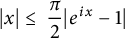 $|x|\leq ~\dfrac {\pi }{2}|e^{ix}-1|$
for
 $x\in {(-\pi ,\pi ]}$
that
 $$ \begin{align*} \|A\|_n^n & = \sum_{i=1}^{\infty}\langle |A|^ne_i,e_i\rangle\\ & =\sum_{i=1}^{\infty}\int_{-\pi}^{\pi}|\lambda|^n\, \|E(d\lambda) e_i\|^2\\ & \leq~\left(\dfrac{\pi}{2}\right)^n\sum_{i=1}^{\infty}\int_{-\pi}^{\pi}|e^{i\lambda}-1|^n~\|E(d\lambda) e_i\|^2\\ & = \left(\dfrac{\pi}{2}\right)^n\,\|U_1-U_0\|_n^n. \end{align*} $$
Since
 $U_1-U_0\in \mathcal {B}_n(\mathcal {H})$
, we conclude that
 $A\in \mathcal {B}_n(\mathcal {H})$
.
Case 1:
 $n=2$
.
We have
 $$ \begin{align*} \mathcal{R}_{2}^{\mathrm{Lin}}(U_1,U_0,f) =\mathcal{R}_{2}^{\mathrm{Mult}}(U_0,A,f)-T_{f^{[1]}}^{U_0,U_0}\left(\left(e^{iA}-I-iA\right)U_0\right), \end{align*} $$
where
 $\mathcal {R}_{2}^{\mathrm{Mult}}(U_0,A,f)$
is defined in (3.1). Therefore, by Theorem 3.2 and Corollary 2.3, there are
 $\eta _{12}$
,
 $\eta _{22}$
in
 $L^1(\mathbb {T})$
, and a measure
 $\nu $
on
 $\mathbb {T}$
such that
 $$ \begin{align*} \|\nu\|\le\|e^{iA}-I-iA\|_1 \end{align*} $$
and
 $$ \begin{align*} \operatorname{Tr}(\mathcal{R}_{2}^{\mathrm{Lin}}(U_1,U_0,f))= \int_{\mathbb{T}} f"(z)\eta_{22}(z)\,dz+\int_{\mathbb{T}} f'(z)\eta_{12}(z)\,dz-\int_{\mathbb{T}} f'(z)d\nu. \end{align*} $$
Integrating by parts yields the existence of an integrable function
 $\eta _2$
such that (5.2) holds (see, e.g., the proof of [Reference Potapov, Skripka and Sukochev31, Theorem 3.2]).
Case 2:
 $n\geq 3$
.
Note that
 $$ \begin{align} \mathcal{R}_{n}^{\mathrm{Lin}}(U_1,U_0,f)=\mathcal{R}_{n-1}^{\mathrm{Lin}}(U_1,U_0,f)-T_{f^{[n-1]}}^{U_0,\ldots,U_0}(U_1-U_0,\ldots,U_1-U_0). \end{align} $$
Let
 $\{A_m\}_{m\in \mathbb {N}}\subset \mathcal {B}_1(\mathcal {H})$
be a sequence of self-adjoint operators converging to A in the norm
 $\|\cdot \|_n$
and such that
 $$ \begin{align*}\sup_{m\in\mathbb{N}}\|A_m\|\le \|A\|.\end{align*} $$
Define
 $$ \begin{align*}U_{0m}=e^{iA_m}U_0.\end{align*} $$
It follows from Corollary 2.3 and equations (5.3) and (5.6) that there exist measures
 $\mu _{n,m}$
,
 $ m\in \mathbb {N}$
, satisfying
 $$ \begin{align*} \|\mu_{n,m}\|\le c_n\|U_1-U_0\|_n^n \end{align*} $$
and
 $$ \begin{align} \operatorname{Tr}\left(\mathcal{R}_{n}^{\mathrm{Lin}}(U_{0m},U_0,f)\right)=\int_{\mathbb{T}} f^{(n-1)}(z)\,d\mu_{n,m}. \end{align} $$
Integrating (5.7) by parts yields the existence of a sequence
 $\{\eta _{n,m}\}_{m\in \mathbb {N}}\subset L^1(\mathbb {T})$
such that
 $$ \begin{align} \operatorname{Tr}\left(\mathcal{R}_{n}^{\mathrm{Lin}}(U_{0m},U_0,f)\right)=\int_{\mathbb{T}} f^{(n)}(z)\eta_{n,m}(z)\,dz. \end{align} $$
By Lemma 2.6,
 $$ \begin{align} \|e^{i A_m}-e^{iA}\|_n \leq e^{\|A\|}\,\|A-A_m\|_n. \end{align} $$
It follows from (5.9) that
 $U_{0m}$
converges to
 $U_1$
in
 $\mathcal {B}_n(\mathcal {H})$
. Hence,
 $$ \begin{align*}V_m:=U_{0m}-U_0\end{align*} $$
forms a Cauchy sequence in
 $\mathcal {B}_n(\mathcal {H})$
. In particular, there exists
 $M>0$
such that
 $$ \begin{align*}\sup_{m\in\mathbb{N}}\|V_m\|_n\leq M.\end{align*} $$
By (5.3) and telescoping,
 $$ \begin{align*} &\mathcal{R}_{n}^{\mathrm{Lin}}(U_{0m},U_0,f) -\mathcal{R}_{n}^{\mathrm{Lin}}(U_{0p},U_0,f)\\ &\quad = T_{f^{[n-1]}}^{U_{0},U_{0m},U_0,\ldots,U_0}(V_m,\ldots,V_m)-T_{f^{[n-1]}}^{ U_{0},U_{0p},U_0,\ldots,U_0}(V_p,\ldots,V_p)\\ &\qquad -\left(T_{f^{[n-1]}}^{U_0,\ldots,U_0}(V_m,\ldots,V_m)-T_{f^{[n-1]}}^{U_0,\ldots,U_0}(V_p,\ldots,V_p)\right)\\ &\quad =T_{f^{[n-1]}}^{U_0,U_{0m},U_{0p},U_0\ldots,U_0}(V_m,U_{0m}-U_{0p},\ldots,V_m)\\ & \qquad +\sum_{k=1}^{n-1}\Big[T_{f^{[n-1]}}^{U_0,U_{0p},U_0\ldots,U_0}(V_p,\ldots,V_p,\underbrace{V_m-V_p}_{k-\text{th entry}},V_m,\ldots,V_m)\\ &\qquad -T_{f^{[n-1]}}^{U_0,U_0,U_0\ldots,U_0}(V_p,\ldots,V_p,\underbrace{V_m-V_p}_{k-\text{th entry}},V_m,\ldots,V_m)\Big]\\ &\quad =T_{f^{[n]}}^{U_0,U_{0m},U_{0p},U_0\ldots,U_0}(V_m,U_{0m}-U_{0p},\ldots,V_m)\\ &\qquad +T_{f^{[n]}}^{U_0,U_{0p},U_0\ldots,U_0}(V_m-V_p,U_{0p}-U_0,V_m,\ldots,V_m)\\ &\qquad +\sum_{k=3}^{n}T_{f^{[n]}}^{U_0,U_{0p},U_0\ldots,U_0}(V_p,U_{0p}-U_0,V_p\ldots,V_p,\underbrace{V_m-V_p}_{k-\text{th entry}},V_m,\ldots,V_m). \end{align*} $$
The latter along with Corollary 2.3 implies
 $$ \begin{align*} &\left|\operatorname{Tr}\left(\mathcal{R}_{n}^{\mathrm{Lin}}(U_{0m},U_0,f)\right) -\operatorname{Tr}\left(\mathcal{R}_{n}^{\mathrm{Lin}}(U_{0p},U_0,f)\right)\right|\\ &\quad \leq c_n M^{n-1}\|f^{(n)}\|_\infty\max\big\{\|U_{0m}-U_{0p}\|_n, \|U_0-U_{0p}\|_n,\|V_m-V_p\|_n\big\}, \end{align*} $$
which further implies
 $$ \begin{align} \nonumber&\sup_{f\in\mathcal{F}_n(\mathbb{T}):\;\|f^{(n)}\|_\infty\leq 1}\left|\operatorname{Tr}\left(\mathcal{R}_{n}^{\mathrm{Lin}}(U_{0m},U_0,f)\right) -\operatorname{Tr}\left(\mathcal{R}_{n}^{\mathrm{Lin}}(U_{0p},U_0,f)\right)\right|\\ &\leq c_n M^{n-1}\max\big\{\|U_{0m}-U_{0p}\|_n, \|U_0-U_{0p}\|_n,\|V_m-V_p\|_n\big\}\longrightarrow 0 \text{ as } m,p\to \infty. \end{align} $$
Applying [Reference Skripka37, Lemma 4.3] along with (5.8) and (5.10) yields
 $$ \begin{align*} \|[\eta_{n,m}]-[\eta_{n,p}]\|_{L^1(\mathbb{T})/\mathcal{P}_n}\longrightarrow 0 \text{ as } m,p\to \infty. \end{align*} $$
Hence, there exists an
 $L^1(\mathbb {T})$
-function
 $\eta _n$
, unique up to an additive polynomial of degree
 $n-1$
, satisfying (5.2). The estimate (5.1) follows from (5.4) and (5.5).
We note that the trace formula (5.2) does not translate from unitaries to contractions via the Schäffer matrix dilation because the block matrix representation of
 $T_{f^{[k]}}^{U_{T_0},\ldots ,U_{T_0}}(U_{T_1}-U_{T_0},\ldots ,U_{T_1}-U_{T_0})$
contains both upper and lower triangular matrices.
Below, we apply Theorem 5.2 to derive trace formulas for resolvent comparable self-adjoint operators.
Notations 5.3 Let
 $n \in \mathbb {N}$
,
 $n \geq 2$
. Let
 $H_0$
be a closed, densely defined self-adjoint operator in
 $\mathcal {H}$
and V a self-adjoint operator in
 $\mathcal {B}(\mathcal {H})$
. Denote
 $H_1 := H_0 + V$
. Define the unitary operators via the Cayley transforms of
 $H_0$
and
 $H_1$
:
 $$\begin{align*}U_0 := (H_0 + iI)(H_0 - iI)^{-1}\, \text{ and }\; U_1 := (H_1 + iI)(H_1 - iI)^{-1}.\end{align*}$$
Observe that
 $$ \begin{align*} U_1 - U_0 &= -2i(H_1 - iI)^{-1}V(H_0 - iI)^{-1},\\ U_1U_0^* &= I - 2i(H_1 - iI)^{-1}V(H_0 + iI)^{-1}. \end{align*} $$
If
 $(H_1 - iI)^{-1} - (H_0 - iI)^{-1}\in \mathcal {B}_n(\mathcal {H})$
, then
 $U_1-U_0,A\in \mathcal {B}_n(\mathcal {H})$
, where
 $A = A^*$
is such that its spectrum is contained in
 $(-\pi , \pi ]$
and
 $U_1 U_0^* = e^{iA}$
(see the proof of Theorem 5.2).
Theorem 5.4 Assume Notations 5.3 and assume that
 $$\begin{align*}(H_1-iI)^{-1}-(H_0-iI)^{-1}\in\mathcal{B}_n(\mathcal{H}).\end{align*}$$
Then, there exist
 $c_n>0$
and
 $\gamma _n(\lambda ):=(\lambda -i)^{-2}\,\eta _{n}\left (\frac {\lambda +i}{\lambda -i}\right )$
, with
 $\eta _n$
as in Theorem 5.2, satisfying
 $$\begin{align*}\|\gamma_n\|_1\leq c_n \|(H_1-iI)^{-1}-(H_0-iI)^{-1}\|_n^n\end{align*}$$
and
 $$ \begin{align} \nonumber&\operatorname{Tr}\left(\psi(H_1)-\psi(H_0)-\sum_{k=1}^{n-1}\sum_{1\leq j_1<\cdots<j_k\leq n-1} T_{\psi^{[k]}}^{H_0,H_0,\ldots,H_0}(V_{j_1},\ldots,V_{j_k})\right)\\ &\quad =\dfrac{i^{n-1}}{2^{n-1}}\int_{\mathbb{R}} (\lambda-i)^ n\,\dfrac{d^{n-1}}{d\lambda^{n-1}}\left((\lambda-i)^n\psi'(\lambda)\right)\gamma_n(\lambda)\,d\lambda \end{align} $$
for every
 $\psi \in \mathfrak {F}_{n}(\mathbb {R})$
, where
 $$ \begin{align*} V_{j_l}=\big((I-V(H_1-iI))^{-1}V(H_0-iI)^{-1}\big)^{j_l-j_{l-1}}(I-V(H_1-iI))^{-1}V \end{align*} $$
and
 $j_0:=0$
.
Proof The result follows upon applying the substitution of [Reference Skripka37, Theorem 5.2] on the left-hand side of (5.2) and changing the variable on the right-hand side of (5.2) as outlined in the proof of [Reference Potapov, Skripka and Sukochev32, Theorem 3.5].
Acknowledgements
The authors thank the anonymous referee for several suggestions that helped to improve the exposition of the article.



