Introduction
Management of giant ragweed (Ambrosia trifida L.) is a problem in many crop production regions, which can be attributed to several characteristics of A. trifida, including a wide germination period, rapid early-season growth, and a high degree of competitiveness compared with most summer annual weeds (Abul-Fatih and Bazzaz Reference Abul-Fatih and Bazzaz1979; Bradley et al. Reference Bradley, Johnson, Smeda and Boerboom2007; Johnson et al. Reference Johnson, Loux, Nordby, Sprague, Nice, Westhoven and Stachler2007; Schutte et al. Reference Schutte, Regnier, Harrison, Schmoll, Spokas and Forcella2008). Control of A. trifida is further complicated by the evolution of glyphosate-resistant (GR) biotypes, which are currently found in 13 states in the United States and in Ontario, Canada (Heap Reference Heap2017). A unique rapid response to glyphosate has been observed in several GR A. trifida biotypes (hereafter referred to as the RR biotype), in which mature leaves begin to accumulate H2O2 by 0.5 h after treatment (HAT) and become necrotic in as little as 2 HAT, while the immature leaves remain uninjured (Harre et al. Reference Harre, Nie, Robertson, Johnson, Weller and Young2017a; Van Horn et al. Reference Van Horn, Moretti, Robertson, Segobye, Weller, Young, Johnson, Schulz, Green, Jeffery, Lesperance, Tardif, Sikkema, Hall, McLean, Lawton, Sammons, Wang, Westra and Gaines2017). This sacrificial form of glyphosate resistance, which effectively reduces glyphosate translocation throughout the plant so that a lethal dose does not reach apical meristems, has not been documented in any other weed species (Moretti et al. Reference Moretti, Van Horn, Robertson, Segobye, Weller, Young, Johnson, Sammons, Wang, Ge, d’Avignon, Gaines, Westra, Green, Jeffery, Lesperance, Tardif, Sikkema, Hall, McLean, Lawton and Schulz2017). Another GR A. trifida biotype displays a non–rapid response (NRR) to glyphosate that more closely resembles phenotypes of other GR weeds, whereby apical meristems become slightly chlorotic but resume normal growth within 1 to 2 wk (Harre et al. Reference Harre, Nie, Robertson, Johnson, Weller and Young2017a; Van Horn et al. Reference Van Horn, Moretti, Robertson, Segobye, Weller, Young, Johnson, Schulz, Green, Jeffery, Lesperance, Tardif, Sikkema, Hall, McLean, Lawton, Sammons, Wang, Westra and Gaines2017).
In geographies affected by GR weeds, application of POST herbicides in combination with glyphosate has become routine practice for many grain producers to broaden the spectrum of weed control and employ additional mechanisms of action to manage GR biotypes (Benbrook Reference Benbrook2016). However, in both field and greenhouse studies, the glyphosate-induced RR in A. trifida can antagonize the efficacy of glyphosate mixtures with atrazine, cloransulam, dicamba, and topramezone (Harre et al. Reference Harre, Young and Young2017b). Furthermore, at increasing glyphosate rates, the RR elicits greater H2O2 production in leaf tissue, thereby amplifying the degree of glyphosate-induced antagonism on POST herbicides (Harre et al. Reference Harre, Nie, Robertson, Johnson, Weller and Young2017a, Reference Harre, Young and Young2017b). In contrast, increasing glyphosate rates did not alter H2O2 generation in the NRR biotype and largely improved performance when applied with POST herbicides. Similar to the glyphosate dose response, anecdotal evidence suggests air temperature may also be involved in regulating the onset of the RR (SC Weller, personal communication).
The effect of environmental conditions on herbicide performance has been the topic of many studies (for reviews, see Kudsk and Kristensen Reference Kudsk and Kristensen1992; Varanasi et al. Reference Varanasi, Prasad Vara and Jugulam2016). From these reports, a central tenet of herbicide physiology is that phytotoxicity is enhanced when a plant is actively growing. For example, favorable summer annual weed growing conditions (i.e., warm temperatures, high soil moisture, and sufficient irradiance) enhance photosynthetic rates and, in turn, increase translocation of photoassimilates and concomitant xylem- and phloem-mobile herbicides (Lambers et al. Reference Lambers, Chapin and Pons2008). Likewise, because mechanisms of action for foliar herbicides with limited mobility are intricately linked to photosynthesis (e.g., paraquat, lactofen), increased photosynthetic rates generally improve performance of these herbicides as well (Hatterman-Valenti et al. Reference Hatterman-Valenti, Pitty and Owen2011).
Efficacy of the phloem-mobile herbicide glyphosate on sensitive weeds tends to increase at elevated temperatures (Coupland Reference Coupland1983; Franz et al. Reference Franz, Mao and Sikorski1997; Jordan Reference Jordan1977; Masiunas and Weller Reference Masiunas and Weller1988; Waltz et al. Reference Waltz, Martin, Roeth and Lindquist2004). However, there are reports of reduced efficacy (Adkins et al. Reference Adkins, Tanpipat, Swarbrick and Boersma1998b; Tanpipat et al. Reference Tanpipat, Adkins, Swarbrick and Boersma1997) or no change in efficacy (Devine et al. Reference Devine, Bandeen and McKersie1983; Sivesind et al. Reference Sivesind, Gaska, Jeschke, Boerboom and Stoltenberg2011). Soil moisture variations also influence glyphosate performance. Weeds grown in soils with a water status near field capacity are often most sensitive to glyphosate (Adkins et al. Reference Adkins, Tanpipat, Swarbrick and Boersma1998a; Franz et al. Reference Franz, Mao and Sikorski1997), while flooding or drought conditions tend to reduce glyphosate efficacy (Skelton et al. Reference Skelton, Ma and Riechers2016; Zhou et al. Reference Zhou, Tao, Messersmith and Nalewaja2007). In contrast, Sherner et al. (Reference Sherner, Avila, Schreiber, Kruse, Fernando and Garcia2017) reported greater glyphosate efficacy on flooded soils, Tworkoski et al. (Reference Tworkoski, Engle and Kujawski1998) described greater efficacy under dry soil conditions, and Zanatta et al. (Reference Zanatta, Procopio, Manica, Pauletto, Cargnelutti, Vargas, Sganzerla, Rosenthal and Pinto2007) found no difference between varying soil moisture levels. The effect of elevated irradiance levels has been shown to increase (Coupland Reference Coupland1983; Kells and Rieck Reference Kells and Rieck1979), decrease (Santos et al. Reference Santos, Amaral, Alves and Gasparino2016; Sharkhuu et al. Reference Sharkhuu, Narasimhan, Merzaban, Bressan, Weller and Gehring2014), or be unrelated to glyphosate performance (Adkins et al. Reference Adkins, Tanpipat, Swarbrick and Boersma1998b; Masiunas and Weller Reference Masiunas and Weller1988).
Similar studies have been performed on the influence of environmental conditions on GR weeds. Perhaps the most notable instance of environmental regulation on glyphosate efficacy in a GR weed is that of horseweed [Conyza canadensis (L.) Cronq.]. Ge et al. (Reference Ge, d’Avignon, Ackerman and Sammons2010) identified the glyphosate-resistance mechanism in C. canadensis to be enhanced vacuolar sequestration. The authors surmise that GR individuals overexpress a glyphosate transporter protein across the tonoplast that is more efficient at warmer temperatures, evidenced by a rapid increase in vacuolar sequestered glyphosate in plants acclimated at 20 C compared with 12 C (Ge et al. Reference Ge, d’Avignon, Ackerman and Sammons2010, Reference Ge, d’Avignon, Ackerman, Duncan, Spaur and Sammons2011). Consequently, suboptimal temperatures suppressed the glyphosate-resistance mechanism in GR C. canadensis, with control >90% when treated with glyphosate at 12 C. Similar accounts of suboptimal temperatures improving glyphosate efficacy have been reported for GR rigid ryegrass (Lolium rigidum Gaudin), GR johnsongrass [Sorghum halepense (L.) Pers.], and GR hairy fleabane [Conyza bonariensis (L.) Cronq.] (Kleinman et al. Reference Kleinman, Ben-Ami and Rubin2016; Vila-Aiub et al. Reference Vila-Aiub, Gundel, Yu and Powles2012). In contrast to the latter findings, elevated temperatures contributed to greater glyphosate translocation to meristematic regions and improved glyphosate efficacy on GR soybean [Glycine max (L.) Merr.] with an insensitive 5-enolpyruvyl-shikimate-3-phosphate synthase (EPSPS) enzyme (Pline et al. Reference Pline, Wu and Hatzios1999) and NRR A. trifida with an unknown mechanism of resistance (Ganie et al. Reference Ganie, Jugulam and Jhala2017). In GR junglerice [Echinochloa colona (L.) Link.] possessing both an EPSPS target-site mutation and enhanced EPSPS activity, control from glyphosate improved at field capacity versus one-half field capacity. Furthermore, glyphosate performance on this GR E. colona population improved substantially at 50% light versus full light conditions (Alarcón-Reverte et al. Reference Alarcón-Reverte, Garcia, Watson, Abdallah, Sabate, Hernandez, Dayan and Fischer2014; Steinhauer and Shrestha Reference Steinhauer and Shrestha2017). Shade treatment of GR C. bonariensis also enhanced glyphosate activity, though the mechanism of resistance in this population had not yet been elucidated (Kleinman et al. Reference Kleinman, Ben-Ami and Rubin2016). Based on the varying glyphosate resistance mechanisms in the previous reports and the variable responses to environmental factors, glyphosate toxicity in GR plants may differ on a case-by-case basis depending on the specific plant species and resistance mechanism(s) present.
To determine how air temperature, soil moisture, and light intensity influence the response to glyphosate and combinations of glyphosate plus POST herbicides in RR A. trifida, the following objectives were established: (1) elucidate how these environmental factors regulate the onset of the RR by measuring H2O2 generation in leaf disks; (2) determine whether these environmental factors affect glyphosate efficacy; and (3) describe the interaction between glyphosate and POST herbicides in response to these differing environmental variables.
Materials and Methods
Plant Propagation
A RR A. trifida population previously characterized for glyphosate resistance by Harre et al. (Reference Harre, Nie, Robertson, Johnson, Weller and Young2017a) was stratified in a moist 3:1 sand:soil mixture to alleviate seed dormancy and improve germination (Westhoven et al. Reference Westhoven, Davis, Gibson, Weller and Johnson2008). Seeds were planted in commercial potting media (Sun Gro® seedling mix, Sun Gro Horticulture, Bellevue, WA 98008) in 25 by 50 cm flats in a greenhouse with day and nighttime temperatures of 30 and 25 C (±5 C), respectively, and a relative humidity of 45% (±10%). High-pressure sodium bulbs providing 1,100 μmol m−2 s−1 photon-flux density on a 16-h photoperiod supplemented natural lighting. Upon reaching the 1-node growth stage (first true leaves fully expanded), plants were transplanted into a 50% potting mix, 25% unsterilized field soil, and 25% unsterilized sand mixture in 10-cm2 pots for the temperature and light-intensity experiments and 16.5-cm2 pots for the soil moisture experiment. As elucidated by Schafer et al. (Reference Schafer, Hallett and Johnson2012), inclusion of unsterilized field soil in GR A. trifida experiments is imperative to avoid false-positive results. Plants were watered daily and fertilized weekly with a macro- and micronutrient fertilizer [Jack’s Classic Professional (20-20-20), JR Peters, Allentown, PA 18106] to sustain optimal growth.
Controlled Environment Manipulation
Because herbicide application for the 4- to 5-node growth stage was being targeted, plants were exposed to each environment 3 d prior and 3 d after treatment (DAT). This acclimation period has been used by other researchers to evaluate environmental effects on herbicides (Kleinman et al. Reference Kleinman, Ben-Ami and Rubin2016; Pline et al. Reference Pline, Wu and Hatzios1999; Saini et al. Reference Saini, Malone, Preston and Gill2016) and was selected to avoid introducing confounding factors such as variances in leaf cuticle thickness that may arise from a longer acclimation period. Growing conditions beyond this 6-d period were as described earlier.
Temperature
Plants were randomly assigned to a set of growth chambers (Conviron Controlled Environments, North Branch, MN 55056) with a constant temperature of 30 or 10 C. Other factors, including watering schedule, light intensity (950 μmol m−2 s−1), and relative humidity (55±5%), were identical between chambers. Plants were returned to the greenhouse 3 DAT.
Soil Moisture
Following the methods of Gardner (Reference Gardner1986), plants were randomly assigned to a soil moisture level of field capacity or one-third field capacity. Field capacity was determined by saturating air-dried growing media and measuring the change in weight 1 d later to allow water drainage by gravity. Soil moisture levels were maintained by weighing pots each morning and adding water to reach the desired weight. The experiment was performed in the greenhouse, and plants were placed on the same watering schedule following 3 DAT.
Light Intensity
Randomly assigned plants were either placed under shade cloth (50% Sunblock, AgFabric, Vista, CA 92081) or left uncovered in the greenhouse. During the 6-d period surrounding herbicide treatment, photosynthetic active radiation (PAR) measurements were recorded every 4 h during the 16-h photoperiod at plant canopy height for both no-shade and shade treatments. The average PAR for no-shade conditions was 487 μmol m−2 s−1 (SD=196), and the average PAR for shade conditions was 223 μmol m−2 s−1 (SD=114). The shade cloth was removed at 3 DAT. At the time of the light-intensity experiment in summer, the ambient light intensity in the greenhouse was reduced to maintain temperature control. Therefore, while differences in PAR were achieved by use of shade cloth, it must be acknowledged that PAR for no-shade conditions of 487 μmol m−2 s−1 was still below the 600 μmol m−2 s−1 threshold of Sage and Pearcy (Reference Sage and Pearcy1987) for weed growth in controlled environments to mimic field conditions. For the H2O2 accumulation experiment described later, a third light treatment was included, in which plants sprayed with glyphosate were immediately placed in a growth chamber in complete darkness for 48 HAT and then returned to normal light conditions in the greenhouse.
Herbicide Treatments
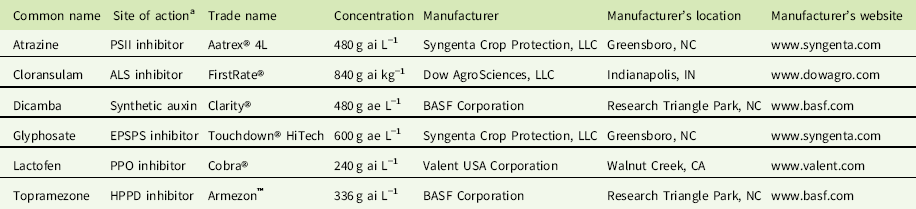
Glyphosate (840 g ae ha−1) was applied alone and in combination with the following POST herbicides at reduced rates: atrazine (370 g ai ha−1), cloransulam (4.5 g ai ha−1), dicamba (50 g ae ha−1), lactofen (35 g ai ha−1), and topramezone (4 g ai ha−1). To accurately characterize herbicide interactions, each POST herbicide was also applied without glyphosate. The rates of POST herbicides were based on previous work determining the appropriate dose to achieve 60% to 70% dry weight reduction in the greenhouse (Harre et al. Reference Harre, Young and Young2017b). All glyphosate treatments contained a nonionic surfactant (Activator 90, Loveland Products, Loveland CO 80538) at 0.25% v/v. Atrazine, cloransulam, and lactofen treatments contained crop oil concentrate (Prime Oil, Winfield Solutions, St Paul, MN 55164) at 1% v/v, and topramezone treatments contained methylated seed oil (MSO Ultra™, Precision Laboratories, Waukegan, IL 60085) at 1% v/v. Herbicide manufacturer information is provided in Table 1. Treatments were applied using a single-nozzle spray booth calibrated to deliver 140 L ha−1 at a pressure of 207 kPa using an XR 8002 spray tip (TeeJet® Technologies, Urbandale, IA 50322).
Sources of commercial herbicides used in experiments.

a Abbreviations: ALS, acetolactate synthase; EPSPS, 5-enolpyruvyl-shikimate-3-phosphate synthase; HPPD, 4-hydoxyphenyl-pyruvatedioxygenase; PPO, protoporphyrinogen oxidase; PSII, photosystem II.
H 2 O 2 Accumulation
Use of 3, 3′-diaminobenzidine (DAB) staining enables detection of H2O2 at an earlier stage than visual tissue damage and has been used previously to follow induction and progression of the RR in A. trifida (Harre et al. Reference Harre, Nie, Robertson, Johnson, Weller and Young2017a; Moretti et al. Reference Moretti, Van Horn, Robertson, Segobye, Weller, Young, Johnson, Sammons, Wang, Ge, d’Avignon, Gaines, Westra, Green, Jeffery, Lesperance, Tardif, Sikkema, Hall, McLean, Lawton and Schulz2017). Following the methodology of Thordal-Christensen et al. (Reference Thordal-Christensen, Zhang, Wei and Collinge1997), DAB staining was used to detect the presence of H2O2 over time following treatment with 840 g ha−1 glyphosate under the various environments described earlier. Using different plants at each sampling event, two 7.9-mm leaf disks were collected from the intercostal region of 2nd-node leaves on 4-node plants and placed in 1.5-ml centrifuge tubes at 0, 0.5, 1, 1.5, 2, and 2.5 HAT. For the dark followed by no-shade treatment in the light-intensity experiment, leaf disks were collected at the same time points during the dark period, in addition to 48.5, 49, 49.5, 50, and 50.5 HAT upon returning to normal light conditions. To facilitate dissolution of DAB, drops of HCl were added to water to attain pH 3.62 before creating a DAB solution of 1 mg ml−1 water-HCl. Centrifuge tubes were filled with DAB solution and immediately covered with aluminum foil, as DAB is light-sensitive. Leaf disks were suspended in solution for 8 h by placing centrifuge tubes atop a laboratory gyrating shaker. In the presence of H2O2, DAB forms a brown precipitate. To aid in visual confirmation, chlorophyll was destroyed by placing leaf disks in boiling ethanol (100%) for 15 min. Drops of 50% glycerol solution were applied to leaf disks to facilitate handling, as these are brittle following chlorophyll removal. Digital photos were taken of each leaf disk and analyzed for percent area stained using APS Assess image-analysis software (v. 2.0, American Phytopathological Society, St Paul, MN 55121).
Experimental Design and Analysis
Following herbicide treatment, visual control ratings were taken at 1, 3, 7, 14, and 21 DAT using a scale of 0 (no control) to 100 (complete control). Shoot tissue was harvested at 21 DAT and dried at 45 C until constant weight to determine dry weight reduction compared with the nontreated control. Experiments were analyzed as completely randomized designs and consisted of four replications (1 plant replicate−1), except for the H2O2 accumulation experiments, which contained eight replications. All experiments were performed twice. Data were evaluated for normality and homogeneity of variance using PROC UNIVARIATE and Levene’s test in SAS 9.4 (SAS Institute, Cary, NC 27513). Per the assumptions of ANOVA, data were square-root transformed before analysis using PROC MIXED. Data were pooled over experimental runs, as there were no treatment by run interactions (P>0.05). Within each environmental factor and for each herbicide treatment, efficacy data were compared using a two-tailed Student’s t-test (α=0.05). Data for H2O2 accumulation were regressed over time and fit using linear regression in PROC REG. Equality of slopes was compared using analysis of covariance, where H2O2 accumulation was the dependent variable, environment was the categorical factor, and HAT was the covariate. Interactions between glyphosate and POST herbicides were classified as antagonistic, synergistic, or additive according to the multiplicative survival model and using Colby’s equation (Reference Colby1967) to calculate expected growth reduction for herbicide mixtures:
 $$E\,{\equals}\,100{\minus}\left\{ {\left[ {\left( {100{\minus}x} \right){\times}\left( {100{\minus}y} \right)} \right]{\div}100} \right\}$$
where E is the expected growth reduction as a percent of the control, and x and y represent the growth reduction as a percent of the control from the two herbicides applied alone. Expected values were separated from observed values using a two-tailed Student’s t-test (α=0.05). A herbicide combination was classified as antagonistic if observed control was significantly less than expected control and as synergistic if observed control was significantly greater than expected control.
Results and Discussion
H 2 O 2 Accumulation
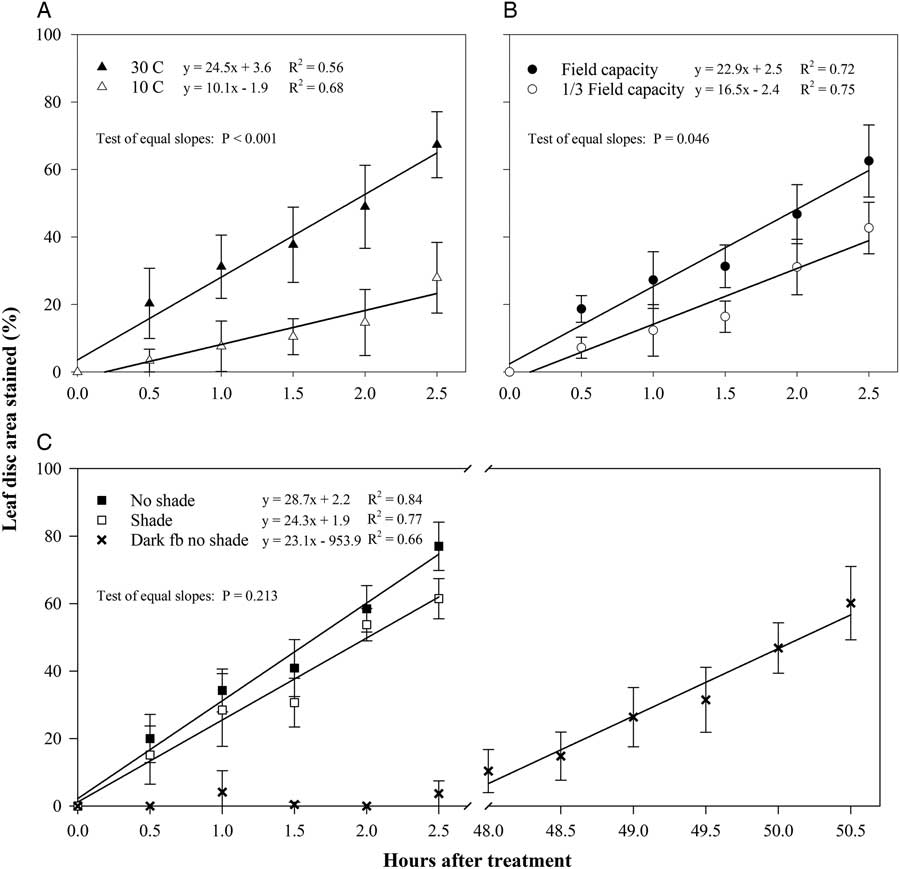
H2O2 is a reactive oxygen species eliciting cellular damage through oxidation of DNA, proteins, and lipids (Das and Roychoudhury Reference Das and Roychoudhury2014). An increase in H2O2 after treatment with glyphosate was detectable in as little as 0.5 HAT under all environments, excluding the dark followed by no-shade treatment (Figure 1). The rate of H2O2 accumulation was greater in leaves under 30 C conditions compared with 10 C conditions (Figure 1A). By 2.5 HAT, the area of leaf disk stained under 30 C conditions was more than twice the area stained under 10 C conditions. Likewise, the rate of H2O2 accumulation was greater in leaves from plants at field capacity compared with one-third field capacity (Figure 1B). However, differences in H2O2 accumulation rates between soil moisture levels were not as pronounced as those observed in the temperature experiment. Leaves of glyphosate-treated plants under no-shade and shade conditions accumulated H2O2 at similar rates (Figure 1C). As PAR for both of these treatments was low relative to ambient sunlight under field conditions, differences in irradiance were likely not large enough in this experiment to detect differences in H2O2 accumulation. For the plants placed in complete darkness following glyphosate treatment, leaf disk staining at any collection time up to 2.5 HAT was never greater than 5%. By 48 HAT, this value had risen to 11%, and upon return to normal light conditions, H2O2 accumulation followed a similar pattern to that in plants placed in no-shade or shade conditions immediately following glyphosate treatment.
Accumulation of H2O2 in rapid response, glyphosate-resistant A. trifida following treatment with 840 g ae ha−1 glyphosate, assessed under differing regimes: (A) temperature, (B) soil moisture, and (C) light intensity. H2O2 content was quantified in leaf disks using 3,3′-diaminobenzidine staining and image-analysis software. Slopes of linear regression models were compared using analysis of covariance. Errors bars denote 1 standard error of the mean.

Environmental conditions used in these experiments were selected to promote high or low photosynthetic activity as, within reason, summer annual plants generally become more productive at warmer temperatures, greater soil moisture levels, and higher light-intensity regimes (Lambers et al. Reference Lambers, Chapin and Pons2008). H2O2 accumulated in glyphosate-treated leaves faster at temperature and soil moisture levels more conducive to photosynthetic activity and, moreover, was stimulated only in the presence of light. These results suggest the RR is an energy-dependent process requiring high-energy electrons to start the chain reaction of lipid peroxidation that is characteristic of reactive oxygen species accumulation (Das and Roychoudhury Reference Das and Roychoudhury2014). Future work to identify the subcellular accumulation site of H2O2 and other reactive oxygen species will be valuable, as these factors may further influence induction of the RR to glyphosate (Lespérance Reference Lespérance2016; Mittler et al. Reference Mittler, Vanderauwera, Gollery and Van Breusegem2004; Moretti et al. Reference Moretti, Van Horn, Robertson, Segobye, Weller, Young, Johnson, Sammons, Wang, Ge, d’Avignon, Gaines, Westra, Green, Jeffery, Lesperance, Tardif, Sikkema, Hall, McLean, Lawton and Schulz2017).
Herbicide Efficacy
Glyphosate
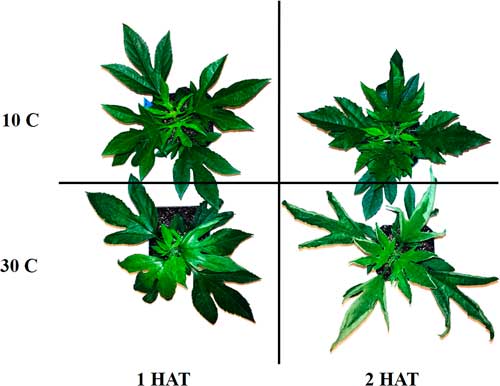
Suboptimal temperature and soil moisture conditions delayed H2O2 accumulation following glyphosate treatment and, accordingly, symptomology of the RR was also delayed, as depicted in Figure 2. Nevertheless, control from glyphosate was similar between optimal and suboptimal growing conditions at 21 DAT (Table 2). Thus, while it is plausible that delaying the RR would enhance glyphosate efficacy, this effect may be offset by the concomitant reduction at suboptimal growing conditions of plant physiological activities such as photosynthesis, phloem translocation, respiration, and protoplasmic streaming (Lambers et al. Reference Lambers, Chapin and Pons2008; Varanasi et al. Reference Varanasi, Prasad Vara and Jugulam2016). Although not measured in this experiment, changes in the rates of these processes have been shown to influence glyphosate efficacy (Franz et al. Reference Franz, Mao and Sikorski1997).
Delayed rapid response symptomology at 10 C vs. 30 C in glyphosate-resistant A. trifida treated with 840 g ae ha−1 glyphosate. Photos were taken at 1 and 2 h after treatment (HAT).

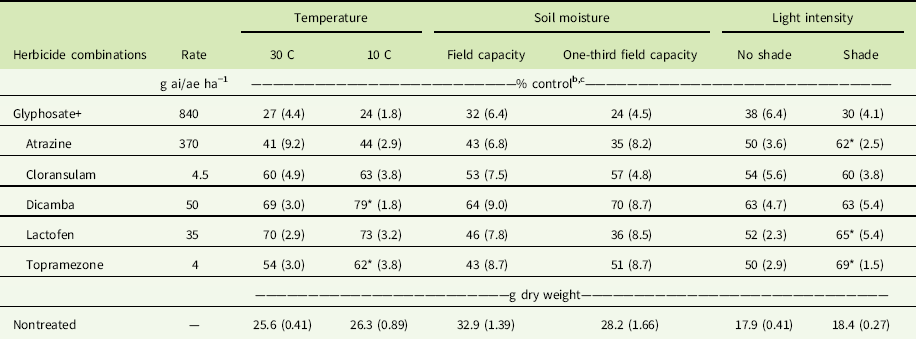
Influence of environmental factors on control from glyphosate plus POST herbicides on rapid response, glyphosate-resistant A. trifida at 21 d after treatment.Footnote a

a Values in parentheses represent the standard error of the mean.
b Control based on plant dry weight reduction compared with nontreated check.
c Values with an asterisk (*) denote a significant difference between the two levels of each environmental factor within rows according to a Student’s t-test (α=0.05).
These results are in contrast to those of Ganie et al. (Reference Ganie, Jugulam and Jhala2017), whereby glyphosate efficacy on GR A. trifida was greater at 29 C versus 20 C due to enhanced glyphosate translocation. However, the GR A. trifida biotype used in the latter experiment displayed the NRR phenotype and thus lacked the apparent temperature-sensitive oxidative burst associated with the RR. Reports on other GR weeds, including C. canadensis (Ge et al. Reference Ge, d’Avignon, Ackerman, Duncan, Spaur and Sammons2011) and L. rigidum (Vila-Aiub et al. Reference Vila-Aiub, Gundel, Yu and Powles2012), documented suboptimal temperatures inhibiting vacuolar sequestration of glyphosate, thereby improving glyphosate efficacy. As elucidated by Moretti et al. (Reference Moretti, Van Horn, Robertson, Segobye, Weller, Young, Johnson, Sammons, Wang, Ge, d’Avignon, Gaines, Westra, Green, Jeffery, Lesperance, Tardif, Sikkema, Hall, McLean, Lawton and Schulz2017), glyphosate is not sequestered in the vacuole of RR A. trifida. Thus, sensitivity to glyphosate among GR weed species at suboptimal temperatures is likely contingent upon the specific mechanism of resistance involved. Reports on the influence of soil moisture or light intensity on glyphosate toxicity in GR weeds are less common than temperature experiments. In one case, glyphosate efficacy on GR E. colona improved by 30% at field capacity compared with one-half field capacity, while low light intensity improved efficacy by at least 50% over full sunlight (Steinhauer and Shrestha Reference Steinhauer and Shrestha2017). Similarly, when GR C. bonariensis was placed under 90% shade cloth 3 d before treatment, glyphosate efficacy improved by 16% to 30% compared with full sunlight treatment (Kleinman et al. Reference Kleinman, Ben-Ami and Rubin2016).
Glyphosate Mixtures with POST Herbicides
The POST herbicides dicamba or topramezone in combination with glyphosate slightly improved control (<10%) when applied to plants under 10 C compared to 30 C conditions (Table 2). For atrazine, cloransulam, and lactofen, no differences were observed in efficacy between these two temperature levels. Equivalent efficacy was achieved when all combinations of glyphosate plus POST herbicides were applied to plants at field capacity or one-third field capacity. Atrazine, lactofen, or topramezone in combination with glyphosate applied to plants under shade improved control compared with no shade. At no time did optimal growing conditions (30 C, field capacity, or no shade) improve efficacy of glyphosate mixtures over suboptimal conditions. These results are peculiar, as it is generally held that environments conducive to plant growth will improve herbicide performance either by directly enhancing the translocation rate of systemic herbicides or by indirectly causing changes in plant anatomy, such as reducing cuticle thickness or increasing leaf area index (Kudsk and Kristensen Reference Kudsk and Kristensen1992; Lambers et al. Reference Lambers, Chapin and Pons2008; Varanasi et al. Reference Varanasi, Prasad Vara and Jugulam2016). Provided dry weights of nontreated plants were similar between optimal and suboptimal environments (Table 2), it is unlikely the 6-d period under which plants were exposed to each controlled environment significantly altered plant anatomy. Thus, it may be expected that efficacy of these mixtures would be improved at optimal growing conditions due to improved translocation rates. However, as induction of the RR to glyphosate occurs sooner under such conditions (Figure 1) and reduces translocation (Moretti et al. Reference Moretti, Van Horn, Robertson, Segobye, Weller, Young, Johnson, Sammons, Wang, Ge, d’Avignon, Gaines, Westra, Green, Jeffery, Lesperance, Tardif, Sikkema, Hall, McLean, Lawton and Schulz2017), the lack of improved control from POST herbicide mixtures with glyphosate is likely due to glyphosate-induced antagonism.
Glyphosate and POST Herbicide Interactions
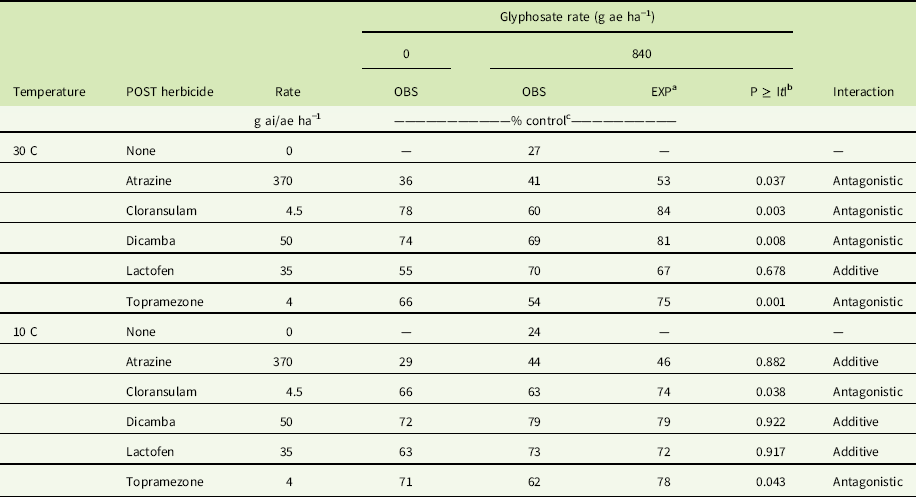
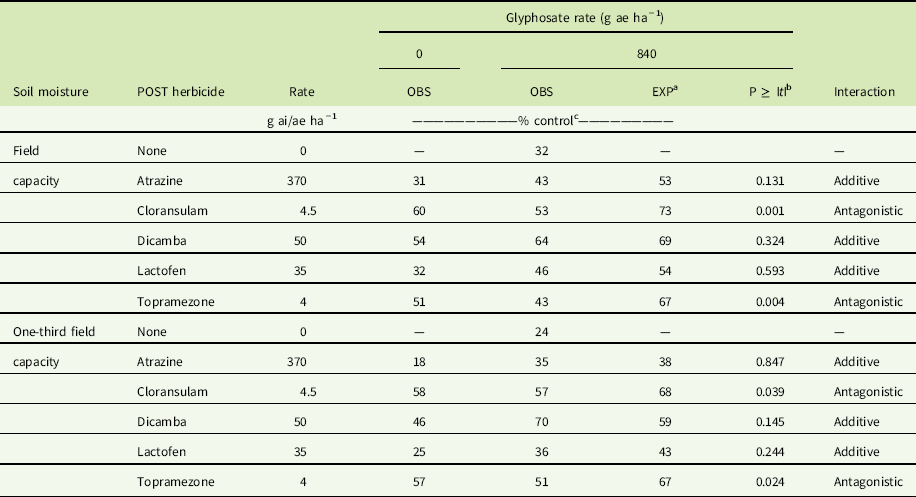
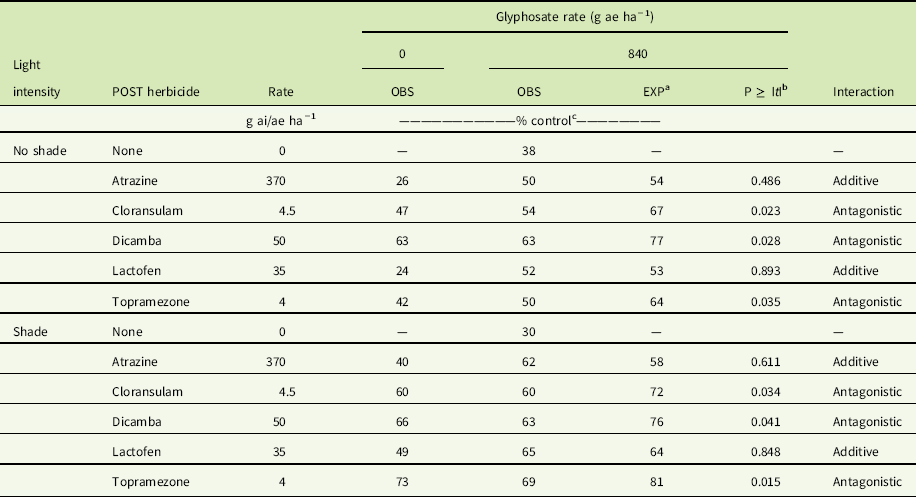
Combinations of glyphosate plus cloransulam or topramezone were antagonistic when applied to RR A. trifida at 10 C conditions (Table 3). These glyphosate mixtures, in addition to those containing atrazine or dicamba, were antagonistic at 30 C. Moreover, the relative differences between observed and expected levels of control tended to be greater at 30 C compared with 10 C. For example, the mixture of glyphosate plus cloransulam had an 11% difference between observed and expected values at 10 C versus a 24% difference at 30 C. Combinations of glyphosate plus cloransulam or topramezone were the only mixtures resulting in antagonism at either soil moisture level (Table 4). Similar to results for the temperature experiment, differences between observed and expected control were greater at the environmental conditions more conducive to plant growth. At one-third field capacity, glyphosate mixtures with cloransulam and topramezone resulted in 11% and 16% differences, respectively, between observed and expected control; at field capacity, these differences rose to 20% and 24%. For both no-shade and shade conditions, antagonism was detected for glyphosate mixtures with cloransulam, dicamba, and topramezone (Table 5). Unlike the temperature and soil moisture experiments, there were minimal differences between observed and expected levels of control between the differing light intensities. A constraint of this research is that PAR values for both no-shade and shade treatments were low compared with ambient sunlight under field conditions; thus, inferences as to how light intensity may affect herbicide interactions in a field setting are minimal. Nevertheless, these results do indicate the propensity of the RR to antagonize POST herbicides even at low light intensities.
Temperature influence on observed means (OBS) and Colby’s expected responses (EXP) of control for the interaction of glyphosate and POST herbicide mixtures on rapid response, glyphosate-resistant A. trifida at 21 d after treatment.

a Colby’s expected responses were calculated using Equation 1.
b Significant differences between observed and expected control were determined using a two-tailed Student’s t-test (α=0.05).
c Control based on plant dry weight reduction compared with the nontreated check at each temperature.
Soil moisture influence on observed means (OBS) and Colby’s expected responses (EXP) of control for the interaction of glyphosate and POST herbicide mixtures on rapid response, glyphosate-resistant A. trifida at 21 d after treatment.

a Colby’s expected responses were calculated using Equation 1.
b Significant differences between observed and expected control were determined using a two-tailed Student’s t-test (α=0.05).
c Control based on plant dry weight reduction compared with the nontreated check at each soil moisture.
Light-intensity influence on observed means (OBS) and Colby’s expected responses (EXP) of control for the interaction of glyphosate and POST herbicide mixtures on rapid response, glyphosate-resistant A. trifida at 21 d after treatment.

a Colby’s expected responses were calculated using Equation 1.
b Significant differences between observed and expected control were determined using a two-tailed Student’s t-test (α=0.05).
c Control based on plant dry weight reduction compared with the nontreated check at each light intensity.
This work documents induction of the RR in GR A. trifida occurs sooner at environmental conditions conducive to optimal growth surrounding the time of herbicide application. While this faster response to glyphosate application does not influence glyphosate efficacy, it can have a pronounced effect on glyphosate plus POST herbicide mixtures. Across all three environmental factors tested, the phloem-mobile herbicides cloransulam, dicamba, and topramezone were the POST herbicides most consistently antagonized by the glyphosate-induced RR. Although antagonism of these herbicides was still present under suboptimal environmental conditions, the magnitude of antagonism was amplified at conditions more favorable to plant growth, particularly at 30 C and field capacity. The implications of such findings are relevant, particularly regarding early-season glyphosate applications where forecasts of cooler temperatures can be used to target appropriate scenarios to enhance control of the RR biotype. For example, in northern Indiana the 30-yr mean air temperatures for March and April are 3.9 and 10.6 C, respectively (Indiana State Climate Office 2017). Previous work has shown that increasing glyphosate rates from 420 to 1,680 g ha−1 causes the RR to be induced sooner (Harre et al. Reference Harre, Nie, Robertson, Johnson, Weller and Young2017a). Moreover, work on both NRR and RR biotypes of GR A. trifida has shown that increasing glyphosate rates when applied with POST herbicides improves efficacy on the NRR biotype, yet reduces efficacy on the RR biotype (Harre et al. Reference Harre, Young and Young2017b). Collectively, these results suggest that any factor that more quickly elicits induction of the RR will have the propensity to antagonize translocated POST herbicides, highlighting the importance of knowing which biotypes of GR A. trifida are present in fields. Consideration of these results will enable growers to make more informed management decisions, as application of glyphosate with POST herbicide mixtures made under cool, dry soil conditions is likely to improve control of the RR biotype.