Introduction
About 25% of the disease burden in terms of disability-adjusted life years (DALYs) can be attributed to mental disorders (Vos & Mathers, Reference Vos and Mathers2000; Vos et al. Reference Vos, Mathers, Herrman, Harvey, Gureje, Bui and Begg2001). Among youth aged between 10 and 24 years, mental disorders are the leading contributor to the burden of disease (Vos & Mathers, Reference Vos and Mathers2000; Vos et al. Reference Vos, Mathers, Herrman, Harvey, Gureje, Bui and Begg2001; Harhay & King, Reference Harhay and King2012).The first onset of psychiatric disorders often occurs in childhood and adolescence, and the lifetime prevalence of diagnosable disorders increases substantially during adolescence (Wittchen et al. Reference Wittchen, Perkonigg, Lachner and Nelson1998; Costello et al. Reference Costello, Mustillo, Erkanli, Keeler and Angold2003; Merikangas et al. Reference Merikangas, He, Burstein, Swanson, Avenevoli, Cui and Swendsen2010a ; Copeland et al. Reference Copeland, Shanahan, Costello and Angold2011; Ormel et al. Reference Ormel, Raven, van Oort, Hartman, Reijneveld, Veenstra, Vollebergh, Buitelaar, Verhulst and Oldehinkel2015). The increase in the incidence of disability due to mental disorder during adolescence is nearly fivefold (Vos & Mathers, Reference Vos and Mathers2000), which creates a poor starting position to enter adulthood for affected adolescents. Adequate functioning at the time of entry into adulthood is important, given the developmental challenges that lie ahead: staying healthy and maintaining an acceptable quality of life, avoiding risky behaviors, completing one's education, getting and maintaining a job, developing a social support network, avoiding or desisting illegal behavior, finding and maintaining a partner and starting a family. Some of the disease burden caused by mental disorders is due to relatively rare (<1%) but very impairing chronic disorders (e.g. schizophrenia and autism), but the largest proportion is due to common mental disorders and subclinical emotional and behavioral problems.
Whereas multiple studies among youth have documented that mental health status is an important cross-sectional determinant of functioning (e.g. Quinton et al. Reference Quinton, Gulliver and Rutter1995; Rutter et al. Reference Rutter, Dunn, Plomin, Simonoff, Pickles, Maughan and Eaves1997; Costello, Reference Costello1999; Fergusson & Horwood, Reference Fergusson and Horwood2001; Fergusson & Woodward, Reference Fergusson and Woodward2002; Verboom et al. Reference Verboom, Sijtsema, Verhulst, Penninx and Ormel2013), less is known about the additional influence of psychiatric history on current functioning (Fergusson et al. Reference Fergusson, Boden and Horwood2013; Copeland et al. Reference Copeland, Wolke, Shanahan and Costello2015). Based on data from the Great Smoky Mountains Study, Copeland and colleagues (2015) reported that childhood and adolescent mental disorders, even if not persisting into adulthood, were associated with a disrupted transition to adulthood, as indexed by one or more adverse outcomes related to health, the legal system, personal finances, and social functioning in young adulthood. Copeland and colleagues defined cases as individuals that met clinical criteria for a psychiatric disorder at any given time during their youth. They distinguished neither between types of disorder nor between ages of onset.
The study reported herein sought not only to replicate the findings of Copeland and colleagues with regard to the relevance of psychiatric history for current functioning, but also to expand those findings by additionally investigating the potential influence of type of disorder (internalizing v. externalizing) and age of onset (childhood v. adolescence). Both aspects are important. Internalizing and externalizing disorders are likely to impact different outcomes, and early onset disorders may have more severe consequences compared to later onset disorders. Substantial differences in mean age of onset do exist between disorders, with relatively early ages of onset for specific phobia, attention deficit hyperactivity disorder, and separation anxiety and behavior disorders, whereas most other anxiety disorders, mood disorders, and substance dependence, typically develop after the transition into adolescence (Ormel et al. Reference Ormel, Raven, van Oort, Hartman, Reijneveld, Veenstra, Vollebergh, Buitelaar, Verhulst and Oldehinkel2015). Thus, the present study aimed to examine whether psychiatric history explains variation in functioning at age 19 – the time of entry in adulthood – over and above current mental health status in a representative Dutch population sample of 2230 youths. More specifically, we focused on a broad array of functioning indicators in economic, social, psychological and health behavior domains; and related these indicators to not only current mental health status but also to psychiatric history, taking into account the number of lifetime disorders, co-morbidity of internalizing and externalizing disorders, and the age of onset of the disorders.
Method
Sample and procedure
The TRacking Adolescents’ Individual Lives Survey (TRAILS) is a prospective cohort study of Dutch adolescents using bi- or triennial measurements from age 11 onward. Its aim is to chart and explain the development of mental health from preadolescence into adulthood. Previous publications have extensively described its design, methods, response rates and bias (de Winter et al. Reference de Winter, Oldehinkel, Veenstra, Brunnekreef, Verhulst and Ormel2005; Huisman et al. Reference Huisman, Oldehinkel, Winter, Minderaa, Bildt, Huizink, Verhulst and Ormel2008; Nederhof et al. Reference Nederhof, Jorg, Raven, Veenstra, Verhulst, Ormel and Oldehinkel2012; Ormel et al. Reference Ormel, Oldehinkel, Sijtsema, van Oort, Raven, Veenstra and Verhulst2012; Oldehinkel et al. Reference Oldehinkel, Rosmalen, Buitelaar, Hoek, Ormel, Raven, Reijneveld, Veenstra, Verhulst, Vollebergh and Hartman2015). The study was approved by the Dutch Central Committee on Research Involving Human Subjects (CCMO; www.ccmo.nl).
Briefly, participants were selected from five municipalities in the North of The Netherlands, both urban and rural, including the three largest cities. Children born between 1 October, 1989 and 30 September, 1991 were eligible for inclusion, providing they met the inclusion criteria and their schools were willing to participate (de Winter et al. Reference de Winter, Oldehinkel, Veenstra, Brunnekreef, Verhulst and Ormel2005). Over 90% of the schools, enrolling a total of 2935 eligible children, agreed to participate in the study. Through extended efforts, 76% of these children and their parents consented to participate (T1, n = 2230, mean age = 11.1 years, s.d. = 0.6, 51% girls). Subsequent data collection waves took place bi- or triennially, and had good retention rates (T2 mean age: 13.6; 96%; T3: 16.3, 81%; T4: 19.1, 84%).
Measures
Diagnostic assessment
The presence of lifetime mental health disorders was assessed at age 19 (T4) using the Composite International Diagnostic Interview (CIDI) 3.0. The CIDI is a structured diagnostic interview that has been used in multiple surveys worldwide to generate diagnoses based on the DSM-IV (Kessler & Ustun, Reference Kessler and Ustun2004). Clinical calibration studies found its assessment of disorders to be generally valid in comparison to blinded clinical reappraisal interviews using the Structured Clinical Interview for DSM-IV (SCID; Kessler et al. Reference Kessler, Abelson, Demler, Escobar, Gibbon, Guyer, Howes, Jin, Vega, Walters, Wang, Zaslavsky and Zheng2004, Reference Kessler, Avenevoli, Green, Gruber, Guyer, He, He Ym Jin, Kaufman, Sampson, Zaslavsky and Merikangas2009; Haro et al. Reference Haro, rbabzadeh-Bouchez, Brugha, de Girolamo, Guyer, Jin, Lepine, Mazzi, Reneses, Vilagut, Sampson and Kessler2006). CIDI-based prevalence estimates were typically comparable to SCID-based prevalence estimates, except for specific phobias and oppositional defiant disorders, for which CIDI estimates were higher.
The assessment included mood disorders (major depressive disorder, dysthymic disorder, and bipolar disorder I and II), anxiety disorders (panic disorder, agoraphobia, social phobia, specific phobia, generalized anxiety disorder, separation anxiety disorder, and obsessive compulsive disorder), behavior disorders (attention deficit hyperactivity disorder, oppositional defiant disorder, and conduct disorder), and substance dependence (alcohol dependence and drug dependence). The interview was administered by trained lay-interviewers. Of the total sample, 1584 adolescents (84% of T4 sample, mean age 19.3 years, 54% girls) provided CIDI data (Ormel et al. Reference Ormel, Raven, van Oort, Hartman, Reijneveld, Veenstra, Vollebergh, Buitelaar, Verhulst and Oldehinkel2015).
Predictors: current mental health status and psychiatric history
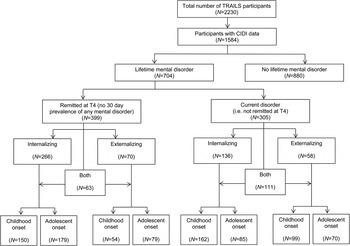
We constructed several predictor variables based on CIDI data. First, we determined current mental health status based on T4 CIDI data. We created two continuous predictor variables representing the total number of internalizing (i.e. mood and anxiety disorders combined) and externalizing (i.e. behavior disorders and substance use dependence combined) mental health disorders that were present (i.e. non-remitted) at age 19 (T4), according to the 1-month prevalence data. Second, we created two continuous diagnostic history variables representing the total number of internalizing and externalizing disorders a person had prior to T4, thus excluding all disorders with 1-month point prevalence at T4. Third, we determined separately for the domains of internalizing and externalizing disorders, whether or not the onset was in young childhood (i.e. onset before age 11 years, T1) or in adolescence (i.e. onset between ages 11 and 18 years). We created two dichotomous variables representing onset (0 = childhood, 1 = adolescence) of internalizing and externalizing disorders. See Fig. 1 for a detailed overview of the sample.
CIDI-based flowchart of the sample.

Young adult functional outcomes
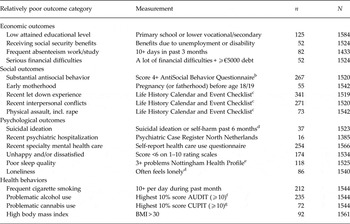
Table 1 describes the 19 economic, social, psychological and health functioning outcomes assessed at age 19 years (T4). Most outcomes refer to T4, some to the 3 months preceding T4. Outcomes measured at ordinal or interval level were analyzed as binary variables, dichotomized in a manner that set apart – as much as possible – the 10% of young adults with relatively poor outcomes. We chose 10% because the prevalence of a definite case of any DSM-III-R diagnosis in Dutch adolescents is 8% (Verhulst et al. Reference Verhulst, vanderEnde, Ferdinand and Kasius1997). Table 1 summarizes the outcomes and their measurement, the definition of the poor outcome category and its frequency.
Young adult functional outcomes, definition and measurement of the relatively poor outcome category and frequenciesa

n = number of individuals reporting the outcome; N = total number of individuals providing data on the outcome.
a See also: de Winter et al. Reference de Winter, Oldehinkel, Veenstra, Brunnekreef, Verhulst and Ormel2005; Huisman et al. Reference Huisman, Oldehinkel, Winter, Minderaa, Bildt, Huizink, Verhulst and Ormel2008; Nederhof et al. Reference Nederhof, Jorg, Raven, Veenstra, Verhulst, Ormel and Oldehinkel2012; Ormel et al. Reference Ormel, Oldehinkel, Sijtsema, van Oort, Raven, Veenstra and Verhulst2012; Oldehinkel et al. Reference Oldehinkel, Rosmalen, Buitelaar, Hoek, Ormel, Raven, Reijneveld, Veenstra, Verhulst, Vollebergh and Hartman2015); b Moffitt & Silva (Reference Moffitt and Silva1988); c Caspi et al. (Reference Caspi, Moffitt and Thornton1996); d Achenbach & Rescorla LA (Reference Achenbach and Rescorla2003); e Hunt et al. (Reference Hunt, McKenna and McEwen1980); f Santis et al. (Reference Santis, Garmendia and Acuña2009); g Bashford J, et al. (Reference Bashford, Flett and Copeland2010).
Statistical analysis
We first calculated some descriptive information on the prevalence, recency, and onset of lifetime mental health disorders in our sample. Then, to examine the association between CIDI-based current and past mental disorders on the one hand, and young adult economic, social, psychological and health functioning outcomes on the other, we conducted several multiple logistic regression analyses, with the binary T4 outcome variables (as described in Table 1) as dependent variables. First we tested whether current mental health status significantly predicts T4 functioning (step 1). Second, we tested whether a history of internalizing and/or externalizing disorders prior to T4 predicted T4 functioning, above and beyond the effect of current diagnostic status (step 2). Third, we examined the predictive effect of age-of-onset (childhood v. adolescence) on T4 functioning in those individuals in which a history of mental health disorder significantly predicted T4 outcome. We ran separate binary regression analyses for onset of internalizing and externalizing variables. Pearson correlations were calculated between the predictor variables.
Results
Descriptives
We found an overall lifetime prevalence of CIDI-DSM-IV disorders of 44.4% (n = 704). Out of the 1584 participants with CIDI data, 305 participants (29.2%) were diagnosed at T4 with a current mental health disorder in the past month (1-month prevalence at T4), whereas 399 were disorder-free (remitted) at T4 (25.2%), and 880 never had a lifetime mental health disorder (55.6%). (See further Fig. 1.) For more information on prevalence, severity, age of onset, continuity and co-morbidity of DSM disorders, see Ormel et al. (Reference Jorg, Visser, Ormel, Reijneveld, Hartman and Oldehinkel2015).
Less than 5% of the data was missing for all T4 outcome variables, except frequent absenteeism (9.5%) and recent psychiatric hospitalization (12.9%). Information on psychiatric hospitalization was received through data linkage with psychiatric case registry data (fully described in Jorg et al. Reference Jorg, Visser, Ormel, Reijneveld, Hartman and Oldehinkel2015), for which not all participants had given informed consent), which explains the larger proportion of missing data for this variable.
Association between psychopathology and early adult functioning
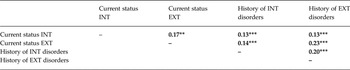
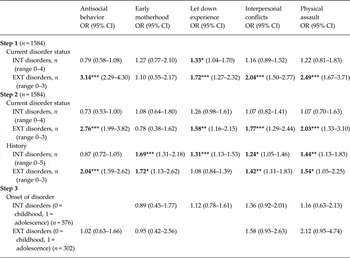
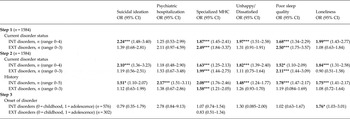
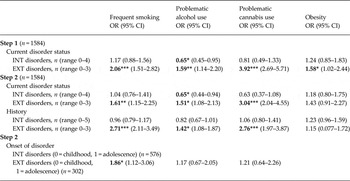
Table 2 shows the correlations among the predictors. Tables 3–6 show the odds ratios (ORs) for each of the predictors for economic, social, and psychological functioning and health behavior outcomes. Overall, both current and past disorders seem important as 14 of the 19 outcomes were predicted by both current and past disorders, three only by past disorders (receiving social benefits, psychiatric hospitalization, adolescent motherhood), and two only by current disorder (absenteeism, obesity).
Correlations between predictors

INT, Internalizing disorders (mood and anxiety disorders); EXT, externalizing disorders (behavior disorders and substance dependence).
Correlations between current status and history predictors are based on the full sample (N = 1584), correlations between INT and EXT onset dummy variables are based on participants with a history of mental disorders only (n = 174).
Bolding represents significance. *** p < 0.001, ** p < 0.01.
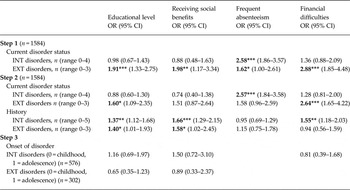
Binary logistic regression results for economic functioning

n, Number of disorders; INT, internalizing disorders; EXT, externalizing disorders. Step 1 = model with current status (i.e. number of mental disorders at T4) as predictors of economic functioning at T4, based on the full sample (n = 1584). Step 2 adds history of INT and EXT mental disorders variables as predictors to the model. Step 3 examines if onset of INT/EXT disorders (childhood v. adolescence) further predicts economic functioning at T4 in participants with a history of mental disorders only (INT: n = 576; EXT: n = 302).
Entries represent odds ratios (OR) and 95% confidence intervals (CI).
Bolding represents significance. *** p < 0.001, ** p < 0.01, * p < 0.05.
Binary logistic regression results for social functioning

n, Number of disorders; INT, internalizing disorders; EXT, externalizing disorders. Step 1 = model with current status (i.e. number of mental disorders at T4) as predictors of social functioning at T4, based on the full sample (n = 1584). Step 2 adds history of INT and EXT mental disorders variables as predictors to the model. Step 3 examines if onset of INT/EXT disorders (childhood v. adolescence) further predicts social functioning at T4 in participants with a history of mental disorders only (INT: n = 576, EXT: n = 302).
Entries represent odds ratios (OR) and 95% confidence intervals (CI).
Bolding represents significance. *** p < 0.001, ** p < 0.01, * p < 0.05.
Binary logistic regression results for psychological functioning

n, Number of disorders; INT, internalizing disorders; EXT, externalizing disorders. Step 1 = model with current status (i.e. number of mental disorders at T4) as predictors of psychological functioning at T4, based on the full sample (n = 1584). Step 2 adds history of INT and EXT mental disorders variables as predictors to the model. Step 3 examines if onset of INT/EXT disorders (childhood v. adolescence) further predicts psychological functioning at T4 in participants with a history of mental disorders only (INT: n = 576, EXT: n = 302).
Entries represent odds ratios (OR) and 95% confidence intervals (CI).
Bolding represents significance. *** p < 0.001, * p < 0.05.
Binary logistic regression results for health behavior

n = number of disorders, INT, internalizing disorders; EXT, externalizing disorders. Step 1 = model with current status (i.e. number of mental disorders at T4) as predictor of health functioning at T4, based on the full sample (n = 1584). Step 2 adds history of INT and EXT mental disorders variables as predictors to the model. Step 3 examines if onset of INT/EXT disorders (childhood v. adolescence) further predicts health functioning at T4 in participants with a history of mental disorders only (INT: n = 576, EXT: n = 302).
Entries represent odds ratios (OR) and 95% confidence intervals (CI).
Bolding represents significance. *** p < 0.001, ** p < 0.01, * p < 0.05.
Economic functioning
The ORs in Table 3 show that current mental health status significantly predicts economic outcome. Individuals with mostly externalizing disorders are at increased risk of having attained a lower educational level, receiving social benefits, being frequently absent from work and/or school, and of having financial difficulties. Adding psychiatric history to the model, both a history of internalizing and externalizing significantly increased the odds of a low educational level and receiving social benefits, over and above the effect of current disorder. For social benefits, the effects of current disorder even became non-significant after including psychiatric history in the model. A history of internalizing disorders additionally increased the odds of having financial difficulties, over and above the effect of current externalizing disorders. Psychiatric history did not significantly predict recent frequent absenteeism from work or school. No differences were observed for the effects of childhood v. adolescent onset disorders on economic functioning.
Social functioning
The ORs in Table 4 show that current externalizing disorders significantly increased the risk of antisocial behavior, let down experiences, interpersonal conflicts and physical assaults (including rape). Adolescents with current internalizing disorder were also more likely to experience letdowns compared to adolescents without current internalizing disorder. Further, a history of internalizing and externalizing disorder significantly increased the odds of poorer social outcomes above and beyond the effect of current, largely externalizing disorders. Early motherhood was (understandably) not predicted by current disorder, but adolescents with a history of internalizing and externalizing disorders were at increased risk of becoming a parent before the age of 18/19. Onset of the disorders did not significantly add to the prediction of these social outcomes.
Psychological functioning
Particularly a history of internalizing disorders increased the odds of poor psychological outcomes, including unhappiness or dissatisfaction with life, sleep problems, and loneliness, above and beyond the effects of current internalizing disorders (Table 5). Both history and current internalizing and externalizing disorders increased the odds of using specialized mental health care. Psychiatric hospitalization was not predicted by current diagnostic status, but adolescents with a history of internalizing and/or externalizing disorders were at increased risk of being recently hospitalized. Individuals with a history of internalizing disorders with an onset in adolescence were more likely to feel lonely compared individuals with childhood-onset internalizing disorders.
Health behaviors
A history of externalizing (but not internalizing) disorders significantly increased the odds of frequent smoking, and problematic alcohol and cannabis use, but not obesity, in addition to the effects of current externalizing disorders on these outcomes (Table 6). Particularly individuals with a history of externalizing disorders with an onset in adolescence were more likely to frequently smoke compared to individuals with childhood-onset externalizing disorders. In contrast, individuals with current internalizing disorders were less likely to use alcohol in a problematic manner than individuals without mental health disorders. A history of internalizing disorders did not add to the prediction of problematic alcohol use.
Discussion
The study reported herein sought to examine whether psychiatric history, in terms of internalizing v. externalizing disorder and age of onset, explains additional variation in functioning at age 19 – the time of entry in adulthood- over and above current mental health status. The answer is definitely yes. Out of the 19 outcomes, 14 were predicted by both current and past disorders, three by only past disorders, and two by only current disorder (absenteeism). If history matters, which type of past disorders is most important depends on the nature of the outcome studied. Adjusted for current disorder, past internalizing disorders predicted in particular psychological outcomes while externalizing disorders predicted in particular health behavior outcomes. Economic and social outcomes were predicted by a history of co-morbidity of internalizing and externalizing disorder. The risk of problematic cannabis use and alcohol consumption dropped with a history of internalizing disorder. Strength of effects depended on the specific outcome as well. In general, ORs waxed and waned around 2.0 for the multi-categorical predictors (e.g. current number of disorders, past number of internalizing disorders). An OR of 2.0 indicates that for each extra disorder, the risk of a maladaptive outcome doubles. As noted by Copeland and colleagues (2015), it is not surprising that psychiatric history is associated with functional status. What is surprising is (a) that these effects are still found after adjustment for current mental health status, and (b) that they hold for a broad variety of economic, social, psychological, and health behavior outcomes.
For various reasons, our findings do not provide causal evidence that past disorders cause poor outcomes. First, we cannot exclude the possibility that the higher rate of poor outcomes in youth with a history of mental disorder is a consequence of unmeasured risk factors influencing both mental health and life outcomes. Earlier work showed that confounding by preadolescent IQ, temperament and parental socioeconomic status (SES) is very limited (Ormel et al. nonpublished). The second (related) reason limiting causal interpretation is the possibility that particular poor outcomes may be the result of a trajectory of prior events and experiences that as such may have influenced the development of childhood and adolescent psychopathology. For example, poor academic achievement may well have been preceded by systematic underachievement in secondary school, which in turn may have contributed to the development or worsening of psychopathology, due to the stress and events related to this lack of achievement.
Strengths and limitations
Strengths of this study include its well-documented sample of adolescents, followed from preadolescence to early adulthood, consideration of co-morbidity, age of onset, and the breadth of outcomes. One limitation is that, despite moderate non-response at baseline and limited attrition at follow-ups, both were not random. CIDI non-response was predicted by male gender, non-Western ethnicity, low SES, low IQ and academic achievement, poor physical health, and behavior and substance use problems (Nederhof et al. Reference Nederhof, Jorg, Raven, Veenstra, Verhulst, Ormel and Oldehinkel2012). However, non-response bias in psychiatric epidemiological studies tends to be conservative, with actual associations between psychopathology and functional outcomes often being stronger, especially for behavior disorders and substance dependence (Eaton et al. Reference Eaton, Kessler, Wittchen and Magee1994; Kessler et al. Reference Kessler, Chiu, Demler and Walters2005; Merikangas et al. Reference Merikangas, He, Burstein, Swanson, Avenevoli, Cui and Swendsen2010b ).
Concluding comments
Economic, social, and psychological functioning and health behavior during the transition into adulthood is predicted not only by current mental disorder but also – and about as strongly – by psychiatric history. This suggests that at least part of the disadvantage has occurred long before the transition into adulthood and that disorder remission has not resulted in catching up completely. The risk of relatively poor functional outcomes tends to double with each additional past disorder. In turn, these functional limitations may increase future risk of mental disorder, disability, and loss of quality of life (Moffitt et al. Reference Moffitt, Arseneault, Belsky, Dickson, Hancox, Harrington and Caspi2011).
It is well established that childhood and adolescent mental disorders are costly, impairing, and often a burden for all involved, especially the child/adolescent and family (Costello et al. Reference Costello, Angold, Burns, Erkanli, Stangl and Tweed1996, Reference Costello, Copeland, Cowell and Keeler2007). Many youth will experience mental health problems during their pre-adult years. As observed in different longitudinal studies, these common early disorders are often associated with a disrupted transition to adulthood, even if the disorders remit before adulthood (Fergusson et al. Reference Fergusson, Boden and Horwood2013; Copeland et al. Reference Copeland, Wolke, Shanahan and Costello2015). Earlier we reported that about 5% of all youth suffer from pervasive concurrent and sequential co-morbidity as indexed by at least three lifetime disorders from at least three major diagnostic domains. We coined this ‘generalized’ psychopathology (Ormel et al. Reference Ormel, Raven, van Oort, Hartman, Reijneveld, Veenstra, Vollebergh, Buitelaar, Verhulst and Oldehinkel2015). These 5% seem especially at risk of poor future outcomes.
Collectively, the findings strongly stress the need to improve prevention and treatment of mental disorder in childhood and adolescence, especially ‘generalized’ psychopathology rather than single disorders (Weisz et al. Reference Weisz, Sandler, Durlak and Anton2005). If effective in the long term, early treatment and prevention will decrease the burden of pre-adult psychopathology and benefit a more successful transition to adulthood. We fully endorse Copeland's statement that ‘If the goal of public health efforts is to increase opportunity and optimal outcomes, and to reduce distress, then there may be no better target than the reduction of childhood psychiatric distress – at the clinical and subthreshold levels’ (Copeland et al. 2015, p. 898).
Acknowledgements
TRAILS has been financially supported by various grants to J.O., A.J.O., F.V., R.V., and W.A.M.V. from The Netherlands Organization for Scientific Research NWO (Medical Research Council program grant GB-MW 940-38-011; ZonMW Brainpower grant 100-001-004; ZonMw Risk Behavior and Dependence grants 60-60600-97-118; ZonMw Culture and Health grant 261-98-710; Social Sciences Council medium-sized investment grants GB-MaGW 480-01-006 and GB-MaGW 480-07-001; Social Sciences Council project grants GB-MaGW 452-04-314 and GB-MaGW 452-06-004; NWO large-sized investment grant 175.010.2003.005; NWO Longitudinal Survey and Panel Funding 481-08-013), NWO Zwaartekracht grant 024.001.003; the Dutch Ministry of Justice (WODC), the European Science Foundation (EuroSTRESS project FP-006), Biobanking and Biomolecular Resources Research Infrastructure BBMRI-NL (CP 32), and the participating universities. This research is part of the longitudinal TRacking Adolescents’ Individual Lives Survey (TRAILS). Participating centers of TRAILS include various departments of the University Medical Center and University of Groningen, the Erasmus University Medical Center Rotterdam, the University of Utrecht, the Radboud Medical Center Nijmegen, and the Parnassia Bavo group, all in The Netherlands. We are grateful to all adolescents, their parents and teachers who participated in this research and to everyone who worked on this project and made it possible.
Declaration of Interest
Dr Verhulst is a contributing author of the Achenbach System of Empirically Based Assessment, from which he receives remuneration. All other authors report no financial interests or potential conflicts of interest.