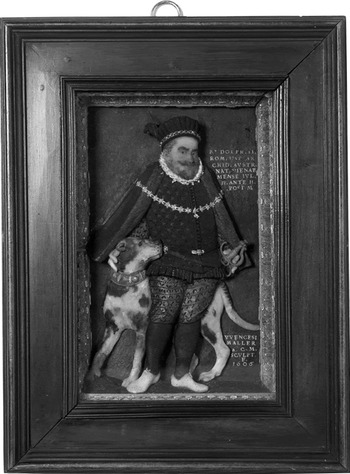
All rulers' portraits are, in several senses, forms of representation. In the first and most obvious instance, all portraits epitomize one of the basic functions of visual art as imitation (mimesis). Portraits represent a person by providing his or her likeness. The Renaissance sculptor Vincenzo Danti (1530–1576), a contemporary of the artists discussed here, pointed to this basic mimetic function when he defined one of the fundamental forms of artistic imitation as ritrarre, using a verb related to the Italian word for portrait, ritratto.Footnote 2 Because they are works in three dimensions, sculpted portraits may approach this end even more directly, as seen in the sculpted heritage of Charles V that is the subject of this paper. In any case, hyperrealist works of the 1970s and wax sculpture of the past, including a small wax sculpture of Emperor Rudolf II with a favorite hound (London, Victoria and Albert Museum) (see Figure 1), demonstrate that sculpture may make the effort to portray individuals as close to life as possible.
Wenzel Maler, Relief of Emperor Rudolf II, 1606. Wax in high relief. Victoria and Albert Museum, London. (Photo Credit: Courtesy of the Board of Trustees, © Victoria and Albert Museum, London).

Portraits also may be said to represent a person, in the sense that they may stand for that individual when he or she is not actually present. In this way, they also may serve as the ruler's representative. The twenty-first-century viewer may readily understand this usage because it has been preserved in the worldwide practice of hanging pictures of heads of state in government offices and other public places. A picture of a ruler or head of state may hang over the place where an official sits or stands when he receives guests or does business: Both the image and the governor are representative of the head of state.Footnote 3
Portraits may represent a ruler in other senses as well. Although the sculptures, medals, and prints considered here present the likenesses of Emperor Charles V, Emperor Rudolf II, Elector Christian II of Saxony, and other rulers, they are not literal depictions because they do not simply copy the physical features of these individuals. The notorious underbite of the Habsburgs is not shown in the images of Charles and Rudolf; Rudolf's small stature cannot be gauged; Christian II's obesity and usually drunken state are not to be seen in the alert, youthful appearance of his bronze portrait. Moreover, Christian had worn a beard for several years by the time his portrait was made. Portraits such as these thus re-present the rulers by idealizing their features.
More than idealized depictions of their physical appearance, portraits of rulers may also present images of their ideal character, symbolize their apirations and deeds, and suggest further concepts, too. In another sense that would have been understood during the European Renaissance of the sixteenth and early seventeenth centuries, they are forms of representation, of representatio. Specifically, rulers' portraits are forms of the representation of majesty, representatio majestatis, the symbolic presentation of the ruler's majesty or grandeur.Footnote 4
It was probably because of the importance of these functions that portraiture became a primary task for court artists. Rulers regularly called on the services of artists to provide their portraits. Consequently, as indicated by the payment books now preserved in Vienna (in the Hofkammerarchiv), painters at the Habsburg court are listed as Maler und Conterfetter, specifying portraitists as a category of activity. Although the title was not specifically applied to them, the term Conterfetter could hold equally for sculptors, and documents indicate it applied equally to medalists like Antonio Abbondio.Footnote 5
Because they are usually made using casts, European sculpture in bronze or other related metals (e.g., brass) also allows for the creation of replicas. Either the original mold can be preserved, or casts may be made after an existing bronze. In either case, replications or reproductions may be the result: They are a feature of rulers' portraits in the Renaissance. In fact, several versions were made of the busts of Charles V and Philip II.
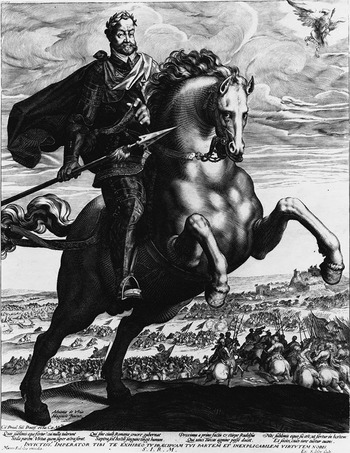
Other multiple portraits may be created in the form of medals. Medals may be cast, in bronze or brass or other materials, and they may also be struck, like coins. In either instance, they may be produced in multiples. The media of printmaking, of course, epitomize the familiar process of mechanical reproducibility. Engravings may reproduce sources from paintings, drawings, prints, or even sculpture. This is seen in images of the emperor Rudolf II by Aegidius Sadeler (see Figure 2), including one that reproduces a lost statuette by Adriaen De Vries.Footnote 6
Ægidius Sadeler II, Print of Rudolph II. Draft by Adriaen De Vries, Prague, 1603. Engraving on silk. Kupferstich-Kabinett, Staatliche Kunstsammlungen, Dresden, Inv. Nr. A 48274. (Photo Credit: The Illustrated Bartsch, Vol. 72, pt. 2, Ægidius Sadeler II).

It should be recalled that engravings were usually made on copper plates and thus further involve techniques similar to those of chasing bronze. An artist may work on the cold cast bronze with tools like the burin the engraver uses to make a design on the copper plate. Works in many media, in addition to prints, may in any case not only reproduce other objects, but also derive from or engender further replications, here meaning variations that are not simply copies but whose forms or content are nevertheless taken from an earlier source.
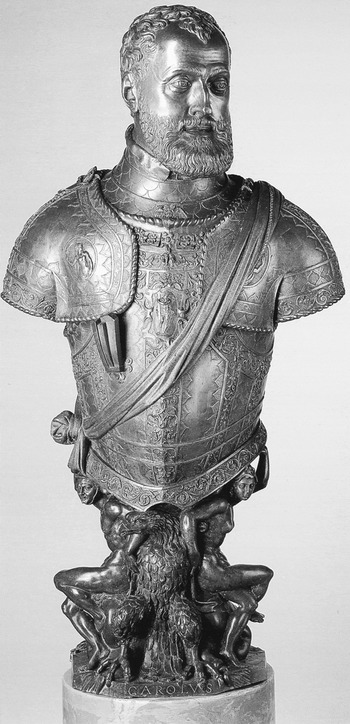
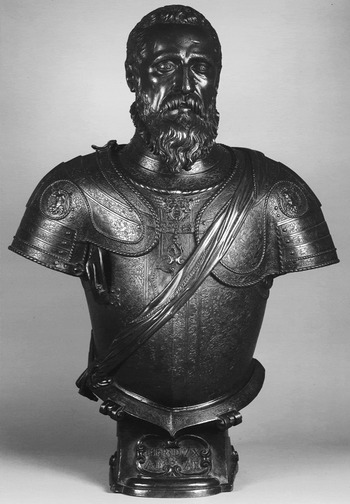
The bust of Charles V (Museo del Prado, Madrid) by Leone Leoni (see Figure 3) became one such source. Leoni's bust was first designed, or as he might have said, invented during the early 1550s. It thus originated at the acme of the emperor's power and prestige, after he had defeated both the French and most recently the Protestant Schmalkaldic League, whom he had beaten at the Battle of Mühlberg (1547).
Leone Leoni, Bust of Emperor Charles V, 1553–1555. Bronze, 112 cm, Madrid, Museo del Prado, Inv. Nr. E-271. (Photo Credit: Joaquín Cortés, Madrid).

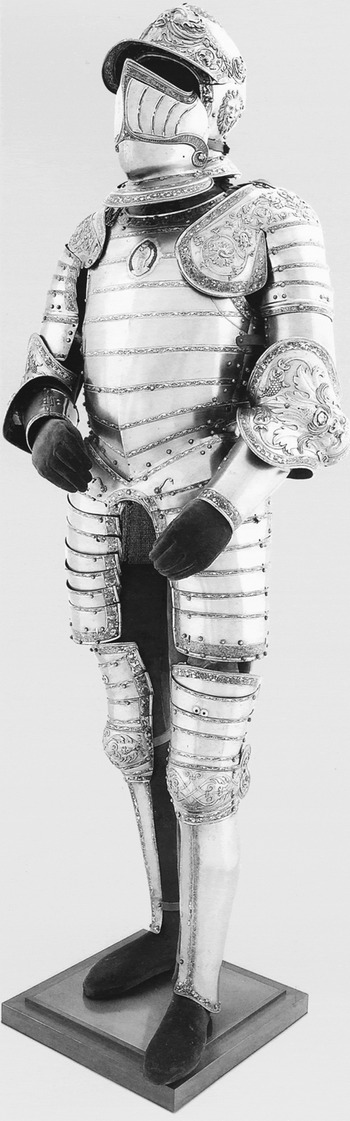
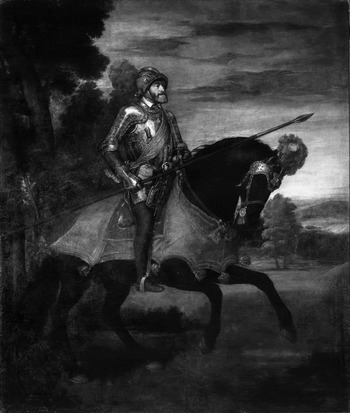
The bust registers these events both literally and symbolically. Charles V wears the sash of a commander. A medallion shown on the armor on his shoulder depicts a nude female figure, holding a palm, the palm offered to a victorious general. Otherwise, the armor Charles V wears closely resembles one that survives (Madrid, Armory) (see Figure 4) and that he is known to have worn at Mühlberg. Charles is also shown wearing armor like this in Titian's famed equestrian portrait of the emperor (see Figure 5). Titian's painting portrays him with a lance, recalling the accoutrement of a Roman emperor in the act known as the profectio Augusti, when he went on campaign, but the portrayal in contemporary armor with a lance also suggests that Charles is a knight: In the context of Mühlberg, he is to be regarded as a Christian knight. Leoni's bust likewise expresses the idea that he is a miles Christianorum, a Christian soldier—an appropriate image for the emperor, who could have claimed to triumph over heresy and religious disunity. This image is suggested by the medal hanging from a chain that Charles wears in which Christ is depicted leaning on a cross.Footnote 7 The ideal of a Christian prince would have been known to the emperor through the Education of a Christian Prince, a work which appeared in a manuscript in 1516, by Desiderius Erasmus, which Erasmus dedicated to Charles V when it was published as a book in 1532.
Filippo Negroli, Armor of Emperor Charles V, Milan, 1539. Embossed and gold- and silver-damascened steel, brass, and leather. Madrid, Real Armería, cat. A.139. (Photo Credit: Laboratório fotográfico del Patrimonio Nacional, Madrid).

Titian, Emperor Charles V at the Battle of Mühlburg, 1547. Oil on canvas, 332 × 279 cm. Madrid, Museo del Prado, Inv. Nr. 410. (Photo Credit: Erich Lessing/Art Resource, N. Y.).

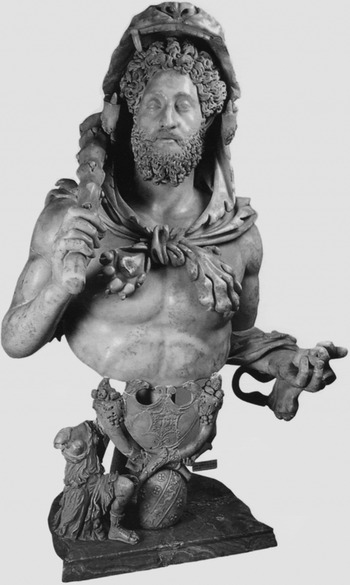
The bust also recalls other Roman imperial precedents. Bronze had been employed for ancient statuary, and the half-length format is that often used for imperial portraits. The allegorical base is also found in ancient portraiture. The Leoni bust resembles that of the emperor Commodus (Rome, Musei Capitolini) (see Figure 6) in particular details. Like that of Commodus, the bust of Charles V is supported on a base with an allegorical center flanked by two figures. In the Leoni bust, a nude male and a nude female figure flank an eagle.
Commodus as Hercules, c. 190. Marble, 118 cm. Rome, Museo dei Conservatori. (Photo Credit: U. D. F.—Photothéque).

These details reinforce the imperial associations. Either the helmeted male figure represents the god Mars and the female Bellona, the deities of war, or they are perhaps Hercules and Minerva, the protectors of the arts. In the former case, the figures would allude again to the emperor's military success; in the latter case, the suggestion would be that Charles is ex utroque Caesar, an emperor or ruler in war and peace (this might also be the implication if the figures were Mars and Minerva). If the male nude is interpreted as Hercules, a further reference would be made to ancient Roman sources, like the sculpture of Commodus that depicts him as Hercules, wearing a lion's skin and holding a club in one hand and the apples of the Hesperides in the other.Footnote 8
In turn, the Herculean reference alludes to the Habsburgs, because they claimed Hercules as an ancestor.Footnote 9 Habsburg and imperial references are otherwise clearly evident in the sculpture, because Charles is shown wearing the order of the Golden Fleece, the “house order” of the Habsburgs. The eagle below may be read as the imperial eagle, standing for Germany, the Empire, and the Habsburgs' rule. Because eagles carried Roman emperors to the gods, it may also be an allusion to the emperor's immortality.
The combination of Christian and classical references makes this bust the quintessential image of Charles V as Holy Roman Emperor. As such, it expresses the imperial ideal that was revived with his reign. The accumulation of the Spanish, Burgundian, and Habsburg heritage, election to the imperial dignity, and Habsburg accession to the Bohemian and Hungarian thrones (in the person of Charles's brother Ferdinand) seemed to betoken that the universal monarchy once embodied in the Roman Empire and revived by Charlemagne had returned with Charles V.Footnote 10 Conceived at the height of Charles's power, this portrait also evinces the dream that the ruler had a divinely ordained imperial mission. Together with the universal monarchical ideal, it thus also reflects the hope—especially vivid after the crushing of the Protestant league—that peace and order, like that once established by the Roman imperium, could be restored in Europe after a period of confessional and dynastic strife. Charles V's reign thus would signal a return of the Golden Age, to be associated with the peace that Emperor Augustus had brought to the dominions of Rome. At the time the bust was completed, peace in Europe was in fact being achieved, at least for a while, by the Peace of Augsburg of 1555, which established the basis for peace in the empire, and after Charles's death by the Treaty of Château Cambrésis (1559), which brought about a similar result with France and in Italy.
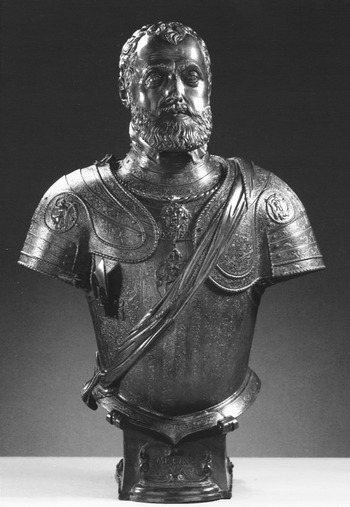
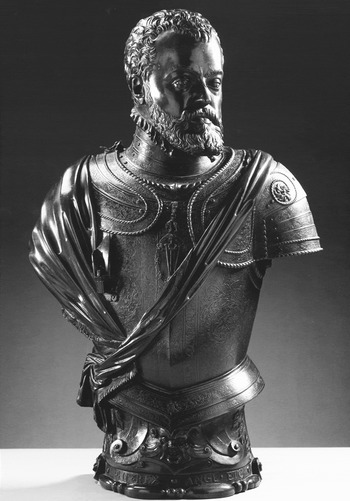
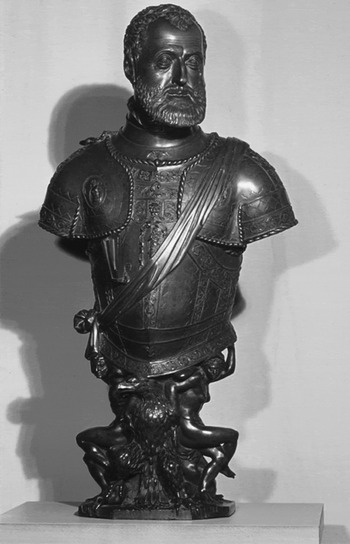
Cast during the years 1553–1555 in relatively expensive material, this finely modeled bust would also have been fit to present to an emperor, although the Prado version remained in the possession of Leoni's son Pompeo (1533–1608), who perhaps had continued working on it sometime until his death; only thereafter did it enter the Spanish royal collection and eventually the Prado. Nevertheless, already at the time that the Prado original was being made, it served as the basis for at least two replicas, also probably by Leone Leoni,Footnote 11 that were in fact presented to important personages. One was ordered by the Duke of Alba (now Royal Collection, Windsor Castle) (see Figure 7), Charles V's commander in chief; this is the version in the Royal Collection, which it entered much later, during the nineteenth century when George IV acquired it. The Duke of Alba was Charles V's general, and his leadership was largely responsible for the victory at Mühlberg. The duke later became Philip II's commander in chief. Hence, Leoni made another similar bust of Philip (Royal Collection, England) (see Figure 8) that also belonged to the duke and probably was meant to complement the first.
Leone Leoni, Bust of Charles V, c. 1553–1555. Bronze, 95.3 cm. Windsor Castle, RCIN 35325. (Photo Credit: The Royal Collection Trust, © Her Majesty Queen Elizabeth II, 2012).

Leone Leoni, Bust of Philip II, King of Spain, c. 1554–1555. Bronze, 88.9 cm. Windsor Castle, RCIN 35323. (Photo Credit: The Royal Collection Trust, © Her Majesty Queen Elizabeth II, 2012).

Given that Philip took over the reign of Spain when Charles V retired to Yuste in 1556 and became king on Charles's death in 1558, the bust probably dates to this period as well; it may be dated 1554–1558, or more precisely 1554–1555, when Philip could claim the title inscribed on the cartouche “king of England” as consort of Queen Mary but was not yet able to claim to be exclusive king of Spain (or Castile and Aragon). To complete the series (also now Royal Collection) (see Figure 9), Leoni made yet another bust that portrays the duke of Alba himself. The conceptualization of the busts of Philip II and of the Duke of Alba is clearly quite close to that of Charles V.
Leone Leoni, Bust of Fernando Álvarez de Toledo, Third Duke of Alba, 1554–1556. Bronze, 96.5 cm. Windsor Castle, RCIN 35337. (Photo Credit: The Royal Collection Trust, © Her Majesty Queen Elizabeth II, 2012).

Yet another bust of Charles V, this one cast in 1555, was sent to the imperial chancellor, Cardinal Granvelle (along with busts of Mary of Hungary and the cardinal himself, together with other sculpture). A major patron of the arts (of Bronzino among others), Granvelle was also a close associate of Charles V. This bust entered the collections of the Austrian Habsburgs and is now in Vienna (Kunsthistorisches Museum) (see Figure 10). Still other, later casts (e.g., Washington, DC, National Gallery of Art, Kress Collection; Gaasbeck, Belgium) are also known.Footnote 12
Leone Leoni, Bust of Emperor Charles V, c. 1550–1555. Bronze, 113 cm. Vienna, Kunsthistorisches Museum. (Photo Credit: Vienna, Kunsthistorisches Museum).

The first two replicas (and the original) could have served many functions. They would have been portraits of the sovereign, reminders of the recipients' suzerain, and accordingly would have carried many of the representational associations mentioned. They were costly items, and would have been seen as impressive gifts. As such, they assuredly would also have been regarded as fine works of art, to be cherished in collections of the sort that indeed were begun in the sixteenth century both by monarchs and by aristocrats, as they have been by collectors and museum visitors ever since.Footnote 13
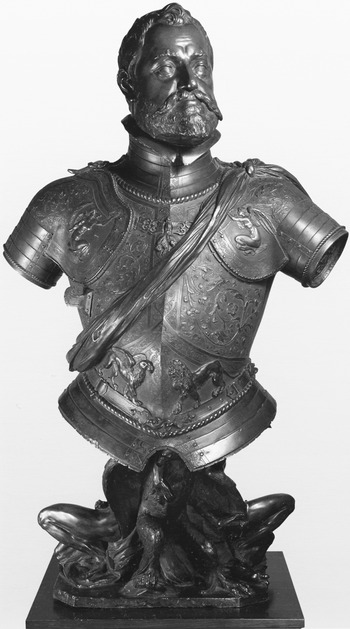
The Prado version thus spawned a number of replicas and may be regarded accordingly as a prime object that stimulated the creation of replications, to use George Kubler's terminology.Footnote 14 These include both smaller reductions and variants of the portrait of Charles V himself, including some in marble, and portraits of other rulers that were modeled on Leoni's original. Chief among these is the bust of Rudolf II (1552–1612) that the imperial court sculptor Adriaen De Vries (1545–1626) made in 1603 for the emperor.
De Vries's bronze (Vienna, Kunsthistorisches Museum) (see Figure 11) was clearly inspired by the version of the bust of Charles V that had been owned by Cardinal Granvelle and acquired by Rudolf, Charles's grandson, in 1602.Footnote 15 It closely approximates Leoni's work in size, format, and general iconography. Rudolf II acquired this bust, along with other objects from the Granvelle collection, in 1602. Like the bust of Philip II, who was at the same time Rudolf's uncle, first cousin, and brother-in-law, the bust of Rudolf II also expresses a claim to the continuity and legitimacy of the Habsburg dynasty. This is expressed by the emblem that the emperor wears. Rudolf wears the Golden Fleece, the order that is associated with the House of Habsburg, which Charles had promoted. Because Charles is depicted wearing the order in Leoni's bust, De Vries shows Rudolf similarly, thus strengthening the connection between the two rulers. In general, De Vries's statue thus transfers the imperial ideal or dream to another generation, to Rudolf II.
Adriaen de Vries, Bust of Emperor Rudolf II, Prague, 1603. Bronze, 112 cm. Vienna, Kunsthistorisches Museum, Inv. Nr. 5506. (Photo Credit: Vienna, Kunsthistorisches Museum).

De Vries's bust is, however, more than merely a copy or adaptation of the bust of Charles V. It sharpens and specifies some of the imperial references of the earlier work and vies with its model in several other key ways. Rudolf II was frequently portrayed in art as a victorious general, especially since he was embroiled in a war with the Turks (lasting from 1593 to 1606) at the time the sculpture was made: In the bronze bust, Rudolf II wears the commander's sash, as does Charles in the Leoni bust. But the allusions in the De Vries remain symbolic and fictive because, unlike Charles V, Rudolf II never led troops into battle. His armor, rather than being a specific suit like that worn by Charles V, is for example a fictive design—but that in itself is significant, because the lack of reference to a specific suit of armor in the De Vries as opposed to the Leoni allows it to be filled with symbolic devices. The shoulders display on their front clearly legible personifications of victory and fame, the overall connotation of the depiction in armor. On the back, they show putti carrying a globe and a celestial sphere, allusions to imperial aspirations at universal dominion. A lion's head in the middle of the back is a Herculean reference and perhaps also an allusion to the supposedly leonine aspects of the emperor's physiognomy. The cuirass sports four beasts at or around the waist: a lion for Herculean strength and also imperial power; the griffin for swiftness, often coupled with the lion as a heraldic beast; the ram, along with supporting the bust, alludes to Capricorn, the zodiacal symbol of Augustus, which Rudolf II (and other rulers) had adopted as his own sign, that proclaims the return of the Golden Age with Rudolf's reign; and the eagle, seen below at front, is again a reference to Jove, the imperial bird. The eagle may thus here alude to empire and to immoratlity as well.
The eagle may also here allude to empire and perhaps immortality; he stands on a base, where he is flanked by two nude male figures, which, in comparison with those found in the Leoni, are now made specifically identifiable. The presence of their attributes (respectively, thunderbolt and caduceus) makes clear that they are Jupiter and Mercury. Jupiter, as king of the gods, personifies omnipotence; Mercury personifies eloquence and may also allude to wisdom and the emperor's support of the arts. All of these symbols recur in Rudolfine iconography, in which the emperor is occasionally personified as Jupiter or Mercury.
The formal qualities of the bust also vie with those of the Leoni. The surface treatment and indication of features are much more generalized: The element of idealization is thereby increased. At the same time, De Vries's bust is presented much more as a statue in the round. Like other bronzes of the time, it invites viewing from a number of different aspects as it is beautiful from all angles.Footnote 16 All aspects of its symbolism are also only fully legible when it is viewed from all sides (note, for example, that the head of the eagle faces forward in the Leoni but is turned around in the De Vries; important details appear on the front, back, and partly on the sides). In contrast, the Leoni requires just one principal view. The upturned head and slight torsion suggesting contrapposto lend the De Vries a more dynamic effect as well.Footnote 17
The features that may be interpreted as characterizing imitative emulation in the De Vries were probably quite intentional. Other works of both painting and sculpture demonstrate that artistic competition, within and across the media, was one of the driving forces for making art at the court of Rudolf II in Prague. In their efforts to compete with their predecessors, contemporaries, and with other media, several imperial court artists, including De Vries, created works that clearly responded to their prototypes in competitive fashion, often striving for “modern” or ever new designs, or in the sculptor's instance, with painting. Thus, the emulation of the Leoni bust in such a way as to surpass or heighten some of its features was probably a conscious effort on the part of De Vries, who in other examples of his work may often be seen to vie with other artists, including his master Giambologna and ancient sculpture.Footnote 18
There is further background to this competition. During the 1580s, De Vries had assisted Pompeo Leoni in his Milanese workshop. There De Vries would have been involved with the preparation of bronzes, including that of Philip II and Charles V for their tomb in the Escorial.Footnote 19 It has, however, not previously been observed that because the bronze bust that is the first version of the portrait of Charles V by Leone Leoni was still in the possession of his son Pompeo while De Vries was working in the latter's atelier, De Vries would probably have become familiar with this prime version before he even saw the version from the Granvelle collection, that is, after the version that arrived in Prague in 1602 when it was acquired for De Vries's patron Rudolf II. It seems likely that beside the symbolic and political references, De Vries responded to the commission to portray Rudolf II in a guise similar to that of Charles V by taking on Leoni not only as a model, but also as a form of artistic competition with a composition he had already absorbed. His composition seems to reveal considerable cogitation on the effects he wished to create in contrast with the source, in addition to responding to a commission in which he filled the needs of creating resonant imperial iconography.
Both the artistic and political aspects of the bust would have helped to earn for it a prominent place in the imperial Kunstkammer, where it was in fact soon housed together with, although apparently not alongside of, the bust of Charles V from the Granvelle collection. Like the Kunstkammer as a whole, it could have been admired for its qualities as a work of art, for its accomplishment in working in a metal that is also a valued material, and for its statements about the emperor. In this last regard, the representational aspects of the piece fit very well its location in the Kunstkammer of Rudolf II, because the Kunstkammer itself may be interpreted as a form of representatio. Rudolf's Kunstkammer played this role both for the emperor's own self-glorification and for purposes of diplomacy.Footnote 20
The diplomatic uses of works of art and collections are tied up with the background and circumstances attending the creation and transfer of a second bronze bust that De Vries made the same year (1603) he completed the portrait of Rudolf II. This is a bust of Duke-Elector Christian II of Saxony (Dresden, Skulpturensammlung) (see Figure 12). Christian II's portrait is closely related to that of Rudolf II, and thus derives ultimately from that of Charles V. It portrays the ruler in bust format, wearing armor, with a medal attached to a sash around his neck, supported on a base that has two allegorical figures on either side of a coat of arms, with bound spears below. Unlike the busts of Charles V and Rudolf II, the one of Christian II is cut off before the waist. This format also more closely resembles that found in Roman portraits. Like Rudolf II's attire, Christian's armor is generalized; like Rudolf's physical features, Christian's countenance is idealized, as observed above. Furthermore, since Christian wore a beard from 1600 onward, his bust presents a youthful impression that would not have been visible when the portrait was modeled and cast in 1603, much less than when it was actually given to the Duke in 1607.Footnote 21
Adriaen De Vries, Bust of Elector Christian II of Saxony, Prague, 1603. Bronze, 94.2 cm. Skulpturensammlung, Staatliche Kunstsammlungen, Dresden, Inv. Nr. H41/4. (Photo Credit: Skulpturensammlung, Staatliche Kunstsammlungen, Dresden).

According to an inventory reference of 1610, Christian II received the bust as a gift from the emperor while on a visit to Prague in 1607. This was the culmination of a diplomatic initiative in which gift-giving and collecting played an important part. The visit was occupied with various pastimes, and the one formal audience the duke-elector had with the emperor was spent looking at the emperor's horses and collections. The emperor thus received the duke in and through his Kunstkammer.Footnote 22 There, the Leoni bust of Charles V and the De Vries of Rudolf would have been seen, along with many other objects; the gift of a similar object must have made an impression.
The symbolism of the bust of Christian II may be associated with this initiative. On the one hand, it glorifies the ruler by casting him in the guise of a Roman imperator, suggested by the truncated bust format and by giving him as well a chivalrous, knightly appearance by showing him in armor like that seen in the busts of the Holy Roman emperors to whom his portrait is related. The gorgon's head on the front of Christian's suit of armor refers most likely to the similar device seen on the shield of Minerva/Athena, and hence associates him with her, as an allusion to princely wisdom; that of a lion's head on the back has Herculean associations of heroic strength. Again the notion may thus be suggested that Christian is a ruler strong in both the arts of war and peace. The coat of arms shown on the plinth below bears the heraldic devices of Meissen and Saxony surmounted by the electoral hat, referring to Christian II's electoral and princely dignity, and showing the territories he ruled. Furthermore, because he wears a medal with an imperial double eagle and portrait of Rudolf II hanging from a sash that is seen directly above the coat of arms and electoral hat, it is suggested that his reign is legitimate and connected with loyalty to the emperor. On the one hand, the legitimacy of his position as ruler of Saxony and elector might still have needed emphasis, because in fact Christian II's predecessors in the so-called Albertine line of the House of Wettin, the ruling house of Saxony, had taken the electoral dignity from their Ernestine cousins. This transfer of the electorate had occurred because Christian's ancestor Maurice, although he was a Protestant, had allied himself with Charles V against the Schmalkaldic League.
On the other hand, there are good reasons why the bust of Christian II directly emphasizes Habsburg-Wettin relations, and particularly those with Rudolf II. As noted, Christian wears a doubled-headed eagle pendant, which resembles a knightly order, but in fact bears a portrait of Rudolf II presented in the form of a medal. This obviously suggests his attachment to the emperor. The two female figures below clasp hands, a symbolic representation of concord. The bound spears, which resemble fasces, also suggest concord or unity—here the unity of the House of Habsburg and Wettin. Imperial support would have lent authority to the claims to rule by Christian, while at the same time this suggestion by the imperial sculptor De Vries would have expressed the wishes of the emperor's policies.
The bust embodies a policy that Rudolf II had specifically articulated in a letter of 10 January 1600 to Christian II. Rudolf II said that after he had learned that Christian delighted in paintings and other works of art, that he would send him some items as signs of his friendship and affection. These were intended to help preserve and continue the friendship and true relations that had always existed between the houses of Austria and Saxony.Footnote 23
Rudolf bestowed a series of gifts on Christian II during the first years of the seventeenth century. Some of these also had particular political messages, of the sort the De Vries possessed. One such item was the personal coat of arms of Christian II, made out of pietre dure by the Prague court workshops, on the reverse of which was painted an allegory of the victorious alliance of Christian II with the imperial cause, executed by the workshop of the imperial painter Hans von Aachen. In 1607, Christian II came home laden with many gifts, which were reported as being worth 10,000 Thalers.Footnote 24 The bust, a culminating expression of Rudolf's policy, was one of them, a shining token of the implementation of Rudolf's diplomatic efforts.
The De Vries portrait bust of Christian II may furthermore be situated in a longer history of Habsburg-Wettin relations in which displays of collections and gift-giving attached to symbolically important objects played an important part. In 1570, Duke August of Saxony had attended a tourney in Prague on a visit to Rudolf's father Emperor Maximilian II, much as Christian II later attended tourneys when he visited Prague in 1607; on another visit August made to Vienna in 1573, Emperor Maximilian II evidently showed him works of art, including what may be identified as a work by Giuseppe Arcimboldo. Probably soon afterwards, if not directly on the occasion of the 1573 visit, the duke-elector received a suite of paintings dated 1573 of the Four Seasons from the artist, for which he was probably paid, at least in part, in 1574. Eventually, the Saxon collections contained as many as ten paintings by the imperial painter, as well as many studies of animals.
The original versions of Arcimboldo's paintings of the Seasons and Elements were, among other things, imperial allegories celebrating the eternal reign and world dominion of the Habsburgs. Habsburg devices and the letter M for Maximilian II are placed on the painting of Winter, marking the Seasons as the emperor's own and emphasizing the special importance of this particular season for the ruler. On the Saxon versions, the arms of Meissen/Saxony are substituted for the devices and M, thus transferring the allusions to Duke August.Footnote 25 Because Arcimboldo continued to work for Rudolf II and made similar gifts to other courts during Rudolf's reign,Footnote 26 there is further reason to connect his pictures with the later period: Arcimboldo's Saxon pictures may accordingly be seen as beginning a sequence of Habsburg gifts to the Saxon court in which imagery created for the Habsburgs is transferred to the Wettins.
This process again may be seen to culminate with the gift of the bust of Christian II by De Vries. In both instances, works by artists that had originally been created for an emperor served as models for objects given to a Saxon duke. The symbolism and form of each were meaningfully transferred from the imperial frame of references to those of Saxony. The process seems to culminate with the gift of the bust of Christian II by De Vries.
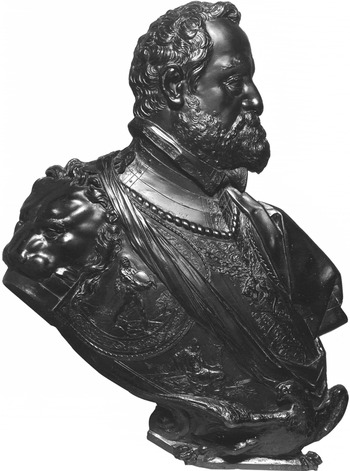
The bust of Christian II is recorded in the Dresden Kunstkammer in 1610. It entered there much as the Leoni and De Vries busts had entered the Kunstkammer in Prague. The connection of these busts with the Kunstkammer leads us to a consideration of several other important works of art by De Vries, including most pertinently for this discussion a bronze bust in relief (London, Victoria and Albert Museum) (see Figure 13).Footnote 27 This is a signed and dated bronze portrait of 1609 depicting Emperor Rudolf II. The portrayal in profile may be related to depictions of rulers on medals, for example, those made of Rudolf by Antonio Abbondio (see Figure 14). This sort of profile portrait may also be related to the portrayal of Roman emperors on coins. These were well known at the imperial court, in part because of the presence of numismatic manuscripts, and because of the expert knowledge possessed by the imperial antiquaries (antiquarii), at first Jacopo and especially Ottavio Strada, who served the court until his death in 1607.
Adriaen De Vries, Relief Portrait of Emperor Rudolf II, Prague, 1609. 71.1 cm. London, Victoria and Albert Museum, Inv. Nr. 6920.1560. (Photo Credit: © Victoria and Albert Museum, London).

Antonio Abbondio, Medal, Vs./ Rudolf II., Rs./ SALVTI PUBLICÆ, Prague, 1576. Lead and Pewter, 47.8 mm. Münzkabinett, Staatliche Kunstsammlungen, Dresden, Inv. Nr. 3755. (Photo Credit: Dresden, Staatliche, Kunstsammlungen, Elke Estel/Hans-Peter Klut).

In the relief, the slanted placement of Rudolf's chest, which raises the portrait from a pure profile, seems to be designed to emphasize the lion that is shown on the shoulder. The lion appears to be almost the same size as the emperor's face. It thus not only complements, but also suggests a direct parallel between the two. This sort of parallel was discussed in physiognomic theory of the day. The main contemporaneous proponent of this theory was Giacomo della Porta, who dedicated a treatise to Rudolf II and was in communication with the imperial court. The association suggests that Rudolf has a leonine disposition; king of men, he is like the king of the beasts.
There are other reasons for the appearance of the lion, which to be sure recalls the lion skin that Hercules wore after he accomplished one of his “labors,” the slaying of the Nemean Lion. Like the Leoni busts of Charles V on which it no doubt relied, the appearance of the lion on the relief portrait therefore also obviously invokes an association with the demigod Hercules. Like Charles V, Rudolf II thus claimed to be comparable to Hercules in heroism. The Habsburgs claimed to be descended from the ancient hero, so Rudolf II's bust is here also recalling that claim.
The identification with Hercules on the relief bust is reinforced by the appearance of Hercules in another scene shown on the breastplate of the suit of armor that Rudolf II is shown wearing. This is a hammered and incised depiction of Hercules carrying the vault of heavens. In this role, he takes up the burden of Atlas, who supported the heavens: This is another of the legends of Hercules. This scene moreover clearly alludes to Charles V, because Charles V's device included the pillars of Hercules, which the hero had set at the boundaries of the known world. Charles's device contained the motto plus ultra, suggesting that he had surpassed even these limits, establishing a worldwide empire.
On the relief sculpture a seated female figure is shown on the other part of the breastplate beneath Hercules. She wears a helmet, as she holds a little figure of victory in her hands, and she sits on top of a bundle arms. This is an allusion to triumph over savage forces in war. No doubt this image refers to the role of the Habsburgs in fighting the Turks. But the allusion is also to a victorious peace, and therefore a reference to Augustus, who had been celebrated by Vergil in this role, especially in his Aeneid (I:293ff). Because of the helmet and the shield, the figure has been identified with Minerva, who has assumed, in addition to her role as goddess of wisdom, the guise of goddess of war. Although this identification may be possible, I believe that as in other Rudolfine images this figure may, however, also be read as corresponding to a well-known image of Rome, Roma, who by extension personifies the Holy Roman Empire. The implication would be that Rudolf II is a triumphant Roman, or Holy Roman emperor, who brings peace to the world, like Augustus.
This association with Roman emperors coincides with the prominent eagle on which the bust rests. As in the prime version rounded bust of Charles V by Leoni and that of Rudolf by De Vries, the eagle may refer to Jupiter, whose bird it was, or to Roman or imperial eagles in general. But as the eagle is shown here supporting the bust, which it might even be interpreted as carrying, it quite closely resembles the common symbolism of Roman imperial apotheosis, which is associated with the consecration of ancient Roman emperors, as we have repeatedly seen. Moreover, the eagle seems to be spreading out its wings, as if to take flight to the heavens.
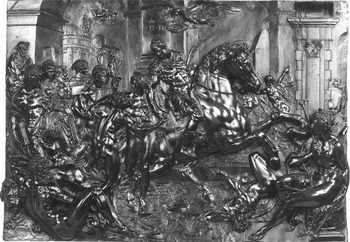
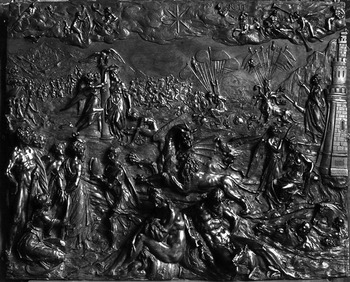
Originally the relief bust of Rudolf II was mounted on black marble and placed in the Prague Kunstkammer. According to early-seventeenth-century inventories, it was hung between two other bronze reliefs by De Vries. The date of one of these reliefs, which is now in the Royal Collection, is also 1609 (see Figure 15). This sculpture also depicts Rudolf II as a hero. It is thus likely that the two reliefs were planned together to fulfill a program. They complemented another, slightly earlier relief by De Vries (now in Vienna), which depicted the emperor's undertakings in the Turkish wars (see Figure 16).
Adriaen De Vries, Rudolf II Protecting the Liberal Arts in Bohemia, Prague, 1609. Bronze, 59.0 × 84.0 cm. England, Collection of H. M. Queen Elizabeth II. (Photo Credit: The Royal Collection Trust, © Her Majesty Queen Elizabeth II, 2012).

Adriaen De Vries, Allegory of the War Against the Turks in Hungary (also known as Victory over the Turks), Prague, 1604–1605. Bronze, 71 × 88.5 cm. Vienna, Kunsthistorisches Museum. (Photo Credit: Vienna, Kunsthistorisches Museum).

The three reliefs, therefore, form what might be envisioned as a triptych sculpted in separate works of bronze. Seen together, they enact a kind of secular apotheosis. The relief portrait in the Victoria and Albert Museum expresses this idea most directly, as it may be read as showing the emperor being carried off on an eagle. His portrait is central to the meaning of the group. The condensed imagery of the portrait relief is expanded by the two related reliefs, which show, on the one hand, Rudolf II as a heroic patron of the arts, and, on the other hand, allude to his victories in wars over the Turks.
The latter of these, the bronze relief now in the Royal Collection, shows the emperor in action. However, he is not depicted leading troops in war, but leading the arts into Bohemia, as a reference in early inventories also states. He stretches to greet painting, which, along with sculpture and architecture, is shown in the company of the liberal arts. The emperor tramples on ignorance; in the foreground, Fame celebrates his virtues. In the background, Hercules is shown chasing vicious figures, thus echoing the emperor's actions. Capricorn, the symbol of Augustus and hence Rudolf and other rulers, the monogram RII, and the imperial eagle, Rudolf's personal device, are shown overhead; they all allude to familiar claims associated with the emperor.Footnote 28
This image of the emperor as triumphant patron is complemented by a relief now in Vienna celebrating his victories in the Wars with the Turks. An early inventory describes the allegory on the Turkish wars as depicting his imprese, which as in Ariosto probably refers to his knightly undertakings. Briefly, a series of topographic and allegorical images derived from compositions by Hans von Aachen and Paulus van Vianen represent the imperial victories in the “Long” Turkish War of 1593–1606. Rudolf appears in symbolic form, identified again by his monogram RII above; in the foreground, he is also portrayed directly, as he restores the bishop's miter to the coronation seat of Hungary, Szekesvehevar, or Stühlweissenburg in German, thus symbolizing the Christian reconquest of the city from the Turks. In sum, the relief shows Rudolf II allegorically as a triumphant general.
Taken together, the reliefs therefore depict the two sides of imperial virtue. They demonstrate that Rudolf II is ex utroque Caesar, a great ruler in both war and peace. This message is epitomized in the portrait of the emperor in relief, which originally would have been hung between them.
The initial impetus for this program seems to have come from the emperor. He was clearly closely involved with the planning of De Vries's projects, as we learn from some other references. We know that the relief with the allegory on the Turkish wars was in particular Rudolf's idea. It is described in an inventory of 1621 as the emperor's invention.Footnote 29
The personal involvement of the ruler suggests that these works probably meant a great deal to him. This helps us understand the function of such images. Although they might seem to represent a kind of aggrandized propaganda, they were in fact kept in the Kunstkammer, where they were difficult to access, available to the emperor and only a few of his associates or those privileged enough to see them. At the end of Rudolf II's life, what was perhaps all that was necessary for him was that he could contemplate his own glory as power and authority were gradually stripped from him. (He lost control over many of his lands.) But beyond that: In an age in which personal connections and self-esteem accounted for much more than widespread popularity, it well might have been enough that such images were seen by a few people, if they counted, like Christian II, or Rudolf II's close associate Duke Heinrich Julius of Braunschweig-Wolfenbüttel.Footnote 30
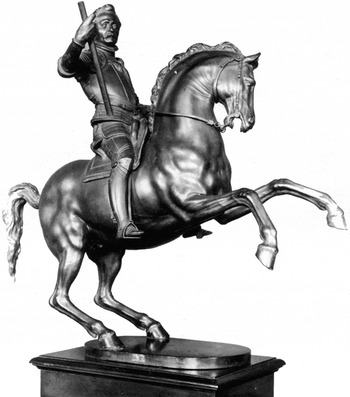
Mention of this Protestant duke, another of the German rulers friendly to the emperor, takes us back to the beginning of this paper. For works made for the duke also emulated Charles V's and Rudolf's portraiture. De Vries made a small equestrian statuette of the duke (Braunschweig, Herzog Anton Ulrich Museum) (see Figure 17). This statuette recalls the print by Sadeler after De Vries, whose lost statuette it probably emulates, and thus ultimately echoes the equestrian portrait of Charles V by Titian.
Adriaen De Vries, Equestrian Statue of Duke Heinrich Julius, c. 1605, Braunschweig, Herzog Anton Ulrich Museum. (Photo Credit: Missing. Source: Kaufmann, The Eloquent Artist, 197).

To conclude: We have seen how in the sixteenth and seventeenth century portraits followed in the tradition of Charles V in having special roles in the propagation of the image of the ruler. The sculptures in bronze discussed here could serve purposes of representation, in various senses of the word. They could be replicated and given as gifts, which might also serve diplomatic purposes. They could be reproduced and also emulated, in forms of artistic competition. Finally, as the case of De Vries's relief bust of Rudolf II suggests, portraits of Renaissance rulers could become not merely forms of representation. A ruler could admire them as visions of his ideal self. Hence, in the end, rulers' portraits could become more than objects of representation: They could become paragons of self-representation.