INTRODUCTION
Language learners are faced with the challenge of determining who did what to whom. For example, given a subject relative clause (SRC) in (1a) or a subject wh-question in (1b), a child learning English might decide that the first noun phrases the lady and which lady, pronounced sentence initially, are interpreted as the agents of the predicate ‘hug’. This strategy, however, would lead to misinterpretation in the case of object relative clauses (ORCs) and object wh-questions like (2), where the first noun phrases should instead be interpreted as the object of the verb ‘hug’:
-
(1)
-
a. The lady that ___ is hugging the girl.
-
b. Which lady ___ is hugging the girl?
-
-
(2)
-
a. The lady that the girl is hugging ___.
-
b. Which lady is the girl hugging ___?
-
Such dependencies, which require interpreting constituents in a position (the gap) different from the one in which they are pronounced (the filler), have long represented a test case for exploring the relation between grammatical knowledge and the accompanying processing system, in both children and adults. Previous research in language acquisition has shown that children find subject dependencies like those illustrated in (1a) and (1b) easier to produce and comprehend than object dependencies like (2a) and (2b). This pattern has been observed in various cross-linguistic studies with typically developing children (Adani, van der Lely, Forgiarini & Guasti, Reference Adani, van der Lely, Forgiarini and Guasti2010; Arnon, Reference Arnon, Brugos, Clark-Cotton and Ha2005, Reference Arnon2010; Avrutin, Reference Avrutin, Grodzinsky, Shapiro and Swinney2000; Belletti, Friedmann, Brunato & Rizzi, Reference Belletti, Friedmann, Brunato and Rizzi2012; Contemori & Marinis, Reference Contemori and Marinis2014; Friedmann, Belletti & Rizzi, Reference Friedmann, Belletti and Rizzi2009; a.o.). Moreover, the same subject/object asymmetry emerges in atypical language acquisition (Contemori & Garaffa, Reference Contemori and Garraffa2010; Durrleman, Marinis & Franck, Reference Durrleman, Marinis and Franck2016; Friedmann & Novogrodsky, Reference Friedmann and Novogrodsky2011; Volpato & Adani, Reference Volpato and Adani2009) and in agrammatic aphasics (Avrutin, Reference Avrutin, Grodzinsky, Shapiro and Swinney2000; Garraffa & Grillo, Reference Garraffa and Grillo2008; Grillo, Reference Grillo2008). However, the cause of children's difficulties with object dependencies is debated.
In the remainder of this ‘Introduction’, we will review three accounts that have been proposed to explain children's patterns of comprehension with object dependencies. We will then present our studies, which tap into this debate by investigating French-speaking children's comprehension of object wh-questions and ORCs in which the referential properties of either the object or of the intervener were manipulated, while their structural NP feature was held constant. Finally, we will discuss our findings in light of the predictions put forth by these approaches. While in this paper we concentrate on accounts that provide explanations in terms of structure and processing, it is worth noting that there is also a different context to this debate provided by frequency/usage-based approaches to the development of such dependencies (Brandt, Diessel & Tomasello, Reference Brandt, Diessel and Tomasello2008; Brandt, Kidd, Lieven & Tomasello, Reference Brandt, Kidd, Lieven and Tomasello2009; Diessel, Reference Diessel2004; Diessel & Tomasello, Reference Diessel and Tomasello2000, Reference Diessel and Tomasello2005). By relying mainly on data from early production corpora and elicited imitation experiments, these studies argue that the development of complex sentences in child speech is related to input frequency (i.e. children are more accurate at producing and comprehending relative clauses which conform to patterns occurring regularly in their linguistic environment) and involves a process of clause expansion (i.e. children's relative clauses develop from constructions that contain only a single proposition, being not very different from simple sentences, and they are gradually turned into bi-clausal constructions in which two separate situations are expressed by two different clauses). We will come back to this approach and its potential for explaining our data in the ‘Summary and concluding discussion’ section.
Intervention accounts
Object dependencies are harder than subject dependencies, and those object dependencies involving objects similar to the intervening subjects are hardest of all, even for adults (Gibson, Reference Gibson1998; Gordon, Hendrick & Johnson, Reference Gordon, Hendrick and Johnson2001, 2004; Warren & Gibson, Reference Warren and Gibson2002). Such asymmetries in children's comprehension of object dependencies have been recently interpreted in terms of the locality constraint known as Relativized Minimality (RM) (Rizzi, Reference Rizzi1990, Reference Rizzi and Belletti2004; Starke, Reference Starke2001). The RM principle states that a local relation between X and Y cannot hold if there is an intervener, Z, which is of the same structural type as X and which can be a potential candidate for the relation. That is, RM predicts that the presence of an intervening element Z, which shares the same set of features with X, will create a minimality effect by blocking the establishment of a syntactic dependency (i.e. of a chain) between the two elements of the dependency, X and Y.
Drawing on prior work by Grillo (Reference Grillo2009) and Garraffa and Grillo (Reference Garraffa and Grillo2008), who used this principle to account for the subject/object asymmetries identified in agrammatic aphasics, Friedmann et al. (Reference Friedmann, Belletti and Rizzi2009) extended the RM approach to explain the comprehension asymmetry between subject and object dependencies in child language. In a study with twenty-two Hebrew-speaking children (age range 3;7 to 5;0), Friedmann et al., identified the source of children's difficulties with the presence of a lexical restriction (or [ +NP] feature, to use their terminology) on both the moved object and the intervening subject. In other words, they show that children only struggle with those structures in which (i) there is an embedded subject (the girl in (2)) intervening in the interpretive chain formed by the fronted object (the lady) with its gap and (ii) this element shares a partial featural specification with the moved object: both are full DPs (i.e. they both contain a lexical NP). This leads to a minimality effect since the subject DP represents a potential competitor in establishing the correct grammatical dependency between the moved constituent and its original position, as shown in (3):
-
(3)


Friedmann et al.’s (2009) account therefore predicts that not all object dependencies cause minimality effects in children and that their comprehension difficulties can be modulated by the degree of structural similarity between the moved or the intervening element. Indeed, their results revealed an improvement in children's performance with ‘free’ ORCs (i.e. those constructed with who) and with object who questions, as well as with ‘headed’ ORCs (i.e. those constructed with a full DP) in which the intervening subject was an arbitrary pro element. Based on these findings, Friedmann et al., concluded that children find headed ORCs and which NP questions with an intervening [+NP] subject more problematic because they fail to compute the subset–superset relations between the features of the DP filler and the embedded subject DP. This failure to distinguish the two elements in terms of their featural specifications causes intervention effects stemming from a violation of RM in their grammar. Note that intervention is computed here in a hierarchical manner, not a linear one, therefore this approach also predicts worse performance with object dependencies not only in head-initial languages, but also in head-final languages such as Chinese. This prediction has been borne out in a large-scale study assessing the comprehension of SRCs and ORCs in 120 Mandarin-speaking children (Hu, Gavarró, Vernice & Guasti, Reference Hu, Gavarró, Vernice and Guasti2016).
Subsequent studies in the framework of an RM approach to children's difficulties with object dependencies have shown that the internal structure of the subject and object DPs plays an important role in explaining the comprehension patterns found with these dependencies. These studies show that the features entering into the computation of locality appear to be more fine-grained than the simple presence of a lexical NP restriction. For example, Adani et al. (Reference Adani, van der Lely, Forgiarini and Guasti2010) found that a number mismatch between the moved object and the intervening subject improves Italian children's performance with ORCs (compared to the conditions in which the two elements matched in features). The authors also reported better results when the two elements mismatched in gender features, although the effect was not as prominent as in the case of a number mismatch.
In the same vein, Belletti et al. (Reference Belletti, Friedmann, Brunato and Rizzi2012) investigated the impact of a gender mistmach on the comprehension of headed relative clauses in Hebrew and Italian. They observed that a gender mismatch sharply improved the comprehension of headed ORCs in Hebrew-speaking children, but did not significantly affect comprehension of the same dependencies in Italian children. The authors argue that the different impact of gender in Hebrew and Italian stems from the different morphosyntactic status that the gender feature has in the two languages: while in Hebrew gender is morphologically specified on the verb and acts as an attractor for movement of the subject, in Italian it is not and therefore the gender feature does not enter in the computation of intervention.
More recently, Bentea and Durrleman (Reference Bentea and Durrleman2015) and Bentea, Durrleman, and Rizzi (Reference Bentea, Durrleman and Rizzi2016) showed that features such as animacy, which are not morphologically encoded on the verb, are also visible for the computation of intervention effects. They base their observations on the effect that a mismatch in the animacy feature between the two DPs had on the comprehension of filler–gap dependencies headed by either a full lexical NP or by an element lacking a lexical NP restriction. Bentea et al.’s results are in line with those obtained by Arosio, Guasti, and Stucchi (Reference Arosio, Guasti and Stucchi2011) for ORC comprehension in Italian-speaking children, by Adani (Reference Adani, Bianchi and Chesi2012) for ORC comprehension in German monolingual children (aged four years), and by Kidd, Brandt, Lieven, and Tomasello (Reference Kidd, Brandt, Lieven and Tomasello2007), who found that German and English children's difficulty with ORCs is reduced when the head noun and the embedded subject are of different animacy.
To recapitulate, the RM account focuses on the structural processes that have an impact on children's knowledge of filler–gap dependencies. The assumption is that children's selective difficulties with object dependencies derived by movement arise from the morphosyntactic featural specification of the moved element and the intervener. However, it is only a mismatch in syntactically active features that can modulate intervention effects in filler–gap dependencies.
Other accounts that explain the difficulties with ORCs in terms of intervention, although in a different sense to RM, are based on adult sentence processing, but can be extended to acquisition data as well. According to Gibson (Reference Gibson1998, Reference Gibson, Marantz, Miyashita and O'Neil2000) and Warren and Gibson (Reference Warren and Gibson2002, Reference Warren and Gibson2005), sentence complexity is linked to the number of new referents (nouns, verbs) that intervene between the moved element and the gap where this element is integrated in the structure. The greater the number of intervening discourse referents, the longer the moved element has to be kept in memory until the gap is encountered and the filler–gap dependency resolved. This leads to higher processing costs.Footnote 1 Moreover, referents that are easily accessible will have lower processing costs than newly introduced referents, therefore leading to lower processing costs when resolving the dependency that crosses such elements. Under this view, an intervening pronoun reduces processing cost because it does not introduce a new discourse referent. Warren and Gibson indeed show that adults have less difficulty with doubly nested ORCs and object clefts when the most embedded DP is a pronoun rather than a full DP. Other studies, such as Gordon et al. (Reference Gordon, Hendrick and Johnson2001, Reference Gordon, Hendrick and Johnson2004), define the difficulties with ORC processing in terms of similarity between the moved element and the embedded subject and show that it is easier to parse an ORC when the two constituents are sufficiently dissimilar. For instance, Gordon et al., found that ORCs with a second person pronoun or a proper name as an embedded subject reduce processing difficulty in adults. Children are also more accurate with the comprehension of ORCs in which the intervening subject is a pronoun, be it a first person pronoun (Arnon, Reference Arnon2010) or a second person pronoun (Kidd et al., Reference Kidd, Brandt, Lieven and Tomasello2007). Note that Friedmann et al.’s (2009) account outlined above makes the same predictions with respect to the facilitator role of pronouns, as these constituents lack a lexical restriction or +NP feature (but see Haendler, Kliegl & Adani, Reference Haendler, Kliegl and Adani2015, who found that comprehension of ORCs with two full DPs was more accurate as compared to ORCs with a third person pronominal subject).
The ‘set-restriction’ account
Recent work has questioned whether a solely syntactic view, taking the mere presence of an NP restriction as crucial for triggering intervention effects, is sufficient to capture children's difficulties with filler–gap dependencies. Goodluck (Reference Goodluck2010) challenges the structural intervention or RM approach on two grounds. First, she claims that this account assumes a stricter version of RM in child grammar as compared to adult grammar, which is problematic for a continuity approach to language acquisition (Crain, Reference Crain1991; Pinker, Reference Pinker1984). More specifically, this analysis implies that child grammar does not contain an A and A-bar distinction. Indeed, the structures in (1) and (2) are grammatical in adult grammar because the intervening DP does not occupy an A’-positionFootnote 2 and is thus not ‘similar’ to the fronted object in this respect. Postulating that children would not take this into account appears to go against evidence suggesting that despite some differences between child and adult grammar in terms of question formation and relativization, child performance reveals a clear awareness of functional projections including CP and hence of A/A-bar distinctions (Goodluck, Guilfoyle & Harrington, Reference Goodluck, Guilfoyle and Harrington2006; Thornton, Reference Thornton1995).
Second, Goodluck (Reference Goodluck2010) shows that the discourse properties of the moved object modulate children's difficulties with filler–gap dependencies. In an experiment with fourteen English-speaking children (mean age 4;8), Goodluck (Reference Goodluck and Di Sciullo2005) assessed comprehension of who and which questions, including which elements with different levels of descriptive content, i.e. a constituent with more specific referential features (which dog) versus a more generic one (which animal). If we take, for example, the case of object wh-questions with a more or less specific wh-element (which dog vs. which animal), we see that, from a syntactic point of view, they both require an NP as an answer. The questions introduced by these two wh-elements will also have similar logical forms:
-
(4) Which dog did the tiger push?
For which x, x is a dog, the tiger pushed x.
-
(5) Which animal did the tiger push?
For which x, x is an animal, the tiger pushed x.
Wh-phrases of the type in (4) and (5) have been termed as D(iscourse)-linked (Pesetsky, Reference Pesetsky, Reuland and ter Meulen1987, Reference Pesetsky2000), since answering such questions implies a choice from “a set of individuals previously introduced into the discourse” or “from a set that is presumed to be salient to both speaker and hearer” (Pesetsky, Reference Pesetsky2000, p. 16). Although both wh-words create a set of potential referents, which animal, by being less specific, does not limit this set as much as which dog, a more specific expression. From this point of view, which person is closer in meaning to a bare wh-phrase like who, although the latter does not presuppose the availability of a given set of referents in the discourse context.Footnote 3
Whereas an approach appealing to intervention effects of a RM type predicts that both which phrases should be equally difficult as they both contain a [+NP] feature (and are matched on number, animacy, etc.), the children in Goodluck's (Reference Goodluck and Di Sciullo2005) study find questions of the type Which animal did the tiger push? as easy as questions introduced by who (Who did the tiger push?), but they have more difficulties with questions like Which dog did the tiger push? In addition, a follow-up study (Goodluck, Reference Goodluck2010) revealed that even in the case of subject questions, where no intervention effects arise, more specific wh-elements (which dog) yielded poorer performance than less specific ones (which animal). Goodluck (Reference Goodluck2010) argues that these effects cannot be captured in terms of RM. Instead, she suggests that children's difficulties with object which questions are determined both by the length of syntactic movement (because which dog / which animal are extracted from the more distant position of object of the verb push), and by the more costly operation of set-restriction. That is, in order to correctly interpret which dog, children have to restrict the set of potential referents only to ‘dogs’ and then understand which dog is being referred to. This operation of set-restriction is less costly in the case of the more generic constituent which animal, potentially because these elements do not require choosing a specific subset from a contextually determined set of entities. Taking this reasoning further, Goodluck and Zweig (Reference Goodluck and Zweig2013) suggest that children's difficulties with object which questions result from the pressure exerted by certain computations on their limited processing abilities and this pressure is not necessarily grounded in structural sources, but may rather be brought about by mental computations such as the operation of set-restriction that distinguishes between questions introduced by which dog and those introduced by which animal. For ease of reference, we will refer to the account put forth in Goodluck (Reference Goodluck2010) as the set-restriction account.
That set-restriction is a costly operation, even for adults, has been revealed by a self-paced reading study in Dutch by Donkers, Hoeks, and Stowe (Reference Donkers, Hoeks and Stowe2013). Donkers et al., found that object questions introduced by who and which person displayed significantly faster reading times (RTs) than which N questions (where N represents a noun that has a more specific reference than person). They take this as evidence for a higher processing cost associated with which N questions, as their interpretation requires access to a more restrictive set than who or the generic which person. Goodluck and Zweig (Reference Goodluck and Zweig2013) interpret this result as reflecting the distinction between a set-restriction operation applicable to which N questions and a syntactic mechanism differentiating between who and which person / which N. Note, however, that the reason why set-restriction is such a complex operation yielding worse results in object chains than in subject chains is not clearly detailed in the literature.
Somewhat contradictory evidence for the approach outlined above comes from Gordon et al. (Reference Gordon, Hendrick and Johnson2004), who examined RTs for SRCs (6) and ORCs (7) in English-speaking adults:
-
(6) The salesman / the person that contacted the person / the accountant spoke very quickly.
-
(7) The salesman / the person that the person / the accountant contacted spoke very quickly.
In their study, the presence of a noun like the person, conveying weaker descriptive information, did not significantly reduce the processing difficulty of ORCs with respect to SRCs. Nonetheless, it is interesting to note that the three types of ORCs they tested yielded different RTs. A closer look at these reading times reported in Gordon et al. (Reference Gordon, Hendrick and Johnson2004) shows that RTs at both critical regions (the embedded verb contacted and the main verb spoke) were faster (although not significantly so) for ORCs headed by the more generic noun the person as compared to those headed by a more specific expression, irrespective of the type of embedded subject (the account / the person). The online results were corroborated by participants’ scores on the comprehension questions, which also revealed slightly higher accuracy for ORCs headed by the person. From this perspective, Gordon et al.’s results, although yielding only a subtle effect, could be put on a par with those in Donkers et al. (Reference Donkers, Hoeks and Stowe2013), who found a more significant effect of the absence of set-restriction in wh-questions. This could point to the fact that the absence of an operation of set-restriction modulates at least the encoding of the A′-filler in filler–gap dependencies in adults.
The incremental processing account
Another way to account for the discrepancy between subject and object dependencies is in terms of incremental processing. Drawing on theories of language processing in adults (MacDonald, Pearlmutter & Seidenberg, Reference MacDonald, Pearlmutter and Seidenberg1994; Trueswell & Tanenhaus, Reference Trueswell, Tanenhaus, Clifton and Frazier1994), accounts of children's language processing argue that children incrementally interpret utterances as they unfold and that, once they have committed to an initial interpretation, children struggle to revise it when they encounter information that arrives later in the structure (Omaki & Lidz, Reference Omaki and Lidz2015; Omaki, Davidson White, Goro, Lidz & Phillips, 2014; Trueswell & Gleitman, Reference Trueswell, Gleitman and Gaskell2007; Trueswell, Sekerina, Hill & Logrip, Reference Trueswell, Sekerina, Hill and Logrip1999). Evidence in favor of this comes from children's processing of prepositional phrase (PP) attachment ambiguities, as in the garden-path sentence:
-
(8) Put the frog on the napkin in the box.
Note that when hearing the PP on the napkin, this could be understood either as the Goal argument of the verb put or as a modifier of the direct object NP the frog. The presence of a second Goal argument (in the box) resolves this PP attachment ambiguity, because it supports a modifier interpretation of the first PP (‘the frog that's on the napkin’). However, Trueswell et al. (Reference Trueswell, Sekerina, Hill and Logrip1999) show that five-year-olds show a strong bias toward the Goal parse of the PP and that, contrary to adults and older children, they find it difficult to correctly revise their interpretation of the PP to be a modifier of the noun.
These observations have interesting repercussions for children's processing of patient/object-first structures, like object relatives and object wh-questions (see (2a) above). Given the increased exposure to agent/subject-first constructions, children would show a bias toward an interpretation of the first NP encountered as an agent/subject. Their commitment to an ‘agent-before-patient’ interpretation would be wrong in the case of a patient-first structure and would thus require revision of this canonical agent-first analysis.
However, not all initial nominals trigger the same level of commitment to an agent/subject-first analysis, as evidenced by an eye-tracking study with children and adults on the interpretation of passives in Mandarin Chinese (Huang, Zheng, Meng & Snedeker, Reference Huang, Zheng, Meng and Snedeker2013). Active sentences in Mandarin are signaled by the marker BA, so that the NP preceding this marker gets assigned an agent role. Passive sentences are signaled by the BEI marker, so that the NP preceding this marker gets assigned a patient role. Huang et al., used both full lexical NPs like ‘the seal’ and pronouns such as ‘it’ (see examples (9–10)), to test whether children make use of the relevant markers to disambiguate between passive and active readings for N(noun) N(noun) V(erb) sequences of words.
-
(9)
-
a. Seal BA fish quickly eat
‘The seal is quickly eating the fish’
-
b. Seal BEI shark quickly eat
‘The seal is quickly eaten by the shark’
-
-
(10) It BA (BEI) seal quickly eat
‘It is quickly eating the seal (eaten by the seal)’
Children fared better when they heard the structures in (10) with the pronoun ‘it’ in clause-initial position than they did in the expressed NP condition. The authors suggest that, in these instances of referential ambiguity, children were less likely to prematurely assign the NP1 the agent role because they could not immediately identify the referent in the display. Critically, the delay in interpretive commitment to an agent/subject first structure arguably allows children to subsequently infer that the less specific NP1 is a theme, without having to revise an agent first bias.
If this reasoning is on the right track, predictions are made for filler–gap dependencies as well. For example, in the case of object filler–gap dependencies, the difficulty in revising initial interpretive commitments surfaces as a limited ability to abandon the preferred agent/subject interpretation of the first NP in favor of a patient/object one. This agent/subject bias should arise when a more specific/set-restricted object occurs before a similar subject NP, as in ‘the dog that the tiger is pushing’, and should cause comprehension difficulties. In turn, when the first NP introduces referential ambiguity, as in the case of less specific/non-set-restricted constituents like person or animal, one could argue that these elements do not trigger the same level of commitment on the part of the child to an agent/subject analysis when presented with a structure like ‘the animal that the tiger is pushing’. As such, children may hold off from theta-role assignment until they encounter the second NP, and thus avoid revision of an agent/subject-first analysis.
CURRENT STUDIES
Taken together, these observations point to the necessity of investigating the nature of intervention in child grammar in more detail. While there are reports that the use of a less specific noun like animal as a filler affects comprehension of wh-questions in English (Goodluck, Reference Goodluck and Di Sciullo2005, Reference Goodluck2010), there is no replication to date in any other language, nor has any study assessed this in RCs. Moreover, Goodluck's studies do not investigate the effect that a less specific noun in the intervening subject position has on children's comprehension of filler–gap dependencies. This unexplored dimension actually provides essential data allowing for the teasing apart of the predictions of the set-restriction and the incremental processing accounts. Our studies on the comprehension of object filler–gap dependencies in French-speaking children address the debate between the various accounts outlined above by investigating (i) the effect of the set-restriction properties of the object filler (Experiment 1), as well as (ii) the impact of a less-restricted DP intervener (Experiment 2). This is the first investigation into how French typically developing children comprehend ORCs and wh-questions varying with respect to the referential properties of either the object filler or the intervening subject, while holding constant the structural properties relevant for syntactic intervention.
GENERAL METHOD
Children in both experiments were tested individually in a separate room at their schools. Each testing session lasted about twenty to thirty minutes. At the beginning of each session, there was a warm-up phase during which the experimenter explained the task to the child and practiced precise pointing. This ensured that children were familiar with the characters presented in the experiment. The warm-up was followed by two practice sentences and then by the actual experimental trials.
In the studies reported here we used a character-selection task adapted to French based on Friedmann et al.’s (2009) design for Hebrew. The experimental material consisted of pictures representing different pairs of human and animal characters (either two humans, or two animals, or a human and an animal) involved in reversible transitive actions (e.g. a girl drying a grandmother and a grandmother drying a girl). Figure 1 illustrates one such picture used in the experiment.
Example of target picture used in the character-selection task in Experiment 1 and Experiment 2.

The presence of two entities of each kind (e.g. two grand-mothers and two girls) made the use of RCs and of which N questions pragmatically felicitous (see Hamburger & Crain, Reference Hamburger, Crain and Kuczaj1982). Each set of images was associated with only one target item, so children never saw the same picture twice. We randomized the order of presentation of the trials, as well as the direction of the actions and the position of the target character across conditions. Before every trial, the experimenter provided a lead-in to the child by describing the actions depicted in the pictures: “Look! There are some people, two girls and two grandmothers! Here the grandmother is drying the girl. And here the girl is drying the grandmother.” The experimenter then uttered a wh-question or a RC, which prompted the child to choose one among the four characters depicted in the image: “Which girl is the grandmother drying? / Show me the girl that the grandmother is drying.” Children received positive feedback after each trial, irrespective of whether their response was correct or not. The experimenter recorded each answer on a response sheet.
EXPERIMENT 1
The first experiment focused on the properties of the moved object. The test items included object wh-questions and object relatives varying according to the lexical descriptive features of the filler: this was either a descriptively impoverished, more generic noun (like person or animal) or a descriptively rich, more specific noun (such as lady or dog). We labeled less specific nouns like person/animal as –Set-restricted, and more specific nouns like lady/dog as +Set-restricted. The featural specification of the intervening subject was always [+Set-restricted, +Animate].
The intervention accounts, on the one hand, and the set-restriction and incremental processing accounts, on the other hand, make different predictions with respect to the structures under investigation in Experiment 1. For +Set-restricted questions and relatives (Quelle fille est-ce que la grand-mère sèche? ‘Which girl is the grandmother drying?’/ Montre-moi la fille que la grand-mère sèche. ‘Show me the girl that the grandmother is drying.’), all three approaches predict weaker performance, although for different reasons. However, for –Set-restricted filler–gap dependencies, the intervention accounts differ from the other two approaches by continuing to predict poor performance, as we will explain.
For the RM account, based on Friedmann et al. (Reference Friedmann, Belletti and Rizzi2009), the difficulty associated with +Set-restricted structures stems from the presence of intervention effects determined by the similarity between the object filler and the intervening subject in terms of their featural specification – that is, both elements contain a lexical NP restriction. In more recent work (Belletti et al., Reference Belletti, Friedmann, Brunato and Rizzi2012), this is refined to refer to the Phi feature set triggering movement, such as that expressed in the verbal morphology, i.e. here person and number. Crucially, the notion of similarity throughout this framework is defined in strictly morphosyntactic terms. Since the grammatical feature specification does not change when switching to quelle personne ‘which person’ / quel animal ‘which animal’, as these elements still contain a singular, third person, lexical NP person/animal, the featural intervention approach continues to predict poor performance with these –Set-restricted questions due to the presence of similar syntactic features on both the object filler and the intervening subject. Gordon et al. (Reference Gordon, Hendrick and Johnson2004) also predict that such object dependencies headed by ‘person’ or ‘animal’ and containing an embedded subject like ‘the grandmother’ should be difficult to parse, as the two NPs are similar in that they both contain a ‘common noun’, in Gordon et al.’s terms. The same difficulty with these structures is expected under Gibson's (Reference Gibson1998, Reference Gibson, Marantz, Miyashita and O'Neil2000) and Warren and Gibson's (Reference Warren and Gibson2002, Reference Warren and Gibson2005) account, because in order to integrate the filler to the gap position, a new discourse referent needs to be crossed (i.e. a specific NP like ‘the grandmother’) and this should lead to a higher processing cost for the structure.
The set-restriction account argues that the application of a set-restriction operation is what is costly for both children and adults. This approach thus postulates that +Set-restricted dependencies should show lower comprehension scores due to the impact of two factors: the length of movement of an element and the requirement to apply a set-restriction operation which involves choosing a subset from a contextually determined set of entities. Under this view, processing of –Set-restricted wh-elements such as quelle personne ‘which person’/ quel animal ‘which animal’ should be easier than processing of +Set-restricted which N phrases, as the former refer to a set of potential referents which is less limited than the one presupposed by +Set-restricted which N elements.
From the perspective of the incremental processing account, children's difficulties with +Set-restricted questions and ORCs stem from the presence of an agent-first bias determined by a more specific first NP. According to this account, the referential properties of the first NP (i.e. whether its reference is more or less specific) are crucial in triggering, or not, a commitment to an agent-first analysis which children will afterwards have to revise based on the incoming linguistic information. In the case of –Set-restricted questions and ORCs, elements like person/animal, which introduce referential ambiguity by not restricting the set of referents, should prevent children from linking the agent role to a particular character and lead them to postpone theta-role assignment. This delay would allow children to infer that the first NP is a theme without having to revise an agent-first bias and guide them to the correct interpretation of object dependencies when the moved object is –Set-restricted, but not when it is +Set-restricted.
Participants
A total of one hundred and thirty-four typically developing French-speaking children (71 girls and 63 boys) aged 4;8 to 12;1 (mean age = 8;1; SD = 2·23) took part in the study. The participants were distributed across four age groups: 30 five-year-olds (18 girls and 12 boys) aged 4;8 to 5;11 (mean age = 5;2; SD = 0·45); 38 seven-year-olds (18 girls and 20 boys) aged 6;2 to 7;7 (mean age = 6;11; SD = 0·44); 32 nine-year-olds (13 girls and 19 boys) aged 8;7 to 10;0 (mean age = 9;2, SD = 0·52); 34 eleven-year-olds (22 girls and 12 boys) aged 10;5 to 12;1 (mean age = 11;1, SD = 0·44). All the children were recruited from two schools in the Geneva area, Switzerland.
Design
Children were tested on sixteen items, half of which were wh-questions and half ORCs, with Set-restriction (+Set-restricted/–Set-restricted) as a between-subject variable. The nouns that designated the object filler in the +Set-restricted condition were replaced with two nouns in the –Set-restricted condition (personne ‘person’ and animal ‘animal’). All the nouns used were in the singular form and they were matched for gender (there were always two masculine or two feminine noun phrases). For example, since personne ‘person’ is feminine in French, this was paired with feminine subject nouns. Animal ‘animal’, which is masculine, was used with masculine subject noun phrases. This controlled for the potential effect of gender mismatch on comprehension. Examples (11) and (12) are examples of target items used throughout the experiment: (11a) and (12a) represent the items for the + Set-restricted condition; (11b) and (12b) exemplify items in the –Set-restricted condition. A list of all items is given in ‘Appendix 1’.
-
(11)
-
a. Object + Set-restricted question
Quelle fille est-ce que la grand-mère sèche?
which.f.sg girl esk the.f.sg grandmother dries
‘Which girl is the grandmother drying?’
-
b. Object –Set-restricted question
Quelle personne est-ce que la grand-mère sèche?
which.f.sg person esk the.f.sg grandmother dries
‘Which person is the grandmother drying?’
-
-
(12)
-
a. Object + Set-restricted relative
Montre-moi la fille que la grand-mère sèche.
show.me the.sg girl that the.f.sg grandmother dries
‘Show me the girl that the grandmother is drying.’
-
b. Object –Set-restricted relative
Montre-moi la personne que la grand-mère sèche.
show.me the.sg person that the.f.sg grandmother dries
‘Show me the person that the grandmother is drying.’
-
Set-restriction was a between-subjects factor, but the two groups of children were tested using the same pictures. The only difference consisted in the type of noun used to refer to the object filler, which was +Set-restricted (i.e. ‘the girl’) for one group of participants and –Set-restricted (i.e. ‘the person’) for the other group.
The experiment also included twelve filler items to ensure that participants did not develop answer strategies and to control for their level of attention throughout the task. These were questions like “Where is the elephant with the headphones?” associated with pictures in which several characters were performing various actions. The fillers also prompted the child to point to a specific character, which was identified through the use of a prepositional phrase modifier. Therefore, each child heard a total of twenty-two sentences, including the two practice items preceding the actual experimental phase.
RESULTS
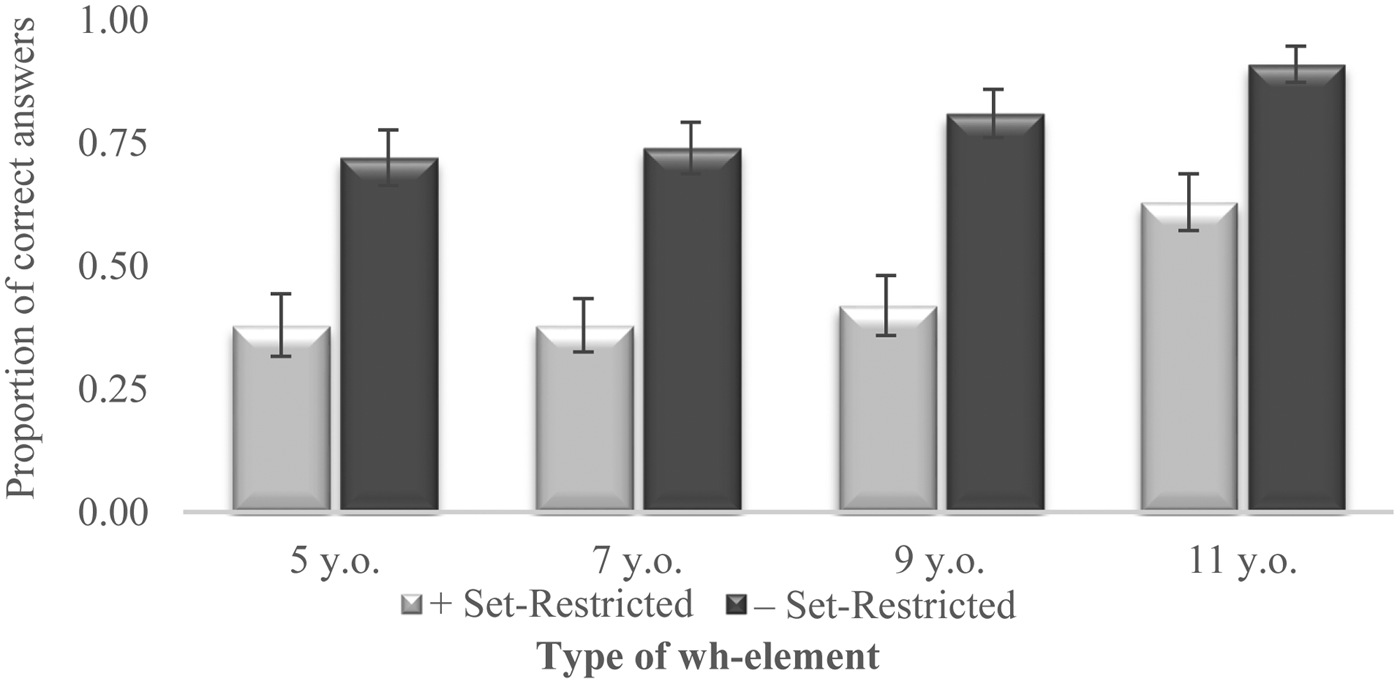
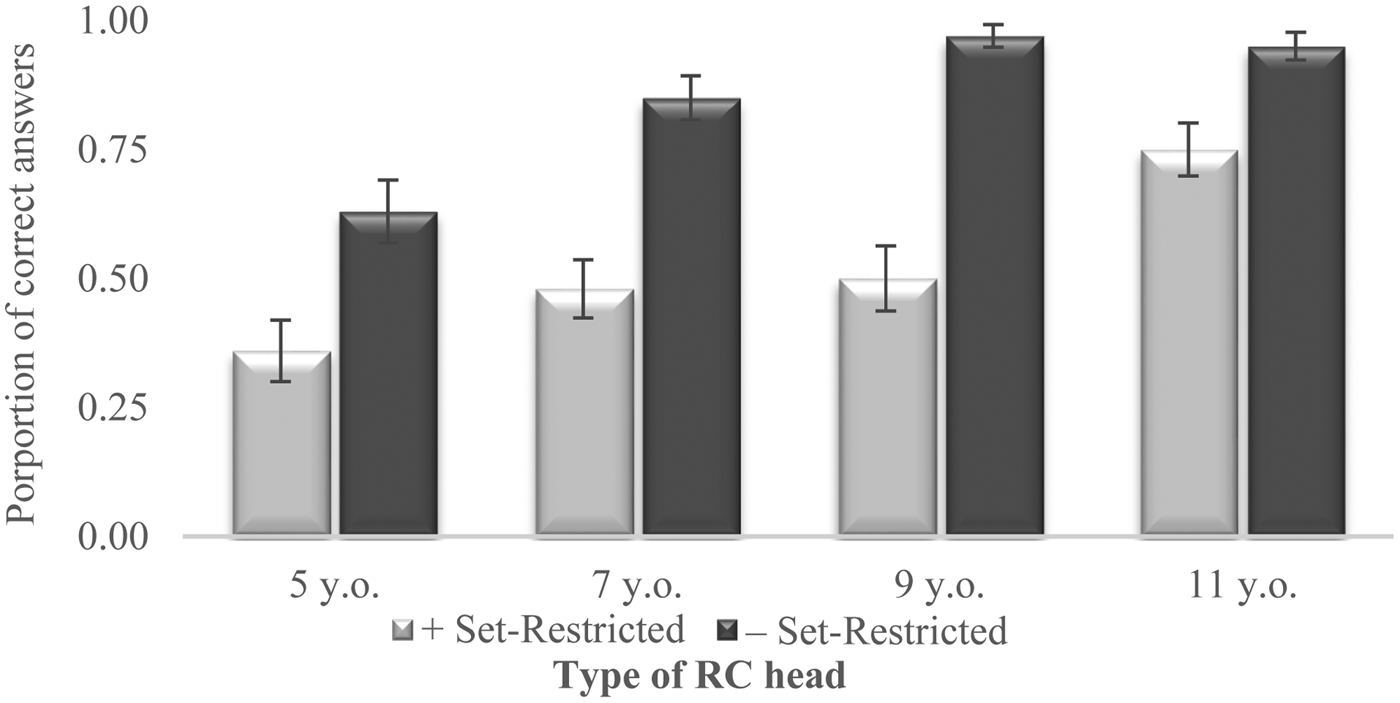
Figure 2 summarizes the results obtained for object wh-questions, while those for object relatives are given in Figure 3. In each case we plot the overall proportion of accurate responses in the various experimental conditions (i.e. the mean number of correct responses) and for all the age groups tested. An answer was coded as accurate whenever the child pointed to the correct character, that is, to the correct referent of the wh-element or of the relative head. An answer was coded as 1 if accurate, otherwise it was coded as 0. In order to reply correctly, children had to be able to identify the correct character affected by the action in the corresponding image. The bars represent standard errors to the mean.
Overall proportion of correct answers for wh-questions with a ±Set-restricted object in four age groups (5 years to 11 years).

Overall proportion of correct answers for relatives with a ±Set-restricted object in four age groups (5 years to 11 years).

The configurations that posed the most difficulties to children were those in which both the intervening subject and the filler were +Set-restricted. Younger children's accuracy with these structures was at 36% for relatives, and 38% for wh-questions. This difficulty persisted beyond the age of nine, remaining clearly observable even in the eleven-year-old children who were otherwise at ceiling for the other conditions tested. Children's accuracy scores sharply increase when the object was –Set-restricted. In such cases, performance improves to 63% accuracy on relatives and 72% accuracy on wh-questions as early as five years old and goes up to 90% for the eleven-year-olds.
An analysis of the kind of errors also reveals an asymmetry between the two conditions. Children made two recurrent types of errors: reversed role errors and agent errors (the error labels and interpretation are based on Arnon, Reference Arnon, Brugos, Clark-Cotton and Ha2005, who shows that four- and five-year-old Hebrew-speaking children make the two errors at almost the same rate in ORCs). For example, given (13) and Figure 1 above,
-
(13) Montre-moi la fille que la grand-mère sèche.
‘Show me the girl that the grandmother is drying.’
a Reversed role error occurred when children chose the girl on the bottom right. This kind of error suggests that the child assigns the wrong thematic role to the DP head by interpreting it as an Agent, whereas it is the Patient of the action expressed by the verb. An Agent error occurred when the child pointed to the grandmother on the top right instead of the girl on the top left. In this case, children identify the correct action, but point to the character corresponding to the DP Agent instead of pointing to the character designating the Patient. The rate of these different kinds of errors varied for the items containing a +Set-restricted vs. a –Set-restricted object. While the +Set-restricted object condition yielded 36% Reversed role errorsFootnote 4 and 17% Agent errors, the rate of these errors dropped considerably for the –Set-restricted object condition: 6% Reversed role errors and 5% Agent errors.
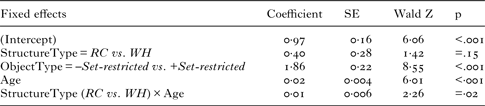
In order to investigate differences between the two +Set-restricted and –Set-restricted groups, we fit the categorical accuracy data to a logit mixed model (Jaeger, Reference Jaeger2008) and analyzed it using the lme4 package (Bates, Maechler, Bolker & Walker, Reference Bates, Maechler, Bolker and Walker2015) in the R environment (R Development Core Team, 2014). Structure Type (WH vs. RC) and Object Type (+Set-restricted vs. –Set-restricted) were fixed factors, while Age was modeled as a continuous covariate. Both fixed predictors were coded using a sliding contrast specification, in which the intercept is the overall mean of the dependent variable and the slopes indicate the differences between adjacent factor levels. The model also included intercepts for random effects of subjects and items, as well as by-subject random Object Type slopes. We only report the significant results of the analyses. The complete output of the model is given in ‘Appendix 2’. The main effect of Structure Type was not significant (coef = 0·40, SE 0·28, z = 1·42, p = ·15), showing that there was no difference in performance between wh-questions and relative clauses. The main effect of Object Type was significant (coef = 1·86, SE = 0·22, z = 8·55, p < ·001), confirming that performance on object dependencies headed by a –Set-restricted nominal was significantly more accurate than performance on object dependencies introduced by a +Set-restricted constituent. There was also a significant effect of Age (coef = 0·02, SE = 0·004, z = 6·01, p < ·001), as well as a significant interaction between Structure Type and Age (coef = 0·01, SE = 0·006, z = 2·26, p= ·02). This interaction reflects the fact that, whereas the younger five-year-old children performed better on wh-questions than on relative clauses, the other age groups were overall more accurate with relative clauses than with wh-questions. Neither the interaction Structure Type by Object Type (χ 2(2) = 1·15, p = ·28), nor the interaction Object Type by Age (χ 2(2) = 0·85, p = ·35) added significance to the model. This illustrates that children's performance with –Set-restricted and +Set-restricted object dependencies is the same across the two structures tested, as well as across ages.
DISCUSSION
Comprehension of object wh-questions and RCs was significantly better when the object filler was less specific or –set-restricted as in quelle/la personne ‘which/the person’ / quel/l'animal ‘which/the animal’ than when the object was a more specific or + set-restricted element, in spite of the two structures being identical in terms of syntactic complexity. The results do not follow from the intervention accounts, according to which both structures should yield similar performance, either due to the similarity between the object filler and the intervening subject stemming from the presence of a lexical NP restriction on both elements, or because the intervening subject is a newly introduced discourse referent associated with a higher processing cost. The findings of Experiment 1 show that the predictions of the set-restriction and incremental processing accounts are borne out.
Despite the presence of the NP feature on the moved object, these dependencies are easier for comprehension. As Goodluck (Reference Goodluck2010) pointed out, the superset relations in the case of animal/bear and in the instances discussed by Friedmann et al. (Reference Friedmann, Belletti and Rizzi2009) are different. In the former case, it is a semantic relation and in the latter it involves grammatical features. This difference may be responsible for the different results. Nonetheless, the RM approach cannot account for the improvement obtained in this study with object dependencies in which the head of the chain is a less specific constituent. Still, while an approach in terms of set-restrictiveness appears to fare better, it is not entirely clear why set-restriction makes processing more difficult; one might equally have thought that the restricted set would make identifying the appropriate referent easier. In addition, if children's selective difficulties with object dependencies are due to the complexity of applying the operation of the set-restriction, then such an account would predict that children also comprehend better object dependencies in which the intervening subject is –set-restricted.
The incremental processing account offers a different explanation for the improvement found with object dependencies in which the filler is –set-restricted. According to this account, children struggle more with object dependencies because they start off with a subject interpretation in which the first NP is the agent of the action expressed by the verb, and they have difficulties revising these initial interpretive commitments. As such, children, unlike adults, have a more limited ability to abandon the preferred subject interpretation in favor of an object one. However, when the properties of the first NP prevents an early subject commitment due to referential uncertainty, and postpones the assignment of theta-roles, no revision is necessary and comprehension of object dependencies should improve, which is what the results of Experiment 1 show. However, children should struggle to use the linguistic information if it is presented later in the sentence, and critically after they have made an initial commitment to a subject interpretation. Consequently, the incremental processing account would predict that children do not comprehend better object dependencies in which the intervening subject is –set-restricted, contrary to the set-restriction approach. Distinguishing between the predictions of the incremental processing and the set-restriction accounts is the focus of Experiment 2, presented in the next section.
EXPERIMENT 2
The second experiment compared French children's performance with object wh-questions and RCs in which we manipulated the properties of the intervening subject with respect to the object filler. The latter element was a set-restricted animate DP, while the subject intervener was a lexical element like personne ‘person’ or animal ‘animal’, which does not require the operation of set-restriction to establish its reference. This manipulation of the referential properties of the intervening DP goes in line with adult processing studies (Gordon et al., Reference Gordon, Hendrick and Johnson2001; Warren & Gibson, Reference Warren and Gibson2002) showing that the difficulty associated with object relatives is modulated by the type of NP acting as intervener. To our knowledge, no language acquisition study to date has examined the effect of a less specific intervening DP on the comprehension of object wh-questions and RCs. Critically, this second study allowed us to disentangle the predictions of the set-restriction and incremental processing accounts.
The manipulation of set-restriction on the crossing element and the intervener should not affect comprehension under the featural intervention account – for which the crucial ingredient is the presence or absence of a +NP feature on the subject or the object DP. Note that the presence of a subject intervener like personne ‘person’ or animal ‘animal’ is not expected to reduce comprehension difficulties under Gibson's (Reference Gibson1998, Reference Gibson, Marantz, Miyashita and O'Neil2000) and Warren and Gibson's (Reference Warren and Gibson2002, Reference Warren and Gibson2005) account either, since these NPs are also definite descriptions, as opposed to proper names and pronouns, and therefore accessing their referent will have a higher processing cost (see also Gordon et al., Reference Gordon, Hendrick and Johnson2004, who consider ‘the person’ and ‘the lady’ on a par because both NPs contain ‘common nouns’).
Although the set-restriction account does not explicitly deal with configurations in which it is the second nominal or the intervener that does not require a costly set-restriction operation, the logical prediction is that children should experience less processing load, and thus their performance should be similar to that of corresponding object structures in which the first nominal is –set-restricted and the subject is +set-restricted. However, for the incremental processing account, what matters is the nature of the first NP encountered. This will determine whether or not children assign an agent interpretation to the first nominal element. The incremental processing account therefore predicts that an agent bias arises when the object NP filler is specific, regardless of the specificity or lack of specificity on the intervener, and that children will have to revise this initial agent or subject interpretation based on the incoming linguistic information.
METHOD
Participants
The participants in the second study were eighty French-speaking children (41 girls and 39 boys) aged 4;11 to 12;7 (mean age = 8;0; SD = 2;29). The children were all recruited from the same school and, as in Experiment 1, they were grouped according to age, as follows: 20 five-year-olds aged 4;11 to 5;8 (mean age = 5;2; SD = 0·20); 20 seven-year-olds aged 6;7 to 7;4 (mean age = 7;0; SD = 0·25); 20 nine-year-olds aged 8;7 to 9;6 (mean age = 9;1, SD = 0·30); 20 eleven-year-olds aged 10;8 to 12;7 (mean age = 11;3, SD = 0·43).
Design
The second experiment followed the same procedure as the one outlined in the ‘General method’ section above. Children were tested on twelve experimental items, six object wh-questions and six object RCs. All items contained two animate DPs, which were mismatched for Set-restriction: the object filler was a + Set-restricted element (e.g. la fille ‘the girl’), while the intervening subject was –Set-restricted (e.g. personne ‘person’, animal ‘animal’). This is exemplified in (14) for wh-questions and in (15) for relatives. As in Experiment 1, only singular nouns were included and gender was controlled for, such that all items had either two feminine or two masculine noun phrases. ‘Appendix 1’ lists all the items used in Experiment 2.
-
(14) Object question with a –Set-restricted subject
Quelle fille est-ce que la personne sèche?
which.f.sg girl esk the.f.sg person dries
‘Which girl is the person drying?’
-
(15) Object RC with a –Set-restricted subject
Montre-moi la fille que la personne sèche.
show.me the.f.sg girl that the.f.sg person dries
‘Show me the girl that the person is drying.’
Each target sentence was associated with a picture showing two pairs of characters involved in the same action. The same types of images as in Experiment 1 were used, so we refer the reader to Figure 1 above.
RESULTS
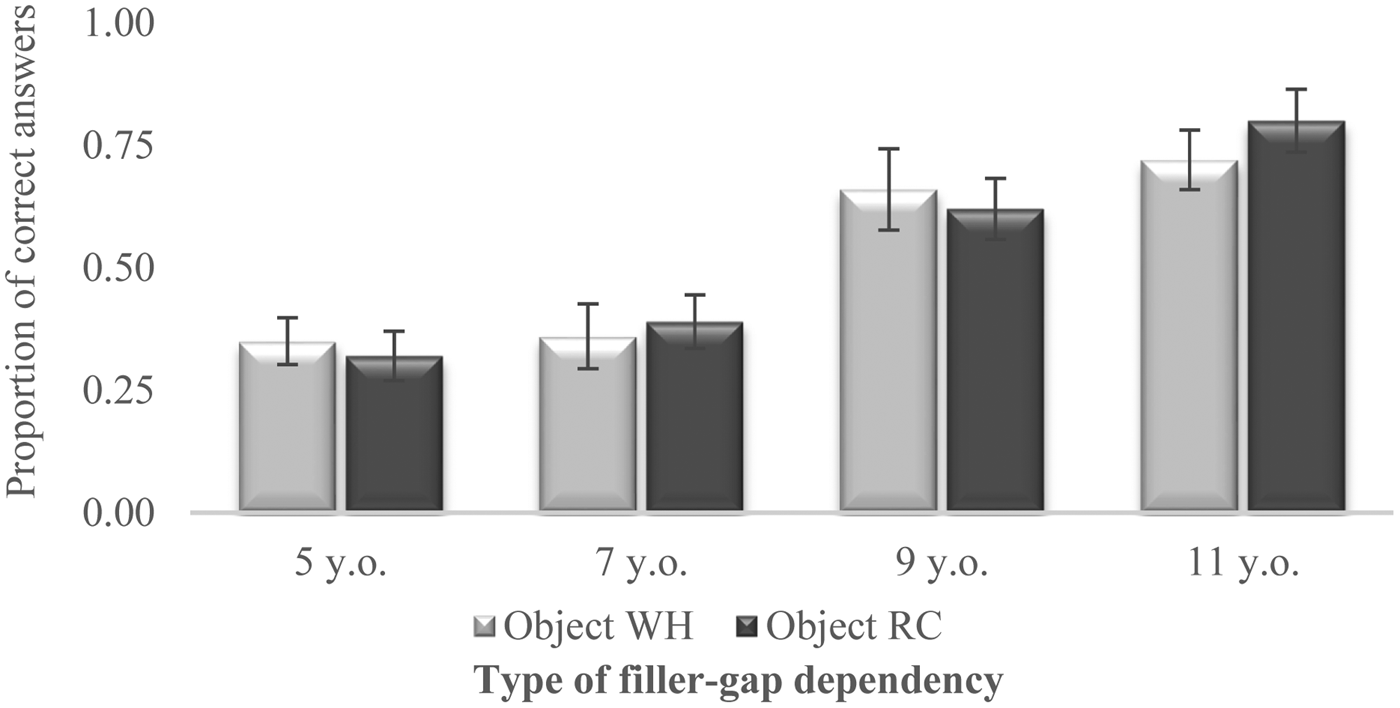
The results of Experiment 2 (Figure 4) indicate similar performance for both object wh-questions and object relatives with a less specific intervening subject across all the age groups tested. In addition, five- and seven-year-old children found these structures harder to comprehend than the nine- and eleven-year-olds participating in the experiment.
Overall proportion of correct answers for object wh-questions and relative clauses with a –Set-restricted intervener in four age groups (5 years to 11 years).

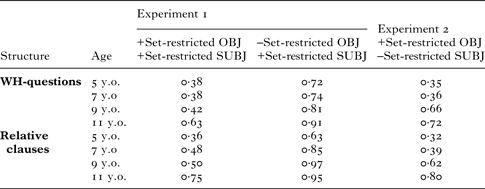
Table 1 compares the results in Experiment 2 to those already obtained in Experiment 1. This comparison clearly indicates that which object questions and headed object relatives with a lexically restricted +Set-restricted object and a –Set-restricted subject are also problematic for children, much like object dependencies in which both the object and the subject are +NP +Set-restricted (first column in Table 1). The results also show that both object wh-questions and object relatives can be understood well only when the moved object is referentially less specific or –Set-restricted. This improvement in performance occurs even though the object is of the same type as the crossed element in terms of lexical NP restriction.
Proportion of correct responses by age group for wh-questions and relatives in Experiments 1 and 2

The error pattern in Experiment 2 parallels the one found for the +Set-restricted conditions in Experiment 1: children made 37% Reversed Roles errors and 17% Agent Errors. This indicates that, when the reference of the first nominal is more specific, children tend to reverse theta-roles and interpret the Patient NP as an Agent.
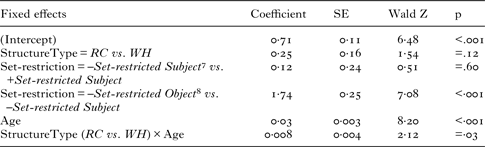
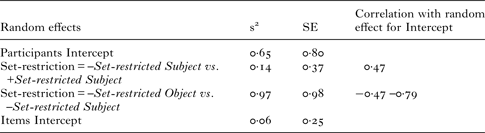
As the goal of Experiment 2 was to test the effect of a non-set-restricted intervener on the comprehension of object dependencies, and to compare children's performance with the different structures tested in Experiment 1, the data from the two experiments were analyzed together by fitting them to a logit mixed model, by using the same method as reported for Experiment 1. Structure Type and Set-restriction were included as fixed factors, coded again with a sliding contrast specification, and Age was included as a covariate in the model. The maximal random effect structure justified by the data included by-subject and by-item intercepts and random slopes for subject by Set-restriction. The complete output of the model is provided in ‘Appendix 2’ and we report only the most relevant results. When comparing the results of the two studies, no main effect of Structure Type emerges (coef = 0·24, SE = 0·16, z = 1·54, p = ·12), confirming that children's performance on wh-questions is similar to that on relative clauses. In addition, the statistical analysis indicates no difference in comprehension between object dependencies without a mismatch in set-restriction between the two DPs and those with a mismatch in which the subject was –Set-restricted (coef= 0·12, SE = 0·24, z = 0·51, p = ·60). On the other hand, children find wh-questions and relatives with a –set-restricted object and +set-restricted intervener easier to comprehend than object dependencies in which the subject is –set-restricted (coef = 1·74, SE = 0·25, z = 7·08, p < ·001). Age had a significant effect on comprehension as well (coef = 0·03, SE = 0·003, z = 8·20, p < ·001). There was also a significant interaction between Structure Type and Age (coef = 0·08, SE = 0·004, z = 2·12, p = ·03), indicating that young children perform similarly with both wh-questions and relative clauses, while in the older children we find the same advantage for the comprehension of relative clauses with respect to wh-questions. None of the interactions with the term Set-restriction were significant (χ 2(2) = 1·47, p = ·47 for the interaction Set-restriction by Structure Type; χ 2(2) = 1·29, p = ·52 for the interaction Set-restriction by Age).
DISCUSSION
Experiment 2 showed that the same difficulty found in the comprehension of which questions and headed relatives with a set-restricted object DP moved across a subject DP that shares the same set-restriction properties is maintained when the set-restricted object DP crosses a –set-restricted intervener like la personne ‘the person’ or l'animal ‘the animal’. Despite the mismatch in set-restriction properties of the two DPs, the structures tested in Experiment 2 are harder for children to process than those tested in Experiment 1, in which the moved object DP was –set-restricted and the subject was set-restricted.
This suggests that comprehension of object filler–gap dependencies does not improve, irrespective of the direction of the mismatch in set-restriction between the two nominals. If children's problems with object dependencies were caused by the difficulty of applying the operation of set-restriction, then we should have seen that the presence of an element which does not entail reference to a less restrictive, set as opposed to a more restricted set, should facilitate comprehension independently of whether the less set-restricted element appears in the subject or in the object position. Consequently, the operation of set-restriction per se does not seem sufficient to account for the asymmetries found in the comprehension of object dependencies.
SUMMARY AND CONCLUDING DISCUSSION
The goals of our studies were to assess different accounts which have been proposed to explain the developmental path of object dependencies, and to tease apart their respective predictions via an experimental investigation of filler–gap dependencies involving different levels of specificity or set-restriction (to use Goodluck's, Reference Goodluck2010, terminology). As such, these studies tap into the notion of similarity as defined by the presence of an NP restriction by assessing how set-restriction of the moved object or of the intervener contributes to modulating the comprehension of object dependencies. Experiment 1 focused on the moved object and compared the comprehension of wh-questions and relative clauses in which the object was a more or less specific nominal, while the intervening subject was always a more specific DP. From the point of view of the operation of set-restriction, we classified more specific nouns like dame ‘lady’ or ours ‘bear’ as +Set-restricted, since they presuppose restricting the set of referents to a greater extent than less specific or generic DPs like personne ‘person’ and animal ‘animal’, which were thus labeled –Set-restricted. Experiment 2 investigated the role played by the set-restriction properties of the intervening subject on the processing of A′-dependencies. In this study the manipulation of set-restriction was achieved by using, as subject intervener, a nominal like personne or animal not requiring the same degree of set-restriction to establish its reference, while the object was always +Set-restricted.
When comparing the results of the two experiments, the following pattern emerges for the comprehension of object dependencies: children perform more accurately when the fronted object DP denotes a nominal referring to a less restrictive set (e.g. L'animal que le chien soulève ‘The animal that the bear is lifting’), rather than when both the intervening subject and the object belong to a more restrictive class of referents (e.g. L'ours que le chien soulève ‘The bear that the dog is lifting’). This effect surfaces to the same degree in both wh-questions and relative clauses. The presence of a –Set-restricted noun in subject position does not seem to impact comprehension, as the accuracy scores for these configurations are similar to those found for object dependencies in which both the subject and the object are two + Set-restricted expressions.
In what follows we will discuss the data from the present experiments in light of the three approaches – intervention accounts (Belletti et al., Reference Belletti, Friedmann, Brunato and Rizzi2012; Friedmann et al., Reference Friedmann, Belletti and Rizzi2009; Gordon et al., Reference Gordon, Hendrick and Johnson2001, 2004; Warren & Gibson, Reference Warren and Gibson2002, 2005), set-restriction (Goodluck, Reference Goodluck2010; Goodluck & Zweig, Reference Goodluck and Zweig2013), and incremental processing (Huang et al., Reference Huang, Zheng, Meng and Snedeker2013; Omaki et al., Reference Omaki, Davidson White, Goro, Lidz and Phillips2014; Trueswell et al., Reference Trueswell, Sekerina, Hill and Logrip1999) – that were outlined at the beginning of the chapter. In the ‘Introduction’, we also mentioned an alternative account – the frequency/usage-based approach – which, contrary to the three accounts outlined above, focuses mainly on the discourse/pragmatic factors that impact children's early linguistic knowledge and its usage. Although the aim of this study was not to draw a direct comparison between this approach and the other three mentioned above, it is worth noting that the frequency/usage-based account does not straightforwardly explain the similar results obtained for both wh-questions and relative clauses. Recall that this approach considers that relative clauses evolve from simple non-embedded sentences denoting a single situation, and that children only gradually learn to use complex bi-clausal constructions. Therefore, we can hypothesize that children's comprehension difficulties with relative clauses might stem from the fact that they cannot successfully integrate the situations expressed by multiple-clause constructions. Given that wh-questions, unlike relative clauses, do not contain such multiple-clause constructions, they should not be of equivalent difficulty. Our results, on the other hand, show that both relative clauses and wh-questions with a +Set-restricted object are challenging for children to the same degree. Another point related to this approach is that of the frequency with which such constructions appear in the input and in children's productions; that is, children are more accurate at producing and comprehending relative clauses which conform to patterns occurring regularly in their linguistic environment. In order to see whether children's improved performance with –Set-restricted object dependencies could be related to frequency of use, we ran a frequency search of both children's spontaneous productions and adults’ input in two French corpora available on CHILDES, namely the York corpus (Plunkett, Reference Plunkett, Greenhill, Littlefield and Tano1999) and the Paris corpus (Morgenstern & Parisse, Reference Morgenstern and Parisse2007).Footnote 5 This frequency search revealed that, while children produced a whole array of wh-questions, there was no occurrence of wh-questions introduced by quelle personne or quel animal, or of relative clauses headed by personne or animal in children's productions. As for the adults’ production, there was only one instance of a wh-question introduced by quel animal. Consequently, an explanation in terms of frequency of use fails to capture the improved results we found with wh-questions and relative clauses with a –Set-restricted object.
Children's comprehension of dependencies in which both the subject and the object were +Set-restricted, and of dependencies with a +Set-restricted object and a –Set-restricted subject, is in line with intervention accounts, such as the featural RM approach. To recapitulate, this account links the problematic A′-dependencies to the presence of a similar +NP element (the subject) in the interpretive chain formed by the moved object, with the gap appearing in a postverbal position, and which gives rise to intervention effects of a Relativized Minimality type (Rizzi, Reference Rizzi and Belletti2004; Starke, Reference Starke2001) similar to those found in adult grammar. As both nouns like person/animal and nouns like lady/dog contain a lexical NP restriction (or a ‘common noun’, to use Gordon et al.’s, 2004, term), the difficulty with structures in which the subject was less specific finds a straightforward explanation within the featural intervention account. However, the overall enhanced performance in Experiment 1 with object dependencies introduced by –Set-restricted constituents, but which also have a lexical NP restriction, does not follow from this account. From the point of view of their syntactic complexity, there is no difference among the structures tested in the two experiments, in the sense that they are all object A′-dependencies in which a constituent bearing a lexical NP restriction moves from the embedded object position to the left periphery of the clause. According to the featural intervention account, children should have equal difficulties processing this movement, as well as resolving the A′-dependency. Experiment 1 showed that the manipulation of the referential properties of the two DPs (i.e. the fact that their reference can be more or less specific) clearly affects processing in children, even in cases in which the NP feature is held constant. While children struggle with configurations in which both the moved object and the subject are +NP +Set-restricted, as predicted by the featural intervention account, they perform significantly better when the A′-object is less specific or –Set-restricted, despite the presence of a lexical NP restriction. If children only paid attention to the presence of the NP feature of the two elements, then such results are not expected, since these structures should have created an inclusion configuration as far as the featural specifications of the subject and the object are concerned, and therefore lead to problems in comprehension similar to those found for dependencies in which both elements are +NP +Set-restricted. The enhanced performance in instances in which the referential properties of the moved object are manipulated suggests that a characterization of children's selective difficulties only in terms of absence or presence of a lexical NP restriction is too coarse to capture all the effects observed in Experiment 1.
The results obtained in Experiment 1 pattern with those reported by Goodluck (Reference Goodluck and Di Sciullo2005, Reference Goodluck2010), who also found that five-year-old English children comprehend object questions introduced by the more generic expression which animal better than those introduced by the more specific which dog. In addition, the present study extends Goodluck's findings to relative clauses and shows that these results also hold when a different generic noun, such as personne ‘person’ is used in object position. Goodluck (Reference Goodluck2010) and Goodluck and Zweig (Reference Goodluck and Zweig2013) attribute children's enhanced performance with these structures to the mechanism of set-restriction, “a mental computation that is not specifically linguistic”. Object A′-dependencies in which the target of movement is a –Set-restricted nominal such as la personne ‘the person’ or l'animal ‘the animal’ are easy because these elements do not require restricting the set of referents to the same degree as + Set-restricted elements like la dame ‘the lady’ or l'ours ‘the bear’. The observation regarding the set-restriction properties of the two types of elements is particularly interesting given the experimental setting, which links both the + Set-restricted and –Set-restricted nominal expressions to a context with a limited number of referents. Therefore, both expressions imply identifying a subset from a contextually determined set of entities. What distinguishes them is the amount of descriptive content conveyed and which is richer and more specific in the case of la dame or l'ours, while it is more impoverished and less specific in the case of la personne or l'animal. According to the set-restriction account, what challenges children is the difficulty of constructing the representation of the +set-restricted element, as this comes at an increased processing cost. In the absence of this set-restriction operation, children are capable of assigning the correct syntactic representation to the object dependency and link the moved constituent to the object gap position of the verb.
Moreover, the prediction made by the set-restriction account is that the absence of a set-restriction operation on either of the two DPs should modulate comprehension: if the set-restriction operation is what impacts children's performance, then continuing to alleviate the child's system of the need to apply this costly operation for one of the DPs should yield good performance. The data from Experiment 2 make it possible to evaluate this prediction, since the experimental items were object wh-questions and relative clauses with a +Set-restricted object DP and a –Set-restricted subject. Contrary to the predictions of the set-restriction account, the comprehension scores for object dependencies in which the intervener was a less specific noun like personne/animal were lower, as compared to their scores for object dependencies with a –Set-restricted object and a +Set-restricted subject. Children showed poor comprehension with the former structures despite the operation of set-restriction for one of the NPs being unnecessary. These scores patterned with those obtained for dependencies in which both elements were +Set-restricted. Hence, the data from the second study do not support the set-restriction account and show that the notion of set-restriction by itself is insufficient to explain the overall findings that come out from the two studies.Footnote 6
Both the featural intervention approach and the set-restriction approach can only account for part, but not all, of the dataset described in this paper. What the data reveal is that not all types of mismatches help modulate children's comprehension of object A′-dependencies. The direction of the mismatch plays an important role: when all the other syntactic properties are kept constant (i.e. object extraction, presence of a lexical NP restriction, match in gender and number, match in animacy), the referential specificity of the nominal element matters more when associated with the target of movement than when associated with the intervener. Note that we can easily dispense with an explanation in terms of difficulties establishing the reference of personne or animal in Experiment 2, since the same difficulty should be expected to hold in Experiment 1.
The data pattern obtained in the two experiments receives a straightforward explanation under the incremental processing account. According to proponents of incremental processing, children's difficulties vary as a function of the first argument. This is because children would rapidly assign an agent role when confronted with an NP allowing the identification of its referent, as in the case of a +set-restricted nominal, and they would subsequently fail to revise this analysis in the instance of object-first structures. In contrast, children would hold off from an agent-first commitment with pronouns (Huang et al., Reference Huang, Zheng, Meng and Snedeker2013) and, by extension, other referentially ambiguous nominals, alleviating them of the need to perform a revision of an inaccurate analysis. It is worth noting that this sensitivity to the amount of semantic information associated with the filler in an object dependency persists into adulthood (see Donkers et al., Reference Donkers, Hoeks and Stowe2013; Gordon et al., Reference Gordon, Hendrick and Johnson2004).
That children are likely to interpret a set-restricted NP as an agent/subject may be related to the fact that set-restricted nominals are good topics, and thus good subjects, since they are discourse-linked (Radó, Reference Radó1998, cited in Frazier & Clifton, Reference Frazier and Clifton2002). The idea that some constituents are more topic-worthy and therefore make good subjects was also used by Mak et al. (Reference Mak, Vonk and Schriefers2006) to account for the difference in processing between ORCs headed by inanimate nouns and ORCs headed by animate nouns. According to Mak et al., the parser is more likely to commit to a subject interpretation in the presence of animate head nouns, since these are more topic-worthy and make good subjects. However, the parser may delay theta-role assignment and the commitment to a subject interpretation when it encounters an inanimate head noun. With this in mind, let us turn to the –set-restricted NPs included in our experiments. A closer look at these less specific nominals reveals that they do not lend themselves well to topicalization. Consider the contrast in (16a) and (16b):
-
(16) Context: You are at a party and you spot a man and woman standing in a corner of the room. You turn to your friend and say:
-
a. La femme, je me demande qui va l'inviter à danser.
‘As for the lady, I wonder who is going to invite her to dance.’
-
b. *La personne, je me demande qui va l'inviter à danser.
*‘As for the person, I wonder who is going to invite her to dance’.
-
While the first sentence containing a more specific expression la femme ‘the lady’ is perfectly acceptable, a noun like personne ‘person’ is less felicitous in a topic position. This might suggest that less specific expressions, contrary to more specific expressions like la femme ‘the lady’, are less topic-worthy and are less likely to be interpreted as subjects. As such, these elements would not trigger a subject/agent-first bias and children would be less likely to assign a subject interpretation to object dependencies headed by these NPs.
The errors children make in the various experimental conditions further support this view. As shown in the ‘Results’ sections above, the most common mistake when interpreting object which questions or ORCs introduced by a +Set-restricted nominal was the Reversed Role error, whereby children assigned the wrong thematic role to the head of the dependency (i.e. they interpreted it as the Agent and linked it to the subject gap even when the head of the dependency should have been assigned an object interpretation). Interestingly, this kind of error occurred at similar rates across the two experiments when the first NP was +set-restricted, irrespective of whether the second NP (i.e. the subject) was + or –set-restricted. The Reversed Role error thus illustrates children's propensity to interpret the first noun phrase as the Agent of the embedded verb instead of assigning it a Patient role. The low rate of these errors for the items containing a –set-restricted NP object (Experiment 1) suggests that the subject/Agent-first bias does not arise in these instances.
Thus, if what matters is the nature of the first NP encountered, then a –set-restricted intervener should not yield good performance as long as the first NP is + set-restricted, because the erroneous interpretative commitment in the instance of an object-dependency would already have taken place, and revision would remain difficult. Our results for Experiment 2 show that the comprehension of object filler–gap dependencies is not enhanced in French-speaking children when the semantic properties of the subject DP are manipulated to a less restrictive set. As such the notion of set-restriction (sometimes also referred to as d-linking, or specificity) is insufficient to account for children's performance. Recall that, in this instance, the object was always +Set-restricted, while the subject intervener was a nominal not requiring an operation of set-restriction to establish its reference, like person or animal. In these cases, children show poor results despite not needing the operation of set-restriction for one of the NPs. This is predicted by the incremental processing account which postulates that an early commitment to an agent/subject first analysis, as would be the case with a first NP which is a referentially rich, set-restricted nominal, cannot be successfully revised by young children, regardless of the nature of information unfolding later on. This is also predicted to remain problematic until children develop better inhibitory control in the middle school years.
CONCLUSION
This study asked two main questions: (i) does the degree of specificity/set-restriction of the head or (ii) does the degree of specificity/set-restriction of the intervener modulate comprehension of object dependencies when structural properties are held constant? The first question was dealt with in Experiment 1, and the second in Experiment 2. The results of Experiment 1 demonstrate that semantic properties such as set-restriction on the head of the object chain do indeed modulate children's comprehension of object A′-dependencies, despite maintaining equivalent structural properties. An explanation purely in terms of complexity of syntactic structure is not sufficient to capture the effects observed. Inclusion of the NP feature on both the fronted object A′-element and the intervening subject does not necessarily entail difficulties for children. The improved performance observed is predicted by the non-structural accounts considered here. Indeed, the set-restriction account attributes improved performance in these instances to alleviating processing difficulties associated with the operation of set-restriction or d-linking. The incremental processing account attributes better performance to the referential ambiguity of NP1 alleviating children from an erroneous interpretive commitment to an agent/subject-first structure. NP1 is thus inferred to be a theme/object without implying revision of an earlier role assignment. This is also corroborated by the error pattern, which shows that children are more likely to assign an agent interpretation to the filler when this is a +set-restricted nominal than when it is a –set-restricted NP. The results of Experiment 2 reveal that the degree of specificity/set-restriction of the intervener does not yield higher accuracy in children's processing of object filler–gap dependencies. This is not predicted by set-restriction accounts, given that the costly set-restriction operation is removed for one nominal and thus should alleviate children's processing system allowing them to fare well. However, this pattern of performance is predicted by the incremental processing account because once children have committed to an interpretation, which is triggered by a referentially rich NP1, the revision remains difficult regardless of the nature of NP2. The current study thus explains why some object dependencies of equivalent structural complexity are easy off the bat, namely because the first argument does not trigger commitment to an agent/subject first interpretation and revision is unnecessary. Interpretation of object dependencies is precisely difficult due to the need to revise initial erroneous analyses, which only becomes possible with increased cognitive control abilities (Novick, Trueswell & Thompson-Schill, Reference Novick, Trueswell and Thompson-Schill2005). Future work should seek to explore the related prediction that improved parsing of the relevant structures in children relates to better cognitive control. It is worth noting that successful revision is also possible when there is a mismatch in morphosyntactic features, such as gender, number, or animacy (Belletti et al., Reference Belletti, Friedmann, Brunato and Rizzi2012; Bentea et al., Reference Bentea, Durrleman and Rizzi2016; Friedmann et al., Reference Friedmann, Belletti and Rizzi2009). Under this view, the findings of the current studies are reconciled with the results of the syntactic literature.
Appendix 1
List of test items for Experiment 1.
wh-questions

List of test items for Experiment 2
wh-questions

Appendix 2
Fixed effect estimates for the mixed logit model of correct answers for Experiment 1

Summary of random effects in the mixed logit model of correct answers for Experiment 1

Fixed effect estimates for the mixed logit model comparing the results of Experiment 1 and Experiment 2

Summary of random effects in the mixed logit model comparing the results of Experiment 1 and Experiment 2