Introduction
The health status of foreign-born individuals is a central topic in global health and a growing concern for developed countries receiving a large number of immigrants. This is particularly true in large urban centres where immigrants arrive attracted by the possibility of employment or following the settlement pattern of other family members.
Individuals from Latin America represent the largest immigrant group in the USA (~40 million) (Pew Research Center, 2011). Within this group, it is estimated that approximately 50% were born in Latin American countries, while the other 50% were born in the USA, of parents who immigrated to the USA from that region (Pew Research Center, 2012). The capital of the USA, Washington, DC, ranks number 12 among 60 metropolitan areas, being home to a significant population of almost 66,000 individuals from different Latin American countries (Pew Research Center, 2011).
Some authors have proposed that new immigrants tend to be young and healthy and that environmental factors in host developed countries are responsible for the gradual decline of their health status, as they adopt new life-style and nutritional habits (Barcellos et al., Reference Barcellos, Goldman and Smith2012). However, others reject this hypothesis, observing that immigrants from high health-risk areas make their journey to developed countries not knowing whether they are carrying a pre-existent condition (Ostera et al., Reference Ostera, Blum and Mejia2014). With the exception of refugees, the US entry medical examination does not test for the presence of neglected infections of poverty, which include gastrointestinal parasites (Hotez, Reference Hotez2013; Ostera et al., Reference Ostera, Blum and Mejia2014). Therefore, the prevalence of these infections in immigrant groups in the USA is unknown (Hotez, Reference Hotez2013; Ostera et al., Reference Ostera, Blum and Mejia2014).
Strongyloidiasis, a disease caused by the parasitic nematodes Strongyloides stercoralis and, less frequently, by S. fuelleborni, is considered a neglected tropical disease (NTD). Approximately 100 million people living in sub-Saharan Africa, South-East Asia, Central and South America are infected with these parasites (Olsen et al., Reference Olsen, van Lieshout, Marti, Polderman, Polman, Steinmann, Stothard, Thybo, Verweij and Magnussen2009; Schär et al., Reference Schär, Trostdorf, Giardina, Khieu, Muth, Marti, Vounatsou and Odermatt2013), predominantly in regions where improper management of human waste allows for continued transmission (Jombo et al., Reference Jombo, Egah and Akosu2007).
Strongyloides stercoralis has the unique ability to re-infect continuously its human host (autoinfection) (Montes et al., Reference Montes, Sawhney and Barros2010), who can remain infected for decades, even after having migrated to regions with optimal sanitary conditions (Hauber et al., Reference Hauber, Galle, Chiodini, Rupp, Birke, Vollmer, Zabel and Lange2005; Thamwiwat et al., Reference Thamwiwat, Mejia, Nutman and Bates2014). Strongyloides stercoralis infections can be life threatening in immunosuppressed individuals or in those infected with the human T-lymphotropic virus-1 (HTLV-1), leading to hyperinfection and parasite dissemination, a severe condition reported to cause 85–100% mortality (Mejia & Nutman, Reference Mejia and Nutman2012; Weatherhead & Mejia, Reference Weatherhead and Mejia2014). In addition, organ transplant recipients are at risk in the event of receiving organs from individuals with undiagnosed strongyloidiasis (Centers for Disease Control and Prevention, 2013).
Despite the large number of individuals from Latin America living in the USA, there have been very few studies investigating S. stercoralis in this population. The Centers for Disease Control and Prevention (CDC) estimate that S. stercoralis prevalence ranges from 0 to 46.1% in immigrants, including all countries of origin (Centers for Disease Control and Prevention, 2016). However, a PubMed search spanning the period 1990–2015 produced only two studies investigating S. stercoralis infection in healthy Latin American subjects living in the USA (Ciesielski et al., Reference Ciesielski, Seed, Ortiz and Metts1992; Rapoport et al., Reference Rapoport, McCormick and Cohen2015). Given the well-documented risk of hyperinfection syndrome in those infected with S. stercoralis, and the large Hispanic population currently living in the USA, the need for further investigation is granted. Therefore, we conducted a pilot study at Mary's Center, a hub that combines health, social and educational services to a large group of immigrants, predominantly of Latin American origin, to determine the prevalence of S. stercoralis infection in this group. Strongyloides stercoralis is the major cause of strongyloidiasis in Latin America and the focus of this study (Schad, Reference Schad and Grove1989).
Mary's Center is characterized by a high performance and quality of care in a wide variety of health and social indicators (Uniform Data System, 2014). However, clinics that provide free health care to a significant portion of their patients cannot usually afford the cost associated with parasitological diagnostic tests. Therefore, an additional goal of this study was to provide diagnostic information to Mary's Center medical staff about the group of volunteers enrolled in this study, to enhance the quality of care. In addition, our pilot study aimed to assess the need for a more comprehensive and systematic investigation of S. stercoralis infection in individuals coming to the USA from endemic regions.
We performed S. stercoralis-specific NIE-ELISA IgG antibody assays in study participants. NIE is a 31-kDa recombinant S. stercoralis antigen. NIE-based immunoassays have a range of 75.4–97% sensitivity and 94.8–95% specificity, depending on the part of the world that the testing population comes from (Ramanathan et al., Reference Ramanathan, Burbelo, Groot, Iadarola, Neva and Nutman2008). An additional goal of this study was to determine the presence of polyparasitism using quantitative real-time polymerase chain reaction (qPCR) to identify eight common gastrointestinal parasites in stool samples of those patients with a positive NIE-ELISA test.
Materials and methods
Study group
The study was open to adult, foreign-born individuals visiting the Mary's Center Maternal and Child Care clinic in Washington, DC, between January and September 2014. The researchers were blinded to the clinical reason for patients' visits. A total of 119 patients consented to participate (97 female and 22 male; median age of all patients = 34 years). Results and treatment recommendations were provided to Mary's Center medical staff.
Strongyloides stercoralis NIE-ELISA IgG assay
NIE-ELISA was performed as described previously (Nabha et al., Reference Nabha, Krishnan, Ramanathan, Mejia, Roby, Sheikh, McAuliffe, Nutman and Sereti2012). The threshold for positive samples (>76 units/ml) was calculated using receiver operating characteristic (ROC) curves for 20 serum samples from individuals who had never travelled to endemic areas and 20 serum samples from patients with stools positive for S. stercoralis by microscopy. Stool-positive patients were used as positive controls, collected at the Laboratory of Parasitic Diseases, National Institute of Allergy and Infectious Diseases, National Institutes of Health (Nabha et al., Reference Nabha, Krishnan, Ramanathan, Mejia, Roby, Sheikh, McAuliffe, Nutman and Sereti2012). Standard curves were used and values from patient samples were interpolated from the curve, and units of NIE-specific IgG were determined and reported as Ss units/ml.
Cross-reactivity to other helminth infections was tested by NIE-ELISA on 96 serum samples from stool-positive patients with soil-transmitted helminths (STH) including Ascaris lumbricoides, Ancylostoma duodenale, Necator americanus and Trichuris trichiura.
Multi-parallel quantitative real-time PCR
Multi-parallel real-time quantitative PCR intended to identify eight common gastrointestinal parasites (S. stercoralis, A. lumbricoides, N. americanus, A. duodenale, Giardia lamblia, Cryptosporidium hominis/parvum, Entamoeba histolytica and T. trichiura) was performed as described previously (Mejia et al., Reference Mejia, Vicuña, Broncano, Sandoval, Vaca, Chico, Cooper and Nutman2013). Results were reported as parasite DNA concentrations in fg/μl of reaction volume and interpolated from parasite standard curves (Mejia et al., Reference Mejia, Vicuña, Broncano, Sandoval, Vaca, Chico, Cooper and Nutman2013).
Data analysis
All statistical analyses were performed with Prism version 6.0f (GraphPad, La Jolla, California, USA). An a priori sample size calculation for estimation of the proportion positive for S. stercoralis with a 10% error bound or precision level, 95% confidence interval for true proportion and 50% anticipated population proportion, where N = Zα2*p(1 − p)/E 2, was 100 participants. Comparison of NIE-ELISA results was analysed using Fisher's exact test, and P values <0.05 were considered to be statistically significant. Correlations were estimated by calculation of Spearman's rank correlation coefficients. Welch's unpaired t-test was used in comparisons of DNA concentrations.
Results and discussion
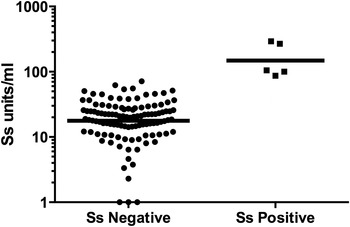
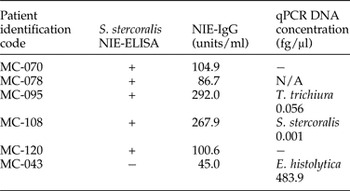
Of the 119 serology-tested samples, five were positive for S. stercoralis (4.2% prevalence) with a significantly higher geometric mean of S. stercoralis IgG units/ml compared to the serology negative group (148.2 versus 17.7, P = 0.001, respectively) (fig. 1). Cross-reactivity assays were negative for NIE IgG in detecting any other STH from stool-positive individuals. Stool multi-parallel qPCR of four out of five individuals who had a positive NIE-ELISA, revealed the presence of T. trichiura DNA (0.056 fg/μl) in one patient (MC-095) and S. stercoralis DNA (0.001 fg/μl) in another patient (MC-108). Multi-parallel qPCR performed in five out of six patients who submitted stool samples, detected E. histolytica DNA (483.9 fg/μl E. histolytica DNA) in one patient (MC-043) (table 1).
Differences in Strongyloides IgG units/ml in NIE-ELISA Ss-positive compared with Ss-negative patients (P = 0.001).

Summary of parasitological findings using S. stercoralis NIE-ELISA and multi-parallel quantitative PCR.

The putative T. trichiura egg burden (7186 eggs) was calculated from the amount of parasite DNA detected using qPCR, using the formula: Y = 6.555e − 006*X + 0.008899 (Mejia et al., Reference Mejia, Vicuña, Broncano, Sandoval, Vaca, Chico, Cooper and Nutman2013). Using the World Health Organization (WHO) intensity of infection classification (World Health Organization, 2012), this estimation suggests that patient MC-095 carries a moderate T. trichiura egg burden.
Overall, we detected five S. stercoralis cases using NIE-ELISA, one case of T. trichiura and one case of E. histolytica using multi-parallel qPCR, making a total of six gastrointestinal parasitic infections and one patient with polyparasitism (prevalence 5.9 ± 4.23%, 95% CI). These findings suggest a significant S. stercoralis prevalence (4.2 ± 3.6%, 95% CI) in a population not preselected on the basis of any clinical symptom.
Multi-parallel qPCR of stool samples from four out of the five patients who tested positive with NIE-ELISA detected S. stercoralis DNA in one of these patients (MC-108). PCR negativity in the other three patients might be explained because egg/larvae shedding in S. stercoralis infection is intermittent and relatively low; alternatively, S. stercoralis might have been in an extraintestinal location at the time the stool sample was collected. A positive serology can also indicate a previous infection, although, due to the autoinfectious nature of S. stercoralis, any patient not treated with appropriate anthelminthics should be considered infected (Mejia & Nutman, Reference Mejia and Nutman2012).
Combining S. stercoralis serology and multi-parallel qPCR, we detected one S. stercoralis and T. trichiura co-infection. However, recently, T. trichiura antibody has been recognized to be 100% cross-reactive with the NIE-ELISA antigen, although that study used an IgG4 assay, which may have more cross-reactivity than the IgG used in the present study (Rascoe et al., Reference Rascoe, Price, Shin, McAuliffe, Priest and Handali2015). Our NIE IgG optimization assays did not detect cross-reactivity in Trichuris-infected individuals. If we consider that this patient was only infected with T. trichiura, then the total number of infections found using NIE-ELISA and qPCR is six, which would change the prevalence for all infections to 5.0%. This value is similar to the S. stercoralis prevalence found by Monge-Maillo and colleagues in a group of Latin American immigrants living in Spain, using ELISA (~5.0%), and confirms the sensitivity and practicality of NIE-ELISA serology for population screening (Monge-Maillo et al., Reference Monge-Maillo, López-Vélez, Norman, Ferrere-González, Martínez-Pérez and Pérez-Molina2015; Rascoe et al., Reference Rascoe, Price, Shin, McAuliffe, Priest and Handali2015).
Results from this pilot study suggest that an S. stercoralis prevalence of at least 5.0% is to be expected in Latin American immigrants. It is also worth noting that individuals who have lived all their lives in a developed country can also acquire S. stercoralis or other helminthic infections when travelling or living for extended periods in endemic regions. New global trends of human activity demand that physicians become aware of the possibility of detecting cases of helminthic infections, or other parasitic diseases, in unusual settings.
Our results also support the use of highly sensitive diagnostic methods compatible with population studies for the systematic testing of gastrointestinal parasites in individuals from all origins. These data point to implementing a S. stercoralis infection survey in foreign-born individuals living in the USA, as this infection can seriously impact medical standards of care. Systematic health surveys of the ever-growing immigrant population can increase the medical professionals' awareness about conditions that are rarely seen in the native-born US population. In addition, quantitative assessment of immigrant health status is indispensible for informing future healthcare delivery and public-health policies.
Acknowledgements
The authors would like to thank Dr Carlos Naranjo and Dr Pablo Lorenzon for their assistance with patient recruitment, and Maria Gomez, Mary's Center President and CEO, for facilitating patient access and providing performance data.
Financial support
This research was supported by Baylor College of Medicine, section of Pediatrics: Tropical Medicine.
Conflict of interest
R.M. is a consultant for Lupin Pharmaceuticals. This relationship did not influence the present paper.
Ethical standards
The authors assert that all procedures contributing to this work comply with the ethical standards of the relevant national and institutional committees on human experimentation and with the Helsinki Declaration of 1975, as revised in 2008. The protocol was approved by the Institutional Review Board at Georgetown University Medical Center and at Baylor College of Medicine.