Introduction
Acquired brain injury describes any damage to the brain experienced after birth as a result of trauma, hypoxia, stroke, tumour, infection, poisoning or substance abuse, and it has been identified as the most common cause of disability in Australia (Australian Institute of Health and Welfare, 2007). The impact of a brain injury on the individual can be evident many years post injury and includes cognitive-behavioural impairments, reduced social communication skills, impaired psychological adjustment and physical impairment. Rehabilitation following a brain injury aims to increase independence and facilitate community integration and role participation (Sloan et al., Reference Sloan, Callaway, Winkler, McKinley, Zino and Anson2009). The continuum of care for individuals with a brain injury involves several stages, including acute care, sub-acute inpatient rehabilitation, post-acute rehabilitation and home or community rehabilitation.
Transitional living service (TLS) programmes are live-in residential programmes that function as part of post-acute rehabilitation. Such live-in programmes have existed as part of the continuum of brain injury rehabilitation, since at least the 1980s (Sachs, Reference Sachs1986). TLS programmes were developed for individuals with complex cognitive, behavioural and psychosocial needs resulting from a brain injury, and provide a means of assessing and retraining daily living skills, as well as an opportunity to work towards living independently in the community (Geurtsen, Martina, Heugten & Geurts, Reference Geurtsen, Martina, Heugten and Geurts2008; Hopman, Reference Hopman2006; Ponsford, Sloan & Snow, Reference Ponsford, Sloan and Snow2013). An important component of a TLS programme, which differentiates it from supported community living, is the focus on rehabilitation and enabling residents to reach their optimal level of function and independence (United Nations, 2016).
Turner et al. (Reference Turner, Fleming, Ownsworth and Cornwell2008) reviewed literature on the process of transition from inpatient rehabilitation to home for individuals with a brain injury and identified TLS programmes as one transition pathway. They concluded that TLS programmes bridged the gap between inpatient rehabilitation and home, and facilitated increased independence for individuals. They also found that the duration of TLS programmes ranged from 2 to 6 months, therapy was provided by multidisciplinary teams, residents worked towards functional goals, and therapy was focused on learning and developing skills in activities of daily living, social relationships, time management and community access. Whilst this review by Turner et al. (Reference Turner, Fleming, Ownsworth and Cornwell2008) provides a comprehensive overview of TLS programmes in the context of transitioning from inpatient rehabilitation to home, further exploration is required regarding the characteristics of these programmes, including their function in the lifelong continuum of recovery following brain injury. Therefore, this scoping review of TLS programmes for adults with a brain injury aims to extend the review by Turner et al. (Reference Turner, Fleming, Ownsworth and Cornwell2008) to better understand the implementation of TLS programmes based on best evidence. The research question that underpins this scoping review is to determine what is known about TLS programmes for adults with an acquired brain injury?
Method
A scoping review framework (Arksey & O'Malley, Reference Arksey and O'Malley2005) was considered the most appropriate method for use in the current study, as this is an emerging area of research within brain injury rehabilitation and requires a broad focus to capture all available evidence. The five-stage framework described by Arksey and O'Malley (Reference Arksey and O'Malley2005) was used in this review.
Stage1: Identifying the research question
The initial search question identified was ‘What models of transitional living services have been used with adults with an acquired brain injury?’ This question sought research evidence on models of care for TLS programmes specific to acquired brain injury, however on a preliminary review of the literature the search was found to be too narrow. Consistent with the guidelines of Arksey and O'Malley (Reference Arksey and O'Malley2005), a broader question was developed to generate greater breadth of coverage in the search. The revised research question that guided this scoping review was ‘What is known about transitional living service programmes for adults with an acquired brain injury?’ To assist with refining the search, a clear definition of TLS programmes was also required and, using a definition by Hopman (Reference Hopman2006), TLS programmes were defined as:
a short term set of treatments that promote evaluation and development of a client's functional independence, psychological independence and community integration following brain injury. Therapy is provided daily and within a supervised, home-like environment (Hopman, Reference Hopman2006, p. 6).
Stage 2: Identifying relevant studies
A comprehensive and systematic approach to searching was undertaken and documented for replicability using the PRISMA checklist (Moher, Liberati, Tetzlaff, & Altman, Reference Moher, Liberati, Tetzlaff and Altman2009). Literature searches were carried out in November 2015 for studies published over the previous 20 years (since 1996). Databases searched were Cumulative Index to Nursing & Allied Health Literature (CINAHL), Medline, PsycINFO and OTseeker. Further searches were completed using Google Scholar, Australasian Society for the Study of Brain Impairment (ASSBI) conference papers and publications from the Institute for Safety, Compensation and Recovery Research (ISCRR). Reference lists of identified papers were also searched for potentially relevant papers. Inclusion and exclusion criteria were identified, and the below sets of keywords were paired accordingly:
-
1. ‘Transitional living service’, or ‘transitional living programme’, or ‘transitional living unit’, or ‘transitional living centre’, or ‘residential rehabilitation’; ‘community reintegration’, or ‘community rehabilitation’; and ‘acquired brain injury’, or ‘traumatic brain injury’, or ‘stroke’; and adults 18+.
-
2. Papers published since 1996 were included, which met the inclusion criteria: TLS programme/s discussed, participants were people with an acquired brain injury, and paper discussed models of care, inclusion or discharge criteria, programme components, programme outcomes and/or outcome measures.
-
3. Exclusion criteria for the review were: TLS programmes located within the inpatient setting (e.g., independent living units within a rehabilitation facility), research participants with progressive neurological conditions, and papers not published in the English language.
Stage 3: Study selection
Two reviewers (AP and DS) screened the titles and abstracts of all identified items, removed duplicate and irrelevant items as outlined in Figure 1. The full text was reviewed if the relevance of the article was uncertain from the abstract or title; all disagreements were discussed with the full author team.
Flow of study selection for current review.

Stage 4: Charting the data
Key information from the 13 identified papers was charted by the two reviewers.
Stage 5: Collating, summarising and reporting the results
Descriptive data retrieved from the included studies was thematically analysed using an inductive qualitative approach (Thomas, Reference Thomas2006). The analysis involved repeated review of the descriptive data and initial coding by two reviewers (AP and DS) with subsequent coding, discussion and consensus agreement occurring between all authors. Given the consistency of the emerging themes from the data, consensus between all authors was achieved with little debate on all occasions. The thematic analysis resulted in the development of five main themes, informing an understanding of TLS programmes for adults with an acquired brain injury.
Results
As shown in Figure 1, a total of 3183 papers were identified after duplicates were removed. A total of 3163 records were excluded through abstract screening. From the remaining 20 articles, 8 were excluded as they involved services attached to a hospital or aged care facility, did not refer to approaches to TLS for individuals with an acquired brain injury, or were out of date. The remaining 12 articles were included in the review, with one additional paper sourced from a search of Google Scholar, ASSBI conference papers, publications from the ISCRR, and reference lists. Key information from papers that met the eligibility criteria were entered into a table categorised according to the following headings: author and year, location, objectives, method, sample characteristics, staffing profile, intervention, outcome measures and findings.
Five main themes relating to what is known about TLS programmes were identified as follows: (1) TLS programme residents; (2) subjective experiences of TLS residents and staff; (3) TLS intervention approaches; (4) TLS staffing and (5) TLS programme outcomes.
TLS Programme Residents
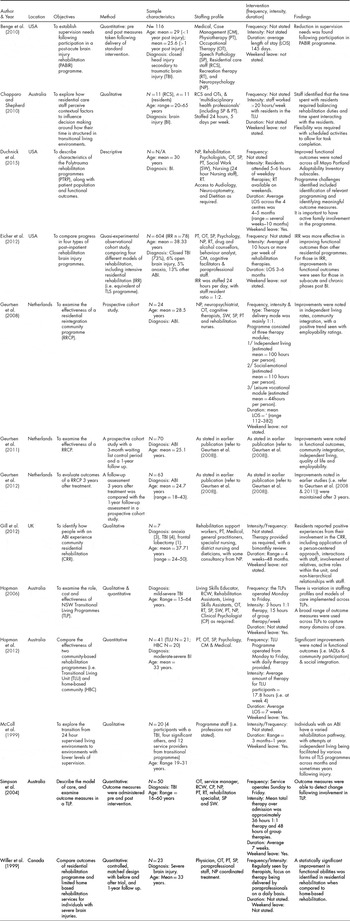
Of the 13 studies retrieved from the search, all study participants had a diagnosis of an acquired brain injury, including traumatic brain injury (TBI), anoxic brain injury, stroke, brain tumour, encephalitis and hypoxia. TBI was the most common diagnosis across all the studies. Table 1 provides a summary of participant information. While most studies reported the severity of brain injury, the method for rating severity varied across studies and was based on either post-traumatic amnesia (PTA) duration and/or Glasgow coma score (GCS) ratings. Four studies reported that all participants were classified as sustaining a severe brain injury (Benge, Caroselli, Reed, & Zgaljardic, Reference Benge, Caroselli, Reed and Zgaljardic2010; Chapparo & Shepherd, Reference Chapparo and Shepherd2010; McColl et al., Reference McColl, Davies, Carlson, Johnston, Harrick, Minnes and Shue1999; Willer, Button, & Rempel, Reference Willer, Button and Rempel1999). An additional four studies reported that 70–100% of their participants were classified as having severe brain injury, but also included participants with mild brain injury (Geurtsen et al., Reference Geurtsen, Martina, Heugten and Geurts2008, Reference Geurtsen, Heugten, Martina, Rietveld, Meijer and Geurts2011, Reference Geurtsen, Heugten, Martina, Rietveld, Meijer and Geurts2012; Hopman, Reference Hopman2006). Whilst two studies did not report the severity of brain injury, they reported PTA duration, with the participants in the study by Hopman, Tate, and McCluskey. (Reference Hopman, Tate and McCluskey2012) having a mean PTA duration of 48 and 31 days in the two centres they included, and Simpson et al. (Reference Simpson, Scheny, Lane-Brown, Strettles, Ferry and Phillips2004) reporting a PTA duration range of 4–183 days. Two studies reported inclusion of participants with mild–moderate brain injuries but did not mention the rating scale used (Duchnick, Ropacki, Yutsis, Petska, & Pawlowski, Reference Duchnick, Ropacki, Yutsis, Petska and Pawlowski2015; Gill, Wall, & Simpson, Reference Gill, Wall and Simpson2012).
Study Characteristics

ABI=acquired brain injury; LOS=length of stay; N/A=not applicable; NP=neuropsychologist; OT=occupational therapist; PT=physiotherapist; RCS =residential care staff; RCW – residential care workers; RT=recreational therapist; SP=speech pathologist; SW=social worker; TBI=traumatic brain injury; TLS=transitional living services.
The period of time post brain injury of participants admitted to TLS programmes varied greatly between studies. Benge et al. (Reference Benge, Caroselli, Reed and Zgaljardic2010) included two groups of participants who were either less than one year or one to five years post injury. In a study comparing four ‘Polytrauma Transitional Rehabilitation Programmes’, Duchnick et al. (Reference Duchnick, Ropacki, Yutsis, Petska and Pawlowski2015) reported that time since injury ranged from 200 to 611 days. Another study reported a mean time post injury of 5.1 years (Eicher, Murphy, Murphy, & Malec, Reference Eicher, Murphy, Murphy and Malec2012). In contrast, McColl et al. (Reference McColl, Davies, Carlson, Johnston, Harrick, Minnes and Shue1999) reported that participants entered the TLS anywhere between 14 months and 12 years post injury. Participants across three other studies (Eicher et al., Reference Eicher, Murphy, Murphy and Malec2012; Hopman et al., Reference Hopman, Tate and McCluskey2012; Willer et al., Reference Willer, Button and Rempel1999) showed measureable improvement across both the sub-acute and chronic phases following brain injury. The absence of a linear pathway within the post-acute and chronic phases of brain injury rehabilitation was also evident, with one study highlighting that individuals experienced anywhere from five to seven transitions through various rehabilitation services (i.e., including TLS programmes) and residential locations (McColl et al., Reference McColl, Davies, Carlson, Johnston, Harrick, Minnes and Shue1999).
Subjective Experiences of TLS Residents and Staff
Only three of the 13 studies explored the subjective experiences of residents and staff within a TLS setting (Chapparo & Shepherd, Reference Chapparo and Shepherd2010; Gill et al., Reference Gill, Wall and Simpson2012; McColl et al., Reference McColl, Davies, Carlson, Johnston, Harrick, Minnes and Shue1999). In these studies, it was identified by both residents and staff that flexibility with scheduling of activities to allow residents adequate time for task completion was important. Residents also linked this flexibility to building awareness of their own abilities across their stay in the TLS programmes. Two studies also made reference to the importance of the need for a non-hierarchical relationship between residents and staff in a TLS setting, as perceived by the residents and staff (Chapparo & Shepherd, Reference Chapparo and Shepherd2010; Gill et al., Reference Gill, Wall and Simpson2012). Residents also reported that a sense of equality between residents and staff contributed to their own positive personal identity within the TLS setting (Chapparo & Shepherd, Reference Chapparo and Shepherd2010). In contrast, residential care staff identified that time spent in less formal social interactions with residents was challenging as this was not considered ‘work’ within their organisation (Chapparo & Shepherd, Reference Chapparo and Shepherd2010), raising the importance of defining scope of practise for staff working in a TLS setting.
In a study which explored the perspectives of residents, staff and families, McColl et al. (Reference McColl, Davies, Carlson, Johnston, Harrick, Minnes and Shue1999) found that both family and staff expressed challenges relating to communication within the TLS programme; poor communication was found to lead to different expectations between residents, staff and families. Thus, the early and clear identification of TLS programme responsibilities for residents, family and staff within the TLS programme was also identified as a means of facilitating communication in this setting. While this finding was not corroborated by other studies, findings are limited by a lack of studies in this area.
TLS Intervention Approaches
While this scoping review sought to understand the interventions provided in TLS programmes, only one paper explored this in any detail (Hopman, Reference Hopman2006). Hopman (Reference Hopman2006) noted several different approaches across the brain injury rehabilitation programmes offered in New South Wales (Australia). These approaches included multidisciplinary models where assessment and intervention were delivered by all disciplines, interdisciplinary models where therapists collaboratively completed assessments and interventions, and a trans disciplinary model where more generic roles were attributed to staff.
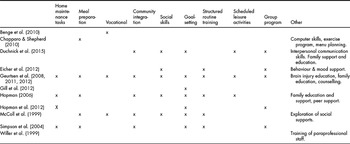
Several interventions could be identified from the TLS programmes described in the 13 selected articles (see Tables 1 and 2 for an overview of intervention approaches and therapy intensity details with detail limited by the original papers). Only five studies reported incorporating structured routine training as one of the fundamental components of their TLS programme (Eicher et al., Reference Eicher, Murphy, Murphy and Malec2012; Geurtsen et al., Reference Geurtsen, Martina, Heugten and Geurts2008, Reference Geurtsen, Heugten, Martina, Rietveld, Meijer and Geurts2011, Reference Geurtsen, Heugten, Martina, Rietveld, Meijer and Geurts2012; Hopman, Reference Hopman2006; McColl et al., Reference McColl, Davies, Carlson, Johnston, Harrick, Minnes and Shue1999; Simpson et al., Reference Simpson, Scheny, Lane-Brown, Strettles, Ferry and Phillips2004).
Type of Intervention Delivered in Transitional Living Programmes

The most common treatment approaches cited by all studies involved elements of daily routine training (e.g., home maintenance tasks, meal preparation and community integration). Scheduled leisure activities were reported in three studies (Duchnick et al., Reference Duchnick, Ropacki, Yutsis, Petska and Pawlowski2015; Geurtsen et al., Reference Geurtsen, Martina, Heugten and Geurts2008, Reference Geurtsen, Heugten, Martina, Rietveld, Meijer and Geurts2011, Reference Geurtsen, Heugten, Martina, Rietveld, Meijer and Geurts2012; Hopman, Reference Hopman2006), with family members of TLS residents reporting that there was a need for appropriate social activities for evenings and weekends in order to prevent boredom (McColl et al., Reference McColl, Davies, Carlson, Johnston, Harrick, Minnes and Shue1999). Vocational therapy was reported in four studies (Benge et al., Reference Benge, Caroselli, Reed and Zgaljardic2010; Eicher et al., Reference Eicher, Murphy, Murphy and Malec2012; Geurtsen et al., Reference Geurtsen, Martina, Heugten and Geurts2008, Reference Geurtsen, Heugten, Martina, Rietveld, Meijer and Geurts2011, Reference Geurtsen, Heugten, Martina, Rietveld, Meijer and Geurts2012; McColl et al., Reference McColl, Davies, Carlson, Johnston, Harrick, Minnes and Shue1999).
Most studies reported using individual therapy sessions for residents of the TLS programmes (Benge et al., Reference Benge, Caroselli, Reed and Zgaljardic2010; Duchnick et al., Reference Duchnick, Ropacki, Yutsis, Petska and Pawlowski2015; Eicher et al., Reference Eicher, Murphy, Murphy and Malec2012; Geurtsen et al., Reference Geurtsen, Martina, Heugten and Geurts2008, Reference Geurtsen, Heugten, Martina, Rietveld, Meijer and Geurts2011, Reference Geurtsen, Heugten, Martina, Rietveld, Meijer and Geurts2012; Hopman, Reference Hopman2006; Hopman et al., Reference Hopman, Tate and McCluskey2012; Simpson et al., Reference Simpson, Scheny, Lane-Brown, Strettles, Ferry and Phillips2004; Willer et al., Reference Willer, Button and Rempel1999). The intensity of individual therapy varied across the programmes, ranging from 5 to 20 hours per week. Six of the studies (Duchnick et al., Reference Duchnick, Ropacki, Yutsis, Petska and Pawlowski2015; Eicher et al., Reference Eicher, Murphy, Murphy and Malec2012; Geurtsen et al., Reference Geurtsen, Martina, Heugten and Geurts2008, Reference Geurtsen, Heugten, Martina, Rietveld, Meijer and Geurts2011, Reference Geurtsen, Heugten, Martina, Rietveld, Meijer and Geurts2012; Hopman, Reference Hopman2006; Hopman et al., Reference Hopman, Tate and McCluskey2012; Simpson et al., Reference Simpson, Scheny, Lane-Brown, Strettles, Ferry and Phillips2004) also reported incorporating group programmes into service delivery, with Hopman (Reference Hopman2006) noting provision of up to 15 hours per week of group activities for each TLS resident. The duration of TLS programmes was reported in 10 papers and ranged from 4 weeks to 48 months (Benge et al., Reference Benge, Caroselli, Reed and Zgaljardic2010; Duchnick et al., Reference Duchnick, Ropacki, Yutsis, Petska and Pawlowski2015; Eicher et al., Reference Eicher, Murphy, Murphy and Malec2012; Geurtsen et al., Reference Geurtsen, Martina, Heugten and Geurts2008, Reference Geurtsen, Heugten, Martina, Rietveld, Meijer and Geurts2011, Reference Geurtsen, Heugten, Martina, Rietveld, Meijer and Geurts2012; Gill et al., Reference Gill, Wall and Simpson2012; Hopman et al., Reference Hopman, Tate and McCluskey2012; McColl et al., Reference McColl, Davies, Carlson, Johnston, Harrick, Minnes and Shue1999; Simpson et al., Reference Simpson, Scheny, Lane-Brown, Strettles, Ferry and Phillips2004).
Four articles described TLS programmes in which weekend leave was embedded into the therapy programme (Duchnick et al., Reference Duchnick, Ropacki, Yutsis, Petska and Pawlowski2015; Hopman, Reference Hopman2006; Hopman et al., Reference Hopman, Tate and McCluskey2012; Simpson et al., Reference Simpson, Scheny, Lane-Brown, Strettles, Ferry and Phillips2004), with the expectation that residents spent time at their discharge environment over the weekend to generalise therapy strategies into this environment.
TLS Staffing
Three studies provided specific details regarding the staffing profile of their TLS programme, and while all three reported being staffed for 24 hours per day, there was considerable variability in the represented professions (Chapparo & Shepherd, Reference Chapparo and Shepherd2010; Duchnick et al., Reference Duchnick, Ropacki, Yutsis, Petska and Pawlowski2015; Eicher et al., Reference Eicher, Murphy, Murphy and Malec2012). All three studies reported a combination of both professional and para-professional staff with varying qualifications working within the TLS programmes. Only two studies explicitly stated that disciplines comprised their core team, including occupational therapists, service managers, social workers, nurses, psychologists, recreation therapists, physiotherapists and residential care workers (Duchnick et al., Reference Duchnick, Ropacki, Yutsis, Petska and Pawlowski2015; Simpson et al., Reference Simpson, Scheny, Lane-Brown, Strettles, Ferry and Phillips2004). A total of 11 of the 13 studies reported the involvement of occupational therapists, speech pathologists, psychologists and physiotherapists, with recreation therapists noted in five of the studies. Specific details around staffing levels for each discipline were only outlined in one paper, with physiotherapy, occupational therapy and ‘pre-vocational interventions’ reported as taking up the greatest number of therapy hours per week (Hopman et al., Reference Hopman, Tate and McCluskey2012). In a service evaluation report, Hopman (Reference Hopman2006) reported that staffing levels across the TLS programmes were flexible due to the range of models of service delivery (i.e., the TLS programmes ranged in their approaches, applying either multidisciplinary, interdisciplinary or trans-disciplinary frameworks). Similarly, three of the studies made reference to flexibility in their approach through accessing additional professionals as required, such as dietitians, audiologists, clinical psychologists and optometrists (Duchnick et al., Reference Duchnick, Ropacki, Yutsis, Petska and Pawlowski2015; Gill et al., Reference Gill, Wall and Simpson2012; Hopman, Reference Hopman2006).
TLS Programme Outcomes
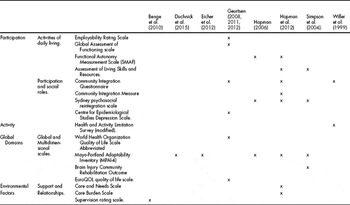
Eight studies directly investigated the effectiveness of TLS programme interventions, with all demonstrating improvements in functional outcomes with their selected outcome measures from pre- to post-involvement in their TLS programmes (Benge et al., Reference Benge, Caroselli, Reed and Zgaljardic2010; Duchnick et al., Reference Duchnick, Ropacki, Yutsis, Petska and Pawlowski2015; Eicher et al., Reference Eicher, Murphy, Murphy and Malec2012; Geurtsen et al., Reference Geurtsen, Martina, Heugten and Geurts2008, Reference Geurtsen, Heugten, Martina, Rietveld, Meijer and Geurts2011, Reference Geurtsen, Heugten, Martina, Rietveld, Meijer and Geurts2012; Hopman, Reference Hopman2006; Hopman et al., Reference Hopman, Tate and McCluskey2012; Simpson et al., Reference Simpson, Scheny, Lane-Brown, Strettles, Ferry and Phillips2004; Willer et al., Reference Willer, Button and Rempel1999). Three studies investigated the effectiveness of TLS programmes in comparison to other forms of community rehabilitation, with TLS programmes found to be the most effective of these programmes for achieving gains in measures of community integration and participation (Eicher et al., Reference Eicher, Murphy, Murphy and Malec2012; Hopman et al., Reference Hopman, Tate and McCluskey2012; Willer et al., Reference Willer, Button and Rempel1999). Table 3 provides details of the outcome measures used in these studies. These outcome measures typically fit the International Classification of Functioning, Disability and Health (WHO, 2001) areas of participation, environmental factors or global assessments. When considering all 10 studies that applied outcome measures, two used measures of environmental factors that included support and relationships. Global measures (i.e., measures covering multiple domains) were used in nine of the ten studies that used quantitative data, with the Mayo-Portland Adaptability Inventory (MPAI-4), which was considered a global assessment, the most widely used standardised outcome measure in the reviewed papers (Duchnick et al., Reference Duchnick, Ropacki, Yutsis, Petska and Pawlowski2015; Eicher et al., Reference Eicher, Murphy, Murphy and Malec2012; Hopman, Reference Hopman2006; Hopman et al., Reference Hopman, Tate and McCluskey2012; Simpson et al., Reference Simpson, Scheny, Lane-Brown, Strettles, Ferry and Phillips2004). While the MPAI-4 was found to be sensitive in detecting change in individuals with brain injury participating in TLS programmes (Eicher et al., Reference Eicher, Murphy, Murphy and Malec2012; Hopman, Reference Hopman2006), Hopman (Reference Hopman2006) found that the Sydney Psychosocial Reintegration Scale was more sensitive than the MPAI-4 in detecting change in this population. Seven of the studies used outcome measures focusing on aspects of participation, with these outcomes ranging from improvement in community integration to the ability to live independently, with benefits seen for participants in both the sub-acute and chronic phases of recovery. There was a broad range of outcome measures applied both across and within the TLS programmes, with Duchnick et al. (Reference Duchnick, Ropacki, Yutsis, Petska and Pawlowski2015) reporting challenges with selection of outcome measures that could meaningfully detect change in functional outcomes. Importantly, Simpson et al. (Reference Simpson, Scheny, Lane-Brown, Strettles, Ferry and Phillips2004) noted that outcome measures spanning each of the ICF domains were able to detect change following intervention provided within a TLS programme.
Outcome Measures

Cost-effectiveness of the TLS programmes was only reported in one study (Geurtsen et al., Reference Geurtsen, Heugten, Martina, Rietveld, Meijer and Geurts2012). Based on outcomes one and three years post-intervention, they found that the cost of the TLS programme could be recovered after eight years given a stable psychosocial situation for residents post treatment. From the four papers that described funding models for TLS programmes, three different funding models were identified. Benge et al. (Reference Benge, Caroselli, Reed and Zgaljardic2010) reported that 65% of its participants were government funded and 35% privately funded. The Brain Integration Programme in the Netherlands (Geurtsen et al., Reference Geurtsen, Martina, Heugten and Geurts2008; Reference Geurtsen, Heugten, Martina and Geurts2010; & Reference Geurtsen, Heugten, Martina, Rietveld, Meijer and Geurts2012) was funded by healthcare insurance companies and two studies based in Australia reported that the TLS programmes were government funded (Hopman, Reference Hopman2006; Hopman et al., Reference Hopman, Tate and McCluskey2012).
Discussion
The aim of this scoping review was to build on the literature review findings of Turner et al. (Reference Turner, Fleming, Ownsworth and Cornwell2008), and guide the development of TLS programmes that are based on best evidence and support the implementation of evidence into practise. Findings of this scoping review show that while TLS programmes have variable characteristics, this residential approach to rehabilitation is able to improve functional outcomes following brain injury and appears to provide benefits over other forms of community rehabilitation. These improvements were noted at the sub-acute or chronic phase post brain injury, highlighting that this approach may not just be beneficial in the transition from hospital to home, but also during several stages throughout an individual's life-long recovery after brain injury.
The apparent success of the TLS programmes raises important considerations regarding rehabilitation context, including the intensity and frequency of practise. In a systematic review of brain injury rehabilitation programmes across home and clinic settings it was suggested that rehabilitation delivered in ‘real-life community contexts’ resulted in superior functional outcomes compared to clinic-based rehabilitation (Doig, Fleming, Kuipers, & Cornwell, Reference Doig, Fleming, Kuipers and Cornwell2010, p. 2074). One of the key advantages of TLS programmes compared with other rehabilitation settings is the opportunity for supported application of strategies throughout the daily routine in a home-like setting. Both the staffing levels and environment of rehabilitation within TLS programmes support an intensity of therapy that would be difficult to replicate in other outpatient rehabilitation programmes. TLS programmes may also be considered more appropriate than home-based community rehabilitation when a person is not yet considered safe to be living independently in the community with current support levels, or without further therapeutic intervention. When considering the importance of contextual practise in rehabilitation, some of the TLS programmes in this review were noted to have periods of weekend leave incorporated into their programme, where participants would return to their own residence. This ‘adaptation phase’ of rehabilitation where opportunity is provided to generalise skills across activities and environments is thought to be essential in terms of sustainability of outcomes (Bottari, Dutil, Dassa, & Rainville, Reference Bottari, Dutil, Dassa and Rainville2006; Doig et al., Reference Doig, Fleming, Kuipers and Cornwell2010; Haskins et al., Reference Haskins, Cicerone, Dams-O'Connor, Eberle, Langenbahn, Shapiro-Rosenbaum and Trexler2012). The opportunity to apply skills in the home environment may also serve to build awareness regarding abilities for both individuals and their families, whilst also providing invaluable information around readiness to return home and the associated level of support required.
The importance of considering the family to facilitate successful outcomes for residents involved in TLS programmes was highlighted by the subjective experiences of residents, staff and family (Chapparo & Shepherd, Reference Chapparo and Shepherd2010; Gill et al., Reference Gill, Wall and Simpson2012; McColl et al., Reference McColl, Davies, Carlson, Johnston, Harrick, Minnes and Shue1999). Family are significantly impacted by the brain injury of a family member and often provide the majority of long-term support and assistance (Duchnick et al., Reference Duchnick, Ropacki, Yutsis, Petska and Pawlowski2015; Geurtsen et al., Reference Geurtsen, Martina, Heugten and Geurts2008; Lefevbre et al., Reference Lefebvre, Clouteir and Levert2008; Ponsford et al., Reference Ponsford, Sloan and Snow2013). In a study exploring long-term outcomes associated with brain injury, Lefebvre, Clouteir, and Levert (Reference Lefebvre, Clouteir and Levert2008) found that family members reported that they did not receive adequate education, resources or assistance to cope with the challenges of successfully supporting their family member with brain injury. This finding was further supported by McColl et al (Reference McColl, Davies, Carlson, Johnston, Harrick, Minnes and Shue1999), who identified that family members felt they were left to ‘pick up the pieces’ in their qualitative study. A collaborative approach between resident, staff and family has been identified as an important aspect of a TLS programme to ensure clear and regular communication of goals and therapeutic approaches (Chapparo & Shepherd, Reference Chapparo and Shepherd2010; McColl et al., Reference McColl, Davies, Carlson, Johnston, Harrick, Minnes and Shue1999). Turner et al. (Reference Turner, Fleming, Ownsworth and Cornwell2008) proposed a model where factors influencing transition from hospital to home for individuals with a brain injury were described, with personal, family/informal care and professional service identified as key factors impacting on this population. Levack, Kayes, and Fadyl (Reference Levack, Kayes and Fadyl2010) noted that factors of central importance to individuals who have survived a TBI are not always featured in standardised outcome measures, and suggest that qualitative research on the subjective experience of the person with brain injury and their family is required to better understand their needs and identify more person-centred outcome measures. Such a recommendation may be difficult to implement within current hospital-based services, but with the ongoing development and refinement of patient reported outcome measures in brain injury it may not be too far away.
As with all rehabilitation services, TLS programmes were also noted to be structured around functional goals (Turner et al., Reference Turner, Fleming, Ownsworth and Cornwell2008). Although not unique to TLS programmes, studies in our review found that goal setting be collaborative, with trust developed between all parties. Consistent with the broader research on engagement in goal-setting after brain injury, the TLS studies also found that the process of goal setting enables successful active engagement in rehabilitation for both residents and families (Guertson, Reference Geurtsen, Martina, Heugten and Geurts2008; D'Cruz et al., Reference D'Cruz, Unsworth, Roberts, Morarty, Turner-Stokes, Wellington-Boyd and Lannin2016; Duchnick et al., Reference Duchnick, Ropacki, Yutsis, Petska and Pawlowski2015; McColl et al., Reference McColl, Davies, Carlson, Johnston, Harrick, Minnes and Shue1999). Therefore, there is a need for TLS programmes to support residents and families to be actively engaged in goal setting. While seven of the reviewed papers reported that goal setting was incorporated into their TLS programme, specific goal setting tools were not identified. Goal-attainment was also not reported as an outcome measure in any of the reviewed papers. Ponsford et al. (Reference Ponsford, Sloan and Snow2013) recommended that goal-attainment be measured within TLS programmes in order to evaluate the effectiveness of the programme, and Hopman (Reference Hopman2006) reported that outcome measures used within TLS programmes should reflect individual participants’ goals while also evaluating clinical practise. Due to the wide scope of interventions and individual goals within TLS programmes, global outcome measures, in addition to goal-attainment, have been recommended (Hopman, Reference Hopman2006). Use of outcome measures, however, was minimal across all the reviewed studies. Only one study (Geurtsen et al., Reference Geurtsen, Heugten, Martina, Rietveld, Meijer and Geurts2012) completed follow-up outcome measures to measure the long-term effectiveness of TLS programmes, and although they reported significant improvements at three years after involvement in a residential TLS for persons with a brain injury, the study was not randomised and thus, further research is still needed in this area. Brain injury is a lifelong condition and interventions focused on long-term community integration and role participation are coveted by patients and families alike; thus, it is recommended that TLS programmes link residents with their local community and community services (McColl et al., Reference McColl, Davies, Carlson, Johnston, Harrick, Minnes and Shue1999; Sloan et al., Reference Sloan, Callaway, Winkler, McKinley, Zino and Anson2009). Further studies are needed to evaluate TLS programmes and their effectiveness with respect to longer term community integration (Eicher et al., Reference Eicher, Murphy, Murphy and Malec2012).
Limitations and Recommendations for Future Research
Only studies published in English and in peer-reviewed journals were included, which may have excluded additional information from international sources. As with all reviews, findings are limited to a synthesis of the existing research. While the retrieved research provided varied information about TLS programmes, only 13 studies were located which limited the available information. In particular, there was limited information regarding interventions and staffing profiles, which reflects that the key characteristics and associated effectiveness of TLS programmes in brain injury is an emerging area of research. The studies reviewed demonstrated a lack of mixed methodological designs across both the subjective experience and quantifiable outcome areas. Study comparisons were also limited by different funding structures, which impacted on scope of service delivery; direct comparisons between programmes and studies was challenging. Within the papers reviewed, only three reported using leisure as an intervention strategy and four using vocational rehabilitation, which is in contrast to the strong body of literature supporting the use of both leisure and vocation within rehabilitation programmes for individuals with a brain injury (Douglas, Dyson, & Foreman, Reference Douglas, Dyson and Foreman2006; Mitchell, Veitch, & Passey, Reference Mitchell, Veitch and Passey2014; Piccenna et al., Reference Piccenna, Pattuwage, Romero, Lewis, Gruen and Bragge2015; Tate, Wakim, & Genders, Reference Tate, Wakim and Genders2014). Future research should, therefore, consider the subjective experience of TLS residents, family and staff, in combination with objective standardised outcome measures, longer term outcomes and the cost-effectiveness of TLS programmes to support future justification for funding.
Key Practise Recommendations
Clinical practise recommendations were developed to help support implementation of TLS programmes based on best evidence. These included: (1) Multiple outcome measures should be used to evaluate TLS programme outcomes, including a combination of global measures, subjective feedback and goal-attainment; (2) Collaborative goal setting with both residents and family should be used to encourage active participation in the TLS programme. All parties should be actively engaged in review of these goals across the duration of the TLS programme; (3) Generalisation of treatment strategies should be built into the programme through encouraging periods of leave from TLS facilities to allow the resident to apply strategies in their own environment; (4) Eligibility criteria for TLS programmes should consider all individuals across the continuum of recovery following a brain injury.
Conclusions
Overall this scoping review has provided valuable information describing what is known about TLS programmes in brain injury rehabilitation. Whilst TLS programmes are an emerging research area, the findings of this scoping review suggest there is sufficient evidence to support their use to maximise functional independence and community integration of individuals with a brain injury, and this review now provides guidance for the development of TLS programmes by synthesising available research evidence.
Financial Support
This research received no specific grant from any funding agency, commercial or not-for-profit sectors.
Conflict of Interest
None.
Ethical Standards
This paper adheres to ethical standards.