Introduction
There has been a noted policy shift towards ‘activating’ unemployed social security benefit claimants (i.e., promoting their labour market participation) in the US and across the EU (Daguerre, Reference Daguerre2007). In Britain, all major political parties now agree that benefits should no longer be paid to employable people of working age who refuse work or training, and that governments must ensure jobs pay more than out-of-work benefits (Deacon and Patrick, Reference Deacon, Patrick and Bochel2011). The coalition's Work Programme (WP), like its predecessor the Flexible New Deal (fND), gives voluntary and private sector organisations contracts to support long-term claimants of various out-of-work benefits into employment. The main differences are that in the WP, payments to organisations are results-based (including more generous payments for mobilising ‘harder-to-help’ claimants into employment) and that organisations have greater control than previously in deciding what work activities individual claimants must undertake (DWP, 2010a). Long-term claimants of JSA (Britain's main subsistence benefit for unemployed people) must participate in the WP or face the harshest benefit sanctions in the history of the British welfare state (Wright, Reference Wright2012). Indeed, claimants who fail to take part in ‘mandatory work activity’ when directed to, fail to apply for a job or reject a reasonable job offer will suffer a loss of benefit for three months in the first instance, and for three years if it happens three times (see DWP, 2010b: 30). Alongside the WP, the Universal Credit, a new state social security benefit that replaces various benefits including JSA, aims to go beyond Labour's aspiration to ‘make work pay’ and ‘ensure that work always pays and is seen to pay’ by guaranteeing that all transitions from welfare benefits to employment result in a net income gain (Duncan Smith, Reference Duncan Smith2010: 1). If coalition welfare policy continues on its present trajectory, this net income gain seems likely to be achieved through less-than-generous increases in out-of-work benefit rates rather than by boosting in-work incomes.
Underpinning these policy developments is an assumption that negative attitudes to employment are widespread among claimants of out-of-work benefits. Indeed, coalition ministers, like their Labour predecessors, have accompanied their policies with rhetoric endorsing the view that something akin to a culture of welfare dependency exists. Social Security Minister Iain Duncan Smith (Reference Duncan Smith2010: 1) wrote that ‘welfare dependency took root in communities up and down the country breeding hopelessness and intergenerational poverty’, which echoed the view of one of his predecessors, Labour's John Hutton (Reference Hutton2006: n.p.) that a ‘can work, won't work culture’ exists among benefit claimants. Yet these views contrast sharply with British social policy conventional wisdom about out-of-work benefit claimants, including the JSA claimants this article focuses upon. Existing evidence – gathered mainly in the 1980s and early 1990s when unemployment was last high enough to make it a major topic of academic investigation – strongly suggests that claimants generally have positive attitudes towards employment. Bradshaw and Holmes’ (Reference Bradshaw and Holmes1989: 138) conclusion that they are ‘the same people as the rest of our population, with the same culture and aspirations’ is typical of this literature, while Walker's (Reference Walker and Howard2000: 97) review of it was able to conclude that ‘the evidence is clear that very few unemployed claimants prefer welfare benefits to a job’.
Yet the conclusions are based largely upon researching unemployed people directly, and social policy authors have routinely failed to discuss the argument that this can deliver inaccurate findings because respondents sometimes mislead researchers in an attempt to be viewed more positively. Conservative Charles Murray made this argument when defending his controversial view that a morally distinct ‘underclass’ of undeserving poor had developed on both sides of the Atlantic. Discussing the US, Murray wrote that ‘getting people to admit to a poll taker that they do not share the middle-class values of hard work, honesty and personal responsibility’ was ‘no easy feat’, whereas the existence of underclass values had long been ‘obvious to social workers and police officers who worked in underclass neighbourhoods’ (Reference Murray1994: xvii, emphasis in original). Likewise, when arguing that an ‘underclass’ was emerging in Britain, Murray insisted that ‘those who say there is no underclass tend to rely on studies where scholars go into poor neighbourhoods for a few hours’, whereas ‘the people who deal most intimately with poor communities in their daily lives use the same distinction among poor people [between deserving and undeserving/underclass] that I use’ (Murray, Reference Murray and Lister1996a: 83). Whatever the merits of Murray's ‘underclass’ thesis, it is noteworthy that social policy authors have drawn conclusions about unemployed claimants without considering the views of agency workers they come into contact with.
This article focuses on what people who work with long-term (over six months) JSA claimants say about their attitudes to employment and their job search behaviour. It presents findings from forty telephone interviews with people working for charities and private companies contracted by the Department of Work and Pensions (DWP), as part of the fND, to help ‘activate’ claimants. The organisations provided back-to-work support such as helping claimants with job search and organising work placements for them. While some existing research has involved workers in organisations like these (see Millar, Reference Millar2000), no study has focused in detail on their perceptions of their clients’ attitudes towards employment.
The first part of the article reviews literature about unemployment and employment commitment. It suggests that key existing empirical conclusions are counterintuitive and require further explanation. It then argues that research has left questions unanswered about two issues in particular – diversity (in attitudes, preferences, values, etc.) and choosiness (in the jobs people are willing to do to escape living on benefits). Hence, a concern with investigating diversity and choosiness informed the design of the research presented in the second part of the article. The results section focuses on respondents views about what proportion of their clients wanted employment, whether they believed that a ‘dependency culture’ exists and whether they believed their clients were too choosy in job search. A conclusion reflects on the main findings and their implications.
Research on unemployed people's employment commitment: towards a greater focus on diversity and choice
In concluding that unemployed people are strongly committed to employment, British social policy accounts draw upon empirical studies of their attitudes to work (e.g., Gallie and Vogler, Reference Gallie, Vogler, Gallie, Marsh and Vogler1994), their views on conditionality in welfare policy (e.g., Dwyer, Reference Dwyer2000), their job search behaviour (e.g., McKay et al., Reference McKay, Walker and Youngs1997) and their values (e.g., Dean and Taylor-Gooby, Reference Dean and Taylor-Gooby1992). All of these findings are based on responses given by unemployed people themselves (Murray's criticism of this approach, referred to earlier, is left to one side in the discussion that follows). The following extract is taken from an accurate and typical summary of this body of literature's main conclusions (Surender et al., Reference Surender, Noble, Wright and Ntshongwana2010: 205–06):
Dean and Taylor-Gooby's (Reference Dean and Taylor-Gooby1992) UK study found no evidence of an alternative ‘work shy’ culture among welfare users, but rather that the long-term unemployed shared the same work orientation of the mass of the population, while Gallie and Paugam's (Reference Gallie and Paugam2000) comparative study of EU countries found that the unemployed in each of the 15 European states attached greater importance to having a job than those who were actually in paid work. The level of benefit was of little relevance; in fact, those countries which had the most generous welfare arrangements were among those where the unemployed demonstrated the highest level of employment attachment.
Yet even readers who accept that unemployment is essentially a structural problem might argue that all the findings reported in the above extract are counterintuitive. More precisely, if all other relevant variables are held constant, the findings only seem plausible if hardly anyone prefers being unemployed to undertaking even the most badly paid, unpleasant, inconvenient or unsuitable jobs. If, on the other hand, the popular assumptions that some people prefer living on benefits to doing jobs they consider unattractive and that people differ considerably in their preferences are both true (my earlier research suggests they are – Dunn, Reference Dunn2010), then unemployed people's commitment to employment will be less, on average, than employed people's, because those who are choosiest in the jobs they are willing to undertake will be more likely (than the least choosy) to become and remain unemployed. This applies even if, as in the above quotation, they have a broadly similar ‘work orientation’ to ‘the mass of the population’. Furthermore, with some preferring being on unemployment benefits to undertaking jobs they consider unattractive, it follows that, where welfare benefits are most generous, more people will be tempted to opt for unemployment instead of these unattractive jobs. In short, if we assume there is significant diversity in preferences around being employed and being unemployed (instead of assuming that practically everyone strongly prefers employment to unemployment), the extract's findings appear to require further explanation.
But further explanation has not been provided. When unemployment was last a major academic topic, conservative authors made empirically unsubstantiated claims that significant numbers remained on unemployment benefits because they were unwilling to do jobs that, while unattractive or badly paid, provide workers with self-respect and valuable experience (Murray, Reference Murray and Lister1996b; Marsland, Reference Marsland1996). But these authors were not responded to in detail by mainstream social policy authors because they were considered beyond the pale (Deacon and Mann, Reference Deacon and Mann1999). As Deacon (Reference Deacon2002: 22–26) noted, left-dominated British Social Policy academia's strong emphasis on structural explanations of social problems had extended into a ‘denial of agency’, whereby any focus on sub-cultures or the actions of individuals when explaining poverty was castigated for ‘blaming the victim’. Furthermore, as Mead (Reference Mead1988: 48) observed, these left-of-centre authors typically consider the question of whether or not unemployed claimants are avoiding unattractive jobs irrelevant because, unlike conservatives, their overriding concern is for social justice, so they only insist that claimants apply for jobs that are ‘attractive as well as legal’. These traits persist strongly in British social policy writing (e.g., Shildrick et al., Reference Shildrick, MacDonald, Webster and Garthwaite2010) so there remains little discussion of diverse work attitudes or choosiness in job search behaviour. I now offer a critical examination of some existing findings relating to diversity and choosiness and suggest that further investigation is worthwhile.
Diversity and the ‘dependency culture’ thesis
A neglect of differences in values, attitudes and preferences in British studies of social security claimants and their labour market behaviour has been noted elsewhere (Smith, Reference Smith2005). Even authors who lamented the treatment of the unemployed as a homogenous group (McLaughlin et al., Reference McLaughlin, Millar and Cooke1989; White, Reference White1991) went on to recommend examining categories like age and gender, not differences in values or preferred lifestyles. Indeed, social policy authors have instead been inclined to highlight the homogeneity of preferences around employment and unemployment, due to their preoccupation with opposing claims made mainly by Conservatives that a ‘dependency culture’ exists among benefit claimants (e.g., Moore, Reference Moore1987) or, more boldly, that a morally distinct ‘underclass’ was developing (Murray, Reference Murray and Lister1996a, Reference Murray and Listerb). The ‘dependency culture’ thesis is similar to Murray's controversial ‘underclass’ except that it stops short of proclaiming the existence of a separate social class and rarely mentions crime. McGlone's (Reference McGlone, Savage and Robins1990: 171) summary of the ‘dependency culture’ thesis – ‘the government believes that the payment of certain types of social security encourages people to become dependent on benefit and lowers their desire to find work or behave in a responsible manner’ – was expanded upon by Dean and Taylor-Gooby in what became a widely accepted description. They suggested the thesis connects the following three ideas (see Dean and Taylor-Gooby, Reference Dean and Taylor-Gooby1992: 3–4):
1. An economistic assumption that ‘people respond to financial incentives in a simple economistic calculus of cash benefit against effort’.
2. A sociological assumption that people's choices are influenced by the ‘values of significant others and of the neighbourhood’, just as is the case for ‘clothes, holidays, children's forenames’, etc. As it is a ‘culture’, values are transmitted through generations.
3. A ‘moralistic edge’ – claiming benefits is an ‘affront to the cherished values of right-thinking people’.
The first idea applies to an initial phase in which generous social security provision encourages more people in poorer neighbourhoods and households to avoid employment. This precipitates a decline in their subscription to the paid work norm so that eventually, when the culture has taken hold, the second idea becomes crucial in explaining employment decisions.
Empirical work has given no support to the dependency culture thesis. Dean and Taylor-Gooby's (Reference Dean and Taylor-Gooby1992: 155) research found that the ‘mainstream cultural orientation which social security claimants share is one which values employment’, as did other studies (notable examples include Gallie, Reference Gallie1994). Yet the picture is arguably less clear-cut if we look beyond this broad cultural homogeneity and instead focus on diversity by starting from the premise that all individuals, whether currently unemployed or not, possess unique, complex and changeable sets of attitudes towards all kinds of jobs and towards being unemployed. These unique sets of attitudes are inevitably socially patterned. After all, the second idea Dean and Taylor-Gooby identified – that people's choices in various domains of life reflect socially patterned values that are passed from generation to generation – is well established empirically (see, for example, British qualitative studies of socio-demographic groups’ educational choices – Reay et al., Reference Reay, David and Ball2005). Therefore, with unemployment known to be concentrated in certain groups and locations, it seems unlikely that people who have grown up amid widespread joblessness will generally consider being outside employment and reliant on state benefits for the bulk of their income to be no more normal and morally acceptable than those socialised in more affluent communities and households in which unemployment is rare. At the very least, their attitudes might be expected to generally differ in some way. So some further exploration of the social pattern of attitudes and values around employment and unemployment seems worthwhile.
Choosiness in job search behaviour
‘Choosiness’ is defined here as being selective in the jobs one is willing to apply for in order to avoid reliance on benefits for the bulk of one's income – it therefore relates to the flexibility and intensity of job search. In fact, all job searchers are choosy in that they do not apply for all available jobs, and choosiness can be viewed positively as it facilitates a mutually beneficial match between employer and employee. However, if people are too choosy in relation to their employment chances, this can arguably lead to their unemployment persisting. Yet major British surveys have demonstrated that choosiness in job search plays no part in explaining why some people remain on unemployment benefits longer than others (Daniel, Reference Daniel1990; White, Reference White1991; McKay et al., Reference McKay, Walker and Youngs1997). Daniel (Reference Daniel1990: 150), for example, found that unemployed men who said they were ‘looking for a specific type of job’ stayed unemployed for an average of fifty-five weeks, whereas those who reported ‘looking for anything going’ averaged seventy-two weeks. Importantly, the studies found that choosiness in job search did not associate with remaining unemployed even when measures of individuals’ chances of finding a job were held constant. Authors attributed the success of choosy job searchers to their wisdom in adopting a more ‘focused’ strategy (White, Reference White1991: 132; McKay et al., Reference McKay, Walker and Youngs1997: 142).
But again, these findings appear counterintuitive because, unless job searchers are generally severely pressed for time, ‘focused’ job seekers who, in addition, also apply for several low status jobs each week will stand a better chance of swiftly entering employment than those who do not (holding other relevant factors constant). Perhaps the authors would have been more sceptical about their findings if they had been confronted with them in the mid-2000s, when hundreds of thousands of JSA claimants coexisted with a similarly sizeable number of unfilled vacancies for unskilled jobs (Hutton, Reference Hutton2006). They might have instead suggested that their quantitative work's lack of detailed information about individuals’ job search behaviour and employment chances meant that the significance of choosiness had gone undetected. Indeed, as well as the problem of a lack of detailed information, the role choosiness plays in determining an individual's employment status is hard to isolate because it is obscured by their employment chances for two reasons: (1) because employment chances (and not choosiness) is the key determinant of a person's employment status (for example, people with no formal qualifications face a considerable risk of unemployment); (2) because people's choosiness tends to closely shadow their employment chances (highly employable people tend to apply for the best jobs while the least employable tend to apply for the worst). Hence, the most employable people are generally very choosy yet successful in job search, while the least employable often want low status jobs but cannot find them. Crucially, this should not lead us to conclude that choosiness has no influence at all in deciding individuals’ employment status. Indeed, choosiness occasionally surfaces in British qualitative work as a possible explanation of why some people remain on JSA (Dunn, Reference Dunn2010), including some research involving activation workers (Millar, Reference Millar2000).
Methods
While interviewing activation workers (rather than JSA claimants themselves) can deliver useful data and avoids the problem of unemployed respondents ‘pleasing the interviewer’ when discussing their attitudes to work, this approach has weaknesses too. Perhaps most importantly, it cannot access JSA claimants’ lived experience and viewpoints. Furthermore, respondents’ biases and prejudices inevitably feed into their accounts. In particular, workers might be inclined to over-emphasise clients’ unwillingness to seek employment in order to deflect attention from their own possible failings in helping them into work.
The forty interviews, sponsored by the British Academy, were conducted in July and August 2011, by which time unemployment was substantially higher than when the recession started. Official figures for the end of June 2011 show the number on JSA stood at 1.52 million (it was around 0.9 million throughout 2007), while the International Labour Organisation measure of unemployment (which includes all outside employment who want employment and have sought it in the last four weeks) stood at 2.45 million (it was around 1.7 million throughout 2007). The interviews were semi-structured, in order to explore respondents’ perspectives while also asking all respondents some key questions, notably those referred to later in Tables 1 and 2. Questioning focused on the following topics: the level and nature of respondents’ experience with JSA claimants; the extent to which they felt their clients wanted employment, applied for jobs, and were choosy in the jobs they applied for (and how types of client differed in these respects); what policies were needed to help clients (and specifically, what would help mobilise them into employment). Interviews lasted between twelve and twenty-five minutes – this brevity was helpful in accessing busy respondents and appropriate for a narrow topic. Interviewing ceased after the fortieth because the findings had become repetitive.
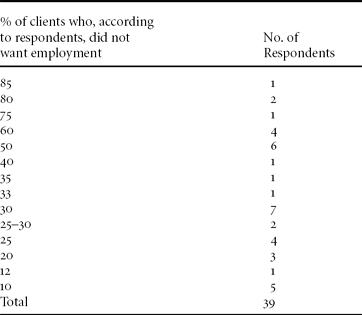
According to respondents, what percentage of their clients did not want employment?
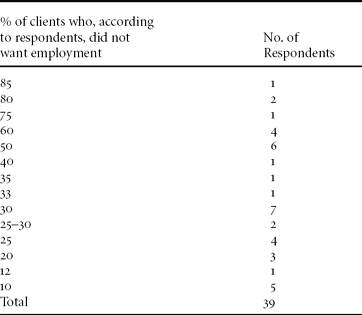
Note: Excludes one case in which the response was unclear; respondents were also asked to give a number out of 20, to check against a possible lack of knowledge of percentages.
Source: Interview data.
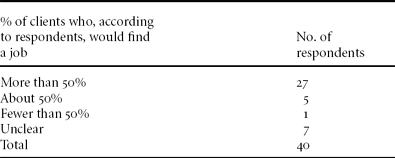
According to respondents, what percentage of their clients would find a job in the next two months if they applied for a range of badly paid and low status jobs?
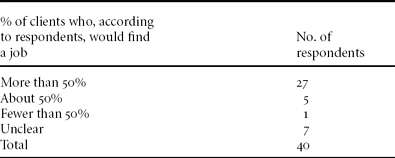
Note: Answers are grouped because they were usually less precise than in Table 1.
Source: Interview data.
To access respondents, I telephoned branches (randomly) of all organisations that provided welfare-to-work services for the fND. This helped secure a wide variety of organisations. I asked if someone who had any experience working with JSA claimants was willing to do an interview about their clients’ attitudes towards employment. About a quarter of these approaches resulted in an interview. A minority of potential respondents/receptionists asked their line manager or central office's permission to take part, and some refused. The main fear expressed by respondents/receptionists was that they might be reprimanded for talking honestly about their clients’ unwillingness to seek employment because, if made public, this might damage their organisation's relations with its clients. Therefore, strong guarantees of confidentiality and anonymity were given to all participating individuals and their organisations. While most respondents (twenty-five) had ‘employment adviser’ roles (mainly helping clients with job search and developing their employability through such activities as CV-writing workshops), the inclusion of eleven who liaised with employers and clients in organising work placements and four office managers helped tap different perspectives and experiences within organisations. The vast majority of all respondents’ clients had claimed JSA for at least six months and almost all attended as a condition of receiving their JSA.
The sample's composition was never meant to be statistically representative (the results section uses quantities, but only to aid description). However, it was balanced, albeit loosely, in terms of gender (twenty-three women, seventeen men), age (eleven in their twenties, seven in their thirties, fourteen in their forties, seven in their fifties and one in their sixties), ethnicity (thirty-seven white – of which twenty-six were English, seven Scottish, two Welsh, one Eastern European and one Irish, and three Black – two Africans and one West Indian) and local labour market conditions. The locations – in Scotland, Wales and various English regions – were of various levels of prosperity. Sizes of towns and cities varied (ten respondents were in large cities, eighteen in large towns, eight in smaller towns and four in suburban areas). When socio-demographic groups became noticeably underrepresented they were deliberately sought, either by selecting particular branches or by requesting particular categories of respondent during initial telephone conversations. Respondents’ reported hours of experience in the presence of long-term JSA claimants (calculated from contact hours per week and months/years in the job) varied from 700 to 14,000 – the median was 1,700, the mean 3,675 and the combined total 147,000. Thirty-one of the respondents worked for private organisations and nine for charities. At the time of interviewing, the WP was being introduced – eighteen of the forty respondents worked for WP providers.
Data analysis involved repeatedly listening to tapes to identify themes and drawing up categories of response for each respondent. These categories were then analysed in order to expose patterns among respondents with particular characteristics (including all the characteristics listed so far in this section). These patterns were then followed up by further qualitative analysis. But, as the results section shows, there were few noticeable differences between these sub-groups.
What percentage of long-term JSA clients did not want employment at all?
The following two questions are crucial in understanding how these percentages were arrived at (the answer to the second question is relevant to the entire results section):
1. How was ‘not wanting employment’ measured?
I asked respondents to include all clients who they believed did not presently make any serious attempt to apply for jobs which might be considered attainable (i.e., jobs which they felt a client had some chance, however small, of getting), except people with positive attitudes to work who did not look for work only because they held a realistic belief that they had no chance of finding jobs paying enough to increase their net income. In fact, respondents almost always said the latter group was very small, and no respondent said they knew any client who was only applying for jobs that were certainly out of their reach, so therefore ‘not wanting employment’ almost always simply meant those ‘they believed did not presently make any serious attempt to apply for jobs’. The focus on attainable jobs means the measure has the drawback that individuals are categorised as ‘not wanting employment’ even though they might accept an extremely lucrative job, or one they considered enjoyable, if it was offered. Moreover, the measure risks wrongly portraying those chronically lacking employability as more ‘work shy’ just because the jobs that can be considered ‘attainable’ for them are relatively unattractive. But all available measures are imperfect, and this was considered the best available, not only because it reflects the expectation – found in both JSA regulations and debates about unemployment – that claimants should attempt to find an attainable job, but also because it is sensitive to the financial circumstances individual claimants face.
2. How did respondents decide whether or not their clients ‘wanted employment’?
I asked respondents to base their answers on their experiences in the presence of clients. Respondents often said their clients felt able to be more honest than they were with Jobcentre Plus (JCP) staff (who deal with JSA claims), but not completely honest because they could be sanctioned for openly admitting they were not actively seeking employment. Thus, respondents usually said they based their accounts on clients’ actual job search behaviour, which often did not match their expressed attitudes:
They can say the right things but when you actually probe, for example one [client] will say ‘oh I've searched in this newspaper, I've applied for these jobs, I've sent these emails’, and then ‘cause I know what he's like, I probe, I say ‘what job did you apply for? When did you apply for it? Show me the emails’ and he can show me nothing – no evidence at all. (Male, thirties, employment adviser, prosperous large town)
For this reason, respondents often argued that they had a better vantage point than JCP staff for judging whether JSA claimants were really looking for employment: ‘They just take their piece of paper [to JCP], making up jobs totally freely . . . in my role, I need evidence, that's what shocks them when they come here’ (female, fifties, employer liaison, medium-prosperity large town). Nevertheless, respondents’ accounts were inevitably perception-based, and some even referred to TV programmes when defending viewpoints.
As Table 1 shows, respondents tended to report that around one-third of the long-term JSA claimants they dealt with did not presently want employment. While answers were widely dispersed, twenty-two out of thirty-nine gave a figure between a quarter and a half. Older respondents (though not respondents with more experience working with JSA claimants) tended to give higher percentages. The eleven under thirty years had a mean of 31 per cent, and the twenty-nine over thirty had a mean of 39 per cent, which is perhaps symptomatic of older respondents’ often-stated belief that younger people were less committed to employment than past generations. The only other noteworthy finding about types of respondent was that men had a higher mean (men, 43 per cent; women, 33 per cent), but it is unclear why.
When asked which ethnic, gender, social class, age, household type and ‘former occupation’ groups tended to not want employment, respondents often said it was ‘across the board’. Only eleven mentioned the most frequently cited group – young people. The reasons given for naming this group match existing qualitative studies of young British adults which found they are more likely than other groups to favour unemployment because they usually have no dependents, are less accustomed to employment, have friends who are also unemployed and often enjoy parental financial support (see Pahl, Reference Pahl, Bryson and McKay1994). Nevertheless, younger clients were often, though not always, considered the most ‘workable’ – meaning easily influenced by activation workers’ intervention. The next most cited group was older people. Six mentioned people in their late-forties, or in their fifties or sixties who ‘feel they've maybe done their time’ in employment (male, sixties, employment liaison, large poorer industrial town). Again, this matches published British research, which has found that older people often feel they have ‘done their stint’ in employment and are therefore absolved from negative moral judgment when unemployed (Westergaard et al., Reference Westergaard, Noble and Walker1989; White, Reference White1991) – except that in these studies the ‘older’ clients were all nearing sixty-five. However, as the next section shows, there was a clear consensus that the most difficult client group to encourage towards employment was one known as the ‘third generation’.
The ‘third generation’
Thirty-six respondents supported the view that a ‘dependency culture’ existed among some of their clients, and none of the other four disputed the culture's existence. No-one called it a ‘dependency culture’ – they instead used the industry buzz-phrase ‘third generation’ (or occasionally ‘second’ or ‘fourth’ generation), meaning people who had grown up in households reliant on state benefits for the bulk of their income for several generations, and who, therefore, unlike British citizens generally, saw claiming out-of-work benefits long-term as normal and morally acceptable. People from these families – particularly younger generations in whom the culture's values were considered particularly well entrenched – were said to hold very negative attitudes towards employment and were the least likely to meet employment's typical behavioural demands, notably around punctuality, social etiquette and accepting authority.
Coming from like a third generation of people who have claimed benefit, their mother and father didn't work, their mother and father didn't work, and it's sort of like, kind of like ingrained in their culture. (Male, twenties, senior employment adviser, large industrial city)
If their families have never worked, then that ethic isn't there. What would seem obvious to, like, me or you for example, it's just not there and I've found that really shocking with some people. To me, if I need money, I work for it, and I think, particularly the younger ones, you just don't see that even when you explain it in black and white to them. (Female, twenties, employment adviser, small prosperous town)
This culture was seen to be reinforced by the peer groups of these deprived young adults, in this case male:
It's a social thing – they don't see the need to work. Because none of their associates work . . . people don't look down on them ‘cause they don't work. (Female, thirties, employment adviser, large poorer industrial town)
Some of the thirty-six who made claims about this ‘third generation’ acknowledged they were not well positioned to witness the supposed connections between parental joblessness and subsequent attitudes towards employment and unemployment. Furthermore, while evidence suggests there is a strong intergenerational correlation in worklessness across Britain, only about 15,000 households have two or more generations who have never been employed (see Harkness et al., Reference Harkness, Gregg and MacMillan2012: 18–21). Thus, while respondents might have been correct on occasions when they said that there were some families in which three adult generations were all usually outside employment, they were almost certainly wrong on occasions when they claimed they had come into contact with significant numbers of families in which three adult generations had never had a job. Some said they based their belief in the culture's existence on behavioural and attitudinal differences between clients who identified themselves as ‘third generation’ and those with employed parents and grandparents. Others said they noticed similarities among members of the same family – such as a tendency to dispute ‘benefits calculations’ which showed they would be better off economically in employment. A common theme was that ‘third generation’ clients’ considerable welfare rights knowledge and an ability to ‘play the game of keeping the job centre happy’ (female, forties, employability coach [same as employment adviser], small prosperous town) contrasted sharply with their overall competence level.
While respondents were relatively well placed to judge whether these clients really wanted employment, and even whether or not they considered reliance on benefits normal and morally acceptable, their vantage point was arguably more limited in its ability to decide if some of the apparent manifestations of a ‘culture’ might in fact be understandable (even predictable) human responses to adverse circumstances. In fact, respondents were, at times, so sympathetic and understanding towards the ‘third generation’ that their accounts lent support to that view. Respondents routinely spoke of ‘third generation’ clients’ defeatism (about the chances of finding a job or a better life) and cynicism (about the JCP and welfare-to-work schemes) in a way that made these feelings seem understandable, given their general lack of success in the education system and subsequently in the labour market. While these clients were categorised as ‘not wanting employment’, the jobs they could realistically obtain were limited both in quantity and quality, and their apparent belief that claiming benefits is ‘normal’ might just have stemmed from them becoming increasingly accustomed to claiming.
Furthermore, respondents’ descriptions of the reasons why this ‘third generation’ chose to remain on benefits made them seem understandable. They were seen to ‘fear’ coming off benefits, thus failing to act in their longer-term economic interests. Given their lack of employability, and their high propensity to have had negative past experiences in jobs, it seems understandable that they worried that if they found a job (and therefore forfeited benefits) they might hate it, or lose the job and have to make a new JSA claim which might be unsuccessful. Furthermore, respondents also sometimes noted that clients would suffer financially while waiting for the first pay cheque (this disincentive is well known – e.g., Shaw et al., Reference Shaw, Walker, Ashworth, Jenkins and Middleton1996). Some respondents said that clients were even under pressure from family members to avoid employment because it might jeopardise their own benefit claim – a finding which illustrates the difficulty of deciding whether these ‘third generation’ traits are symptomatic of a culture that rejects mainstream work values, or simply a sensible reaction to dire circumstances. In fact, with Mead's earlier observation in mind, this decision is likely to be influenced by one's political beliefs and hence how one believes unemployed benefit claimants should react to these circumstances.
According to respondents, an important consideration in understanding employment decisions was that many of their clients were ‘comfortable’ living on benefits – especially younger, ‘third generation’ clients who had lived on a low income from a young age and were, as yet, unaccustomed to full-time wages:
They think ‘how would [a job] make my life any different?’ ‘Everything's already covered, I can still have some fun, I can indulge myself to a certain degree, what do I need to work for?’ (Male, forties, employment adviser, large poorer industrial town)
Yet even respondents who said they believed that some JSA claimants lived in material ‘comfort’ did not advocate severe benefit reductions for those not seeking employment. The reason was usually that such cuts might damage their employment chances further, by reducing their ability to fund job search (this is consistent with in-depth research on unemployed people – McLaughlin et al., Reference McLaughlin, Millar and Cooke1989, which also finds that economic incentives have very limited overall employment effects) or possibly pushing them into crime. While there was no widespread agreement on what policies were best, the most popular was compulsory work placements (supported by five), mainly because they would develop long-term JSA claimants’ skills and work habits while making them contribute to production.
Choosiness
All forty respondents agreed that significant numbers of long-term JSA claimants they worked with were being too choosy in the jobs they were willing to apply for (this layer of choosy job searchers is in addition to people who did not want employment at all). Clients were said to be unwilling to apply for jobs they considered inadequately paid, uninteresting, unpleasant, inconvenient (mainly in terms of distance from home) or unsuitable.
The phrase ‘unrealistic expectations’ was popular – it referred to clients searching only for jobs respondents considered them unlikely to obtain. Employment advisors often saw persuading their clients to apply for lesser jobs as an important part of their role, as it was widely believed that the longer clients’ stayed on benefits, the more their employment chances diminished. Respondents often said clients ‘unrealistically’ believed they had a strong chance of finding a job similar to the one they lost immediately prior to their current JSA claim. This was considered unrealistic for two reasons in particular: (1) six months or more of unemployment had scarred their CV and (2) the recession had damaged people's employment chances generally.
However, much of what respondents called ‘unrealistic expectations’ (a phrase well established in the welfare-to-work literature – Millar, Reference Millar2000), was in fact ‘choosiness’ in the way I defined the term above. ‘Unrealistic expectations’ implies something akin to a delusion of grandeur – so it is really a reason for choosiness. Yet respondents often used the phrase when referring to people who were being choosy for reasons other than having unrealistically high expectations, or when the reason for their choosiness was unknown. Furthermore, respondents’ accounts were not consistent with a view that clients’ expectations were unrealistically high – they were often considered defeatist and lacking in self-confidence.
Respondents were asked which categories of client were most choosy in relation to their employment chances. This is problematic, as assessing someone's employment chances inevitably involves guesswork – e.g. how useful are particular educational qualifications in their local labour market. Furthermore, categories of client with fairly normal levels of choosiness can be singled out just because their employment chances are deemed to be particularly dismal. This might account for former construction workers often being heavily criticised for being unwilling to consider other jobs. Likewise, respondents in large, isolated towns that had experienced industrial decline were particularly heavily critical of clients for being reluctant to travel to neighbouring towns or cities, when similar reluctance among people in more favourable labour markets might have gone unnoticed. In fact, this criticism is arguably unfair anyway because excessive transport costs are one of the few factors (along with childcare costs and the costs of moving into employment) which can still make people worse off financially in employment than on benefits (see Spicker, Reference Spicker2011: 206–07). Yet other findings seemed more noteworthy. Working-class males’ reluctance to do what they sometimes considered to be ‘women's jobs’ and those requiring interpersonal skills was widely noted, and chimes with some existing research (McDowell, Reference McDowell2003; Lindsay and McQuaid, Reference Lindsay and McQuaid2004). Furthermore, people with recently acquired qualifications – particularly degrees and NVQs – who nevertheless lacked on-the-job experience were often considered to be aiming too high in their job search.
But was choosiness seen as an important reason for clients remaining on benefits so long? I asked respondents: ‘In your opinion, what percentage of your long-term JSA claimant clients would find employment in the next two months if they were willing to apply for a range of badly paid and low status jobs?’ (I acknowledge that if all adopted such a zealous approach to job searching simultaneously, labour supply would increase dramatically making such jobs harder to obtain). Most respondents said that most of their clients would make a swift return to employment if they adopted this strategy (see Table 2).
Despite the recession, a popular phrase was ‘there are jobs out there’, and the following quotation sums up many respondents’ feelings about their clients’ choosiness:
If somebody wants a job badly enough, unless they are completely stupid, for want of a more PC way of delivering that, you can get a job, and anybody who says different to that probably just doesn't have the gumption to go out and get it. They'll be a lot of people who disagree with that who say ‘well I've been trying, I've been trying, I've been trying’, but when you analyse it they're not prepared to take the cleaning jobs, or the car park attendant jobs, or the jobs they could get because they are being unrealistic looking for jobs that aren't available any more. (Male, forties, employer liaison, large poorer industrial town)
Conclusion
This article investigated activation workers’ views about their long-term JSA-claiming clients’ work attitudes and job search behaviour. Activation workers have considerable personal experience of their clients’ job search activity, and interviewing them avoids the problem of unemployed people ‘pleasing the interviewer’. Yet they lack detailed knowledge of circumstances their clients’ have faced and are currently facing, and their perception-based accounts inevitably contained biases and prejudices. Importantly, while they gave overwhelming support to the ‘dependency culture’ thesis, the connections they made between parental joblessness, values and socialisation were based on guesswork. Nevertheless, even though these connections were not established, the fact that thirty-six out of forty people, with unrivalled access to long-term JSA claimants, said they believed the culture existed is staggering when considered in the context of existing UK social policy conclusions about unemployed people.
When reflecting on what respondents said about the proportion of their clients who wanted a job and how choosy they were in job search, it is important to remember that nearly all these clients had been on JSA for over six months. Most JSA claimants leave the register within six months, usually to enter employment, so the finding that only about a third of those who remain are believed to not want a job is consistent with the prevailing wisdom that a large majority of unemployed people are strongly committed to employment. Yet respondents reported considerable choosiness among the (supposed) other two-thirds, even after at least six months of unsuccessful job search. Respondents said they believed that choosiness was an important reason why their clients remained on JSA – a finding which contradicts several major quantitative studies which concluded that choosiness does not influence unemployment durations, but which is consistent with my qualitative work with JSA claimants (Dunn, Reference Dunn2010).
While the study had its limitations, the consistency of the views expressed by respondents must surely go some way to dispelling the possible argument that JSA claimants’ employment commitment is so strong that attaching job search conditions to the receipt of their benefits is unnecessary. Yet deciding on the exact policy implications of the findings is problematic, as one's views about welfare policy tend to closely mirror one's political beliefs. Mead's point – that our political beliefs are important in determining the behaviour we insist upon from unemployed social security claimants – is perhaps crucial. For example, Left commentators might defend the right of long-term JSA claimants to be ‘choosy’ in job search. They might also argue that the so-called ‘third generation’ are some of the most disadvantaged members of a chronically unequal and unfair society, and that job creation, greater vertical redistribution of income and wealth and better training and education is required to improve their lives. Mainstream British politicians, on the other hand, who support ‘activation’ measures, might suggest the findings imply that Jobseeker's Agreements (now called Claimant Commitments, which state the jobs JSA claimants must seek) need to be more demanding and more strictly monitored, or that tax credits and the minimum wage should be substantially increased (though findings here and elsewhere suggest the employment effects of such enticements are fairly small). Respondents often claimed that gaining education and training qualifications tended to make claimants choosier – a reason conservative Mead (Reference Mead2004) gives for preferring ‘work first’ policies to schemes which develop claimants’ longer-term employability. Indeed, several respondents considered compulsory work placements a good idea – though sometimes this reflected their personal desire to make claimants contribute to production. Perhaps more tellingly, most respondents’ descriptions of ‘third generation’ clients implied a need for policy interventions to develop the latters’ skills and employment-related habits – whether the WP will deliver this effectively remains to be seen.
Acknowledgement
I would like to thank the two anonymous reviewers for their helpful comments on an earlier draft of this article. I also thank the British Academy for a small grant (SG110099) which helped fund the research.