I. INTRODUCTION
Coordination polymers (CPs), which are a class of materials of hybrid organic/inorganic nature, combine the properties of both organic and inorganic materials.Reference Kitagawa, Kitaura and Noro1, Reference O’Keeffe, Eddaoudi, Li, Reineke and Yaghi2 These materials, especially porous CPs [so-called PCPs (porous coordination polymers), MOFs (metal-organic frameworks), or MIL (Material Institut Lavoiser)], have attracted a great deal of attention in the past decade owing to their diverse topologies and enormous potential applications for molecular storage and separation, catalysis, and ion exchange.Reference Férey, Mellot-Draznieks, Serre, Millange, Dutour, Surblé and Margiolaki3–Reference Maji, Matsuda and Kitagawa8 HKUST-1 [Cu3(C9H3O6)2(H2O)3·xH2O], abbreviated Cu3(BTC)2, originally reported by Chui et al.,Reference Chui, Lo, Charmant, Orpen and Williams9 consists of Cu2(H2O)2 dimer units linked by benzene-1,3,5-tricarboxylate groups, forming a three-dimensional open framework. Owing to their microporous structure and robustness as well as open coordination sites, HKUST-1 has been widely studied experimentallyReference Guo, Zhu, Hewitt and Qiu10, Reference Wang, Shen, Bülow, Lau, Deng, Fitch, Lemcoff and Semanscin11 and computationallyReference Skoulidas12–Reference Keskin, Liu, Johnson and Sholl14 for gas purification and separation.
HKUST-1 films were recently intensively studied by Zhu et al.,Reference Guo, Zhu, Hewitt and Qiu10 Cyganik et al.,Reference Szelagowska-Kunstman, Cyganik, Goryl, Zacher, Puterova, Fischer and Szymonski15 Allendorf et al.,Reference Allendorf, Houk, Andruszkiewicz, Talin, Pikarsky, Choudhury, Gall and Hesketh16 Bein et al.,Reference Biemmi, Scherb and Bein17–Reference Biemmi, Darga, Stock and Bein19 Jeong et al.,Reference Guerrero, Yoo, McCarthy and Jeong20 Vos et al.,Reference Ameloot, Gobechiya, Uji-i, Martens, Hofkens, Alaerts, Sels and De Vos21–Reference Ameloot, Stappers, Fransaer, Alaerts, Sels and De Vos23 and Gascon et al.Reference Gascon, Aguado and Kapteijn24 They thoroughly explored the concepts of film fabrication and the oriented growth of HKUST-1. HKUST-1 films with highly oriented along the [100] or [111] has attracted much attention, but that oriented along other direction hasn't been obtained. In simulated XRD pattern from standard crystal data, (400) diffraction is much weaker than (200) diffraction. However, the relative intensity of (400)/(200) diffraction is much higher in XRD pattern of many synthesized HKUST-1 films.Reference Zhuang, Ceglarek, Pethuraj and Terfort25 Some of the reported XRD patterns even show that the (400) diffraction is stronger than the (200) diffraction.Reference Guerrero, Yoo, McCarthy and Jeong20, Reference Shekhah, Liu, Fischerb and Wöll26, Reference Li, Qiu, Xu, Wu, Wang, Wu and Jiang27 Such as in the sample of that loading inorganic guest species in HKUST-1, which was reported by Shekhah, the XRD data reveal that the (400) diffraction is stronger than the (200) diffraction after loading.Reference Shekhah, Liu, Fischerb and Wöll26 This suggests that the (400) epitaxial growth happened in most of HKUST-1 film but was not discussed specifically. Here, we fabricate film that only shows (400) and (800) diffractions to shed light on the stronger (400) diffraction in synthesized HKUST-1 film.
Although a large number of CPs with abundant topologies have been structurally established, the rational design and patterned inorganic metal ion and organic ligand are still a challenge. Shekhah et al.Reference Shekhah, Wang, Kowarik, Schreiber, Paulus, Tolan, Sternemann, Evers, Zacher, Fischer and Wöll28 introduced the stepwise layer-by-layer growth mode of MOFs, which is based on the combination of the reaction partners in a sequential stepwise fashion. The individual steps are separated by removing unreacted components via rinsing with a solvent. Fischer et al.Reference Zacher, Shekhah, Wöll and Fischer29 pointed out that this step-by-step method offers the unique opportunity to grow nonperiodic MOF-like ordered structures, which cannot be obtained by established solvothermal routes. However, to our knowledge, no disordered HKUST-1-like complex was prepared. This is probably due to its nature of easily crystallization. Crystallized HKUST-1 can be obtained by many methods, such as electrochemical deposition,Reference Ameloot, Pandey, Auweraer, Alaerts, Sels and De Vos22 evaporation of mother solution,Reference Biemmi, Scherb and Bein17, Reference Guerrero, Yoo, McCarthy and Jeong20, Reference Zacher, Liu, Huber and Fischer30 solvothermal,Reference Guo, Zhu, Hewitt and Qiu10 step-by-step,Reference Nan, Dong, Wang, Jin and Xu31 ultrasonic,Reference Li, Qiu, Xu, Wu, Wang, Wu and Jiang27 and gel-layer synthesis.Reference Schoedel, Scherb and Bein18 De Vos et al.Reference Ameloot, Gobechiya, Uji-i, Martens, Hofkens, Alaerts, Sels and De Vos21 even found that clouding was observed when an alcoholic solution of trimesic acid is mixed with an aqueous copper nitrate solution before solvothermal treatment.
As we all know, the essential of fabrication of film is to promote the growth of material on the support rather than free growth. Self-assembly monolayers, spin-coating MOF hydrothermal mother solutions, and layer-by-layer strategy were used to control the growth of MOF on the substrate.Reference Shekhah, Liu, Fischerb and Wöll26, Reference Zacher, Shekhah, Wöll and Fischer29 Here, we use copper foil as substrate and reactant. It should be noted that growth of nanocrystal by using substrate as reactor is well known, such as Cu(OH)2 nanoarray on copper foil,Reference Zhang, Wen, Yang, Berta and Wang32 Ag2S nanowires on silver.Reference Wen, Wang, Xie, Li and Yang33 This salt-free strategy warranted the formation of film on solid substrate rather than solution. It has only recently been transferred to the fabrication of MOF thin film. Zhu et al.Reference Guo, Zhu, Hewitt and Qiu10 used Cu(NO3)2·H2O and copper net as Cu2+ source, which was named as “twin copper source.” De Vos et al.Reference Ameloot, Pandey, Auweraer, Alaerts, Sels and De Vos22 used copper foil only, but they had to anodic oxidized metal substrate to produce Cu2+. Our strategy is simple oxidization of copper foil to Cu2+ by air, sequentially coordination with the vapor of benzene-1,3,5-tricarboxylate groups to form copper 1,3,5-tricarboxylate. Copper foil was both support material and Cu2+source. The copper 1,3,5-tricarboxylate film was only fabricated on the surface of copper foil.
II. EXPERIMENTAL
In typical synthesis, 0.4 mM of H3BTC was added to 20 mL of 14:6 (v/v) dimethylformamide (DMF):ethyl alcohol (EtOH) at 80 °C water bath in beaker. Copper foil was hung on 0.3 cm in distance from the solution to warrant that there was enough ligand vapor reached on the surface of copper foil. After 2–3 days, film with color ranged from dark blue to blue was obtained on red copper foil.
The x-ray powder diffraction pattern of product was obtained using a Bruker D8-ADVANCE (Bruker, Germany). Raman spectra were recorded by using a Renishaw inVia Raman Microscope spectrometer (England). An Ar+laser emitting at 514 nm was used. The infrared (IR) spectrum was generated by Nicolet 330 Infra-Red Spectrometer (Madison, WI). The high-resolution transmission electron microscope (HRTEM) image was taken with a JEOL JEM-2010HR transmission electron microscope (Tokyo, Japan), using an accelerating voltage of 200 kV. Scanning electron microscopy (SEM) was performed on a JEOL JSM-6330F scanning electron microscope operated at 20 kV. X-ray photoelectron spectrometer (XPS) was taken with an ESCALab250 spectrometer (Thermo electron corporation, Waltham, MA).
III. RESULTS AND DISCUSSION
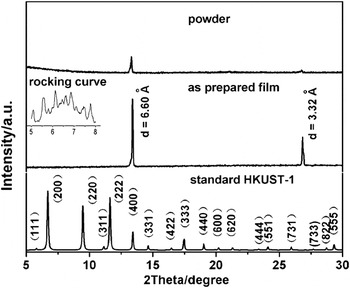
The XRD pattern of the as-prepared thin film was shown in Fig. 1 (middle). Compared with the simulated diffraction pattern of HKUST-1 (Fig. 1, lower), there were only (400) (d = 6.60 Å) and (800) (d = 3.32 Å) diffractions of HKUST-1 in that of product. There were two possibilities that lead to this result. One is that the as-prepared film is oriented to the substrate. The other is that the atoms are orderly arranged only in one dimension, the other two dimensions are in disorder, and the length of the period is equal to the d value of (400) diffraction of HKUST-1. XRD rocking curve was measured at θ = 6.7° to study the possibility of orientation. The result [Fig. 1 (inset)] showed no orientation. In addition, it is not reasonable that (200) peak, which is much stronger than (400) diffraction in bulk HKUST-1, was not shown in hypothetic oriented film. We also cut the powder from the copper foil and grinded it to break the hypothetic orientation. The XRD pattern [Fig. 1 (upper)] showed no change but extremely weak, which also means no orientation. For further investigation of crystal structure of HKUST-1, it was found that the d value of 6.60 Å is very close to the thickness of one-layered Cu2+ plus one-layered C9H3O63− (6.59 Å), as shown in Fig. 1 in supported material. So the XRD pattern that shows only (400) and (800) diffractions of HKUST-1 means that Cu2+ and C9H3O63−stacked periodically in the direction of perpendicular to the substrate. There is no periodic structure within the layer. As a result, arrangement of atoms is one-dimensional (1D) order or two-dimensional (2D) disorder in the as-prepared copper 1,3,5-tricarboxylate film.
X-ray diffraction patterns of the standard HKUST-1 (lower), 2D disordered copper 1,3,5-tricarboxylate thin film (middle), and powder that cut from the film (upper) (Inset: Rocking curve of 2D disordered copper 1,3,5-tricarboxylate thin film).

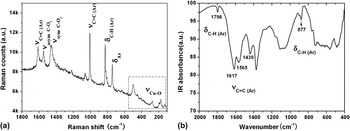
In addition, XRD pattern of Cu(COOH)(OH)34 is quite similar to that shown in Fig. 1 (middle). So it is very important to make clear investigation of the organic part of the as-prepared film. IR and Raman spectroscopy were measured to distinguish Cu(COOH)(OH) and Cu3(C9H3O6)2. The Raman spectrum [Fig. 2(a)] obtained is in good agreement with the spectra of HKUST-1 described by Prestipino et al.Reference Prestipino, Regli, Vitillo, Bonino, Damin, Lamberti, Zecchina, Solari, Kongshaug and Bordiga35 The bands at 1618 and 1008 cm−1 are associated with v(C = C) modes of the benzene ring; the peaks at 828 and 742 cm−1 are ascribed to ring bending, respectively. While the double peaks at 1551 and 1459 cm−1 is due to the v asym(C–O2) and v sym(C–O2) units. In the low frequency region (600–170 cm−1 range), the peaks were attributed to Cu–O stretch. From the IR spectrum of sample [Fig. 2(b)], the bands at 1617, 1565, and 1439 cm−1 are associated with v(C = C) modes of the benzene ring. The peaks at 877 and 1798 cm−1are ascribed to out-of-plane ring (C–H) bending vibrations. Both Raman and IR proved the existence of benzene ring, indicating that BTC is the ligand.
(a) Raman spectrum (collected with a 514-nm laser). (b) IR spectrum of 2D disordered copper 1,3,5-tricarboxylate film.

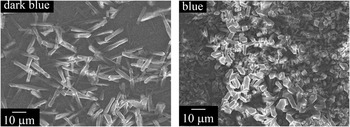
SEM image, as shown in Fig. 3, was used to investigate the morphology of as-prepared film. This 2D disordered copper 1,3,5-tricarboxylate is tetragonal prism with steeple. Like other MOF films,Reference Shekhah, Liu, Fischerb and Wöll26, Reference Zacher, Shekhah, Wöll and Fischer29 the as-prepared films can be rather rough consisting of separate crystallites [Fig. 3 (left)] or dense crystals [Fig. 3 (right)]. The difference in morphology between dark blue film and blue film is the density of particles. The blue films, in which the reaction took more than 3 days, whose color is close to the bulk HKUST-1 crystal, are dense coatings [Fig. 3 (right)]. The dark blue films, in which the reaction took less than 3 days, are separate crystallites [Fig. 3(left)].
SEM images of 2D disordered copper 1,3,5-tricarboxylate film with different color. Left: dark blue, right: blue.

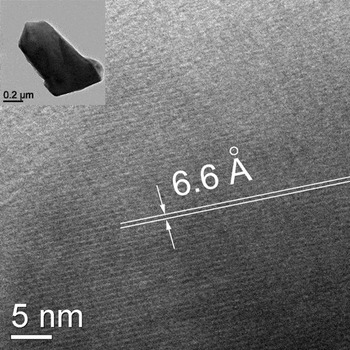
Figure 4 shows the HRTEM and TEM (insert) images of 2D disordered copper 1,3,5-tricarboxylate film. The lattice spacing in the HRTEM images of 6.60 Å is also consistent with the bulk value of 6.59 Å for the (400) lattice spacing in HKUST-1.
The HRTEM and TEM (insert) images of 2D disordered copper 1,3,5-tricarboxylate crystal.

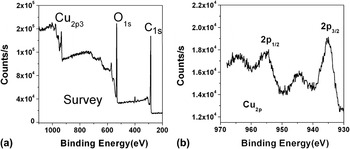
XPS was used to determine the valence of copper in the film. To exclude the effect of copper substrate, blue film, which was proved to be dense coatings, was selected as the sample for XPS measurement. The result was shown in Fig. 5. The product is pure and copper exists in the divalent state having mainly d 9 character. The XPS detected the Cu 2p 3/2 and Cu 2p 1/2 at 935 and 954.6 eV, respectively. The main peak was known as the characteristics of copper, and the shake-up satellite peaks are evident and diagnostic of an open 3d 9 shell, corresponding to Cu2+state.Reference Ghijsen, Tjeng, Elp, Eskes, Westerink and Sawatzky36, Reference Chawla, Sankarraman and Payer37
XPS spectra of 2D disordered copper 1,3,5-tricarboxylate film (a) survey, (b) Cu2p.

To investigate how Cu0 was oxidized to Cu2+, the reactions were taken under air and N2, respectively. No copper 1,3,5-tricarboxylate can be found while putting the reaction system under N2 instead of air, indicating that the complex is start with the oxidation of Cu(s) by O2 in the air, followed by the coordination with C9H3O63−. The growth site has to be at one of the two ends, the root or the tip. Like other reactions that the copper foil worked as Cu2+ source,Reference Zhang, Wen, Yang, Berta and Wang32 the well-established VLS (vapor-liquid-solid) growth mechanism, which happened at the tip, is not supported by our experiment. There wasn't drop-like feature at the crystal tips in our sample. The root growth mechanism, which is common practice in nanowire synthesis by vapor–solid reaction on copper foil substrate,Reference Zhang and Yang38 might be at work because the close by copper surface can provide the necessary feeding materials.
To investigate how the 2D disordered copper 1,3,5-tricarboxylate film was synthesized and to optimize growth condition, we examined the effect of the kind of copper foil [(220) and (111) preponderant foil], temperature (70–100 °C), the ratio of DMF/EtOH (14/6 to 6/14 v/v cm3/cm3), and the distance between solution and copper foil. The 80 °C temperature and the 0.3-cm distance are important. Reactions took place under lower temperature and more distance show no or less product. Those happened under higher temperature and lesser distance produce bulk HKUST-1 film. The ratio of DMF/EtOH and the kind of substrate are irrelevant. Unlike other works, for fabrication of HKUST-1 film, we used vapor of benzene-1,3,5-tricarboxylate groups and Cu(s) instead of solution of ligand and Cu2+. The difficulty of diffusion of ligand and Cu2+in this system is probably the reason for the formation of 2D disordered copper 1,3,5-tricarboxylate film.
IV. CONCLUSIONS
In summary, we have for the first time successfully in situ synthesized 2D disordered or 1D ordered copper 1,3,5-tricarboxylate film on copper foil. This result probably explains why (400) diffraction in XRD pattern of reported synthesized HKUST-1 film is anomalously strong. This kind of disorder probably also existed in the reported HKUST-1 film that shows strong (400) diffraction in XRD pattern. The kind of substrate and the ratio of DMF/EtOH are irrelevant. The 80 °C temperature and the 0.3-cm distance between solution and copper foil play a key role. This strategy is simple; no seed, no pretreated solvothermal mother liquors, and no specific functionalization are required. We believe that this salt-free method can be applied for preparation of more MOF film.
Supplementary Material
Supplementary materials can be viewed in this issue of the Journal of Materials Research by visiting http://journals.cambridge.org/jmr.
ACKNOWLEDGMENTS
This work was supported by “the Fundamental Research Funds for the Central Universities” (Grant No. 11lgpy10).