Implications
Animals slaughtered at 11 months of age had the best carcass parameters. From a nutritional point of view, foals slaughtered at 8 months of age showed the best nutritional quality (except for the cholesterol content) because they presented the highest content of n-3 fatty acids and the lowest values for n-6/n-3 ratio. The administration of finishing diet only for 3 months would also reduce production costs. This study contributed to a description of the physico-chemical and nutritional composition of foal meat, which would be used to extend existing information about the nutrient composition of horsemeat.
Introduction
The ‘Galician Mountain’ (GM) horse is an autochthonous crossbreed located in the mountains of Galicia (NW Spain), where it is born and raised. The usual GM production system is weaning and selling the foals when they are 6 to 8 months old, without any fattening period (160 to 170 kg of live weight (LW)). The heaviest foals sometimes undergo a finishing period of 3 to 6 months. However, even with a concentrate feed, the carcass weight (CW) is much lighter than the usual in the meat industry, as the most common carcasses in other regions of Spain, or other countries, are heavier than 250 kg (Sarriés and Beriain, Reference Sarriés and Beriain2005; Juárez et al., Reference Juárez, Polvillo, Gómez, Alcalde, Romero and Valera2009). However, there are some ways to improve the CW – that is, by crossing with heavier breeds, increasing slaughter age and including a finishing period with concentrate – which could make the exportation easy (Franco et al., Reference Franco, Crecente, Vázquez, Gómez and Lorenzo2013).
In recent studies, it has been established that carcass and horsemeat quality can be influenced by the livestock production system (Franco et al., 2011; Lorenzo et al., Reference Lorenzo, Crecente, Franco, Sarriés and Gómez2014a), breed and crossbreed (Juárez et al., Reference Juárez, Polvillo, Gómez, Alcalde, Romero and Valera2009; Franco et al., Reference Franco, Crecente, Vázquez, Gómez and Lorenzo2013), finishing diet (Sarriés and Beriain, Reference Sarriés and Beriain2006; Franco and Lorenzo, Reference Franco and Lorenzo2014) or age/live weight (Sarriés and Beriain, Reference Sarriés and Beriain2006; Franco et al., 2011), among others.
Horsemeat has become more popular in recent years, and it has great potential as an alternative form of meat in wider domestic markets (Sarriés et al., Reference Sarriés, Murray, Troy and Beriain2006). In fact, the production of horsemeat has increased during the last few years. According to FAOSTAT, 2014, the production of horsemeat increased from 5300 tons in 2007 to 8300 tons in 2012 (which represents an increase of 64%). Despite the increased consumption of horsemeat, it is not yet comparable with the consumption of other types of meats such as beef, chicken or pork, which are more important in human diet (Franco et al., 2011).
Horsemeat can be considered a good substitute for traditional meat (chicken, pork, sheep or beef) because of its nutritional characteristics. This meat is characterized by its low fat content (Franco et al., 2011; Franco and Lorenzo, Reference Franco and Lorenzo2014), low cholesterol content (Lorenzo and Pateiro, Reference Lorenzo and Pateiro2013; Lorenzo et al., Reference Lorenzo, Sarriés and Franco2013a and Reference Lorenzo, Crecente, Franco, Sarriés and Gómez2014a), high iron content and vitamins of the B group (Badiani et al., Reference Badiani, Nanni, Gatta, Tolomelli and Manfredini1997). This meat has a favourable dietetic fatty acid profile, with a high content of unsaturated fatty acids relative to saturated acids and contains a greater proportion of components from the α-linolenic fatty acid family (Sarriés et al., Reference Sarriés, Murray, Troy and Beriain2006; Tateo et al., Reference Tateo, De Palo, Ceci and Centoducati2008; Lorenzo et al., Reference Lorenzo, Fuciños, Purriños and Franco2010; Franco et al., Reference Franco, Crecente, Vázquez, Gómez and Lorenzo2013) and also provides a large amount of essential amino acids (Franco and Lorenzo, Reference Franco and Lorenzo2014; Lorenzo et al., Reference Lorenzo, Crecente, Franco, Sarriés and Gómez2014a).
Recent studies (Lorenzo et al., Reference Lorenzo, Fuciños, Purriños and Franco2010; Franco et al., Reference Franco, Rodríguez, Purriños, Crecente, Bermúdez and Lorenzo2011; Polidori et al., Reference Polidori, Pucciarelly, Ariani, Polzonetti and Vincenzetti2015) have shown that slaughter age affects the foal carcass characteristics and meat quality. Therefore, the aim of this study was to investigate the influence of slaughter age on carcass characteristics, physico-chemical properties (chemical composition, colour parameters and textural profile) and nutritional value (fatty acid and amino acid content) of foal meat.
Material and methods
Experimental design and animal management
For this study, 21 foals obtained from crossing Galician Mountain×Hispano-Bretón (GM×HB) were used. The foals were obtained from an experimental herd of the Agricultural Research Centre of Mabegondo (Marco da Curra, A Coruña, Spain). Animals were reared with their mothers on pasture and were allowed to suckle freely until 5 months of age. Subsequently, they were fattened with a commercial feed (2.0 kg of fodder/foal-day) and pasture. At this point, half of the foals were separated into two groups: animals slaughtered at 8 months of age (the 8-m group; n=10; six males and four females) and animals slaughtered at 11 months of age (the 11-m group; n=11; six males and five females). The composition (%) of the commercial feed was as follows: CP (15.1), crude fibre (6.7), ashes (5.5), fat (4.5) and sodium (0.2). The commercial feed was composed of barley, corn, soya bean flour, wheat bran, alfalfa, sugar cane molasses, beet, animal fat, calcium carbonate, sodium chloride and powder lactose. This ration was supplemented with the next mineral/vitamin mix: vitamin A (6000 UI/kg), vitamin D3 (600 UI/kg), mineral expressed in mg/kg zinc (150), manganese (70), iron (90), copper (10), cobalt (0.30) and iodine (2) as well as butyl-hydroxyanisol (0.03 mg/kg) and etoxiquine (0.03 mg/kg). There was a period of adaptation to the commercial feed in order to avoid colics that usually appear with a sudden change in the diet. The amount of commercial feed was gradually increased, starting with small quantities to reach the final amount. The period of adaptation was 11 days. Animals were reared in a semi-extensive production system. Animals were transported to the abattoir (distance around 70 km) the day before slaughter in order to minimize the stress of the animals. The animals were stunned with a captive bolt and slaughtered and dressed according to the specifications outlined in the European legislation (Council Directive 93/119/EC, 1993).
Carcass measurements and sample collection
Carcasses were chilled for 24 h at 4°C in a cold chamber immediately after slaughter. Subsequently, carcasses were weighed (CW), and the dressing percentage (DP) was calculated. At this point, the left half-carcasses were moved to the research centre pilot plant, and the following carcass measurements were collected: length of carcass (LC), length of leg (LL), width of leg (WL) and internal depth of chest, as described by De Boer et al. (Reference De Boer, Dumont, Pomeroy and Weniger1974), as well as the external depth of chest and perimeter of leg (PL) were also obtained. These parameters were determined to assess carcass morphology. In addition, carcass compactness index (CCI)=(CW/LC) and hindlimb compactness index (LTI)=(LL/WL) were calculated (Espejo et al., Reference Espejo, García, López, Izquierdo, Robles and Costela2000).
The longissimus dorsi (LD) muscle was cut into five 2.5-cm-thick steaks. The first three steaks were used to determine pH, colour, proximate composition and fatty acid and amino acid profiles. The fourth and fifth steaks were packed under vacuum conditions (99%) (FRIMAQ, V-900, Lorca, Spain) and aged for 4 days at 4°C. Water-holding capacity and texture parameters were obtained after this period.
Analytical methods
The pH, chemical composition, colour and haeme-iron content were measured according to Franco et al. (Reference Franco, Rodríguez, Purriños, Crecente, Bermúdez and Lorenzo2011) at 24 h postmortem. The water-holding capacity was measured in two ways: cooking loss (CL) and drip loss (DL), as described by Franco et al. (Reference Franco, Rodríguez, Purriños, Crecente, Bermúdez and Lorenzo2011). The textural profile analysis test was carried out by compressing to 80% with a compression probe of 19.85 cm2 of surface contact at a compression speed of 1 mm/s in a texture Analyzer (TA.XT.plus of Stable Micro Systems, Vienna Court, UK). Between the first and second compression, the probe waited for 2 s. Hardness, cohesiveness, springiness, gumminess and chewiness of the meat were measured. The Warner–Braztler test was performed following the procedure described by Franco et al. (Reference Franco, Rodríguez, Purriños, Crecente, Bermúdez and Lorenzo2011).
Analysis of cholesterol
For saponification, 2 g of homogenized meat sample was placed in a screw teflon-lined cap tube, in duplicate, to which 0.2 g l-ascorbic acid and 5 ml saponification solution were added. The saponification solution, freshly prepared each week, contained 11% w/v potassium hydroxide in a mixture of 55% v/v absolute ethanol and 45% v/v distilled water. The sample was then immediately vortexed in order to avoid meat agglomeration. After vortexing, the air was eliminated from the reaction by displacement with nitrogen gas, and the sample was further shaken until the ascorbic acid was completely dissolved. The saponification reaction was carried out in a shaking water bath (THER-SPIN, Orto Alresa, Madrid, Spain; 200 r.p.m.) at 85°C for 45 min.
After saponification, samples were cooled in tap water for 1 min. After cooling, 1.5 ml of distilled water and 3 ml of 25 µg/ml BHT solution in n-hexane were added (final proportions of 4.5 ml H2O: 3 ml ethanol: 3 ml n-hexane; the meat sample was assumed to contribute 0.5 ml H2O). The samples were vigorously vortexed and centrifuged at 1500×g for 5 min, in order to accelerate phase separation. An aliquot of the upper layer (n-hexane) was transferred into a small screw teflon-lined cap tube and a spatletip of anhydrous sodium sulphate was added. Finally, the tube was briefly shaken and an aliquot of the n-hexane layer was filtered through a 0.45-µm hydrophobic membrane into an amber screw-cap vial with teflon septum.
The HPLC systems used were an Alliance 2695 model (Waters, Milford, MA, USA) and a 996 photodiode array detector (Waters). Empower 2TM advanced software (Waters) was used to control system operation and result management. The analysis of cholesterol in foal meat was carried out using a normal-phase silica column (SunFireTM Prep Silica, 4.6 mm ID×250 mm, 5 μm particle size; Waters), with UV–Vis photodiode array detection for cholesterol (208 nm). The solvent (2% v/v isopropanol in n-hexane) flow rate was 1 ml/min; the run last for 17 min, and the temperature of the column oven was adjusted to 25°C. From each sample, 20 µl was injected.
The content of total cholesterol in foal meat was calculated in duplicate for each muscle sample, based on the external standard technique, from a standard curve of peak area v. concentration.
Analysis of fatty acid methyl esters (FAMEs)
Intramuscular fat was extracted from 50 g of ground meat sample, according to Folch et al. (Reference Folch, Lees and Sloane-Stanley1957). Lipid extracts were evaporated to dryness under vacuum at 56°C and stored at −80°C until analysis by preparation of FAMEs. Fifty milligrams of fat was used to determine the fatty acid profile. For the fatty acids transesterification, 4 ml of a sodium methoxide (2%) solution was added to the fat samples, vortexed every 5 min during the 15 min at room temperature, then 4 ml of a H2SO4 solution (in methanol at 33%) was added, vortexed for a few seconds and vortexed again before adding 2 ml of distilled water. The organic phase (containing fatty acid methyl esters) was extracted with 2.5 ml of hexane.
Separation and quantification of FAMEs were carried out using a gas chromatograph, GC-Agilent 6890 N (Agilent Technologies Spain, S.L., Madrid, Spain), equipped with a flame ionization detector and an automatic sample injector HP 7683, and using a Supelco SPTM-2560 fused silica capillary column (100 m, 0.25 mm i.d., 0.2 μm film thickness; Supelco Inc., Bellafonte, PA, USA). Chromatographic conditions were as follows: initial oven temperature of 120°C (held for 5 min), first ramp at 5°C/min to 200°C (held for 2 min) and second ramp at 1°C/min to a final temperature of 230°C (held for 3 min). The injector and detector were maintained at 260°C and 280°C, respectively. Helium was used as the carrier gas at a constant flow-rate of 1.1 ml/min, with the column head pressure set at 35.56 psi. One microlitre of solution was injected in split mode (1 : 50). Nonadecanoic acid (C19:0; 0.3 mg/ml) was used as the internal standard and was added to the samples before methylation. Individual FAMEs were identified by comparing their retention times with those of authenticated standards (Supelco 37 component FAME Mix), and the results were expressed as g/100 g of total fatty acids identified.
Protein amino acid profile
Hydrolysis of the protein, derivatization and identification of hydrolysed amino acids were carried out following the procedure described by Lorenzo and Pateiro (Reference Lorenzo and Pateiro2013).
Statistical analysis
For the statistical analysis of the data on carcass parameters, meat quality and nutritional value, an ANOVA of one way using IBM SPSS Statistics 19.0 program (IBM Corp., 2010) was performed. A total of 21 animals were studied. Correlations between variables were determined by correlation analyses using the Pearson’s linear correlation coefficient with the above-mentioned statistical software package.
Results and discussion
Carcass characteristics
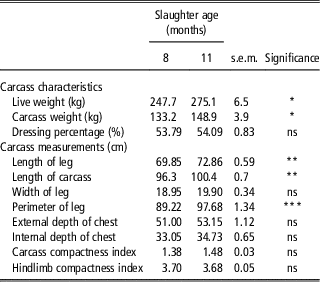
The influence of slaughter age on LW, carcass traits and morphometric measurements is shown in Table 1. LW, CW, LL, LC and PL were significantly affected by slaughter age. Animals slaughtered at 11 months of age (11 m) had higher (P<0.05) values of LW (275 kg) and CW (148 kg) than those slaughtered at 8 months of age (8 m) (247 and 133 kg for LW and CW, respectively). According to Polidori et al. (Reference Polidori, Pucciarelly, Ariani, Polzonetti and Vincenzetti2015), LW and CW increase in animals slaughtered at an older age. Therefore, as expected, the differences in LW and CW could be due to the fact that animals from the 11-m group were 3 months older than the animals from the 8-m group. The results obtained in the present study are similar those reported by Franco et al. (Reference Franco, Crecente, Vázquez, Gómez and Lorenzo2013) and Lorenzo et al. (Reference Lorenzo, Crecente, Franco, Sarriés and Gómez2014a) in foals receiving a finishing diet and slaughtered between 15 and 18 months of age (258 to 287 kg for LW and 132.8 to 152.2 kg for CW). However, Lorenzo et al. (Reference Lorenzo, Sarriés and Franco2013a) reported lower values of LW (184 to 194 kg) and CW (87.5 to 93.3 kg) in foals raised in an extensive production system in freedom regimen and slaughtered at 18 months of age. In contrast, recent studies in other foal breeds presented higher values of LW (between 320 and 568 kg) and CW (in all cases >250 kg) (Juárez et al., Reference Juárez, Polvillo, Gómez, Alcalde, Romero and Valera2009; Lanza et al., Reference Lanza, Landi, Scerra, Galofaro and Pennisi2009; De Palo et al., Reference De Palo, Maggiolino, Centoducati and Tateo2013 and Reference De Palo, Tateo, Maggiolino and Centoducati2014). These differences were mainly due to the difference in slaughter age, finishing diet (animals receiving a finishing diet presented more weight than animals fed only pasture) and also due to the use of specialized breeds for meat production.
Effect of slaughter age on carcass parameters of foals

Significance: ns: not significant; *P<0.05; **P<0.01; ***P<0.001.
Statistical analysis indicated that DP was not affected by slaughter age (53.79% and 54.09% from animals slaughtered at 8 and 11 months, respectively). These values are similar to those reported by Franco et al. (Reference Franco, Crecente, Vázquez, Gómez and Lorenzo2013) (52.8%) and Lorenzo et al. (Reference Lorenzo, Crecente, Franco, Sarriés and Gómez2014a) (54.16%) in foals finishing with 3 kg of commercial fodder and slaughtered between 15 and 18 months of age. Our values were lower than those found by Lanza et al. (Reference Lanza, Landi, Scerra, Galofaro and Pennisi2009) in Sanfratellano and Halfinger foals slaughtered at 18 months (59.3% and 59.6%, respectively) and De Palo et al. (Reference De Palo, Maggiolino, Centoducati and Tateo2013 and 2014) in Italian Heavy Draught Horse foals slaughtered between 6 and 18 months of age (70% to 73.9%).
Regarding morphometric measurements, foals slaughtered at 11 months of age presented higher values of LL (P<0.01; 19.9 cm), LC (P<0.01; 100.4 cm) and PL (P<0.001; 97.7 cm) than animals from the 8-m group (18.9, 96.3 and 89.2 cm for LL, LC and PL, respectively). The rest of the morphometric measurements did not show significant differences between the two groups. As it occurs in the weight of animals, some of the morphometric measurements (such as LL, LC and PL) also increased with age. The CCI (1.38 and 1.48 for animals from the 8- and 11-m groups, respectively) and hindlimb compactness index (HCI; 3.70 and 3.68 for animals from the 8- and 11-m groups, respectively) also showed no significant differences with an increase in slaughter age. As expected, our results agree with those of Franco et al. (Reference Franco, Crecente, Vázquez, Gómez and Lorenzo2013) (1.44 and 3.68 for CCI and HCI, respectively) and Lorenzo et al. (Reference Lorenzo, Crecente, Franco, Sarriés and Gómez2014a) (1.42 and 3.86 for CCI and HCI, respectively) in GM×HB foals finishing with 3 kg of commercial fodder and slaughtered between 15 and 18 months of age.
Meat quality
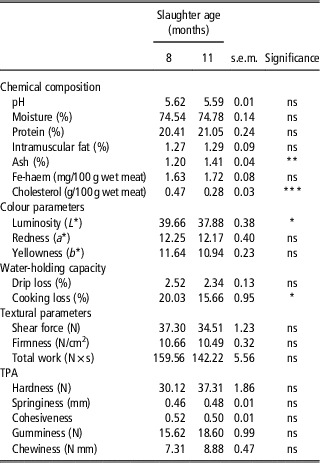
Physical and chemical proximate composition, colour, water-holding capacity and textural parameters of LD from foals are shown in Table 2. No significant differences were observed between animals from the 8 and 11-m groups in chemical composition, except for ash and cholesterol contents. The pH values (5.62 and 5.59), moisture content (74.54 and 74.78 g/100 g of wet meat from animals from the 8 and 11-m batches, respectively) and protein content (20.41 and 21.05 g/100 g of wet meat from animals of the 8 and 11-m batches, respectively) were similar to those obtained for foal meat in previous studies (Lanza et al., Reference Lanza, Landi, Scerra, Galofaro and Pennisi2009; Franco et al., Reference Franco, Crecente, Vázquez, Gómez and Lorenzo2013; Lorenzo et al. Reference Lorenzo, Sarriés and Franco2013a, Reference Lorenzo, Pateiro and Franco2013b and 2014a; Franco and Lorenzo, Reference Franco and Lorenzo2014).
Effect of slaughter age on chemical composition, colour parameters, water-holding capacity and texture of longissimus dorsi from foals

Significance: ns: not significant; *P<0.05; **P<0.01; ***P<0.001.
The intramuscular fat content (IMF) in the present study (1.27 and 1.29 g/100 g from animals of the 8 and 11-m batches, respectively) was higher than the content described by Franco et al. (Reference Franco, Rodríguez, Purriños, Crecente, Bermúdez and Lorenzo2011 and 2013), Lorenzo et al. (Reference Lorenzo, Sarriés and Franco2013a) and Franco and Lorenzo (Reference Franco and Lorenzo2014), who obtained IMF values below 0.6 g/100 g in all cases. Polidori et al. (Reference Polidori, Pucciarelly, Ariani, Polzonetti and Vincenzetti2015) also found no difference in the IMF content between foals sacrificed at 8 and 12 months of age, and described similar values (1.76% to 1.87%) to those found by us in the present study. Other authors (Juárez et al., Reference Juárez, Polvillo, Gómez, Alcalde, Romero and Valera2009; Mamani-Linares and Gallo, Reference Mamani-Linares and Gallo2011; De Palo et al., Reference De Palo, Maggiolino, Centoducati and Tateo2013 and Reference De Palo, Tateo, Maggiolino and Centoducati2014) found higher values of IMF in horsemeat (between 2.08 and 3.80 g/100 g). The higher content of IMF in these studies compared with ours may be attributed to genetics.
With regard to iron content, foal meat showed high bio-available amounts of this element (1.63 and 1.72 mg/100 g of meat in foals from the 8 and 11-m groups, respectively). Similar results were reported by Franco et al. (Reference Franco, Rodríguez, Purriños, Crecente, Bermúdez and Lorenzo2011) and Lorenzo et al. (Reference Lorenzo, Sarriés and Franco2013a and 2014a), with values ranging from 1.5 to 1.7 mg/100 g of meat.
Slaughter age had a significant effect (P<0.01) on ash content. Foals slaughtered at 11 months of age had the highest ash content (1.41% v. 1.20%). The values presented in this study agree with those reported by Lorenzo et al. (Reference Lorenzo, Sarriés and Franco2013a and Reference Lorenzo, Pateiro and Franco2013b), Franco and Lorenzo (Reference Franco and Lorenzo2014) and Lorenzo et al. (Reference Lorenzo, Crecente, Franco, Sarriés and Gómez2014a). In contrast, Polidori et al. (Reference Polidori, Pucciarelly, Ariani, Polzonetti and Vincenzetti2015) did not find differences in ash content between foals slaughtered at 8 or 12 months of age.
On the other hand, cholesterol content showed significant differences (P<0.001) between the animals from the 8 and 11-m groups. Foals slaughtered at 8 months of age had the highest values of cholesterol (0.47 v. 0.28 g/100 g of meat). These values were lower than those found in other studies in horsemeat (between 50 and 66 mg/100 g of meat) (Mamami-Linares and Gallo, Reference Mamani-Linares and Gallo2011; Lorenzo and Pateiro, Reference Lorenzo and Pateiro2013; Lorenzo et al., Reference Lorenzo, Sarriés and Franco2013a and Reference Lorenzo, Crecente, Franco, Sarriés and Gómez2014a). According to Lorenzo et al. (Reference Lorenzo, Sarriés, Tateo, Polidori, Franco and Lanza2014b), the amount of cholesterol in meat can vary widely depending on factors such as species, feeding, cut and cooking conditions. The fact that there are many factors that affect cholesterol content could explain the lower content found in the present study compared with others. In contrast, according to Polidori et al. (Reference Polidori, Pucciarelly, Ariani, Polzonetti and Vincenzetti2015), the slaughter age did not affect the cholesterol content.
Regarding colorimetric characteristics of foal meat, only luminosity (L*) was significantly (P<0.05) affected by slaughter age. Foals from the 8-m group presented higher L*-values (39.66) than foals from the 11-m group (37.88). Lorenzo et al. (Reference Lorenzo, Crecente, Franco, Sarriés and Gómez2014a) concluded that foals fed commercial fodder had lower L*-values than those fed only pasture, whereas Vestergaard et al. (Reference Vestergaard, Oksbjerg and Henckel2000) described lower meat L*-values in pasture-finished bulls compared with stall-finished bulls because of higher physical activity and muscle fibre characteristics. In addition, Franco et al. (Reference Franco, Crecente, Vázquez, Gómez and Lorenzo2013) and Franco and Lorenzo (Reference Franco and Lorenzo2014) found that L*-values increased with an increase in the amount of finishing diet. Pearson’s correlation test indicated that L*-values were negatively correlated with Fe-haeme content (r=−0.558; P<0.01). In this regard, Sarriés and Beriain (Reference Sarriés and Beriain2006) and Lorenzo et al. (Reference Lorenzo, Crecente, Franco, Sarriés and Gómez2014a) also found a negative correlation between L*-value and Fe-haeme.
Redness (a*; about 12) and yellowness (b*; about 11) values did not show differences between animals from the two groups; in another study, Polidori et al. (Reference Polidori, Pucciarelly, Ariani, Polzonetti and Vincenzetti2015) also did not observe differences in these parameters by increasing the amount of finishing diet. The L*, a* and b* values observed in the present study are in agreement with values reported by Lorenzo et al. (Reference Lorenzo, Crecente, Franco, Sarriés and Gómez2014a) in foals receiving a finishing diet.
Water-holding capacity and textural parameters are important for consumer decision-making, in order to provide an idea about meat quality, mainly in terms of juiciness and tenderness (Lorenzo et al., Reference Lorenzo, Crecente, Franco, Sarriés and Gómez2014a). DL was not affected by slaughter age, whereas CL was higher (P<0.05) in animals slaughtered at 8 months of age (20.03%) than foals slaughtered at 11 months of age (15.66%). Our values of CL agree with the values reported by Franco et al. (Reference Franco, Rodríguez, Purriños, Crecente, Bermúdez and Lorenzo2011), Franco et al. (Reference Franco, Crecente, Vázquez, Gómez and Lorenzo2013), Franco and Lorenzo (Reference Franco and Lorenzo2014) and Lorenzo et al. (Reference Lorenzo, Crecente, Franco, Sarriés and Gómez2014a) (values between 14% and 22%).
By analysing the textural parameters, differences were not noticeable between animals from the two groups. Our results are in agreement with those reported by Lorenzo et al. (Reference Lorenzo, Crecente, Franco, Sarriés and Gómez2014a). In contrast, Polidori et al. (Reference Polidori, Pucciarelly, Ariani, Polzonetti and Vincenzetti2015) found that older animals had higher values of shear force than younger animals. The shear force values observed in the present study (around 36 N) are higher than those described in foals by Franco et al. (Reference Franco, Crecente, Vázquez, Gómez and Lorenzo2013) and Franco and Lorenzo (Reference Franco and Lorenzo2014) (values between 27 and 33 N), whereas Tateo et al. (Reference Tateo, De Palo, Ceci and Centoducati2008), Lanza et al. (Reference Lanza, Landi, Scerra, Galofaro and Pennisi2009), Lorenzo et al. (Reference Lorenzo, Crecente, Franco, Sarriés and Gómez2014a) and Polidori et al. (Reference Polidori, Pucciarelly, Ariani, Polzonetti and Vincenzetti2015) reported higher values (between 47 and 62 N). Belew et al. (Reference Belew, Brooks, McKenna and Savell2003) suggested the following categories for beef steaks on the grounds of shear force measured using the WB test: very tender <31.7 N, tender from 31.7 to 38.3 N and intermediate from 38.3 to 45.1 N. According to this classification, foal meat shear force that was obtained in the present study implies that it belongs to the tender category.
Fatty acid profile
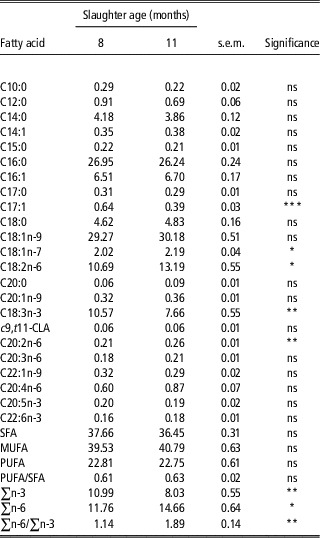
The effect of slaughter age on the fatty acid composition of the LD muscle of foals is shown in Table 3. Intramuscular fatty acid profile showed the prevalence of monounsaturated fatty acids (MUFA; 39.53 and 40.79 g/100 g of FAME in animals from the 8 and 11-m groups, respectively) followed by saturated fatty acids (SFA; 37.66 and 36.45 g/100 g of FAME in animals from the 8 and 11-m groups, respectively) and finally polyunsaturated fatty acids (PUFA; 22.81 and 22.75 g/100 g of FAME in animals from the 8 and 11-m groups, respectively). These results are in agreement with those reported by other authors for foal meat, as MUFAs are the predominant fatty acids in horsemeat from animals fed a finishing diet (Franco et al., Reference Franco, Crecente, Vázquez, Gómez and Lorenzo2013; Franco and Lorenzo, Reference Franco and Lorenzo2014; Lorenzo et al., Reference Lorenzo, Crecente, Franco, Sarriés and Gómez2014a). In contrast, other authors found SFAs as the predominant fatty acids in horsemeat (Sarriés et al., Reference Sarriés, Murray, Troy and Beriain2006; Juárez et al., Reference Juárez, Polvillo, Gómez, Alcalde, Romero and Valera2009; Lanza et al., Reference Lanza, Landi, Scerra, Galofaro and Pennisi2009; De Palo et al., Reference De Palo, Maggiolino, Centoducati and Tateo2013 and Reference De Palo, Tateo, Maggiolino and Centoducati2014; Polidori et al., Reference Polidori, Pucciarelly, Ariani, Polzonetti and Vincenzetti2015), whereas Lorenzo et al. (Reference Lorenzo, Sarriés and Franco2013a and 2014a) described PUFAs as the main fatty acids in foals fed only pasture. In the decreasing order of amount, the major fatty acids in the intramuscular fat were oleic (C18:1n-9; 29.27 to 30.18 g/100 g of FAME), palmitic (C16:0; 26.95 to 26.24 g/100 g of FAME), linoleic (C18:2n-6; 10.69-13.19 g/100 g of FAME) and α-linolenic (C18:3n-3; 10.57 to 7.66 g/100 g of FAME) acids. These findings are in agreement with those obtained by Franco and Lorenzo (Reference Franco and Lorenzo2014) and Lorenzo et al. (Reference Lorenzo, Crecente, Franco, Sarriés and Gómez2014a) for foal meat.
Effect of slaughter age on the fatty acid profile of longissimus dorsi from foals

SFA=saturated fatty acids; MUFA=monounsaturated fatty acids; and PUFA=polyunsaturated fatty acids.
SFA=∑ (C10:0+C12:0+C14:0+C15:0+C16:0+C17:0+C18:0+C20:0); MUFA=∑ (C14:1+C16:1+C17:1+C18:1n-9+C18:1n-7+C20:1n-9+C22:1n-9); PUFA=∑ (C18:2n-6+C18:3n-3+C20:2n-6+c9,t11-CLA+C20:2n-6+C20:3n-6+ C20:4n-6+C20:5n-3+C22:6n-3). Results expressed as g/100 g of total fatty acids.
Significance: ns: not significant; *P<0.05; **P<0.01; ***P<0.001
Increasing the slaughter age only modified five out of 23 fatty acids. Sum and individual SFA contents did not show differences between the two groups. Sum of MUFA contents also did not show significant differences between groups. However, the amount of cis-10-heptadecanoic acid (C17:1) was higher (P<0.001) in animals from the 8-m group (0.64 v. 0.39 g/100 g of FAME), whereas animals from the 11-m group had higher (P<0.05) amounts of cis-11-vaccenic acid (C18:1n-7; 2.19 v. 2.02 g/100 g of FAME). Finally, the major differences between the two groups of animals were obtained with regard to individual PUFA. C18:2n-6 contents increased (P<0.05; 10.69 v. 13.19 g/100 g of FAME), whereas the C18:3n-3 content decreased (10.57 v. 7.66 g/100 g of FAME), with an increase in slaughter age. Due to this fact, the sum of n-3, n-6 and the n-3/n-6 ratio was also affected by slaughter age. Animals from the 8-m group had the highest values of ∑n-3 (10.99 v. 8.03 g/100 g of FAME) and the lowest values of ∑n-6 (11.76 v. 14.66 g/100 g of FAME) and ∑n-6/∑n-3 ratio (1.14 v. 1.89). In addition, Polidori et al. (Reference Polidori, Pucciarelly, Ariani, Polzonetti and Vincenzetti2015) also found that foals slaughtered at 12 months of age had higher amounts of C18:2n-6 and lower amounts of C18:3n-3 than animals slaughtered at 8 months of age, although they did not observe significant differences.
Forages such as grass and clover contain a high proportion (50% to 75%) of C18:3n-3 (Dewhurst et al., Reference Dewhurst, Shingfield, Lee and Scollan2006), and its content in tissues is directly related to the dietary intake of the animal. The lower proportion of C18:3n-3 found in foals slaughtered at 11 months of age can be attributed to the reason that this group of animals had eaten more commercial fodder than foals from the 8-m group. Therefore, in the meat from animals from the 11-m group (fed during 6 months with a finishing diet), the fatty acids from grass were more intensely replaced by fatty acids from the commercial feed. The same trend was described by Franco et al. (Reference Franco, Crecente, Vázquez, Gómez and Lorenzo2013), Franco and Lorenzo (Reference Franco and Lorenzo2014) and Lorenzo et al. (Reference Lorenzo, Crecente, Franco, Sarriés and Gómez2014a). This is an expected result but not less important, because an increase in the proportion of C18:3n-3 in meat may be beneficial for human health, as it can prevent heart diseases (Sacks and Katan, Reference Sacks and Katan2002).
Finally, the ∑n-6/∑n-3 ratio should not exceed 4.0 (British Department of Health, 1994). In our study, the meat from both groups of animals was within the nutritional recommendations for human diet. Our results (1.14 and 1.89 from 8 and 11-m groups, respectively) were similar to those reported by Franco et al. (Reference Franco, Crecente, Vázquez, Gómez and Lorenzo2013), Lorenzo et al. (Reference Lorenzo, Sarriés and Franco2013a) and Franco and Lorenzo (Reference Franco and Lorenzo2014). In contrast, other authors reported in horsemeat less favourable values of this ratio. Sarriés et al. (Reference Sarriés, Murray, Troy and Beriain2006) described values between 8.0 and 15.56, Lanza et al. (Reference Lanza, Landi, Scerra, Galofaro and Pennisi2009) described values between 4.09 and 6.69 and De Palo et al. (Reference De Palo, Maggiolino, Centoducati and Tateo2013 and 2014) described values between 4.34 and 4.54.
Amino acid profile
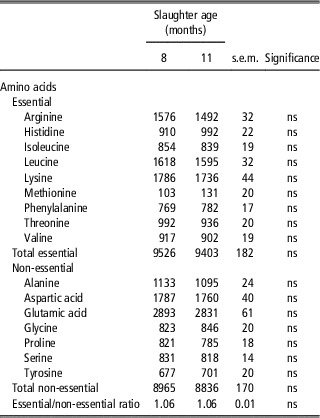
The hydrolysed amino acid content of foal meat, expressed as mg/100 g of wet tissue, is shown in Table 4. Arginine was included in the essential amino acids group, as done by Hoffman et al. (Reference Hoffman, Kritzinger and Ferreira2005), because arginine is considered a conditionally essential amino acid (Arienti, Reference Arienti2003). No statistically significant differences in amino acid contents were found between foals slaughtered at 8 and 11 months of age. These results agree with those reported by Polidori et al. (Reference Polidori, Pucciarelly, Ariani, Polzonetti and Vincenzetti2015), who also did not find differences between animals slaughtered at 8 or 12 months of age, and with results obtained by Lorenzo et al. (Reference Lorenzo, Crecente, Franco, Sarriés and Gómez2014a), who found no differences in amino acids between animals fed different amounts of fodder during the finishing period.
Effect of slaughter age on the amino acid profile (mg/100 g wet tissue) of longissimus dorsi from foals

Significance: ns: not significant; *P<0.05; **P<0.01; ***P<0.001.
Glutamic acid content was the highest in all samples (around 2800 mg/100 g of meat), representing 16% of the total amino acids, followed by aspartic acid, lysine and leucine with similar values (between 1595 and 1786 mg/100 g of meat), each representing between 8% and 10% of total amino acids. This profile was previously described in different foal muscles (Polidori et al., Reference Polidori, Cavallucci, Beghelli and Vincenzetti2009; Franco et al., Reference Franco, Crecente, Vázquez, Gómez and Lorenzo2013; Lorenzo and Pateiro, Reference Lorenzo and Pateiro2013; Lorenzo et al., Reference Lorenzo, Sarriés and Franco2013a; Franco and Lorenzo, Reference Franco and Lorenzo2014).
The essential amino acids that showed the highest concentration for both groups were lysine (around 1750 mg/100 g of meat), leucine (around 1600 mg/100 g of meat) and arginine (around 1500 mg/100 g of meat), representing about 18%, 17% and 16% of the total essential amino acids, respectively. The content of these amino acids was similar to those described by Polidori et al. (Reference Polidori, Cavallucci, Beghelli and Vincenzetti2009) (1630, 1510 and 1380 mg/100 g of meat for lysine, leucine and arginine, respectively) and Lorenzo et al. (Reference Lorenzo, Crecente, Franco, Sarriés and Gómez2014a) (1610, 1720 and 1560 mg/100 g of meat for lysine, leucine and arginine, respectively).
Glutamic acid, aspartic acid and alanine were the most abundant amino acids found in the non-essential fraction, representing a mean value of 32%, 20% and 12% of the total non-essential amino acids, respectively, whereas the lowest values were found for tyrosine (around 700 mg/100 g of meat) and proline (around 800 mg/100 g of meat), representing 7% to 9% of total non-essential amino acids. The same profile was previous described by Lorenzo et al. (Reference Lorenzo, Sarriés and Franco2013a) and Lorenzo et al. (Reference Lorenzo, Crecente, Franco, Sarriés and Gómez2014a), although these authors found slightly higher amounts (expressed as g/100 g of meat) of the aforementioned amino acids.
Finally, a particularly high essential/non-essential amino acid ratio (1.06 in both groups) was also recorded. In this case, we also did not find significant differences with respect to slaughter age. The values of the essential/non-essential ratio agree with those previously reported by Lorenzo and Pateiro (Reference Lorenzo and Pateiro2013), Lorenzo et al. (Reference Lorenzo, Sarriés and Franco2013a) and Lorenzo et al. (Reference Lorenzo, Crecente, Franco, Sarriés and Gómez2014a), whereas Badiani et al. (Reference Badiani, Nanni, Gatta, Tolomelli and Manfredini1997), Franco et al. (Reference Franco, Crecente, Vázquez, Gómez and Lorenzo2013) and Franco and Lorenzo (Reference Franco and Lorenzo2014) found lower values (0.8 to 0.9) than those obtained in the present study.
Conclusions
From the results obtained on carcass characteristics and meat quality, it can be concluded that slaughter age (between 8 and 11 months of age) had a very small effect or had no significant effect on the majority of carcass measurements, chemical composition, colour parameters, textural properties and amino acid content. LW, CW, LL and LC increased, whereas the cholesterol content decreased, with an increase in slaughter age. Regarding fatty acid content, only five out of 23 fatty acids showed differences between the two groups. It is interesting to note that animals slaughtered at 8 months of age presented higher values of α-linolenic acid than foals slaughtered at 11 months of age, which is an interesting fact from a health point of view.
Therefore, as a general conclusion, slaughter age had minimal effect on carcass measurements and meat quality, although foals slaughtered at 8 months of age had higher nutritional meat quality (with higher content of n-3 fatty acids) than meat from foals slaughtered at 11 months of age. In addition, the slaughter of animals at 8 months of age reduced production costs because they ate a smaller amount of commercial fodder.
Acknowledgements
The authors are grateful to Xunta de Galicia (The Regional Government) (Project 10MRU004CT) for the financial support.