Introduction
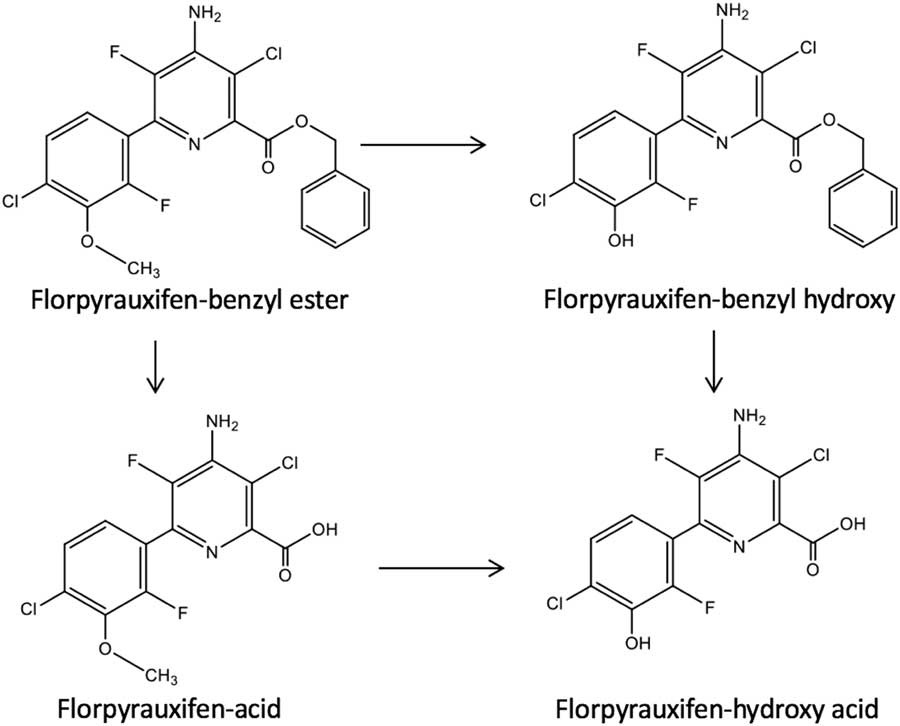
In the absence of effective sites of action, weeds such as barnyardgrass [Echinochloa crus-galli (L.) P. Beauv.], hemp sesbania [Sesbania herbacea (Mill.) McVaugh], and yellow nutsedge (Cyperus esculentus L.) continue to threaten rice (Oryza sativa L.) production systems. According to a recent survey, E. crus-galli is the most problematic weed in Arkansas rice, with S. herbacea and C. esculentus listed as the 7th and 8th most problematic weeds, respectively (Norsworthy et al. Reference Norsworthy, Bond and Scott2013). Florpyrauxifen-benzyl (Rinskor™ Active, Dow AgroSciences, Indianapolis, IN) is a new herbicide being developed for use in rice. It is a member of a new auxin herbicide family, arylpicolinate, and will provide a novel site of action in rice production (Epp et al. Reference Epp, Alexander, Balko, Buysse, Brewster, Bryan, Daeuble, Fields, Gast, Green, Irvine, Lo, Lowe, Renga, Richburg, Ruiz, Satchivi, Schmitzer, Siddall, Webster, Weimer, Whiteker and Yerkes2016). Structurally, florpyrauxifen-benzyl is composed of a highly substituted 4-amino-pyridine ring (4-amino-3-chloro-6-(4-chloro-2-fluoro-3-methoxyphenyl)-5-fluro-pyridine-2-benzel ester) that shares many characteristics with halauxifen-methyl (ArylexTM active, Dow AgroSciences), an active ingredient in many new herbicide products (Figure 1). Weeds treated with florpyrauxifen-benzyl typically exhibit auxin-like symptoms shortly after application, and molecular studies revealed the new herbicide exhibits strong binding affinity for auxin-signaling F-box proteins with preference for the AFB5-Aux/IAA co-receptor, instead of favoring TIR1, thus signifying its novelty compared with other synthetic auxin herbicides (Bell et al. Reference Bell, Schmitzer, Weimer, Napier and Prusinska2015; Jeschke Reference Jeschke2015a). Previous research has indicated that, in rice, the herbicide should be applied pre-flood to provide its full herbicidal benefits, suggesting that soil moisture has an impact on efficacy (H Miller, personal communication). For many rice producers, fields are flooded using a levee-based irrigation system, where water is introduced to the field at its highest point and flows across the field via gravitational flow through a series of gates and levees (Hardke Reference Hardke2014). Additional systems include zero grade, in which the field is precision leveled and the entire field is simultaneously flooded, and multiple inlet rice irrigation, another irrigation method becoming more common in Midsouth rice fields.
Florpyrauxifen-benzyl structure for the formulated benzyl ester parent and primary metabolites. Source: Dow AgroSciences LLC.

The influence of soil moisture on the activity of herbicides has been well documented (Ahmadi et al. Reference Ahamdi, Haderlie and Wicks1980; Hinz and Owen Reference Hinz and Owen1994; Levene and Owen Reference Levene and Owen1995; Moyer Reference Moyer1987; Peregoy et al. Reference Peregoy, Kitchen, Jordan and Griffin1990; Zhang et al. Reference Zhang, Webster and Selim2001). Green and Obien (Reference Green and Obien1969) concluded that soil moisture impacted herbicidal activity for soil-applied herbicides with low adsorptive characteristics. For soil-applied herbicides, characteristics such as solubility, soil organic carbon–water partitioning coefficient (Koc), and half-life are typically used as a means of indication for activity. The chemical characteristics for florpyrauxifen-benzyl relative to other auxin herbicides used in rice are quite different. Triclopyr (Grandstand® herbicide, Dow AgroSciences), a POST option in flooded rice, is highly water soluble (430 ppm L−1), is loosely bound to soil (Koc, soil organic carbon-water coefficient=20 mg L−1), and has a DT50 (half-life) in soil ranging from 10 to 46 d (Vencill Reference Vencill2002). Florpyrauxifen-benzyl, however, has low water solubility (0.015 ppm L−1), is tightly bound to soil (32,400 ml g−1), and has a DT50 in soil of 1 to 8 d in field-dissipation studies (M Weimer, personal communication). These characteristics are an indication that florpyrauxifen-benzyl would likely have limited soil activity and would primarily behave as a foliar herbicide.
Soil moisture can also have a significant impact on the efficacy of foliar-applied herbicides. Research conducted on glyphosate, one of the most popular foliar-applied herbicides in the world, found a significant reduction in junglerice [Echinochloa colona (L.) Link] control with glyphosate applied under dry compared with moist soil conditions (Tanpipat et al. Reference Tanpipat, Adkins, Swarbrick and Boersma1997). Additional research has reported similar occurrences. In one such example, Boydston (Reference Boydston1990) found low soil moisture to reduce the effectiveness of sethoxydim on green foxtail [Setaria viridis (L.) P. Beauv.]. In another report, glyphosate control of common milkweed (Asclepias syriaca L.) was reduced under low soil moisture conditions as a result of a decrease in absorption and translocation (Waldecker and Wyse Reference Waldecker and Wyse1985).
With the introduction of a new active ingredient into rice production, understanding the extent to which soil moisture impacts herbicidal efficacy will be critical in the development of effective use patterns, especially in dry-seeded rice. It was hypothesized that florpyrauxifen-benzyl absorption, translocation, and metabolism would differ across soil moisture treatments. The objectives of this research were to (1) evaluate whether soil moisture status would impact absorption and translocation of florpyrauxifen-benzyl and (2) determine whether metabolism of florpyrauxifen-benzyl would differ across soil moisture regimes.
Materials and Methods
Absorption and Translocation
A greenhouse experiment was conducted and repeated during the fall of 2016 at the University of Arkansas Altheimer Laboratory in Fayetteville, AR. The experiment was conducted to evaluate the effect of soil moisture on absorption and translocation of florpyrauxifen-benzyl. Preliminary field studies indicated that soil moisture had some impact on the efficacy of the herbicide, especially when soil moisture conditions were extreme (i.e., very dry or very wet). Weeds evaluated included E. crus-galli, S. herbacea, and C. esculentus. These weeds were selected due to their problematic nature in rice production as well as to gain information on a grass, broadleaf, and sedge species respectively. Seed or tubers from each species were sown in individual pots in a greenhouse with 32/22 C day/night temperatures and later thinned to 1 plant pot−1. The soil included a Leaf silt loam (fine, mixed, active, thermic Typic Albaquults) containing 1.8% organic matter and with a pH of 6.1.
To achieve accurate soil moisture regimes, a soil moisture retention curve was developed and used to determine the gravimetric moisture tension of the soil. The soil moisture content measured 30% at field capacity. The experiment was run twice and was arranged as a completely randomized design with a two-factor factorial treatment structure and three replications. The first factor consisted of the weed species, with either E. crus-galli, S. herbacea, or C. esculentus subjected to the herbicide and soil moisture conditions. The second factor included the two moisture regimes, in which the soil moisture was either maintained saturated at 60% (2 times field capacity) or 7.5% (0.25 times field capacity). These soil moisture treatments were specifically selected to determine whether differences existed between drastically different soil moisture conditions. Soil moisture regimes were imposed after plant thinning but before herbicide application for a period of ≥4 d. The plant material was harvested either 0 or 48 h after treatment. Nonlabeled herbicide treatments of florpyrauxifen-benzyl at 30 g ai ha−1 were applied POST at the 3- to 4-leaf growth stage to all weed species to simulate an early-POST or pre-flood application timing in rice. Applications were made inside a stationary spray chamber with a two-nozzle boom track sprayer fitted with flat-fan 800067 nozzles (TeeJet® Technologies, Springfield, IL) calibrated to deliver 187 L ha−1 at 276 kPa. Herbicide treatments also contained 1% v/v methylated seed oil concentrate (MSO concentrate with LECI-TECH, Loveland Products, Loveland, CO).
Following the nonlabeled application, treated plants were moved into a dedicated 14C laboratory, where four 1-μl droplets, each containing 0.416 kBq of [14C]florpyrauxifen-benzyl and MSO, were applied evenly across the adaxial leaf surface of the most mature leaf, which was covered during the time of application, using a repetitive microsyringe. Two droplets were placed on one side of the midrib and two were placed on the other side, resulting in approximately 1.66 kBq applied to each treated leaf. Immediately after spotting, half of the plants were dissected into four sections (treated leaf, area above the treated leaf, area below the treated leaf, and roots). Each plant section was rinsed with 5 ml of a 50/50 deionized water/methanol solution by placing the plant section in a 20-ml scintillation vial, gently swirling, and then removing the section. Following the wash, 10 ml of scintillation cocktail (Ultima GoldTM, PerkinElmer, Waltham, MA) was added to the 5-ml wash solution. Concurrently, the remaining plants were returned to the greenhouse, and soil moisture treatments were maintained. These plants were later collected at 48 h after treatment for the same dissection process as previously outlined. This timing was selected based on the results of Epp et al. (Reference Epp, Alexander, Balko, Buysse, Brewster, Bryan, Daeuble, Fields, Gast, Green, Irvine, Lo, Lowe, Renga, Richburg, Ruiz, Satchivi, Schmitzer, Siddall, Webster, Weimer, Whiteker and Yerkes2016). After each plant was segmented, samples were placed in an oven at 30 C for 96 h. Samples were then oxidized in a biological oxidizer (OX-500, R.J. Harvey Instrument, Tappan, NY) to assess the radioactivity present within the tissues of the separated plant parts by trapping the 14CO2 in a scintillation cocktail. Treated leaf wash and oxidized samples were analyzed for the presence of radioactivity in a liquid scintillation analyzer (Tri-Carb 2900TR Liquid Scintillation Analyzer, PerkinElmer). Absorption of applied [14C]florpyrauxifen-benzyl was calculated as a percentage of the amount recovered. Translocation of the herbicide within the plant was based on the total amount absorbed divided by the amount detected in each plant section.
Metabolism
Plants used in the metabolism experiment were produced using the same procedure as outlined in the absorption and translocation experiment. Once plants reached the 3- to 4-leaf growth stage, four 0.2086 μg μl−1 droplets of a florpyrauxifen-benzyl were applied evenly across the adaxial leaf surface using a 1-μl repetitive microsyringe. The solution used for the droplets was the same concentration that would occur in a typical florpyrauxifen-benzyl 30 g ai ha−1 spray solution and contained the appropriate adjuvant load (1% v/v MSO). Two droplets were placed on one side of the midrib and two on the other side, resulting in 0.8345 μg of florpyrauxifen-benzyl active ingredient applied to each treated leaf. At the 48-h harvest time, the treated leaf from each plant was then sectioned and placed in a 15-ml tube to be freeze-dried (Botanique model 18DX48SA, Botanique Preservation Equipment, Phoenix, AZ) at −30 C for 72 h to cease further metabolic activity within the plant tissue.
For the extraction, samples were transferred into 50-ml centrifuge tubes, and 20 ml of extraction solution (90/10 acetonitrile/0.1 N HCL) was added to each tube. Each sample was homogenized for 60 s using a 10-mm probe in a Tomtec homogenizer (Tomtec Autogizer, 701 series, Hamden, CT). To extract any remaining herbicide residue from the treated leaf, samples were placed on a flatbed shaker for 60 min at approximately 180 excursions min−1. Samples were then centrifuged for 5 min at 2,000 rpm, and an aliquot of 2 ml was collected from each sample and placed into a 16 by 100 mm culture tube where 50 μl of a 10/90 glycerol/methanol solution and 100 μl of 0.01 μg ml−1 internal standard were added. Immediately afterward, the samples were evaporated using an automated evaporation system (TurboVap®, Biotage USA, Charlotte, NC) until approximately 200 to 300 μl remained and were then reconstituted with 1 ml of 50/50 acetonitrile/methanol and volume adjusted to 2 ml using water containing 0.1% formic acid. Instrumentation used for analysis of the parent molecule and primary metabolites included: Agilent 1290 Infinity LC System, AB SCIEX API 6500 LC/MS/MS System with a Phenomenex Kinetiex 2.6u, PFP 100A column (Agilent Technologies, Santa Clara, CA). Absorption of applied florpyrauxifen-benzyl was calculated as a percentage of the treated leaf.
Statistical Analyses
For both experiments, data were subjected to ANOVA using the MIXED procedure in JMP (JMP v. 12, SAS Institute, Cary, NC). Weed species and soil moisture were analyzed as fixed effects, while experimental run and replication nested within experimental run were random effects. Where the ANOVA indicated significant differences, means were separated with Fisher’s protected LSD (α=0.05).
Results and Discussion
Absorption
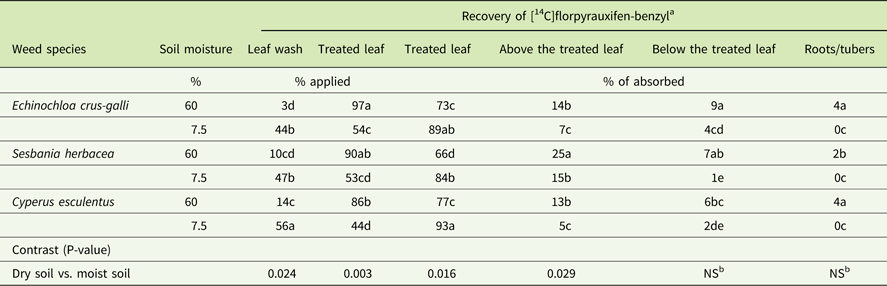
A significant two-way interaction (P≤0.05) for the weed species evaluated and soil moisture regime was observed (Table 1). Very little of the radiolabeled herbicide was absorbed in any of the species at 0 h after application (≤4%) (unpublished data). As a consequence, most of the herbicide applied was recovered in the treated leaf wash at 0 h after application. At 48 h after application, 97%, 90%, and 86% of the applied [14C]florpyrauxifen-benzyl was absorbed into the treated leaf of E. crus-galli, S. herbacea, and C. esculentus, respectively (Table 1). It was mentioned previously that preliminary field research on this herbicide has indicated that it performs better when applied immediately before flooding, indicating that herbicidal efficacy will likely improve with the addition of soil moisture close to the time of application. Evidence of this occurrence was observed via contrast statements, which revealed greater absorption of [14C]florpyrauxifen-benzyl into the treated leaf of all weed species under moist versus dry soil conditions (Table 1). Similarly, the absorption of [14C]florpyrauxifen-benzyl into the treated leaf at 48 h after application was the greatest in all three weed species under the 60% soil moisture regime. This result thereby confirms that soil moisture can play a significant role in herbicide absorption in species in which the herbicide is typically efficacious.
Influence of weed species and soil moisture on foliar absorption and translocation of [14C]florpyrauxifen-benzyl, averaged across experimental runs 48 h after application.

a Means within a column followed by different letters are significantly different according to Fisher’s protected LSD (α=0.05).
b NS, not significant according to orthogonal contrast.
Translocation
Based on the amount of [14C]florpyrauxifen-benzyl absorbed into the treated leaf, S. herbacea had the highest amount of translocation to plant tissue above the treated leaf (25%) when subjected to 60% soil moisture content (Table 1). In addition, 14% and 13% of the radiolabeled herbicide translocated to the area above the treated leaf for E. crus-galli and C. esculentus, respectively, when subjected to the same soil moisture treatment. All other treatments translocated less [14C]florpyrauxifen-benzyl to the area above the treated leaf. For the area below the treated leaf, E. crus-galli and S. herbacea translocated 9% and 7% of the herbicide, respectively, while only 6% translocated in C. esculentus under the 60% soil moisture treatment. This amount of translocation would be expected for E. crus-galli, being that it is a monocot with its meristematic tissue remaining at or near the soil line until reproductive growth stages (Mitich Reference Mitich1990). Very little of the herbicide translocated to the root portion of the three weed species with only 4%, 2%, and 3% recovered from E. crus-galli, S. herbacea, and C. esculentus, respectively, under 60% soil moisture.
Most of the [14C]florpyrauxifen-benzyl applied remained in the treated leaf (73%, E. crus-galli; 66%, S. herbacea; 77%, C. esculentus) under high-moisture conditions (Table 1). However, the total amount of translocation out of the treated leaf (sum of recovered percentages including: area above, below, and roots/tubers) for E. crus-galli, S. herbacea, and C. esculentus added up to 27%, 34%, and 23%, respectively, under the high-moisture regime. This amount of translocation appears to be consistent with other auxinic rice herbicides that have systemic activity, such as 2,4-D and quinclorac. Shultz and Burnside (Reference Shultz and Burnside1980) reported that 31% of [14C]2,4-D was translocated in the broadleaf species hemp dogbane (Apocynum cannabinum L.) at 3 d after application. In a similar study, 33% translocation of [14C]2,4-D was observed in Canada thistle [Cirsium arvense (L.) Scop.] (Turnbull and Stephenson Reference Turnbull and Stephenson1985). Furthermore, Lovelace et al. (Reference Lovelace, Talbert, Hoagland and Scherder2007) found that 33% of [14C]quinclorac translocated out of the treated leaf of a susceptible E. crus-galli biotype. Under dry soil conditions, total translocation out of the treated leaf for E. crus-galli, S. herbacea, and C. esculentus added up to 11%, 16%, and 7%, respectively.
Even with significant translocation, other plant compounds or hormones are also likely being expressed, causing the visible basal swelling and callus production typically observed in the field following florpyrauxifen-benzyl applications (Bell et al. Reference Bell, Schmitzer, Weimer, Napier and Prusinska2015; Epp et al. Reference Epp, Alexander, Balko, Buysse, Brewster, Bryan, Daeuble, Fields, Gast, Green, Irvine, Lo, Lowe, Renga, Richburg, Ruiz, Satchivi, Schmitzer, Siddall, Webster, Weimer, Whiteker and Yerkes2016). It is also important to consider that the amount of translocation will vary according to various factors such as temperature, weed species, and proximity to sink tissue (Devine et al. Reference Devine, Duke and Fedtke1993; Price and Hutchings Reference Price and Hutchings1992; Price et al. Reference Price, Marshall and Hutchings1992). While these data only provide a limited view into the physiological processes impacted, they do highlight that soil moisture can influence absorption and translocation of florpyrauxifen-benzyl.
Metabolism
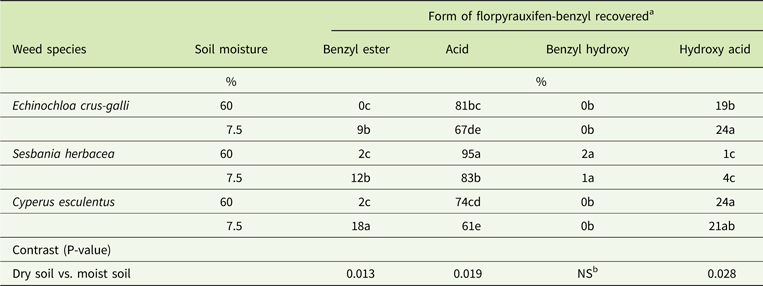
Data from the absorption and translocation experiment indicated that most of the herbicide applied remained in the treated leaf; therefore, metabolism data will only be discussed for the treated leaf. Similar to the absorption and translocation experiment, the ANOVA indicated a significant two-way interaction between the weed species evaluated and soil moisture regime for metabolism of florpyrauxifen-benzyl (Table 2). For the benzyl ester, low amounts were recovered at 48 h after application (≤18%) for all weed species regardless of soil moisture, signifying the conversion of the parent into the various metabolites within the leaf tissue. This result was expected, as the benzyl ester is the applied form of the herbicide. Being that florpyrauxifen is an auxin mimic and a proherbicide, previous research has indicated that it can be metabolically converted in weeds through enzymatic hydrolysis into its active acid form (Jeschke Reference Jeschke2015b; Epp et al. Reference Epp, Alexander, Balko, Buysse, Brewster, Bryan, Daeuble, Fields, Gast, Green, Irvine, Lo, Lowe, Renga, Richburg, Ruiz, Satchivi, Schmitzer, Siddall, Webster, Weimer, Whiteker and Yerkes2016). Therefore, one would expect to find less of the benzyl ester form of the herbicide at 48 h after application due to its being metabolized by the weed.
Influence of weed species and soil moisture on metabolism of florpyrauxifen-benzyl in the treated leaf, averaged across experimental runs 48 h after application.

a Means within a column followed by different letters are significantly different according to Fisher’s protected LSD (α=0.05).
b NS, not significant according to orthogonal contrast.
For each of the weed species evaluated, significantly more of the acid (active form of the herbicide) was recovered when the plant was subjected to 60% compared with 7.5% moisture content (Table 2). This signifies that within a relatively short period of time (48 h), weeds are able to absorb the herbicide, and higher soil moisture will likely result in increased conversion of the benzyl ester into the active acid form of the herbicide. Consequently, this occurrence could lead to increased efficacy. Very little of the benzyl hydroxyl, nonherbicidal metabolite was recovered across the entire experiment, and no significant differences were observed among the two soil moisture treatments (P ≥ 0.05). For the hydroxy acid, another nonherbicidal metabolite, E. crus-galli and C. esculentus contained the highest amount at 48 h after treatment, regardless of soil moisture regime. In contrast, S. herbacea contained very little of the metabolite across either harvest time or soil moisture, likely due to the large amount of conversion to the acid.
Overall, a significantly greater amount of the parent and each of its primary metabolites, with the exception of the benzyl hydroxyl metabolite, were recovered under saturated (60% soil moisture content) versus dry (7.5% soil moisture content) soil across all weed species (P≤0.05) (Table 2). As mentioned previously, these data only provide a limited perspective into the physiological processes being affected. However, this research does highlight that soil moisture conditions have a significant impact on metabolism of florpyrauxifen-benzyl and can therefore play a significant role in conversion of the herbicide into its active form.
Conclusions and Practical Implications
This research suggests that for E. crus-galli, S. herbacea, and C. esculentus, soil moisture can play a significant role in the absorption, translocation, and metabolism of florpyrauxifen-benzyl, as observed with various other POST-applied herbicides (Boydston Reference Boydston1990; Tanpipat et al. Reference Tanpipat, Adkins, Swarbrick and Boersma1997; Waldecker and Wyse Reference Waldecker and Wyse1985). Florpyrauxifen-benzyl absorption, translocation, and metabolism improved under the higher soil moisture condition in these studies. For rice producers who choose to adopt this new herbicide, it would appear that for optimal absorption and translocation, soil moisture should be near or above field capacity close to the time of application. With an anticipated pre-flood application timing, flooding shortly after application would also seem to be a recommended practice to increase weed uptake, translocation, and metabolism of the herbicide. In addition to flooding, it is not uncommon for rice producers in the southern United States to irrigate their fields before establishing a flood in order to maintain optimum soil moisture (Hardke Reference Hardke2014). This practice would also likely result in soil moisture conditions conducive for florpyrauxifen-benzyl to achieve its full herbicidal potential. It is important to note that the outcomes from this research, while significant, only evaluated three weed species under two soil moisture regimes. Further research should be performed on many other weed species, under different soil types, and over more time intervals.
Acknowledgments
Funding for this research was provided by the Arkansas Rice Promotion Board and Dow AgroSciences. No conflicts of interest have been declared.