Early-modern strategies for addressing serious crime in England centred around the twin pillars of a reliance on the public to police their communities and prosecute any crimes which took place, and the use of the ultimate sanction of the death penalty to deter people from committing crime.Footnote 2 Both pillars had their limitations, however. A reluctance to execute too many convicts and concerns that the death penalty failed to deter crime led to the development, from the late seventeenth century, of the secondary punishments of transportation and imprisonment,Footnote 3 while for a variety of reasons victims and witnesses of serious crime (felonies) frequently failed to prosecute, despite their legal obligations. Instead, they chose informal methods for dealing with the culprit (or simply ignored the crime). When, around the turn of the eighteenth century, awareness grew via the medium of print of the amount of serious crime which went unprosecuted, the English state was pressed into action. Starting in 1692, substantial rewards were offered for the prosecution to conviction of those who committed some of the most threatening crimes, including robbery and burglary. While official rewards had been offered before, the size and duration of the statutory and proclamation rewards paid out in the ensuing decades was unprecedented.Footnote 4
This article assesses the impact of this major innovation, which lasted for over a century before the final abolition of statutory rewards in 1818. We argue that, in a combination of intended and unintended consequences, the rewards system undermined the twin pillars of early-modern criminal justice. The rewards which stimulated so many capital convictions came to be labelled as ‘blood money’, and they added to growing doubts about the use of the ‘bloody code’ (a term used by historians, and early nineteenth-century reformers, to refer to the body of statutes which mandated the death penalty for a wide range of offences). Moreover, the practice of the state paying for the costs of apprehending and prosecuting criminals contributed to the development of modern forms of policing and, paradoxically given that victims were principal initial beneficiaries of rewards, their long-term marginalisation in criminal justice.Footnote 5 By the end of the eighteenth century reformers called for a centralised police force and the creation of public prosecutors, further steps in the evolution of a system in which the state, not the victim, would eventually acquire the power to determine which criminals would be prosecuted.Footnote 6
Following the Revolution of 1688, two developments facilitated the new system of rewards.Footnote 7 A large increase in printed publications, dating from earlier in the century but further stimulated by the abolition of prepublication censorship in 1695, included extensive reporting of crimes in London and led to increasing public and official concerns about the growth of crime.Footnote 8 Concurrently, parliament began to meet regularly, allowing more legislation to be passed in response to pressing concerns. As well as offering rewards for the conviction of criminals, parliamentary statutes created new capital offences (adding to the bloody code) to deter potential offenders and revised and introduced new secondary punishments.Footnote 9
The rewards statutes, together with later royal proclamations, offered financial incentives to anyone (not just victims) who apprehended certain types of the most threatening criminals, and prosecuted them to conviction. In 1692, the first statute offered a £40 reward for the prosecution of highway robbers. As the preamble explained,
the Highways and Roads within the Kingdom of England and Dominion of Wales have been of late time more infested with Thieves and Robbers than formerly for want of due and sufficient encouragement given and means used for the discovery and apprehension of such Offenders…
Therefore, a £40 reward was offered to ‘all and every person and persons who shall apprehend and take One or more such Thieves or Robbers and prosecute him or them so apprehended and taken until he or they be convicted’.Footnote 10 As explained below, rewards were typically divided up between several beneficiaries. Significantly, this statute focused not simply on encouraging victims or witnesses to take action (clearly, they had been failing to do so), but its provisions were targeted at anyone who was willing to detect, apprehend, and prosecute the culprits. This was a government initiative which used the incentive of private interest to motivate, or circumvent, inactive victims.
Further statutes offered £40 rewards for the prosecution of counterfeiters and clippers of coins (1695); burglars and housebreakers (1706); and those who returned from transportation before the expiry of their sentence (1743). A statute in 1741 provided £10 rewards for convictions for the theft of sheep or cattle.Footnote 11 In 1720 another statute clarified that all the streets in London and other cities were to be considered highways, and thus eligible under the 1692 statute (though they almost certainly already were), and, in a significant escalation of incentives, a royal proclamation offered £100 rewards ‘for the encouragement of all persons to be diligent and careful in endeavouring to discover and apprehend’ and convict those who committed robberies on the public streets (the ‘highways’) within a five mile radius of the centre of London. These proclamation rewards were time-limited, but a series of further proclamations meant they were in effect for most of the time until June 1752.Footnote 12 From 1720, therefore, one could earn a share of the massive sum of £140 for the conviction of a highway robber in London. These rewards were in addition to those occasionally offered by local authorities, private bodies, and private citizens.Footnote 13
Although rewards were divided between a median of seven beneficiaries per reward, as discussed below, the sums were sufficient to motivate individuals to act. The median value of rewards was £8 for the £100 rewards and £3 15s. for the £40 rewards (many rewardees received both). These were substantial sums even for the middling sort, whose cost of living was between one and a few hundred pounds a year, and could represent a considerable windfall for an artisan family, whose expenses totalled approximately £40 per year.Footnote 14 As we will see, few people received sufficient rewards to make a living from the practice of detecting, arresting and prosecuting criminals, but even one or two rewards would have provided significant financial benefits for most people at the time.
The impact of the payment of substantial sums of money by central (as opposed to local) government in the eighteenth century on domestic policing and prosecution was unprecedented.Footnote 15 This major government intervention lasted intermittently until 1752 in the case of the £100 proclamation rewards and continuously to 1818 for the £40 statutory rewards, when they were abolished, owing to concerns–also voiced in 1752–that rewards encouraged perjury, and led juries to be disinclined to convict.Footnote 16 This article will argue that these rewards, which were routinely paid out upon convictions, significantly shaped patterns of criminal prosecutions and verdicts, and thus the judicial record historians rely on for the study of crime. Moreover, while victims remained key actors, rewards encouraged others to become more active in policing and prosecution, and the resulting executions contributed to a crisis of faith in the merits of capital punishment. Historians have for too long focused their attention on the corrupt practices of some of the beneficiaries of these rewards, so-called ‘thief-takers’, arguably neglecting far more important consequences of this new policy.
1. Historiography and methodology
One of the principal themes in the history of eighteenth-century criminal justice is the considerable reluctance, as implied in the preamble to the statute cited above, of victims to report and prosecute crime: victims exercised discretion in their choices of how to respond to crime. With the exception of their award to thief-takers (discussed below), the use of rewards to incentivise prosecutions has yet to be the subject of significant historical research.Footnote 17 Our interest in this subject was prompted by recent research on two topics. First, recent criminological and historical interest has focused on the long-term marginalisation of victims in the English courts, influenced by modern campaigns to enhance and enforce victims’ ‘rights’. This has prompted research into how victims came to play such a minor role in the prosecution of crime.Footnote 18 Second, historians have identified victims’ frequent failure in the eighteenth century to prosecute crime despite their legal obligation in the case of felonies to do so. Only a small proportion of the crimes recorded in diaries and correspondence actually led to prosecutions, despite the fact that anyone who witnessed a felony was legally required to attempt to arrest the felon and report the crime, and, if bound over by a magistrate, to appear in court to prosecute.Footnote 19 The many reasons victims chose not to prosecute include the difficulty and time involved in locating the culprits at a time when policing agents were rarely proactive, the court costs involved in pursuing formal legal action, and concerns about the repercussions of a successful prosecution. Some victims were subject to pressure to resolve disputes informally within the community and worried about retribution, and, in the case of capital convictions, did not want to be held responsible for the execution of the defendant, particularly if s/he were young, or a person of status or reputation in the community.Footnote 20 Consequently, if they did report and prosecute the crime, some victims framed the offence as a non-capital charge. But more often victims preferred informal methods of resolving criminal complaints or no action at all. The rewards system was a government intervention which was meant to address these omissions, and an examination of its impact sheds light on the early stages of the marginalisation of the victim in English criminal justice.
Thief-takers, who often arranged for the return of stolen goods to victims for a fee, have long been a subject of interest to historians. As private businessmen, thief-takers were essentially ‘broker[s] between the worlds of authority and crime’.Footnote 21 They had long existed before the 1692 statute and subsequent measures, but their practices were significantly encouraged by the offer of such generous rewards, much larger than any fees they had earlier received from victims, which provided them with a substantial additional source of revenue. In addition, the possibility of arresting thieves and obtaining a reward gave thief-takers the ability to control thieves by holding the threat of an arrest and prosecution over them, a threat they often carried out. Most famously, Jonathan Wild, the self-proclaimed ‘thief-taker general of Great Britain & Ireland’, both operated a substantial ‘office’ for the return of lost property and was responsible for the prosecution of as many as one hundred and fifty thieves between 1714 and 1724.Footnote 22 That Wild, who met his doom in 1725 when the authorities finally tired of his corrupt practices, represented only the most active of a number of thief-takers who operated in London from the 1690s throughout at least the first half of the eighteenth century is evident from the work of Tim Wales, John Beattie, Ruth Paley and Heather Shore.Footnote 23 The overwhelming theme in these studies is that of corruption, in which thief-takers colluded by turns with victims, thieves and the state to profit from both the illegal acceptance of informal rewards from victims for returning their stolen goods (without prosecution) and the turning over of a regular supply of criminals to the courts in pursuit of the much more substantial legal rewards. Most egregiously, some thief-takers, including Wild in the early 1720s and Stephen McDaniel's gang of thief-takers in 1754, turned thief-makers, who staged crimes and arranged for the conviction of innocent men to obtain the rewards. As Ruth Paley argued, through their practices of perjury, extortion and blackmail, the McDaniel gang turned ‘the legal system into what was, in effect, a sophisticated offensive weapon’.Footnote 24
This focus on corruption, however, has constrained our understanding of the impact of the rewards, which was much wider than historians initially recognised. Beattie, who studied the distribution of £100 rewards in London from 1720–50, noted the presence of perjury, but also demonstrated how the practice of thief-taking, along with the evident limitations of the rewards system, contributed to Henry and John Fielding's creation of the Bow Street Runners, important forerunners of modern detective policing.Footnote 25 In addition, John Langbein showed that the presence of thief-takers in the courtroom prompted judges to accept the participation of defence counsel in London trials. This was closely followed by the appearance of counsel for the prosecution in some trials, a development which would fundamentally transform the conduct of English criminal trials.Footnote 26 Largely neglected to date is the wider impact of the substantial amount of money paid out on patterns of policing, criminal prosecution and punishment.
The rewards system, however, is not a straightforward object of study. Like many official practices, the best records the central government kept were of the money spent, in this case derived from the claims made by sheriffs for reimbursement for rewards paid out, recorded in the Treasury Warrant Books, Sheriffs’ Cravings (requesting the reimbursement of payments to rewardees, among other expenses) and reward certificates (showing how the rewards were divided between rewardees). These financial records can be linked to the judicial records of trials, where both survive. Some orders concerning the distribution of individual rewards also survive in local court records. The volume of relevant records is thus enormous but dispersed, and survival is patchy. It was therefore necessary to construct a carefully defined sample of the surviving evidence, designed to combine chronological and geographical breadth with in-depth examination of some of the most detailed records. To obtain a picture of the number of awards issued over time, we have examined the warrant books, which document the payment of £40 rewards, for crimes prosecuted in the whole country for three key five-year periods: 1727–1731, 1748–1752, and 1780–1784.Footnote 27 These were times of ‘crime waves’, when the impetus for prosecution was greatest. The first period provides evidence of the extent of thief-taking following the demise of Jonathan Wild. The second allows us to assess the initial impact of the creation of the Bow Street Runners, while 1780–84 examines the use of £40 rewards following the end of the £100 proclamation rewards, at a time of penal crisis when the highest levels of criminal prosecutions and executions in the whole century magnified the impact of the rewards.Footnote 28 With a few exceptions, the records of £40 rewards cover the whole country, though few of these records include the names of all the rewardees. The latter can be found more systematically in the records of the £100 proclamation rewards in London. We have examined the surviving reward certificates and court orders for these rewards (supplemented by a smaller number of £40 rewards) for 1728–1733 and 1748–1752, which enabled us to identify all the recipients of portions of rewards for a significant number of cases.Footnote 29 Our focus is on the three offences with identifiable victims for which a substantial number of rewards were issued: highway robbery, burglary, and housebreaking.
To assess the relationship between the distribution of rewards and patterns of prosecutions we have linked them to available court records. For London, where prosecutions of serious crimes took place at the Old Bailey courthouse, we have compared them to the Old Bailey Proceedings, a virtually comprehensive record of prosecutions for serious crimes in London which also includes edited accounts of the trial proceedings. We have also used the statistics facility of the Old Bailey Proceedings Online to analyse broader patterns of prosecutions for the relevant offences throughout the whole period of the statutory rewards, from the late seventeenth to the early nineteenth century.Footnote 30 For outside London, we have compared the rewards evidence with the Western Circuit Assizes gaol books for prosecutions in the counties of Cornwall, Devon, Dorset, Hampshire, Somerset and Wiltshire. Since these manuscript records are not sufficiently detailed to warrant extensive analysis, we have focused only on the mid-century period (1748–1752).Footnote 31
Overall, we have examined records of 2,251 £40 and £100 rewards issued, and 588 men and women who benefitted from portions of the rewards, a sufficiently large sample to draw significant conclusions on their use. We have contextualised these cases by comparing them to the records of the 75,742 trials for theft recorded in the Old Bailey Proceedings between 1720 and 1828, and 275 prosecutions for aggravated theft (excluding simple larceny) in the six counties of the Western Circuit Assizes between 1748 and 1752. In addition, to understand the broader cultural context in which the rewards system operated, we have consulted relevant printed publications including books, pamphlets, newspapers and the Parliamentary papers.Footnote 32
2. Frequency of rewards
The number of £40 statutory rewards paid was substantial and, although it varied from year to year, it increased considerably in the second half of the eighteenth century. Over the three sample periods (1727–1731, 1748–1752, 1780–1784), an average of 177.5 rewards per year (totalling £7,100) were paid out in England, of which over three quarters (136) were for burglary, highway robbery, and housebreaking (the remaining were for coining, returning from transportation, and sheep and cattle theft).Footnote 33 Further large sums were spent on the £100 proclamation rewards for convictions for highway robbery in and around London: between 1748 and June 1752 the 119 rewards issued cost the government £11,900.Footnote 34 While the national total number of £40 rewards averaged 116.5 annually in the first two sample periods, it more than doubled to 299.6 during the crime panic in 1780-1784, indicating that the cessation of the £100 proclamation rewards in 1752 and the thief-making scandal in 1754 did not undermine the practice of paying statutory rewards. According to an 1817 parliamentary committee report, an average of almost £9,280 was spent annually on rewards for all offences (mostly £40, but some £10 and £20) between 1775 and 1816, which is equivalent to an average of at least 232 rewards per year, double the number awarded in 1727–1731 and 1748–1752. The total sum peaked at £16,490 in 1784, declined in the 1790s, and then increased in the early nineteenth century. Even in their last years, rewards were still seen by judicial officials and the state as an important instrument of policing: between 1811 and 1816, shortly before the system was abolished, an average of over £12,000 a year was spent, indicating the payment of at least 300 rewards annually.Footnote 35
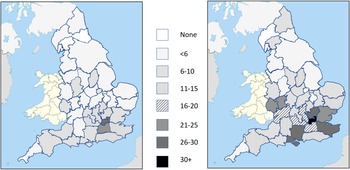
Even without considering the £100 rewards, only available until 1752 and for London and its immediate surroundings, the geographical distribution of rewards was concentrated on London and Middlesex, which account for over a quarter (28.2 per cent) of all £40 rewards. Figure 1 shows that the capital had by far the highest concentration of rewards per capita, and outside London rewards were most frequent in the Home Counties. In 1780–1784 the distribution widened somewhat to include significant concentrations of rewards in Hampshire, Gloucestershire, Warwickshire and Herefordshire. There were still, however, no northern counties with significant numbers of rewards per capita. It is difficult to explain these county by county variations, which no doubt resulted from a combination of patterns of crime, decisions on whether or not to prosecute, the role of non-victims in apprehending suspects, and jury verdicts (especially the number of partial verdicts, which did not lead to rewards).
£40 Rewards by County, 1748–1752 (left) and 1780–1784 (right), per 100,000 population: burglary, highway robbery and housebreaking.
Sources: The National Archives (London), Treasury Warrant Books, T 53/43–44 and T 53/54–57, supplemented by Sheriff's Cravings T 64/262, T 90/148 and T 90/163–65. Sheriff's Cravings are missing for 1748, 1750, and for some counties: Durham for both periods and London for 1748–52. Population figures are from E. A. Wrigley, ‘English county populations in the later eighteenth century’, Economic History Review 60 1 (2007), Table 5.

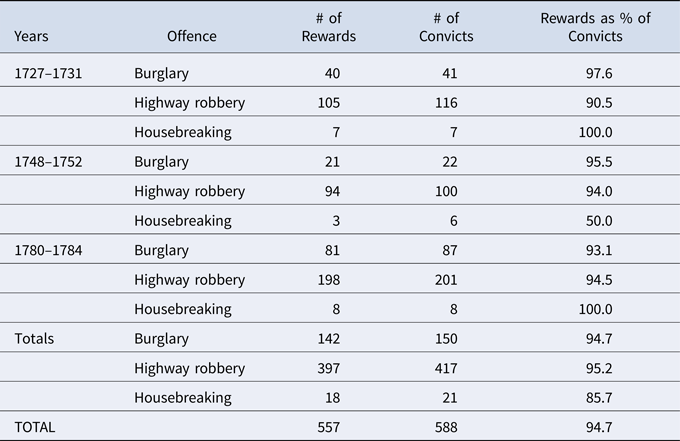
Focusing on the London area cases, Table 1 shows that 557 £40 rewards were paid out over the fifteen years sampled, or an average of 37.1 per year, with highway robbery receiving the overwhelming majority (71.2 per cent). By far the highest number was in 1780–1784.
Old Bailey £40 rewards for burglary, highway robbery and housebreaking

Sources: The National Archives (London), Treasury Warrant Books,T 53/33–36, T 53/43–44 and T 53/54–57, supplemented by Sheriff's Cravings E 197/32–33, T 64/262, T 90/148 and T 90/163–65; Tim Hitchcock, Robert Shoemaker, Clive Emsley, Sharon Howard and Jamie McLaughlin et al., The Old Bailey proceedings online, 1674–1913 (www.oldbaileyonline.org, version 8.0, March 2018). To compile this table, all defendants charged with each offence who were convicted of the full offence at the Old Bailey and sentenced to death were identified, and then checked against the records of rewards (each reward is for one convict). Some adjustments have been made to the Old Bailey Online categorisations of offence types and verdicts to correct tagging errors.
Rewards were almost automatically awarded immediately following the courtroom convictions of the relevant offences; victims and others did not need to petition for them. At the Old Bailey, the £40 rewards were given out for 94.7 per cent of all the defendants fully convicted of highway robbery, burglary and housebreaking (not including those convicted on a reduced charge, for whom rewards could not be issued). The figure for the Western Circuit is even higher (97.7 per cent).Footnote 36 Some of the missing rewards may have been recorded in sheriffs’ cravings documents which have not survived. When available, the £100 rewards for highway robbery were given in the same cases as the £40 statutory ones, also almost automatically.Footnote 37
3. Impact
How did the almost certain availability of such substantial rewards upon conviction shape patterns of prosecutions? While it is of course impossible to know how many of these types of crimes actually occurred and thus what proportion of such crimes were prosecuted, there is strong circumstantial evidence that the existence of these rewards significantly affected the behaviour of victims and others, thus distorting the business of the courts.
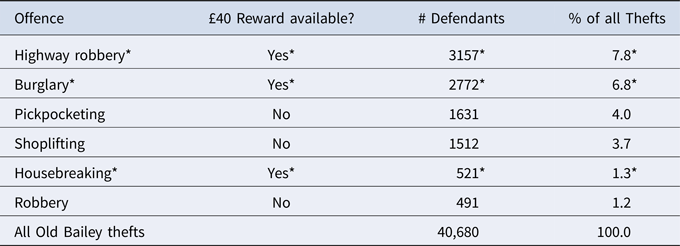
Looking first at the Old Bailey, where we have the most substantial evidence about prosecutions, the number of trials for two of these forms of aggravated theft (highway robbery and burglary) far outnumbered those for other specific but non-rewardable forms of aggravated theft (pickpocketing, shoplifting and robbery not on a ‘highway’) during the period under study, as Table 2 indicates. (Housebreaking, a less-frequently prosecuted form of burglary which occurred in the daytime, is an exception to this pattern.) These specific forms of theft, all capital offences, could only be prosecuted if the circumstances permitted and we do not know how often that was the case, but all these offences were thought to be endemic in London. Given the reluctance of some victims to prosecute capital offences, it is remarkable how much more often offences were prosecuted when a reward was on offer.
Defendants prosecuted for theft at the Old Bailey, 1720–1790

* = Crimes were subject to rewards. Source: Tim Hitchcock, Robert Shoemaker, Clive Emsley, Sharon Howard and Jamie McLaughlin et al., The Old Bailey proceedings online, 1674–1913 (www.oldbaileyonline.org, version 8.0, March 2018), statistics search.
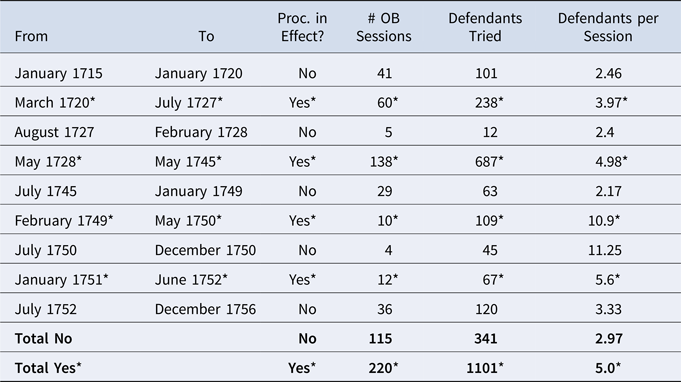
It is also significant that the introduction of rewards led to an increase in prosecutions. The pre-1692 Old Bailey Proceedings are insufficiently detailed (and their survival is patchy), so we cannot measure the impact of the introduction of £40 rewards in 1692, but we can examine the impact of the periodic use of the £100 rewards for the conviction of London highway robbers. These rewards were in force for most of the time from March 1720 to June 1752, but there were three periods when they lapsed.Footnote 38 Table 3 compares the number of defendants prosecuted for highway robbery at the Old Bailey during periods prior to and following periods in which a proclamation was in effect. With the exception of the short period from July to December 1750 at the height of a panic over crimes committed by returning soldiers, periods when a £100 proclamation gave an added incentive to prosecute witnessed significantly higher numbers of defendants prosecuted for highway robbery.Footnote 39 As the right-hand column demonstrates, more than two-thirds more defendants were prosecuted during the periods when the proclamations were in force. Of course, since the proclamations were intended to combat perceived increases in highway robbery, these periods may have witnessed more highway robberies than the periods when the proclamations lapsed. But that is unknowable. What we do know is that, when offered this incentive, substantially more victims overcame their general reluctance to prosecute in the years when the proclamation rewards were available.
Old Bailey defendants tried for highway robbery during periods with and without £100 proclamations in effect

Periods indicated in * were when £100 proclamations were in effect. Source: Tim Hitchcock, Robert Shoemaker, Clive Emsley, Sharon Howard and Jamie McLaughlin et al., The Old Bailey proceedings online, 1674–1913 (www.oldbaileyonline.org, version 8.0, March 2018), statistics search.
It is not surprising that the number of highway robberies prosecuted at the Western Circuit Assizes, where the £100 rewards were not available, was proportionally far lower than in London. Whereas highway robbery accounts for 79.7 per cent of the rewards issued for burglary, highway robbery, and housebreaking in London between 1748 and 1752, it accounted for about half (51.6 per cent) of the rewards for these offences in the Western Circuit in those years.Footnote 40 This is not because the definition of ‘highway’ did not apply (rewards were offered to anyone ‘convicted of any Robbery committed in or upon any Highway Passage Field or open place’), and is more likely because the robberies which did occur were not prosecuted.Footnote 41 While the difference between the number of these offences committed in urban and rural areas is unknowable, and this pattern could be explained by other unknowns such as different inclinations to prosecute, this distribution of prosecutions reinforces the implication drawn from the other evidence that the prospect of a £100 reward significantly increased efforts to prosecute highway robbery in London.
Table 3 indicates that the withdrawal of the £100 rewards in June 1752 was followed by a fall in prosecutions for highway robbery. The cessation of the statutory rewards system in the early nineteenth century had a similar effect of reducing the incentive to prosecute.Footnote 42 A comparison of the ten years before and after the 1818 decision to stop automatic statutory rewards reveals that the proportion of prosecutions for the three rewardable offences (highway robbery, burglary and housebreaking) decreased by about a third following the end of statutory rewards, from 10.5 to 6.8 per cent of all Old Bailey trials. The number of prosecutions of these offences slightly increased, but the period following the end of the Napoleonic wars in 1815 witnessed a major long-term increase in prosecutions for all crimes at the Old Bailey. In this context, it is significant that prosecutions for previously rewardable offences increased at a slower pace.
Victims of crime in eighteenth-century England had many reasons not to prosecute, and, as noted above, the evidence suggests that the vast majority of crimes were not prosecuted. But the offer of a reward appears to have changed that calculus for victims, encouraging them to abandon their usual hesitation and fulfil their legal obligation to prosecute (the median value of rewards to victims was £14 for £100 rewards and £6 for £40 rewards; as with all rewardees, many victims received both). Faced with the prospect of a substantial reward, they more frequently chose to prosecute, leading to increases in trials for the specific offences where rewards were payable, and decreases when those rewards were withdrawn. It is also possible that some prosecutors exaggerated the amount of violence in a theft, and the fear it induced in the victim, in order to turn more mundane thefts into accusations of the rewardable offence of highway robbery.Footnote 43
Moreover, rewards gave prosecutors a specific incentive to push for a conviction of the defendant on the full charge. Some victims and prosecutors at this time, bound over to appear in court to prosecute capital offences, may have wished to avoid becoming responsible for hanging the defendant, and chose to ignore aggravating circumstances and testify to a lesser offence when appearing before a grand jury (grand larceny, for example, rather than highway robbery).Footnote 44 Others failed to appear at the trial, presented a weak case, or recommended the defendant to the mercy of the court.Footnote 45 Alternatively, in capital cases trial jurors, sometimes prompted by pleas from the victim, could find the defendant guilty of a lesser offence, thereby preventing the court from sentencing the convict to death. For theft offences there was the possibility of both finding the value of the stolen goods to be lower than the threshold for a capital conviction, and of ruling that an aggravating aspect of the crime was not present. In burglary or housebreaking, for example, they could find that the crime did not involve forcible entry, or in a robbery that it did not involve actual or threatened violence, in which case the prosecutor and witnesses were not eligible for a reward. Of the 22,608 defendants found guilty of theft offences (whether or not they were eligible for a reward) between 1720 and 1790 at the Old Bailey, 38.0 per cent were found guilty of a lesser offence.Footnote 46
But when a reward was at stake, some victims and their witnesses pushed harder for full guilty verdicts, leading to higher rates of full convictions. In an Old Bailey trial for highway robbery in 1786, the judge, noting that a reward was payable in the case, complained about a witness, a ‘runner belonging to one of the Rotation Justice's offices’, who ‘strained the evidence against the prisoner, particularly in swearing that he had attempted to make his escape, which was disproved by other witnesses’. Three years later, in another case, The Times complained that the availability of a reward ‘makes some men look rather too sharp in criminal prosecutions’.Footnote 47 While these two trials resulted in acquittals, many such attempts were successful, and such practices continued. In testimony to a Parliamentary committee in 1816 two officers with over thirty years’ experience at the Old Bailey made similar complaints. John Townshend, a Bow Street officer, testified that ‘officers [are] dangerous creatures, who have it frequently in their power (no question about it) to turn the scale, when the beam is level, to the other side [and push for conviction] … because that thing, nature says, profit, is in the scale’. John Shelton, Old Bailey clerk, said ‘he considers it probable that these rewards warp the minds of witnesses’.Footnote 48
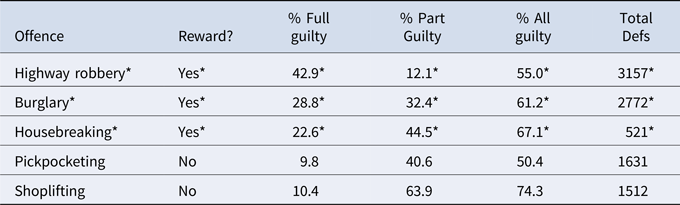
Table 4 shows that those accused of highway robbery, burglary and housebreaking at the Old Bailey were far more likely to be found fully guilty of the offence than those charged with two non-rewardable forms of theft, pickpocketing and shoplifting. The latter two offences were far more likely to result in part guilty verdicts than those charged with highway robbery and burglary (though not housebreaking). If we restrict the analysis to the period from 1720–51 and the crime of highway robbery, when the £100 rewards were available for most of the period, an even higher proportion of guilty verdicts was obtained: 52.8 per cent were found guilty of the full offence, compared to the Old Bailey average for all offences for those years of 32.6 percent. The three rewardable offences did not have distinctively high overall levels of convictions (full guilty plus part guilty), however, which suggests that jurors could still be sceptical, and the key dynamic in these trials was the efforts made by the prosecution and its witnesses to ensure that when the jury was inclined to convict, they would convict on the full charge.
Verdicts for selected theft offences at the Old Bailey, 1720–1790 (counting by defendant)

* = Crimes were subject to rewards. Source: Tim Hitchcock, Robert Shoemaker, Clive Emsley, Sharon Howard and Jamie McLaughlin et al., The Old Bailey proceedings online, 1674–1913 (www.oldbaileyonline.org, version 8.0, March 2018), statistics search. The overall pattern holds when controlling for the gender of the defendant.
On the Western Circuit, the entries in the gaol book from 1748–52 demonstrate the overall greater hesitancy of juries to convict fully defendants charged with capital crimes in the provinces. Whereas in London in these years 44.8 per cent of those convicted of housebreaking and burglary were found fully guilty, only a quarter of guilty verdicts in the Western Assizes were full convictions, with the remainder found guilty of a lesser offence.Footnote 49 In these courts, rates of full conviction for housebreaking and burglary were similar to those for the non-rewardable offences of pickpocketing and shoplifting, which suggests either that witnesses were less keen to press for a reward, and/or that juries were more sceptical, or more determined to avoid capital convictions. Highway robbery is a significant exception, however: 52.3 per cent of defendants were fully convicted, almost three times the rate for pickpocketing and shoplifting. In the case of what was often perceived as a far more serious offence, it appears that, like at the Old Bailey, victims, witnesses and jurors on the Western Circuit were willing to push for a full conviction and accept that the defendant might hang, owing to a combination of recognition of the severity of the crime and the attraction of the financial reward (for the prosecutors).
While each of the tables in this section must be subject to the caveat that since we do not know overall levels of crime and guilt we cannot know whether the statistics reflect actual criminal behaviour or prosecutorial (or judicial) propensities, the cumulative evidence strongly suggests that the availability of rewards, particularly the largest £100 rewards, significantly shaped prosecutorial behaviour, and thus the historical record of crime as recorded in sources such as the Old Bailey Proceedings. Our findings suggest that levels of prosecution, particularly for highway robbery, were higher than would have been the case if no rewards were offered, and that verdicts were significantly more likely to be a full conviction, particularly in London. In this respect, accounts of certain offences in the Proceedings must be read as a record of prosecutorial behaviour which was strongly influenced by the rewards offered by the government.
The fact that the rewards system was so successful in stimulating prosecutions and full convictions is indicative of the significant and hitherto unrecognised role played by the rewards system in shaping the evolution of capital punishment in England. Those fully convicted of highway robbery, burglary and housebreaking did not have benefit of clergy (the right to be sentenced to a lesser punishment) and had to be sentenced to death. While, owing to pardons, only about half of capital convicts in London were executed between 1730 and 1790, rewards increased the number of executions by increasing the number of capital convictions. This was particularly true in the 1780s, when a perceived crime wave and the suspension of transportation following the outbreak of war in America led to the highest levels of both prosecutions and executions in the century.Footnote 50 Table 1 shows that the number of rewards paid out in London between 1780 and 1784 on convictions for the three rewardable offences of burglary, housebreaking, and highway robbery, 287, was greater than the total of the two earlier sample periods combined. Correspondingly, the annual number of executions reached levels not seen during the previous or subsequent centuries. While this was partly the result of the decision by the Home Secretary in 1782 to refuse to pardon those convicted of robberies and burglaries ‘attended with acts of great cruelty’, it was facilitated by the high number of full convictions.Footnote 51 During the peak period which followed, between 1783 and 1787, the 230 men and one woman executed for highway robbery, burglary and housebreaking accounted for over two-thirds (68.1 per cent) of all London executions.Footnote 52 This bloodbath prompted an outcry, contributing to currents of public opposition to capital punishment that had been growing since at least the 1750s.Footnote 53
While execution rates were lower in the rest of the country, rewardable offences also accounted for a high proportion of executions outside London. In 1780–84 the same three rewardable offences accounted for over half of all executions (225 of 399, 56.4 per cent), and if other rewardable offences are included (sheep and cattle theft and coining), offences which led to rewards account for two-thirds (68.7 per cent) of all executions. This represents an increase in the proportion of non-killing offences which led to executions in the provinces, compared to previous years, as patterns of punishment began to converge with those found in London.Footnote 54 Overall, eight of the ten counties with the highest numbers of per capita executions also ranked in the top ten in terms of the per capita number of rewards.Footnote 55 Given the general reluctance to execute offenders outside London, particularly on the ‘periphery’, awareness of the connection between rewards and executions must have contributed to public scepticism of capital punishment, particularly during the 1780s.Footnote 56
It was impossible not to see the connection between rewards and the executions they facilitated. The payment of rewards, such as for the return of lost or stolen goods, was generally accepted by the eighteenth-century public, as can be seen in advertisements for the return of ‘lost’ goods, a ‘consistent and expanding feature of daily newspapers’ in the late seventeenth and eighteenth centuries. These notices offered often substantial rewards, ‘no questions asked’, under the ‘reassuring pretence [that the goods were] “lost” rather than “stolen”’.Footnote 57 Thus, the statutory rewards for the convictions of felons initially prompted little comment in the press (except for their contribution to the ‘thief-making’ scandals). But informers had never been popular, and the practice of profiting from the executions of convicts was increasingly condemned. In London, this is evident in the growing use of the term ‘blood money’ in the 1780s to taint those who profited from rewards. This term was first used in a publication, similar to the Old Bailey Proceedings, of trial reports for the neighbouring county of Surrey in 1751, where a defendant described his accusers as ‘thief-takers, they swear for what they call blood-money’. Footnote 58 It was first used in the Proceedings in 1774, when a witness testified that he saw ‘some of the people’ in a public house ‘jeering’ a watchman ‘about the blood money’ he would receive if the prisoner, Thomas Walsom, was convicted of burglary, with those present saying ‘he would have a suit of clothes’. In the next decade the defence lawyer William Garrow repeatedly taunted prosecution witnesses at the Old Bailey with allegations that their testimony, which put prisoners’ lives at stake, was motivated by greed. In a case of housebreaking, for example, he asked the thief-taker Joseph Levy, ‘What is the price of the blood of these men, if they are convicted?’Footnote 59 The defendants were acquitted. The connection between rewards and executions was made explicit in Francis Grose's Classical dictionary of the vulgar tongue in 1785, when he labelled the ‘handsome reward[s]’ earned by thief-takers as ‘blood money. It is the business of these thief-takers, to furnish subjects for a handsome execution, at the end of every sessions’.Footnote 60
Growing public dissatisfaction with the high execution rates in the capital in the mid-1780s contributed to the government's decision, through the use of pardons, to scale back executions dramatically from 1788 (assisted by the return of transportation as a secondary punishment–now to Australia–as a possible condition of pardons).Footnote 61 Never again would executions reach higher than half of the level they reached in London in 1785, either in absolute numbers or in terms of the proportion of capital convicts executed.Footnote 62 While the statutory bloody code would remain substantially in place until the 1830s, the place of hanging in the pantheon of punishments criminals actually received had been fundamentally reduced, as felons were more frequently transported or imprisoned. By providing so many capital convicts and linking individual witness testimonies to their subsequent executions, ‘blood money’ had helped provoke this fundamental shift in penal policy.
4. Rewardees
Victims were not the only beneficiaries of rewards. As we have seen, they were offered to ‘all and every person’ who was deemed to have contributed to convictions. By encouraging others to become involved in detecting, apprehending and prosecuting offenders, rewards contributed to the development of another fundamental aspect of criminal justice, policing. Despite limitations of the available evidence, an examination of the individuals who profited from rewards sheds valuable light on the early history of detective policing in England. The following discussion focuses on London, both because it is the source of the richest evidence and because London is where modern English policing first developed.Footnote 63
Given the large sums involved (up to £140), and in recognition of the various people needed for successful convictions, it is not surprising that the judges divided each reward up among multiple recipients. There were between two and seventeen rewardees per reward; the median number of rewardees in the 118 London awards in this study was seven.Footnote 64 By linking the rewardees to their Old Bailey testimonies, where these are recorded, it is evident that they were involved in a wide range of prosecution tasks, from the initial identification of suspects and their arrest through to their courtroom testimony. To reduce corruption, the Treasury ordered judges to allocate the division of both £40 and £100 rewards in public, at the conclusion of each meeting of the court.Footnote 65 But given the pressure of time, they frequently simply signed off a list provided to them by the clerk of the court, who in turn often relied upon an agreement drawn up by the prosecutors of the case. Judge Dudley Ryder noted in his diary that, at the end of the first criminal trials he judged in Essex in 1754, the clerk of the assizes presented him with certificates he had prepared, ‘showing me in one instance an agreement under their [the prosecutors’] hands, [and] in the other only saying it was agreed between them’.Footnote 66
The original statutes which determined who was eligible to receive the £40 rewards were ‘inaccurately penned’, and the criteria of eligibility for the £100 rewards was not spelled out beyond the phrase ‘whosoever shall discover and apprehend any person… so as such person… be convicted’.Footnote 67 When disputes occurred, it appears that the judges strived for ‘equity’ and inclusiveness, using their discretion to distribute rewards widely. In a case of burglary in Southampton in 1755, one victim prosecutor, Mrs Jones, was denied a reward because after the prisoners had been convicted on other indictments it was deemed unnecessary for her trial to proceed. But a clerk wrote to the judge, arguing that ‘I think it is quite consistent with the Rules of Equity that Mrs Jones should have some little allowed her’Footnote 68 While it appears that Jones went unrewarded in this case, a dispute in 1754 over the distribution of rewards to the Bow Street runners (discussed below) highlights the longstanding practice of inclusiveness in London. When Henry Fielding attempted to secure additional income for his runners by arguing that only those who participated in the actual arrest of the convict were entitled to rewards, the Attorney General flatly rejected the request, stating that
[…]the judges have always, I believe, construed the act on this point with liberality, to include all and therefore have distributed the reward among all the sorts in proportion to the share each had in obtaining final justice to the publick on these offenders, and I think they have made the right construction of the Act.
Thus, ‘upon a fair and equitable construction of these acts the discoverer taker and prosecutor are each intituled to a share according to their respective services of the rewards’.Footnote 69
While the judges never explicitly stated their reasoning when allocating rewards, evidence in the Old Bailey Proceedings demonstrates that the Attorney General's approach was followed, with the sums distributed broadly according to the level of effort put in by each rewardee, to the extent that this can be determined from the usually abridged trial accounts. In 1730 Richard Smith was convicted of robbing Thomas Dickenson and stealing a hat, peruke, pair of scissors and a sheath. Since this crime took place in London, both £100 and £40 rewards were available, and the same ten men received portions of both rewards, roughly in similar proportions. In this case the victim, Dickenson, was seriously wounded in the attack and played a limited role in the prosecution, which occurred because an accomplice, John Wills, turned king's evidence and told John Cauthery [or Cathery], a constable, that Smith was the culprit.Footnote 70 Cauthery, who arrested two others charged with the crime (who were acquitted) and retrieved the stolen goods, received the highest portions of the rewards, £35 and £15, while Wills, the accomplice, received the second most, £23 and £7, in addition to the enormous benefit of avoiding prosecution for his part in the crime. Next came Nicholas Tutton, £12 and £4, who testified that ‘the prisoners and John Wills had been in company together before the commission of this fact, and had lodg'd in the same house’. The victim Dickenson received only the fourth highest rewards, £8 and £4, presumably for prosecuting the case in court. Of the remaining rewardees, Peter Levett (£6 and £2) took a pistol and powder out of Smith's pocket when he was searched, Henry Rogers (£3 and £2) confirmed this evidence, and John Forster (£4 and £1) testified that he had heard Smith confess before the justice. Three other rewardees, who also received relatively small amounts, are not recorded as having testified at the trial.Footnote 71
Dickenson's role in enabling this conviction only occurred after ‘it being put in the news that such persons were taken up’, when he went and identified the stolen goods. Victims and others who played a role in the arrest of the culprits received more. John Stout, for example, helped apprehend Timothy Cotton when Cotton and his accomplice William Marple robbed him in 1729. The robbers had tied up his hands and thrown him in a ditch, but Stout managed to free himself and pursue the robbers, crying out ‘stop thief’ to secure help. Cotton was apprehended and Stout stayed with him and was present when he was brought before a magistrate and searched. For his efforts, which included the prosecution, Stout received £60 out of the £200 proclamation rewards for the conviction of the two culprits.Footnote 72 Also receiving substantial portions of the £200 were Michael Kelly (£30) who responded to the cry for help, stopped Cotton and brought him before the magistrate, William Shaw (£30) who helped apprehend Cotton, and William Key (£30) who helped apprehend Marple after Cotton told him where to find him. Receiving slightly less (£20) was Richard Gough, who confirmed the testimony of the other witnesses and reported what Marple had told the justice after he was arrested. In this case the role of the constable, John Burton, was confined to carrying the prisoners from the magistrate's examination to the Gatehouse prison, and he only received £10.Footnote 73
The judges’ efforts to distribute rewards on this basis, which can also occasionally be seen in provincial records,Footnote 74 ensured that the extraordinary amount of money available was widely distributed. Names of rewardees survive on the certificates which they signed to indicate receipt of a reward, or in court orders dividing up the reward. Both types of records survive erratically, and the largest number come from our first sample period. Although there are no records for 1727, we have evidence of rewardees for more than half (28 of 48) of the Old Bailey sessions for 1728–1733 (rewards were probably not awarded in every sessions). For many sessions, records survive only for the City of London or Middlesex, but not both.Footnote 75 These documents contain the names of 485 individual rewardees. Half are recorded as testifying in the relevant Old Bailey trial, but this almost certainly underestimates the true figure, since the Old Bailey Proceedings do not provide complete transcripts of courtroom testimonies.Footnote 76 All rewardees should have been involved in some aspect of the apprehension and conviction of the convict, though that does not necessarily mean they appeared at the Old Bailey.
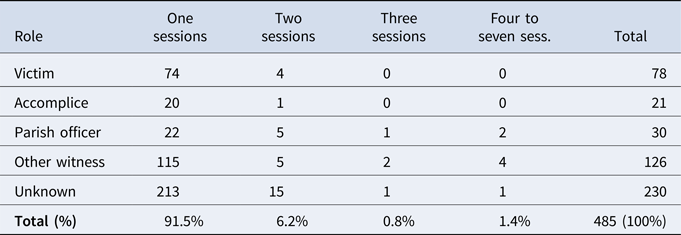
This evidence allows us to measure the relative numbers of shares in rewards awarded to victims, accomplices, thief-takers, officials, and other individuals. The vast majority of rewardees (92.9 per cent) were men, with women most often rewarded as victims, and never as accomplices or officers. For those who are recorded as appearing in the Proceedings, we can ascertain the identities of rewardees and the role they played in the prosecution. Table 5 documents the roles rewardees played in trials, and how often each received portions of rewards (both £40 and £100).
Old Bailey rewardees’ roles and frequencies of appearance, 1728–1733

Source: London Metropolitan Archives, MJ/GB/B/017–018 and CLA/047/LJ/11/013; The National Archives (London), E 407/27–29; checked against relevant trial accounts in the Old Bailey Proceedings: Tim Hitchcock, Robert Shoemaker, Clive Emsley, Sharon Howard and Jamie McLaughlin et al., The Old Bailey proceedings online, 1674–1913 (www.oldbaileyonline.org, version 8.0, March 2018). The unit of analysis is ‘a sessions’, a single meeting of the court on successive days (there were eight per year), since rewardees often appeared in more than one trial relating to the same crime at a single sessions.
Determining how often each rewardee collected a reward is an imprecise exercise owing to the fact reward distributions are missing for so many Old Bailey sessions in the relevant years. But the patterns in Table 5 are so strong that it is unlikely that additional evidence, if it survived, would radically change the findings. Contrary to what the existing historiography implies, a relatively small proportion of rewards went to regular informers. The overwhelming majority of rewardees were involved in the prosecution of only a single felon, or group of felons, with 91.5 per cent receiving a reward in only one of the twenty-eight sessions for which we have evidence. Of the 41 who appeared in more than one sessions, 30 only appeared in two, with the remaining appearing in up to seven sessions. (It should be noted that these figures likely overestimate the number who appeared in more than one sessions, since some may have been different people sharing the same name.)
Most rewardees, therefore, only appeared at the Old Bailey once. Seventy-eight (16.1 percent) were victims who testified in the cases they prosecuted; all but four appeared in only one sessions. Victims were always present in trials for these offences and normally provided the lead testimony. It is thus not surprising that they almost always got some part of the reward, though as we have seen how much they received depended on how much effort they made to apprehend the culprit. That they were unable to do this on their own and benefitted significantly from the assistance of others is indicated by the fact that in two-thirds of rewards (66.5 per cent) they did not receive the highest amount paid in the reward distribution. The most frequent other type of rewardee identified was ordinary witnesses, who responded to a cry for help of ‘stop thief!’ and got involved in the capture and prosecution of a criminal or group of criminals, or they simply happened to be in the right place at the right time to witness a crime or see the accused in a compromising situation. Whether they were motivated to participate in the prosecution by the prospect of a reward, or were simply doing their civic duty, is impossible to say.
Victims and witnesses account for 80.0 per cent of the 255 rewardees whose role has been identified; the remaining 20.0 per cent were accomplices who turned king's evidence or parish officers. While accounting for a minority of rewardees, accomplices, who had additional incentives to join a prosecution, could benefit significantly. By turning king's evidence (if accepted by a Justice of the Peace), those accused of capital crimes could not only avoid prosecution themselves, but could also receive financial compensation, though typically their rewards were less than those of other rewardees. Only thirty county and parish officers (6.2 per cent of all rewardees, comprising twenty-one constables, a high constable, two headboroughs, two beadles, and four watchmen) are identified as such among the rewardees, though this is likely to be less than the true figure since such men were not necessarily identified as such in the Proceedings. Many other witnesses testified to acting in ways (such as searching the accused) which would normally be carried out by an officer, but whether they were legally appointed constables is unclear. The brothers Robert and Thomas Willis had substantial careers in law enforcement between 1716 and 1731, but Robert was only identified in the judicial records as a constable in 1729, and Thomas between 1726 and 1729. At other times, working with brothers John and Michael, they performed actions typical of constables such as apprehending, searching and charging prisoners, and they were labelled, disparagingly, as ‘informing constables’. It is unlikely that they were always appointed officers when they carried out these activities. They also acted outside their local jurisdiction: Robert and Thomas are recorded as constables in the City records, but they were involved in arrests in Middlesex as well.Footnote 77
5. Thief-takers and policing
In addition to appointed officers, rewards thus encouraged others to assist victims with their prosecutions, and some of these men started to act like policemen, apprehending, examining and searching suspects, and even keeping them as prisoners until the victim was notified or they could be brought before a justice. The twenty-eight witnesses and rewardees with unidentified roles (5.8 per cent of all rewardees) in Table 5 who appeared in between two and seven different sessions over six years included some men who, despite not having a formal role, regularly participated in prosecutions for rewardable offences. Some of these men, including occasionally the Willises, were labelled as thief-takers by witnesses. It would be surprising if such men were not motivated by the large sums of money available, and it is notable that all but one of the forty-one men in Table 5 who received rewards from more than one sessions received portions of the larger £100 rewards. When alleged ‘thief-catcher’ William Kirk testified for the prosecution in a burglary case in 1735, he reported that he had approached Brogden Poplet, a ‘thief-catching bailiff’, about arresting ‘Long Will’ for housebreaking, and Poplet allegedly said ‘it was not worth his while, for there was but forty Pound for taking him’ (he was arrested anyway).Footnote 78
Thief-taking did not disappear following the execution of Jonathan Wild in 1725, but rather than focus on their alleged corruption, men involved in multiple criminal prosecutions are better considered in the context of the early history of policing. Historians have assumed thief-takers were corrupt, both because of the presumption that one could not be proficient at the practice without being compromised by a necessary familiarity with criminal networks, and owing to the bad press thief-taking received as a result of the thief-making scandals of both Wild and the McDaniel gang. Those on trial (with their lives at stake) occasionally claimed their prosecutors presented false evidence ‘for the sake of the reward’, but it is difficult to determine the truth of these self-interested claims. With the exception of the Wild and McDaniel scandals, however, there is little evidence of widespread corruption. Beattie, who studied the early 1730s activities of thief-takers in the City, identified only one possible case, involving entrapment in 1732.Footnote 79 More clear cut is the case of John Waller, who repeatedly prosecuted innocent men for highway robbery between 1730 and 1732. But Waller acted alone, and many jurors and judges did not trust him. Several cases resulted in acquittals and the death sentences of all but one of the small number of men convicted were reprieved, owing to the judges’ doubts about Waller's evidence.Footnote 80
It is, of course, difficult at this remove to find evidence of corrupt practices in the records of Old Bailey trials. But what is certain is that a small number of men who were (or might be) called thief-takers on the basis of their repeated involvement in prosecutions, were proactively involved in the detection and arrest of highway robbers, taking the initiative to seek out suspects whenever they had evidence a crime had occurred. Explaining to the court why he had apprehended William Flemming shortly after he had been released from prison, the ‘thief-catcher’ Joseph Williams reported that ‘it was reported by a 100 coachmen’ that he had robbed one of them, and ‘Willi. James the Drawer told me of it’ (James was also accused of being a thief-taker). Significantly, Williams did not invoke any legal authority, such as a warrant or authority as a parish officer, to justify this arrest.Footnote 81 Similarly, explaining the arrest of George Sutton in 1733, John Berry told the court,
Coming out of Marybone-Fields on Sunday Evening, I saw Sutton and Baker and two more going in. As I knew the Characters of Sutton and Baker, I concluded they were going upon some Mischief. In three Quarters of an Hour, I was told there had been a Robbery, and I said, I thought so.
Berry, who went on to play a major role in the 1754 thief-making scandal, had no legal obligation or authority to act on this case, but the next day he went to see the victim, Philip Turst (he does not explain how he found him), and asked him ‘If he should know any of the Persons who robb'd him? and he said, Yes, very well; and he believ'd there was one of the Suttons (for there's two Brothers of them) if not both’, thus prompting the arrest.Footnote 82 Cases like this suggest that the small number of men who received multiple rewards actively sought out victims, and if they could identify the thief, persuaded them to prosecute.Footnote 83
In addition to encouraging victims to prosecute cases to full conviction, therefore, rewards also encouraged some non-victims to become actively involved in detective policing. Reflecting the potential difficulty of arresting a felon, some victims sought help from men who, even if they were not appointed officers, might have become known for their policing skills. When John Wright, a gentleman, was burgled in 1728, he suspected a man who had previously lived with him, but rather than pursue him himself, he ‘employed one Mr Mombray to search after him’. Mombray ‘got two Warrants (one to search, and the other to apprehend) and went to the Prisoner's Brother-in-Laws House’ and charged a constable with him. On this evidence, Mombray, who received a substantial portion (£12) of the £40 reward for his efforts leading to the conviction of Thomas Jinkins, might be labelled a thief-taker, but this is the only recorded case he was involved in at the Old Bailey.Footnote 84 John Berry was more active. In 1734, when Archibald Gregoire found the man that robbed him in an alehouse, he ‘went to the other end of town and to fetch Mrs. Potter [another victim] and advise with John Barry’. This was the thief-taker John Berry, who was involved in several cases (including one mentioned above from the previous year), but most men who assisted with arrests only appeared once at the Old Bailey.Footnote 85
With the lucrative rewards continuing to be available, and an increasing number of experienced watchmen and constables who served for long periods as officers as a form of employment, the number of active thief-takers (whether or not they were in office) increased in the 1740s.Footnote 86 Their methods of detection and prosecution became more sophisticated, especially during the ‘moral panic’ over the criminal activities of the ‘Black Boy Alley gang’ of thieves in 1744, which prompted the offer of additional local rewards on top of the statutory and proclamation rewards. The panic resulted in a wave of prosecutions for highway robbery, in which the activities of a large number of active thief-takers can be identified, including John Berry, some of whom were clearly corrupt. The nine £100 proclamation rewards paid out were shared among 41 recipients, half of whom, according to Beattie, were constables or thief-takers; some of these men continued to be active into the 1750s.Footnote 87
But in the period of our second in-depth examination of rewardees, from 1749–52 (there are no relevant surviving records of rewards for 1748), the nature of thief-taking changed dramatically, following Justice Henry Fielding's creation of the ‘Bow Street runners’ in 1749. Prompted by concerns about the activities of criminal gangs and fears of a crime wave by demobilised soldiers following the end of the War of the Austrian Succession, and in an attempt to reduce corruption and improve the reputation of thief-taking, Fielding assembled a small group of men, some of whom were constables or former constables, and paid them a retainer to work with him at his Bow Street residence to arrest and prosecute criminals.Footnote 88 Crucially, this arrangement was dependent on the runners being able to supplement the income from the retainer with reward money; the importance of this funding to Fielding's business model is evident in his audacious, but unsuccessful, petition to the government that the courts should only award reward money to those who had actually apprehended criminals.Footnote 89
This innovation had a significant impact on patterns of prosecutions and rewards, but it is not straightforward to measure. Only one record of the rewardees for the £40 statutory rewards in London survives from this period, and during the period when the £100 proclamation rewards were available (from February 1749 to June 1750 and from January 1751 to June 1752), we have lists of rewardees for only six sessions in the City of London, as well as lists of the rewards, but not the rewardees, from the National Archives (TNA) for much of the period. Moreover, since Fielding wanted to keep their identities secret, we don't have a complete list of the Bow Street runners at this time. Nonetheless, taking the prosecution witnesses who testified in cases that resulted in rewards as indicative of the rewardees, we have identified a total of 60 individual rewardees in these years.Footnote 90 We have then compared these names with lists of the known Bow Street runners and thief-takers in this period identified by John Beattie and Ruth Paley respectively.Footnote 91
As in the earlier period, most rewardees only appear in one sessions, including those we can identify as officers and accomplices. But the number of rewardees who appeared in more than one Old Bailey sessions increased. Whereas only 8.4 per cent appeared in more than one sessions in 1728–33, this figure doubled to 17.3 per cent in 1749–52 (and 35.8 per cent of the smaller number of confirmed rewardees). In interpreting these figures, we should bear in mind the incomplete survival of records in both periods. Nonetheless, the evidence suggests that active thief-taking appears to have increased, particularly by men identified as thief-takers or Bow Street runners, who account for 18 of the 20 men who appeared in more than one sessions. Of the 34 men identified by Paley as thief-takers between 1745 and 1754, nineteen were rewardees in these records, eleven of whom appeared in multiple (up to five) sessions. Nine of these were identified by Paley as ‘leading thief-takers’.Footnote 92
It is more difficult to measure the impact of the Bow Street runners, but of the ten men Beattie identified as active in the 1750s (mostly later in the decade), two were rewardees in 1750–51: William Pentlow and Samuel Phillipson. In addition, at least five other thief-taker rewardees can be linked to Fielding.Footnote 93 Four testified in a trial that they had participated in the arrest of a highway robber who was then brought before Justice Fielding.Footnote 94 This is not surprising: while Fielding tried to present his runners as a respectable alternative, historians have noted that in his early days he was forced to rely on the experience of already active thief-takers.Footnote 95
These thief-takers and runners account for almost a fifth of all rewardees, and, because they were more active, they participated in almost half of the rewards issued in London between 1749 and 1751.Footnote 96 This suggests that active thief-taking had become more frequent by mid-century, as the continuing availability of rewards, combined with increased pressure from the government to prosecute crime, stimulated the development of more active detective policing and prosecution in London. Victims were being increasingly assisted (and possibly encouraged to prosecute) by men with experiences of apprehending and prosecuting felons, with all the participants motivated by the prospect of a reward. Beattie has shown that the runners were particularly successful in obtaining full guilty verdicts in property cases between 1770 and 1780. Given the efforts Henry Fielding (and his half-brother John, who succeeded him in 1754) made from the start of their Bow Street office to assemble and orchestrate the presentation of prosecution evidence, this is likely to have also been true in the 1750s.Footnote 97 Of course, corrupt practices continued, notably evident in the thief-making scandal involving the McDaniel gang in 1754. But while Paley believes such corruption was endemic, it is not possible to estimate how many of the thief-takers and runners in this period were corrupt.
Over the ensuing decades, the impact of the Bow Street runners increased: in the 1770s and 1780s an average of at least eight or nine testified at every sessions of the Old Bailey.Footnote 98 Thief-takers also continued to be active, but the lack of available evidence on rewardees means that it is not possible to determine how many rewards they and the runners received. A further judicial innovation, the establishment of ‘rotation offices’ from 1763, staffed by justices and ‘runners’ (following the model the Fieldings established at Bow Street), relied on the rewards system to fund the otherwise unpaid thief-takers attached to the offices in order to facilitate arrests and prosecutions.Footnote 99 We have seen that the number of rewards dramatically increased in the early 1780s, and active thief-taking, whether by runners or traditional thief-takers, no doubt played a significant role in these cases. This is what was claimed by the writer ‘Junius Americanus’ in the Public Advertiser in 1782, when he observed that the recipients of ‘blood money’ were ‘gaolers, turnkeys, thief-takers, runners of gaols, hired constables, [and] runners of trading justices’.Footnote 100
Thief-taking, however, was very much a metropolitan occupation. While full lists of rewardees for the Western Circuit do not survive, we have no evidence that thief-takers operated in these counties. Of the rewardees listed in the Warrant Books, very few names appear in more than one case.Footnote 101 Offences in rural areas and towns were not sufficiently concentrated to justify adopting the practice.
6. Conclusion
Although they increased again in the early nineteenth century (a topic for further research), the number of rewards paid out decreased after 1787, as there were fewer full convictions for rewardable offences and the judicial authorities looked for other ways of addressing crime. Beattie detected ‘something of a transition in London policing’ in the 1780s, as the focus shifted to preventing crime rather detecting offenders.Footnote 102 But for almost a century, the rewards system had dramatically shaped criminal justice practices in three major ways. While the most dramatic changes occurred in London, the rewards system functioned in similar ways across the country, and the impact, if reduced, was still significant, particularly in the 1780s.
First, rewards encouraged victims to prosecute, and to prosecute to full conviction, with the virtual certainty that it would lead to a reward. This led to a significant departure from the traditional system of discretionary justice, as victims were stimulated to fulfill their legal obligations. Whereas victims had been typically reluctant to prosecute, the creation of a substantial financial incentive led many not only to prosecute, but also to overcome their frequent preference for partial verdicts and push for a full conviction, despite the fact this meant defendants might be hanged. But these changes only applied to the small number of offences where rewards were payable, principally burglary, housebreaking and highway robbery. By making it more likely that these specific crimes would be prosecuted, the resulting increases in prosecutions and full convictions for these offences distorted patterns of recorded crime, potentially leading both contemporaries and historians to exaggerate the extent of these types of crime compared to other offences. Historians, aware of the disproportionate attention paid to violent crimes in print culture, need to recognise that the dominance of violent property offences in trial reports in the Old Bailey Proceedings was a similar distortion, in this case shaped by the availability of rewards, which led to both increased numbers of prosecutions and higher levels of capital convictions.Footnote 103 This shaped the overall tone and content of the Proceedings, since reports of trials for the rewardable offences of highway robbery, burglary and housebreaking which led to capital convictions were more than three times longer than those of all other offences.Footnote 104
Second, the lucrative rewards on offer encouraged a small number of opportunistic and entrepreneurial men, some of whom were parish officers, to become actively involved as detective and prosecuting policemen. While many witnesses, passersby, and friends of victims, possibly incentivized by the prospect of a reward, helped detect, apprehend and prosecute a criminal once, some men started to do this repeatedly. An indeterminate number of these ‘thief-takers’ were corrupt, but attention to the ‘thief-making’ scandals has obscured the development of a more widespread pattern of proactive policing over the course of the century, both independently and under the auspices of the Fieldings and other justices, some of whom may have had more civic-minded motives. Here, the availability of rewards was both an incentive and an enabler: since there were few other sources of funding to support the ‘runners’, justices relied on the rewards to finance their activities. If, as is often claimed, the detective exploits of the Bow Street runners constitute a foundational element of modern policing, the rewards system must take some of the credit as a key source of their funding, and a stimulus to act.
If these developments (corruption aside) might have been welcomed by the original promoters of the rewards system, its third and perhaps most substantial impact was certainly not intended, and unwelcome to many: undermining support for capital punishment. The full convictions necessary in order to obtain rewards triggered automatic death sentences, and while a significant proportion of those convicted were pardoned, the increase in hangings this facilitated and the unease it caused, particularly in the 1780s, contributed to the existing opposition to capital punishment, as exemplified in the coining of the term ‘blood money’. Paradoxically, the very success of the rewards system in stimulating prosecutions undermined the credibility of the keystone of the penal system, capital punishment, leading to the decline of both rewards and hangings in the ensuing decades.
While victims, and those who assisted them, were initially the principal beneficiaries, in the long run statutory and proclamation rewards contributed to the marginalisation of the victim in the judicial process, and a reduction in the role of discretion in judicial decision-making. Rewards successfully shaped choices of how to respond to crime. Traditionally, while vindictive victims could choose full prosecution in pursuit of a capital conviction, many more victims chose informal settlements outside the law or were content with partial verdicts when the case went to court. But the prospect of a financially beneficial capital conviction altered that calculus, reducing some of their accustomed discretion. This was reinforced by the fact that rewards promoted amateur, quasi-official, and official policing agents to play a greater role in the detection and prosecution of suspects, which pushed victims into participating in formal prosecutions. Finally, with the eventual reform of the bloody code, victims lost their indirect influence over the punishment of their attackers, as the state opted for the certainty of lesser punishments over the discretion of selecting some convicts to be hanged. All these developments undermined the central role victims had traditionally played in the judicial system. Not for the last time, an expensive government initiative to suppress crime had significant unintended consequences.