Introduction
Birth cohort studies, follow-back studies based on school and clinical testing, and high-risk studies all indicate that patients with schizophrenia exhibit impaired performance on tests of intelligence administered before the onset of psychosis (Jones et al. Reference Jones, Rodgers, Murray and Marmot1994; Ott et al. Reference Ott, Spinelli, Rock, Roberts, Amminger and Erlenmeyer-Kimling1998; Bilder et al. Reference Bilder, Reiter, Bates, Lencz, Szeszko, Goldman, Robinson, Lieberman and Kane2006; Woodberry et al. Reference Woodberry, Anthony and Seidman2008), and it is widely believed that schizophrenia is associated with a variety of cognitive deficits (Heinrichs & Zakzanis, Reference Heinrichs and Zakzanis1998; Kremen et al. Reference Kremen, Buka, Seidman, Goldstein, Koren and Tsuang1998; Mohamed et al. Reference Mohamed, Paulsen, O'Leary, Arndt and Andreasen1999). Prospective studies using draft-board tests of intelligence, conducted in Israel (Davidson et al. Reference Davidson, Reichenberg, Rabinowitz, Weiser, Kaplan and Mark1999; Rabinowitz et al. Reference Rabinowitz, Reichenberg, Weiser, Mark, Kaplan and Davidson2000; Reichenberg et al. Reference Reichenberg, Weiser, Caspi, Knobler, Lubin, Harvey, Rabinowitz and Davidson2006), Sweden (David et al. Reference David, Malmberg, Brandt, Allebeck and Lewis1997; Zammit et al. Reference Zammit, Allebeck, David, Dalman, Hemmingsson, Lundberg and Lewis2004) and Finland (Tiihonen et al. Reference Tiihonen, Haukka, Henriksson, Cannon, Kieseppä, Ilmo, Sinivuo and Lönnqvist2005), show impaired pre-morbid intelligence in patients with schizophrenia. Several studies show a linear relationship between low IQ and the risk of illness (David et al. Reference David, Malmberg, Brandt, Allebeck and Lewis1997; Rabinowitz et al. Reference Rabinowitz, Reichenberg, Weiser, Mark, Kaplan and Davidson2000; Walker et al. Reference Walker, McConville, Hunter, Deary and Whalley2002; Tiihonen et al. Reference Tiihonen, Haukka, Henriksson, Cannon, Kieseppä, Ilmo, Sinivuo and Lönnqvist2005; Reichenberg et al. Reference Reichenberg, Weiser, Caspi, Knobler, Lubin, Harvey, Rabinowitz and Davidson2006).
Comparatively few studies have examined a possible relationship between pre-morbid IQ and mental illnesses other than schizophrenia (Mortensen et al. Reference Mortensen, Sørensen, Jensen, Reinish and Mednick2005; David et al. Reference David, Zammit, Lewis, Dalman and Allebeck2008) However, from focusing exclusively on ‘organic factors’ in schizophrenia (‘dementia in dementia praecox’), interest in cognition has gradually been extended to other psychiatric disorders. Today, an increasing number of studies suggest that pre-morbid intellectual impairment may not be unique to schizophrenia but is also detectable in other psychiatric disorders, although the results for affective illness are less clear (Reichenberg et al. Reference Reichenberg, Weiser, Rabinowitz, Caspi, Schmeidler, Mordechal, Zeev and Davidson2002; Zammit et al. Reference Zammit, Allebeck, David, Dalman, Hemmingsson, Lundberg and Lewis2004; Mortensen et al. Reference Mortensen, Sørensen, Jensen, Reinish and Mednick2005; Tiihonen et al. Reference Tiihonen, Haukka, Henriksson, Cannon, Kieseppä, Ilmo, Sinivuo and Lönnqvist2005; Gale et al. Reference Gale, Deary, Boyle, Barefoot, Mortensen and Batty2009). These findings suggest that low pre-morbid IQ may reflect neurodevelopmental disturbances and contribute to the risk of developing mental illnesses in general (David et al. Reference David, Zammit, Lewis, Dalman and Allebeck2008; Koenen et al. Reference Koenen, Moffitt, Roberts, Martin, Kubzansky, Harrington, Poulton and Caspi2009)
In a previous Danish prospective investigation by Mortensen et al. (Reference Mortensen, Sørensen, Jensen, Reinish and Mednick2005), members of the Copenhagen Perinatal Cohort with draft-board IQ were traced in the Danish Psychiatric Central Research Register. Of 3289 cohort members, 350 had been hospitalized with psychiatric illness: the diagnoses of schizophrenia, other psychosis, personality disorders, and adjustment disorder were associated with low pre-morbid IQ, whereas almost normal IQ was observed for the diagnoses of affective and ‘neurotic’ disorders. However, the latter patient samples were very small (n=15 and 21 respectively) and it is likely that the study did not have sufficient power to detect impairment of IQ scores for these diagnoses. Furthermore, the small patient samples obviously prohibited detailed analyses of the distribution of intelligence within diagnostic categories.
The present study was planned to obtain data on pre-morbid IQ in a very large sample of patients and controls (approximately 10 000 patients and 20 000 controls) with an informative, 25-year follow-up. A case–control design was used for data collection to maximize the number of patients in different diagnostic categories to facilitate generalizations on the relationship between adolescent IQ and later psychiatric diagnosis. Specifically, our aims were (1) to examine and compare pre-morbid intelligence in five diagnostic categories [schizophrenia (Sz), non-schizophrenic and non-affective psychosis (NSAP), affective disorders (AD), personality disorders (PD), neurotic/stress disorders (ND)] and the control group; (2) to examine the relationship between pre-morbid intelligence and risk of each of the five diagnoses; and (3) to examine the distribution of IQ scores within each diagnostic category.
Method
The Danish Psychiatric Central Research Register
Since 1938 this register has systematically collected information on all admissions to psychiatric hospitals and psychiatric wards in Denmark (Munk-Jørgensen & Mortensen, Reference Munk-Jørgensen and Mortensen1997). The register data have been manually accessible for hospital admissions prior to 1969; since then the register has been computerized. It contains the discharge diagnoses of each hospitalization. Since 1970, diagnoses were coded according to the Danish version of the ICD-8 and since 1994, according to the ICD-10. All individuals with a CPR number can be followed through the different admissions across different psychiatric hospitals and psychiatric departments of the country. The CPR number (equivalent to the US social security number) is a unique 10-digit identification number used in all Danish civil registration.
Draft-board intelligence data
With the exception of individuals with disqualifying diseases, all Danish males are required to appear before the draft board when they become liable for conscription at the age of 18 years (5–10% are exempted from appearing because of certified invalidating medical conditions such as epilepsy or diabetes). Appearing before the draft board primarily involves a medical assessment, but also intelligence testing.
Since 1957, intelligence has been assessed with Børge Prien's Prøve (BPP). This test takes 45 min to complete and comprises four subtests: letter matrices (19 items, 15 min), verbal analogies (24 items, 5 min), number series (17 items, 15 min) and geometric figures (18 items, 10 min). For a detailed description of the BPP, see Teasdale & Owen (Reference Teasdale and Owen1989). The number of correct answers is counted for each subtest and summed to a total BPP score with a range of 0–78. This total score has been found to correlate 0.8 with the Wechsler Adult Intelligence Scale (Mortensen et al. Reference Mortensen, Reinisch and Teasdale1989). The draft archives only register and store the total score of the BPP and not the scores from the subtests. The archives are not computerized and necessitate a manual search.
Study population
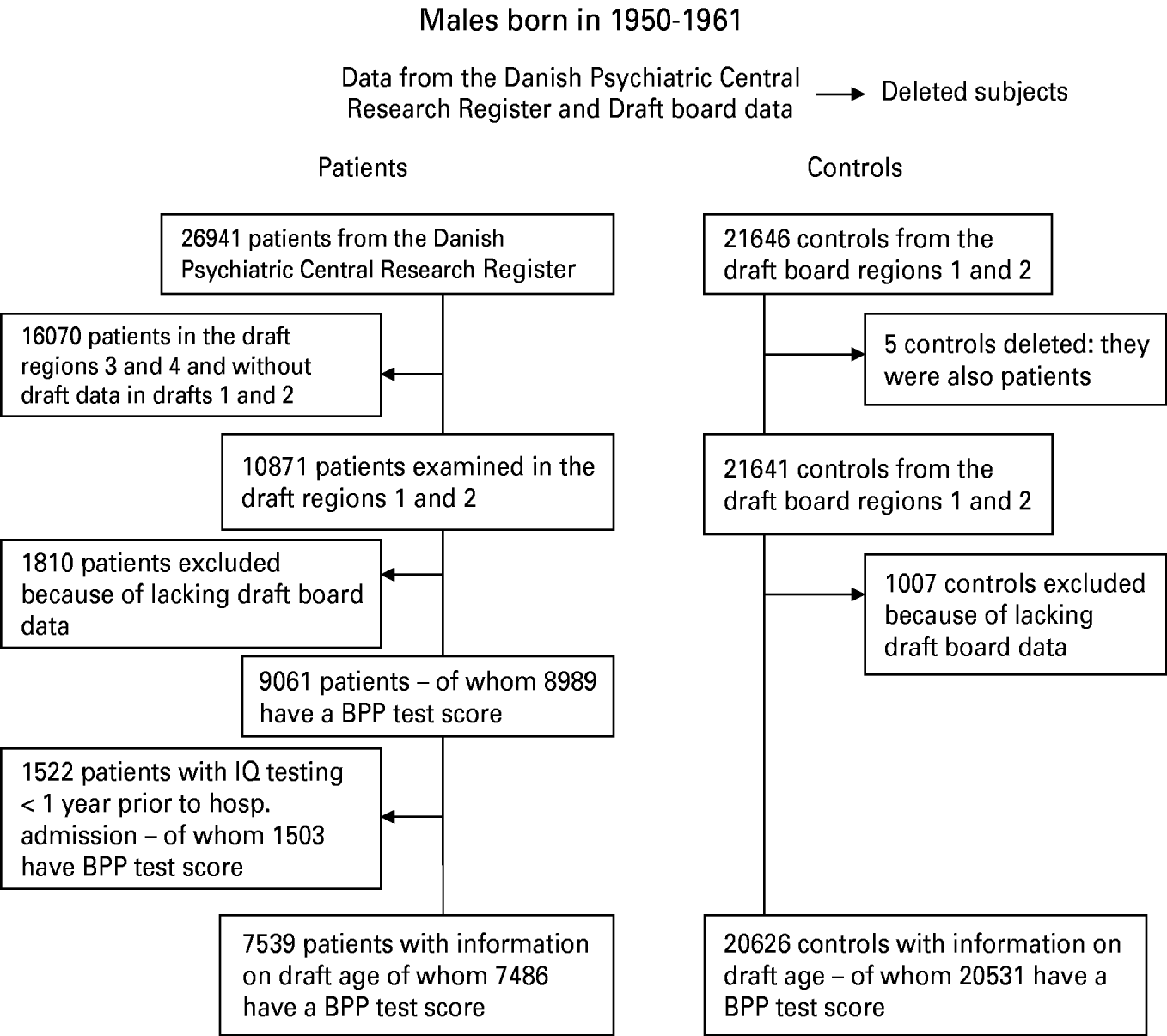
The target population of this study comprised all Danish male citizens, born between 1950 and 1961 and drafted between 1968 and 1989, at a mean age of approximately 19.5 years. With follow-up until 2004, 26 941 individuals from this population were identified as psychiatric patients in the Danish Psychiatric Central Research Register (excluding patients with ‘organic’ diagnoses). The youngest men were aged 43 years and the oldest 54 years at the end of the follow-up period. The age at the first hospitalization was considered as the age of illness onset. Fig. 1 shows the sample attrition.
The sample.

Collection of IQ data
The Danish draft archives are kept in five geographical locations. Because of financial constraints, our data collection was restricted to draft-board districts 1 and 2, including Copenhagen, the islands of Seeland and of Bornholm and representing more than 2 million inhabitants out of the total Danish population of 5.5 million. Using name and CPR number, draft board BPP scores were located for 8989 hospitalized index cases. By selecting the two cards flanking the index case, usually of the same or a very close birth date, intelligence scores were collected for 20 531 controls, never admitted to psychiatric hospital departments.
Psychiatric diagnoses
The mean number of hospitalizations per patient was 10.5 (range 1–393, s.d.=20.4). Many patients had several psychiatric diagnoses and to classify such patients we used a hierarchical diagnostic approach following the rules of the ICD-10: schizophrenia (Sz), non-affective non-schizophrenic psychoses (NSAP), affective disorder (AD), neurotic disorders (ND) and personality disorder (PD). Thus, a patient with a last diagnosis of PD, but previously hospitalized for AD, would be classified as AD.
Data analyses
As the purpose of this study was to examine pre-morbid intelligence, we excluded from the analyses 1503 patients who were hospitalized ⩽1 year following the draft-board examination, a procedure used in two similar studies (Davidson et al. Reference Davidson, Reichenberg, Rabinowitz, Weiser, Kaplan and Mark1999; Reichenberg et al. Reference Reichenberg, Weiser, Caspi, Knobler, Lubin, Harvey, Rabinowitz and Davidson2006). The final sample thus consisted of 7486 patients and 20 531 control subjects with pre-morbid IQ measures. The observed BPP raw score mean of the control sample was 40.11, which is close to the 39.32 mean predicted from a regression formula describing secular trends in BPP scores (Teasdale & Owen, Reference Teasdale and Owen1989). The standard deviation was 11.24, which is also close to the 11.38 observed for 6784 Danish conscripts born in 1954–1958 (Teasdale & Owen, Reference Teasdale and Owen1989). Consequently, to facilitate data interpretation, the BPP intelligence scores were linearly transformed to a scale with a mean of 100 and a standard deviation of 15 in the control group, corresponding to Wechsler's frequently used intelligence scales [this transformation was also used by Mortensen et al. (Reference Mortensen, Sørensen, Jensen, Reinish and Mednick2005)]. For the transformed BPP, age at draft-board examination and age at first admission, the means of the control group were compared with the mean of each diagnostic category and the diagnostic categories were compared two by two. The pooled t test or the Cochran t test was used depending on whether the variances could be assumed equal or not. The folded form of the F statistic was computed to test for equality of the two variances. Finally, for each diagnostic category, logistic regression was used to investigate the association between IQ categorized into seven intervals and the risk of becoming a patient with this particular diagnosis.
Results
The age at first hospitalization was significantly different among all diagnostic categories. The personality disorder patients were the youngest at first hospitalization (mean=28.9 years, s.d.=6.9) followed by Sz (mean=30.4, s.d.=7.8), NSAP (mean=32.2, s.d.=8.2) and ND (mean=33.4, s.d.=8.1). As expected, the patients with AD were the oldest at their first hospital contact (mean=40.0 years, s.d.=8.2). There were weak but significant correlations between pre-morbid IQ and age at first admission for Sz (0.053, p=0.02), NSAP (0.12, p<0.001), AD and PD (0.14, p<0.001) but not for ND (0.05, p=0.16).
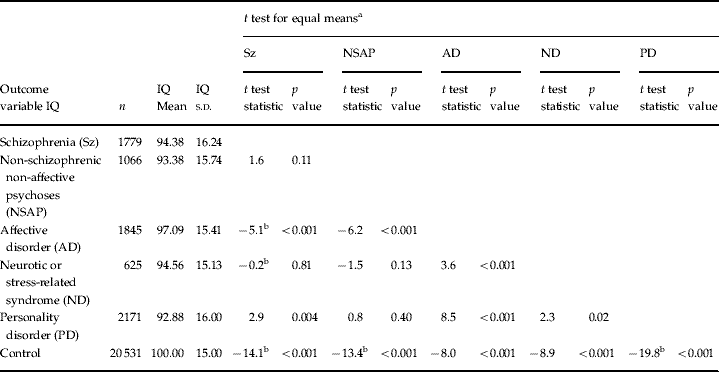
The results for the draft-board BPP are summarized in Table 1. All diagnostic categories of psychiatric patients had significantly lower BPP IQ than the controls. Moreover, there were significant differences among the diagnostic categories: the AD group had a significantly higher IQ than all other diagnostic groups. Patients with Sz, NSAP and ND had a higher IQ than patients with PD, who had the lowest score of all diagnostic categories.
Comparison of pre-morbid IQ given by the transformed BBP between the five diagnostic categories and the control group and between each diagnostic category

BBP, Børge Prien's Prøve; s.d., standard deviation; Sz, schizophrenia; NSAP, non-schizophrenic non-affective psychoses; AD, affective disorder; ND, neurotic or stress-related syndrome; PD, personality disorder.
a When the variances were assumed equal (p⩾0.05), the pooled t test was used for the comparisons. When the variances were not assumed equal (p<0.05), the Cochran t test was used. When the pooled t test was used, degrees of freedom df=n 1+n2 – 2, where n 1 is the number of subjects in the first category and n 2 is the number of subjects in the second category. When the Cochran t test was used, df is undefined.
b The p values from the test for equal variances are significant (p<0.05).
Table 1 also presents standard deviations and shows that all five diagnostic categories had a larger, but not dramatically larger, standard deviation than the control group. The schizophrenia category had the largest standard deviation, significantly larger than that of the control group and the AD and ND categories.
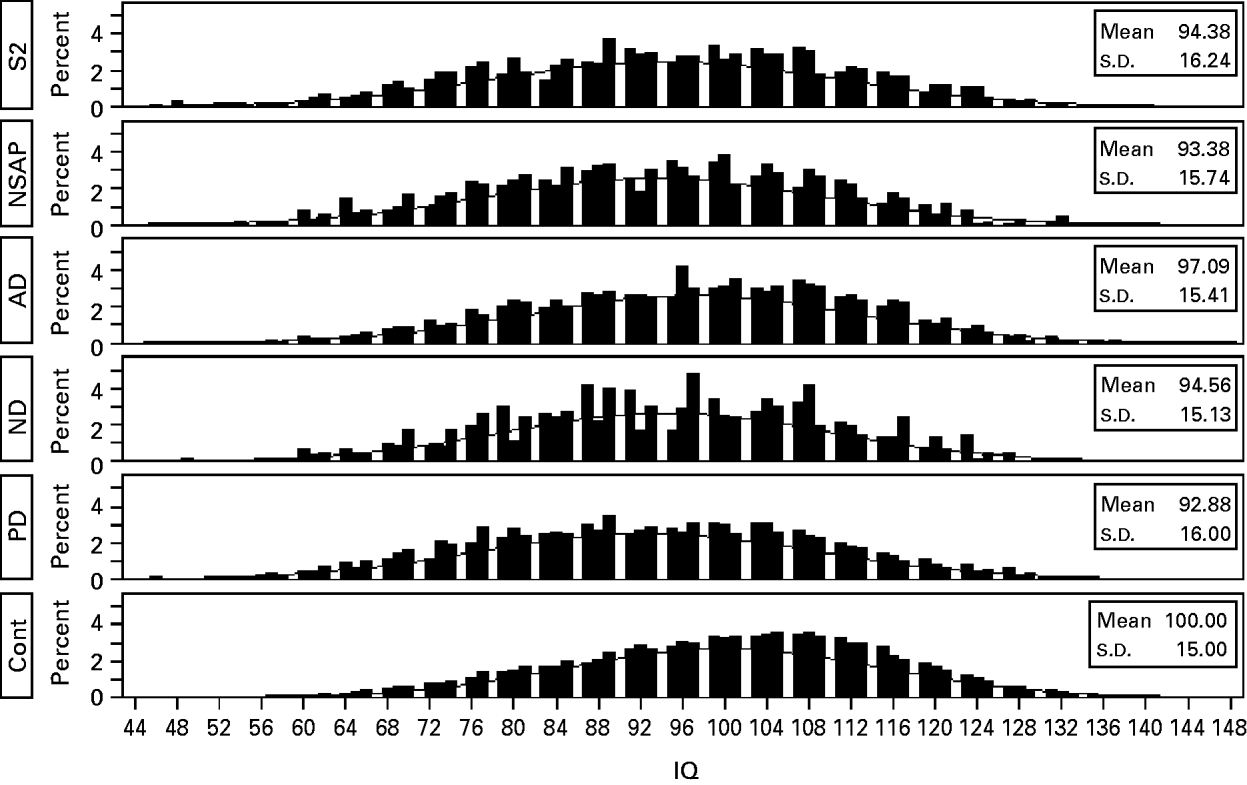
The Kolmogorov–Smirnov test showed that IQ in the control group and the five diagnostic categories was not normally distributed, but calculation of skewness and kurtosis indicated only moderate deviations from normality. In the control group skewness was −0.28 whereas it ranged from −0.01 (PD) to −0.16 (AD) in the diagnostic categories. In the control group kurtosis was −0.28 and ranged among the patients from −0.38 (AD) to −0.50 (Sz). Plots of the IQ distributions also indicated moderate deviation from normality and clearly suggested uni-modal distributions (Fig. 2).
IQ distribution and normal curves in diagnostic categories. Cont, Control, PD, personality disorder; ND, neurotic or stress-related syndrome; AD, affective disorder; NSAP, non-schizophrenic non-affective psychoses; Sz, schizophrenia.

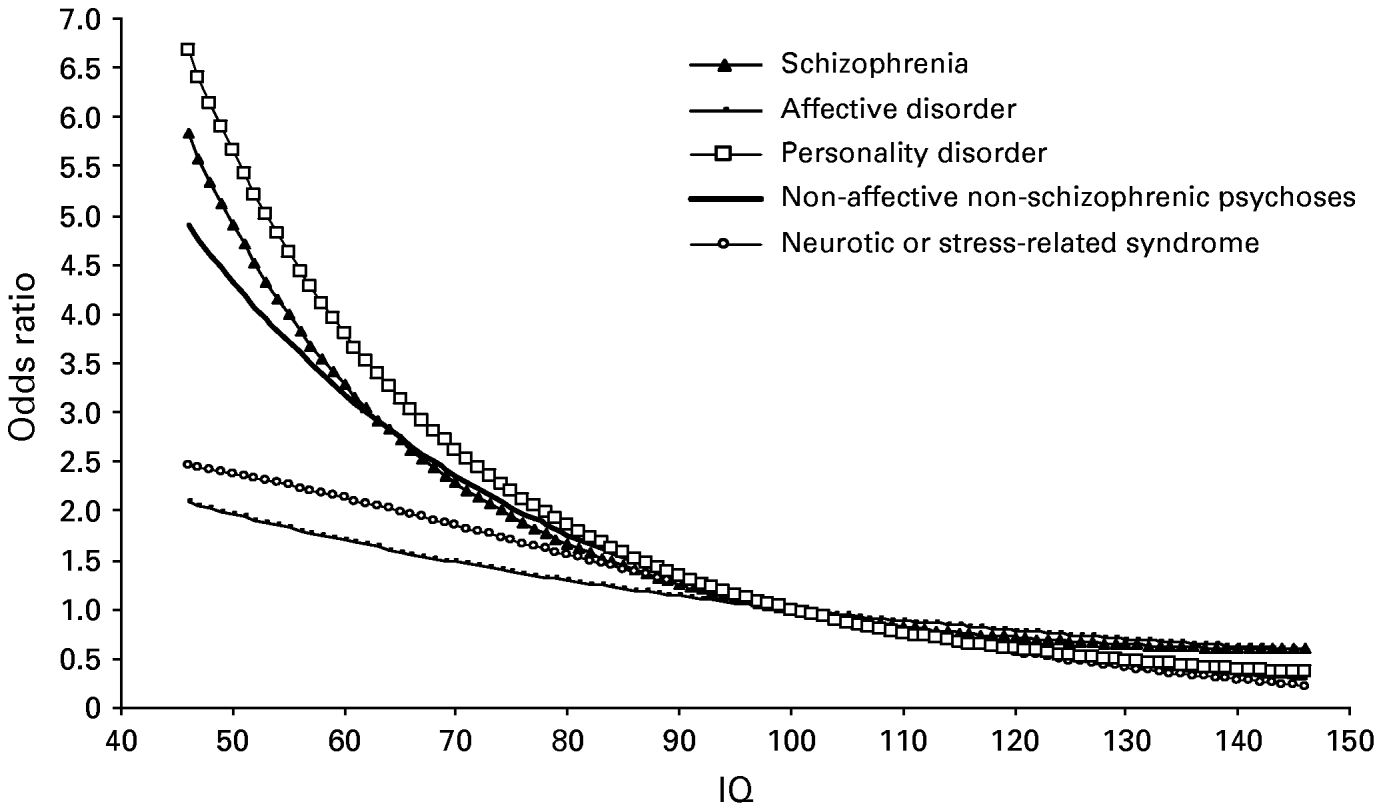
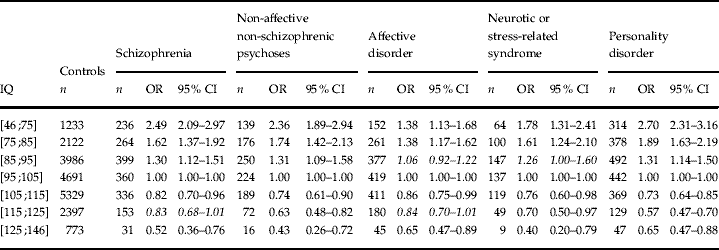
For each of the five diagnostic categories, Table 2 presents odds ratios (ORs) for seven IQ categories. For all diagnostic categories there is increasing risk of becoming hospitalized with a given diagnosis with decreasing intelligence. The confidence intervals (CIs) indicate significantly higher risk for IQ categories <95 compared with the reference group, except for AD and ND in the 85–95 IQ category, and significantly lower risk for IQ categories ⩾105, except for Sz and AD disorder in the 115–125 IQ category. Intelligence differences seem to affect the risk of being diagnosed across the full IQ spectrum, but the ORs in Table 2 suggest a non-linear relationship between IQ and risk of mental disorder, in particular for Sz, NSAP and PD. This is illustrated in Fig. 3, which for each diagnostic category shows the results of fitting logistic regression models with the continuous BPP IQ and IQ2 scores as linear and quadratic predictors and the risk of being a patient versus a control as a binary outcome. The quadratic component was only significant for Sz, but was approaching significance for PD. The linear components were all highly significant, demonstrating a linear trend for all five diagnostic categories.
Theoretical curve for the risk of being a patient versus being a control.

IQ categories and risk of becoming a patient versus a control in each diagnostic category

OR, Odds ratio; CI, confidence interval;
Figures in italics are IQ categories not significantly different from the reference category [95;105].
Discussion
This study focused on describing the observed relationship between draft IQ and risk of mental disorders. The study did not attempt to identify factors that may confound or modify the relationship. The main finding of this large-sample study is that psychiatric in-patients in general, that is irrespective of the diagnosis, have lower pre-morbid IQ than controls from the general population, confirming the previous Danish results by Mortensen et al. (Reference Mortensen, Sørensen, Jensen, Reinish and Mednick2005). The range of observed intelligence deficits was from about 3 to 7 IQ points below the mean of the controls (from about one-fifth to almost half of the standard deviation of 15 in the control group). PDs were associated with particularly low pre-morbid intelligence whereas ADs scored higher on pre-morbid intelligence test than all other diagnostic categories and were closest to the controls. Sz, NSAP and ND performed at similar intermediate levels, numerically closer to the scores of PD than to AD.
All diagnostic categories showed larger IQ variances than the control group, but these differences were modest. The IQ distributions of both the control group and the five diagnostic categories deviated only moderately from the normal distribution. This indicates that, apart from the difference in the mean scores, the distribution of intelligence is similar in healthy controls and in each of the five diagnostic categories. Most ORs in Table 2 are in the range from 0.5 to 2.5, and Fig. 3 shows similar risk patterns for the five diagnostic categories. For schizophrenia, NSAP and PD, IQ<75 may be associated with a particularly high risk, but the general pattern suggests that intelligence differences affect the risk of being diagnosed across the full range of the IQ spectrum for all diagnostic categories. To interpret Fig. 3 it is important to note that the quadratic component was only significant for the schizophrenia category, but also that Table 2 suggests that particular high risk of Sz, NSAP and PD is associated with an IQ<75.
This result is more consistent with a model assuming that the putative risk factors associated with lower intelligence operate in the majority of the patients rather than with a model in which the low mean scores in pre-morbid intelligence within each diagnostic group stem from a specific subcategory of patients with intelligence deficits. Accordingly, the associations between pre-morbid intelligence and risk of becoming a patient may partly reflect factors common to most categories of mental disease; thus, the hypothesis may be ventured that high intelligence acts as a protective factor (Walker et al. Reference Walker, McConville, Hunter, Deary and Whalley2002; Kremen et al. Reference Kremen, Koenen, Boake, Purcell, Eisen, Franz, Tsuang and Lyons2007; Koenen et al. Reference Koenen, Moffitt, Roberts, Martin, Kubzansky, Harrington, Poulton and Caspi2009). For certain categories, such as ‘neurotic’ and personality disorders, high intelligence and the associated coping abilities may decrease the likelihood of hospital admission (see below), and this may have contributed to the pattern of means observed in Table 1.
Our study is based on hospital diagnoses, and it is possible that IQ is related to the probability of hospitalization given mental illness. To investigate this possibility we calculated the Spearman correlation between the draft IQ and the number of hospitalizations. This correlation was low and slightly negative for the total sample of patients (−0.06) and for all diagnostic categories (ranging from −0.12 for Sz to −0.05 for AD). Because of the large sample size these low correlations were significant, but nevertheless they indicate that the correlation between IQ and number of hospital admissions is too weak to explain the observed associations between IQ and risk of mental disorders. Thus, low IQ is not just a common risk factor for hospitalization but also has an impact on the risk of developing specific mental disorders.
Certain methodological aspects of our study deserve attention. First, it is an inherent weakness of the draft studies that IQ is obtained by late adolescence, which is rather late in the natural course of mental illness (Kessler et al. Reference Kessler, Berglund, Demier, Jin, Merikangas and Walters2005). As described, we minimized this problem by excluding from the analysis individuals with hospitalization ⩽1 year after IQ assessment. One limitation of the study is the availability of the total IQ only, but this may not be a serious limitation because aggregate measures of cognitive function tend to predict schizophrenia better than tests of single, very specific cognitive functions (Fearon & Murray, Reference Fearon and Murray2002). Second, the study is limited to males only, and the association between intelligence and specific diagnostic categories may be sex dependent. However, in the Israeli draft studies (Reichenberg et al. Reference Reichenberg, Weiser, Rapp, Rabinowitz, Caspi, Schmeidler, Knobler, Lubin, Nahon, Harvey and Davidson2005) and in the meta-analysis of Woodberry et al. (Reference Woodberry, Anthony and Seidman2008), pre-morbid IQ in schizophrenia did not differ between the sexes. Third, this study only concerns patients identified because of their contact with psychiatric hospitals. In-patients are usually more severely affected than diagnostically similar individuals, who are either untreated or only treated in out-patient clinics (Parnas & Teasdale, Reference Parnas and Teasdale1987). This bias is probably mainly operative for the AD, ND and PD categories (Parnas et al. Reference Parnas, Cannon, Schulsinger, Mednick, Häfner and Gattaz1995). Fourth, socio-economic status may be related to both intelligence and the risk of mental disorder, and information on socio-economic status was not available for the conscripts. However, Mortensen et al. (Reference Mortensen, Sørensen, Jensen, Reinish and Mednick2005) adjusted BPP scores for parental social status and showed that the low IQ associated with the different categories of mental disorder could not be explained by family socio-economic background. A fifth methodological issue is the diagnostic classification of the patients with multiple hospitalizations and diagnoses. Not all researchers explain how they deal with this problem and those who do, use either the latest diagnosis or a hierarchical approach. We relied on a hierarchical approach following the rules of the ICD-10 as in the Israeli and Swedish studies (Reichenberg et al. Reference Reichenberg, Weiser, Rabinowitz, Caspi, Schmeidler, Mordechal, Zeev and Davidson2002; David et al. Reference David, Zammit, Lewis, Dalman and Allebeck2008). Finally, the diagnoses in this study are clinical and not based on research interviews. This is an intrinsic methodological constraint in epidemiological studies based on hospital diagnoses. However, two Danish studies have demonstrated that the clinical ICD-8 schizophrenia diagnosis, as de facto used by the Danish clinicians, was narrow and conservative, compatible with the DSM-III-R operational criteria of schizophrenia (Munk-Jørgensen, Reference Munk-Jørgensen1985; Jørgensen et al. Reference Jørgensen, Teasdale, Parnas, Schulsinger, Schulsinger and Mednick1987). There is also evidence supporting the validity of register-derived diagnoses of affective disorders (Kessing, Reference Kessing1998). It is also possible that changes in diagnostic practice and hospital admission criteria during the follow-up period may have affected the differences in IQ between each diagnostic category and the control group. To investigate this possibility we divided the sample into those born 1950–1955 and those born 1956–1961 and used a 43-year follow-up for both subsamples. There was no significant interaction between the year of birth two-level factor and the patient versus control factor. Thus, the IQ difference between the patients and the controls was similar in two subsamples defined by year of birth for all diagnostic categories, and it seems that that changes in diagnostic practice and hospital admission criteria during the follow-up period have not influenced the differences in IQ between patients and control substantially.
The mean pre-morbid IQ of 94.4 in our schizophrenic subsample was very close to the mean IQ of 94.7 observed in schizophrenic patients in a recent meta-analysis (Woodberry et al. Reference Woodberry, Anthony and Seidman2008). Thus, our results based on the so far largest sample of schizophrenia patients strongly confirm previous findings showing that future schizophrenic patients obtain pre-morbid IQ scores that are about one-half standard deviation lower than that of the controls, but not significantly different from the NSAP or ND patients. Schizophrenia patients performed better than patients with PD and worse than affective patients who showed the best performance of all diagnostic groups, yet nonetheless significantly lower than the performance of the controls (David et al. Reference David, Malmberg, Brandt, Allebeck and Lewis1997; Davidson et al. Reference Davidson, Reichenberg, Rabinowitz, Weiser, Kaplan and Mark1999; Zammit et al. Reference Zammit, Allebeck, David, Dalman, Hemmingsson, Lundberg and Lewis2004; Tiihonen et al. Reference Tiihonen, Haukka, Henriksson, Cannon, Kieseppä, Ilmo, Sinivuo and Lönnqvist2005; Reichenberg et al. Reference Reichenberg, Weiser, Caspi, Knobler, Lubin, Harvey, Rabinowitz and Davidson2006).
Both cohort and clinical studies show mixed results with respect to pre-morbid intellectual functioning in affective disorders (van Os et al. Reference van Os, Jones, Lewis, Wadsworth and Murray1997; Reichenberg et al. Reference Reichenberg, Weiser, Rabinowitz, Caspi, Schmeidler, Mordechal, Zeev and Davidson2002; Zammit et al. Reference Zammit, Allebeck, David, Dalman, Hemmingsson, Lundberg and Lewis2004; Osuji & Cullum, Reference Osuji and Cullum2005; Tiihonen et al. Reference Tiihonen, Haukka, Henriksson, Cannon, Kieseppä, Ilmo, Sinivuo and Lönnqvist2005). It has also been suggested that it is the presence of psychotic symptoms rather than affective disorders per se that is related to low pre-morbid intelligence (Reichenberg et al. Reference Reichenberg, Weiser, Rabinowitz, Caspi, Schmeidler, Mordechal, Zeev and Davidson2002; Hill et al. Reference Hill, Keshavan, Thase and Sweeney2004). Depending on the magnitude and the pattern of cognitive differences between schizophrenia and affective illness, authors either opt for a continuity of these two diagnoses or for a nosological separation (Goldberg et al. Reference Goldberg, Gold, Greenberg, Griffin, Schulz, Pickar, Kleinman and Weinberger1993; Reichenberg et al. Reference Reichenberg, Weiser, Rabinowitz, Caspi, Schmeidler, Mordechal, Zeev and Davidson2002; Hill et al. Reference Hill, Keshavan, Thase and Sweeney2004; Zammit et al. Reference Zammit, Allebeck, David, Dalman, Hemmingsson, Lundberg and Lewis2004; McIntosh et al. Reference McIntosh, Harrison, Forrester, Lawrie and Johnstone2005; Tiihonen et al. Reference Tiihonen, Haukka, Henriksson, Cannon, Kieseppä, Ilmo, Sinivuo and Lönnqvist2005; Green, Reference Green2006). The present study shows that future affective disorder patients pre-morbidly obtain higher scores in intelligence tests than all other diagnostic categories, including schizophrenia, but still lower than non-psychiatric controls. However, we do not think that these results justify any radical claim concerning the relationship between schizophrenia and affective illness.
The categories of ‘neurotic’ (essentially including all non-psychotic Axis I disorders) and personality disorders probably include a fairly heterogeneous spectrum of psychopathology (Coid, Reference Coid1999). As already noted, these hospitalized patients are very likely to be dissimilar from those untreated or treated in psychotherapeutic out-patient facilities. Our ND and PD samples probably include important proportions of individuals with significant dysfunction, abuse, maladaptive behaviour and lower IQ. The literature on personality disorder and pre-morbid intelligence or cognition is limited. However, an association with low intelligence is well documented for anti-social personality disorder (Kandel et al. Reference Kandel, Mednick, Kirkegaard-Sorensen, Hutching, Knop, Rosenberg and Schhulsinger1988). A few clinical studies of borderline, obsessive–compulsive, histrionic and narcissistic PDs identified deficits in several neurocognitive domains (Burgess, Reference Burgess1992; Coid, Reference Coid1999; Ruocco, Reference Ruocco2005).
The results concerning schizophrenia and non-affective psychosis are compatible with the hypothesis of disturbed neurodevelopmental trajectories in the genesis of schizophrenia (Pantelis et al. Reference Pantelis, YÛcel, Wood, Velakoulis, Sun, Berger, Stuart, Yung, Phillips and McGorry2005; Rappaport & Addington, Reference Rappaport and Addington2005), but do not provide information on the possible neurodegenerative decline in the course of the disease (Seidman et al. Reference Seidman, Buka, Goldstein and Tsuang2006). With the exception of ND, there were significant, albeit weak, correlations between low IQ and young age at the illness onset, not inconsistent with a neurodevelopmental genesis of mental disease.
Conclusion
This large sample study demonstrates that hospitalized patients of all major diagnostic categories obtain significantly lower pre-morbid intelligence scores than healthy controls. Patients hospitalized within 1 year of intelligence testing were excluded and the shortest mean time span that elapsed from the time of testing to the first hospitalization was 10 years. Therefore, the observed IQ scores are unlikely to be just a consequence of a fully developed (but undetected) disorder or of the so-called ‘prodromal’ symptoms.
The IQ is an aggregate of several measures of cognitive capacities. It may be considered as an index of the history of ontogenetic interactions between genetic, environmental and complex epigenetic processes, thus lending space to an interaction between several more specific, yet still extremely complex, factors such as genetic vulnerability, perinatal circumstances, socio-economic factors, and upbringing. It is likely that similar IQ deficits may reflect differential functional patterns and temporal vicissitudes of the processes that are operative in different, specific mental disorders. We believe that the demonstration of the IQ deficits in a range of psychiatric disorders should stimulate a multiplicity of research perspectives on the pathogenetic processes involved.
Acknowledgments
This work was supported by grants from the University of Copenhagen, Faculty of Medicine and H:S (Copenhagen Hospital Cooperation). We thank the Ministries of Health and Interior for their permission to consult the archives of the Danish Draft Board and M. Zimmerman from the Institute of Preventive Medicine for her help with data collection.
Declaration of Interest
None