Introduction: constructions of citizenship
Citizenship has become a central concept in sociology and political studies since the seminal articulation of the sociological meaning of the concept by T. H. Marshall (Marshall, Reference Marshall1950). As a field of investigation, citizenship is concerned with questions of what it means to be a member of society, how identities and loyalties are constructed, how we are supported and resourced as members (our rights) and how we contribute to society (our obligations and duties). For each of these questions, there is a range of contested perspectives (Lister, Reference Lister1997: 3–4). As Stokes (Reference Stokes2004: 120) has noted, the concept of citizenship has a number of dimensions. It can be understood as a legal status that defines who is part of a community, an administrative category for allocating certain rights, entitlements and responsibilities, an ethical vision embodying an ideal civic identity and a political practice, involving particular modes of participation.
Marshall (Reference Marshall1950: 8) argued that there has been a gradual extension of citizen rights, from civil rights (such as the right to free speech) to political rights (such as the right to vote) to social rights (the right to welfare). Following Marshall, much of the discussion of the development of citizen rights and obligations constructed citizenship as a status handed down from above (for example, see Mann, Reference Mann1987). This understanding of citizenship led individuals to be deemed passive citizens (Turner, Reference Turner and Mouffe1992: 44). Yet, as Lister (Reference Lister1997: 4) points out, it is possible to take another direction from Marshall's work, offering a more dynamic approach to the development of citizenship, particularly if citizenship is understood as a process. This approach might draw on Marshall's discussion of the way in which trade unions have enabled workers to use their civil rights collectively (see Marshall: 40–1). For Lister (Reference Lister1997: 5):
the struggle to gain new rights and give substance to existing ones is seen as being as important as the substance of those rights . . . From this perspective, citizens appear on the stage of both theory and practice not simply as passive holders of rights but as actively engaging with political and welfare institutions, both as individuals and in groups. In this way the idea of human agency becomes central to our understanding of citizenship.
In his discussion of various critiques of Marshall's work, Turner (Reference Turner and Mouffe1992) emphasises the importance of active citizenship, which involves people shaping rights and obligations through their participation in society as active rather than passive citizens. From the vantage point of active citizenship, the path of analysis begins with humans as autonomous self-determining beings, as agents who shape and change society. This path is based on the emergence of actors who want to be recognised as subjects in their own right, not just ‘subject’ to the state (Touraine, Reference Touraine2000). It places agency at the centre of societal development. Crucially, the focus on agency has opened up citizenship research to questions about different ways of being citizens and how subjects enact themselves as citizens (Isin and Nielsen, Reference Isin and Nielsen2008: 16).
As with much of the deliberations on citizenship, discussion of citizen entitlement is framed by how the relationship between the state and the individual is constructed (Turner, Reference Turner and Mouffe1992, Reference Turner2001). Turner (Reference Turner2001) argues that citizenship entitlement has historically occurred through three forms of citizen labour, resulting in three types of social identity: warrior-citizens, worker-citizens and parent-citizens. Citizens (usually referring to males) have a basic duty to work, and they gain rights and benefits from doing so. Services to the state have occurred through warfare and generate a range of entitlements for the soldier-citizen. Services to the state through the family, that is the procreation and maintenance of children, provide benefits to both men and women as parents. However, there are other ways of framing citizenship development and other ways of practising citizenship rights and obligations. For Turner (Reference Turner2001: 195), the voluntary, or third, sector is where we should first look to find new ways of practising citizenship. He states:
The third sector, and more specifically voluntary associations, can provide opportunities for social participation, for democratic involvement at the local level, and thus for active citizenship. They are essential to the survival of the public sphere, and in terms of service delivery, they can provide welfare programmes that are sensitive to local client needs.
Similarly Beck (Reference Beck2000) identifies another category of work, which he calls ‘civil labour’, which opens up new understandings of participation in civil society. It involves work in civil society, and in cultural, family and political activities. It is voluntary and self-organised, in the sense that what should be done and how it should be done are in the hands of those who actually do it (Beck, Reference Beck2000: 127). Beck's approach is consistent with Walzer's ‘civil society argument’ in which he identifies work in civil society as the alternative avenue of citizenship (Walzer, Reference Walzer and Beiner1995).
Touraine does not talk about citizenship, but about the personal subject, who at the individual level seeks the freedom to act, the desire for individuation. The personal subject is an ethical, autonomous agent, who seeks collective action as a ‘precondition for the transformation of the principles of justice, solidarity and mutual responsibility’ (Touraine, Reference Touraine2000: 57). In other words, the personal enters and shapes the social for the purpose of creating a better world for all. Citizens as individuals are still concerned with a responsibility to the social order, but not necessarily to the state, and may indeed be indifferent to the state or critical of it.
The third sector
The arguments of Touraine, Turner, Beck and Walzer draw attention to the importance of the ‘agency paradigm’, thus signalling new sites for enacting citizenship within civil society and the third sector. Conceptually, third sector organisations are separate from organisations operating in the state and the market, although they can be influenced strongly by both the state and the market. Third sector organisations mediate between the state and the individual and provide moral regulation of society, also generating the social capital necessary for social cohesion (Dasgupta and Serageldin, Reference Dasgupta and Serageldin2000; Turner, Reference Turner2001; Halpern, Reference Halpern2005).
The idea that third sector nurtures and facilitates citizenship practice has been a persistent backdrop to discussion of the third sector ever since Alexis de Tocqueville's reflections on American associational life in the first half of the nineteenth century (Tocqueville, Reference Tocqueville1968). Tocqueville contended that active participation in society through third sector organisations was crucial for maintaining the democratic character of political culture and a civic consciousness and the common good. In the twentieth century, Habermas (Reference Habermas1989) understood the power of emergent voluntary groups and their role in development of the public sphere. More recently the importance of third sector organisations in developing the networks of trust and mutuality that comprise social capital has been illustrated in the research by Putnam (Reference Putnam2000).
What is missing in discussions of active citizenship is empirical research which investigates the sites of active citizenship and critically examines the types and expressions of active citizenship in third sector organisations. The starting point for the arguments presented is that dimensions and meanings of active citizenship can be usefully examined through a study of the activities of third sector organisations and the participants in these organisations. The study explores who is involved, what values and views they hold, their reasons for participating, their activities in the organisation and what they value about their organisation.
The article reports on a study of the forms and roles of active citizenship in third sector organisations in six countries. In particular, this study explores what active citizenship means for citizens who are active within third sector organisations, drawing on the criteria developed by the Johns Hopkins Center for Civil Society. These are organisations with an institutional presence, are separate from the state and are non-profit distributing, self-governing with a voluntary membership (Salamon et al., Reference Salamon, Anheier, List, Toepler and Sokolowski1999: 3–4).
Methodology
This was an empirical study involving some 1,610 respondents across 11 towns in six countries. However, given the broad nature of the research questions, this was not a simple deductive test of hypotheses. Nor was it an inductive exploration of potential themes. Rather it should be viewed as an example of ‘abduction’ (Dubois and Gadde, Reference Dubois and Gadde2002), or systematic combining and matching of empirical data against a number of theoretical positions. That is, while the initial development of questionnaire items was partly shaped by existing theory, an exploration of the literature continued and was later shaped by the empirical findings.
The data were collected in the following countries: Australia, England, Netherlands, Russia, Spain and Sweden. Within each of the six countries, the study attempted to involve third sector organisations within one major regional centre and one small village (only one town was successfully surveyed in Russia). For each of the large regional and small rural towns selected for the study, a database of organisations was constructed from local informal and formal sources. From this database a range of third sector organisations were purposively selected as sites for our quantitative and qualitative research to ensure that different areas of thematic focus were covered. For the quantitative research, the aim was to approach up to twenty organisations in the large towns and up to ten organisations in the small towns. This was done for all 11 sites. In addition, qualitative interviews were conducted for approximately five organisations in each town, covering a mix of issues and sizes (these data are not available for Spain). The qualitative interview data are only briefly presented here, but contributed to the interpretation of the questionnaire responses.
Questionnaire data were obtained for a total of 1,610 respondents in the 11 sites. The obtained sample of questionnaire respondents varies considerably from site to site, reflecting differences in size of population, number of organisations within each and the ease of access to these. It is not intended that these samples be seen as representative of their country or their town. They simply reflect the views of citizens who are active in third sector organisations in these places.
Questionnaire items covered a range of attitudes and behaviours, including attitudes to political action, at local and national levels, and selection of preferred action to potential scenarios which might affect their local community, as well as reasons for joining their organisation. Demographic data items were also included.
Of the questionnaire respondents, 13 per cent were full-time workers within a third sector organisation, 8 per cent were part-time workers, 30 per cent were volunteers and 37 per cent were simply members. Overall, 59 per cent of respondents were involved in decision making within the organisation, and 61 per cent were also involved in other voluntary groups. Women made up two thirds of all survey respondents. The median age category of survey respondents was 45–64 years. The most common household type for the majority of locations was ‘couple with dependent children’, and for the older cohorts, childless couple households and single person households were also common. Many (30 per cent) were retirees or pensioners, while 37 per cent were fully employed. There was a high percentage of respondents with university qualifications.
Results
Types of third sector organisations
Respondents were asked to identify up to three major activities of their organisation. This gives some indication of the range of orientations of those surveyed. These reflect the range of orientations suggested by Brown et al. (Reference Brown, Kenny and Turner2000). Many organisations (33 per cent) were primarily focussed on a charity or formal welfare service orientation where support and services are provided to disadvantaged and marginalised individuals, that is the preservation and support of the community. Some were focussed on culturally oriented (21 per cent) and sporting activities (18 per cent). Some organisations also had an activist orientation (5 per cent), being concerned with human rights. Other organisations had a strong self-help orientation, premised on the value of mutual learning and support based around empathy and trust. Self-help groups were often quite activist in their approach to an issue. The various orientations are not exclusive; one organisation might be based on a constellation of several overlapping orientations.
Attitudes to citizenship action
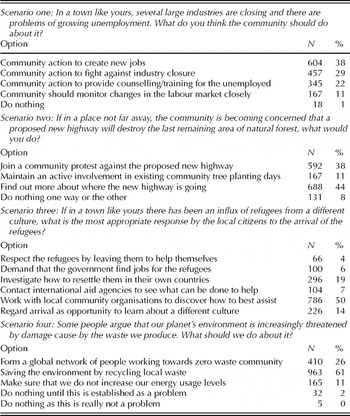
In order to assess respondents’ attitudes to different kinds of citizenship action, several questionnaire items explored typical scenarios faced by citizens in order to gauge their likely response (see
Table 1). Each scenario depicted a fairly typical current social/political issue across all survey locations, and respondents were asked to imagine how this might affect them, and how therefore they would react. Alternative responses were designed to represent key citizenship responses ranging from no or little action, or a conservative support for the status quo, to more active forms of political protest (designed to change government action) or non-oppositional collective community action. We also wished to estimate the likelihood of a global or more local approach.

For scenario one, concerning industry closure, four of the five options concerned some form of community action, but these ranged from simply monitoring the situation or providing counselling, to more interventionist actions to fight the closures or create new jobs. The dominant response was to take community action to create new jobs, followed by a preference to fight the closures. In the case of scenario two, concerning destruction of a forest, the dominant response was to obtain further information first, before joining a protest over land clearing. The most frequent response to scenario three, concerning an influx of refugees, was to work with local organisations to help refugees rather than demand government action or work internationally. Interestingly, there was almost unanimous agreement that scenario four of environmental waste disposal represented a real problem. The most common reaction in all cases was to take some kind of positive action but at the local level. There was a willingness to fight the perceived threat to local services or amenities, but this would only occur after other alternatives had been explored.
Table 2 provides a summary of preferred responses of citizens to a variety of community issues at the local level.
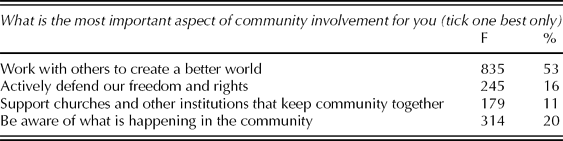
Community Involvement
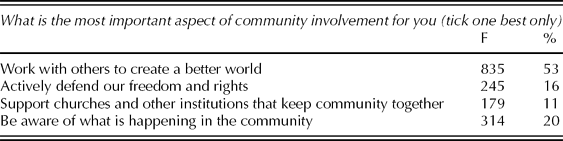
N = 1,573.
Several trends emerge from this summary table. First, the dominant approach is to work with others in the community to create a better world. Overall, 53 per cent of respondents selected this option. Such a response suggests proactivity, a belief that they, as citizens, are agents for collective action that may produce a better world. It also strongly suggests the importance of associationalism, that is it is the collective action of the community that is important. The second option, to actively defend our freedom and rights, was selected by 16 per cent of respondents overall. The final option, to simply be aware of what is happening, may be a necessary prelude to informed action, but may also be a signal of a more passive, non-active citizenship. The response here was 20 per cent. While there were strong overall trends, there were also important variations between towns, reflecting the specific context of each.
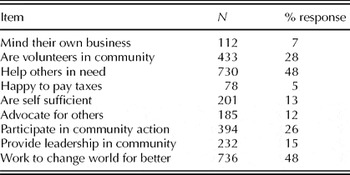
Table 3 identifies the perceived criteria for ‘good citizens’. Most respondents identified helping others, making the world a better place, participation in community action and volunteering as crucial. There is a strong emphasis on positive, collective action.
Good citizens are those who (top two choice only, per cent response)

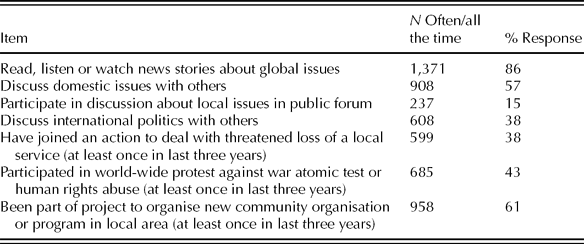
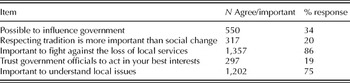
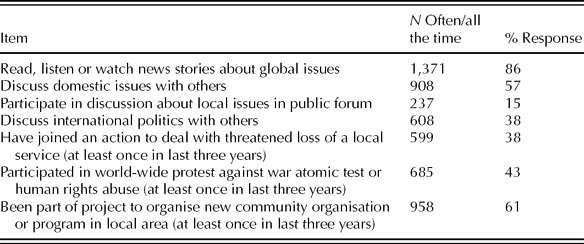
To what extent does active citizenship involve political engagement? A number of items explored this engagement (Tables 4 and 5). In general, respondents believe it is important to be informed about local and global issues. Well over two thirds of respondents believed it important or very important to understand both domestic issues and international politics. However, a much smaller number (15 per cent) were actually prepared to engage in these discussions in a public forum, even concerning domestic issues. Respondents were equally balanced and fairly neutral about the possibility of influencing governments. There was generally low trust in government officials to act in citizens best interest. There appeared to be a preference to act directly within civil society. Few agreed that respecting tradition is more important than social change. The majority (86 per cent) felt it was important or very important to fight against the loss of local services. Indeed, a sizeable minority (38 per cent) had joined in an action to deal with the threatened loss of a local service in the last three years, and 61 per cent had been part of a project to organise a new community organisation or program in the local area in the past three years. Overall, between 40 per cent and 50 per cent of respondents expressed some readiness for political opposition, but only under fairly extreme circumstances. Most preferred a form of positive or constructive action to provide new services within civil society. What is evident here are two, apparently contradictory trends. First, these citizens are concerned, informed, self-reflective about wider social/political issues. Second, they are resistant to active engagement in the political process, preferring instead to avoid confrontation and work constructively within civil society at the local level.
Response to political issues
Attitudes to political action

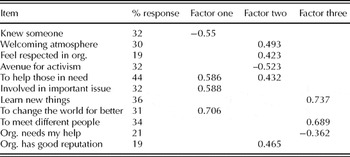
Finally, respondents were asked to indicate their personal reasons for joining their community organisation. A factor analysis of the responses is presented in Table 4 indicating three underlying components explaining 39 per cent of the variance (F1 = 17.4 per cent, F2 = 11 per cent, F3 = 10.6 per cent). Factor one consisted of those reasons for joining that related to social action. Factor two consisted of those reasons that related to social connectedness. Factor three was about personal development or learning as important reasons for joining the organisation.
The qualitative data drawn from organisational interviews reinforced these trends. By and large, these organisations are not specifically oriented towards social/political change at the government policy level, but rather operate as charitable or self-help groups designed to improve the lives of their members and the local community. For instance, a local Artists Association in Russia is a mutual support organisation to support artists and assist in promoting culture, operating with the support of the local government administration. A Breast Cancer Support group in the UK is a self-help group with little or no external funding. The community centre in Warmond, Netherlands, is owned by the village administration, and is host to some fifteen community organisations which use the centre, with brass band, choirs, recreational activities for older people, sport activities and after school care. The village is reputed to have one of the highest rates of volunteering in the country. The Old Mill Heritage Group in the UK was first established to protest against the building of a nuclear power plant in the area. Having succeeded in this protest, the Group subsequently turned to saving heritage buildings, refurbishing and opening these to the public. The Church Women's Society in Blayney, Australia, engages in general welfare work and runs an opportunity shop. The Society has good relations with the local government Council, but they ‘try to avoid getting involved in political issues’. The Development Organisation in Lund, assists refugees, donates to overseas projects and attempts to deal with local racism. Its funding is mainly derived from donations, and it operates independently of state control. Several organisations in the UK, Netherlands and Australia provide services for people with disabilities, using both professional staff and volunteers. There are many similar examples of local organisations in each country, each operating with a spirit of mutuality, volunteering, and positive assistance to some section of the community. Most operate with the support and co-operation of the local government, and most explicitly avoid what they see as political confrontation. However, as in the case of the Old Mill Heritage Group, they will engage in direct political action when necessary. Most focus on local action, though some also have a broader international reach, as does the Swedish Development Organisation.
Reasons for joining organisation

Note: Factor extraction: Principle component Analysis: Varimax rotation with Kaiser normalisation Rotation converged in 5 iterations)
Analysis
We are now in a position to make some tentative conclusions about the nature of active citizenship for those members of third sector organisations in our study. Both the qualitative cases and the survey data provide some consistent themes, and a clear though complex picture of active citizenship as seen from the citizen's perspective.
There are two major, and apparently contradictory, themes emerging in the data. On the one hand, citizens are actively engaged in, usually several, organisations. They are well informed about local and global issues, and believe that good citizens are those who work to make the world a better place. They are concerned with issues of disadvantage and social justice, and work towards ameliorating these issues. On the other hand, citizens by and large avoid active oppositional engagement in the political process. They prefer to work collaboratively with government and to work at the local level. The first is a theme of active engagement, proactively working for a better world. The second provides a theme of social maintenance, of support for the existing structures and facilities in the community, while providing relief for the disadvantaged often within conservative charity or welfare organisations. The extent to which these actions are transformative is more ambiguous. The two themes need to be unpacked and then integrated.
These citizens tend to avoid political confrontation, and prefer where possible to work collaboratively with the local authorities to solve local problems. They do not engage much in public debate, and generally do not show much trust in government, preferring to work outside government, that is within civil society. This suggests that many, perhaps the majority, of the respondents would partially fail the criteria of citizenship established by Kymlicka (Reference Kymlicka2002). For Kymlicka, this kind of active citizenship requires not only that people be well informed, that is to listen, but also that they be prepared to publicly debate the alternatives, thus encouraging better decisions and understanding of political actions. However, our citizens do nonetheless keep a watching brief to ensure that existing institutions are safeguarded, and that the principles of non-discrimination are extended from government to the practical everyday concerns of civil society; and, they were also clearly prepared to act when necessary, usually to defend against the loss of a local and valued service.
While our respondents avoided political activism, they were nonetheless proactive in civil society. So, for example, nearly half defined a ‘good citizen’ as one who works to change the world for the better. There is consistent evidence of both proactivity and associationism. That is citizens wish to be proactive agents of change and to do so collectively, to work together to solve problems faced in the community. This was also one of the core factors in reasons for joining a specific community organisation; many join to assist in social change. Of course, the extent to which active citizens can bring about social change is always circumscribed by the contextual factors, including structural inequalities, a point that was not acknowledged by our respondents. This theme is consistent with Walzer's civil society argument: citizenship is not about political activism necessarily, but about the pluralism of associational life in which men and women perform a great variety of useful work. (Walzer, Reference Walzer and Beiner1995: 173).
Consistent with Walzer's argument, much of the work of citizens is at the local level. Indeed, the responses support the position of ‘think global, act local’. Responses to the scenarios reinforced that perspective. Even global problems could only be tackled through local action. An important motivation to work within the local community is to help those in need. Nearly half of all respondents placed this as equal first definition of a ‘good citizen’. Many of the case study organisations, for example, were concerned with practical assistance for people with a disability. Others were concerned with practical programs for youth. In response to the scenario concerning refugees, the dominant response was to ‘Work with local community organisations to discover how to best assist’. This work is largely positioned within a charity or residual welfare frame. However, many of the people interviewed also had a strong emphasis on self-determination, self-help and self-advocacy, such as the Older Citizens group in Ballarat and the Breast Cancer Support Association in the UK.
This motivation also fits within a model of active citizenship which places emphasis on maintenance of community networks and services, on cohesion and the enactment of social capital. Such engagement by citizens has various desirable consequences, such as improved health and wellbeing, reduced crime and the potential to address a collective emergency (see for instance Halpern, Reference Halpern2005). Many community sports and services organisations (such as bush fire brigades in Australia) are of this sort. Such citizenship is non-oppositional, and involves support for churches and other institutions that keep the community together. It is this aspect of civil society that may be regarded as hegemonic in that it has the effect of maintaining the status quo, including existing power relations, in the interests of harmony. However, it involves active engagement of citizens in support of the community.
Being a member of a local community-based organisation provides an ideal avenue for active citizenship. So, for example, important reasons cited by our respondents for joining their organisation included to help those in need (44 per cent), to change the world for the better (31 per cent) and as an avenue for activism (32 per cent). But it was also important to respondents that the organisation had a welcoming atmosphere (30 per cent) and provided an opportunity to meet different people (34 per cent). Some joined explicitly to effect social change. Others joined the organisation for its social networks, and the opportunities for positive action that provides. This is about helping people, maintaining community, in a gentler way. Interestingly, many respondents value the welcoming interpersonal style of the organisation, even though this is not seen as a primary factor in the success of the organisation. Many join for the opportunity for personal development, including the opportunity to meet different kinds of people. This is where the interpersonal and the political meet. People wish to effect both social and personal change, a point which resonates with Touraine's perspective on living a responsible and happy life (Touraine, Reference Touraine2000: 297).
We may conclude that while there are variations in the respondents’ approach to active citizenship, there are very strong common themes. Active citizens are both proactive and wish to work collectively and collaboratively to solve the immediate social and environmental problems faced by their community. Maintenance of community and social change are not necessarily seen as mutually exclusive. Making the world a better place is social change, but, in the eyes of these respondents, this social change can be incremental. They are by and large pragmatic and practical, assisting those in need, enriching their culture and preserving what is good in the community. Activism may be in defense of preserving local heritage that is threatened. These citizens prefer a collaborative to a confrontational political style. Few are visionary in the sense of working for a radically different new world. They work towards the maintenance of what is good in their community, while rectifying what they see as obstacles to this. They wish to ameliorate the distress of the disadvantaged without however radically calling the status quo into question. But they are prepared to fight if necessary, if what they see as good is severely threatened, to resist the unjust or negative effects of action by the state or the market. Their citizenship is embodied in the form of the third sector organisations to which they devote their energy. People are involved in organisations because they care about the particular issue to be remedied. The specific issue is the driving force of involvement, not a desire to be an active citizen in the general or abstract sense.
This view of active citizenship which avoids political activism, resonates with Turner's analysis, and with Touraines's analysis in particular. As Touraine also notes, new practices centre on ‘concrete issues involving or relating to direct interpersonal relations’ (Touraine, Reference Touraine2000: 57). Social action is taking place at the grass-roots level, not through the mechanisms of the political machinery. Social action is about creating the conditions for the rights of all to live a responsible and happy life. Sometimes that appears as a conservative form of maintenance, but equally it can appear as a creative new form of association and mutual support. The active citizen is one who seeks the freedom of the personal subject, in solidarity and co-operation with others through third sector organisation.
Acknowledgement
An Australian Research Council funded study: Comparative dimensions of active citizenship: an analysis of indicators of inclusivity and exclusivity in civil society. The study has been a collaborative project undertaken by Chief Investigators Sue Kenny, Kevin Brown, Jenny Onyx and Terry Burke, and many other researchers in each of the countries, whose contribution to the project has been invaluable