Introduction
The genus Pronectria Clem. currently comprises c. 35 species. Most of them are host-specific, almost two thirds being confined to one host species and almost one third to one host genus. Only five known species live on different, but related, host genera: Pronectria echinulata Lowen and P. leptaleae (J. Steiner) Lowen on Phaeophyscia, Physcia, and Physconia, P. robergei (Mont. & Desm.) Lowen on Peltigera and Solorina, P. tincta (Fuckel) Lowen on Anaptychia and Physcia, and P. subimperspicua (Speg.) Lowen on Parmelia and Punctelia. Pronectria subimperspicua is also known to live on Physcia, but this is most probably a secondary infection (Brackel Reference Brackel2007).
Three Pronectria species are known to live on members of the Collemataceae: P. leptogii Etayo on tropical Leptogium phyllocarpum (Etayo Reference Etayo2002), P. pilosa Etayo & López-Silanes on Collema furfuraceum (Lopez de Silanes et al. Reference López de Silanes, Etayo and Paz-Bermúdez2009), and P. tenacis (Vouaux) Lowen on Collema tenax (Rossman et al. Reference Rossman, Samuels, Rogerson and Lowen1999). Several other nectroid fungi have been recorded on Collemataceae: Nectria brutia Diederich & Puntillo is known from Collema sp. (Diederich & Puntillo Reference Diederich and Puntillo1995) and from C. auriforme (Lopez de Silanes et al. Reference López de Silanes, Etayo and Paz-Bermúdez2009), Xenonectriella lutescens (Arnold) Weese from Collema fasciculare (Santesson et al. Reference Santesson, Moberg, Nordin, Tønsberg and Vitikainen2004), Xenonectriella leptaleoides (Etayo) Etayo and Trichonectria leptogiicola Etayo from Leptogium phyllocarpum (Etayo Reference Etayo2001, Reference Etayo2002; Etayo & Sancho Reference Etayo and Sancho2008), Nectriopsis collematis Diederich from Collema sp., Nectriopsis lecanodes (Ces.) Diederich & Schroers from Collema and Leptogium (Ertz Reference Ertz, Nash, Ryan, Diederich, Gries and Bungartz2004), although typically on Peltigera, and Nectriopsis leptogii Diederich from Collema fuscovirens (Hafellner & Wieser Reference Hafellner and Wieser2000) and Leptogium azureum (Aptroot et al. Reference Aptroot, Diederich, Sérusiaux and Sipman1997).
The present paper describes material originally placed in P. tenuispora (Hawksw.) Lowen (Etayo Reference Etayo1998) as a new Pronectria species from Collema.
Materials and Methods
Morphological and anatomical observations were made using standard microscopic techniques. Microscopic measurements were made on hand-cut sections mounted in water to an accuracy of 0·5 μm. Measurements of ascospores are recorded as (minimum–)  (–maximum) followed by the number of measurements (n). The specimens are deposited in the private herbaria of the authors and the holotype of Pronectria collematis in M.
The Species
Pronectria collematis Etayo & Brackel sp. nov
Fungus lichenicola. A Pronectria tenacis differt ascomatibus minoribus 120–150 μm et ascosporis longioribus (16–)18–21·5(–23) × 3·5–4·5 μm. Crescit supra thallum Collemae auriforme, C. cristatum et C. undulatum.
Typus: Germany, Oberbayern, Kreis Garmisch-Partenkirchen, Garmisch-Breitenau, Herrgottsschrofen, limestone rocks, on Collema undulatum, alt. 780 m, MTB 8532/1, 47°28′54″N, 11°02′53″E, 24 August 2009, W. v. Brackel 4966 (M—holotypus; hb. Brackel—isotypus).
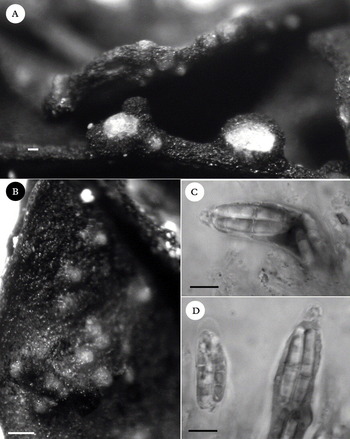
Pronectria collematis. A, ascomata on the thallus margin; B, ascomata on the thallus surface; C & D, asci with ascospores. Scales: A & B = 100μm; C & D = 10μm.

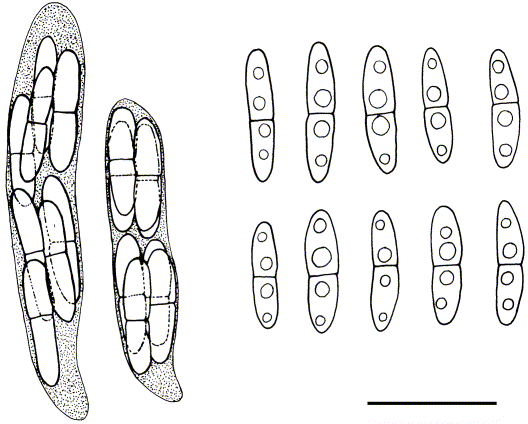
Pronectria collematis, asci and ascospores. Scale = 20μm.

Ascomata completely immersed in the host thallus and apothecium margin, swelling the thallus on the upper and lower side, later erumpent (to less than half), scattered, obpyriform, 120–150 μm wide and 150–180 μm high, yellowish in exposed parts, without hairs or papillae; ostiole concolorous, lined with periphyses c. 1 μm thick; ascomatal wall hyaline to very pale orange, 17–24 μm thick, formed by 4–6 rows of cells, which in cross section are applanate in the outer layer and ± isodiametric in the inner wall layer, in surface view of textura angularis with cells of 5–12 μm diam., K−, I−, lactic acid −; centrum with few oil drops. Paraphyses gelatinized, absent at maturity. Asci clavate, 8-spored, apically convex, wall not thickened, only ascoplasm I+ orange, 50–65 × 8–11 μm (n = 10). Ascospores usually positioned in two subsequent clusters of four spores each, narrowly ellipsoid to cylindrical, straight or slightly curved, hyaline, 1-septate, slightly constricted at the septum, smooth-walled, with two big guttules in each cell, (16–)18–21·5(–23) × 3·5–4·5 μm, l/b = (4–)4·4–5·6(–6) (n = 25).
Substratum and habitat. Pronectria collematis is known from Collema auriforme, C. cristatum and C. undulatum. As the ascomata of the fungus are more abundant on the thallus margin they may be confused with host pycnidia, but they can also appear on lobules and even on the thalline margin of the apothecia. The infested parts of the thallus are not usually visibly damaged; only in areas with many fungal ascomata do they show a slight discoloration. The host lichens are growing in shady situations on limestone rocks.
Distribution. The new species is currently known from S Germany (at the edge of the Alps) and N Spain (Pyrenees).
Other specimens examined. Germany: same locality as type, on Collema auriforme, 24 April 2009, W. v. Brackel 4930 (hb. Etayo—topotype).—Spain: Navarra: Larra, km 22, on calcicolous C. cristatum, Pinus uncinata forest, 1650 m, 1995, J. Etayo 12991 (hb. Etayo).
Discussion
The new species had already been reported as Pronectria tenuispora in Etayo (Reference Etayo1998) and as Pronectria sp. in López de Silanes et al. (Reference López de Silanes, Etayo and Paz-Bermúdez2009). Pronectria tenuispora was described as growing on Peltigera (Hawksworth Reference Hawksworth1978); it has larger asci, 60–90 × (6–)7–9(–10) μm (vs. 50–65 × 8–11 μm), longer ascospores, 22–28(–33) × 3·5–4(–4·5) μm [vs. (16–)18–21·5(–23) × 3·5–4·5 μm], bigger perithecia, 150–250(–350) mm wide, 200–300 μm high (vs. 120–150 μm wide and 150–180 μm high), which are orange with a red ostiolar area (vs. yellowish without red ostiolar area).
The only two species of Pronectria so far described from Collema are P. tenacis and P. pilosa. Pronectria tenacis has larger obpyriform ascomata (200 μm wide and 240 μm high), with a purplish red papillum, the centre with orange oil drops, and shorter and wider ellipsoid-ovoid ascospores, 10–16 × 5–6 μm, at first hyaline, then pale orange and verruculose (Rossman et al. Reference Rossman, Samuels, Rogerson and Lowen1999). Pronectria pilosa has smaller, setose ascomata 50–80 μm diam., and smaller ascospores, 10–13·5(–15) × 3–3·5 μm (López de Silanes et al. Reference López de Silanes, Etayo and Paz-Bermúdez2009).
We have also to compare the new species with P. leptogii Etayo (Etayo Reference Etayo2002), which grows on the tropical Leptogium phyllocarpum. This species has slightly smaller perithecia, 100–120 μm, completely hidden by the host thallus, abundant yellow-pinkish guttules in the hymenium and ascomatal wall, and smaller ascospores, 11–15·5(–17) × 2·5–3(–4) μm, not arranged in two clusters in the ascus.
In the genus Pronectria there are only three other species with similarly sized ascospores: P. oligospora Lowen & Rogerson var. oligospora, P. tincta (Fuckel) Lowen, and P. xanthoriae Lowen & Diederich. The first is separated from the new species by the dark red ascomata and the 2–8-spored asci, the last two by the verruculose ascospores, not arranged in clusters. They all live on different host genera (Punctelia, Anaptychia or Physcia, and Xanthoria).
All the species of Nectria, Nectriopsis, Trichonectria, and Xenonectriella mentioned in the introduction differ from the new species in their generic features: in Nectria, Nectriopsis, and Trichonectria the ascomata are superficial or sessile, the last genus with thick-walled setae; in Xenonectriella the ascospores become brownish and ornamented, and the peridium reacts K+ purplish or dark red.
In the type locality of Pronectria collematis two apparently different species of Pronectria were found growing on C. auriforme. In addition to the new P. collematis, a second undescribed species with larger and finally more erumpent (to more than half) perithecia, 130–200 μm, and wider ascospores, (13·5–)14–16(–19) × (5–)5·5–7 μm, l/b = (1·9–)2·1–2·8(–3) (n = 32), with cells frequently different in size and shape, the upper one being broader, the lower one narrower, attenuated and constricted at the septum, was found. This species also differs from P. tenacis by its yellowish perithecia. However, before describing this species we would like to study samples of this Pronectria from different localities.
Specimens examined of the undescribed species. Germany: Oberbayern: Kreis Garmisch-Partenkirchen, Garmisch-Breitenau, Herrgottsschrofen, limestone rocks, on Collema auriforme, 780 m, MTB 8532/1, iv 2009 / viii 2009, W. v. Brackel 4954 (hb. Etayo), 4967 (hb. Brackel).
We thank Anna Guttova (Bratislava) for confirming the identification of the hosts of specimens W. v. Brackel 4966, 4967, Daniel T. Hardiman (Dublin) for correcting the English text, and Paul Diederich and an anonymous reviewer for helpful comments on the manuscript.