Introduction
It is well documented in psychotrauma research that sex- and violence-related traumatization is especially associated with higher risk of post-traumatic stress disorder (PTSD) (Brewin et al., Reference Brewin, Andrews and Valentine2000) and other mental health problems (Faravelli et al., Reference Faravelli, Giugni, Salvatori and Ricca2004; Rees et al., Reference Rees2011). Furthermore, women are especially vulnerable to sexual victimization in their lifetime (Hapke et al., Reference Hapke, Schumann, Rumpf, John and Meyer2006). However, sexual violence is and has been a taboo in our societies (Henry, Reference Henry2010). After experiencing sexual violence, most victims feel shame, guilt, and embarrassment, which are often responsible for non-reporting of these crimes (Sable et al., Reference Sable, Danis, Mauzy and Gallagher2006; Tjaden and Thoennes, Reference Tjaden and Thoennes2006). These feelings, along with anger and hostility, are also present in witnesses of sexual violence, especially at younger age (Lehmann, Reference Lehmann2000). Consequently, it is not surprising that the psychological consequences of rape during World War II (WWII) and subsequent occupation in today's elderly population are largely unknown (Kuwert and Freyberger, Reference Kuwert and Freyberger2007).
Rape in wartime is not merely an act of individual atrocity but has been applied as strategic weapon to demoralize and destabilize whole societies (Hargreaves, Reference Hargreaves2001; Shanks et al., Reference Shanks, Ford, Schull and Jong2001; Zawati, Reference Zawati2007; Sjoberg and Peet, Reference Sjoberg and Peet2011). Reports of mass rape date from more recent conflicts, such as the Balkan wars during the 1990s (Loncar et al., Reference Loncar, Medved, Jovanovic and Hotujac2006), back to mass rapes conducted by the Red Army after WWII (Messerschmidt, Reference Messerschmidt2006). While rape as trauma has been mentioned among other traumatic experiences in recent studies of WWII-related traumatization and current mental health (Teegen and Meister, Reference Teegen and Meister2000; Kuwert et al., Reference Kuwert, Spitzer, Trader, Freyberger and Ermann2007), so far only one study has focused explicitly on the suffering of (female) victims of rape during WWII (Kuwert et al., Reference Kuwert2010).
In this brief report, we present data on experience and witness of sexual violence during WWII and the subsequent occupation (1945–1955), along with indicators of mental health, that were assessed as part of a larger study on WWII-related trauma in a sample of elderly Austrians.
Methods
From a larger epidemiological study on WWII and postwar-related trauma in elderly Austrians (N = 316; Glück et al., Reference Glück, Lueger-Schuster, Ruggenthaler and Stelzl-Marx2011) we excluded 18 participants reporting experiences of sexual violence that took place solely outside WWII and the subsequent period of occupation, yielding a sample of 298 participants for this study. Of these, 45 persons reported either experience or witness of war- or occupation-related sexual violence. Age ranged between 64–99 years (M = 81.9, SD = 6.75) at the time of the interviews (March–September 2010). The interviews were conducted by trained interviewers in all nine Austrian provinces. During the time of postwar occupation, 58.7% of the participants resided in the Soviet zone and 39.6% in the Western allied zone (comprising the French, UK and US sector). The number of persons interviewed in the regions corresponded to population densities. The interview comprised a biographical and historical section, which also contained items regarding experiencing or witnessing sexual violence by occupational forces. Other sections comprised the Brief Symptom Inventory (BSI; Franke, Reference Franke2000) and the Traumatic Life Event Questionnaire (TLEQ; Teegen, Reference Teegen2003). The TLEQ was used to assess other than war-related traumatic experiences and to cross-validate reports on sexual violence in the historical section of the interview. Post-traumatic Stress Disorder (PTSD) was assessed with the PTSD Checklist–Civilian Version (PCL-C; Blanchard et al., Reference Blanchard, Jones-Alexander, Buckley and Forneris1996). PTSD was diagnosed according to DSM-IV-criteria A–F (American Psychiatric Association, 2000) after experiencing or witnessing a life-threatening event, in which fear, shock or horror was felt (A). For a positive PTSD-diagnosis, persons had to display at least one re-experiencing symptom (B), three avoiding symptoms to trauma related cues (C), and two symptoms of hyperarousal (D) out of 17 possible symptoms, which have caused negative impact (F) and lasted for at least one month (E). Participants with at least one relevant symptom in clusters B to D were diagnosed with subthreshold PTSD (Stein et al., Reference Stein, Walker, Hazen and Forde1997).
Data were analyzed using SPSS 19.0 (SPSS Inc., Chicago IL), using χ2 tests and independent t tests (p ≤ 0.05, two-tailed). Odds ratios (OR) and Cohen's d with 95% confidence intervals (CIs) are reported. To examine shame and guilt in victims of sexual violence, current presence (item ratings > 0) of symptoms and feelings of inferiority (Item 22), worthlessness (Item 50), guilt (Item 52), and that one should be punished for one's sins (Item 34), were examined in detail. As sample size (persons who experienced or witnessed sexual violence) was relatively small and statistical power was low, we opted mainly for an effect size based approach with regard to the interpretation of results, and did not rely solely on statistical significance.
Results
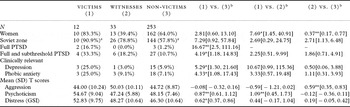
Of 45 participants (23 men) who reported acts of sexual violence committed by the occupational forces, 12 (4.0%) persons were directly affected victims and 33 (11.1%) persons were witnesses. Relevant frequencies and results are reported in Table 1. Compared to witnesses, victims were more often women. Compared to non-victims, witnesses were more often men. Sexual violence tended to occur more frequently in the Soviet zone (OR = 7.29, p = 0.060).
Frequency of experienced or witnessed sexual violence in relation to occupational forces and PTSD criteria

aOne victim and four non-victims did not indicate zone of occupation (frequencies based on valid cases). bOR or Cohen's d with 95% CI in brackets. * p < 0.05, ** p < 0.01. PTSD = post-traumatic stress disorder; GSI = Global Severity Index.
Victims met the criteria of a full PTSD, as well as the criteria of a full and sub-threshold PTSD more often than non-victims. These finding were even more prominent in the subsample of women (victims vs. non-victims; full PTSD: OR = 20.00, p = 0.005, 95% CI = [2.49, 160.83]; full and subthreshold PTSD: OR = 5.33, p = 0.016, 95% CI = [1.37, 20.71]).
Compared to non-victims, victims were more often afflicted by current clinically relevant levels (T score ≥ 63; gender-specific adult norm) of both depression and phobic anxiety. Although not clinically significant, witnesses reported significantly higher levels (T scores) of aggression than non-victims and by trend than victims (p = 0.085). Victims reported higher levels of psychoticism than both witnesses and non-victims. Victims also reported higher levels of global distress than non-victims.
Compared to non-victims, victims more often reported that they felt they should be punished for their sins (BSI Item 34; OR = 8.23, p = 0.016, 95% CI = [1.47, 46.01]). All other comparisons failed to reach significance (ps ≥ 0.097).
Correcting for multiple testing (sequential Bonferroni correction) rendered four formerly significant comparisons nominally insignificant: that women were more often victims than witnesses; that full and subthreshold PTSD occurred more often among victims than witnesses; and that among victims the rates of clinically relevant levels of depression and phobic anxiety were higher than that among non-victims. However, the respective ORs still pointed toward substantial (medium to large) effects.
Discussion
This study set out to evaluate the impact of experience and witness of war- and postwar-related sexual violence on mental health in a sample of elderly Austrian survivors of WWII. Our results corroborate previous findings on high prevalence of post-traumatic distress symptoms among victims of sexual violence committed during WWII (Kuwert et al., Reference Kuwert2010). Additionally, we found a higher prevalence of sexual violence in the former Soviet occupation zone, which has also been suggested by historical reports (Kuwert and Freyberger, Reference Kuwert and Freyberger2007). We further expanded on the impact of sexual violence on witnesses: even after six decades, witnesses of sexual violence reported higher levels of aggression than non-victims and victims (cf. Lehmann, Reference Lehmann2000). These findings may be supportive of the claim that wartime rape is a strategic weapon, used to destabilize and demoralize societies (Hargreaves, Reference Hargreaves2001; Shanks et al., Reference Shanks, Ford, Schull and Jong2001; Zawati, Reference Zawati2007; Sjoberg and Peet, Reference Sjoberg and Peet2011) with a long-lasting impact. Compared to non-victims, victims had more than four-fold odds to display post-traumatic distress symptoms. Overall, female victims and witnesses in our study were generally more likely to display post-traumatic distress (see Brewin et al., Reference Brewin, Andrews and Valentine2000; Hapke et al., Reference Hapke, Schumann, Rumpf, John and Meyer2006). Victims were more likely to show clinically relevant levels of depression and phobic fear and also reported higher levels of distress than non-victims, although not in a clinically relevant range. Moreover, victims displayed higher levels of psychoticism than witnesses and non-victims, which may reflect victims' social isolation, and were also more likely to feel that they should be punished for their sins, which could reflect the shame and guilt aspect of sexual victimization (Sable et al., Reference Sable, Danis, Mauzy and Gallagher2006; Henry, Reference Henry2010).
Interpretation of our results requires recognition of some limitations. Participants were recruited by looking specifically for persons with WWII-related traumata. Along with possible recall bias (Nyberg et al., Reference Nyberg, Backman, Erngrund, Olofsson and Nilsson1996), prevalence rates may thus not be unbiased. Furthermore, this study analyzed data from a larger epidemiological study on WWII traumatization that did not explicitly focus on sexual trauma. Yet, this may also be conceived as one of the strengths of the study design, as these experiences were assessed along with others. An additional and explicit call in the recruitment phase for female victims of rape during WWII and the occupation time remained unanswered. Bearing in mind that high prevalence rates of sexual violence during and after WWII have been reported (see Kuwert and Freyberger, Reference Kuwert and Freyberger2007), and given that in our study 12 persons directly experienced sexual violence compared to 33 witnesses, one might ask: Where are the “missing” victims? However, only a small number of victims may still be alive, either because of their age when assaults occurred or as a consequence of worse health and mortality outcomes after victimization (Golding, Reference Golding1994; Clum et al., Reference Clum, Calhoun and Kimerling2000). Yet, Kuwert and colleagues (Reference Kuwert2010) argued that highly traumatized victims might also actively avoid study participation, which may likewise be the case here. Emotional consequences of rape, such as feelings of shame, guilt, and embarrassment could account for this (Sable et al., Reference Sable, Danis, Mauzy and Gallagher2006), which was also partially reflected by our results. Interpretation of our results is limited by the small sample size and lack of statistical power. However, given that WWII victims of sexual violence are difficult to reach or may no longer be alive, effect sizes reported here were substantial.
Our results corroborate previous findings that wartime rape has lasting influences over decades on current mental health (Kuwert et al., Reference Kuwert2010), both in victims and witnesses. In this context, possible trauma reactivation in elderly persons with a history of sexual violence has to be considered. Physical memories elicit the strongest sense of the traumatic event as it happened at the time (Hiskey et al., Reference Hiskey, Luckie, Davies and Brewin2008). Gynecological examinations or hygienic care in genital areas by nursing home personnel may thus act as trauma triggers (Heuft, Reference Heuft1999). With a growing proportion of elderly persons in Europe's post-WWII societies, geriatric care and the education of dedicated personnel could thus benefit from the integration of more psychotraumatological knowledge on consequences of sexual violence on mental health.
Conflict of interest
None.
Description of authors' roles
B. Lueger-Schuster designed and supervised the study. B. Lueger-Schuster and T. Glück equally wrote the paper and contributed to planning the data analysis. U. Tran and E. Zeilinger planned and performed the statistical analysis, and contributed to writing the paper. All authors contributed in revising the paper.