Introduction
The evolution of herbicide-resistant weeds represents a major challenge in no-till crop production systems (Bhowmik Reference Bhowmik2010; Duke and Powles Reference Duke and Powles2009). Horseweed is one of the most troublesome weeds to control in broadleaf crops such as soybean because of the widespread occurrence in the United States of populations with resistance to acetolactate synthase–inhibiting herbicides and glyphosate (Gibson et al. Reference Gibson, Johnson and Hillger2005; Heap Reference Heap2017; Kruger et al. Reference Kruger, Davis, Weller, Stachler, Loux and Johnson2009; VanGessel et al. Reference VanGessel, Scott, Johnson and White-Hansen2009; Van Wychen Reference Van Wychen2016; Weaver Reference Weaver2001; Zheng et al. Reference Zheng, Kruger, Singh, Davis, Tranel, Weller and Johnson2011).
Control of GR horseweed with effective preplant burndown applications is necessary to protect yield potential and to manage the weed seedbank as a result of the lack of POST herbicide options in no-till soybean systems (Kruger et al. Reference Kruger, Davis, Weller and Johnson2008; Loux and Johnson Reference Loux and Johnson2014; Loux et al. Reference Loux, Stachler, Johnson, Nice, Davis and Nordby2006). Synthetic auxin herbicides such as 2,4-D and dicamba, as well as contact herbicides such as glufosinate, saflufenacil, and paraquat, can be used for GR horseweed control in preplant burndown applications. In general, spring burndown applications of these herbicides in Indiana occur from early April to early May, depending on appropriate weather conditions for entering the field. However, research has shown that herbicides such as 2,4-D, glufosinate, and paraquat can result in variable GR horseweed control in the spring depending on environmental conditions and horseweed size at the time of application (Brown et al. Reference Brown, Shropshire and Sikkema2016; Byker et al. Reference Byker, Soltani, Robinson, Tardif, Lawton and Sikkema2013; Davis et al. Reference Davis, Kruger, Young and Johnson2010; Kruger et al. Reference Kruger, Davis, Weller and Johnson2008, Kruger et al. Reference Kruger, Davis, Weller and Johnson2010; Loux et al. Reference Loux, Stachler, Johnson, Nice, Davis and Nordby2006; Loux and Johnson Reference Loux and Johnson2014; Mahoney et al. Reference Mahoney, Shropshire and Sikkema2017; Mellendorf et al. Reference Mellendorf, Young, Matthews and Young2013; Montgomery et al. Reference Montgomery, Treadway, Reeves and Steckel2017). Research has also shown that saflufenacil and dicamba are effective herbicides for GR horseweed control in burndown applications (Brown et al. Reference Brown, Shropshire and Sikkema2016; Byker et al. Reference Byker, Soltani, Robinson, Tardif, Lawton and Sikkema2013; Kruger et al. Reference Kruger, Davis, Weller and Johnson2008; Mellendorf et al. Reference Mellendorf, Young, Matthews and Young2013; Montgomery et al. Reference Montgomery, Treadway, Reeves and Steckel2017).
Halauxifen-methyl is a new synthetic auxin herbicide for broadleaf weed control in preplant burndown applications in soybean and other crops at a low use rate (5 g ha–1) (Anonymous 2017a, b; Schmitzer et al. Reference Schmitzer, Balko, Daeuble, Epp, Satchivi, Siddall, Weimer and Yerkes2015; Switalski et al. Reference Switalski, Rutter and Hecht2017). Experiments were conducted to evaluate the efficacy of herbicide treatments containing halauxifen-methyl for GR horseweed control in comparison to existing herbicide treatments used in no-till GR soybean systems.
Materials and Methods
Field experiments were conducted in 2015 and 2016 at three locations in Indiana with GR horseweed populations (Brookston: 40.58°N, 86.78°W; Lafayette: 40.27°N, 86.88°W; and Cortland: 38.98°N, 85.94°W). Trials were established in no-till fields using a randomized complete block design with four replications. Plots measured 3 m wide and 9 m in length. GR soybean (Asgrow® 2933, Monsanto Co., 800 N. Lindbergh Boulevard, St Louis, MO 63167, USA) was planted in 76-cm rows at a seeding rate of 345,800 seeds ha–1.
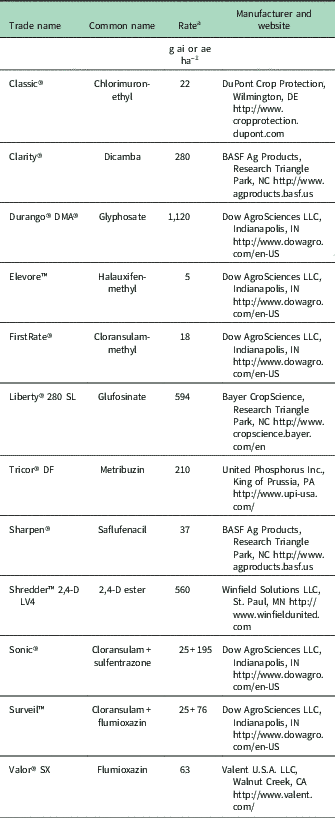
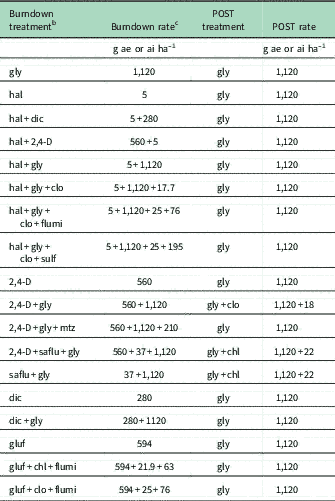
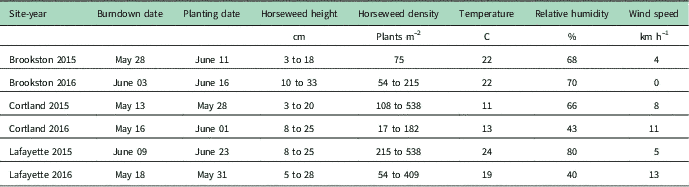
The herbicide programs tested in this study were either currently in use for weed control in GR soybean in Indiana or are new herbicide programs containing halauxifen-methyl (5 g ha–1) suggested by the manufacturer for GR horseweed control (Tables 1 and 2). Burndown herbicide applications occurred 13 to 17 d before planting of soybean targeting horseweed plants 13 to 20 cm in height (average of the horseweed stand), followed by POST herbicide applications at the V2 to V4 growth stage of soybean (Table 3). Herbicides were applied using a handheld CO2-pressurized spray boom equipped with four XR11002 or AIXR 110015 nozzles (TeeJet Technologies, 200 W. North Avenue, Glendale Heights, IL 60139, USA) for wind speeds below 10 mph or above 10 mph, respectively. Nozzles were spaced 50 cm apart and calibrated to deliver 140 L ha–1 while traveling at 4.8 km h–1 and operating at 165 kPa for XR11002 nozzles or 289 kPa for AIXR 110015 nozzles.
List of soybean foliar-applied herbicides and rates used in herbicide treatments, manufacturers, and websites.

a Herbicide rate expressed as active ingredient or acid equivalent as appropriate.
Soybean herbicide treatments evaluated for glyphosate-resistant horseweed control, including herbicide combinations and rates.Footnote a

a Ammonium sulfate (N-Pak® AMS; Winfield Solutions LLC, St. Paul, MN) at 2.5% vol/vol was added to all burndown and POST herbicide applications. Methylated seed oil (MSO UltraTM; Precision Laboratories LLC, Waukegan, IL) at 1% vol/vol was added to all treatments containing halauxifen-methyl or saflufenacil, and to 2,4-D alone. Herbicide treatments containing dicamba without halauxifen-methyl had non-ionic surfactant (Activator 90; Loveland Products Inc., Greeley, CO) at 0.25% vol/vol added. Burndown applications occurred 13 to 18 d before planting of soybean, followed by POST herbicide applications at V2 to V4 soybean growth stage.
b Abbreviations: chl, chlorimuron; clo, cloransulam; dic, dicamba; flumi, flumioxazin; gluf, glufosinate; gly, glyphosate; hal, halauxifen-methyl; mtz, metribuzin; saflu, saflufenacil; sulf, sulfentrazone.
c Herbicide rate expressed as active ingredient or acid equivalent as appropriate.
Burndown application dates, soybean planting dates, and application parameters for all-site years in Indiana.

Data collection consisted of visual ratings of horseweed control and soybean phytotoxicity (0 to 100% scale in comparison to the nontreated control) at 34 to 35 d after burndown application (hereafter referred to as 35 DAB). Horseweed density (plants m–2) and soybean stand (plants m–1 of row) were recorded 35 DAB using two 1.0-m2 quadrats per plot. In addition, soybean grain yield was collected by harvesting the center two rows of each plot at the end of the growing season to evaluate potential yield loss due to competition.
Digital imagery analysis using the public-domain Java-based ImageJ software (W.S. Rasband, ImageJ, US National Institutes of Health, Bethesda, MD, USA) was implemented in 2016 to measure ground cover by weeds as additional information on efficacy of herbicide treatments (Ferreira and Rasband Reference Ferreira and Rasband2012). The parameters hue and brightness were adjusted (hue=46 to 120, brightness=20 to 255) for processing field images with the Threshold colour plugin written by Landini (Reference Landini2009) in ImageJ according to the methodology described by Ali et al. (Reference Ali, Streibig, Duus and Andreasen2013) and allowed for distinguishing between ground cover by vegetation versus soil plus plant residue. Lower ground cover (%) corresponds to higher overall herbicide efficacy. Field images were captured under ambient daylight conditions in the field 35 DAB using a digital camera (COOLPIX 5700, Nikon, Inc.) with resolution 2,560 by 1,920 pixels. The camera was supported by a monopod at a constant height of 170 cm above the soil surface of each plot, and focal length settings adjusted to cover a ground area of approximately 163 by 122 cm. To facilitate the analysis, ground cover provided by soybean plants was assumed to be approximately uniform for all treatments at 35 DAB because of low interspecific competition early in the growing season.
Data were pooled across all six site-years for analysis to summarize data and infer which herbicide treatments were superior across all of the different environments tested in Indiana. Although glyphosate-, 2,4-D-, and glufosinate-based herbicide treatments were variable across different site-years (treatment by site-year interaction), these treatments were not the focus of this experiment. Treatment differences for horseweed control, horseweed density, ground cover, soybean phytotoxicity, and soybean stand counts were determined with one-way ANOVA using PROC GLIMMIX procedure in SAS (V. 9.4; SAS Institute Inc., SAS Campus Drive, Cary, NC 27513, USA) with mean separation using Tukey honest significant difference (HSD) test at α=0.05. Orthogonal contrast statements within PROC GLIMMIX were used to further compare the efficacy of halauxifen-methyl–based herbicide treatments with herbicide treatments containing dicamba, 2,4-D, glyphosate, and glufosinate. Treatment differences for soybean grain yield were determined using PROC GLIMMIX procedure in SAS with Fisher’s protected LSD test at α=0.05.
Results and Discussion
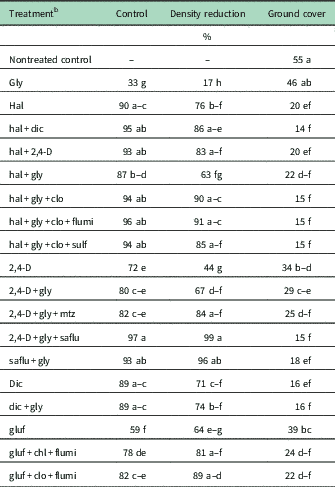
Glyphosate applied alone resulted in 33% horseweed control. Halauxifen-methyl applied alone controlled GR horseweed 90% at 35 DAB, similar to dicamba applied alone (89%), whereas glufosinate and 2,4-D alone resulted in lower GR horseweed control (59% and 72%, respectively) (Table 4). The efficacy of 2,4-D- and glufosinate-based herbicide treatments and glyphosate alone was variable across site-years (data not shown). Variable horseweed control observed with 2,4-D, glufosinate, and glyphosate due to differences in plant size and environmental conditions have been reported in previous research (Ge et al. Reference Ge, d’Avignon, Ackerman, Duncan, Spaur and Sammons2011; Kruger et al. Reference Kruger, Davis, Weller and Johnson2010; Mithila et al. Reference Mithila, Hall, Johnson, Kelley and Riechers2011; Montgomery et al. Reference Montgomery, Treadway, Reeves and Steckel2017; Owen et al. Reference Owen, Steckel, Koger, Main and Mueller2009; Shrestha et al. Reference Shrestha, Hembree and Va2007; Steckel et al. Reference Steckel, Craig and Hayes2006; VanGessel et al. Reference VanGessel, Scott, Johnson and White-Hansen2009).
Glyphosate-resistant horseweed control, density, and ground cover at 35 d after burndown treatment.Footnote a

a Treatment means of six field trials (n=24) in 2015 and 2016 combined for horseweed control and density, and treatment means of three field trials in 2016 combined for ground cover (n=12). Means within a column followed by same letter are not statistically different according to Tukey’s honest significant difference (HSD) test (P ≤ 0.05). Horseweed control as percentage of nontreated control. Horseweed density as percentage reduction of nontreated control. Ground cover as percentage of total ground area cover with green vegetation.
b Abbreviations: chl, chlorimuron; clo, cloransulam; dic, dicamba; flumi, flumioxazin; gluf, glufosinate; gly, glyphosate; hal, halauxifen-methyl; mtz, metribuzin; saflu, saflufenacil; sulf, sulfentrazone. Refer to Table 2 for herbicide rates and adjuvants.
Horseweed control by treatments containing saflufenacil was similar to control by halauxifen-methyl- and dicamba-based herbicide treatments (93% to 97% versus 90% to 96% control, respectively) at 35 DAB, except for halauxifen-methyl plus glyphosate versus 2,4-D plus glyphosate plus saflufenacil (87% versus 97% control, respectively) (Table 4).
Other researchers have shown similar results for horseweed control with preplant burndown applications of 2,4-D, dicamba, glyphosate, glufosinate, and saflufenacil (Brown et al. Reference Brown, Shropshire and Sikkema2016; Byker et al. Reference Byker, Soltani, Robinson, Tardif, Lawton and Sikkema2013; Davis et al. Reference Davis, Kruger, Young and Johnson2010; Eubank et al. Reference Eubank, Poston, Nandula, Koger, Shaw and Reynolds2008; Kruger et al. Reference Kruger, Davis, Weller and Johnson2010; Mahoney et al. Reference Mahoney, Shropshire and Sikkema2017; Mellendorf et al. Reference Mellendorf, Young, Matthews and Young2013; Mithila et al. Reference Mithila, Hall, Johnson, Kelley and Riechers2011; Montgomery et al. Reference Montgomery, Treadway, Reeves and Steckel2017; Owen et al. Reference Owen, Steckel, Koger, Main and Mueller2009; Shrestha et al. Reference Shrestha, Hembree and Va2007; Steckel et al. Reference Steckel, Craig and Hayes2006; VanGessel et al. Reference VanGessel, Scott, Johnson and White-Hansen2009).
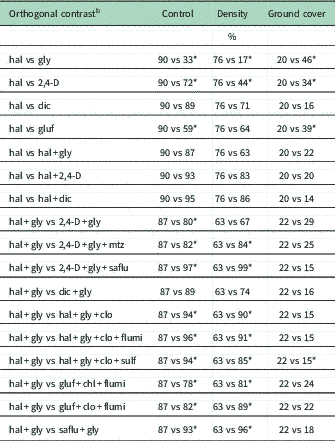
Orthogonal contrasts were used to further compare herbicide treatments (Table 5) and showed that adding glyphosate, 2,4-D, or dicamba to halauxifen-methyl did not significantly increase GR horseweed control compared to halauxifen-methyl alone. Furthermore, halauxifen-methyl plus glyphosate resulted in similar GR horseweed control compared to dicamba plus glyphosate (87% versus 89%), and greater GR horseweed control than 2,4-D plus glyphosate (80%). Halauxifen-methyl plus glyphosate resulted in lower GR horseweed control than saflufenacil plus glyphosate and 2,4-D plus saflufenacil plus glyphosate (87% versus 93% and 97%). However, halauxifen-methyl plus glyphosate resulted in greater GR horseweed control (87%) than all glufosinate- and 2,4-D-based herbicide treatments (59% to 82% control), except 2,4-D plus saflufenacil plus glyphosate.
Orthogonal contrasts for glyphosate-resistant horseweed control, density, and ground cover at 35 d after burndown treatment.Footnote a

a Treatment means of six field trials (n=24) in 2015 and 2016 combined for horseweed control and density, and treatment means of three field trials in 2016 combined for ground cover (n=12). Horseweed control as percentage of nontreated control. Horseweed density as percentage reduction of nontreated control. Ground cover as percentage of total ground area cover with green vegetation. *Significance at P ≤ 0.05.
b Abbreviations: chl, chlorimuron; clo, cloransulam; dic, dicamba; flumi, flumioxazin; gluf, glufosinate; gly, glyphosate; hal, halauxifen-methyl; mtz, metribuzin; saflu, saflufenacil; sulf, sulfentrazone; vs, versus. Refer to Table 2 for herbicide rates and adjuvants.
Tank mixtures of acetolactate synthase–inhibiting (Group 2) and protoporphyrinogen oxidase–inhibiting (Group 14) herbicides such as cloransulam, cloransulam plus flumioxazin, or cloransulam plus sulfentrazone with halauxifen-methyl plus glyphosate resulted in greater GR horseweed control compared to halauxifen-methyl plus glyphosate (94%, 96%, 94% control versus 87% control, respectively) (Table 5). These tank mixtures resulted in similar GR horseweed control compared to 2,4-D plus glyphosate plus saflufenacil (97% control). Similarly, chlorimuron plus flumioxazin or cloransulam plus flumioxazin added to glufosinate resulted in greater GR horseweed control than glufosinate alone at 35 DAB (78% or 82% control versus 59% control, respectively) (Table 4).
Glyphosate alone was the only herbicide treatment that resulted in similar GR horseweed density compared to the nontreated control (17% reduction) at 35 DAB (Table 4). Halauxifen-methyl plus glyphosate resulted in 63% reduction in GR horseweed density. However, horseweed density counts 35 DAB did not reflect visual control of GR horseweed when comparing dicamba- and halauxifen-based treatments versus 2,4-D- and glufosinate-based treatments because of prolonged survival of GR horseweed plants up to 35 DAB with synthetic auxin treatments. Living horseweed plants were found in all these treatments at 35 DAB; however, only 2,4-D- and glufosinate-based treatments had actively growing plants in the plots. Furthermore, horseweed density did not account for plant height or regrowth of injured plants. Therefore, digital imagery analysis was utilized in 2016 to measure ground cover by weeds 35 DAB and provide additional information on efficacy of herbicide treatments.
Cloransulam, cloransulam plus flumioxazin, or cloransulam plus sulfentrazone added to halauxifen-methyl plus glyphosate resulted in lower GR horseweed density at 35 DAB compared to halauxifen-methyl plus glyphosate (90%, 91%, or 85% versus 63% reduction, respectively) (Table 5). Similarly, adding cloransulam plus flumioxazin to glufosinate reduced GR horseweed density compared to glufosinate alone (89% versus 64%) (Table 4).
Digital imagery analysis (ground cover) showed more similar trends to GR horseweed control than horseweed density counts (Tables 4 and 5). Glyphosate alone resulted in similar ground cover compared to the nontreated control (46% versus 55% ground cover, respectively) (Table 4). Halauxifen-methyl alone resulted in lower ground cover than glyphosate, glufosinate, and 2,4-D alone (20% versus 46%, 39%, and 34% ground cover, respectively). The addition of cloransulam plus flumioxazin or chlorimuron plus flumioxazin to glufosinate reduced ground cover compared to glufosinate alone (22% or 24% versus 39% ground cover, respectively).
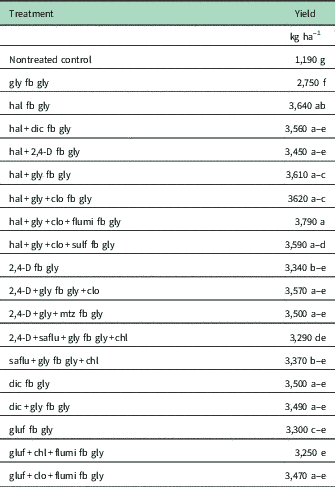
No soybean injury was observed for any treatment containing halauxifen-methyl (data not shown). Soybean was planted 13 to 17 DAB. The current product label requires at least 14 d between halauxifen-methyl application and soybean planting (Anonymous 2017a). Soybean yield for all treatments is presented in Table 6. The nontreated control and glyphosate alone resulted in lower soybean grain yield than all other treatments.
Herbicide programs for glyphosate-resistant horseweed control and soybean grain yield in Indiana.Footnote a , Footnote b

a Treatment means of six field trials (n=24) in 2015 and 2016 combined.
b Abbreviations: chl, chlorimuron; clo, cloransulam; dic, dicamba; fb, followed by; flumi, flumioxazin; gluf, glufosinate; gly, glyphosate; hal, halauxifen-methyl; mtz, metribuzin; saflu, saflufenacil; sulf, sulfentrazone. Refer to Table 2 for herbicide rates and adjuvants. Treatment means followed by same letter are not statistically different according to Fisher’s protected LSD test (P ≤ 0.05).
In conclusion, herbicide treatments containing either halauxifen-methyl, dicamba, or saflufenacil resulted in the greatest control of GR horseweed. Therefore, halauxifen-methyl is a valuable addition for use in preplant burndown treatments for control of GR horseweed in soybean. Further research looking into the weed control spectrum of halauxifen-methyl compared to other synthetic auxin herbicides, preplant intervals for soybean crop safety, herbicide fate, and tank mix interactions is necessary to increase understanding of this new active ingredient.
Acknowledgments
The authors would like to thank Dow AgroSciences for funding this research. No conflicts of interest have been declared.