High content of saturated fatty acids (SFA) in milk was reported to be associated with the induction of coronary heart disease (Mills et al. Reference Mills, Ross, Hill, Fitzgerald and Stanton2011). It is thus important to modify cattle feeding so as to reduce the total SFA concentration in milk; the share of unsaturated fatty acids (UFA) would then simultaneously increase. Supplementation of dairy cows’ fodder with oil seeds and their by-products modify fatty acid (FA) profile (Chilliard & Ferlay, Reference Chilliard and Ferlay2004; Puppel et al. Reference Puppel, Nałęcz-Tarwacka, Kuczyńska, Gołębiowski and Grodzki2012). Vegetable oils reduce the content of C4-16 in milk fat and increase the share of FAs having a beneficial effect on human health, such as oleic c-9C18:1, α-linolenic c-9 c-12 c-15 18:3 and CLA, c-9 t-11 18:2 acids (Lerch et al. Reference Lerch, Shingfield, Ferlay, Vanhatalo and Chilliard2012a, Reference Lerch, Ferlay, Shingfield, Martin, Pomies and Chilliardb), thus considerably improving the nutritional value of milk and its functional properties (Glasser et al. Reference Glasser, Ferlay and Chilliard2008; Shingfield et al. Reference Shingfield, Chilliard, Toivonen, Kairenius and Givens2008). Increasing the content of UFA (e.g. oleic c-9 18:1 and α-linolenic) in milk may result in decreasing the LDL fraction in human blood serum (Lottenberg et al. Reference Lottenberg, Afonso, Ferrari Lavrador, Machado and Nakandakare2012).
Cattle fodder with oilseed addition improves the milk fat FA profile also by increasing the content of t-18:1, mainly vaccenic acid t-11 18:1 (Glasser et al. Reference Glasser, Ferlay and Chilliard2008). Health effects of trans FAs generated in ruminants via natural biohydrogenation reactions are more pronounced compared with those resulting from partially industrially hydrogenated vegetable oils (Wang et al. Reference Wang, Jacome-Sosa and Proctor2012). The majority of studies using cancer cell lines or animal models demonstrate that vaccenic acid reduces cell growth and tumour metabolism, mostly owing to its conversion in vivo to c-9 t-11 CLA (Corl et al. Reference Corl, Barbano, Bauman and Ip2003; Field et al. Reference Field, Blewett, Proctor and Vine2009; Bassett et al. Reference Bassett Ch, Edel, Patenaude, McCullogh, Blackwood, Chouinard, Paquin, Lamarche and Pierce2010).
Apart from beneficial effects of linseed or rapeseed supplements on milk fat FA profile, some unwanted ones were noted: a reduced fodder intake and decreased fat and protein contents in milk (Petit et al. Reference Petit, Côrtes, da Silva, Kazama, Gagnon, Benchaar, dos Santos and Zeoula2009). Lerch et al. (Reference Lerch, Shingfield, Ferlay, Vanhatalo and Chilliard2012a, Reference Lerch, Ferlay, Shingfield, Martin, Pomies and Chilliardb) demonstrated a significant interaction between the milk fat FA profile modified by rapeseed or flax-seed supplementation, and starch content in the basic fodder. Dang Van et al. (Reference Dang Van, Focant, Mignolet, Turu, Froidmont and Larondelle2011) showed that feeding cows diets rich in voluminous fodders increases biohydrogenation of unsaturated FA in the rumen, thus reducing their passage to the digestive tract and, in effect, to milk.
Cold-press extraction of rapeseed oil, gaining importance in Poland as in many countries in the last two decades, brought increasing quantities of e.g. rapeseed cake, a good substitute for soybean meal, owing to its protein content (Zymon et al. Reference Zymon, Strzetelski, Furgał-Dzierżuk, Kowalczyk and Osięgłowski2012). Its addition to fodder reduces methane generation in cows and 6·8% of oilseed supplementation can be fed without production problems and, in many cases, with positive production responses, including an improved milk FA profile (Larsen et al. Reference Larsen, Hymøller, Brask-Pedersen and Weisbjerg2012; Brask et al. Reference Brask, Lund, Weisbjerg, Hellwing, Poulsen, Larsen and Hvelplund2013).
No reports on comparing rapeseed cake and extracted soybean cake used as high-protein supplements as to the effects on milk yield or FA profile were found in the available literature. The aim of this study was thus to assess the effects of partial replacement of extracted soybean meal with a protein-equivalent amount of rapeseed cake diet on the milking parameters and fatty acid composition of milk in dairy cows.
Materials and methods
Animals and experimental design
A group of 16 Polish Holstein-Friesian cows (weighing 620 ± 23 kg; second lactation; days in milk, 115 ± 24; milk yield, 16·9 ± 4·0 kg/milking) were selected from a herd of 120 cows housed in the experimental farm Kosów of the Institute of Genetics and Animal Breeding, Polish Academy of Sciences.
The cows were housed in a loose housing stable and fed by the Callan Feeding Control System with electronically controlled individual access (Am. Calan, Inc., Northwood NH, USA) allows individual control of feed intake by cows and steady, free access to water. Diets were administered ad libitum as total mixed rations (TMR) formulated as per a 620-kg cow producing 35 kg of milk containing 4·0% fat and 3·5% protein. All components were stirred in an experimental feed wagon (SDR-Super Data Ranger; American Calan) to obtain a homogeneous mixture. Amounts of fodder were adjusted so as not to exceed 5% of leftovers.
Animals were allotted by the randomised block method into 2 groups according to milking yield. Cows were milked twice a day at 6·00 and 18·00 with an automated milking plant (Alfa Laval). Cows from the control group (C) received a traditional high-protein supplement (extracted soybean meal), those of the experimental group (E) had part of extracted soybean meal replaced with rapeseed cake but an identical total protein content. Feed intake was recorded electronically. The experiment lasted 75 d. Milk samples were taken on days 21 and 75.
Sample collection and analytical procedures
Samples of each feed component were collected every week, immediately frozen and stored at −20 °C until assayed. Pooled samples of fodder and of leftovers were analysed every 2 weeks for feed components by employing standard procedures (AOAC, 2007). The chemical composition of diet components served to assess their nutritional value according to the system of IZ-INRA (2001) by using PrevAlim 3·22 (Version professionnelle intégrale, INRA 1988–2004, France) software.
Milk yield was individually recorded electronically. Milk samples for basic analysis, preserved with Microtabs II (Bentley), were collected in plastic polypropylene vessels. In addition, individual milk samples (100 ml) were taken and kept frozen at −18 °C until assayed for FA composition.
Milk composition (fat, protein, lactose, casein, total solids and solids nonfat) were determined by infrared spectrophotometry (System 4000 Milkoscan; Foss Electric, Hillerod, Denmark). Health status of the udder was assessed microbiologically and by the number of somatic cells (SCC) in milk using IBCM 9 device (Bentley Instruments) as follows: smears of milk samples on agar supplemented with 5% sheep blood (bioMerieux, Craponne, France) and on MacConkey agar (bioMerieux, Craponne, France) were incubated at 37 °C for 48 h. The isolated bacteria were identified using VITEC2 equipment.
Blood samples (10 ml) were collected before morning feeding by jugular puncture at the beginning and at the end of experiment. Serum was separated by centrifugation at 1600 g 4 °C for 15 min and stored frozen at −20 °C until assayed.
Analysis of fatty acid composition of milk fat
Milk lipids were extracted using the Röse-Gottlieb AOAC method 905·02 (2000). Methyl esters of FA (FAME) prepared by transmethylation of fat samples according AOCS method Ce2-66 (2000) were subjected to GC using an Agilent 6890N (USA) chromatograph equipped with flame ionisation detector using capillary column with stationary phase of high polarity. A butter reference standard (CRM 164; Commission of the European Communities, Community Bureau of Reference, Brussels, Belgium) was used to determine the recovery rates and correction factors for individual FAs in milk samples. Also the Supelco 37 No. 47885-U standard (Sigma Aldrich) was applied for FA identification and recoveries of FAME. The contents of individual FAs were expressed as g/100 g FA. The analytical technique is published in detail elsewhere (Rutkowska et al. Reference Rutkowska, Adamska and Bialek2012).
Atherogenic index (AI) was calculated as the content ratio of SFA/UFA using the following formula (Ulbricht & Southgate, Reference Ulbricht and Southgate1991):
 $$AI = \left[{C12 : 0 + 4\,(C14 : 0) + (C16 : 0)} \right]\,/\sum {(MUFA + PUFA)} $$
Data analysis
Results were subjected to two-way ANOVA; in cases of non-significant interaction (group × sample collection period), the significance was indicated for given component (groups or sample collection periods). Otherwise, a conventional t test was applied for dependent (sample collection periods) or independent (groups) data. Statistica 9PL software (StatSoft, Inc. 2010) was used, the level of P < 0·05 was considered significant.
Results
Feed composition and productive performance
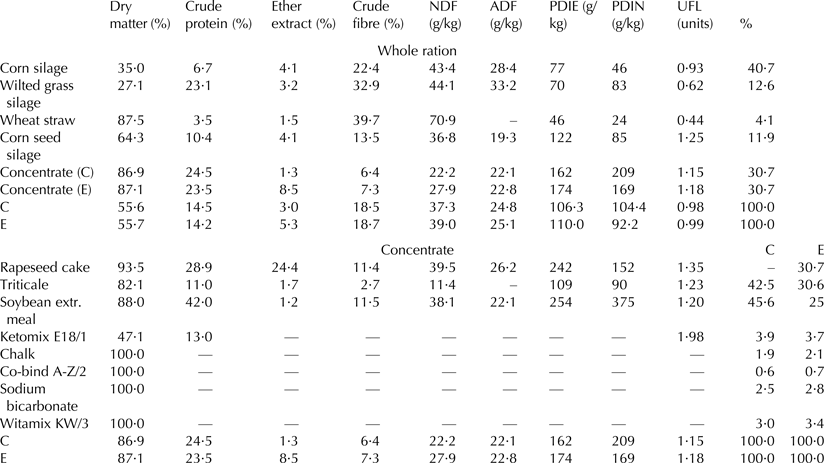
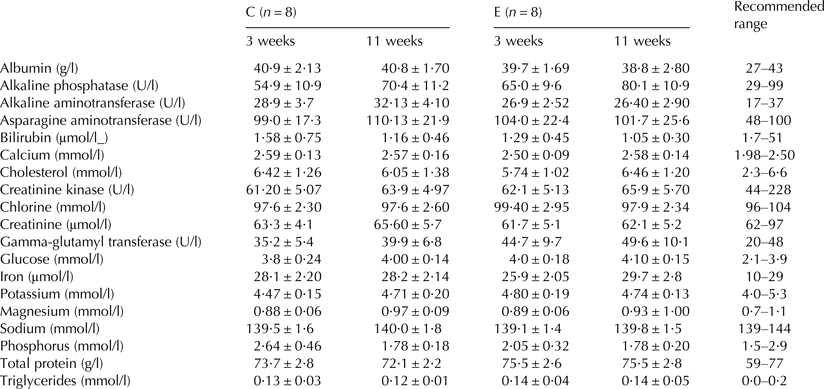
The experimental diet contained more fat, neutral detergent fibre (NDF) and ruminally degradable nitrogen (PDIN) than the control one (Table 1). Concentrations of serum components of C and E cows (Table 2) were in both groups rather alike. All variables were within the recommended ranges; however albumin, asparagine and total protein were in the upper range, whereas bilirubin and creatinine were below the recommended limit.
Chemical composition, feeding value and feed ration and concentrate mixture components (C, control diet; E, experimental diet)

NDF, neutral detergent fibre; ADF, acid detergent fibre; PDIE, metabolisable protein supply; PDIN, ruminally degradable nitrogen; UFL, equivalent of 1 kg of air dried barley
Mean values (±sd) of serum components in control (C) and experimental (E) cows at 3 and 11 weeks of the study
Rapeseed cake contained 24·4% fat (Table 1), the dominant acids being oleic acid, 55·6/100 g FA, linoleic acid 9c 12c 18:2–20·8/100 g FA and α-linolenic acid, 7·9/100 g FA (data not shown).
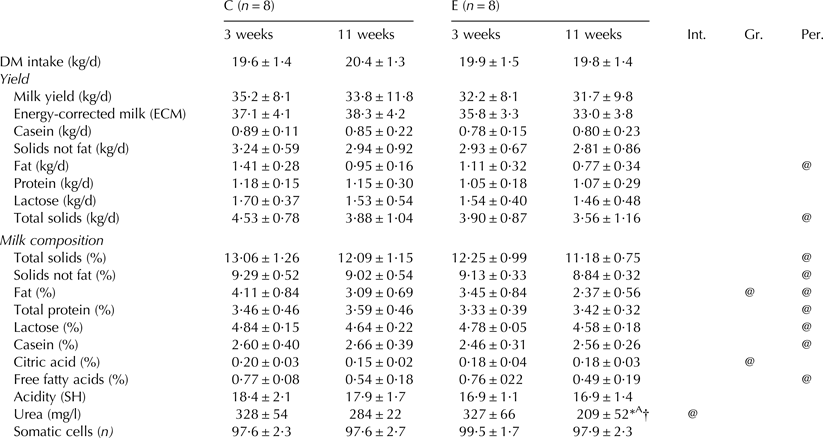
As to the productive performance (Table 3), a significant group × period interaction was found for urea concentration in milk. Groups differed significantly with respect to per cent fat and citric acid in milk and for a number of variables significant differences between sampling periods were noted. No differences were found only in case of milk acidity and SCC in milk. No significant differences were found for most milk yield variables except total fat and total solids.
Mean contents (se) of dry matter (DM) intake, milk production and milk composition (kg/d) of control (C) and experimental (E) cows at 3 and 11 weeks of the study
Int, interaction (groups × sampling periods); Gr, groups; Per, periods; @, significant effect (P < 0·05).
† When significant interaction: *significantly (P < 0·05) different from the respective control (C) value; Asignificantly (P < 0·05) different from the respective value at 3 weeks.
Milk fat composition
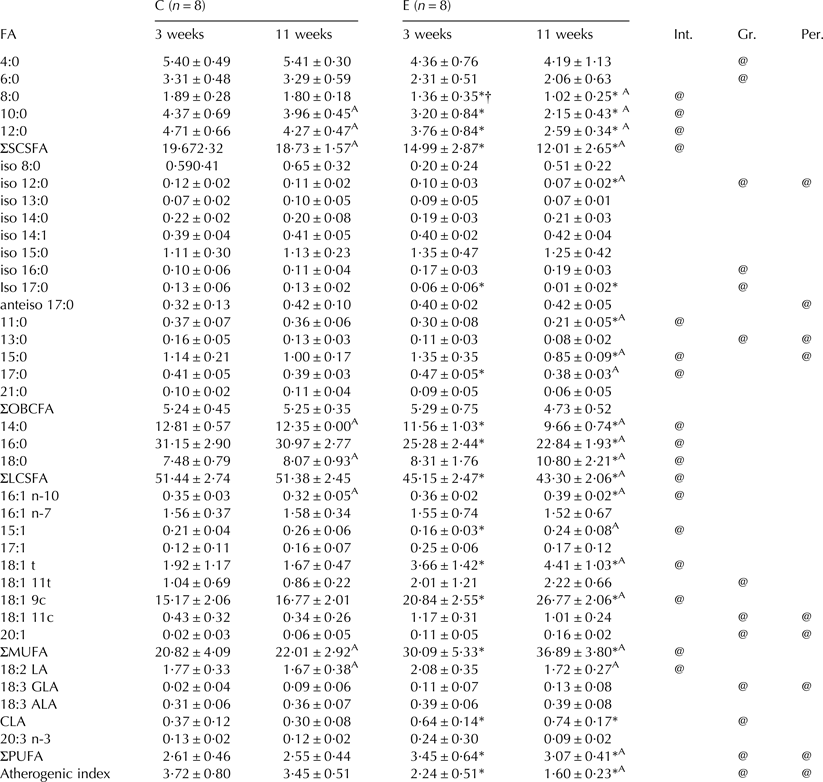
Data related to milk fat composition are presented in Table 4. In the case of only a few FAs were no significant differences between either groups or sampling periods noted, mostly for odd-number, branched chain (OBCFA) acids. For all long-chained SFA (LCSFA) and most short- and medium-chained FA (SCSFA) and MUFA a significant group × sampling period interaction was found.
Mean contents ( ± sd) of fatty acids in milk (g/100 g FA) of control (C) and experimental (E) cows at 3 and at 11 weeks of the study
Int, interaction (groups × sampling periods); Gr, groups; Per, periods; @ significant effect (P < 0·05)
† When significant interaction: *significantly (P < 0·05) different from the respective control (C) value; Asignificantly (P < 0·05) different from the respective value at 3 weeks
The content of total SCSFA in milk decreased by 30 and 55% (after 3 and 11 weeks, respectively) in E group compared with C group. Regarding LCSFA, highest reduction (by 36%) was noted for palmitic acid, 16:0, after 11 weeks. Unlike total SFA, only stearic acid, 18:0, increased by 30% after 11 weeks in E group compared with C group and, in contrast to SFA, the same was true for most unsaturated FA. In E cows a much higher increase of total MUFA in milk (by 44 and 68% at 3 and 11 weeks, respectively) was noted than of total PUFA (32 and 17%, respectively), exceptionally high increases being noted for CLA isomer c-9 11-t 18:2, oleic acid 9-c 18:1 and vaccenic acid t-11 18:1. Milk from E cows at the end of the study (11 weeks) contained more t-11 18:1 than that from C cows (2·22 and 0·86/100 g FA).
The atherogenic index (AI) of milk from the control group was relatively high and the change from week 3 to week 11 was about 7% (P < 0·05). In E group, that index was significantly (P < 0·001) lower than in C group (by 60 and 47%, respectively) and the decrease with time was considerable (by 29%, P < 0·001; Table 4).
Discussion
Cold extrusion of plant oils is steadily increasing worldwide, thus augmenting the significance of oilseed cake compared with extracted meal. Rapeseed cake is rich in valuable fat and antioxidant compounds (Terpinc et al. Reference Terpinc, Čeh, Ulrih and Abramovič2012). It was demonstrated (Lerch et al. Reference Lerch, Shingfield, Ferlay, Vanhatalo and Chilliard2012a, Reference Lerch, Ferlay, Shingfield, Martin, Pomies and Chilliardb) that linseed or its by-products improve milk composition but their global availability was about 27-fold lower than that of rapeseed (Carré & Pouzet, Reference Carré and Pouzet2014) and, according to 2012 official statistics, much lower in Poland (about 2400-fold lower). Rapeseed supplementation is thus economically justified.
In this study, E cows were fed a diet containing extracted soybean meal partly replaced by rapeseed cake. This did not affect dry matter (DM) intake (Table 3), probably owingto the short feeding period of 75 d (cf. Altenhofer et al. Reference Altenhofer, Spornraft, Kienberger, Rychlik, Herrmann, Meyer Heinrich and Viturro2014); however, no differences in DM intake were observed even after 20 weeks (Egger et al. Reference Egger, Holzer, Segato, Werth, Schwienbacher, Peratoner, Andrighetto and Kasal2007) of feeding rapeseed or linseed supplements. Thus, the milk yield remained also unaffected as confirmed by Brask et al. (Reference Brask, Lund, Weisbjerg, Hellwing, Poulsen, Larsen and Hvelplund2013). Also, the health condition of the mammary gland, as reflected by SCC in milk, was not affected by rapeseed cake in the diet, as confirmed by earlier studies of Komprda et al. (Reference Komprda, Dvorak, Fialova, Šustova and Pechova2005). The same was true for metabolic equilibrium, since its markers were well within the recommended ranges (cf. Table 3).
In contrast to the findings of Johansson & Nadeau (Reference Johansson and Nadeau2006), the yield of fat (kg/d) significantly decreased throughout our study, maybe owing to a too low content of crude fibre (in DM) in both groups of cows (slightly above 18%, i.e. near the lower recommended limit), and a too high content of crude fat in the rapeseed cake (Group E; 5·27% in DM). That view is supported by other reports, e.g. Petit et al. (Reference Petit, Côrtes, da Silva, Kazama, Gagnon, Benchaar, dos Santos and Zeoula2009). Similar observations were reported by Altenhofer et al. Reference Altenhofer, Spornraft, Kienberger, Rychlik, Herrmann, Meyer Heinrich and Viturro2014 (reduction in milk fat percentage, no effect on milk protein yield). Furthermore, rapeseed cake supplementation had no effect on total protein, casein and lactose contents or on acidity. It should be emphasised that the reduction of FFA content in milk in both groups (at 11 weeks) evidenced an improvement of the nutritional value and of technological properties of milk.
An obvious advantage of administering rapeseed cake was a markedly lower content of urea in milk at the end of the study compared with control cows that reflected an appropriate protein/energy index of the fodder. Reverse results were, however, reported by Zymon et al. (Reference Zymon, Strzetelski, Furgał-Dzierżuk, Kowalczyk and Osięgłowski2012). Rapeseed is an appropriate fat source to reduce the enteric CH4 production without affecting NDF digestion or milk production (Brask et al. Reference Brask, Lund, Weisbjerg, Hellwing, Poulsen, Larsen and Hvelplund2013).
Partial replacement of soybean meal with a protein-equivalent amount of rapeseed cake favourably altered FA content of milk in this study. The contents of atherogenic acids (16:0 and14:0) significantly decreased in E group after 11 weeks compared with C group. Similar data were reported by other authors who used rapeseed supplements (Komprda et al. Reference Komprda, Dvorak, Fialova, Šustova and Pechova2005; Johansson & Nadeau Reference Johansson and Nadeau2006; Egger et al. Reference Egger, Holzer, Segato, Werth, Schwienbacher, Peratoner, Andrighetto and Kasal2007; Lerch et al. Reference Lerch, Ferlay, Shingfield, Martin, Pomies and Chilliard2012b; Altenhofer et al. Reference Altenhofer, Spornraft, Kienberger, Rychlik, Herrmann, Meyer Heinrich and Viturro2014). That effect is advantageous regarding the nutritional value of milk for LCSFAs are thought to increase the risk of cardiovascular disease. Milk and dairy products are the major source of SFA in the European diet (Mills et al. Reference Mills, Ross, Hill, Fitzgerald and Stanton2011). The potential to reduce these FAs was higher than reported by Altenhofer et al. (Reference Altenhofer, Spornraft, Kienberger, Rychlik, Herrmann, Meyer Heinrich and Viturro2014) who used rapeseed oil in a cow diet. As compared with literature data, that result was even better than supplementing TMR by pasture (Bargo et al. Reference Bargo, Delahoy, Schroeder, Baumgard and Muller2006). Stearic acid, 18:0 was the only SFA that increased in milk of E group, but that acid is reported not to increase cholesterol levels (Lottenberg et al. Reference Lottenberg, Afonso, Ferrari Lavrador, Machado and Nakandakare2012). Increased contents of stearic acid were also found in milk of cows receiving rapeseed or soybean additions (Egger et al. Reference Egger, Holzer, Segato, Werth, Schwienbacher, Peratoner, Andrighetto and Kasal2007; Altenhofer et al. Reference Altenhofer, Spornraft, Kienberger, Rychlik, Herrmann, Meyer Heinrich and Viturro2014), rapeseed cake (Johansson & Nadeau, Reference Johansson and Nadeau2006) or rapeseed by-products (Lerch et al. Reference Lerch, Shingfield, Ferlay, Vanhatalo and Chilliard2012a, Reference Lerch, Ferlay, Shingfield, Martin, Pomies and Chilliardb), as well as when administering oil supplementation to grazing cows (Rego et al. Reference Rego, Slves, Antunes, Rosa, Alfaia, Prates, Cabrita, Fonseca and Bessa2009).
Supplementation of rapeseed cake did not significantly affect the OBCFA content, thus reflecting proper rumen function, e.g. fermentation pattern in cows (Vlaemnick et al. Reference Vlaemnick, Fievez, Cabrita, Fonseca and Dewhurst2006). Moreover, in our study, E cows had a 20% higher content of iso 15:0 FA in milk, an acid having anticarcinogenic properties (Vlaemnick et al. Reference Vlaemnick, Fievez, Cabrita, Fonseca and Dewhurst2006). It should be noted that Altenhofer et al. (Reference Altenhofer, Spornraft, Kienberger, Rychlik, Herrmann, Meyer Heinrich and Viturro2014) observed a decreased content of iso 15:0 in milk of cows receiving rapeseed oil in the diet.
E cows had a markedly increased MUFA content in milk fat, especially of oleic acid c-9 18:1 (by nearly 60% compared with C cows). That effect was more pronounced than in the case of pasture grazing owing to a much higher content of oleic acid in rapeseed cake (55·6 vs. 2·5/100 g FA; cf. Rutkowska et al. Reference Rutkowska, Adamska and Bialek2012). Other authors who studied the effects of supplementing fodder with rapeseed by-products reported much lower figures (Lerch et al. Reference Lerch, Shingfield, Ferlay, Vanhatalo and Chilliard2012a, Reference Lerch, Ferlay, Shingfield, Martin, Pomies and Chilliardb, 24%; Kliem et al. Reference Kliem, Shigfield, Humphries and Givens2011, 19%; and Egger et al. Reference Egger, Holzer, Segato, Werth, Schwienbacher, Peratoner, Andrighetto and Kasal2007, 26%).
Higher intake of oleic acid with rapeseed cake by E cows compared with C cows resulted also in higher content of FA belonging to trans 18:1 isomers. In milk derived from E cows almost 3-fold increase trans 18:1 content was obtained compared with C cows. Increasing trans 18:1 content resulted from isomerisation of oleic acid which is not hydrogenated in the rumen like other unsaturated FA e.g. PUFA originating from fodder (Collomb et al. Reference Collomb, Schmid, Sieber, Wechsler and Ryhanen2006).
Supplementation of fodder with rapeseed cake brought about an increased content of PUFA in milk fat, by about 28% compared with C cows. A similar effect was observed in the case of supplementation with rapeseed cake (Zymon et al. Reference Zymon, Strzetelski, Furgał-Dzierżuk, Kowalczyk and Osięgłowski2012) as well as with rapeseed oil (Altenhofer et al. Reference Altenhofer, Spornraft, Kienberger, Rychlik, Herrmann, Meyer Heinrich and Viturro2014).
The decrease of SFA content in milk of cows fed rapeseed cake, accompanied by an increased content of UFA, brought about reduced AI values, thus evidencing a decreased risk of atherosclerosis and coronary heart disease. A similar effect was observed by Puppel et al. (Reference Puppel, Nałęcz-Tarwacka, Kuczyńska, Gołębiowski and Grodzki2012) in milk from cows receiving linseed or fish oil as a combined diet supplement.
Regarding the trans isomers in milk fat, special attention ought to be paid to vaccenic acid t-11 18:1, which unlike elaidic acid, induces decreases of triacyloglycerols and LDL cholesterol in blood (Dupasquuier et al. Reference Dupasquuier, Ptenaude, Blackwood, Chouinard, Lamarche and Pierce2007; Bassett et al. Reference Bassett Ch, Edel, Patenaude, McCullogh, Blackwood, Chouinard, Paquin, Lamarche and Pierce2010). In our experiment, a 2·6-fold increase of vaccenic acid content was noted in milk of cows fed rapeseed cake. In other similar studies, much lower increases of both trans 18:1 and vaccenic acid were noted: Johansson & Nadeau (Reference Johansson and Nadeau2006) reported a 2-fold increase; Lerch et al. (Reference Lerch, Shingfield, Ferlay, Vanhatalo and Chilliard2012a), Kliem et al. (Reference Kliem, Shigfield, Humphries and Givens2011), Shingfield et al. (Reference Shingfield, Chilliard, Toivonen, Kairenius and Givens2008) and Brouwer et al. (Reference Brouwer, Wanders and Katan2010) reported about 1·5-fold increase. Glasser et al. (Reference Glasser, Ferlay and Chilliard2008) reported that oil in rapeseed by-products increases trans 18:1 in milk to a lesser extent than other supplements rich in PUFA, e.g. linseed oil. It is worth emphasising that the increased vaccenic acid content in milk is additionally beneficial for the desaturation of Δ−9 vaccenic acid to c-9 t-11 CLA 18:2 takes place also in human organism. It was reported (Kuhnt et al. Reference Kuhnt, Kraft, Mockel and Jahreis2006) that the average conversion rate of vaccenic FA in serum was 24%, and the value from FAs incorporated into red blood cell membranes was 19%.
CLA isomers in milk fat, especially the dominant c-9 11-t 18:2, exhibited superior potential in vitro and in vivo to prevent various types of cancer, hypertension, atherosclerosis and diabetes, as well as to improve immune function and body composition, thoroughly discussed in several publications (Bhattacharya et al. Reference Bhattacharya, Banu, Rahman, Causey and Fernandes2006; Collomb et al. Reference Collomb, Schmid, Sieber, Wechsler and Ryhanen2006; Mills et al. Reference Mills, Ross, Hill, Fitzgerald and Stanton2011). Milk from E cows contained 2·5-times more c-9 11-t 18:2 (CLA) than that from C cows (after 11 weeks).
Summing up, partial replacement of soybean cake with a protein-equivalent amount of rapeseed cake in a dairy cow diet positively affected fatty acid content in milk fat not only by reducing the content of atherogenic, saturated FA (palmitic and myristic acids), but also by substantially increasing that of trans 18:1, including vaccenic acid and CLA, without changes in OBCFA. Considering epidemiological reports indicating that consuming products rich in milk fat and CLA reduces the risk of colon cancer (Larsson et al. Reference Larsson, Bergkvist and Wolk2005), supplementation of dairy cow diet with rapeseed cake seems highly recommendable.
The study was supported by the project BIOFOOD – innovative, functional products of animal origin (POIG.01·01·02-014-090/09) and co-financed by the European Union from the European Regional Development Fund within the Innovative Economy Operational Programme 2007–2013.