Policy-makers' long-held view that ex-combatants threaten postconflict transitions has led to a rise in combatant demobilization and reintegration programs in societies recovering from violent conflict. Yet much of the international relations literature has challenged this perception, arguing that military service leads to greater caution regarding the use of force, since veterans have personally borne the costs of war.Footnote 1 Recent microlevel research also rejects negative portrayals of ex-combatants, maintaining that the political effects of combat are surprisingly benign. Military experience has been linked to increased political participation,Footnote 2 greater volunteerism,Footnote 3 and higher voter turnout.Footnote 4 Similarly, an emerging literature on civilians in conflict finds that exposure to violence strengthens resilience and collective coping, which facilitates increased participation and social cohesion.Footnote 5
The literature emphasizing combat's positive effects, however, does not adequately account for the impact of combat exposure in societies undergoing violent conflict. The international relations literature largely focuses on military elites rather than ordinary soldiers and typically does not distinguish between combat and noncombat military service. Moreover, this literature is based mostly on case studies or cross-sectional survey data, making it difficult to isolate combat's causal effects. Recent microlevel studies, conducted primarily in peacetime or during reconstruction efforts, are more concerned with identifying causal effects but are limited in their ability to address the effects of combat exposure on conflict resolution. For example, although political participation may be a positive force in societies at peace, political mobilization can be harnessed during conflict in support of exclusionary policies, which can promote further violence. More generally, studies emphasizing the benign effects of exposure to violence typically do not distinguish between attitudes and behavior toward in-group and out-group members. Conflict resolution efforts, however, depend on attitudes and behavior toward the adversary out-group.
Several aspects of combat experience are likely to harden attitudes toward the rival out-group and reduce support for peaceful conflict resolution. Combatants undergo intense socialization to frame the adversary as an enemy to be defeated by force, which may make them more militarist.Footnote 6 Moreover, combat involves conflictual, threatening intergroup contact, which is associated with prejudice, ethnocentrism, and hostility.Footnote 7 In societies where ex-combatants are a substantial sector of the population, or where their training allows them to pose a violent threat, such attitudes can exert considerable influence on the viability of conflict resolution. The political effects of combat, therefore, may be far from benign.
Despite the importance of this question, much remains unknown about the effect of combat exposure on conflict resolution. Research is especially constrained by the difficulty of isolating combat's causal effects. Since selection into combat is typically not random, it is difficult to disentangle its impact from preexisting differences between combatants and noncombatants that independently affect attitudes toward war and peace. This research note advances the debate by providing causal evidence that combat exposure can reduce the prospects of peaceful conflict resolution and specifying the conditions under which this result is most likely. We employ data from an original survey of former Israeli Defense Forces (IDF) soldiers to investigate how combat affects political behavior and attitudes toward negotiated resolution of the Israeli-Palestinian conflict. Israel's mandatory conscription reduces the selection bias associated with voluntary recruitment. Nevertheless, assignment into combat, though not completely voluntary, is subject to some self-selection.
We overcome the problem of unobserved heterogeneity in combat recruitment by using the health rankings assigned in the IDF recruitment process as an instrument for combat exposure. We find that combat experience substantially hardens attitudes toward the rival and heightens preferences for military solutions over negotiated ones. These effects also extend to voting behavior: ex-combatants vote for more hawkish parties. This has significant implications for the Israeli parliamentary system, in which the majority of citizens votes for parties at the center of the political spectrum, and in which the split between the right and left blocs is typically narrow. Importantly, we also find that this hardening effect depends on both the nature of the conflict and the background of individual combatants. Although the relative rightward shift is significant and robust for ex-combatants who served under the intense conditions of the Second Intifada, we do not find a similar shift among combatants who served in the more stable period following the IDF's withdrawal from Gaza in 2005. We also find that combat's observed effect is largely driven by a significant shift to the right of ex-combatants who grew up in left-leaning, center, and moderate right-leaning households. Ex-combatants from households in the far right report attitudes to the left of noncombatants from similar backgrounds. The implication of this pattern is that whereas combat service reduces polarization among recruits, it also hardens the attitudes of those who might otherwise have supported compromise, thus eroding the support base of parties advocating reconciliation.
To the best of our knowledge, this is the first well-identified study examining attitudes toward war and peace among ex-combatants during an ongoing conflict. As such, it contributes to a long-standing debate on whether military experience is likely to lead to more cautious or militaristic attitudes regarding the use of force. Our findings suggest that social-psychological processes associated with combatant socialization and participation in armed conflict can overcome instrumental calculations, leading to greater support for military solutions. This note also contributes to the emerging literature on the political effects of violence exposure by making an important analytic distinction between attitudes and behavior toward in-group and rival out-group members. Although exposure to war-related violence may have positive intragroup effects (though we do not find evidence of such effects in our sample), its negative impact on intergroup attitudes and behavior provides cause for concern. As such, this study offers important qualifications to this literature and cautions against a benign interpretation of violence exposure based only on measures of political engagement. From a policy perspective, our findings highlight the value of combatant reintegration programs that reduce prejudice and build faith in peaceful conflict resolution.
Combat Exposure and Attitudes Toward War
A considerable body of research has examined how military experience affects political attitudes and behavior. Other research focuses on civilians in conflict, investigating how exposure to violence and victimization affects social and political outcomes. We briefly review both literatures.
Combat's Benign Effects
Contrary to some popular portrayals of ex-combatants as violence-prone, a central approach in international relations argues that combat experience reduces support for the use of force. The primary mechanism is instrumental: because veterans have directly experienced the costs of war and might expect to bear them again should conflict resume, they are more likely to perceive war as a last resort.Footnote 8 Early formulations of this argument were based primarily on historical case studies and focused on senior military officials' influence on the formation of foreign policy. Later studies confirmed that at the elite level, those with military experience tend to be more restrained than civilians regarding the use of military force, partially because they are better positioned to estimate the true cost of war.Footnote 9 Such research is consistent with studies of civilian attitudes toward war, which largely find that as the costs of conflict become more concrete and war casualties proximate, support for military solutions declines.Footnote 10
The attitudes of ordinary soldiers who serve for limited periods and have less access to information may differ, however, from those of high-ranking career officers. Investigating this proposition using cross-sectional survey data, Feaver and Gelpi find that at the mass level, veterans are more supportive of military interventions than nonveterans.Footnote 11 They note, however, that it is difficult to ascertain whether these differences are because of military exposure or preexisting differences in attitudes shaping military recruitment patterns. Erikson and Stoker partially address this limitation by examining the effect of vulnerability to the draft lottery on attitudes toward the Vietnam War.Footnote 12 Consistent with the instrumental approach, they find that those who were more vulnerable to the draft report more antiwar attitudes. However, contrary to their expectations, they find that actual military service is weakly associated with greater support for the war.Footnote 13
A second approach linking combat with positive outcomes emerges from recent microlevel studies on the political consequences of civil wars.Footnote 14 Finding that violence exposure leads to increased political and civic engagement, several of these studies propose a psychological mechanism that links traumatic experiences to an increased sense of resilience and more meaningful relationships. Although most of this research concerns civilian victims of violence, Blattman examines the effects of rebel abduction in Uganda and finds that abduction leads to increased political participation.Footnote 15 The implication of both the instrumental and the resilience arguments is that combat exposure should produce increased support for peaceful conflict resolution.
Combat's Negative Effects
Other studies express less optimism. In international relations, one school of thought argues that military experience leads to militaristic attitudes and behavior.Footnote 16 Combat soldiers experience intense socialization intended to increase their aggression toward rivals, inculcate a sense of identification with the military, and make them more comfortable with the use of force. Such processes can lead combatants to view relations with the adversary through a military lens, resulting in greater acceptance of military solutions to conflict.
There are also reasons to question the generalizability of microlevel studies that discuss the benign political effects of violence exposure. Such research, typically conducted in the aftermath of violent conflict, has largely focused on political and social outcomes for civilians at the communal level, without explicitly testing whether such outcomes differ for in-group and out-group relations.Footnote 17 In the context of ongoing conflict, however, we might expect war experience to have negative effects on intergroup attitudes. Research in social psychology, for example, suggests that when groups disagree over resources and their interests are perceived as incompatible, intergroup prejudice rises.Footnote 18 Although such processes are applicable to societies in conflict in general, combatants are likely to be more susceptible because they typically engage in sustained negative, threatening contact with the out-group.Footnote 19 The conditions of irregular warfare, in which fighting takes place among civilians rather than on conventional battlefields, can further heighten prejudice because civilians are low-status opponents who tend to elicit contempt and even disgust.Footnote 20
Several studies demonstrate that real and perceived threats lead to increased prejudiceFootnote 21 and ethnocentrism,Footnote 22 heightening support for aggressive action.Footnote 23 Since combatants often experience threat firsthand, they may be more likely to harbor hostility toward the out-group. Threat can be compounded in irregular conflict when boundaries between combatants and civilians are blurred and violence sometimes erupts from what initially seem like innocuous conditions.
Combat experience can reduce support for peaceful conflict resolution, thus decreasing the likelihood of reconciliation. Empirical studies of the effects of exposure to violence on civilian intergroup attitudes provide some evidence for these predictions. For example, Northern Sudanese who experienced rioting by Southerners are less likely to favor allowing Southerners to retain citizenship in the North,Footnote 24 whereas in Uganda, conflict exposure adversely affects interethnic trust.Footnote 25 In Israel/Palestine, exposure to Palestinian violence increases support for right-wing partiesFootnote 26 and exclusionist attitudes toward Israel's Palestinian minority.Footnote 27 Similarly, exposure to Israeli violence radicalizes Palestinian public opinion, though this effect is short-lived.Footnote 28 Although these studies have focused on civilians, a recent study by Jha and Wilkinson suggests that similar processes may be at work among ex-combatants. The authors find that during the partition of India, districts with larger numbers of ex-combatants were more likely to undergo minority ethnic cleansing.Footnote 29 Their aggregated district-level data, however, did not permit testing the effects of combat exposure at the microlevel.
In sum, theories highlighting socialization processes and the psychological effects of negative intergroup contact predict that combat exposure has dire consequences for intergroup relations and, thus, for the prospects of peace. We adjudicate between the two contrasting perspectives, using original data from the Israeli-Palestinian conflict.
Military Service in the Palestinian-Israeli Conflict
The ongoing Israeli-Palestinian conflict has been a defining feature of Israeli politics since its occupation of the West Bank, Gaza, and East Jerusalem in 1967.Footnote 30 In 1987, Palestinians mobilized against Israel's military occupation in what became known as the First Intifada (uprising). Since then, relations between Israelis and Palestinians have alternated between episodes of intense violence and periods of relative calm. Repression of the First Intifada was followed by formal negotiations under the Madrid Process (1991) and secret negotiations culminating in the Declaration of Principles (DOP) signed by Israel and the Palestinian Liberation Organization in 1993. The DOP and subsequent Cairo (1994) and Taba (1995) agreements called for Israel's gradual withdrawal from the Occupied Palestinian Territories (OPT) and the creation of a Palestinian National Authority. These agreements were met with violence from opposition groups on both sides and its implementation stalled, until ultimately collapsing in 2000 following the failed Camp David summit in July.
On 29 September 2000, the conflict erupted into its bloodiest phase yet in what came to be known as the Second Intifada. In the course of repressing the insurgency, the IDF reentered areas from which it had withdrawn under the DOP framework, conducting thousands of offensive operations and raids and dramatically restricting Palestinian movement. Levels of insurgent violence gradually declined, and in 2005 Israel unilaterally withdrew its forces and civilians from Gaza. Since 2006 a period of relative calm has ensued, punctuated by occasional bouts of violence. Israeli troops retain freedom of operation in the West Bank, remaining for the most part outside Palestinian population centers though continuing to conduct limited operations. In Hamas-controlled Gaza, Israeli ground troops are stationed along the border, while the IDF maintains indirect control through air and naval power, drones, and occasional incursions.
The bulk of Israel's military effort in the OPT is borne by young men serving their compulsory term in the IDF. All Israeli citizens are required by law to enlist in the military at the age of eighteen and serve a period of three years for men and two years for women. In practice, Israel has exempted several groups from service, chief among them Israeli Arabs, ultra-Orthodox Jews, and religious women. As a result, only about 50 percent of a given cohort of men and women serves in the IDF (or 75 percent of Jewish males).
After a training period, IDF combatants are deployed along Israel's borders and in the OPT. The nature of combat service has varied widely over time, depending on the intensity of conflict. During the Second Intifada, troops spent nearly all of their deployment in the OPT, and ongoing training was all but suspended to allow for continuous participation in counterinsurgency operations. Between 29 September 2000 and 2005, 3,557 Palestinians and 996 Israelis were killed, of which 310 were IDF soldiers.Footnote 31 Combatants who served during this period were therefore exposed to high levels of violence as perpetrators, victims, and witnesses. In contrast, combatants in the years following the IDF's withdrawal from Gaza experienced much less violence on average. Israeli casualties dropped by 90 percent from the previous period, and though numbers of Palestinian fatalities were often high, many were killed by air and artillery strikes without direct engagement from ground troops. The nature of deployment changed as well: ongoing training resumed, tours of duty became more varied, and soldiers had far less direct military engagement with Palestinians.
Though levels of violence have fluctuated considerably, the OPT remain a central theater of operations for the IDF, and nearly all IDF combatants have taken part in the military occupation. Mandatory conscription renders combat exposure a formative socialization experience for a substantial segment of the population. Ex-combatant attitudes are thus instrumental in forming public opinion on matters of security, war, and peace and are an important political force in encouraging or impeding reconciliation.
Research Design, Data, and Measurement
To study the causal effects of combat exposure on voting behavior and attitudes toward reconciliation, we conducted an original survey of former IDF soldiers, targeting Jewish male citizens born between 1980 and 1991 and released from military service between 2001 and 2012. We exclude Arab-Israeli and ultra-Orthodox Jews, who are exempt from military service, as well as women, who for the most part do not serve in combat roles. The survey was implemented in two waves in March and April 2013, generating two samples: former soldiers who enlisted between 1998 and 2003 (the “Second Intifada sample”) and former soldiers who enlisted in the IDF between 2004 and 2009 (the “Post-Gaza withdrawal sample”). Respondents were recruited by iPanel, Israel's largest “opt-in” Internet survey firm. Our power calculation indicated that a sample size of about 1,100 was necessary for a minimum detectable combat effect of 0.3 standard deviations in each sample. Given the expected participation rate of online surveys (15 to 20 percent) and the size of iPanel's pool, we invited every member who matched our inclusion criteria to participate in the survey.
Our respondent recruitment method raises natural questions about the sample's representativeness. Although it is representative of Israel's male Jewish population in the relevant cohort in most observed covariates, it is somewhat skewed toward more educated and less religious respondents.Footnote 32 However, because this study's main goal is not to estimate population values but to investigate the causal relationship between combat service and political behavior, concerns about internal validity make the use of a volunteer panel appropriate.Footnote 33
Of the 15,216 invitees, 2,936 individuals responded, constituting a 19 percent response rate. Of these, 328 respondents were screened for not serving in the military. We further excluded 146 respondents who volunteered for service, served in the air force or navy (and hence had no direct contact with Palestinians), had large amounts of missing data, or “satisficed,” leaving a final data set of 2,334 respondents.Footnote 34 The survey consisted of three parts. We first collected sociodemographic information to test the plausibility of our identification strategy and analyze heterogeneous treatment effects. To avoid priming, we then asked questions on political attitudes and behavior before turning to questions regarding military experience and violence exposure.Footnote 35
Identification Strategy: Combat Eligibility Health Rankings
Measuring the causal impact of combat is complicated by selection problems. Even under Israel's mandatory conscription laws, assignment to combat is subject to at least some self-selection. Combatants may differ from noncombat soldiers in important ways, which is especially problematic when preservice differences contribute to political attitudes later in life. To account for such heterogeneity, we use individual IDF health rankings determining combat eligibility as an instrument for combat exposure. This section provides evidence to support the use of health-based combat eligibility as a valid instrument in this study.
In Israel, all prospective recruits are summoned to local recruitment centers in the year prior to enlistment to evaluate their suitability for various military assignments. At the center they are required to produce detailed medical information and undergo comprehensive medical examinations. A medical committee then assigns each recruit a health score on an A to F scale, known as a “profile score.” These scores are the single-most important criterion for determining the likelihood of combat service. Recruits who score A to D are eligible to serve as combatants; those assigned a score of E or F are ineligible for combat and are assigned to noncombat roles; and those assigned a G or H are released from service, temporarily or permanently (though some nonetheless decide to volunteer). Members of the latter two categories are excluded from the analysis, because they either did not serve or self-selected into military service, a factor that may well be associated with political attitudes. Notably, lower health rankings reflect the presence of medical conditions such as chronic illness, allergies, or physical impairments, rather than lifestyle choices such as physical fitness.Footnote 36
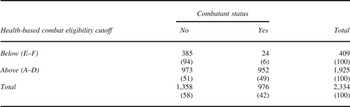
This study's key independent variable is combat exposure, which we define as more than twelve months of combat service. According to this definition, approximately 42 percent of our sample of former soldiers served as combatants—virtually identical to the share of combatants in the population.Footnote 37 Table 1 provides information on the bivariate relationship between health-based combat eligibility and combatant status. Only 6 percent of those assigned a health score below the eligibility cutoff served as combatants, compared with about half of the individuals who were assigned a score above it.Footnote 38 This suggests that health scores are a strong but imperfect predictor of combat status.
Bivariate relationship between health score and combat status

Note: First stage for the 2SLS—regressing combat status on the combat eligibility indicator—returns a coefficient of 0.419 (se = 0.034) and F-statistic = 147.
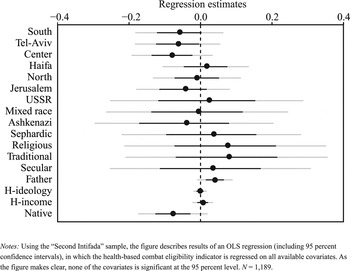
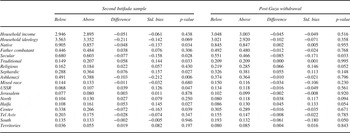
To be a valid instrument, health eligibility must also be exogenous to the study's outcomes. One way to examine this assumption's plausibility is to test whether pretreatment covariates are balanced between former soldiers who are above and below the eligibility cutoff. Our survey includes several questions about the respondent's preenlistment background that may affect their motivation to serve as a combatant: household income, household ideology, residence and level of religiosity prior to enlistment, ethnicity, whether they are an immigrant or Israeli born, and whether their father served in combat.Footnote 39 A rule of thumb for assessing covariate balance is if the means of both groups are less than one-fourth of a standard deviation apart.Footnote 40 Figure A1 in the appendix demonstrates that none of the covariates can predict health eligibility status in a simple regression framework.
There are two ways in which the exogeneity assumption could potentially be undermined. First, health impairments may be correlated with household income, which in turn may be correlated with political attitudes. We do not, however, find evidence for such a correlation in our sample, likely attributable to Israel's comprehensive universal health care system and the fact that its poorest populations are largely exempt from service.Footnote 41
Second, it is possible that some individuals intentionally sort themselves into low or high health categories, and that such sorting patterns are correlated with political attitudes. However, we do not believe that sorting constitutes a major concern in this study for two reasons. First, the ability to sort is limited by the comprehensiveness of the medical examination at the recruitment centers and the quality control mechanisms that are in place to assess the profile assignment process.Footnote 42 Second, because only about 50 percent of those who are eligible ultimately serve as combatants, there are ample ways to avoid combat assignment without manipulating health information.
We nonetheless take several steps to minimize such concerns. First, we surveyed approximately 400 Israeli youth who were assigned health eligibility rankings but had not yet enlisted. If a significant share of recruits had intentionally manipulated their medical condition, we would have found combat eligibility to be correlated with political attitudes or behavior before military service. However, we find no significant differences in political attitudes or participation between youth above and below the combat eligibility threshold.Footnote 43
Second, we test the robustness of our findings to the inclusion of pretreatment covariates. Here, health-based combat eligibility is only conditionally exogenous, and the assumption is that there are no unobserved factors affecting both political attitudes and the presence of chronic health conditions that affect health scores. We then conduct a sensitivity analysis that estimates how large an unobserved covariate u must be to affect combat eligibility. Our findings are robust to the presence of relatively large potential unobserved confounders that influence treatment status.Footnote 44
To better account for the fact that selection into combat is not random for those above the eligibility threshold, we first subset our data to include only those with health scores above the eligibility cutoff. Second, we fit a logistic model regressing combat status on all available covariates. Using this model, we then predict the propensity of all survey respondents to serve as a combatant, regardless of their health scores. Strikingly, the mean combat propensity is almost identical for both of our samples. Had there been systematic intentional sorting into health categories above and below the eligibility cutoff, we would expect the mean propensity to serve as a combatant to be significantly lower among those below the cutoff than those above it.
Finally, a valid instrument must satisfy the exclusion restriction: health eligibility should not affect political attitudes through any channel other than military service. We believe this to be the case, as we know of no systematic relationship between health and attitudes toward the Israeli-Palestinian conflict in Israel. Our youth survey supports this contention, since we find no significant political differences between youth above and below the health eligibility threshold. In sum, we believe the evidence supports the use of health-based combat eligibility as an instrument for combat exposure.
Measurement of Key Variables
Measures and estimation strategies were developed in advance in a preanalysis plan posted on the Experiments in Governance and Politics Design Registration web page.Footnote 45 The online appendix describes deviations from the preanalysis plan and the rationales for these.Footnote 46
Our study examines the causal effect of combat exposure on three broad outcomes: attitudes toward reconciliation, political participation, and vote choice. We operationalize the first two outcomes by grouping several related measures into summary indices. Following Anderson, a summary index is a weighted mean of standardized outcomes in which the weights—the inverse of the covariance matrix—are used to maximize the amount of information captured by the index.Footnote 47 We report the effect of combat exposure on both the summary index and its constituent items but conclude that combat has a causal effect if and only if the coefficient on the summary index is statistically significant. Each of the outcomes is described in turn.
Attitudes toward reconciliation
Attitudes toward reconciliation are operationalized using an index of ten items considered central matters of dispute between Israelis and Palestinians: degree of support for territorial compromise in the West Bank and in Jerusalem; degree of support for compromise on a right of return for Palestinian refugees; degree of belief that there is a Palestinian partner for peace; degree of support for conciliatory policies such as a two-state solution; degree of agreement with the belief that Israel belongs to the Jewish people and is therefore indivisible; degree of support for Israeli settlements in the West Bank; degree of principled opposition to the military occupation; degree of support for freedom of operation for human rights nongovernmental organizations; and self-identification on a seven-point right-left scale. All items were recoded so that higher rankings represent more conciliatory views and were standardized to facilitate comparison of effect magnitude. The ten items are positively correlated with a Cronbach's alpha of 0.90.
Vote choice
To test whether the effect of combat extends beyond attitudes to behavior, we examine its effects on vote choice. First, we asked respondents to indicate which party they voted for in the most recent parliamentary elections, held in January 2013. Responses were coded on a nine-point right-left scale, constructed using the Israel Democracy Institute's 2013 Election Compass.Footnote 48 Second, we measure vote choice in the first elections after the end of respondents' service in the IDF. Comparing these two measures indicates how the effects of combat exposure on voting may change over time.
Political participation
Political participation is operationalized using a summary index of nine proxy measures. These include a five-point scale measure of interest in politics, a three-point scale measure of party activism, and seven indicator variables measuring whether the respondent participated in various political activities in the past twelve months (for example, taking part in demonstrations, contacting a member of parliament, writing a letter or comment to a newspaper or calling into radio shows, writing about political affairs on social media sites, and so on). All nine variables are positively correlated, though the Cronbach's alpha of 0.66 is somewhat low.
Estimation Strategy
Following our preanalysis plan, our main estimation strategy is a two-stage least square (2SLS) instrumental variable (IV) regression with no controls. The IV model considers the effect of combat exposure—endogenous binary treatment di —on outcome variable Yi using the instrument Zi , where Zi is an indicator variable that takes the value of 1 for combat-eligible soldiers, and 0 otherwise. The primary interest is in the following regression function:
 $$Y_{i}\,=\,\alpha_{y}\,+\,\delta d_i\,+\,\varepsilon_{i}$$
where δ is the local average treatment effect (LATE) estimate and εi is the error term. The binary decision to serve or not as a combat soldier di is modeled as the outcome of a linear function of the instrument Zi and a random component υi . Specifically,
 $$d_{i}\,=\,\alpha_{d}\,+\,\Pi Z_{i}\,+\,v_{i}$$
Results
To account for differences in combat environments, we distinguish between the Second Intifada sample (n = 1, 189) and the post-Gaza withdrawal sample (n = 1, 145) in all results.Footnote 49 Results are reported in figures for ease of presentation; dots represent point estimates and surrounding lines represent 90 percent confidence intervals.Footnote 50
Attitudes Toward Reconciliation
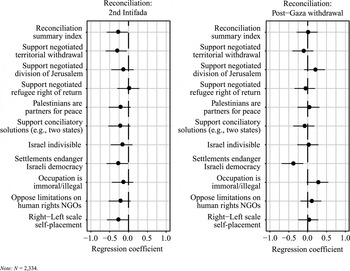
Figure 1 indicates that for ex-combatants from the Second Intifada, combat exposure is associated with a substantial and significant decline in the reconciliation summary index (0.3 standard deviation; p-value = 0.081). This pattern holds for most of the constituent variables that make up the index. Ex-combatants who served during the Second Intifada are significantly less likely to support territorial withdrawal as part of a peace agreement, to believe that Palestinians are partners for peace, and to support conciliatory solutions to the conflict. They are also significantly more likely to support Jewish settlements in the West Bank and to rank themselves as more hawkish on a right-left scale. In contrast, ex-combatants who served in the post-Gaza withdrawal years do not for the most part differ from noncombatants in their attitudes.
Impact of combat exposure on attitudes toward reconciliation

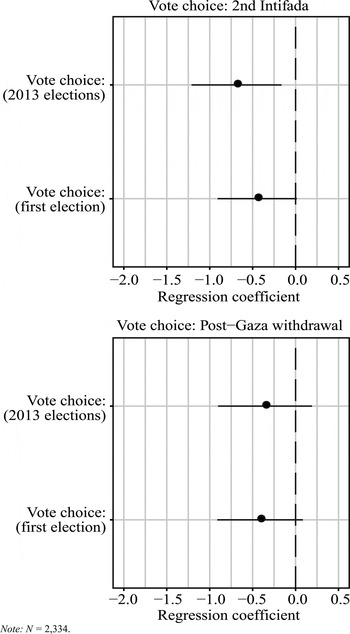
As Figure 2 shows, ex-combatants who served during the Second Intifada are substantially and significantly more likely to vote for harder-line parties. This finding reflects the fact that the Israeli-Palestinian conflict has been among the most salient issues in Israel's political arena since 1967, and attitudes toward the conflict are a key determinant of Israeli voting behavior.Footnote 51 The magnitude of the effect is remarkable: ex-combatants from the Second Intifada voted in Israel's recent elections for parties located 0.7 to the right on the nine-point right-left scale of parties (p-value = 0.031). The effect is also durable, remaining nearly a decade after release from service. Contrary to our expectation, we find no evidence of an attenuation of the hardening effect over time.
Impact of combat exposure on vote choice

To illustrate the magnitude of this effect, consider that in 2013, the Israeli parliament split nearly equally between the right (sixty-one seats) and center-left blocs (fifty-nine seats). One parliamentary seat is equal to approximately 1/120 of the popular vote, which translated into 29,364 votes in the 2013 elections. The number of IDF troops is undisclosed, but according to estimates by the International Institute for Strategic Studies, in 2004 IDF ground troops included 85,000 conscripts, equivalent to about one parliamentary seat per year. Eight cohorts of combatants that served during all or part of the Second Intifada are thus equivalent to seven to eight seats, a number that can exercise considerable influence in Israel's polarized political arena. The hardening effect of combat thus reduces de facto the likelihood that political parties supporting a negotiated agreement could form a winning coalition.
Political Participation
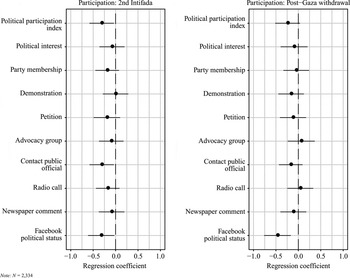
Combat exposure results in lower levels of political participation (Figure 3). The effect is substantial and significant among ex-combatants from the Second Intifada (0.31 standard deviation, p-value = 0.062), and approaches statistical significance in the post-Gaza withdrawal sample as well (p-value = 0.155). These results run contrary to findings by Blattman,Footnote 52 perhaps because of differences in the political environment between Israel and Uganda. For example, it might be that in Israel, combat service itself—including reserve duty—is viewed as a form of political participation.
Impact of combat exposure on political participation

Heterogeneous Combat Effects
In exploring the conditions under which a negative effect on attitudes toward peaceful conflict resolution is most likely, our results indicate a divergence between the two periods examined. Although we find substantial political hardening among combatants from the Second Intifada, we do not find similar effects for the subsequent period. Since recruitment methods, organizational structures, and demographic composition did not vary substantially over these years, what accounts for this difference?
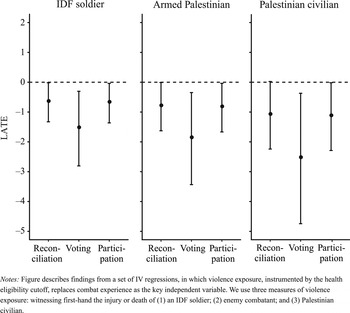
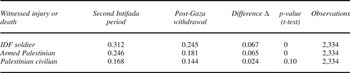
A likely explanation is the different nature of combat service in the two periods. In the Second Intifada, combatants confronted an armed insurgency, engaging in continuous operations in the OPT under risky and intense conditions. High levels of violence, particularly suicide terror attacks in Israeli cities, increased the legitimacy of the IDF's counterinsurgency campaign. Subsequent years saw a sharp reduction in Palestinian violence and consequently a change in the nature of combat operations, which were typically more limited and far less intense. The difference in conflict intensity across the two periods is evident in our sample. Table A2 in the appendix compares the mean levels of violence exposure for individuals serving in the two periods on three binary measures, indicating whether respondents reported witnessing the injury or death of an (1) Israeli soldier; (2) enemy combatant; or (3) Palestinian civilian. The differences in violence exposure are large and significant, corroborating official data on conflict casualties.
To assess whether conflict intensity can indeed account for the hardening effects of combat in the Second Intifada, we rerun our 2SLS regressions, replacing the combat experience indicator with violence exposure indicators. Figure 4 shows that all three conflict intensity indicators are associated with a substantial and significant reduction in support for reconciliation, a shift to the right in vote choice, and a decline in political participation.
Effects of violence exposure

The association between political hardening and conflict intensity suggests that serving in combat leads to more exclusionary attitudes once a certain threshold of violence has been crossed. When combatants operate in relatively nonviolent environments, their experience is not very different from that of noncombatants, and the political effects are far less consequential. This proposition is consistent with studies of Israeli public opinion, which have found attitudes toward peace to be negatively affected by conflict intensity (particularly by Israeli fatalities).Footnote 53
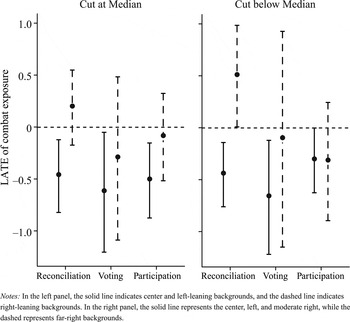
A second factor that may shape how individuals are affected by combat is their ideological background prior to enlistment. We measure ideological background by asking respondents to describe the political ideology of the household in which they were raised on a 1 to 7 right-left scale.Footnote 54 Focusing on the Second Intifada sample, we first dichotomize the household ideology scale at the median, coding those below the median as right-leaning (1 to 3), and those at the median or above as center and left-leaning (4 to 7). The left panel of Figure 5 depicts the effects of combat on individuals from right-leaning households, individuals from center and left-leaning households, and the average effects on the entire sample. The results indicate that the effects of combat vary by ideological background: whereas combatants from center and left-leaning households exhibit a substantial hardening in attitudes and vote choice, combat has no discernible effect on soldiers from right-leaning households.
Combat exposure as a function of household ideology

We then split the data between the far right (household ideology 1 to 2) and the moderate right, center, and left (3 to 7), and find that the hardening effects of combat extend to soldiers from moderate right-leaning backgrounds (Figure 5, right panel). In contrast, combatants from far-right backgrounds exhibit a substantial, significant shift to the left in attitudes toward reconciliation compared with individuals from similar backgrounds who served in noncombat roles. Combat exposure thus hardens the attitudes of all but the most right-leaning combatants, while moderating the attitudes of the latter somewhat, though the significance of this moderation effect is not as robust to changes in model specification.
The political significance of this pattern is twofold. First, it demonstrates that service in combat units reduces political polarization. Socialization processes, brotherhood in arms, and the intense experience of participating in conflict decrease political differences among combat soldiers, which is reflected in the large and significant decline in political attitudes variance among ex-combatants compared with former noncombatants.Footnote 55 Yet the fact that all but the most hardline combatants become more hawkish has substantial implications for the likelihood of reaching a peace agreement because combat hardens precisely those individuals who would otherwise have advocated more conciliatory views. Combat exposure thus erodes the support base of leaders and parties that advocate peace negotiations, a factor that is all the more acute given mandatory conscription.
Robustness
Several tests assess the robustness of our findings. We examine the effects of combat directly without our instrument, employ an alternative measure of combat exposure, estimate the effects of combat on the subset of observations close to the eligibility cutoff, and use a variety of matching methods that improve covariate balance.Footnote 56
First, we estimate combat's direct effect on attitudes toward reconciliation by running a standard ordinary least squares (OLS) regression without instrumental variables. The effect of combat is −0.13 standard deviations (p-value = 0.02), which is much lower (in absolute terms) than our result of −0.31. This suggests that bias caused by nonrandom selection runs in the opposite direction from our findings.
Next, to ensure that our measure of combat captures combat experience, we employ an alternative measure of exposure: a binary variable indicating whether respondents report participating in at least one major military operation during the Second Intifada. The results are even stronger than reported earlier: combat exposure has a substantial and significant negative effect on support for reconciliation. Analysis of heterogeneous effects by household ideology reproduces the pattern reported here.Footnote 57
We then estimate the effects on the subset of the data that is closest to the eligibility cutoff, excluding from the analysis former soldiers who were assigned a health score of A or B. Narrowing the window in this way results in a loss of approximately 70 percent of the observations, such that even large-point estimates fall below conventional significance levels. Still, the direction of the coefficients is generally similar to our findings, which increases our confidence in the results.Footnote 58
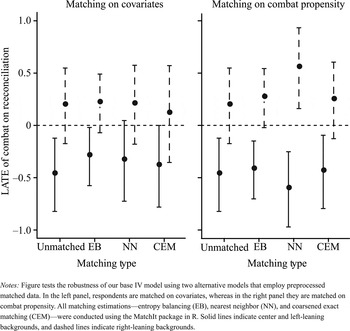
Finally, we test the robustness of our results to various matching estimations. We first use our estimate of combat propensity to match combat eligible and ineligible former soldiers who have similar combat propensities. We then run the instrumental variable regression on the matched sample using a variety of matching algorithms. The core pattern identified here remains in evidence: combatants from center and left-leaning backgrounds are significantly less supportive of reconciliation, negotiations, and compromise, whereas combatants from right-leaning backgrounds show opposite effects, though these do not quite reach statistical significance (Figure 6, right panel). We then perform an additional matching analysis, this time matching eligible and ineligible former soldiers on the covariates themselves. Again we find that combat exposure has substantial and significant negative effects on support for reconciliation among soldiers from center and left-leaning backgrounds, and positive (but insignificant) effects on combatants from right-leaning backgrounds (Figure 6, left panel).
Robustness check: Matching

Causal Mechanisms
Why does exposure to intense combat lead to less conciliatory attitudes? Several mechanisms might explain such a relationship—we explore them empirically in our Second Intifada sample. For each, we examine heterogeneous effects when splitting data at the household ideology median and at the moderate right.Footnote 59
We first assess two socialization mechanisms: framing effects and peer effects. Combat socialization frames the adversary as an enemy to be defeated by force. To test the presence of such framing, we ask our respondents to indicate their position on a seven-point scale between two opposite statements: 1 = “There is no military solution to the conflict with the Palestinians” to 7 = “Palestinians can only be overcome by military force.” Here, higher values indicate greater support for military solutions. Consistent with the general pattern of polarization reduction, we find large and significant framing effects (0.369 standard deviation, p-value = 0.065) among combatants from center, left, and moderate right backgrounds, whereas combatants from far-right backgrounds show reduced support for military solutions (−0.560 SD, p-value = 0.136). This pattern is also evident when the data are split at the median, though the effects are no longer significant.
A second way that socialization might mediate combat's effect on political attitude is through the influence of peers. Combat service is an intense small-group experience in which camaraderie is cherished as a central value. The influence of peers is thus expected to be particularly high. We measure peer effects by asking about the dominant political position in the respondent's unit. We generally find that combatants and noncombatants both report that the dominant political opinion in their unit was right wing. This likely reflects the fact that in the military, militant opinions are more likely to be expressed and valued. We thus conclude that this is unlikely to be a key channel through which combat experience hardens political attitudes.
Combat exposure can also lead to exclusionary views by fostering prejudice. We measure prejudice against Palestinians using a weighted summary index that includes both direct and indirect proxy measures. The direct measure asks respondents to indicate their position on a seven-point scale between two opposite statements concerning the goals of the majority of Palestinians: 1 = “live peacefully alongside Israel's Jewish population” to 7 = “take over Israel and kill or expel its Jewish population.” We measured prejudice indirectly by assessing the extent to which attitudes toward Palestinians differ from attitudes toward Israelis on four dimensions: intelligence, trustworthiness, altruism, and nonviolence (question order was randomized to minimize priming). The prejudice measure was constructed by subtracting the ratings of Palestinians from the ratings of Israelis. All variables were positively correlated (Cronbach's alpha = 0.74). We find that combatants from center and left-leaning backgrounds are far more prejudiced against Palestinians than their noncombatant counterparts. Although the size of this effect is large (0.312 standard deviations), it falls slightly short of statistical significance (p-value = 0.128).
It is also possible that combat exposure leads to a heightened sense of threat. We asked respondents to indicate, on a five-point scale, to what extent they feared (1) missile attacks; (2) terror attacks; and (3) that Palestinians would pose an existential threat to Israel should the IDF withdraw from the West Bank. We do not find evidence that combatants are more likely to fear terror or missile attacks, perhaps because they were no more likely than civilians to be targeted by such violence. However, ex-combatants from center and left-leaning backgrounds are far more likely than noncombat soldiers from similar backgrounds to feel that ending the military occupation of the West Bank would pose an existential threat to Israel's security.Footnote 60 Again, this effect is large (0.35 standard deviations) but falls slightly short of statistical significance (p-value = 0.171).
Conclusion
This study offers robust evidence that combat exposure has a significant and durable negative effect on attitudes toward peaceful conflict resolution, substantially reducing support for negotiated compromise. This effect extends to political behavior, producing a significant shift to the right in vote choice. The study also suggests that the negative effects of combat depend on both the intensity of conflict exposure and combatants' ideological backgrounds. Combat reduces polarization among soldiers, hardening the attitudes of individuals from left-leaning, center, and moderate right-leaning backgrounds, and moderating somewhat the attitudes of combatants from the far right. Put succinctly, high-intensity combat has the most negative political effect on the very individuals who might otherwise have promoted peaceful conflict resolution.
These findings contribute to the decades-old debate regarding the effects of military service on attitudes toward the use of force by addressing two gaps in the existing research. First, they highlight the experience of ordinary soldiers rather than senior officers. Second, by employing health rankings as an instrument, this study identifies causal effects, providing evidence that challenges instrumental approaches. It also provides an important counterpoint to recent microlevel research identifying benign effects of violence exposure. Such research has largely been conducted in postconflict settings and has focused on communal outcomes such as social cohesion, trust, and altruism toward neighbors, without explicitly distinguishing between the effects of combat on intergroup and intragroup relations. We demonstrate that in the context of ongoing conflict, the effects of violence exposure are bleaker, increasing prejudice and fostering support for hardline solutions.
Although our data preclude the possibility of conducting formal mediation analysis, we find suggestive evidence that the hardening effect of combat is partially attributable to combat socialization processes. In addition, the experience of combat under conditions of irregular warfare, heightened violence, and risk inculcate a sense of threat and increase prejudice toward the adversary—which in turn results in more exclusionary attitudes that linger long after combat service has ended.
This study is a first effort to investigate the causal effects of combat exposure on attitudes toward war and peace in the midst of ongoing conflict. A fruitful avenue of future research would be to further explore the mechanisms linking combat exposure and political attitudes, and to identify the potentially different processes at work for civilian victims and combatants. The literature to date has invoked a multitude of mechanisms, each of which points toward distinct processes. Violence exposure is hypothesized to lead to exclusionary attitudes and behavior through psychological distress and post-traumatic stress disorder,Footnote 61 the desire to reduce threat,Footnote 62 or organizational skills that facilitate collective action.Footnote 63 Our study provides initial evidence that combat exposure is associated with increased prejudice and military socialization. A second task for future research is to further specify the relationship between contextual factors and the effect of combat exposure. In our sample, the findings diverge by period of service. Our analysis suggests that this variation is best explained by differences in violence exposure in the two periods. The implication is that the political effects of violence exposure are moderated by conflict intensity, a proposition that awaits further testing and analysis.
Undoubtedly, some features of the Israeli-Palestinian conflict contributed to our results, such as the salience of the conflict for Israeli voting behavior. In settings where combatants exercise little political influence, or where an ongoing violent conflict is less prominent in day-to-day politics, the impact of combat exposure on the likelihood of achieving peace may be lower. Because the effects of combat depend on soldiers' ideological backgrounds, its impact is expected to vary depending on recruitment method and the types of individuals who enlist. In contexts where most combatants are radicalized before entering service, the effects of combat may differ from those reported here. Further research in other settings can shed more light on the generalizability of our findings to comparable contexts of irregular ethnic conflict, and whether the logic linking combat exposure to reduced support for reconciliation extends to other conflicts, including those between or within states. Already, mounting evidence from settings as diverse as India,Footnote 64 Sudan,Footnote 65 Uganda,Footnote 66 and GeorgiaFootnote 67 has demonstrated the harmful legacies of political violence for intergroup relations. Our study thus points to a potential microlevel mechanism for the oft-noted macrolevel finding on the frequent recurrence of conflict.Footnote 68
From a policy perspective, our study has implications for both the Israeli-Palestinian conflict and for conflict resolution more generally. In the Israeli context, it suggests that mandatory conscription has far-reaching political effects that are not yet well documented or fully understood. Individuals who are socialized into violent conflict at formative periods of their lives can be deeply affected by that experience in many ways, including in their political attitudes and behavior. Given the size and impact of the Israeli ex-combatant population, peace-building efforts should take its needs and experiences into account. More generally, our findings underscore the importance of combatant reintegration programs in reducing intergroup hostility and creating the foundation for a viable, durable peace.
Appendix
Convariate balance

Covariate balance

Violence exposure by period

Supplementary Material
Supplementary material for this research note is available at http://dx.doi.org/10.1017/S002081831500020X