Introduction
The ageing of the population is expected to lead to a substantial increase in the prevalence of dementia (Alzheimer Disease International, 2011) and significant concerns exist about whether the current labor force can cope with such an increased future demand (Macdonald and Cooper, Reference Macdonald and Cooper2007). Consequently, the care for PwD will largely depend on informal caregivers, usually spouses. Informal caregivers often provide years of extensive care for their loved one, and must adapt to continuously changing and increasingly demanding circumstances. This challenging role may cause chronic stress, making caregivers highly vulnerable for being overburdened and developing psychological symptoms such as depression and anxiety (de Vugt et al., Reference de Vugt2004). Even in the very early stages, for example in the mild cognitive impairment (MCI) phase, caregivers often experience distress and depressive symptoms (Blieszner and Roberto, Reference Blieszner and Roberto2010).
Clinicians, researchers, and Alzheimer societies stress the importance of a timely diagnosis in dementia, and this is also advocated by most international dementia strategies (De Lepeleire et al., Reference De Lepeleire2008). A timely diagnosis in the early or prodromal phase, may offer caregivers the opportunity to prepare for their future caregiving task in the early stages of the disease and prevent high levels of burden in the later stages (de Vugt and Verhey, Reference de Vugt and Verhey2013). Early intervention and support for caregivers can be effective in reducing strain and may delay institutionalization of the person with dementia (Gaugler et al., Reference Gaugler, Kane, Kane and Newcomer2005; Kjallman Alm et al., Reference Kjallman Alm, Hellzen and Norbergh2013). As levels of stress and burden are relatively low in the early, including prodromal, stages of dementia, interventions at that time present an opportunity for professionals to help caregivers cope with an insecure future and prepare themselves for the possibility of further decline and dependency (Verhey and de Vugt, Reference Verhey and de Vugt2013). However, the specific needs of EDC remain largely unknown (de Vugt and Verhey, Reference de Vugt and Verhey2013). The needs of PwD and their caregivers in later stages of the disease have already been examined extensively. These include the need for emotional, social and financial support, information about the disease and information about appropriate care facilities (Brodaty et al., Reference Brodaty, Thomson, Thompson and Fine2005; Wolfs et al., Reference Wolfs2011; Vaingankar et al., Reference Vaingankar2013; Afram et al., Reference Afram, Verbeek, Bleijlevens and Hamers2014). Caregivers also report a lack of competence to provide care and difficulty to plan ahead for their relative's future care needs (Vaingankar et al., Reference Vaingankar2013). This demonstrates the importance of supporting EDC to prepare them for their difficult future task.
To maximize the benefit of EDC interventions, the needs of caregivers should be carefully assessed to determine whether and which interventions in this stage are desired and to tailor interventions accordingly (Phung et al., Reference Phung2013). The present study therefore focuses on an in-depth analysis of the needs of EDC. More specifically, we sought to (1) gain insight into the problems, needs and wishes that caregivers of PwD encounter during the early stages of the disease, (2) explore if an early-stage intervention for dementia caregivers would be helpful and (3) explore which factors influence caregivers’ perspectives on early-stage need for care.
Methods
Study participants
Purposeful sampling was used to describe the EDC needs that cut across participants with a range of variation on disease severity, gender, age, and relationship with the relative (Patton, Reference Patton2002). The maximum variation sampling strategy was also successfully used in previous research on informal caregiver needs (Vaingankar et al., Reference Vaingankar2013) and allowed us to select participants with these different characteristics to look for common patterns and capture the EDC perceived needs from different points in the caregiver career. A minimum of four focus group interviews with 6–8 participants per group was planned; sampling ended when data saturation was achieved, e.g. no new themes emerged (Patton, Reference Patton2002). Between August 2012 and January 2013, 40 informal caregivers were recruited; 14 early, including prodromal, stage dementia caregivers were purposively selected by professional caregivers from the pool of informal EDC associated with the (1) Memory Clinic of the Maastricht University Medical Center; and 26 later-stage dementia caregivers were purposively selected by professional caregivers from the pool of later-stage informal caregivers associated with the (2) Alzheimer Café Roermond (monthly meeting spot for PwD, caregivers and professionals); and (3) Regional Committee Healthcare (RCH) Proteion, which is a care home for older people. Participants were included if they were (1) the informal caregivers of a person with dementia or prodromal dementia (MCI due to AD, based on the etiological diagnosis expected to convert to dementia), and (2) involved in the daily care of the care recipient at least once a week. The inclusion of caregivers affiliated with different institutions fostered maximum variation of the sample. Twenty-five informal caregivers agreed to participate. Eight caregivers declined participation due to a busy caregiving schedule; six caregivers were not interested in a group meeting and one caregiver declined due to work-related commitments. Three secondary informal caregivers of already represented care recipients requested to join the primary participating caregiver in the focus group interview. The Medical Ethics Committee of the Maastricht University Medical Center approved this study (#12-4-059).
Procedures
Focus group interviews were used to explore caregiver perceptions, opinions, and beliefs, because focus groups are an ideal method to reveal various perspectives on a topic and to uncover new insights and unanticipated issues (Hennink, Reference Hennink2007). Four focus group interviews were scheduled, applying triangulation of sites: two groups (A and B) of six participants in the city of Maastricht and two groups (C and D) of seven and nine participants, respectively in the city of Roermond (both cities are located in the southern part of the Netherlands). Methodological guidelines suggest that most issues around a research topic will be captured after the fourth group discussion (Hennink, Reference Hennink2007). The point of saturation was checked after the fourth group discussion independently by two authors (LMMB, CAGW) to confirm that a sufficient number of focus groups had been conducted as no new themes emerged. Written informed consent was obtained prior to participation in the study. This included explaining the procedure to be followed and the roles of the moderator (MEdV) and assistant (LMMB; taking additional notes). Participants were encouraged to share their expertise (e.g. life experiences) and to view the focus groups as a social event as a means of encouraging open discussion (Eisma et al., Reference Eisma, Dickinson, Goodman, Syme, Tiwari and Newell2004). A semi-structured guide was used during the focus group sessions. It included topics derived from clinical practice that identified needs and wishes expressed by EDC to prevent possible overburdening in the later stages, EDC need for care or experiences with received care, and EDC need for communication of care. Brief summaries of the key points were made throughout the focus group sessions as a method for obtaining participant verification (Hennink, Reference Hennink2007). All focus group interviews were videotaped, and tapes were stored in a locked area. Triangulation of within-method data sources was applied (Patton, Reference Patton2002); video recordings were used in addition to the field notes taken by the assistant to ensure identification of potentially relevant non-verbal information or cues presented by the participants. Interviews lasted approximately 120 minutes.
Context-mapping approach
For the preparation and execution of the focus group sessions a context-mapping approach was used. This approach presumes that information about the context of people's interactions in their everyday life is needed to reveal experiences and emotions in a group environment. Prior to the interview, participants were asked to think, reflect, and explore aspects of their personal context and current situation (Sleeswijk Visser et al., Reference Sleeswijk Visser, Stappers and van der Lugt2005). Therefore, we provided them with packages comprising a booklet to capture parts of their history and current life with their spouse two weeks before the interview. To elicit thoughts and feelings of participants during the group meetings, participants were asked to elaborate on their experiences based on generative techniques such as collage making (Figure 1) (Sleeswijk Visser et al., Reference Sleeswijk Visser, Stappers and van der Lugt2005). This indirect approach was chosen to minimize the risk of increasing feelings of distress caused by directly confronting caregivers with the memory impairment of their loved one (van Rijn et al., Reference van Rijn, van Hoof and Stappers2010). The material was developed in collaboration with an expert in context-mapping to verify its quality and suitability for the present study.
Collages of themes created by participants during a focus group.

Data analysis
The videotapes of all focus group interviews were transcribed verbatim. Analyst triangulation was applied (Patton, Reference Patton2002); the transcripts and observations combined with additional notes taken during the focus group interviews and the collected context-mapping materials were analyzed independently by two authors (LMMB, CAGW) using the qualitative analysis software ATLAS.ti (version 7.0). An inductive content analysis approach was adopted (Elo and Kyngas, Reference Elo and Kyngas2008), in which common themes and categories emerge using inductive reasoning and constant comparison. The texts were thoroughly read and open codes were applied to describe all aspects of the content (Hsieh and Shannon, Reference Hsieh and Shannon2005). Codes referring to the same phenomenon were grouped into categories and these categories were grouped into higher-order themes. Categories and themes were combined into general statements to describe the phenomenon (Elo and Kyngas, Reference Elo and Kyngas2008). Discrepancies in coding and interpretation were discussed in a meeting together with a third author (MEdV) to reach consensus regarding the categories and themes. The video recordings were compared with the written transcripts to be able to identify potentially relevant additional non-verbal information or cues presented by the participants. Saturation was established as none of the categories or themes shown in Table 2 emerged after the third focus group interview. The quotations described in the results section to clarify the major themes were based on those categories that were coded most often by authors LMMB and CAGW. Quotes were selected by the first author (LMMB), verified by the second author (CAGW) and checked for relevance by all authors.
Results
Participants
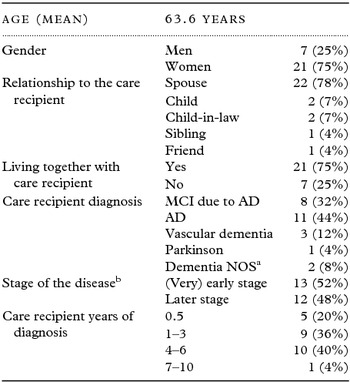
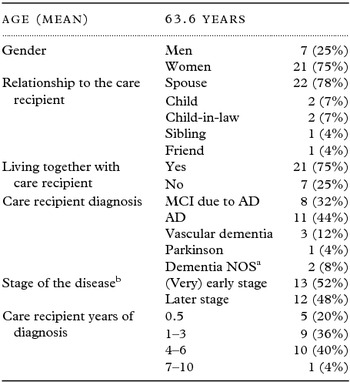
Table 1 represents the characteristics of the 28 informal caregivers (mean age = 63.6 years) that participated in the study. Six participating caregivers (children n = 2, children-in-law n = 2, spouse n = 1, friend n = 1) were responsible for the care of three care recipients. The majority were females (75%), spouses (78%), and lived together with the care recipient (75%). Care recipients (n = 25) were diagnosed with MCI due to AD (32%), Alzheimer's dementia (44%), and other dementias (24%) and were in the (very) early stages of the disease (52%) or had more advanced dementia (48%). The duration of diagnosis ranged from 0.5–10 years. Two groups comprised spousal caregivers only and two groups included a mixture of both spousal caregivers and other informal caregivers. Both authors (LMMB and CAGW) independently concluded that the quotes of prodromal dementia caregivers (MCI due to AD) and EDC were covered by the same codes and categories. Therefore, the results of this study did not separate MCI as a separate group from EDC. EDC and caregivers in the later stages were equally represented in all groups.
Background characteristics of the caregivers (N = 28) and the care recipients (N = 25)
aNOS = not otherwise specified.
bBased on clinical judgment of the referring professional caregiver.
Focus groups
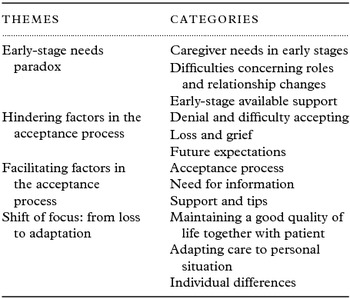
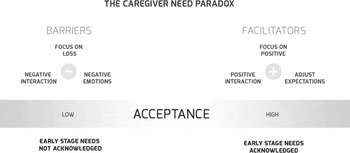
Four major themes covering the problems, needs and wishes experienced in the early stage of caregiving were identified: (1) The early-stage needs paradox; (2) Barriers in the acceptance process; (3) Facilitators in the acceptance process; and (4) Shift of focus: from feelings of loss to adaptation. An overview of the categories and themes is provided in Table 2 and Figure 2, and elaborated below by means of quotations. Each quotation is assigned a code; the letter stands for the location and sequence of the focus group interview, while the number indicates the specific participant. After each code caregivers are assigned to either the EDC or LDC group; EDC stands for early-stage dementia caregiver and LDC stands for later-stage dementia caregiver, as based on the clinical judgment of the referring professional caregiver. Both authors (LMMB and CAGW) concluded that no discrepancies could be discovered between the written transcripts and potentially relevant non-verbal cues brought forward by the participants.
Overview of categories and major themes

Schematic representation of the early-stage needs paradox and the acceptance process.

Early-stage needs paradox
Retrospectively looking back at the early stages, caregivers in the later-stages stressed the need for care that would have facilitated their acceptance process. They indicated that they would have benefited from talking to someone who could understand their situation and recognize their problems earlier. They also stressed the importance of timely guidance tailored to their individual needs as an intervention that would have helped them cope with the situations and worries they experienced.
“Now I think it would have been better for me if I received some guidance in the beginning, just someone helping me find my way. Not telling me: ‘this is what you can expect’, but asking me what I experience or worry about and helping me how to cope with certain situations or incidents. I had to figure that out all by myself and sometimes that worked out but sometimes it really didn’t.” (D6, LDC)
“I would have liked to have received some information that was important for me at that moment. I hear a lot of different stories and some do apply to our situation but others really don’t. It's all so different and it needs to be relevant for your situation at that specific time” (A3, LDC)
However, EDC did not recognize the needs underlined by the later-stage caregivers. EDC found it difficult to accept help, because they did not want to stigmatize their situation or did not want to be seen as in need of professional help.
“I don't like to be called the ‘caregiver’, that makes me feel like a patient and I’m not. He's my husband and of course I take care of him. I don't like to feel pathetic, like I have a problem.” (B6, EDC)
Also, the information that was available for caregivers had a negative, stigmatizing nature, which made it more difficult for EDC to identify with.
“When I go online to find more information about certain things, I get so much information and especially negative information. It seems that I can't find anything positive. That creates a negative image and that's what I take home after reading. All that information really emphasizes the negative. . . but it's not all negative” (B1, EDC)
Despite their difficulty in acknowledging needs and accepting help, EDC did encounter many changes and struggles and found it difficult to cope with and accept the situation.
“I think it's exhausting that my husband forgets so many things. He keeps asking the same thing over and over, places things different than I’m used to or just forgets where he located it. This sometimes irritates me, and afterwards I regret feeling irritated. I don't know. . . I don't like the fact that I might need help.” (A2, EDC)
In sum, a clear paradox existed between the retrospective view provided by caregivers in the later stages of the benefits that early care tailored to personal needs would facilitate the acceptance process and the EDCs’ lack of acknowledging a need for care due to difficulties in accepting the changes, fear of stigma, and the stigmatizing character of the available information.
Barriers in the acceptance process
Acceptance was seen as a prerequisite for caregivers to cope with the changes of the disease. However, besides fear of stigma, several factors hindered the acceptance process and prevented EDC from being able to find an effective way to handle the changing situation. Not acknowledging the disease and a lack of knowledge about the manifestations of the disease seriously hindered the acceptance process.
“As long as you deny it you can't cope with it. As soon as you accept it, you can learn to turn to yourself and think: ‘how can I cope best with this new situation?” (C6, LDC)
“To cope with the diagnosis you need to know what to do and what not to do. Only when you know how to do it right you can learn to accept it. That's a difficult process, before you can set the problem aside for a bit and accept it, but once you’ve accepted it you are not always thinking about it and you can get on with your life.” (A3, LDC)
Because of this lack of knowledge about the possible disease manifestations, EDC often took the changes in behavior personally, which led to insecurities, unnecessary misunderstandings, and discussions.
“I really have to get used to the fact that his head is busy, that he thinks differently. It always escalates when I go on, but it's really hard to understand that he sees it differently. I often push through and we end up in discussion.” (A4, EDC)
Furthermore, lack of knowledge in people surrounding the care recipient and caregiver caused EDC to feel insecure about their own actions.
“It's just the worst feeling in the world when others say: ‘what's wrong with him, he looks just fine?’ That devastates me, then I start to question myself.” (D3, EDC)
Caregivers were confronted with the negative feelings and losses because misunderstandings occurred frequently in the early stages. These feelings of loss hindered the acceptance of the disease and its implications for their lives. Consequently, negative emotions got the upper hand.
“I find it very difficult to accept everything and I can't really cope well with the new situation. I also find it difficult what to do with myself. . . I don't feel like doing anything and I don't enjoy things anymore. That's where I am right now” (D5, EDC)
When negative EDC emotions outweighed the positive, the likelihood of disruptive encounters with the care recipient increased, and this was followed by even more negative emotions. This vicious circle made it increasingly difficult to control the negative interaction with the care recipient.
“The fear of failing and suspicion is constantly present and that makes her restless. The smallest comment can push her over the edge and cause the situation to escalate. You don't want it to, but it happens. . . all the time. Unfortunately in the beginning it happened daily. That really hurt.” (A1, EDC)
In sum, denying the disease, a lack of knowledge, and a focus on loss increased negative emotions and feelings of uncertainty in EDC. When negative experiences outweighed positive emotions the acceptance process was furthered hampered.
Facilitators in the acceptance process
The process of accepting the disease and its changes could be also facilitated. Disease-specific knowledge was identified as crucial in helping caregivers understand the manifestations of the disease and its changeable nature in the early stages. Information helped caregivers avoid taking the changes personally and improved their ability to empathize with the care recipient.
“You need to realize that your spouse is not doing these things on purpose, they happen because of their inability. He is not doing this to hurt me. That really changes the way you look at the situation. If you realize that, you can stay calm and it won't escalate.” (B6, EDC)
Furthermore, caregivers reported that designating personal time was important for maintaining a healthy balance between caring for the care recipients and caring for themselves. Taking a break helped caregivers to recharge their energy level and it improved their ability to cope with the demanding situation.
“Your resilience just decreases during the day. Then, when something happens, I respond irritated and say something wrong. Whenever I feel my resilience declining, I do something to recharge it; I withdraw myself from the situation, we still sit together but I start to read something or do a puzzle while recharging myself and thinking about the fact that it's not her fault. It gives you the time to think about what you’re going to say and avoid restlessness or worse. . .” (A1, EDC)
However, caregivers found it difficult to set aside personal time when the care recipient demanded their attention. Establishing structure and routine in daily life with the care recipient provided personal time for caregivers and simultaneously decreased restlessness and uncertainty in the care recipient.
“I go hiking every week and he knows that. If he starts to get agitated about me leaving I just refer to the calendar and remind him that it's my hiking day today. He doesn't always like that, but he accepts it because it's in our routine.” (A3, LDC)
Dementia obliged caregivers to take on different roles in the relationship with the care recipient. This change in roles was difficult to adapt to. Acknowledging the change in roles and relationship decreased negative encounters. This new role as a caregiver demanded a certain level of confidence that could be increased by positive experiences, such as spending time alone, with the care recipient or with people from the caregivers’ social network.
“I tried working on my confidence by taking walks and going to the gym and talking to others, just being able to say what's on my mind. . . that helps.” (B5, LDC)
Humor, when appropriate, was also mentioned as an approach that lessened the negative impact of the disease and helped caregivers identify positive rather than negative aspects of living with the care recipient.
“When I do something wrong, she usually says: ‘who has Alzheimer’s, you or me?’ Or when something small goes wrong I call it Alzheimer's light. . . that kind of sly jokes help lighten the situation.” (A6, LDC)
In sum, understanding disease manifestations, applying structure and routine, and designating personal time aided the acceptance of the disease and buffered its consequences on daily life. Acknowledging the changes in roles and relationship reduced negative communication. Using appropriate humor increased positive encounters with the care recipient and helped caregivers expand their caregiver-confidence.
Shift of focus: from loss to adaptation
The facilitators in the acceptance process provided caregivers with the opportunity to adjust their expectations and to focus more on the positive aspects such as new or other possibilities in their life together with the care recipient. Their focus shifted from what they had lost to what was still possible with the proper alterations.
“You learn by trial and error. When the same thing happens over and over you start to adjust your expectations so that the situation isn't looking so bad after all.” (B5, LDC)
When caregivers focused more on their possibilities, positive feelings increased, and this facilitated positive interactions with the care recipient and increased the well-being of both the caregiver and the care recipient.
“You keep on adjusting to what fits his changed needs. Because when he is happy with the situation, I feel that I’m also happier. That really works both ways.” (D1, LDC)
However, the process of how spousal dyads adapted to their new situation varied by personality, individual coping mechanisms, and the premorbid relationship.
“Every man is different and has a different character. And every woman is also different towards her husband. There is no solution that works for everyone.” (D9, LDC)
In sum, acceptance led to adjusting expectations and a focus on possibilities rather than on loss. This created opportunities for positive interaction with the care recipient and an increase in well-being. However, the process of adaptation was different for each individual spousal dyad.
Discussion
The aim of this study was to explore the needs and wishes of informal caregivers of people in the early stages of dementia from different perspectives in the caregiver career. The analysis revealed four major themes. The first was the early-stage paradox in needs. The retrospective view of caregivers in the later stages on need for early care tailored to personal needs to facilitate the acceptance process contrasted with the EDC view. EDC struggled with acknowledging needs and accepting help due to difficulties in accepting the changes, fear of stigma, and the stigmatizing character of the available information. The second theme identified factors hindering the acceptance process. These included denying the changes, lack of knowledge, and a focus on loss. These barriers led to negative emotions and negative encounters with the care recipient and blocked positive emotions. The third theme identified factors facilitating the acceptance process. These include understanding disease manifestations, designating personal time, acknowledging, and gradually establishing changes in roles, structuring time and appropriately using humor. These facilitators appeared to reduce negative communication and increase positive encounters and caregiver-confidence. The fourth theme highlighted the importance of acceptance as a prerequisite for adapting expectations and focusing on possibilities to be able to maintain a positive interaction between caregiver and care recipient.
In the current study, no differences were found between prodromal dementia and EDC in the assigned codes and categories. It is possible that no differences were seen between these two groups of caregivers because MCI due to AD can be viewed as the very early stage of dementia (Verhey and de Vugt, Reference Verhey and de Vugt2013). Also, caregivers are often aware of the condition of their loved one long before the actual diagnosis is disclosed (Morgan et al., Reference Morgan2014).
Our results suggest that the early needs retrospectively identified by later-stage caregivers contradict the needs for care emphasized by EDC, who actually struggled with acknowledging specific needs. It is conceivable that EDC also relate their need for care to their currently experienced objective burden opposed to their subjective burden. Objective burden refers to aspects like the amount of time spent on caregiving and the type and number of caregiving tasks that are performed, often predicted by behavioral problems and impairments in daily function and cognition (Wolfs et al., Reference Wolfs2012). Subjective burden refers to the emotional response of the caregiver to the demands of the situation, such as feelings of incompetence or exhaustion (Donaldson et al., Reference Donaldson, Tarrier and Burns1998). In EDC the objective burden might be lower, given the level of impairment and the lower amount of practical and behavioral problems in dementia compared to the later stages of the disease. EDC might experience subjective burden, but this may be more complex to translate into specific needs as compared to objective burden. Brodaty et al. (Reference Brodaty, Thomson, Thompson and Fine2005) also found that, despite a low level of life satisfaction and high levels of subjective burden, EDC as well as caregivers in the later stages felt that they did not need services or help. In addition, caregiver experienced stressors are often not directly related to their self-reported needs (Austrom et al., Reference Austrom, Lu, Perkins, Boustani, Callahan and Hendrie2014).
Our results propose that the willingness and ability to accept the disease is required to acknowledge needs and can also be seen as a prerequisite to maintain an acceptable level of well-being together with the care recipient (Shim et al., Reference Shim, Barroso and Davis2012). However, the current study emphasizes the struggle EDC experience with accepting the changes due to the disease and our results showed that several factors could hinder or facilitate this acceptance process. Previous research confirms that disease-specific knowledge and knowledge on roles and relationship changes can increase caregiver confidence and understanding and facilitate acceptance (Shim et al., Reference Shim, Barroso and Davis2012; Morgan et al., Reference Morgan2014). When caregivers manage to accept the changes in reciprocity, they can shift their focus from loss to opportunities. A strong focus on the intact parts of the relationship and life's simple joys may help to increase the number of positive experiences with the care recipient (Shim et al., Reference Shim, Barroso and Davis2012). This change in attitude enables caregivers to effectively cope with the changes and increase their well-being (Banningh et al., Reference Banningh, Vernooij-Dassen, Vullings, Prins, Rikkert and Kessels2013). This explanation is in line with the dual-process theory on coping with loss (Stroebe and Schut, Reference Stroebe and Schut2010). This theory proposes that adaptation to chronic or life-threatening diseases is characterized by two types of adaptation, namely loss-oriented or restoration-oriented. EDC can be seen as in the early phase of adaptation, where their focus lies more on loss as caregivers first have to appraise a stressor before they can formulate adaptations to it. An increased level of distress and anxiety accompanies this focus on loss. According to the theory, stimulation of the adaptation process towards the restoration-oriented adaptation can lead to an increase in well-being. However, the process of adaptation and level of well-being also depends on individual characteristics of the EDC, such as coping mechanisms, personalities, and premorbid relationships. Previous research confirms that even in apparently similar situations, caregiver experiences can differ depending on the interpretation or meaning caregivers apply to their situation (Shim et al., Reference Shim, Barroso and Davis2012). Also, a negative premorbid relationship is associated with negative caregiver experiences (de Vugt et al., Reference de Vugt2003; Shim et al., Reference Shim, Barroso and Davis2012). Negative caregivers were not able to express empathy and compassion because they interpreted behavior of the care recipient as a continuity of what they considered negative behavior in their relationship, as opposed to a manifestation of the disease. In addition, personality characteristics such as neuroticism are associated with a non-adaptive care strategy resulting in higher levels of negative emotions such as depression (de Vugt et al., Reference de Vugt2004). It is essential to take these personal characteristics and the premorbid relationship into account when addressing needs in tailored intervention programs (de Vugt and Verhey, Reference de Vugt and Verhey2013).
The current study is not without limitations. First, all focus group interviews were held in the southern part of the Netherlands. As caregiver needs may differ based on practical aspects such as the care organization per region (Wolfs et al., Reference Wolfs2011), this may have threatened the transferability of our results. However, to reduce the effect of local factors peculiar to one setting, triangulation of sites was carried out with different institutions in the southern part of the Netherlands (Denzin, Reference Denzin1989). Second, the present study did not apply methodological triangulation of qualitative methods, which could have compensated for the limitations of individual interviews and focus group interviews separately. The use of solely focus group interviews may have caused not all participants to be equally represented in the results (Hennink, Reference Hennink2007). However, the focus group moderator (MEdV) is an experienced clinician with more than ten years of clinical experience and ample experience as moderator of group interviews who ensured that all participants were provided the opportunity to express their views. Also, the present study applied within-method triangulation combining data from the written transcripts, videotapes, and the concept mapping approach, which allowed us to derive information from the context outside of the focus group interviews and allowed participants to reflect on their situation beforehand, possibly increasing the information depth during the focus group interviews (Patton, Reference Patton2002; van Rijn et al., Reference van Rijn, van Hoof and Stappers2010). Finally, the present study applied purposive sampling to capture EDC needs from different backgrounds and different points in the caregiver career. Purposive sampling is often used in qualitative research and has been used and justified in previous research on caregiver needs (Vaingankar et al., Reference Vaingankar2013). Although random sampling helps to ensure that any unknown influences are distributed equally amongst groups and can reduce researcher bias in the selection of participants, it can also lead to a sample that is not representative for the measured phenomenon (Patton, Reference Patton2002). As we wanted to ensure a broad sample in terms of background, care recipient stage of the disease and institution, the current approach fitted the research question.
Conclusion
This study showed that difficulties with acknowledging needs in the early stages can be attributed to a struggle with accepting and adapting to the new role caregivers need to take on in the relationship with the care recipient. This underlines the importance of early-stage interventions aimed at the facilitation of the adaptation process (Banningh et al., Reference Banningh, Vernooij-Dassen, Vullings, Prins, Rikkert and Kessels2013). But early-stage interventions may do more harm than good if they do not fit the situation and are stigmatizing for the caregiver and care recipient (de Vugt and Verhey, Reference de Vugt and Verhey2013). Currently available information and support for caregivers is often of a negative, stigmatizing character, which makes it difficult for EDC to identify with and may frustrate acceptance. Early therapeutic interventions should not be problem-oriented or stigmatizing, but should help caregivers identify their needs based on their individual situation, increase their knowledge on changes in roles and focus more on the enhancement of the positive, intact experiences. With that focus in mind, early therapeutic interventions may strengthen the relationship and reduce negative consequences of caregiving at later stages (Shim et al., Reference Shim, Barroso and Davis2012; Banningh et al., Reference Banningh, Vernooij-Dassen, Vullings, Prins, Rikkert and Kessels2013; de Vugt and Verhey, Reference de Vugt and Verhey2013; Kjallman Alm et al., Reference Kjallman Alm, Hellzen and Norbergh2013).
Conflicts of interest
None declared.
Author contributions
L. Boots, M. de Vugt, G. Kempen, and F. Verhey designed the study. L. Boots collected the data, performed the qualitative analyses and wrote the manuscript. C. Wolfs performed the second independent qualitative analysis. M. de Vugt supervised the data collection and analysis. C. Wolfs, M. de Vugt, G. Kempen and F. Verhey provided valuable comments during the process of writing this manuscript.
Acknowledgments
This study is part of a larger study funded by Alzheimer Nederland (Grant nr WE03-2010-08), and the Alzheimer Research Fund Limburg. We thank the caregivers who participated in this study, Fraukje Sleeswijk-Visser for the help with the preparation of the context-mapping material, Paul Bremmers and Ageeth Thalen of Proteion RCG for their valuable assistance in recruiting participants and facilitating the group meetings and Inge Klinkenberg for entering a great deal of the data.