This paper discusses how Roman visual culture might be useful for deciphering the ecphrastic passages of the ancient Greek novel. Whereas ecphrasis has been one of the blossoming topics in the field, the examination of novelistic ecphrasis alongside particular works of art is still a desideratum.Footnote 1 As a test case I will use Xenophon of Ephesus’ ecphrasis of the bed canopy depicting Ares’ and Aphrodite's embrace, in the Ephesiaca, a novel that might have been written as early as AD 65.Footnote 2 In what follows I will argue that the scene described on the canopy would have stimulated a variety of intertexts, both literary and visual, in the minds of the imperial audience: that is, Xenophon's reader would have been encouraged to recall not just Demodocus’ song of the love of Ares and Aphrodite but also the idealised Roman version of the myth, which was so frequently depicted on frescoes and mosaics in Roman villas in the first century. I then explore Xenophon's ‘interpretatio Romana’ through the adaptations of the Ares and Aphrodite myth found in Plutarch and Lucian.
Ruth Webb brilliantly shows that the ancient term ecphrasis was used for a variety of vivid descriptions which aimed to stimulate the audience's imagination and which encouraged them to retrieve the image described from an embedded stock of images that were part of the literary/rhetorical or other artistic experience of the pepaideumenoi.Footnote 3 Vivid ecphrastic representations, such as Xenophon's bed canopy, were not only rhetorical achievements but also visual narratives well rooted in the audience's visual world. Doro Levi was the first to associate the ecphrasis in Xenophon with a late fourth-/early fifth-century mosaic from the triclinium of the House of the Green Carpet in Antioch showing a couple—presumably Aphrodite and her lover—seated on a couch under a canopy supported by Erotes.Footnote 4 This paper is inspired by Doro Levi's approach but explores Xenophon's contemporary, namely first-century, artefacts. My paper is structured as follows: (i) in the first part I examine Xenophon's description and its supposed debt to Homer's Odyssey; (ii) then I provide an overview of the Roman visual representations of Mars and Venus; (iii) whereas the last section contextualises Xenophon's ecphrasis within the framework of Mythenkritik of the Second Sophistic and compares his version of the myth with those found in Plutarch and Lucian.
1. Homeric intertextuality
As has often been observed, Greek novels frequently open with an ecphrastic scene, not necessarily describing an artefact, and this is the case with Xenophon's Ephesiaca.Footnote 5 Xenophon's novel devotes some time to the description of the parade for Artemis Ephesia where Anthia and Habrocomes meet in what appears to be a hunting procession. The scene seems to be influenced by rhetorical descriptions and by popular visual representations of the Hippolytus myth:Footnote 6 within the broader hunting scene, Habrocomes is depicted as a chaste, Eros-defying character followed by ‘the sacred objects, the torches, the baskets, and the incense, then horses, dogs, hunting equipment, some for war, most for peace’ (X.Eph. 1.2.4).Footnote 7 Anthia poses in a short dress, Artemis-like, and her posture, it has been argued, might recall some figurines of Artemis.Footnote 8 This emblematic entrance with the civic procession recalls a variety of visual intertexts and highlights the importance of the plastic arts for understanding the novel.
After the wedding, the narrator leads the curious reader into the couple's bedroom where they will spend their first night together as husband and wife (X.Eph. 1.8.2). In bed, beneath the Aphrodite and Ares canopy, Anthia and Habrocomes exchange love confessions and make long chastity oaths (X.Eph. 1.9.1–9). This scene has its double at the end of the novel: after managing to stay alive and faithful through a variety of calamities, the two protagonists reunite on the island of Rhodes, where they spend yet another night of passion together (X.Eph. 5.1.12). Eventually, they return to Ephesus, where they live happily ever after and dedicate an inscription with their adventures to Artemis’ temple. Xenophon's narrative starts with the ecphrastic civic procession, moves to their individual erotic adventures, but also ends with the votive plates as a kind of aretalogy.Footnote 9 Both prompt the reader to imagine the text in visual terms, whether in plastic terms or as a graphe, and both emphasise the public nature of their love tale.Footnote 10 Yet the tale about Anthia's and Habrocomes’ adventures, the one narrated between the procession and the votive inscriptions, is not a public but, mainly, a private love tale. Unlike the embedded Ephesian onlookers of the parade and the readers of the graphe, the external reader is granted a brief glimpse into the bedroom of the newlyweds and witnesses their first night.Footnote 11 Thus, the reader occupies a liminal position between the public and the private.Footnote 12 But is this peek into the bedroom such an intimate moment for Roman eyes?Footnote 13
Romans lived and died surrounded by myths, whether in the forum, at home or on their deathbed. And although the same myths were often used in public, domestic or funeral settings, their meaning changed significantly according to the context. Ares and Aphrodite is one of the most characteristic cases that was displayed both in the public and private, domestic and funerary, sphere but as we shall see below its interpretation differed significantly depending on the context. Roman audiences were also trained to draw connections between the sphere of the ‘real life’ and that of mythology, whether through similarities or through differences.Footnote 14 In particular, domestic wall painting seems to have similar traits to the novels since it appears to address a similar kind of elite audience.Footnote 15 Roman villas, albeit private, were meant to be seen by select visitors.Footnote 16 Similarly, the reader of a Greek novel could be like the privileged visitor to a Roman villa, who could be introduced to both its exterior and more or less private interior chambers.Footnote 17 It is with this metaphor in mind that we need to revisit the novel's purported programmatic Odyssean echo:
ἦν δὲ αὐτοῖς ὁ θάλαμος οὕτως πεποιημένος· κλίνη χρυσῆ στρώμασιν ἔστρωτο πορϕυροῖς καὶ ἐπὶ τῆς κλίνης Βαβυλωνία ἐπεποίκιλτο σκηνή· παίζοντες Ἔρωτες, οἱ μὲν Ἀϕροδίτην θεραπεύοντες (ἦν δὲ καὶ Ἀϕροδίτης εἰκών), οἱ δὲ ἱππεύοντες ἀναβάται στρουθοῖς, οἱ δὲ στεϕάνους πλέκοντες, οἱ δὲ ἄνθη ϕέροντες· ταῦτα ἐν τῷ ἑτέρῳ μέρει τῆς σκηνῆς· ἐν δὲ τῷ ἑτέρῳ Ἄρης ἦν οὐχ ὡπλισμένος, ἀλλ’ ὡς πρὸς ἐρωμένην τὴν Ἀϕροδίτην κεκοσμημένος, ἐστεϕανωμένος, χλανίδα ἔχων· Ἔρως αὐτὸν ὡδήγει, λαμπάδα ἔχων ἡμμένην.
(X.Eph. 1.8.2f.)The chamber had been prepared: a golden couch had been spread with purple sheets, and above it hung an awning with embroidered Babylonian tapestry. Cupids were playing, some attending Aphrodite, who was also represented, some riding on Nabataean ostriches (sparrows), some weaving garlands, others bringing flowers. They were on one half of the canopy, on the other was Ares, not in armour, but dressed in a cloak and wearing a garland, adorned for his lover Aphrodite. Eros was leading the way with a lighted torch.
(tr. Anderson)Given the lack of explicit literary allusions in Xenophon and the older assumption that the novel belongs to the alleged ‘pre-sophistic’ samples of the genre,Footnote 18 scholars are now interested in any literary echo that might show that its level of sophistication is higher than previously thought. Hence, recent scholarship has attempted to connect the above ecphrastic passage with the most evident intertext, Demodocus’ song about Ares and Aphrodite in the Odyssey:Footnote 19
The bard famously sings the story of how Helius betrayed the illicit lovers to the clever husband who crafted invisible nets and bonds with which he caught them in the act. The song ends with all the twelve gods laughing around the two unlucky lovers. Demodocus’ song was a problematic Homeric passage throughout antiquity. Most ancient critics found it awkward since its adulterous content seemed to have no place in a heroic epic.Footnote 20 The story of Aphrodite's affair with Ares is known from Hesiod's Theogony 934–7 too, but Hesiod focuses on Harmonia, the patroness of Thebes, thereby avoiding any negative aspects. Among Homer's ancient readers, some interpreted it allegorically as illustrating the submission of power to beauty. Plato, for example, cites the well-known proverb: ‘not even Ares can resist Eros’.Footnote 21 Recent research has found it difficult to reconcile the song's content with the main plot of the epic and has often used it as an argumentum a contrario. It is now commonly agreed that the song of infidelity contrasts with the conduct of the patient and faithful wife of Odysseus and creates tension between what Penelope is and what she could have been doing during her husband's absence instead of weaving on her loom.Footnote 22
No less than Homeric scholars, novelistic scholarship has found it challenging to interpret the meaning of Ares’ and Aphrodite's coupling for the plot of the Ephesiaca. If the novel as we have it is but a summary of the original, it is even trickier to attempt to interpret the scene in detail.Footnote 23 As we now believe that the novel is indeed not that but a complete work as it is, modern researchers interpret this ecphrasis as an argumentum a contrario, following the lead of Homeric studies.Footnote 24 The most recent and erudite analysis in this respect is by Aldo Tagliabue.Footnote 25 He compares the opening erotic scene, whose sensuality is underscored by the allusion to Ares, and Aphrodite's affair, to the final lovemaking scene, which, he claims, describes the spiritual and emotional bonding of the couple. Ultimately, he argues, the novelistic meeting echoes that of Odysseus and Penelope at Odyssey 23.296, the ideal reunion, and shows how Habrocomes and Anthia eventually embody Homer's ideal couple.Footnote 26
But is it necessary for the tapestry to allude to Demodocus’ song for the reader to infer that the couple's meeting and lovemaking in the final book echo Odysseus’ and Penelope's reunion? In fact, as far as the prototypical Odyssean spousal recognition scene is concerned, Silvia Montiglio shows clearly how broadly the Homeric model ought to be understood in this and in some other novels.Footnote 27 Unlike the reluctant and progressive reunion of the epic heroes, that of Anthia and Habrocomes is mutual, spontaneous, and does not include a chastity test, such as the famous bed test at Odyssey 23.174–8. Having no other ‘special signs’, like Odysseus’ immobile bed or the precious ‘virginity signs’ or ‘tests’ that appear in the later novels by Achilles Tatius and Heliodorus, Anthia and Habrocomes are eager to convince each other of their fidelity using only their secret vows of chastity; this was their fervent wish.Footnote 28 The couple is reunited out of pure desire for each other, and not necessarily after painstaking logical deduction, much unlike Penelope and Odysseus. Their eagerness prompts us to infer that the sensual aspect of their relationship is just as important as the emotional: just as in the first bed scene, Anthia and Habrocomes try to swear eternal faithfulness; in the second scene they easily convince each other of their chastity driven by desire.Footnote 29
A closer reading of the two passages involving Aphrodite and Ares reveals that the scene from the Odyssey has very little in common with that described in Xenophon. In fact, only the names of the two main gods and the overall theme of their lovemaking are the same. In the Odyssey the song is about Hephaestus’ smartness in outwitting the adulterers. In Xenophon the ecphrasis is treated more with regards to its erotic context than to its scandalous aspects. Thus a direct association of the above passage with Demodocus’ song seems to me an overinterpretation, since the narrative, despite its overall admiration for the Odyssey, does not give any clear hints regarding possible misconduct on Anthia's part at this early point in the plot. Unlike Penelope in the epic, who is already enduring the twentieth year of her husband's absence and thus might finally choose someone among the suitors, the beautiful Ephesian does not have other disappointed suitors like Callirhoe, and she seems to be the epitome of the chaste wife. Moreover, unlike Odysseus who spent much of his time abroad in the embrace of Circe and Calypso, Habrocomes has never left Ephesus or slept with other women—and he too is in fact a virgin.Footnote 30 As a result, it would be difficult to find an ironic element suggestive of the frailty of conjugal fidelity in the early description of the canopy.
Xenophon's readers were therefore encouraged not to compare the scene to the Odyssey, but rather to see the divine pair on the canopy and the human pair on the bed—both in a sensual embrace—as interchangeable. Such visual images were very popular in the Empire and myths were often used to blur the line between the people's ‘real life’ or, more accurately, their ‘idealised real life’ and the mythical representations. As Zanker and Ewald observe apropos of the tendency to include portrait heads on mythical compositions, ancient viewers could ‘switch easily back and forth between the mythological or allegorical figure and the real world, which after all, was where the portraits had their place’.Footnote 31 Novelistic heroes are compared to gods and heroes throughout the genre.Footnote 32 Froma Zeitlin shows excellently that the Greek novels were interested in the same kind of myth-related portraiture that we find in Roman domestic art.Footnote 33 In fact the visual representations on the walls of the Roman house and the mythical characterisation found in the novels might not have been so very different.Footnote 34 Below, I sketch briefly what might have been the horizon of visual expectations of Xenophon's readers, namely what was part of what Ruth Webb calls their ‘Gallery of the Mind’ when they were confronted with an ecphrasis of Ares and Aphrodite.Footnote 35
2. Visual narratives of Ares and Aphrodite
Stefan Tilg shows very eloquently how the Augustan cult of Aphrodite and the special relationship between Aphrodisias and Rome might have been decisive for the overall assimilation of Callirhoe to Aphrodite and thus important for the shaping of the eponymous novel.Footnote 36 This influence, I believe can be seen in other novels too that are not necessarily associated with Aphrodisias, such as Xenophon's Ephesiaca. Aphrodite was a favourite topic of Greek art throughout. In earlier Greek art, the idealised marriage of Ares to Aphrodite is infrequently depicted; evidence comes instead mainly from the Homeric adultery scene.Footnote 37 One of these rare ideal versions can be seen in Pergamum, which is near Xenophon's Ephesus. There, on the north frieze of Zeus’ altar, which dates to the second century BC, Aphrodite is depicted next to Ares, her mother Dione and Eros, fighting the Giants.Footnote 38 With Augustus, Venus, the mother of Aeneas, and Mars, the father of Romulus and Remus through Rhea Silvia, become the progenitors of the Romans and were seen as a legitimate couple.Footnote 39 Augustus’ Forum was centred around the temple of Venus Genetrix and Mars Ultor.Footnote 40 The idealised transformation of the adulterous pair was further sustained by Augustus’ restrictive marriage and adultery legislation.Footnote 41 Now love in marriage became a desideratum and passion could be found in legitimate relationships.Footnote 42 Most importantly, the scene of Venus embracing Mars became a key image as it now embodied a variety of Augustan Roman ideals.Footnote 43 The main models for the statues that represent the myth are the Capuan Venus and the Borghese Mars type, which were combined in a group of statues and became extremely popular in the second century:Footnote 44 Venus is standing on the left, turning to the right and embracing with her left hand her husband Mars, whose body is turned towards the viewer. Venus’ right hand is stretched towards her husband or rests on his shield. Mars and Venus were considered to be representative of the Emperor's and Empress's male and female virtues, bravery and beauty, and, ultimately, their wedding became an allegory of Roman Concordia.
Later, elite and other middle-class citizens adopted the theme and eventually the gods’ faces were depicted with portrait features.Footnote 45 The theme of the gods’ embrace is present on four second-century sarcophagi, and becomes even more popular on the third-century strigillated sarcophagi, in which the couple is represented in the middle, under an aedicula, together with garlands and flying putti.Footnote 46 What was new on these second-century funerary representations, in contrast to those of Augustan state art and the earlier frescoes, is the dextrarum iunctio: the two figures hold hands, which symbolises marital affection and faithfulness.Footnote 47 These images illustrate the long-lasting bond of love and devotion extending post mortem and seem to suggest that the living, who order the sarcophagus, wanted to remember the tenderness of the marital life rather than the grief imposed by the death of a beloved spouse.Footnote 48
If Xenophon's novel is to be dated to the second half of the first century, the imperial and funerary representations are not relevant for our text as they postdate it. But Xenophon's date is not the only constraint. The treatment of the theme on Pompeian walls and in Xenophon differs significantly from the imperial versions in the capital and from the funerary revisions on the sarcophagi because it belongs to the private and domestic sphere. Whereas state and funerary monuments offer an idealised heroic version of the mortal couples—be they imperial, elite or middle class—they do not provide evidence for the use of these mythical images in everyday life.Footnote 49 Just like Anthia's and Habrocomes’ civic procession and the graphe at the end of the novel, funerary monuments shift between the civic and the private sphere and show how the patrons wanted to be remembered in aeternum.Footnote 50 Contrarily, Xenophon's bed canopy and the Pompeian frescoes are for everyday contemplation.Footnote 51
Among the well-known statues featuring Mars and Venus, Rachel Kousser discusses some new discoveries of the group: domestic small-scale sculpture groups and some gems. Her point is that these artefacts could have a ‘personal meaning, representing the love of the couple who owned the house’.Footnote 52 This way of thinking might be illuminating for understanding the function of the bed canopy as well. What would be ‘the personal meaning’ of the description of Ares and Aphrodite for Anthia and Habrocomes? Does the location of this mythical ecphrasis, the bedroom and the actual bed, matter? In what follows I will concentrate on the works found in the domestic sphere, and in particular on the frescoes and mosaics found in Roman villas for which we have some evidence about their position in the Roman house.
We observed above how in the opening ecphrasis we are led into the bedchamber of the newlyweds from the civic parade for Artemis and how this shift matches the transit from the civic to the erotic theme of the novel. In the same way, the view of a guest entering a Roman house was directed from the threshold of the house to the more private chambers, following the axis fauces–atrium–tablinum. In some cases the visitor could already get a glimpse of the peristylium from the entry hall.Footnote 53 In this context, we observe that most of the Mars and Venus frescoes are found in the tablinum.Footnote 54 This was the master bedroom and later the office of the patron of the villa but also the first room to have a more private character.Footnote 55 Other representations were found on the way to the atrium and there was one painting in the lararium.Footnote 56 The eroticism of these representations and the meaning they might have held for the owners of the villa shift according their location. Katharina Lorenz distinguishes three main types of Mars and Venus scenes:Footnote 57
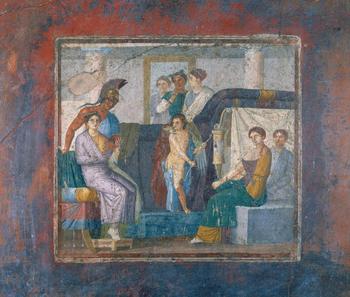
(i) The so-called lectus-indoor scenes, cf. Figure 1, dated to the third style (c. AD 50). In these, Venus is represented (semi-)dressed and seated while Mars is standing armoured next to her in front of an audience of onlookers.Footnote 58 These scenes come mainly from the atrium, the less private area, and stress the marital virtues of the couple, male power and female beauty, as well as their social status. Eroticism is not lacking, as in one, Mars touches Venus’ breast, but elsewhere they pose mainly dressed.Footnote 59
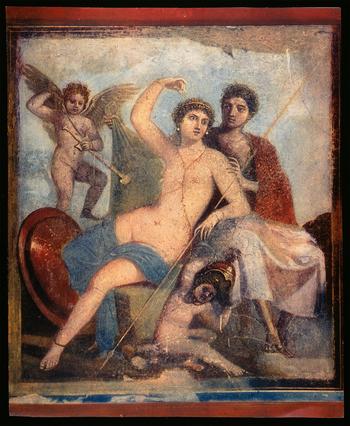
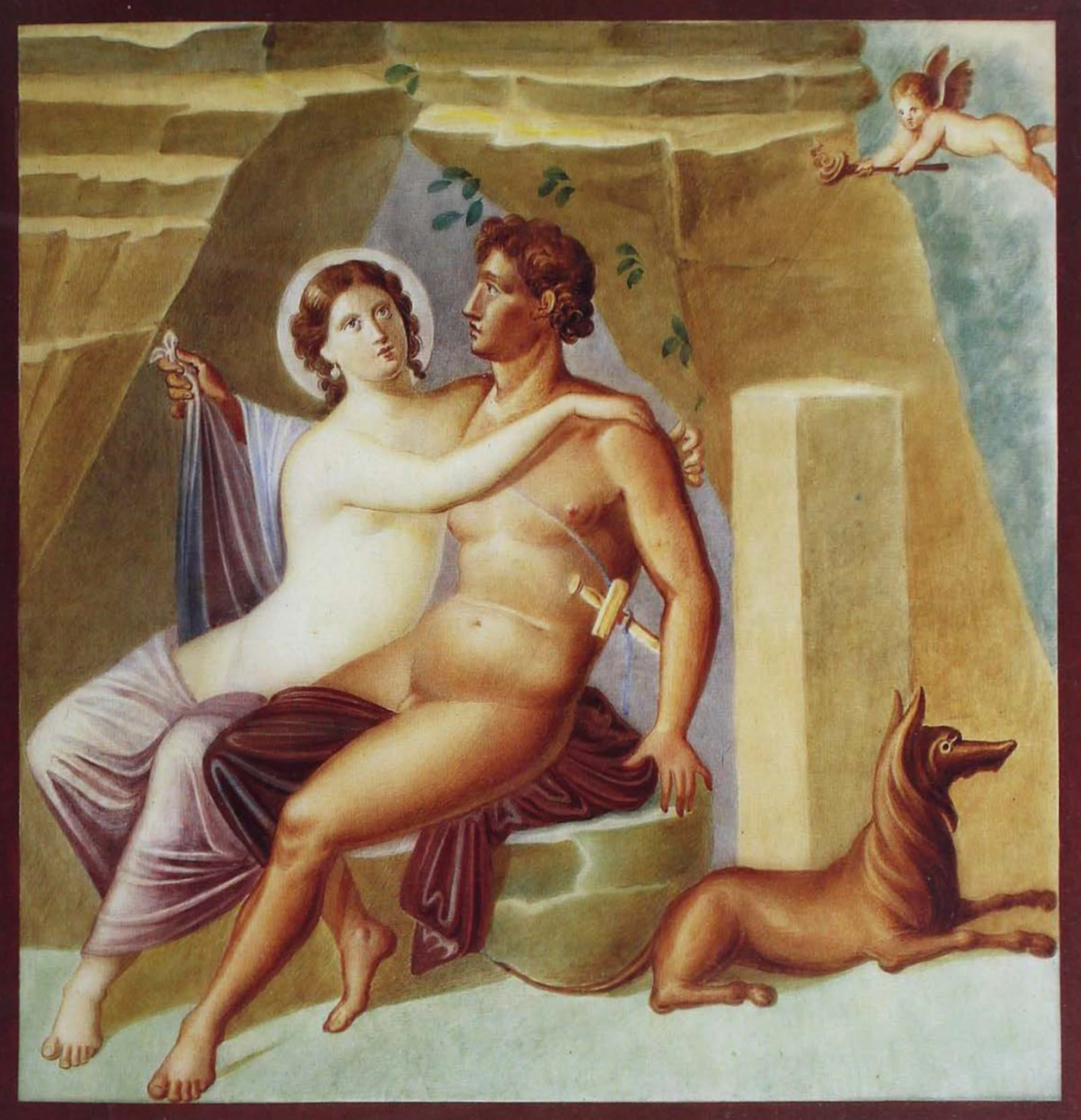
(ii) The second category includes representations of Mars and Venus in a symmetric pyramid-like composition, dated to the late third/early fourth style (c. AD 60–79). These usually come from the tablinum, the more private room of the house. As shown by the example in Figure 2, in these Mars sits behind Venus on the bed, in the countryside, while the goddess leans backwards to Mars and stretches her right hand over her head. Mars is naked and not armoured, while putti carry garlands.Footnote 60 These outdoor scenes are sexually loaded, as Mars appears as a voyeur of Venus and approaches her from behind with clear sexual desire. The weapons that lie on the floor and the outdoor scene align with the ideal of otium that was reserved for these inner rooms. In a sub-category of these representations (see Figure 3), the man next to Venus is not easily identifiable but appears as a mixture of Mars, Adonis or Anchises, becoming thus a more fluid characterisation of the master of the house.Footnote 61 In these paintings the lovers are more symmetrical; in the example from an interior room in the Casa di Sirico shown in Figure 3, the couple is represented seated, embracing each other, while Eros is holding a torch. These images point to the marital ideal embraced by the villa's owners and look more like wedding scenes.Footnote 62
(iii) The last category includes representations inspired by state artworks, in which Mars and Venus are depicted standing on pedestals or alongside columns, representations that bear cult characteristics and may be found in or close to the villa's shrine.Footnote 63 These statue-like images resemble the ones found on the later sarcophagi more closely.
Casa di Lucretius Fronto, Pompeii V 4, 11, tablinum, third style, around AD 50. The topic was originally thought to be the ‘Discovery of Ares and Aphrodite’ but is now believed to be the wedding of the two gods, an idea supported by the big bed and by Eros in the middle. LIMC 2, Figure 379a. Copyright bpk/Alinari Archives/Alinari.

Casa della Nozze di Ercole, Pompeii, tablinum, early fourth style, Mus. Naz. Napoli. Inv. no. 9248. Helbig No. 320. Lorenz Abb. 52. LIMC 2, Figure 376. Copyright, bpk/Hermann Buresch.

Casa di Sirico, Pompeii, fourth style. In situ. The two gods sit in the centre. On their right side sits a dog; high up on the right flies an Eros with a torch. Type II, Abb. 63/ K41 in Lorenz. Watercolour by Giuseppe Abbate, c. 1840, ‘Coppia con cane’, Napoli, Mus. Naz. ADS 512. Copyright Jackie and Bob Dunn (photo).

The above summary does not do justice to Katharina Lorenz's excellent survey of more than eighty Pompeian houses but it shows how to think about myths in domestic contexts. For my purposes here I want to concentrate on the second category, dated to the late third/early fourth style, which seems closer to Xenophon's date and similar to his ecphrasis. The novelistic ecphrasis is presented in two sequences that epitomise the yin and yang of female and male beauty, both in the realm of the immortals and in that of the novelistic characters. In this respect they recall the symmetric pyramid-like compositions of Katharina Lorenz's second group. The reference in the novel to a non-armoured Ares and to birds and garlands seems to echo the outdoor representations of Mars and Venus found in the tablinum (for example Figure 2). These are more private in character than the ones of the first category and also much more sensual. In particular, the mention of Eros carrying a torch in Xenophon might echo representations of the type of Figure 3 in which the matrimonial aspect is accentuated. Indeed, the marital ideal is echoed vividly in the oaths of chastity the couple exchanges and might have prompted Xenophon's contemporary readers to recall the relevant Roman visual gallery rather than the adultery tale.Footnote 64
The reader is then encouraged to interpret the ecphrasis symbolically and to find the correspondences between the myth and the novelistic action.Footnote 65 There are many pointers that stress the function of the ecphrasis as a mise-en-a bîme for the following snapshot of the novelistic embrace. Both represent a lovemaking scene: on the canopy, Aphrodite is depicted on one side together with floral decorations, birds and flower garlands, that function as a metonymy of Anthia's own flowery name;Footnote 66 on the other half,Footnote 67 we see Ares, unarmoured, also with garlands that suggest the subjugation of the god of war to the goddess of beauty, as is the case in the allegorical interpretations. Ares’ defeat echoes Habrocomes’ change from an arrogant youth into Eros’ slave, which is described in the pre-wedding chapters in a language full of military metaphors, indicating that Habrocomes is an Ares analogue. After seeing Anthia, Habrocomes is indeed defeated and becomes a slave not of war but Eros.Footnote 68
That said, whereas Anthia's and Aphrodite's physical beauty remain in focus as the essence of femininity par excellence there is more to be said about Ares’ and Habrocomes’ manliness. What Habrocomes originally considers male qualities are not courage or boldness in battle but virginity and disdain of love. These Hippolytan qualities that resonate in the opening procession scene and support Habrocomes’ characterisationFootnote 69 are diametrically opposed to the description of ideal marital love in the bedroom scene that follows. The ecphrasis counters the protagonist's awkward male ideal and appears to suggest instead an improved model of masculinity: the description of the naked and unarmoured Ares approaching his lover Aphrodite becomes characteristic of the new, idealised masculinity that emphasises the active role of the erastes and the passive role of his eromene.Footnote 70 Since there is no mention of armour in the ecphrasis we may even try to imagine the scene as similar to Figure 3, in which the young man next to Venus has a variety of transferable qualities and is not a model of a strict, Mars-like, masculinity but may evoke Anchises or Adonis.Footnote 71 In sum, the mythical ecphrasis becomes the visual analogue of the ideal novelistic heterosexual love. Thus in the protagonists’ eyes, Ares and Aphrodite are ideal role models, not for two adulterers, but for a married couple in love. Such is their piety that only after the exchange of oaths does the couple proceed to enjoy each other's embrace, which is actually described only briefly, in contrast to the lengthy description of the canopy and the oath scene.Footnote 72
An imperial reader would not have been shocked by the erotic character of the scene and would not have considered it pornographic, as it would have been the kind of image that s/he would expect to see in a domestic context, and especially in more private rooms such as the tablinum. Xenophon's decision to place this scene on a bed canopy and not on a wall might suggest a fusion of the requirements of the novelistic narrative with the Augustan and imperial visual evidence, that favoured depictions of rich bedspreads and couches.Footnote 73 We cannot be sure that Xenophon had actually seen such a canopy in ‘real life’ but it is not impossible, as the mosaic in the House of the Green Carpet in Antioch shows.Footnote 74 However, the decision to place a description of a bed at the beginning of an erotic scene that takes place on an actual bed emphasises the mise-en-abîme and helps the reader to articulate the affinities between the two. Thus the ‘fictional’, novelistic object is now turned into a work of art and an object for contemplation, an ecphrasis, through the medium of ecphrastic description of a work of art.Footnote 75 Visual evidence, therefore, suggests that Xenophon's ecphrasis is sensual and evocative of the erotic pleasures in married life. Ares/Mars and Aphrodite/Venus stand as role models for Anthia and Habrocomes as they embody love and passion in marriage and need to be understood apart from their Homeric setting, abstractly and symbolically, just as the relevant paintings of the Roman tablinum, set in the outdoors, stress the abstract erotic character of the visual representations of Mars and Venus. In other words, Xenophon invites his reader to see rather than to read the ecphrasis of the bed canopy with Roman eyes.
3. Cultural Intertextual Expectations
Yet another issue arises when Xenophon the Ephesian is examined vis-à-vis the Roman visual culture.Footnote 76 This question seems to become more vital if we consider the view of Tim Whitmarsh, namely that Xenophon's novel emphasises the civic aspect of the return theme and illustrates the kind of Hellenocentrism that is absent from the later novels. Whitmarsh also argues that the downplaying of the oriental character of the Ephesian Artemis for the sake of the Greek Artemis might also be read within the same framework cultural negotiation.Footnote 77 Is Xenophon's ecphrasis then an attempt to ‘Hellenise’ the theme of Mars and Venus? Did Xenophon use freely, without misgivings, an image that was available to him from his contemporary experience, just as he mentions other contemporary events en passant, such as the role of the ‘Archon of Egypt’ or that of the εἰρηνάρχης (officer of the peace) Perilaus? In what follows I look for possible conflicts, i.e. either Greek or Roman readings of the myth, in the Greek revisions of the Ares and Aphrodite tale in two other writers, roughly contemporary to Xenophon, Plutarch (AD 46–120) and Lucian (AD 125–180).
3.1 Plutarch's interpretatio Thebana
Plutarch, writing shortly before Lucian, does seem uneasy about the morality of the Homeric scene, since he is aware of its allegorical interpretation.Footnote 78 In contrast to what allegorists think and against those interpretations that attempt to twist the actual epic text entirely, Plutarch tells us that Homer describes this voyeuristic episode precisely because he wants to implicitly caution his audience against such behaviours.Footnote 79 The lesson learned is that intimacy with Aphrodite makes a man effeminate, which is what happens to Ares in the story.Footnote 80 By including an adultery tale, Plutarch says, Homer teaches marital behaviour proper, although the actual tale remains what it is, an affair.
Elsewhere, Plutarch does not downplay the allegorical possibilities offered by the Ares–Aphrodite pairing but this time his model is not Homer but Plato's Symposium, and what is demonstrated is not the adulterous versus moral behaviour but the idealised aspect of the union.Footnote 81 In a work that resonates with the ideals of the Greek novel, the Amatorius, Footnote 82 Aphrodite stands in for ἐπιθυμία (desire) and ἡδονή (pleasure), whereas Ares embodies the θυμός (soul, spirit). Eros is the power that yokes the two together into a sublime ensemble: Eros is no longer the subtle effeminate product of the poets but a warrior.Footnote 83 Women in love, Plutarch says, such as Phaedra or Alcestis are occasionally bolder than Ares;Footnote 84 Aphrodite now is one with Mother Earth who desires the rain from heaven, and Aphrodite alone, namely the carnal pleasures, ‘is nothing without the presence of Eros’.Footnote 85 Their union illustrates the higher cosmic order and Nature's reproductive power and is possible only if Eros is present. This kind of Eros, called celestial (οὐράνιος), does, unlike in Plato, look down on its carnal aspect but harmonises it with its heavenly character. This is the only kind of Eros that can achieve concord.Footnote 86
This kind of harmony is also illustrated in the Life of Pelopidas. In it, Plutarch praises Thebes, Pelopidas’ home city that was founded by Cadmus and Harmonia, who as early as Hesiod's Theogony 935–7 is considered the daughter of Ares and Aphrodite and as a local goddess.Footnote 87 The congruence of this union of beauty and strength is embodied by the city's famous Sacred Band of elite soldiers bound by homosexual love, which is described as the outcome of this extraordinary amalgamation.Footnote 88 This praise of Thebes sounds much like Hesiod's version of the tale. Like Hesiod, who focuses on Harmonia, in both the Amatorius and the Pelopidas Plutarch's references to the Ares–Aphrodite pairing no longer echo the Odyssean adultery scene but instead have an allegorical character. Instead of the pairing of the gods both writers emphasise Eros or Harmonia. Plutarch's echo of Hesiod is no coincidence but seems representative of his mythical, local and panhellenic agenda.
For starters, such a reading would have been comfortable for any Greek reader to follow. For Plutarch, who was a Boeotian and a priest at Delphi, the Hesiodean intertext and the life of Pelopidas offered a good basis for local patriotism,Footnote 89 but with an outlook on the broader political stage, both panhellenic and Roman.Footnote 90 The Thebans might have felt more privileged than other Greeks, as it was their own city, and not Athens or Sparta, which resembled contemporary Rome. Secondly, the Greeks outside Thebes might also have been proud that the tale about Ares and Aphrodite could be found in the two pillars of Greek poetry and identity, Homer and Hesiod.Footnote 91 Finally, Plutarch's Roman readers, such as the addressee of the Lives, Sosius Senecio, Trajan's associate, would have felt at home too.Footnote 92 The allegorical version of the story acknowledges the new Augustan take on it but highlights its older, Theban, pedigree. The union of Aphrodite and Ares in Thebes foreshadows Augustus’ celebration of Mars and Venus in Rome and remains distinct from the Homeric version.Footnote 93 Thus, Plutarch's Roman audience might have read the story as one more of those tales in which Roman myths are foreshadowed in Greek myth, without necessarily finding it difficult to reconcile the two.Footnote 94
Plutarch's interpretation of the myth therefore follows the Platonising allegorical trend but contextualises it into the Greek and Roman mythical politics of his times and tries to accommodate both. The omission of Demodocus’ song therefore is not just part of Plutarch's Homeric criticism, which he applies elsewhere, but a conscious interpretatio Thebana of the mythical tale that competes with the interpretatio Homerica as well as the interpretatio Romana. What is more, his romanticised version seems compatible with the idealised novelistic readings of marital love found in Xenophon and in other novels. It is harmony, rather than passion, that is his focus. In this respect, the symmetrical ideal representations of Mars and Venus in Roman houses and Plutarch's own revision of the myth and his view of idealised marital love seem to be composed in the same milieu that favoured the happy ending, love-in-marriage scenario of the Greek novel.
3.2 Lucian's Adultery Tale
Plutarch's view is by no means the dominant one but a variation among many. The Odyssean scene was a good source of laughter throughout antiquity as the myth was popular in pantomime.Footnote 95 In Lucian's De Saltatione 63 the Cynic Demetrius was bewitched after watching an actor performing the adultery of Ares and Aphrodite:Footnote 96
αὐτὸς ἐϕ’ ἑαυτοῦ ὠρχήσατο τὴν Ἀϕροδίτης καὶ Ἄρεος μοιχείαν, Ἥλιον μηνύοντα καὶ Ἥϕαιστον ἐπιβουλεύοντα καὶ τοῖς δεσμοῖς ἀμϕοτέρους, τήν τε Ἀϕροδίτην καὶ τὸν Ἄρη, σαγηνεύοντα, καὶ τοὺς ἐϕεστῶτας θεοὺς ἕκαστον αὐτῶν, καὶ αἰδουμένην μὲν τὴν Ἀϕροδίτην, ὑποδεδοικότα δὲ καὶ ἱκετεύοντα τὸν Ἄρη, καὶ ὅσα τῇ ἱστορίᾳ ταύτῃ πρόσεστιν.
(Luc. Salt. 63)All by himself he danced Helios tattling, Hephaestus laying his plot and trapping both of them with his entangling bonds, the gods who came in on them, portrayed individually, Aphrodite ashamed, Ares seeking cover and begging for mercy, and everything that belongs to this story.
(tr. Harmon)Lucian's metaliterary comment, namely that the actor performed ‘ὅσα τῇ ἱστορία πρόσεστιν᾽, shows that the theme of infidelity was very popular and that it came with a list of prerequisite story elements, such as Helius’ presence, the nets, the exposure. Without these elements the story was no longer about the affair of Ares and Aphrodite. These are precisely the elements we find on those marble reliefs that depict the ‘deception’ tale but not on frescoes such as Figure 1 that exemplify the dignity of the couple in front of its guests.
That these details were indispensable is obvious from Lucian's Gallus too. Here, the Cynic Micyllus recalls a story about the metamorphosis of a certain soldier called Alectryon into a cock. The soldier was supposed to watch out as Ares visited Aphrodite during Hephaestus’ absence but he fell asleep. Eventually Helius discovered the lovers, informed the cheated husband and the lovers are caught in the deed. But Lucian brings one more twist to the story:
τὸν Ἄρη ἀγανακτῆσαι κατὰ τοῦ Ἀλεκτρυόνος καὶ μεταβαλεῖν αὐτὸν εἰς τουτὶ τὸ ὄρνεον αὐτοῖς ὅπλοις, ὡς ἔτι τοῦ κράνους τὸν λόϕον ἔχειν ἐπὶ τῇ κεϕαλῇ. διὰ τοῦτο ὑμᾶς ἀπολογουμένους τῷ Ἄρει ὅτ’ οὐδὲν ὄϕελος, ἐπειδὰν αἴσθησθε ἀνελευσόμενον τὸν ἥλιον, πρὸ πολλοῦ βοᾶν ἐπισημαινομένους τὴν ἀνατολὴν αὐτοῦ.
(Luc. Gal. 3)Ares was angry at Alectryon and changed him into this bird, weapons and all, so that he still has the crest of his helmet on his head. And for this reason, they say, you cocks when you notice that the sun is about to come up, you raise your voices far in advance and give warning of his rising.
(tr. Harmon)Despite the widespread nature of such metamorphosis narratives in Greek myth,Footnote 97 in the rest of the treatise the cock presents himself not as a mere man metamorphosed into a chicken but as the metempsychosis of Pythagoras himself.Footnote 98 Whereas Micyllus presents the Homeric story through the eyes of Alectryon, the cock mocks the widespread metamorphosis and aetiological tale and turns it into one of metempsychosis! Hence, the Homeric model is doubly subverted and the adultery story that forms the background of the metamorphosis story is reduced to a comic interlude.
It may appear that Lucian juxtaposes with Augustus’ new pair the ‘original’ tale as a reminder of the Homeric, and also Greek, pedigree of the story but this would stretch the argument too far. As is so often the case with Lucian, we cannot be certain whether he was indeed in favour of an interpretatio Graeca.Footnote 99 Not only is the story hilarious but also, if the cock of the story is Pythagoras’ reincarnation, the very aetiological kernel of the metamorphosis myth is diminished to ashes. I do not think that Lucian attempts to make any ideological or moralistic claim as opposed to Plutarch or Xenophon, and his version shows the kind of reception the Homeric tale might have otherwise prompted in the mind of the imperial readership, which is much unlike the idealised versions of Ares’ and Aphrodite's lovemaking found in the Amatorius or the Ephesiaca. For Lucian, the popular adultery tale becomes a guarantee for the success of the rest of the treatise, and, as it is placed at its opening, it functions as a kind of captatio benevolentiae. Illicit sex guarantees a best seller, whereas Xenophon's and Plutarch's legitimate lovers need to be better advertised.
Conclusions
This article shows how Xenophon's description of the Ares and Aphrodite embrace negotiates Greek and Roman cultural identity by merging the Greek theme and its symbolic interpretation with the Roman formal features found in the visual representations of Mars and Venus abed. Xenophon's Ephesus, an imperial metropolis, seems crucial in shaping this shifting interpretation. Although the novel might well have attempted to overplay the Greek elements of the metropolis and its festivals,Footnote 100 the actual city was adorned with many Roman monuments and was a multicultural milieu.Footnote 101 Like Chariton's Aphrodisias the new Augustan revision of the myth about Aphrodite and Ares might have been prominent in Ephesus and supported by the idealised Greek version that was already present on the Hellenistic altar of Zeus in nearby Pergamum. In doing so, Xenophon, like Plutarch too, re-invents local myths that foreshadow or echo the Roman imperial agenda.
It is therefore plausible that Xenophon's classical literary models, Homer and the symbolic interpretation of the myth, as well as the Roman and Greek visual variants of his day, would intersect.Footnote 102 The analysis aimed to show how Xenophon's ecphrasis differs significantly from the Homeric tale. Instead, it presents many themes similar to the popular erotic Mars and Venus representations and especially those of the late third/early fourth style. These elements, as well as the ideological similarities between Xenophon and his (probable) contemporary Plutarch regarding the marital ideal, might be further indicative of the novel's date and literary milieu. These formal and thematic similarities of Xenophon's ecphrasis with the visual arts seem to confirm the late first-century hypothesis and so does his allegorical interpretation that recalls that of Plutarch.
Yet, and most importantly, the examination of this ancient visual ‘Gallery of the Mind’ tells us much more about the kind of world in which the novel was written and the actual audience of these mythical scenes. Like paintings in Roman villas, erotic novels were meant as private entertainment and they were probably addressed to the same audience that could appreciate the erotic mythical paintings, namely elite and middle-class citizens. The content of Xenophon's novel ought to be compared to the otium-related representations of Mars and Venus from the inner rooms in particular, since Xenophon is not interested in the myth per se but in its erotic character. The gods’ embrace is a double for the embrace of the two human lovers. Xenophon's take on the myth should then be understood detached from its Homeric model. Just as in the Roman villas the Mars and Venus paintings in the tablinum did not allude to a particular mythical context, as opposed to the more formal lectus-scenes of the atrium, the ecphrasis of Anthia's and Habrocomes’ bedroom invites yet another peek into the private chambers of a Roman couple.
The amours of Ares and Aphrodite in the Ephesiaca are a model for emulation for the young couple and not an argumentum a contrario: they show how beauty and manliness can be superbly combined and how their union embodies both the carnal and the moral aspect of marriage. The focus is no longer the illicit aspect of the affair but the harmonious character of the divine marriage. Besides, as it appears from the visual representations and from Lucian's comments, the adultery tale came with a specific set of narrative elements that are not found in Xenophon's description. In this respect the novel not only echoes the visual testimony from the more private chambers of the Roman villa but also Plutarch's symbolic take on the myth. And whereas Xenophon does not make an allegory out of the Ares and Aphrodite theme, he, like Plutarch, is using the gods as powerful symbols of marital virtues, such as female beauty and male gentleness, which aligns with the new ideal of masculinity discussed in this and other novels. Xenophon's new kind of unarmoured Mars not only agrees with the characterisation of the novelistic hero but also with the soft idealised partners of Venus found in Roman wall paintings.
If Xenophon does not opt for an all-out allegorical approach, this is because the novel has a different agenda than Plutarch where myth is concerned. Unlike Plutarch Xenophon is not interested in myth criticism or Homeric criticism per se. Moreover, unlike the opening Europa ecphrasis in Achilles Tatius, Xenophon's mythical description is not the first but the second ecphrasis of the novel and is not placed in a public area but in a private bedroom. The civic character of the novel is highlighted in the first ecphrastic procession scene for Artemis Ephesia but the mythical bed canopy is described later in the intimate chamber of the newlyweds. Both these snapshots within the novelistic narrative mark the shift of the readerly focus from civic to private and back to the civic. The procession, the canopy, the reunion scene and the graphe illustrate different aspects of the same tale, which is about the power of reciprocal heterosexual love but which was differently disclosed to the embedded and to the external readership. Ultimately, the tale's erotic details are kept for the liminal onlookers of the bedchamber scene, the external readers, who, like the visitors to the interior parts of a villa, will not just read the outlines of the erotic narrative about Anthia and Habrocomes on the graphe but will witness firsthand the titillating details. Xenophon's subordination of the mythical ecphrasis to the novelistic one, the procession, indicates that myth belongs to the private realm.
The story of the image on Xenophon's bed canopy is a characteristic case of mythic re-borrowing, which moved from a chiefly Homeric source to Rome, where its meaning changed and was embellished with their own cultic elements. From Rome it returned to Greece, where its newfound Roman imperial meaning was supported by local Greek traditions and allegorical interpretations of the difficult Homeric passage that aimed to demonstrate the Greek priority of the idealistic interpretation of the tale. Xenophon's version is not part of the Homeric revision but a touch of everyday life introduced into the ideal plot of the novel. Eventually, the myth about Ares and Aphrodite was transposed into a different, non-mythical genre, where it maintained its primarily erotic content, while its mythical aspects were downplayed. Contrary to the loves of Ares and Aphrodite, which might have been problematic for Homer's ancient readers, and which might have been better digested through an allegorical revision, the novel's de-mythologised version of Mars and Venus aims to focus on Habrocomes and Anthia, the ideal couple. This novelistic ideal of marital love would appeal to any reader, as the tale's Ephesian colour and the non-mythical characters would have made it accessible to a variety of audiences. Besides, who does not want to peek into the bedchamber of two exceptionally beautiful and innocent newlyweds?