I
I begin with a cautionary tale: the story of Isaac Dorislaus, the first ever Professor of History to be appointed at the University of Cambridge. Endowed by Fulke Greville, Lord Brooke, in 1627, his post paralleled the chair established a few years earlier by William Camden in Oxford. A Dutchman by birth and a scholar of some mediocrity, Dorislaus took as the subject of his inaugural lectures the Latin Annals of Tacitus, and more specifically the contrast between legal and tyrannical monarchy in ancient Rome. Just two of these lectures were sufficient to raise eyebrows in certain academic circles and to precipitate calls, led by the master of Peterhouse, Matthew Wren, for the vice-chancellor to silence him. According to Wren, his lectures were ‘stored with … dangerous passages … applicable to the exasperations of these villainous times’: they savoured, in his view, of the seditious Calvinist doctrine of resistance to royal authority and of republicanism and regicide. Although others defended the unwitting lecturer, Wren's complaint prevailed and Dorislaus was forbidden from mounting the podium again. In exile from Cambridge, he nevertheless continued to collect his annual stipend and spent the following two decades carrying out his research and pursuing a second public career in law and diplomacy. It was his role as counsel for the prosecution in the trial of Charles I that led to his murder by angry royalist assassins in The Hague a few months after the king's execution for treason in January 1649. An emblem of the political conflicts that troubled Stuart England, he remained as controversial a figure in death as he had been in life.Footnote 1 Invoked in a number of contemporary cartoons, poems, pamphlets, and squibs, his ghost will make a fleeting reappearance at the very end of this article.
I earnestly hope that my own tenure of a Cambridge chair in history will prove to be less eventful and colourful, not to say fatal, than Dr Dorislaus's. Established in 1930, from its inception the Professorship of Modern History has been occupied by scholars of British and/or European history since 1500. The periodization implicit in the title now seems somewhat old-fashioned and I often find myself trying to explain why I am qualified to hold it, since my own research focuses on the sixteenth and seventeenth centuries – an era commonly presumed to predate the advent of modernity. Insiders who work in other fields find this baffling enough; puzzled outsiders regard it as another quaint example of the eccentric and rather antediluvian views that apparently still prevail in this hallowed institution. The fact that until 1937 the remit of the chair explicitly included the middle ages as well only adds to their bewilderment.
There is a further element of anomaly and irony associated with my occupancy of this post. And this is the wry reflection that I have spent much of my career so far reacting vigorously against grand narratives that chart the birth and development of the modern world. Underpinning much of my published work is a spirited resistance to teleological models of history as a record of linear progress towards ‘enlightenment’ and ‘civilization’. Following in the footsteps of my predecessor Herbert Butterfield, and in common with others of my generation, I have refined and nuanced claims that the period between 1500 and 1800 witnessed dramatic transformations such as ‘the rise of toleration’, the ‘printing revolution’, ‘the decline of magic’, and the ‘disenchantment of the world’. Highlighting the ambiguities and contradictions that accompany moments of ideological and cultural rupture, I have argued that the Protestant and Catholic Reformations played a more equivocal role in these processes than has often been implied. An emphasis on continuity over change has been a hallmark of my interpretations, sometimes, perhaps, at the risk of eclipsing the decisive shifts and transitions that did occur in the course of the early modern period.
At the heart of my research is a preoccupation with exploring the connections and tensions between official theology, institutional structures, and lived experience. In this, I am a product of my undergraduate and postgraduate training at the Universities of Melbourne and Cambridge, and of two traditions of historical scholarship that continue to thrive in both places – of a distinguished, empirically driven tradition of ecclesiastical and political history and of the newer school of cultural history and historical anthropology that has revitalized our discipline over the last half century. The lecture that follows reflects the dual influence of these approaches. It explores the ways in which the religious upheavals of the sixteenth and seventeenth centuries helped to transfigure perceptions of the ancient and medieval past, stimulate shifts in historical method, and transform the culture of memory, before turning to the interrelated question of when and why people began to remember the English Reformation as a critical juncture in history. It investigates the dialectical interaction between individual subjectivity and social memory, and the manner in which personal recollections of the events of the 1530s, 1540s, and 1550s were distorted by the lenses of emotion and retrospection. Involving amnesia as well as invention, the narratives thus created still shape our understanding of the period in both overt and insidious ways.
II
As Phil Withington's important book has taught us, it was in the late sixteenth century that modernity as a concept and a category entered into the vernacular language and into widespread use. The emergence of the word ‘modern’ to describe current times and to demarcate them from the golden age of ancient Greece and Rome which contemporary culture simultaneously sought to recreate was a side-effect of Renaissance humanism. It reflected a retrospective outlook that entailed an attempt to transform the present through dialogue with this classical heritage, and to move forwards into the future by imitating a remote and idealized past. It involved not sharp dissociation from this past but rather dialectical engagement with it, an attempt to return ad fontes to the original source and fountain of its glory and greatness. Only later did the term become transformed into a semantic shorthand denoting an epoch discrete from those that preceded it, the contrast being seen as a positive cause for celebration rather than a disappointing index of failure. This was a culture that deeply distrusted and indeed abhorred novelty, that cloaked innovation under the mantle of continuity, and that regarded age as the touchstone of authenticity.Footnote 2
Inherited from the medieval centuries, these regressive habits of mind were also, of course, invoked to justify the Reformation. Like a long succession of religious reformers before them, Protestants employed the notions of reformatio and renovatio to represent their movement as an enterprise of evangelical renewal.Footnote 3 They envisaged themselves as engaged in an act of recuperation, an effort to recapture a lost era of apostolic purity, and a quest to reinstate the Christian faith in its pristine and primitive simplicity. Martin Luther and other Protestant reformers vociferously denied that they were guilty of devising a newfangled religion; they retorted to this charge by turning it back against their polemical enemies, whom they in turn accused of inventing traditions to keep the laity in subjugation and thraldom. Under ‘the visard of antiquitie’, declared one English minister, they had hidden a mass of fabricated superstitions: ‘their whole pretenced religion is nothing else, but a huge heape of hypocrisie, and a store basket of all Apostacie’.Footnote 4 It was not Catholicism but Protestantism that embodied the true church of Christ laid down in blueprint in the Bible and that could trace its lineage back to his earliest disciples. A false and bastard child begotten by Antichrist, the papacy and its allies in the priesthood had both perverted doctrine and practice and eclipsed, if not extinguished, the Gospel for the better part of a millennium. One notable consequence of this recasting of the past was to strengthen a prejudice against the benighted centuries of ignorance and ‘barbarism’ that can be traced back to Petrarch – to cement and elaborate the notion that the middle ages was an era of intellectual and cultural backwardness.Footnote 5
As much recent research has shown, the bitter confessional conflicts unleashed by the fragmentation of Christendom were a major stimulus to the study and writing of sacred history in sixteenth- and seventeenth-century Europe on both sides of the emerging religious divide. Determined to refute the mocking taunt ‘Where was your Church before Luther?’ and eager to acquire the powerful imprimatur of the past, the reformers energetically hunted down evidence that their faith had deep historical roots. The exhaustive researches of the Magdeburg Centurians (1562–74) in Germany both mirrored and stimulated similarly ambitious antiquarian initiatives within Catholic ranks. The recovery of textual and material traces of early Christianity that demonstrated Catholicism's apostolic origins and unbroken institutional continuity since primitive times was a central element of the Counter-Reformation, epitomised by Cesare Baronius's monumental Annales Ecclesiatici (1588–1607). It ran alongside the new spirit of critical enquiry in the field of hagiography that culminated in the activities of the Bollandists.Footnote 6
In Britain, John Bale and John Foxe unearthed a brotherhood of true believers who had kept the torch alight through the dark medieval centuries: an eclectic band of heretics from the Cathars and Waldensians to John Wyclif, Jerome of Prague, and Jan Hus who had defied the papal hierarchy and suffered persecution and martyrdom.Footnote 7 Although the pedigree of such figures as proto-Protestants was sometimes dubious, selective editing smoothed over the discrepancies and ingeniously transformed them into heroic defenders of evangelical doctrine avant la lettre.Footnote 8 Similar strategies allowed certain orthodox bishops and churchmen to be imported into the catalogues of witnesses compiled by such writers.Footnote 9 The same set of impulses inspired subtle rewritings of the lives of medieval Catholic saints, who were transformed into figures of satanic tyranny or ingeniously rehabilitated as patriotic icons or moral exemplars.Footnote 10 Eager to demonstrate that the true faith had been planted on national soil by indigenous evangelists long before the arrival of foreign missionaries from Rome, Protestant writers in Wales and Ireland heralded St David and St Patrick as their precursors.Footnote 11 Pushing back into the past further still, some English reformers credited Joseph of Arimathea with first converting their country to Christianity in ad 63 or attributed it to the patronage of King Lucius, the mythical ruler of Britain in the late second century.Footnote 12 Meanwhile, scholars in the circle associated with Archbishop Matthew Parker were busily gathering documents to show that the Anglo-Saxons themselves had retained some glimmering of the truth prior to the complete declension of the church into diabolical error that reputedly followed the Norman Conquest.Footnote 13 Some of the manuscripts they discovered, such as the sermons of Ælfric, were published in facsimile as a ‘testimony of antiquitie’ that reformed theology on the eucharist and other topics had enjoyed the status of orthodoxy in the tenth century, despite the creeping advance of ‘superstition’ and ‘monckery’.Footnote 14 So too were the works of early reformers such as William Tyndale, Robert Barnes, and John Frith: through the providential instrument of printing, declared Foxe, God had revived ‘the light of knowledge to these blynde tymes’ and brought the monuments of these ‘learned fathers of blessed memory’ out of oblivion to remain ‘as perpetual Lampes … to posteritie’.Footnote 15 Print – and providence – also enabled the dead to speak through the ‘godly, fruitful, and comfortable letters’ left behind by those who had made the ultimate sacrifice for the faith of Christ and died at the stake during Mary's reign, which were later edited for publication by Henry Bull and Miles Coverdale.Footnote 16
An integral element of early Protestant historiography was its intimate link with intense apocalyptic expectation of the Second Coming. In the guise of eschatology, history was the typological fulfilment and consummation of the past in the present and in a millenarian future when Christ would once again reign over his kingdom on earth. Scrutinized for signs that the end was nigh, it was regarded as the culmination of the prophecies embedded in the Bible. The events described therein prefigured those of subsequent times, which were themselves the working out of God's mysterious and hidden will for mankind.Footnote 17 Predicated on the assumption that the forces of good and evil were locked in perpetual combat, this historical vision was underpinned by the belief that the Lord incessantly intervened in the world to bring about both momentous and mundane occurrences. History was the theatre of his providential mercies and judgements, in which men and women played no more than a supporting role. Providing proof of divine omnipotence and governance, it was primarily written to glorify God and studied as a text second only in status to scripture as a repository of spiritual wisdom and moral instruction. The ‘principall commoditie’ of studying the past, wrote the chronicler Richard Grafton in 1563, was in ‘the settynge foorth of the course of Goddes doings, and in disposing the estates of men to the advauncement of his glorye’.Footnote 18
The sheer vitality of this mode of historical writing in early modern Europe and Britain in the wake of the Reformation must be underlined. Its remarkable efflorescence in the sixteenth and seventeenth centuries sets a series of question marks alongside another influential thesis about the birth of modernity – the idea that a ‘historical revolution’ occurred in the course of this period. According to its proponents, several key methodological and epistemological shifts which laid the foundations for the modern profession of history: a sense of anachronism, the adoption of a critical attitude towards sources, and the elevation of archivally excavated facts over the weight of inherited tradition. No less significant a symptom of the transfiguration of the discipline was the gradual eclipse of providentialism as an explanatory paradigm. The disappearance of the hand of God from history in favour of greater emphasis on human motivation and agency reflected the ‘steady self-emancipation [of the discipline] from the bondage of religion’. It reflected a process of secularization set in motion by the Renaissance and the secession of confessional sentiment that Enlightenment philosophers and their heirs saw as preconditions for the rise of historical objectivity.Footnote 19
In recent years, however, these claims have been contested and qualified from various directions. Where an earlier generation of medievalists kicked against the imputation that a sophisticated understanding of causation, a recourse to documents, and a healthy scepticism about evidence was absent from historical writing in their period, their successors have seen this as an error of perspective and concentrated instead upon illuminating the generic and rhetorical conventions that permitted the coexistence of truth and fiction, fabrication and verisimilitude. Recognizing the mental habit of regarding historiography as a transparent medium as a product of the nineteenth century, they have shown that history in the middle ages was a self-consciously literary enterprise and textual artefact.Footnote 20 More generally, postmodernism has undermined academic confidence about the possibility of ever peeling away the distorting veil of language that divides us from the past and discarding the ideological baggage with which we are saddled. The aspirations of modern historians to detachment and neutrality are an illusion because we too remain prisoners of the culture that formed us, and of traditions of discourse that were forged in the very eras we study.
No less telling is the revelation that ostensible advances in historical method were at least in part a side-effect of the polemical conflicts engendered by the Reformation and Counter-Reformation themselves. The violent confrontations that accompanied the rise of these movements catalysed and converged with other tendencies: with the increasing pursuit of precedents by lawyer antiquarians and the steady spread of the philological techniques cultivated by learned humanists. They gave rise to empirical inquiry as well as to myth-making and forgery. It was the urgent need for the sanction of history that sent both Protestants and Catholics scurrying into the archives and that propelled the antiquarian endeavours that created the great libraries of books and manuscripts in Cambridge, Oxford, London, and across the continent, upon which we are now reliant. It was the imperative of demonstrating the deviousness of their adversaries and the verity of their own tenets that engendered some of the most distinctive protocols of modern scholarship. It is in the crucible of ecclesiastical controversy, for instance, that Anthony Grafton has located the origin of the curious species that is the lowly footnote.Footnote 21 Such developments were the offspring of passionate religious conviction rather than things that arose in defiance of it.Footnote 22 They indicate not its demise but its resilience. Confessionalism was often less an obstacle to scholarly erudition and critical discrimination than a vital incentive to them.Footnote 23
These insights have combined to cut the historiographical revolution sharply down to size. Nevertheless, historical consciousness did undergo a metamorphosis in the course of the early modern period. As Daniel Woolf has argued, this was perhaps less about technical innovation than about the changing milieux within which knowledge of the past circulated.Footnote 24 The contours of the culture of memory contemporaries inherited from their predecessors were significantly altered during the sixteenth and seventeenth centuries.Footnote 25
III
The Reformation played a critical part in this process in several respects. First and foremost, the advent of Protestantism involved the obliteration of a large portion of the medieval past. In a world in which the art of remembering was primarily an art of mental visualization, the reformers recognized that removing physical reminders of popish error was vital to the task of transforming mentalities. Successive sets of injunctions and statutes called for the systematic destruction of statues, images, and relics in parish churches and private homes, so that ‘no memory of the same’ remained to perpetuate the besotted in the misguided ways of their forefathers.Footnote 26 The lingering presence of other abominable eyesores like standing crosses and wayside shrines in the wider landscape was intolerable to the hottest sort of Protestants, who carried out iconoclastic attacks against them, sometimes under cover of night and sometimes in broad daylight.Footnote 27 Radical Elizabethan separatists like Henry Barrow called for the wholesale dismantling of all ecclesiastical buildings, since these structures were ‘fretted’ with no less ‘leprosie’ than their brethren the monasteries. John Penry said that it was essential to pluck them down, together with every other ‘remnant of this [purple] harlott’, ‘so that all memory of the Apostaticall romish religion may bee buryed’.Footnote 28 Otherwise, like Lot's wife in the bible, people might be tempted to look back regretfully and return to their former vomit.
Similar sentiments had animated the Henrician dispersal and holocaust of monastic libraries. Lamented as a ‘calamity’ and ‘moste horryble infamy’ by conservative and evangelical antiquaries alike, the purgation of popish works inaugurated in the 1530s was a strategy for eradicating textual vessels of Catholic falsehood.Footnote 29 Accompanied by initiatives that excluded rank papists from the roll of honour of the nation's illustrious writers,Footnote 30 it amounted to a devastating assault upon the nation's bibliographical heritage and a concerted attempt to remodel it to buttress Protestant priorities. In 1549, the Edwardian privy council ordered the burning of old missals, because these ‘were but a preferring of Ignorance to knowledge and darknes to light and a preparacion to bring in … superstition again’.Footnote 31 What was reserved from the fire and rescued from recycling in the kitchen or from being flushed down the privy neatly reflected the ideological preoccupations of men such as John Leland, John Bale, and Matthew Parker who engaged in these acts of preservation. In the hands of book and manuscript collectors like Robert Cotton and the Bodleian librarian Thomas James, hagiographical texts that had hitherto been the subject of reverence were transformed into historical artefacts, into testimonies to the delusion of previous generations.Footnote 32 Mutilated images and the decaying shells of abbeys and priories came to be seen by some in a comparable light: as trophies and monuments of the triumph of the Gospel and as warnings against the ever-present danger of backsliding.Footnote 33 In the same way, relics that escaped the bonfires of vanities ignited by the Tudor regimes migrated into a different realm of apprehension: while older attitudes persisted in practice, in theory Protestant theology transformed them from transcendent conduits to and receptacles of the divine into things that were bounded by and testified to the mutability of time.Footnote 34 It transformed them into what Pierre Nora has called ‘lieux de mémoire’.Footnote 35
A second and closely connected dimension of the Reformation's reconfiguration of the culture of memory was the fundamental redefinition of the sacraments that it effected. The Swiss reformers, and Zwingli in particular, reconceptualized the eucharist as a mere commemoration of the historic event of the Last Supper rather than an ineffable miracle and a solemn re-enactment of Christ's redeeming sacrifice of his body and blood for the sake of mankind. They inaugurated a ‘revolution in ritual theory’ that reinterpreted liturgical rites as seals and badges of the faith of true believers, rather than bearers and agents of charismatic grace.Footnote 36 For Calvin, they were not efficacious instruments of salvation but instead memorials of the eternal decree of predestination by which God had already decided who numbered among the elect and who among the damned and reprobate.Footnote 37
Thirdly, the advent of Protestantism dramatically changed the way in which people remembered their deceased ancestors and friends. The abolition of the halfway house of purgatory as a false doctrine ‘grounded upon no warrant of scripture’ created a radical disjuncture between the living and the dead, rendering prayer on behalf of the latter futile and irrelevant and displacing attention from the task of safeguarding their fate in the afterlife onto the task of memorialization.Footnote 38 Funeral monuments ceased to function as invitations to intercession and became instead invitations to emulation, but the presence of tombs, brasses, and plaques to inhabitants of the dark and repudiated popish past remained a troubling focus for religious survivalism, and inspired some zealots to deface and demolish them. A royal proclamation of 1560 sought to defend those set up only to commend the virtuous dead to posterity rather than to sanctify them in a quasi-idolatrous fashion, but demarcating this boundary was difficult and challenging.Footnote 39 Recording medieval memorials that were gradually mouldering into extinction in manuscript and print became ‘almost a surrogate for those unpardonable prayers’. Many Protestants, moreover, proved reluctant to consign their medieval Catholic forebears collectively to the pit of hell and to expunge their charitable deeds from the historical record. They piously hoped that their relatives might be excused from perdition because they had sinned out of ignorance and they persisted in thinking that those who had died within the embrace of the old faith nevertheless occupied a place in heavenly paradise.Footnote 40 They physically translated some monuments to the dead into locations less compromised by association with the discredited cult of the perpetual chantry and monasticism,Footnote 41 and they devised new epitaphs in keeping with a prevailing ideological climate that denied that good works could earn one merit in the eyes of the Almighty.Footnote 42 Affection and sentiment inspired a process of partial forgetting that sanitized the memory of those who had not been illuminated by the light of the Gospel, as well as those who had stubbornly refused to recognize the truth when it had been presented to them. It posthumously baptized them into the select ranks of those predestined to salvation.
Memoirs left behind by parents and grandparents were retrospectively rewritten by their reformed heirs in a similar fashion to edit out of their personal archives (both mental and physical) elements that the passage of religious events in recent times had rendered embarrassing. So, in compiling a history of the providential mercies vouchsafed to his family in 1607, the Yorkshire gentleman Sir William Wentworth recast an account of his own conception in 1561 passed down by his mother and father to remove incriminating traces of traditional belief about saints and miracles. The vision of St Anne and pilgrimage to her thaumaturgic shrine and well at Buxton, which his parents had credited with helping them to overcoming their infertility, was quietly transformed by their son into an impeccably Protestant story of the appearance of an angel and a journey to a freshwater spring renowned for its natural healing properties. He recorded it for his own posterity to urge them to give earnest thanks to God, who ‘hath in this extraordinary manner continued and blessed your house’.Footnote 43
Remodelling hagiography to conform with humanist convention and Aristotelian ideals of moderation, the biographies of the Protestant martyrs of the 1550s written by their disciples and subsequently incorporated in Foxe's famous anthology, the Actes and monuments, likewise involved conscious and unconscious emendations and mutations of memory. Understandable waverings of courage in the face of acute danger were quietly omitted or glossed, and the temptations to recant to which some, such as Thomas Cranmer, archbishop of Canterbury, himself, had temporarily succumbed were transformed into edifying examples of how, with divine assistance, the godly overcame the moral weaknesses inherent in the human race. Foxe and the many contributors to the vast wikipedia that was the ‘Book of Martyrs’ censored material that stained the inspiring image of Protestant stoicism and unity in the face of popish persecution that their convictions compelled them to project. They suppressed and discarded evidence of those who had faltered in their faith after being bitten by ‘the old serpente our auncient enemy’, the devil, and ‘airbrushed from history’ the fractious internal disputes with heretical dissidents such as the Freewillers that had threatened the internal stability and cohesiveness of the reformed church in its infancy.Footnote 44
The genre of godly lives of later clerical worthies who became leading lights of the post-Reformation church that emerged towards the end of the sixteenth century as appendices to funeral sermons and flourished from the 1640s and 1650s was shaped by the same editorial techniques. The relatively belated reappearance of biography as a mode of historical writing in post-Reformation England may itself be a measure of residual anxiety about the risk of turning the virtuous dead into objects of popish veneration, and of transgressing the newly redrawn line between idolatry and memory. The individual lives that comprised compilations like Samuel Clarke's Marrow of ecclesiastical divinity and Thomas Fuller's Abel redivivus were carefully passed through the double sieve of scripture and classical panegyric. Designed to function as ‘magazeens of religious patterns’, such texts conceived of their subjects as ‘living effigies’ and ‘walking sermons’ or commentaries on abstract Protestant doctrine. Once again, emotion played tricks with the memories of the friends and family members who wrote these encomiastic discourses, silently eliminating dissonant details and transforming their loved ones into cardboard cut-outs and clones of biblical models of precocious and superlative piety largely free of personal faults and individual foibles.Footnote 45
Protestantism gave a significant filip to two related forms of life-writing: the diary and the spiritual autobiography, though these too were a feature less of the heady first phases of the Reformation than of its later stages. A space in which the godly laid bare their consciences and searched for proof of their predestination, such texts more typically described the tortuous inner journeys taken by their souls than the part played by their authors in the historic events that swirled around them. The vacillations of church and state were often a mere backdrop to the central Christian drama of salvation. Thin on the ground until the 1570s and 1580s, diaries and autobiographies of this distinctive kind were a product of the experimental piety and the obsessive pursuit of assurance of election that was characteristic of English Calvinism as it advanced into its second and later generations.Footnote 46 Recent work, however, has rightly questioned and qualified the tendency to see their proliferation as a symptom of the rise of individualism and of new senses of the self and underlined the role they played in religious sociability and communal religion.Footnote 47 It has also drawn our attention to a wider and vibrant culture of life-writing marked by ‘inclusivity’, ‘taxonomical strangeness’ and ‘generic unfixity’ and expanded our understanding of the parameters and manifestations of contemporary subjectivity.Footnote 48
It is against this backdrop that we must assess the varied textual forms in which eyewitnesses of the religious revolutions of the mid-sixteenth century sought to record and chronicle the unprecedented developments they saw occurring around them. Suffering and tribulation was one significant stimulus to literary activity. It was to comfort and encourage his beleaguered co-religionists in England that the former Carmelite friar John Bale described his ‘vocacyon’ to the bishopric of Ossory in Ireland and his ‘miraculouse deliveraunce’ from many ‘daungerous parels and from the greedy mouthes of devourynge lions’ into the safety of exile in Germany. Comparing his hair-raising adventures with the trials of the apostle Paul, he recounted them not to win praise for himself but to glorify the Lord and to console those at home that their afflictions were His way of transforming them ‘into the very similitude of his derely beloved sonne’.Footnote 49 From the gaols in which they were incarcerated, early evangelicals also felt compelled to send letters detailing their persecutions by the devil's agents to their wives and children. Preserved in manuscript and printed in Foxe's voluminous book, they became precious remnants of the martyrs.Footnote 50 Eager to accrue some of their charisma, those who had escaped the fires of Smithfield and survived the mid-1550s to see Protestantism restored under Elizabeth I wrote down their scarring experiences. Protesting that he did ‘not take in hand to wryte this lytyll tratys as followeth of myne owne provoking’, William Maldon of Chelmsford recalled how he had been viciously whipped by his father for reading William Tyndale's New Testament some forty years before, but ‘felt not the strypes’ because he ‘rejoiced that I was betten for Christ's sake’.Footnote 51 Thomas Mountain, minister of St Michael Tower-Ryall in London, likewise recounted later in life his ‘paynful perygrynasyon[s]’ during these decades ‘for the testymonye of the truthe, and keapynge of a good conscyence’, to show how God had ‘myghtyllye delt with me, and most marsyfullye hathe dellyvered me from the cruell handes of bludye men’.Footnote 52 Writing in 1561, Edward Underhill took pride in how he had been interrogated for composing a scurrilous ballad against the papists and mocked by his peers as a ‘hoote gospellar’, and boasted about his refusal to bow to Baal and attend the blasphemous Catholic mass. Through the medium of a text celebrating the Lord's providential interventions to preserve his servants from the malice of their Catholic enemies, ‘evyne as he presarved Danyelle, Jeremy, Paulle, and many in the olde tyme’, he carved out a niche for himself in an eschatological saga.Footnote 53
Such narratives involved processes of retrospective self-fashioning, in which people rewrote their lives in imitation of those immortalized as martyrs. Conveniently forgetting their frailties as professors of the Protestant faith, some wrote to vindicate their reputations against slanderous aspersions of ‘cloked hypocrysie’ and timeserving cast by their enemies.Footnote 54 These memoirs were psychological exercises in self-exoneration. Others constructed new identities that reflected less how they had actually behaved during these testing times than how they wished they had done with the benefit of hindsight. They embellished the troubles they had endured in defence of their faith. In the autobiographical fragments she composed for perusal by her posterity in the eighty-fifth year of her age in 1610, the gentlewoman Rose Hickman emphasized the sacrifices she had made for the sake of the Protestant religion, by leaving behind her ‘houshould stuffe’ when she emigrated to the Low Countries, which ‘I accompted all nothing in comparison to libertie of conscience for the profession of Christ’. Her text was a meditation, mingling thankfulness and pride, on God's ‘most mercifull deliverances’ of her family during the reign of Mary I, ‘when the cruell papists persecuted the people of God’. It highlighted the difficult moral dilemmas they had experienced as they tried to reconcile their faith with the imperative of preserving their financial prosperity. Repressing the mixed mercantile motives that had induced them to choose the Catholic city of Antwerp above Geneva, which John Knox had recommended to her as the ‘maist perfyt schoole of Chryst that ever was in the erth since the dayis of the Apostillis’,Footnote 55 Rose re-imagined her relatively comfortable exile as a time of heroic suffering and trial. She recalled the words with which she had admonished her sister-in-law for staying in England, ‘yow stay heere for covetousnes and love of your husbands lands and goods: but I feare the Lords hande wilbe uppon yow for it’, and how her prediction had come true when her husband had died prematurely from guilt.Footnote 56 Refracting their lives through the rose-tinted spectacles of selective memory, early modern people continually reconfigured their personal pasts. To adapt a phrase from Ethan Shagan, they ‘forged new consciences’ to navigate the evolving circumstances in which they found themselves.Footnote 57 They created ‘social selves’ in a dialogue between their ‘ever changing inner eye’ and the ideological and cultural pressures by which they were surrounded.Footnote 58 Laboriously and lovingly copied out by their children and grandchildren, these texts were transformed into what Ulinka Rublack has called grapho-relics.Footnote 59 And in the course of transcription, they were subtly and subconsciously modified by their descendants to protect, amend, and enhance the reputations of relatives whose lives were by now the subject of filial reverence and family legend.Footnote 60
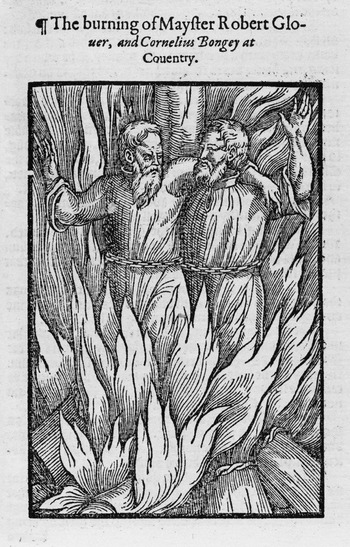
In turn, these narratives preserved in manuscript and print seeped into the consciousness of later generations. The case of the pious puritan teenager Mary Glover, who was possessed by the devil in a celebrated episode that became a sensation in early Jacobean London, is especially illuminating. At the moment she was exorcized, she uttered the very same words used by her grandfather, Robert Glover, as he was burnt as a heretic in Coventry in 1555: ‘The comeforter is come. O Lord thow hast delivered me’ (Figure 1). Assimilating her own mental disturbances with the physical torments suffered by her heroic forebear as described in the pages of Foxe's ‘Book of Martyrs’, this was a young girl upon whom the memory of the Marian past had etched itself indelibly and fused with the present.Footnote 61 The internal torments she experienced remind us that a sense of crisis was vital to the Protestant psyche and to godly piety. Once the trials of the 1550s were a thing of the past, people had to find a way of reproducing this paradoxical mixture of persecution and empowerment within their own minds. Some achieved this surrogate feeling of suffering through reading; in others, it took the somatic form of sickness.Footnote 62
The martyrdom of Robert Glover, 1555: John Foxe, Actes and monuments (3 vols., London, 1583 edn), iii, pp. 1709–15. Reproduced by permission of the Syndics of Cambridge University Library. Shelfmark: Young 201.

At first glance, the official, bureaucratic records that were by-products of the growth of the Tudor state and of the church as a financial institution may seem rather unpromising sources for understanding how contemporaries experienced the Reformation as it unfolded and how it came to be remembered in subsequent decades. But parish registers and churchwardens' accounts should not be dismissed as purely functional administrative statements. They were freighted with the emotion felt by those who composed them, and through them we can hear individual voices if we listen carefully. Eamon Duffy has employed the accounts kept by the eccentric and idiosyncratic priest of the Exmoor village of Morebath to open a window into the outlook of Sir Christopher Trychay and, indirectly, into the mental world of the congregation he served.Footnote 63 Intended to be read aloud to parishioners at an annual public meeting, such texts had devotional and commemorative purposes. Filling the void left by the official abolition of the cult of purgatory, they helped to construct the collective memory and identity of the communities by and for whom they were created.Footnote 64
Compiled by the Benedictine monk Thomas Botelar between the years 1538 and 1562, the register of Much Wenlock, Shrophsire, is a moving record of the storm that swept aside a whole way of life. Its laconic entries chart the slow but steady demise of his fellow brethren in the dissolved abbey at Shrewsbury and record the cataclysmic destruction of images and relics of the Anglo-Saxon virgin St Milburga beloved by the parish by the Edwardian commissioners in 1547. Botelar betrays his regret at the devastation of his holy mother church wrought by Henry VIII and his son and cannot hide his delight at the return of traditional worship under Mary I. At the end, he notes for special remembrance how he had proclaimed the accession of Elizabeth I on 17 November 1558, after completing his celebration of the mass of St Catherine, praying for the soul of the deceased Catholic queen, and singing the Te deum and Kyrie Eleison. Surviving only in an eighteenth-century copy after the original perished in a fire in 1859, there is a potent sense embedded in this register of the passing of a generation.Footnote 65
Equally compelling is a brief town chronicle of Worcester prepared during the same decade, probably by the merchant John Rowland of Steynor, and transcribed by his son in the early seventeenth century. The terse and formulaic character of the text masks but does not completely repress a note of lament at the dissolution and looting of the monasteries in 1535–6 and the destruction of shrines two years later: ‘at that tyme’, observed the compiler, ‘God sent suche lighteninge and thunder that all thereabouts thought the churche would fall on them.’ The Lord's anger at the onset of the Reformation could not pass without particular mention. Nor can it hide the chronicler's regret at the stripping of images and altars from local parish churches and demise of rituals that had bound the community together and marked the ecclesiastical year: ‘on Candlemass day [1547] was noe candles hallowed nor borne. On Ashwensday was noe Asshes hallowed … On Good Friday was noe creping to the crosse. One Easter Even noe fire halowed but the pascall taper and the font.’ It is a bede roll of holy objects and sacred practices that had been systematically evacuated from parish worship.Footnote 66 Embedded within these ostensibly dry documents are poignant hints of personal subjectivity, of a yearning for the Catholic past that was one of the paradoxical consequences of the onset of Protestantism: to echo Margaret Aston, ‘the very process of casting off that past generated nostalgia for its loss. And with nostalgia came invigorated historical activity.’Footnote 67
One manifestation of this was the growing impulse of conservative writers to record in writing and image remnants of a religious world that they feared would soon be lost. It was the perception that monuments defaced by Protestant iconoclasm were rapidly receding from public and private consciousness that inspired the Catholic recusant Roger Martyn to prepare a description of the Suffolk wool church of Long Melford, and the now proscribed ceremonials and rituals performed there in his youth sometime prior to his death in 1615.Footnote 68 In a similar labour of love designed to ‘preasarve … within paper walles … that [which] strong rocke cannot keepe’, the recusant Thomas Habington documented the dead carcasses of abandoned chapels and hermitages in Worcestershire once occupied by pious anchorites and visited by devout pilgrims.Footnote 69 Implicit in such memoranda was the wish that when the times once more turned in favour of the Church of Rome, their heirs would repair and restore these churches and structures again. The endeavours of John Stow, John Weever, John Aubrey, and other antiquaries to rescue ‘fragments from the shipwreck’ of the Dissolution were inspired by the same sentiments: by a sense, increasingly shared by many Protestants themselves, that the religious developments of the mid-sixteenth century amounted to a deplorable assault upon the nation's material and cultural heritage, which it was vital to rescue before it was too late.Footnote 70 By the seventeenth century, in some reformed circles, the aesthetic atrocities and acts of sacrilege that were the result of this ‘fatall Thunderclapp’ became a source of considerable shame.Footnote 71 The excessive zeal displayed by those who had perpetrated them in the name of eradicating idolatry provoked a backlash that helped to engender major works of historical scholarship like William Dugdale's monumental compilation of the records of England's former religious houses, the Monasticon Anglicanum (1655–73).Footnote 72 Such men looked back in dismay and anger at the turbulent middle decades of the previous century, and they feared the renewed onslaught against the medieval past that the Civil Wars both threatened and delivered. The transmutation of memory of the Reformation had a distinctly generational dimension.
IV
The penultimate part of this lecture turns more directly to the question of when awareness of the Reformation as a critical watershed and turning point in English history developed. As noted earlier, the term had a long lineage and was repeatedly invoked in the middle ages to describe an ongoing cycle by which institutional and spiritual life underwent a process of reform and revitalization.Footnote 73 But when and why did contemporaries begin to conceive of it as a unique and unprecedented event confined to a particular moment in time? When did they start to think of Reformation less as a verb than as a proper noun, and to christen it with a capital R? Intimately linked with the slippery issue of when the English people began to label themselves Protestants, this is no less difficult to discern and gauge with any degree of accuracy. But it too offers insight into the intersection between historical consciousness and what Peter Marshall has called the ‘intricately transactional patterns of identity-formation’.Footnote 74
It is my impression that, like the nickname Protestant itself, Reformation was first used in this sense by its enemies. It was deployed by Catholics as a weapon against the upstart heretics whose disorderly proceedings had riven Christendom in two. Defenders of Rome invariably deployed it with a derogatory edge. Thus, in his account of ‘the orygynall ground of these Lutheran faccyons’ William Barlow mocked the ‘mervelouse zele’ and ‘fervent spyryt’ cultivated by the Wittenberg monk as a means of seducing the common people to perceive him as ‘syngulerly chosen of god … for a dew reformacion of the hole worlde’.Footnote 75 Polemicists such as the Elizabethan exile John Rastell and the Scottish priest Ninian Winzet spoke disparagingly of the ‘praetentit reformatioun’ or ‘deformation’ perpetrated by Luther, Calvin, and their English disciples, and the same phrases spilled from the pens of Jacobean controversialists like William Bishop.Footnote 76 Protestantism was a pathetic and impious parody of the true reformation of the church which they sought to initiate themselves. To adopt one of Patrick Collinson's most classic formulations, these invocations of the term ‘Reformation’ represent ‘one half of a stressful relationship’.Footnote 77 They encapsulated a belligerent historical vision embodied in Nicholas Sander's Latin narrative De origine et progressu schismatis Anglicani, published posthumously in 1585, which depicted the Reformation in England as driven by lust, greed, and whim. An act of ecclesiastical apostasy that had its genesis in the sins of Henry VIII and was accompanied by ruthless tyranny and cruelty, this was a top-down, political Reformation akin to that described by Geoffrey Elton, but without his admiration for the king's chief minister, Thomas Cromwell, whom Sander described as rude and savage. But it was also a providential one, a punishment of the impenitent English people, who were visited first with the scourge of Henry, followed by his fanatical son Edward and Protestant daughter Elizabeth, with a brief and miraculous reprieve during the reign of the saintly Queen Mary. After her death, ‘the hour of Satan’ had returned and ‘the power of darkness’ had repossessed the realm.Footnote 78 Building on unpublished work by Nicholas Harpsfield and Cardinal Pole and complemented by Robert Persons's extended riposte to Foxe's Actes and monuments, the Treatise of three conversions (1603), Sander's hostile commentary inaugurated a tradition of interpretation that still tinges the writing of ‘recusant history’.Footnote 79 It also helped to crystallize the conviction that the religious complexion of England's heretical revolt from Rome was distinctly Calvinist, complementing an emerging strand of scurrilous ad hominem polemic against the Genevan reformer, which drew heavily on continental texts by Jerome Bolsec and others. Both may be seen as manifestations of a process of mental confessionalization.Footnote 80 Sarcastic Catholic usages of the phrase ‘Reformation’ prompted Protestant responses in turn, which served to cement yet further the tensions and divisions indexed by these terms. Thus, in his Expostulation or complaynte agaynste the blasphemies of a franticke papyst, printed c. 1550, John Bale defended ‘the most christen reformacyon of Englande’, insisting it was ‘to other natyons a wurthie spectacle’, which ‘they very turkyshely deryde & mocke’.Footnote 81
When the word was employed by another set of critics of the Elizabethan settlement, puritans, however, it had a different inflection. It denoted developments that had not yet reached their final conclusion. In the petitions they presented to parliament in the 1570s and the publications that emanated from their clandestine presses, these hotter sort of Protestants castigated the Church of England as ‘but halfly reformed’, as a mongrel that bore too many traits of its Antichristian parent and too little resemblance to the new Presbyterian Jerusalem that was Geneva, not to say the image of the apostolic faith enshrined in scripture. Incomplete and flawed in its current form, a tantalizing vision of the ‘thorow and speedy’ Reformation for which they called had appeared on the horizon during the reign of Edward VI, but, in the eyes of the godly, under his half-sister it increasingly became a mere dream and chimera. Never celebrated as something that had happened in the past, it remained frustratingly beyond reach in an elusive future.Footnote 82 Foxe's Actes and monuments must itself be read as a prophetic exhortation to the queen to complete the work begun by her precocious brother. The subtle but substantial emendations and additions he made to later editions enshrined his growing disappointment about her failure to carry out her weighty responsibilities as a godly ruler.Footnote 83 John Knox's ‘historie of the reformation of Religion’ in Scotland by contrast was an ebullient account of the success of ‘our enterprise’ and ‘the manner & by what persones the light of Christes Evangele hath bene manifested unto this Realme after the horrible & universall desertion from the truth which is come by the meanes of that Roman Antichrist’. Whitgift's efforts to censor its publication in London in 1587 reveal that it was regarded as a revolutionary blueprint and rallying call for further reform in England.Footnote 84
The 1640s and 1650s seemed to promise the fulfilment of puritan hopes and during those decades a rhetoric of ‘blessed Reformation’ gave expression to a sense that this glorious event was at last within grasp, a prelude to the millennium and to the imminent Second Coming of Christ.Footnote 85 Addressing the assembled House of Commons on the anniversary of Elizabeth's accession, 17 November 1640, Cornelius Burgess remembered ‘our happy deliverance out of Babylon by the blessed Reformation of Religion begun amongst us, some good number of yeeres by past’ and urged MPs to set their hand to finishing the task.Footnote 86 Sermons on the text of Hebrews 9.10 ‘Untill the time of Reformation’ proliferated. Some preachers anticipated and demanded institutional reforms that would eliminate the traces of papistry that remained in the Prayer Book and abolish the hierarchy of bishops.Footnote 87 Others, such as William Dell, chaplain to the parliamentary general Sir Thomas Fairfax, denigrated the programme of reconstructing the ‘carnall’ church and ‘worldly states and common-wealths’ in favour of an inward ‘Gospel Reformation’ wrought not by magistrates and ministers ‘by the power of flesh and blood’, but by Christ and the Holy Spirit, which would take place inside the hearts of the elect and render the laws and ordinances devised by men completely redundant.Footnote 88 There were those who thought of themselves as witnesses of this long anticipated victory: the London turner Nehemiah Wallington saved shards of stained glass broken during the iconoclastic purges of city churches in 1641 ‘to keep for a remembrance to show to the generation to come what God hath done for us, to give a reformation that our forefathers never saw the like’.Footnote 89 But the initial optimism of the godly about what ‘had happily begun’ and seemed at first ‘so neere the birth’Footnote 90 gave way to fresh disillusionment, and eventually to horror at the gangrenous growth of sects who pursued their own path to the achievement of a ‘blessed Reformation’.Footnote 91
The idea that God had brought the people of Civil War and Interregnum England ‘even to the entrance of a Canaan’Footnote 92 progressively faded in the lead up to the Restoration, to be replaced by an older vein of prophetic Protestant discourse, the keynote of which was the progressive declension of piety from an earlier peak of fervour. Since the Marian era, preachers had paralleled the indifference and apathy of the English nation with that of ancient Israel. The death of Edward VI and the restoration of Catholicism had provoked exiled evangelicals to engage in earnest soul-searching to find an explanation for the eclipse of Protestantism: it had compelled them to reflect upon and interpret the recent past.Footnote 93 They found their template for understanding these events in the Old Testament, in the stories of the divine judgements by which the Lord had chastised and punished the faithful and of the holy remnant he had spared from annihilation. Blaming the traumatic set-back to the Reformation cause on the country's unthankfulness, Thomas Becon and others observed: ‘We abhorred the light of Goddes worde therfore are we now justly overwhelmed with the darkenes of mens tryffeling tradicions and develishe decrees.’Footnote 94 Stepping into the shoes of Isaiah, Micah, Hosea, Jeremiah, and Amos, they predicted that this plague of papistry would be followed by a plague incurred by the papistry to which the populace had returned with alarming alacrity. Catholic polemicists deftly turned this providentialist historicism back against them, demanding that their enemies admit that the sudden reversal of Protestantism's fortunes was a sign of divine disapprobation.Footnote 95 And yet, ironically, the experience of defeat and persecution was more compatible with the psychology and ecclesiology of the godly than the sweet taste of victory.Footnote 96
The renewal of reformation with Elizabeth's accession accordingly fostered growing concerns about complacency. By the late sixteenth century, the clergy had begun to regard the 1530s, 1540s, and 1550s as a time of unequalled zeal. Tried in the fire of persecution, the first generation of Protestants had proved worthy of the blessing of the Gospel bestowed upon them. But since then, people had ‘waxed weary’ of it and lapsed into Laodicean lukewarmness: there was wide agreement that the institutionalization of the reformed faith had been accompanied by a slide into spiritual lethargy. Preaching on the book of Jonah in York in 1594, John King lamented the tendency of contemporaries to think that ‘the garlicke and onions of Ægypt’ had ‘a better relish’ than the ‘milke and honey’ of Protestant doctrine and bewailed the fact that ‘abundance of grace hath brought forth in us aboundance of sinne’.Footnote 97 From the public pulpit of Paul's Cross in London, dozens of ministers deplored the ‘catholike cooling’ of piety and prophesied that if England persisted in its accustomed wickedness then biblical history would surely repeat itself. God would punish it no less fiercely than he had the Jews, whose ingratitude had cost them the coveted title of His chosen people. Unless there was mass repentance, it would be afflicted with a new famine of the word and see the candlestick of Christian truth removed. The five years of Mary's Counter-Reformation had provided but a tiny foretaste of the heavy and enduring vengeance that would befall this disobedient nation.Footnote 98 Against the backdrop of William Laud's controversial religious policies in the 1630s and the militant resurgence of Catholicism on the continent during the Thirty Years' War, godly divines grew increasingly fearful that God would desert them and obsessively traced his retreating footsteps. If in its earliest phases advanced Protestants had looked back to the apostolic era as a golden age, in the later stages of England's long Reformation they glanced wistfully towards the perilous years in the middle of the previous century and thought of them as their proudest days.
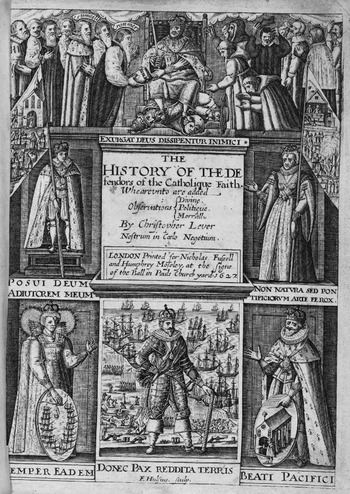
This was an atmosphere conducive to the begetting of myths. Symptomatic here were texts and pictures celebrating the part that England's monarchs had played in the making of its Reformation. Dating the onset of the Gospel's flourishing to Elizabeth's accession, George Carleton's Thankfull remembrance of God's mercy (1624) explored the country's merciful deliverances from popish plots and conspiracies by the intervention of divine providence, from the Northern Rising of 1569 through to the Gunpowder Treason of 1605. It recalled how the Lord had planted the truth of his word ‘by his owne hand’ and dispelled the ‘darkness’ and ‘the shadow of death’ under which Catholic England had sat for so long.Footnote 99 Christopher Lever's Historie of the defenders of the Catholique faith (1627) was a patriotic narrative of the progress of Protestantism since the beginning of Henry VIII's reign combined with ‘Observations Divine, Politique, and Morrall’. Conceding that this king was, on the face of it, an unfitting instrument of the ‘miraculous alteration in the state of Christendome’ to which his reign had borne witness, Lever stressed the omnipotence of God, who often used unexpected mechanisms to bring about his mysterious will. His title-page reproduced an older iconography showing Henry trampling on the pope and handing out the Bible to Cranmer and Cromwell for distribution to his grateful subjects, with the papists in disarray on the right (Figure 2). He was, however, critical of this monarch's ‘remisse and colde proceeding in the worke of reformation’ and compared him unfavourably with that more perfect prince, Edward VI, whom he depicted as the spitting image of the ardent young destroyer of idolatry described in the Old Testament, King Josiah. Reversing the evil policies of her bloody and misguided half-sister, Elizabeth was heralded as a ‘sacred Virgin’ whose ‘holy hands [had] put out the fires of trouble’ and rebuilt God's house. Skipping over the deficiencies that had been the source of grievance in the 1590s and omitting any reference to her stubborn refusal to countenance puritan moves to remodel the Church of England, Lever presented an upbeat assessment of the Elizabethan Reformation and concluded with a remembrance of how the Lord had preserved James I from the malice of his Catholic enemies and an exhortation to Charles I to mimic his predecessors' commitment to the protection and advancement of true religion.Footnote 100
Christopher Lever, The historie of the defenders of the Catholique faith. Wheareunto are added observations divine, politique, morrall (London, 1627), title-page. Reproduced by permission of the Syndics of Cambridge University Library. Shelfmark: 9. 15. 84.

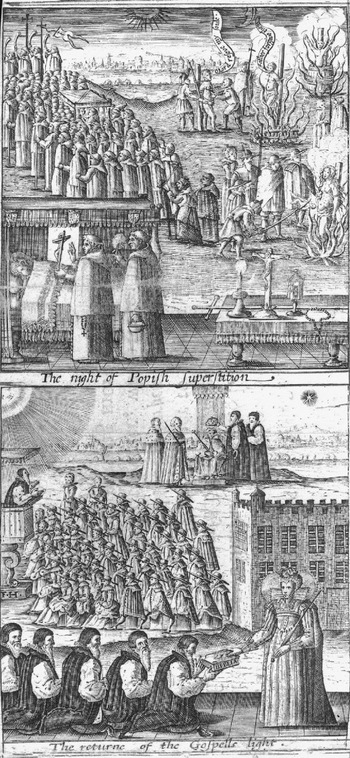
Once again, selective memory was in operation. But the obsequious praise that Lever heaped upon the Tudor and Stuart dynasties should also be understood as an oblique strategy for offering political counsel. In a culture in which flattery was often a form of instruction and a vehicle for veiled criticism,Footnote 101 historical recollection could double as a didactic device. As David Cressy and others have taught us, remembering the recent Protestant past was often a means of articulating discontent about the present.Footnote 102 Devotional texts such as Michael Sparke's bestselling anthology of prayers entitled Thankfull remembrances reflected growing concern that the religious legacy of the sixteenth century was in serious jeopardy. With its emblem contrasting ‘the night of Popish superstition’ with ‘the return of the Gospells light’ (Figure 3), it needs to be seen as a protest against the perceived attempts of a faction within the English Church itself to subvert Protestantism and a battle cry to the godly to stand up and defend it.Footnote 103 Ironically, only when it seemed at risk of reversal and destruction did zealous Protestants of a puritan proclivity turn away from disparaging it and begin to acknowledge it as a watershed.
‘The night of Popish superstition’ and ‘The return of the Gospells light’: Michael Sparke, Thankfull remembrances of Gods wonderfull deliverances of this land, bound with Crumms of comfort (London, 1627 edn), fold-out plate. © The British Library. Shelfmark: C. 65.i.7 (2).

The publication during these decades of prints such as Faiths victorie in Romes crueltie, depicting the cloud of witnesses who had sealed their commitment to Protestantism with their blood, is another index, not of the conviction that the Reformation was safe, but of the fear that it was under renewed and sinister threat (Figure 4).Footnote 104 Peopled with the heroes immortalized in Foxe's ‘Book of Martyrs’, it was the visual counterpart to the new edition of the Actes and monuments printed in 1632, which gave graphic expression to the profound disquiet some contemporaries were beginning to feel about the disturbing direction in which the Church of England was heading. It incorporated an ‘additional treatise of afflictions’ urging the faithful to prepare to suffer for the sake of the Protestant faith once again.Footnote 105 Such symbols and slogans were never the exclusive property of puritans, however: the petitions to save the Prayer Book that many signed in the early 1640s also invoked the rhetoric of a ‘blessed Reformation’ in the sixteenth century and recalled the sacrifices made by its martyred bishops Latimer, Ridley, and Cranmer. In some of these petitions, their deaths were invoked as evidence of the sanctity of the episcopal office itself.Footnote 106
Faiths victorie in Romes crueltie (c. 1620s). British Museum Department of Prints and Drawings, Satires 11. © Trustees of the British Museum.

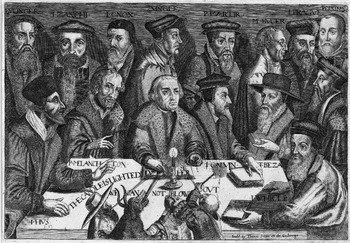
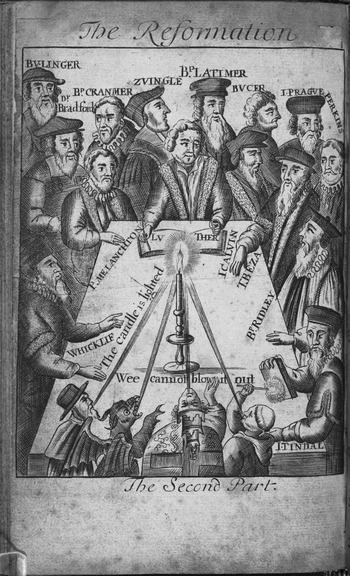
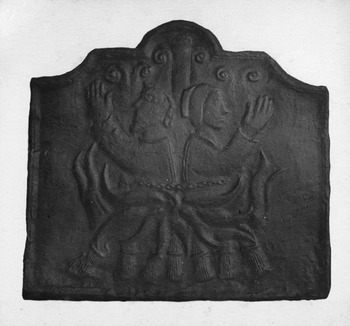
It is no coincidence that the decade preceding the outbreak of Civil War in 1642 saw the reissue of another striking image that seems to have first appeared in England around the beginning of the seventeenth century. Adapted from earlier German prototypes, this is a group portrait of the reformers sitting around a table upon which stands a burning candle. At the centre is Luther, with Melanchthon to his left, and Calvin and Beza on his right. Also present are their fourteenth- and fifteenth-century precursors, Wyclif, Hus, and Jerome of Prague. Bullinger, Zanchius, Knox, Zwingli, Peter Martyr Vermigli, Bucer, and the great Cambridge puritan divine William Perkins stand in a row at the back. Time has been telescoped to bring together men who were not contemporaneous. Below the pope and devil, together with a monk and cardinal, cry plaintively ‘We can not blow [it] out’, echoing a phrase in the second book of Esdras 24: 25 (Figure 5).Footnote 107 Sold by the godly bookseller Thomas Jenner and intended for display by devout householders, this engraving may be seen as another testimony to concern that the light of the Gospel might soon be extinguished in England, and as a badge and mascot of the self-styled godly. It is a visual version of the texts that recorded Luther's table-talk. A counterpart to another popular and much-reproduced print showing a conspiratorial cabal of the pope and his minions,Footnote 108 this iconography proliferated in paint as well as in ink. One version expands the group to include other Protestant worthies such as Thomas Cranmer and the seventeenth-century Irish primate James Ussher.Footnote 109 In another, significantly entitled ‘The Reformation’, which appeared in a biographical compilation entitled Ecclesiastical history epitomized, the table is even more crowded and includes John Bradford, Nicholas Ridley, and William Tyndale (Figure 6).Footnote 110 In a third, the cast consists exclusively of English Protestants, with Latimer displacing Luther as the central figure.Footnote 111 A cheaper woodcut version of this image was published as a broadsheet in 1680, at the time of renewed concern that the fate of the Reformation hung in the balance which coincided with the Popish Plot and Exclusion Crisis. This was printed as ‘a thankful Remembrance of God's goodness to all Protestants in these three Kingdomes of England, Scotland and Ireland … necessary to be set up in every house and Family’.Footnote 112 Indeed, by the late seventeenth century, inspiring images of reformers and martyrs had left a notable imprint upon domestic piety and its attendant material culture. They had infiltrated the godly household and found their way onto earthenware platters and firebacks. One example of the latter, now preserved at Lewes in Sussex, depicts a man and woman surrounded by flames (Figure 7). The effect of lighting a fire in front of this image must have been startling: it made later Protestants vicarious eyewitnesses of the horrific but momentous events that had taken place more than a century before.Footnote 113 A Dutch delftware dish embellished with the same group portrait dating from 1692 appears to be a wedding gift: here, remembrance of the origins of Protestantism combines with commemoration of a critical rite of passage in a couple's life.Footnote 114 Such objects became media through which moral guidance was provided and which served to stimulate the formation of a confessional Protestant identity.Footnote 115 They served to crystallize an embryonic sense of the Reformation as a decisive event.
The candle is lighted we can not blow [it] out (c. 1620s): British Museum, Department of Prints and Drawings, British xviic Mounted Roy. © Trustees of the British Museum.

‘The Reformation’: frontispiece to Part ii of J. S., Ecclesiastical history epitomized (London, 1682). © The British Library. Shelfmark: G. 19593.

Fireback decorated with an image of two Marian martyrs derived from Foxe's Actes and monuments: Anne of Cleves House, Lewes, Sussex. By permission of the Sussex Archaeological Society, Barbican House Museum.

This coexisted and sometimes converged with another current of historical interpretation that gathered momentum as the seventeenth century progressed. This was the view that the English Reformation was not a half-baked and prematurely aborted confection, but one that had been carefully crafted and was perfectly shaped. Far from an unholy compromise produced by haphazard and chance, it was a deliberate creation of considerable genius. Uniquely poised between the extremes of Rome and Geneva, it corresponded more closely with the primitive church than any other ecclesiastical institution upon earth. The notion that England's Reformation was more ‘agreeable to the Archetype of Jerusalem’ than any other can be detected in certain strands of anti-Catholic polemic from the 1560s, but ideas of this kind first began to be articulated systematically in the circles of avant-garde conformists like Richard Hooker who have been credited with the invention of Anglicanism.Footnote 116 They were taken up and elaborated by Laudian writers in the 1630s, who repudiated the traditional Calvinist view that the pope was Antichrist and offered a more positive analysis of the Catholic middle ages. They recast the Reformation as a reluctant institutional schism rather than a frenzied flight from Babylon and played down its connections with its Swiss brethren. The medieval church was not a limb of Satan but an organization that had more than a few redeeming features.Footnote 117
Nowhere is this novel interpretation of the origins of Protestantism in England more clearly expressed than in the work of the intemperate Anglican polemicist Peter Heylyn. Dedicated to Charles II, his Ecclesia restaurata, or, the history of the Reformation of 1661 saw Henry VIII's reign as politique prelude to the radical excesses of Edward VI's campaign of Protestantization, the enormities of which (including disorder and sacrilege) he indicted in no uncertain terms. Although he acknowledged the zeal and piety of the boy king, he could not reckon his premature death ‘an Infelicity to the Church of England’, since this had prevented it from becoming the prey of a malign ‘Calvinian faction’ which sought to set up Genevan Presbyterianism. He applauded Elizabeth's diligence in banishing Anabaptists and other ‘fantatical spirits’ and her prudent resistance to puritan attempts to overturn her religious settlement, which he saw as a model of moderation. The ‘dangerous doctrines’ of this sect and its rise to power in more recent times were ‘discovered’ in another book published after his death.Footnote 118
To echo a comment made in another context by his biographer Anthony Milton, Heylyn massaged the history of the Reformation to make it speak with a Laudian accent or voice.Footnote 119 The high church view of the ecclesiastical past that he popularized found enthusiastic supporters after the Restoration. It was also during the decades between 1650 and 1690 that the relationship between the Church of England and the church fathers was redefined and its much invoked via media legitimized by an appeal to patristic antiquity.Footnote 120 The version of Reformation history that emerged exerted ongoing influence in the eighteenth and nineteenth centuries, where its echoes can be detected in the output of leading figures of the Oxford Movement and in the tradition of Anglo-Catholicism which this inaugurated.Footnote 121 It ran alongside a rival historiographical stream represented by the work of Gilbert Burnet, John Strype, and others. Burnet's famous History, the first two volumes of which were published in 1679 and 1681, was written as a rebuttal of both Nicholas Sander and Peter Heylyn. Infused by the Foxeian conviction that the true and false churches were locked in an apocalyptic struggle for mastery which continued in his own time, it was a providential history in which political manouevring was a mere cipher for the working out of God's eternal will and in which Burnet detected biblical patterning in the Lord's dealings with the English people. Its engraved title-pages evoked older visual tropes: the crushing of the pope's tiara under Henry VIII's feet, the handing out of the Bible by Thomas Cranmer, the dismantling of superstition and the erection of the temple of true religion, the godly zeal of Edward VI, the persecution and martyrdom of Protestant leaders in the 1550s by Queen Mary's regime, and Elizabeth as a serene protectress of the faith (Figure 8). This too was the story of how darkness had been overcome by the light. The work of a vocal opponent of James II and avid supporter of the claims of William and Mary to the throne, it was a history that resonated with the sentiments that swept in the tide of the Glorious Revolution in 1689, but which must also be recognized as an attempt to marginalize opponents within the Church of England against a backdrop of considerable political and religious contention. It did not command consensus and it reflected ‘a household at war with itself’; it was just one manifestation of the multidimensional, complex, and fractured entity that was, and is, memory of the English Reformation.Footnote 122
Gilbert Burnet, The history of the Reformation of the Church of England (London, 1679–81), title-page of part ii. Reproduced by permission of the Syndics of Cambridge University Library. Shelfmark: 5. 40. 21.

The official and written narratives analysed above must not be allowed to eclipse the existence of the alternative histories and myths about the nation's religious past that were progressively expelled from academic discourse but survived in the sphere of speech. Consigned to the wilderness of ‘superstition’ and scholarly backwater of ‘folklore’, they too have much to tell us about the dynamic process by which the notion of the Reformation as a critical turning point in history evolved and splintered. The making of this mosaic involved forgetting as well as remembering; it was marked by the interweaving of individual subjectivity and social memory; and it mutated organically with the passing of the generations. Despite the problems of the written sources in which they were later deposited, such stories provide compelling insight into the many afterlives of the religious revolution of the mid-sixteenth century.Footnote 123 They illustrate an insight that has been a leitmotiv of the foregoing analysis: that the past is ‘a matrix to which the present is crucially connected’ and that in remembering it we continually recreate it in our own image.Footnote 124
The advent of Protestantism in England, as in Europe as a whole, then, precipitated significant shifts in the mental and cultural environment within which people perceived, investigated, and interpreted the past. Its theology severed traditional links between living people and their dead ancestors and reinterpreted sacred religious rites and objects as merely commemorative acts and historical remnants. To this extent, it fundamentally reconfigured the mnemonic culture contemporaries had inherited from their precedessors. At the same time, the polemical conflicts that followed in the wake of the Reformations fostered developments that historians have long seen as a measure of the liberation of scholarship from the constraining shackles of religious partisanship and prejudice. Together with Renaissance humanism, they helped to engender techniques that have become hallmarks of the historical discipline as it is currently practised; to create the very archives that still shape our understanding of the period subtly but decisively; and to forge the models of periodization that continue to divide medievalists from (early) modernists today. They too contributed to the evolution of the oxymoronic concept of modernity and to the teleological narratives about its origins that exert a lingering and tenacious influence on our thinking. The ‘unexamined habits of mind’ to which the Reformation gave rise continue to seduce us to judge the past by the yardstick of our own times.Footnote 125 Finally, they persist in colouring the questions we ask and the categories of analysis we employ in seeking answers. In this sense, we remain children of a confessional age.Footnote 126
V
Before closing, I have one last comment to make. Early modern writers of history, whether sacred or civil, providential or political, wrote with a purpose. The prefaces to their works keenly underlined its value as a vehicle of moral teaching and an incentive to ‘vertuous living’. They spoke of the ‘nobility’ and ‘utilitie’ of studying the past and of the ‘commodity’ which this brought ‘to the commonwealth’. They insisted that it was as hard for their readers to come away without deriving some ‘profite’ as it was for a man ‘to walke up & downe in the hot parching Sun, and not to be therewith Sunburned’.Footnote 127 They had no doubt that history should contribute to the welfare of society at large and indeed this was the principal objective of the chairs in the subject created by Camden and Greville in the early seventeenth century. The latter specifically declared that the incumbents of the post he endowed were to be men ‘exercised in public affairs’ and that the ‘use and application’ of history ‘to the practice of life is the main end and scope of this foundation’.Footnote 128 History, they were convinced, should be an instrument of social engineering, political wisdom, and the creation of cultural capital. It ought to make what current policy makers in higher education call ‘impact’. The problem for our friend Isaac Dorislaus was that he made too much.
We too should hope that the history we write has relevance to those who work beyond the narrow confines of our discipline, as well as reach and resonance outside the ivory tower of the university and academy. But what we should resist – and, dare I say, have resisted much more vociferously – is any attempt to assess and measure this, and to use it as a criterion for distributing financial resources. The plans to do so enshrined in the Research Excellence Framework will constrain and distort our endeavours in regrettable ways; they will compromise scholarly freedom and autonomy; and they will distract us from the task of expanding knowledge and human understanding. And it is an extraordinary irony that ‘impact’, as defined in the REF documents, explicitly excludes the most vital dimension of what we do – and that is to inspire, challenge, and widen the horizons and minds of our students. In conclusion, I can do no better than quote from the inaugural lecture delivered by my predecessor Herbert Butterfield in 1944:
If we fall into a utilitarianism that is too direct we defeat the very purpose of an historical education … If we wish to increase our usefulness to society in general, then – whatever the world outside may demand, however blind officialdom itself may be in regard to this matter – in a university school of history there is no short cut to the utilities: the only genuine service we can perform is to teach history and train men [and women] out of their terrible misuse of it.Footnote 129