

1. Introduction
Economists have long debated the effects of trade on economic outcomes. While there is little dispute about the capacity of international trade to enhance world and national output, there has typically been less agreement about the distributional effects of international trade within countries. Motivated by a sharp rise in imports to high-wage countries from low-wage countries between the 1990s and the 2000s, a growing number of empirical studies examine the relationship between import competition and labour market outcomes in advanced economies. Contrasting findings emerge from these studies. Reference Mion and ZhuMion and Zhu (2013) find that import competition from low-wage countries has a small negative effect on employment growth in Belgian firms and that imports from China play a special role in inducing skills upgrading in importing firms. Reference Bloom, Draca and Van ReenenBloom et al. (2016) find that exposure to Chinese imports has led European companies to innovate and to become more efficient and suggest that this is likely to have shifted demand away from low skilled workers. In contrast, Reference Lu and NgLu and Ng (2013) suggest that the positive relationship between skill intensity at the industry-level and import penetration in the US over the period 1970–90 does not specifically pertain to imports from China or from other low-wage economies. Reference Hijzen, Pisu, Upward and WrightHijzen et al. (2011) study UK firms over the period 1996–2004 and find that offshoring of services was not associated with job loss or higher worker turnover.
In a seminal paper, Reference Autor, Dorn and HansonAutor, Dorn and Hanson (2013) investigate the impact of Chinese import penetration on local labour market outcomes in the US and show that the liberalisation of Chinese trade led to reductions in manufacturing jobs and a fall in real wages, particularly for low skilled workers in direct competition with Chinese labour. Key to their identification strategy is the simple observation that local labour markets will face differential exposure to import competition because of their particular industry structure and the notion that the rise in trade with China is to a large extent exogenous, i.e. not demand driven, facilitating a quasi-experimental approach to identification.
In a similar study Reference Balsvik, Jensen and SalvanesBalsvik, Jensen and Salvanes (2015) find that trade with China was associated with de-industrialisation and negative employment effects for low-skilled workers in Norway, but not with any changes in wages. The latter finding the authors attribute to the particular Nordic labour market model, which is characterised by centralised wage bargaining. Reference Dauth, Findeisen and SuedekumDauth et al. (2014) adopt the same identification strategy and study the impacts on German labour markets of the rise in imports from both China and from Eastern Europe. They find that while German labour markets that specialised in import competing industries faced manufacturing job loss, these losses were offset by increased exports largely to Eastern Europe.
The studies mentioned above rely on geographical variation in the industrial composition of jobs to identify the impacts of import competition on the labour market. In a related approach using individual level data Reference Autor, Dorn, Hanson and SongAutor et al. (2014) show that Chinese imports reduced US manufacturing workers' cumulative earnings over time. This methodology was adopted in two UK studies. Using the UK New Earnings Survey and a similar methodology, Reference LindleyLindley (2014) provides some evidence that Chinese import exposure had adverse effects on the cumulative earnings of affected workers in the UK and Reference PessoaPessoa (2014) provides evidence of a negative effect on UK workers' wages and time spent in employment.
In this paper we analyse local labour markets in the UK. We adopt the identification approach first introduced in Reference Autor, Dorn and HansonAutor et al. (2013) to study two developments that influenced the nature of international trade: the ascendency of China as an important player in global markets and the accession to the European Union of a number of Eastern European economies in 2004. As discussed in Dauth et al. (2014), both of these changes were associated with a shift in trade regimes and led to a sharp rise in import competition in particular European manufacturing sectors. We construct a series of indicators of import penetration that give a detailed picture of the increasingly global nature of production, illustrating differences in the intensity of competition from workers abroad in different sectors and how this has changed over time. Similar to the findings for the US, Norway and Germany, we find significant variation in the nature of import competition across local areas in the UK and that where import competition was toughest, manufacturing jobs contracted more quickly than elsewhere. We conclude that these shifts in international trade during the early 2000s were associated with some dismantling of UK industry.
2. The changing composition of goods imports
Table 1 illustrates some key trends in the growth and composition of UK goods imports and of goods imports by other similarly advanced economies. Between 2000 and 2015 the value of UK imports nearly doubled, much as it did in the US, Germany, France and Italy. Over the same period, UK imports from China rose by a factor of five and from the A8 by a factor of six, far faster than UK goods imports from the World and reflecting the increasing share of goods imports originating from low income countries. As shown in table 1, these trends are broadly similar in other large and high income European countries. In the US, the rise in A8 imports has been slower than in European countries. This is unsurprising as the rise in trade between Western and Eastern Europe is likely to be driven in part by the accession of Eastern European countries to the EU and proximity. At the same time the manufacturing share of employment fell in all the countries shown in table 1; most in the UK and least in Germany. It is these trends that have motivated the studies discussed above and the analysis in this paper.

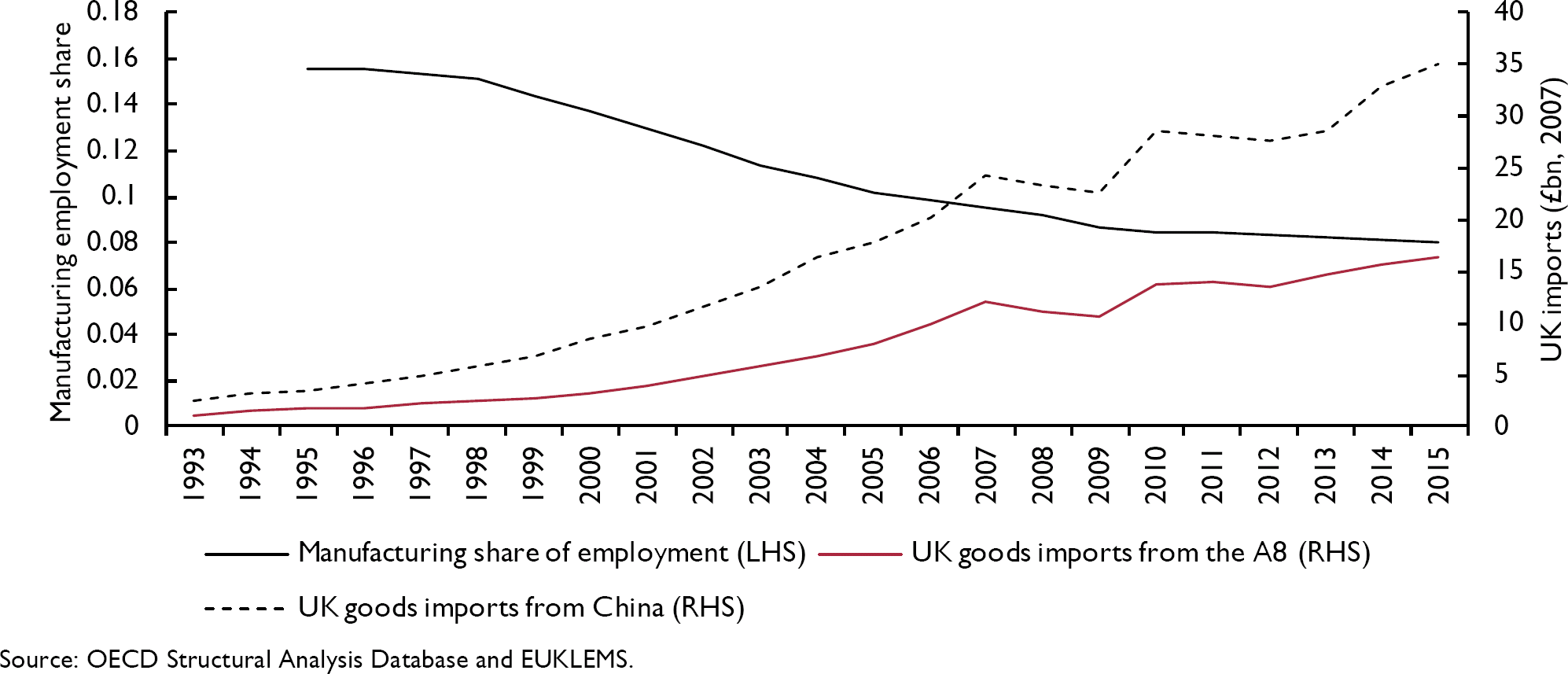
Figure 1 illustrates the volume of UK goods imports from China and the A8. These were generally rising throughout the 1990s, and have increased substantially in absolute terms between the 1990s and the 2000s. The manufacturing share of employment exhibited a steeper rate of decline in the early 2000s than the late 1990s, coinciding with these shifts. Of course the manufacturing share of employment had been decreasing long before the 1990s and the 2000s, when globalisation gathered pace. We take this into account in our analysis.
UK Imports and the manufacturing share of employment

Our identification strategy relies on the differential increase in import competition across sectors and therefore across local areas. In table 2 we illustrate import penetration rates from China and the A8 across two-digit manufacturing products/sectors. The measure of import penetration used here equals the ratio of UK imports from a particular country or set of countries to the sum of turnover and UK imports from the world less UK exports to the world, by product (ISIC Rev.3); details regarding the data are reported in the data section.

Between 2000/01 and 2014/15 UK import penetration from China increased most in the textiles, apparel and leather goods industries and in office & computing machinery and radio, tv and communications equipment industries. UK import penetration from the A8 rose less quickly than that from China, but is concentrated in many of the same products/industries. In particular, import competition has increased from both areas in office & computing machinery and radio, tv and communications equipment industries. Unlike Chinese imports, A8 imports are not concentrated in textiles and clothing, but are increasingly concentrated in motor vehicles. Together, the rise in import penetration from China and the A8 between 2000/01 and 2014/15 account for around 40 per cent of the rise in total import penetration from the world in UK manufacturing.
3. Methodology
Existing studies of the impacts of import competition on labour markets vary in their unit of analysis. Studies based on industry- and firm-level datasets do not capture the effects of import competition on the reallocation of workers across sectors that may play an important role in explaining the dynamics of employment and wages. Research based on regional-level or individual-level data is more suitable for capturing these effects. Our analysis is conducted at the level of the region (local area), which allows us to capture the broader (general equilibrium) labour market effects of import penetration.
Our identification strategy builds on the exposition in Reference Autor, Dorn and HansonAutor et al. (2013). We identify the effect of low wage import penetration on labour market outcomes off the differential exposure of local labour markets to trade with low wage countries. We derive measures of sector and local area labour market exposure to import competition from low wage countries using detailed bilateral trade data and data on the industry composition of local area labour markets (data sources are described in the next section).
Following numerous other studies we focus on Chinese import penetration as a measure of import competition from low wage countries, which, it is argued, has partly been driven by supply side shifts rather than endogenous changes in import demand and is therefore particularly suitable for identification purposes. We also consider A8 import penetration. Arguably, political developments in the early 1990s, with the disintegration of the Soviet Union, and the subsequent accession of a number of Eastern European countries to the EU in 2004, might also be regarded as a set of supply side changes that led to increased openness and international trade. We concentrate primarily on goods trade, which accounts for the majority of imports from low wage countries and for which detailed data are available.
We use information on bilateral trade flows from COMTRADE to determine the variation in the volume of UK imports from China or the A8 in industry j between time t and time t+1,  We follow Reference Autor, Dorn and HansonAutor et al. (2013) to map industry-level changes in imports onto local labour market measures of (changes in) import penetration in import competing markets:

where the change in the volume of UK imports from China or the A8 in industry j is apportioned to local market i by local market i's share of UK employment in industry j measured at the beginning of the period (time t). Summing across all industries this gives a measure of the change in the volume of imports from China or the A8 that is in direct competition with production in local market i; we normalise by local area employment (or jobs) at time t, Li,t.
These metrics capture the change in exposure to import competition from low-wage countries in local labour markets, and we use them to examine the effect on manufacturing jobs of increased import competition. Ex ante, the expectation is that these effects are negative, as has been found for other countries, as discussed above. But, the rise in trade with low-wage countries may have wider labour market effects. For example, exporters or potential exporters will have new markets in which to trade. These factors may benefit jobs (and possibly wages), as has been found to be the case in Germany (Reference Dauth, Findeisen and SuedekumDauth et al., 2014). To capture these types of effects we develop additional trade metrics. To measure the increase in low-wage economy export markets we map industry-level changes in UK exports to China or the A8 onto UK local labour market measures of (changes in) export intensity to low-wage markets.Footnote 1 Following other studies this is subtracted from the measure of import penetration in equation (1) to generate a measure of net import penetration.
Next we estimate OLS regressions specified as shown in equation (2), where the dependent variable is the change in the ratio of manufacturing jobs to the population of working age measured at the local-labour market level. The independent variable of interest is the measure of the (change in) import penetration as specified in equation (1) above.

Regressions in differences eliminate unobservable labour market fixed effects from the error term, while a vector of time t covariates is used to control for cross-regional heterogeneity in initial conditions (Xi,t). Importantly we also include the start of period ratio of manufacturing jobs to the population of working age. This controls for the secular decline in manufacturing, which means that areas with high rates of manufacturing will on average experience higher rates of decline in manufacturing. This is important because of the correlation between manufacturing intensity and exposure to import competition.
We look at changes in labour market outcomes and import penetration from 2000, before China joined the WTO and before the Accession of the A8 countries to the European Union, to 2015. The start period is partly determined by the nature of our data, as described below. We examine long changes to the end of our sample in 2015. This is to allow for sufficient time post EU accession in 2004 and to avoid the Great Recession period. We have experimented with different time periods and our main conclusions are robust to changes in the specification of precise start and end dates.
To control for endogeneity arising from UK-specific industry-level shocks we follow the literature and instrument local area import penetration derived from UK imports with a similar measure based on industry-level import flows to other advanced economies. Basically, in equation (1) we replace sector-specific changes in UK imports from China or the A8 with sector-specific changes in imports from China or the A8 to other advanced economies.Footnote 2 The local area variation in this variable will be similar to the local area variation in (1) to the extent that the rise in imports from China or A8 reflect supply side shocks. We also replace local area-industry employment shares at time t with local area-industry employment shares from an earlier time period (1994) to avoid issues of simultaneity. This is a standard instrumental variables approach in the literature (see e.g., Autor et al. (2013); Reference Balsvik, Jensen and SalvanesBalsvik, Jensen and Salvanes, 2015).
4. Data
To construct measures of exposure to import competition in local labour markets and other local labour market characteristics we use a variety of data sources. In particular, we use the UN COMTRADEFootnote 3 database, which contains details on bilateral international goods trade flows by detailed product category, the Business Structure Database, which contains a register of UK firms, including details of their employment, industry and location, and the UK Labour Force Survey, which facilitates construction of a number of local labour market characteristics.
International trade data
To construct information on import penetration (import competition) we rely first and foremost on Commodities Trade Statistics (COMTRADE), a database disseminated by the United Nations Statistical Division and widely used in the analysis of international trade. This dataset can be freely accessed online through the UN website (http://comtrade.un.org/data/) or via the WITS platform maintained by the World Bank. COMTRADE include data on USD values and quantities (in different units) of yearly trade flows, both imports and exports, as reported by individual countries to the UN. Reported flows are disaggregated up to the 6-digit level of the Harmonised Standard Classification (HS6) of products and for each product-specific import flow it is possible to identify the country of origin. There are some well known issues with COMTRADE data. First, for some trade flows different values are reported by the exporting and by the importing country. Second, the values of the reported detailed commodity data do not necessarily sum up to the total trade value for a given country. As is relatively standard, we rely on trade values as reported by the importing country. In our analysis we consider averages over two years to minimise the erratic nature of the trade data.Footnote 4 We use standard concordance tables (see Reference Pierce and SchottPierce and Schott, 2009)Footnote 5 to associate the HS commodity codes of UK import flows in COMTRADE to different four-digit industry groups.
In analysing the impacts of import competition from China on the UK economy the UN COMTRADE data have one particular peculiarity that needs to be considered. There is a sharp shift in reported UK imports from China between 1999 and 2000 which is sustained thereafter. This most likely reflects a change in the treatment of imports from Hong Kong that originate in China, and is discussed in detail in Reference BarangaBaranga (2017), who proposes a methodology for optimising the information reported by exporter countries and importer countries, which minimises this discontinuity. Here we only consider the COMTRADE data from 2000 onwards, avoiding spurious changes in the level of UK imports from China.
Business Structure Database (BSD)
The Business Structure Database (BSD) is a business micro-dataset maintained by the Office of National Statistics. It provides basic information on employment and turnover for a near census of UK businesses on an annual basis since 1997. The source of this information varies for different types of firm and is described in Reference Evans and WelptonEvans and Welpton (2009). For our purposes the benefit of this database is that it allows us to construct a detailed picture of the industrial structure of jobs for low level geographies. The database contains employment (or rather jobs) and industry information for plants that operate within the firm. Unlike firms, plants have a fixed physical geographical location, and can easily be assigned to a particular area of the country. Using this database we construct information on local area jobs at the four-digit ISIC Rev.3 level. In combination with detailed trade data we construct measures of local area import penetration.
Labour market data from the UK Labour Force Survey (LFS)
We use the LFS to create a series of local labour market statistics, including the population of working age, its skill and gender composition, and measures of the foreign born population. The latter is a relevant control variable because the surge in import competition in the 2000s was also accompanied by a sharp increase in immigration to the UK, in particular from the A8 countries. The LFS has been used extensively to investigate labour market issues in the UK. The LFS is a quarterly survey of approximately 61,000 households across the UK with a 5-quarter rolling panel design. We use information at the individual level aggregating up to our local unit of analysis. We do not use the LFS to construct our main measures of import exposure. This is because the relatively small sample sizes limit granular analysis. In constructing the instrumental variables described in the methodology section we do rely on the LFS to create estimates of past local area industry structures, combining data over several survey waves.
Unit of analysis
Ideally the local area unit of analysis is such that there is sufficient overlap between area of residence and of work, approximating some concept of a local labour market. In the extreme case, if there is no overlap between area of residence and work, we might end up relating the intensity of import competition in one place to labour market characteristics in another. We use Travel-to-Work Areas (TTWA) as our local unit of analysis, as defined by the 2001 Census. The main defining characteristics of these are that at least 75 per cent of working residents work in the area and that at least 75 per cent of workers are resident in the area. This division of the UK results in 243 local labour markets. For the econometric analysis we exclude the eleven Northern Ireland TTWAs. Given the available information in the LFS, these could not be constructed using our mapping methodology. The BSD contains plant level post codes, which allows us to assign plants to TTWAs.
5. Results
Local area exposure to import competition with low wage countries
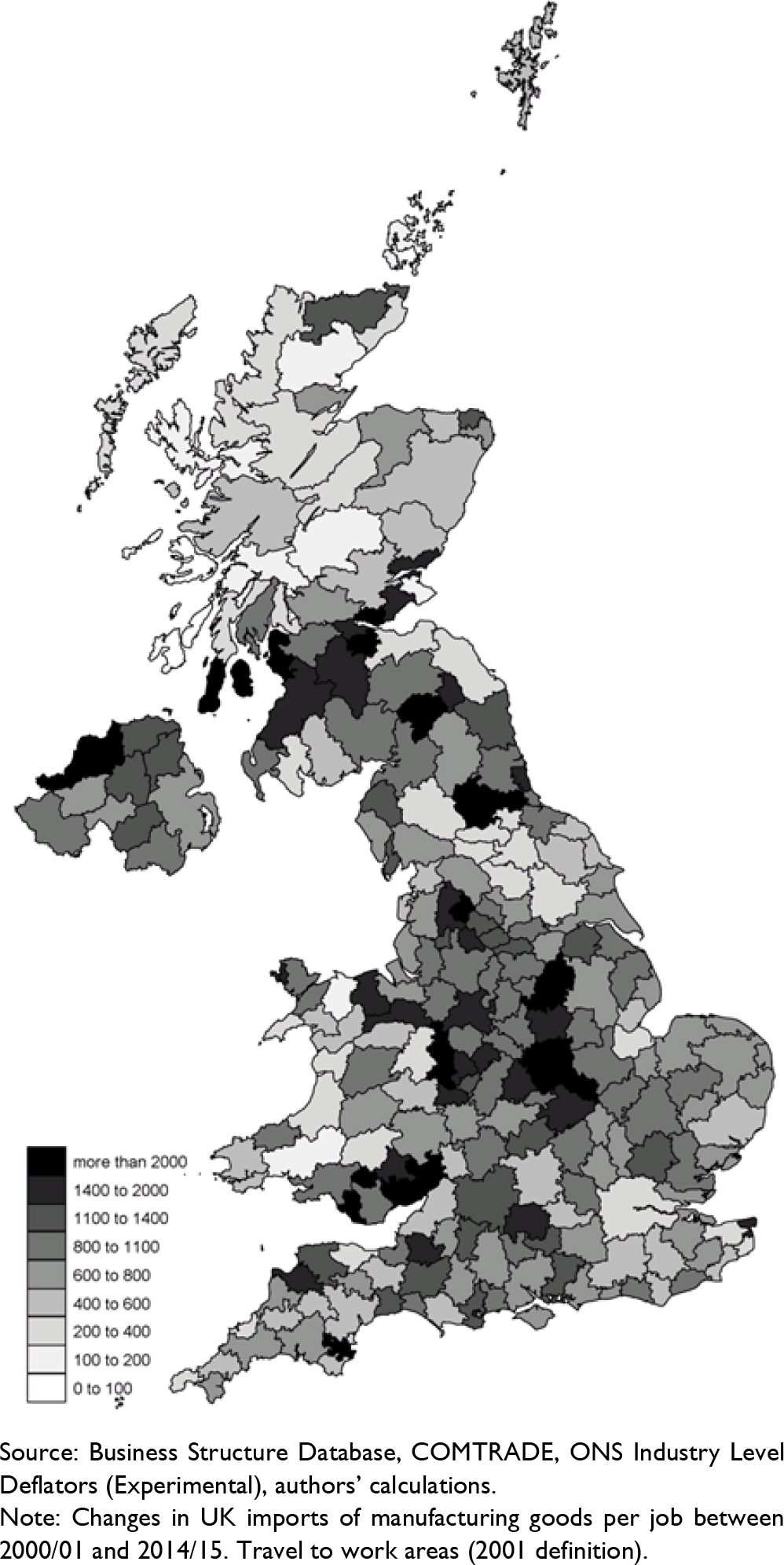
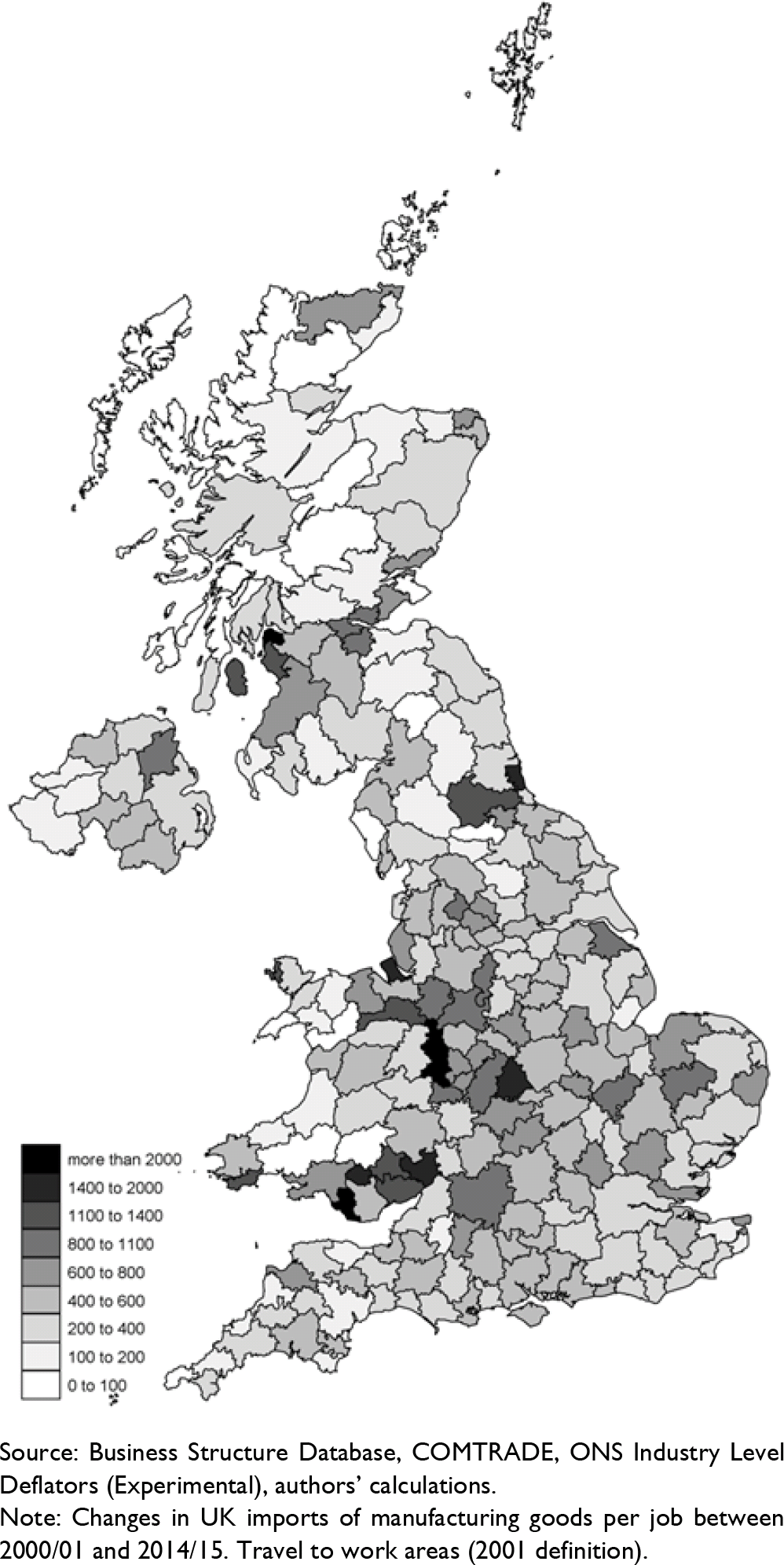
While we know from aggregate data that import penetration from low-wage economies has increased, we do not currently have available a detailed or nuanced understanding of the magnitudes of these changes. It is also a necessary first step in order to carry out empirical analysis of the links between international trade with low wage countries and the UK labour market. Figures 2 and 3 illustrate the pattern of exposure to imports from China and the A8 respectively, calculated as per equation (1). More specifically, they illustrate the change between 2000/01 and 2014/15 in the £ value of imports from China and the A8, measured in 2007 prices, per job across 243 TTWAs. Local measures of exposure to import competition reflect the detailed product composition of imports, mapped to the industrial structure of jobs in the local area in 2000.
Change in UK imports of manufacturing goods from China per job (£, 2007 prices)

Change in UK imports of manufacturing goods from the A8 per job (£, 2007 prices)

Comparing across figures 2 and 3, the generally darker shading in figure 2 reflects the bigger change in import exposure from China than from the A8 over this period, consistent with the aggregate data in figure 1. On average (unweighted) across TTWAs, the increase in UK goods imports from China per job between 2000/01 and 2014/15 is £1,004 measured in 2007 prices in this dataset. The median value across TTWAs is £777. In comparison, the increase in UK goods imports from the A8 per job over the same period is £476 on average and £378 at the median.
Importantly, for identification purposes, there is substantial variation in the change in exposure to import competition from China and the A8 across TTWAs. This means we can contrast developments in those areas where import competition rose dramatically to those where it rose less to gauge the effects of import competition on local labour markets, much as has been done in studies for the USA and other European countries. In figure 2, we see that import competition from China has been strongest in the South Western parts of Scotland, the South Eastern parts of Wales around Newport, parts of the North East around Sunderland, and the West and Central Midlands. These are all areas that, in 2000, were relatively specialised in the production of goods that are increasingly imported from China (see table 2 and discussion there). In figure 3, we see that the darkest shaded areas of the map coincide to some extent with those in figure 2. This means that many of the local areas of the UK that were exposed to significant import competition from China also faced significant import competition from the A8, albeit on a smaller scale. This reflects commonalities in the industrial composition of import penetration from China and the A8, as shown in table 2. But there are also differences in the industrial composition of these imports, which may be more apparent at lower levels of disaggregation than shown in table 2. As a result we also observe areas that are relatively exposed to import competition from China, but not from the A8, and vice versa. The correlation between the two import shocks across local areas is 0.60 in these data. We return to this in our discussion of the econometric results in the next section.
Table 3 reports UK TTWAs that were least and most exposed to import competition from the two low wage areas we consider during the 2000s. Greenock in Scotland, traditionally an area of heavy industry, scores highest on both import competition from China and the A8. Hawick, which faced a strong increase in import competition from China, but hardly any from the A8, traditionally specialised in textiles. Bridgend in Wales, another very industrialised area, scores second in terms of the rise in import competition from the A8. The industrial composition of jobs in Bridgend at the beginning of the century also meant that this area saw a sharp rise in import competition from China, although it does not rank amongst the top 10 TTWAS in table 3. Sunderland, which for many years has had many jobs in motor vehicles production, faced a sharp rise in import competition from the A8 countries.

Econometric results
In table 4 we report the results of estimating the model shown in equation (2). Our measure of the intensity of import competition is derived using equation (1) and UK imports from China. The dependent variable is the change in the ratio of manufacturing jobs to the population of working age between 2000/01 and 2014/15. All regressions are weighted with the TTWA population of working age at 2000/01, adding more weight to more populated TTWAs.

In model (1) in table 4 we simply regress the dependent variable on the measure of import competition from China and a constant. This results in an estimated coefficient on the import measure of −0.0293, implying that a £1000 increase in imports from China (measured in 2007 prices) per job is associated with a reduction in the ratio of manufacturing jobs to population of working age of 2.9 percentage points. In model (2), where we control for the start of period manufacturing share, this coefficient is very much reduced and implies that a £1000 increase in imports from China (measured in 2007 prices) per job is associated with a reduction in the ratio of manufacturing jobs to population of working age of 0.8 percentage points. In model (3) we include additional controls: the start of period share of low skilled population (highest qualification GCSE grade A–C or BTEC first/general diploma), share of females, share of foreign born and the change in the share of foreign born. This increases the magnitude of the coefficient on the change in imports from China slightly. In model (4) we estimate a two-stage least squares model, where in the first stage we model the change in UK imports from China as a function of the change in imports from China to high income EU countries weighted using local area industrial structures as they were in 1994. The first stage is highly significant, as has been found to be the case in related studies. In this model the coefficient on import changes implies that a £1000 increase in imports from China (measured in 2007 prices) per job is associated with a reduction in the ratio of manufacturing jobs to population of working age of 1.6 percentage points.
The estimates in models (3) and (4) in table 4 imply that the rise in imports from China between 2000 and 2015 can account for a fifth to a third of the reduction in the manufacturing share over this period. Overall the ratio of manufacturing jobs to the population of working age fell by 4.2 percentage points between 2000 and 2015. These estimates are not dissimilar in magnitude to those found for the USA in Reference Autor, Dorn and HansonAutor et al. (2013). We note that when we consider net exports (not reported) these estimates are somewhat smaller.
In table 5 we estimate equation (2) using imports from the A8. In model (1) we find a substantial negative correlation between the intensity of import competition from the A8 and the manufacturing share. Including the manufacturing share at the start of the period in model (2) and additional controls in model (3) we find that a £1000 increase in imports from the A8 (measured in 2007 prices) per job is associated with a reduction in the ratio of manufacturing jobs to population of working age of 0.9 to 1.1 percentage points. These magnitudes are similar to those shown for imports from China in table 4. In the two-stage least squares model the import coefficient remains stable, but the estimator is less efficient and so the statistical significance of the coefficient estimate falls just outside standard levels of significance. We note that in robustness checks, not reported here, using additional instruments and other measures of import competition we find a statistically significant relationship in the two stage least squares model between the manufacturing share and import competition from the A8.

The point estimates in models (3) and (4) in table 5 imply that the rise in imports from the A8 between 2000 and 2015 can account for around a tenth of the reduction in the manufacturing share over this period. This effect is smaller than the effect of the rise in imports from China, mainly because of the relative size of these import flows.
It is tempting to add together the results obtained from the models in tables 4 and 5 to arrive at an estimate of the overall effect of the rise in imports from the A8 and China on UK manufacturing. However, as discussed above, these two import ‘shocks’ are correlated and hence we should estimate their impacts jointly. We do this in table 6. Here we see that most of the explanation is allocated to import competition from China.Footnote 6 Using the coefficients from models (3) and (4) in table 6 we find that the combined effect of import competition from China and the A8 accounts for between 22 and 35 per cent of the reduction in the manufacturing share between 2000 and 2015. Note that these models account only for gross imports, however our main results are not very different when we consider net imports.

6. Conclusions
We have in this paper illustrated the nature of rising import competition from low wage countries in different industries and local areas of the UK over the past fifteen years. Using a now standard identification approach, we analyse the relationship between import competition and manufacturing jobs in the UK economy. We find, in line with evidence from some other advanced economies, that the rise in imports from China in the 2000s is likely to have reduced the number of manufacturing jobs domestically. We also find evidence that the rise in imports from the A8 was similarly associated with reductions in UK manufacturing jobs relative to the population of working age. The extent of import competition from low wage economies differs markedly across the UK. Thus, the rise in trade with low income countries such as China and the A8 will have had very different implications for different UK communities.
Given the patterns we observe in this paper, an obvious question to ask is how did local labour markets adjust to the loss of manufacturing jobs associated with rising import competition? This is a question we explore in on-going research.