Introduction
About three-quarters of the world’s main food crop plants are pollinated by animals, predominantly wild insects or domesticated honeybees, especially the European honeybee Apis mellifera (Klein et al. Reference Klein, Vaissière, Cange, Dewenter, Cunningham, Kremen and Tscharntke2006). Maintaining pollination by wild insects is arguably a more secure option for crop production than dependence on single-species beehives, but has been poorly studied (Blaauw & Isaacs Reference Blaauw and Isaacs2014; Garibaldi et al. Reference Garibaldi, Steffan-Dewenter, Winfree, Aizen, Bommarco, Cunningham, Kremen, Carvalheiro, Harder, Afik, Bartomeus, Benjamin, Boreux, Cariveau, Chacoff, Dudenhoffer, Freitas, Ghazoul, Greenleaf, Hipolito, Holzschuh, Howlett, Isaacs, Javorek, Kennedy, Krewenka, Krishnan, Mandelik, Mayfield, Motzke, Munyuli, Nault, Otieno, Petersen, Pisanty, Potts, Rader, Ricketts, Rundlof, Seymour, Schuepp, Szentgyorgyi, Taki, Tscharntke, Vergara, Viana, Wanger, Westphal, Williams and Klein2013). There is a need for targeted and quantitative research to provide a better understanding of the roles and identities of wild pollinators, and of the environmental factors that sustain their populations (Garibaldi et al. Reference Garibaldi, Carvalheiro, Leonhardt, Aizen, Blaauw, Isaacs, Kuhlmann, Kleijn, Klein, Kremen, Morandin, Scheper and Winfree2014; Kevan & Phillips Reference Kevan and Phillips2001; Klein et al. Reference Klein, Vaissière, Cange, Dewenter, Cunningham, Kremen and Tscharntke2006). This knowledge can potentially lead to improvements in crop productivity through orchard design and management to better support wild pollinators (Garibaldi et al. Reference Garibaldi, Carvalheiro, Leonhardt, Aizen, Blaauw, Isaacs, Kuhlmann, Kleijn, Klein, Kremen, Morandin, Scheper and Winfree2014). Such an approach may also provide a lower-cost alternative to domestic beehives (Klein et al. Reference Klein, Vaissière, Cange, Dewenter, Cunningham, Kremen and Tscharntke2006).
Across all plants, pollination by insects is more common in the tropics than in the temperate zone (Ollerton et al. Reference Ollerton, Winfree and Tarrant2011). For tropical fruit tree crops, research in greenhouse or experimental contexts has revealed that many are insect pollinated (Bumrungsri et al. Reference Bumrungsri, Sripaoraya, Chongsiri, Sridith and Racey2009; Cunningham & Blanche Reference Cunningham, Blanche, Stork and Turton2008; Garibaldi et al. Reference Garibaldi, Carvalheiro, Leonhardt, Aizen, Blaauw, Isaacs, Kuhlmann, Kleijn, Klein, Kremen, Morandin, Scheper and Winfree2014; Kumar & Kumar Reference Kumar and Kumar2014). However, apart from a handful of studies (Blanche et al. Reference Blanche, Ludwig and Cunningham2006; Cunningham & Blanche Reference Cunningham, Blanche, Stork and Turton2008; Klein et al. Reference Klein, Steffan-Dewenter and Tscharntke2003; Ricketts Reference Ricketts2004), there has been little investigation of how insect-mediated pollination processes operate in commercially productive tropical orchards. Bees (Apidae) are important pollinators, and tropical regions typically support a high species diversity of native bees, including both honeybees (Apini) and stingless bees (Meliponini), all of which are potential (but often unproven) pollinators of many fruit crops (Heard Reference Heard1999; Wardhaugh Reference Wardhaugh2015).
Tropical fruit crops are grown in many regions as tree orchards set within a landscape mosaic of different habitats. Such mosaics may collectively provide a sufficient year-round food supply and suitable nesting habitats to sustain populations of wild pollinators, which then travel between their nest sites and orchards when trees are flowering (Garibaldi et al. Reference Garibaldi, Carvalheiro, Leonhardt, Aizen, Blaauw, Isaacs, Kuhlmann, Kleijn, Klein, Kremen, Morandin, Scheper and Winfree2014; Klein et al. Reference Klein, Steffan-Dewenter and Tscharntke2003). In south-east Asia, fruit grown by individual farmers in small- and medium-scale landholdings provides one of the main income sources (OECD 2017). Often, in these rural landscapes, crop productivity depends on unmanaged pollination services, although the pollination processes in this context have rarely been rigorously investigated, apart from a handful of studies, into durian (Bumrungsri et al. Reference Bumrungsri, Sripaoraya, Chongsiri, Sridith and Racey2009), longan (Pham Reference Pham2012), and mango (Sritongchuay et al. Reference Sritongchuay, Kremen and Bumrungsri2016).
The native Asian lychee (Litchi chinensis) has long been domesticated to provide an important high-value fruit crop (Huang et al Reference Huang, Subhadrabandhu, Mitra, Ben-Arie, Stern, Menzel and Waite2005). More recently, lychee production has expanded worldwide in subtropical and tropical regions (FAO 2002a). Some studies have implicated honeybees (Apis spp.) as pollinators of lychee, following observations that they are common and active flower visitors (Davenport & Stern Reference Davenport, Stern, Menzel and Waite2005). Domestic hives of Apis mellifera and the Asian honeybee A. cerana have been used to enhance pollination and crop production in some industrial lychee plantations in China and India (Davenport & Stern Reference Davenport, Stern, Menzel and Waite2005; Kumar & Kumar Reference Kumar and Kumar2014). However, most commercial plantations rely on little-studied wild pollinators.
This study tests and quantifies the importance of different types of wild insects as providers of pollination services in the context of the small-scale landholdings that are typical of lychee production in south-east Asia. Using 18 different commercial lychee orchards across an area of about 10 km2 in northern Thailand, we conducted trap-based and visual assessments of insects within flowering trees, combined with experimental manipulations of pollinator access, to answer the following questions. First, what insect taxa occur most commonly within lychee inflorescences, and which are the most common visitors to lychee flowers? Second, do visits to lychee flowers by wild insects enhance the quantity of fruit produced per flower? Third, do different kinds of flower visitors (according to taxonomic identity and body size) show stronger associations with increased fruit production than others?
Methods
Study region and study design
Thailand is a major global lychee producer, especially in the north (FAO, 2002b). Within northern Thailand, our study took place in the Doi Suthep-Pui mountain region, Chiang Mai (18°51′43.39″–18°53′51.99″N and 98°50′4.83″–98°52′2.32″E). In this region, lychee orchards were embedded within a landscape that also contained areas of forest (including remnant mature forest, regrowth and timber plantation with a regrowth understorey) and small village settlements, whose residents derived a major source of income from lychee, vegetables, and other fruits (Elliot et al. Reference Elliott, Kuaraksa, Tunjai, Toktang, Boonsai, Sangkum, Suwannaratana, Blakesley, Stanturf, Madsen and Lamb2012). Lychee orchards were first established in the 1970s, most being about 0.3–2.5 ha in area and scattered across the landscape, sometimes forming clusters of adjacent orchard habitat of up to 29 ha in total area.
Observations and experiments used 18 replicate individually managed lychee orchards at 700–1,050 m elevation, near Ban Mae Sa Mai village (Supplement 1). Landholders made independent decisions about management (e.g., initial plantation establishment, pruning, and chemical usage). However, none actively managed pollination processes, apart from limiting pesticide application during the flowering season to avoid potential impacts on pollinators, and there was no use of domesticated pollinator hives. Orchards were selected for similarity in tree maturity (19–39 years) and continuity of past maintenance and were spatially dispersed as far as possible (mean nearest-neighbour distance 63.1 m, SE 77.7 m, range 0–200 m), across a total area of about 10 km2. All orchards contained flowering trees when the study commenced in January 2016. Orchards’ distances to any type of forested land varied (0–800 m; mean 54.2 m, SE 62.6 m).
Lychee inflorescences are panicles in which a central main branch (peduncle) typically produces about 10–20 lateral sub-branches (each a rachis). Each panicle bears large numbers of three types of small flower, which are spatially interspersed but vary in opening time over a 2–6 week period (Stern & Gazit Reference Stern and Gazit1996): male flowers, which open first, have only stamens and release pollen; female hermaphrodite flowers (henceforth ‘female flowers’), which open second, have functional pistils and fertilisable ovules but vestigial stamens; and male hermaphrodite flowers, which open last, have functional stamens which release pollen, but vestigial pistils without fertilisable ovules (Stern & Gazit Reference Stern and Gazit1996). Male flowers open during daylight (about 08:00–16:00, Malhotra et al. Reference Malhotra, Singh and Nath2018). In the study region, the observed flowering duration of individual lychee trees was up to 4 weeks, while different trees across all orchards collectively flowered within about 5 weeks.
In each orchard, we selected four trees, spaced as widely as possible (usually about 10 m apart; range 8–20 m). The trees had been pruned when young, to produce wide and low branching, and were typically 3–5 m tall and 8–11 m in diameter. At each tree, 12 similar-sized inflorescences were then selected (48 inflorescences per orchard), located at accessible positions, generally near a tree’s outer branches. Because the lychee inflorescences varied greatly in size, we selected inflorescences that were at least 30 cm long and 30 cm wide as far as possible, and then cut back longer peduncles to 30 cm. Additionally, side branches were cut as needed in large inflorescences, to obtain a total rachis length of 100–135 cm. Of the 12 inflorescences per tree, 4 were then used for measuring insects at inflorescences (2 for recording visitors at flowers, 2 for sticky trap sampling), and 8 were used for experimental pollination treatments.
Measurement of insects visiting inflorescences
Flying insects moving within inflorescences were sampled using a single sticky trap at each of two inflorescences per tree, installed when flowers were newly opened. Each trap was a transparent circular plastic sheet 15 cm in diameter, coated with TanglefootTM adhesive, and attached to the base of the inflorescence. After 10 days of exposure, all trapped insects were removed using mineral turpentine solvent and stored in 70% ethanol. All were subsequently identified to at least Order level, and counted. Within Apidae, the genus and species of all morphospecies were later identified by expert taxonomists, using individuals from both sticky traps and flower observations (see below). Additionally, the body lengths (head to end of abdomen) of 3–5 individuals were measured to obtain species-specific averages.
Flower visitors (insects that contacted any part of flowers within an inflorescence) were recorded by direct observation during sunny weather without strong wind, on each of two inflorescences per tree, each for a single 5-min period, in either morning (08:30–11:30) or afternoon (15:00–17:00), during 9–13 March 2016, soon after female flowers had opened. Data recorded at each inflorescence comprised the total number of insects of each recognisable morphospecies, with higher taxa identified at least to Order. Within Hymenoptera, we also separated ants, bees, and others and assigned a morphospecies to all bee records. Notes were also made of how individuals interacted behaviourally with each type of flower and with each other, and we used a manual aspirator to collect representative specimens of morphospecies whose behaviours at flowers implicated them as potential pollinators.
Experimental pollination treatments
To test the contributions of wild insects to fruit set and development, four experimental treatments were applied to inflorescences: No bag, No bag + add pollen, Open bag + add pollen, and Closed bag. The No bag treatment aimed to assess fruit set under natural conditions when insect visitation was unimpeded; the inflorescence was simply tagged. The No bag + add pollen treatment aimed to assess whether there was a pollinator deficit under natural conditions, by applying manual cross-pollination in addition to any pollen transfer provided by insect visitors. Ripe pollen was obtained by removing an inflorescence from each of three other trees in the orchard and then collecting and mixing all their shed pollen grains. This pollen was then transferred to the stigmas of all female flowers in the experimental inflorescence using a small brush. The Closed bag treatment aimed to exclude all insect visitors, allowing only self-pollination, by enclosing the inflorescence within a fine nylon mesh (0.1 mm) bag supported by a light metal wire frame that maintained some space between the bag and flowers (aiming to minimise pollen transfer through mechanical contact). The Open bag + add pollen treatment aimed to provide a control for the bag effect in the presence of known pollination, by both hand-pollinating and enclosing the inflorescence in a similar nylon mesh bag to that used in the Closed bag treatment, but with two large holes (8 cm diameter) cut into the bag, so that insects could enter. Exploratory pilot trials had indicated that insects can enter these bags.
Eight inflorescences in each subject tree (total 32/orchard) were used in experimental pollination treatments, 2 per tree for each of the 4 treatments (total 8/treatment/orchard). We selected inflorescences in each subject tree when well-developed flower buds were present, but before the female flowers had opened. When female flowers first opened, we added bags to establish the previously described experimental treatments. At this stage, unopened female flowers (<5% of the total) were removed from inflorescences in all treatments. All bags were then removed after flowering had finished and very young fruit had appeared (thus the bags were in place for 20–22 days).
Flower and fruit measurements
To quantify pollination success and fruit development, the numbers of female flowers or fruit on each experimental inflorescence were counted at four different stages. First, the numbers of recently opened female flowers were counted immediately before bags were added (but after cutting if necessary to the standard inflorescence size), and the total length of peduncle and rachis (henceforth ‘rhachis length’) was then measured. Second, 2 weeks later, the numbers of early young fruit (with visible ovary development) were counted. Third, 3 weeks after commencement, numbers of young fruit were counted, including only those with enlarged persistent green ovaries. Fourth, 8 weeks after commencement, numbers of mature fruit were counted (nearly ripe and soon to be harvested). At this stage, the size of each mature fruit was also measured, as three linear dimensions: height (stem attachment to fruit apex), width, and length (both in the plane perpendicular to the stem attachment and arbitrarily allocated when similar). Fruit was not weighted because they remained in situ for landholders to harvest.
Data analyses
The unit of replication for data analyses was an individual orchard (N = 18 for most measurements, but N = 17 for measurements of mature fruit because in one orchard they were harvested early). Numbers of insects per orchard were obtained by averaging across each of: (1) the eight sticky traps and (2) the eight observed inflorescences. In both cases, the insects were grouped into Orders, except for Hymenoptera, which was partitioned into four subgroups: recorded bee families (Apidae, Halictidae), Formicidae, and other Hymenoptera collectively (wasps). For Apidae, we further partitioned all individuals by tribe (Apini, Meliponini) and by body length (large >7 mm, small <7 mm), and also considered each identified species separately.
To measure variables that indicated flowering and fruit set in each orchard, we calculated the average numbers (m−1 of rachis per inflorescence) of female flowers, early young fruit, young fruit, and mature fruit. We also calculated the average volume of individual mature fruit per inflorescence, with individual fruit volume = 4/3 π × (½length) × (½width) × (½height). To quantify the success of fruit set, we calculated four flower or fruit variables for each inflorescence: percent of young and mature fruit per female flower, percent of mature fruit per young fruit, and average mature fruit volume. For each orchard separately, we then averaged the values of each fruit set variable across the eight inflorescences within each treatment.
To test the ecological roles of wild insects in fruit development and production, we compared mean values of each of the four fruit set variables among the four different experimental pollination treatments using repeated measures ANOVAs with Greenhouse–Geisser correction, together with Least Significant Difference (LSD) paired comparison tests (Quinn & Keough Reference Quinn and Keough2002), a similar approach to that of Gehrke-Velez et al. (Reference Gehrke-Vélez, Castillo-Vera, Ruiz-Bello, Moreno-Martinez and Moreno-Basurto2012) and Greenleaf & Kremen (Reference Greenleaf and Kremen2006). These analyses used the SPSS statistics 22 package (Davis Reference Davis2013). Orchards were subjects (N = 18, except N = 17 for mature fruit measurements), with the four pollination treatments being the within-subjects factor.
We used two approaches to assess how different types of insect flower visitors influenced fruit set. First, Pearson’s correlations were used to test the strength and direction of relationships among orchards (N = 17 or 18 orchards), between each of the four fruit set variables and the numbers of flower visitors within each taxon or group. Only taxa or groups present at >3 orchards were used. Second, two-dimensional non-metric multidimensional scaling ordination (MDS) within the vegan package in R x64 3.35.1 (Dixon, Reference Dixon2003) was used to display the pattern of among-orchard similarity and difference in species composition of potential pollinators; intrinsic variables were the abundances of all bee (Apidae) species recorded as flower visitors. We then used biplot vector overlays on this ordination to assess the relationship of among-orchard variation in potential pollinators with (1) abundances of individual bee species recorded visiting flowers at >3 sites, (2) five broader taxonomic and functional groupings of bee species (as previously described), and (3) the four fruit set variables.
Results
Insects visiting inflorescences
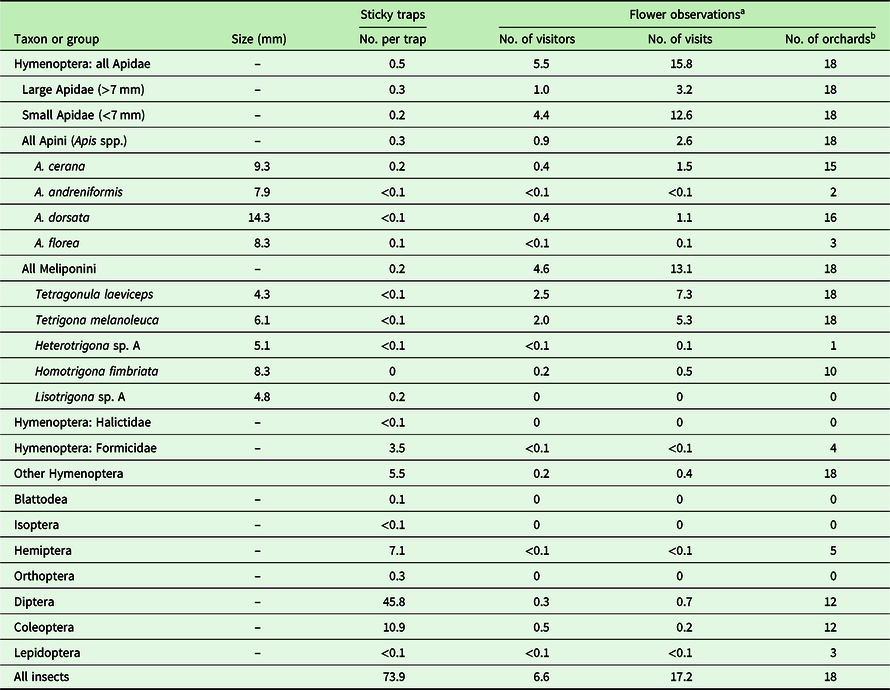
Flying insects within inflorescences caught by sticky traps comprised a total of 10,643 individuals (73.9/trap) in 8 Orders (Table 1). Diptera accounted for 62% of all trapped insects, being mostly tiny flies in the Family Chloropidae. Among other Orders, Coleoptera accounted for 15% of the total, Hemiptera 10%, and all Hymenoptera 14% (within which the Family Apidae contributed 0.7%). In contrast, Apidae strongly dominated the 952 insects (6.6 per inflorescence) recorded actually visiting flowers, comprising 83% of the total, with Diptera, Coleoptera, Hemiptera, and Lepidoptera contributing 5%, 7%, 0.8%, and 0.03%, respectively (Table 1).
Abundances of insects within lychee inflorescences, in selected taxonomic and ecological groupings, sampled using two methods: flying into sticky traps and observed visiting flowers. Average body lengths (size) of species in Apidae are also shown

a Numbers are mean values across 18 orchards; the value for each orchard is averaged across two traps or two observations per tree in four trees. Each sticky trap was a 15-cm diameter clear plastic circle, attached to an inflorescence’s base for 10 days; each flower observation comprised a 5-min visual record of all insects visiting flowers within a 30 × 30 cm inflorescence.
b Number of orchards (out of 18) where the taxon or group was present during flower observations.
From the direct observations of how each recognisable morphospecies interacted behaviourally with flowers, any morphospecies that were regularly seen making physical contact with both male and female flowers, and bearing pollen, were considered to be potential pollinators. This behaviour was seen in all bees (Apidae), across both flower observations and sticky traps. Potential bee pollinators comprised nine species of Apidae, in two subfamilies: four in Apini (all genus Apis, dominated by A. cerana and A. dorsata) and five Meliponini (four of which were recorded visiting flowers, dominated by Tetragonula laeviceps and Tetrigona melanoleuca). Additionally, the sticky traps yielded a small number of unidentified individuals in Family Halictidae, but these were not recorded visiting flowers. All Apis species were large bodied (>7 mm), and all Meliponines except Homotrigona fimbriata were small bodied (Table 1).
Fruit set and its response to experimental pollination treatments
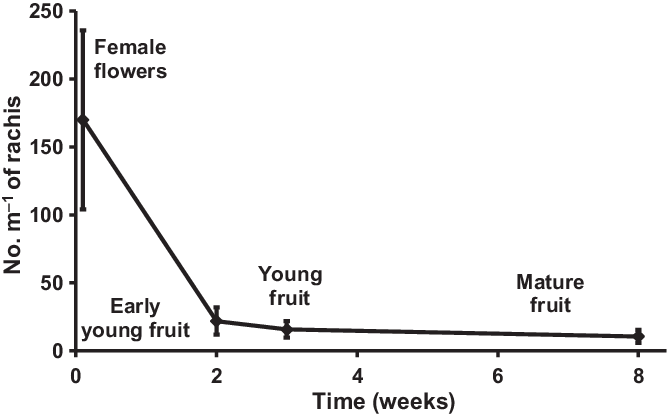
Across all 576 measured inflorescences in 18 orchards, the lychee trees produced an average of 170 female flowers m−1 of rachis, opening synchronously on the first day, on a mean total rachis length of 6.3 m. In the absence of experimental intervention (the No bag treatment), only about 13% of these flowers resulted in fertilised ovules, 9% in persistent young fruit, and 6% in mature fruit (Figure 1).
Changes in density from flowers to mature fruit, within exposed lychee inflorescences without experimental manipulation. Measurements are no. m−1 of rachis (mean and SE, N = 18 orchards, except N = 17 for mature fruit, after first averaging across eight inflorescences per orchard).

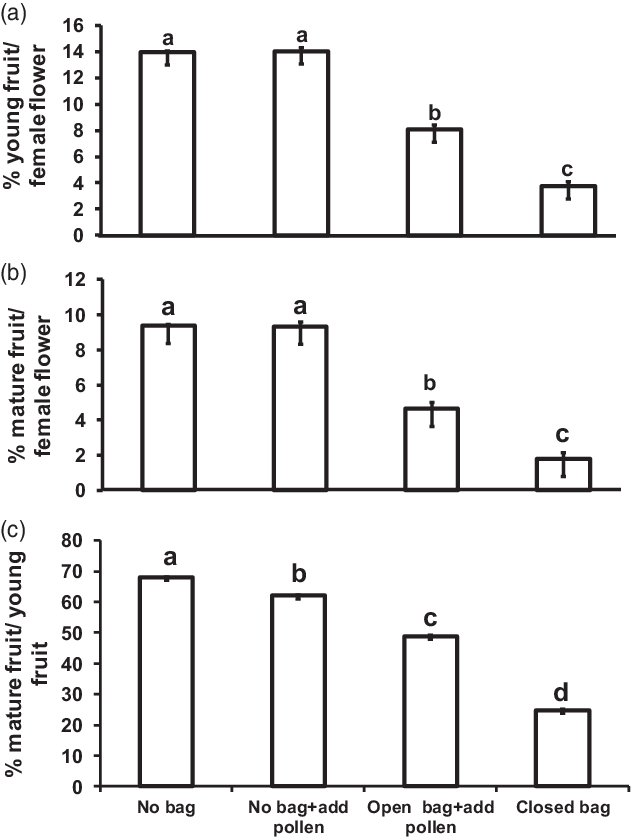
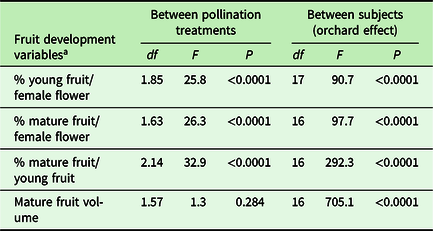
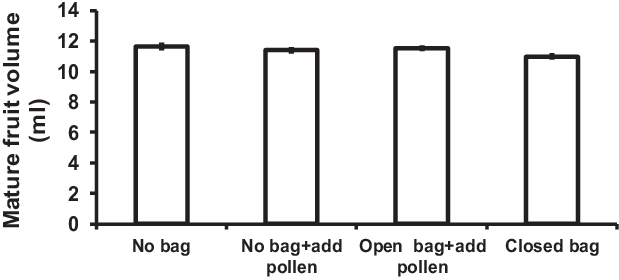
The experimental pollination treatments had a large and statistically significant effect on all three measures of the rate of fruit set (young and mature fruit per female flower, mature fruit per young fruit; Figure 2, Table 2), but did not affect the volumes of individual fruit (Figure 3, Table 2). There were also substantial differences in all variables among orchards (Table 2). Because survival from young to mature fruit stages was relatively high, the overall pattern of difference in mature fruit per female flower was similar to that of young fruit per female flower. In both cases, hand pollination of unbagged flowers had no effect on fruit set; full enclosure of inflorescences in mesh bags (Closed bag treatment) greatly decreased fruit set (to 27% of the No bag value for young fruit, and 19% for mature fruit), while the Open bag + add pollen treatment produced intermediate rates of fruit set between these extremes (Figure 2). For the number of mature fruit per young fruit (which represents retention rates of early fruit after successful fertilisation), adding pollen to unbagged inflorescences caused a decrease to 91% of the No bag mean; full bag enclosure caused a decrease to 36% of the No bag mean, and the Open bag + add pollen treatment was again intermediate (Figure 2).
Effects of experimental pollination treatments on the values of three measurements of fruit set in lychee orchards: means and SEs for young fruit/flower (a), mature fruit/flower (b), mature fruit/young fruit (c). Letters above bars indicate significant (P < 0.05) differences, from LSD tests in repeated measures ANOVA with orchards as subjects (see Table 2). N = 18 and 17 orchards for measurements involving young and mature fruit, respectively.


Effect of experimental pollination treatments on the volumes of individual lychee fruit (first averaged per orchard, with means and SEs from N = 17 orchards). There were no significant differences (P > 0.05, Table 2) in repeated measures ANOVA with orchards as subjects.

Influence of different types of insect flower visitor on fruit set
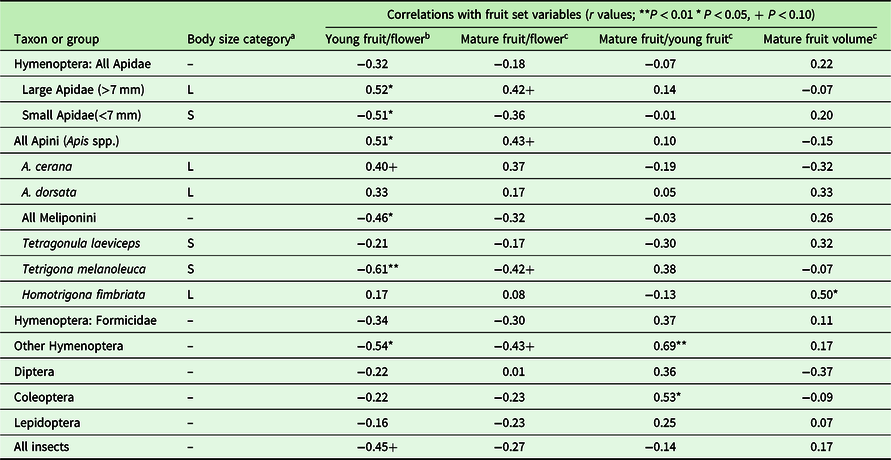
Across all orchards, different bee species and subgroups of Apidae had both positive and negative relationships with fruit set (young and mature fruit per female flower, Table 3). Although small Apidae (all in Meliponinae) comprised 68% of insects visiting flowers (Table 1), young fruit set was significantly negatively correlated with the abundances of small Apidae, all Meliponinae, and one common Meliponine species, Tetragonula melanoleuca (Table 3). In contrast, young fruit set had significant positive correlations with abundances of large Apidae and all Apis, and a relatively strong positive correlation with the abundance of one common species of large Apidae, Apis cerana. Mature fruit set showed similar but statistically weaker patterns to those of young fruit set. Among all the bee taxa, there were very strong positive correlations between abundances of Apini (all Apis) and large Apidae (r = 0.92, N = 18 orchards), and between all Meliponinae and small Apidae (r = 0.93), but non-significant (P > 0.05) negative correlations between large and small Apidae (r = −0.25), and between Apini and all Meliponini (r = −0.41) (Supplements 2 and 3). Fruit volume was uncorrelated with any taxon’s abundance except for a positive relationship with Homotrigona fimbriata (Table 3).
Strength of association (Pearson’s r) between four measurements of fruit development (in exposed inflorescences without experimental manipulation) and the abundances of insect taxa recorded visiting flowers in >3 of 18 lychee orchards

a For species and groupings within Apidae; S, small <7 mm; L, large >7 mm (see Table 1).
b N = 18 orchards; ‘flowers’ are female flowers.
c N = 17 orchards.
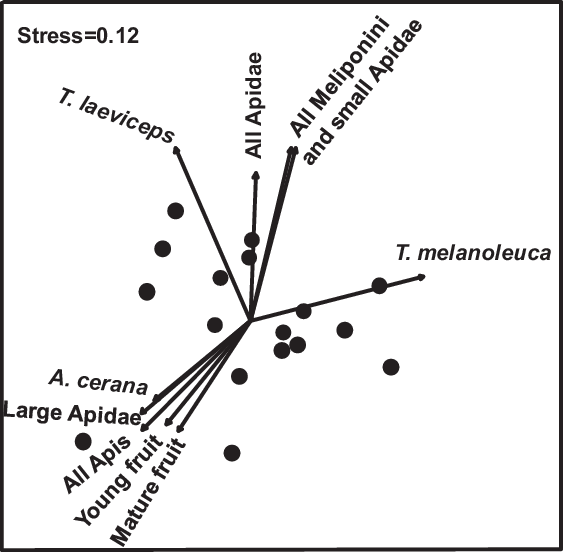
MDS ordination yielded similar findings, with the 18 orchards being spread into different regions of the ordination plot according to the species composition of their bee (Apidae) flower visitors (Figure 4). Vector overlay of intrinsic and extrinsic variables showed that orchards whose species composition was characterised by greatest abundance of all Meliponinae (and of small Apidae and the two most abundant Meliponines, Tetrigona melanoleuca and Tetragonula laeviceps) were separated from orchards in which all Apis (and all large Apidae and A. cerana) were more strongly represented, and these latter orchards also had higher rates of both young and mature fruit set per female flower, but no association with either mature fruit per young fruit or volumes of individual mature fruits (Figure 4, Supplement 4).
MDS ordination plot showing the variation in species composition of bees (Apidae) among 18 lychee orchards. Input variables were abundances of eight bee species recorded as flower visitors. Biplot vectors are shown for significantly associated variables (P < 0.05): three of five tested intrinsic variables (five bee species recorded from >3 orchards) and seven of nine tested extrinsic variables (abundances in five taxonomic and body size groupings and four measurements of fruit set).

Additionally, the abundance of other Hymenoptera (wasps) correlated negatively with young fruit set but positively with the persistence of young fruit (mature fruit/young fruit). The abundance of Coleoptera (beetles) also correlated positively with young fruit persistence.
Discussion
Importance of wild insect visitors for pollination and fruit set
Lychee trees typically produce very large numbers of female flowers, followed by low rates of fruit set (Davenport & Stern Reference Davenport, Stern, Menzel and Waite2005), as was also the case in this study. Our results showed that visits by wild insects were important to achieve a commercially viable fruit crop: insect exclusion bags reduced fruit set to about one-fifth that in exposed inflorescences. An even greater reduction in fruit set (to <1%) was reported from caging experiments in India (Kumar & Kumar Reference Kumar and Kumar2014), although their pollinator supply was also supplemented by A. cerana from domesticated hives. Some flowers in our Closed bag treatment may have been pollinated through mechanical transfer (such as from rubbing caused either by wind or during bag installation) between functionally male and female flowers, whose opening times partially overlap (Stern & Gazit Reference Stern and Gazit1996). Similarly, for the closely related longan (Dimocarpus longan), Blanche et al. (Reference Blanche, Ludwig and Cunningham2006) and Pham (Reference Pham2012) reported fruit set values of one-third and 16% in inflorescences within insect exclusion cages compared with those accessed by insects.
The presence of ovary development in our caged flowers indicates that there is some pre-zygotic self-compatibility. However, we also found a reduction in retention of young fruits to maturity within cages, to about one-third of the value in exposed flowers, which indicates that restricting access by wild insects to flowers increased the incidence of fruit abscission, as also suggested by Menzel (Reference Menzel1984). Following self-fertilisation, abscission of early-developing fruits is a recognised post-zygotic self-incompatibility mechanism, to avoid seed set from ovules homozygous for deleterious recessive genes (Gibbs Reference Gibbs2014). Similar processes have been implicated for mango (Mangifera indica L.; Gehrke-Vélez et al. Reference Gehrke-Vélez, Castillo-Vera, Ruiz-Bello, Moreno-Martinez and Moreno-Basurto2012). However, we found no such effect of reduced cross-pollination on fruit volume, although that may be because genetically inferior fruits had already been abscised.
Hand pollination of our unbagged lychee inflorescences did not result in increased fruit set. This could occur if the abundance and behaviours of wild insect pollinators in these orchards were sufficient to avoid much pollinator limitation. Hand pollination may also have been relatively ineffective in supplementing pollination by insects, for three reasons. First, Pandey & Yadaya (Reference Pandey and Yadava1970) suggested that insect pollinators are able to detect and select the ripest pollen. Second, we collected pollen from simple male flowers, whose pollen may have a lower germination rate than the later-opening male hermaphrodite flowers (Stern & Gazit Reference Stern and Gazit1998). Third, we transferred pollen on only one occasion. Furthermore, supplementary hand pollination unexpectedly caused a slight but statistically significant reduction in fruit set. This reduction may have occurred because we collected pollen from trees in the same orchard, which landholders had propagated from cuttings. The application of genetically similar pollen may have triggered a pre-zygotic self-incompatibility mechanism (Gibbs Reference Gibbs2014), as well as pre-empting delivery of pollen collected by bees from genetically different orchards (as further discussed in the next section).
The Open bag + add pollen treatment was included in order to control for the potential effect of the mesh cage on fruit production, in the absence of any reduction in pollination. For example, although we used a fine, semi-transparent gauze mesh, it would be impossible to avoid some interruption of incident light and of air movement. The reduced light is likely to lower the rate of photosynthesis, thereby reducing the energy supply needed for fruit development, and the reduced ventilation could create physical conditions more suitable for the growth of fungi and microbes. These factors may have contributed to the observed reduction in fruit set relative to exposed inflorescences. However, despite having observed some insects entering during the pilot trials, we cannot be confident that the Open bags permitted unrestricted access by insects, especially of large Apidae (whose abundance was positively associated with fruit set). Therefore, it remains impossible to unambiguously separate the effects of reducing pollinator access from the abiotic side-effects of bagging. Previous experimental studies of pollinator exclusion in lychee and other tropical fruits have simply compared fruit production between bagged and unbagged inflorescences (Blanche et al. Reference Blanche, Ludwig and Cunningham2006; Bumrungsri et al. Reference Bumrungsri, Sripaoraya, Chongsiri, Sridith and Racey2009; Klien et al. Reference Klein, Steffan-Dewenter and Tscharntke2003; Kumar & Kumar Reference Kumar and Kumar2014), without a ‘bagging control’. In future pollinator exclusion studies, it would be desirable to both incorporate a bagging control and quantitatively measure the pollinator visits within bags, to verify that entry by all potential pollinators remains unimpeded.
Roles of different flower visitor taxa in lychee pollination and fruit set
Lychee inflorescences in the study region contained abundant visible flying insects, from a range of higher taxa, all of which would have been excluded by the 0.10 mm mesh bags. These flying insects were sampled by the sticky traps, and most belonged to non-pollinator taxa, including numerically dominant tiny flies too small for pollen transfer, as well as detritivores or herbivores (Blattodea, Orthoptera). However, direct flower observations, which enable potential pollinators to be distinguished from other insects (Heard Reference Heard1999), showed that bees (Apidae) were the dominant flower visitors (83% of individuals) and were also taxonomically diverse (eight different species, from two tribes and five genera). In India two previous studies quantified visits by insects to lychee flowers; Kumar & Kumar (Reference Kumar and Kumar2014) found that Apini were the main visitors, whereas Pandey & Yadava (Reference Pandey and Yadava1970) reported that both Apini and Meliponini were frequent visitors. Longan flowers were visited only by Apini in Vietnam (Pham Reference Pham2012), but by both Meliponini and Apini in Australia (Blanche et al. Reference Blanche, Ludwig and Cunningham2006).
However, not all wild bees that visit flowers may be effective pollinators (Kleijn et al., Reference Kleijn, Winfree, Bartomeus, Carvaleiro, Henry, Isaacs, Klein, Kremen, M’Gonigle, Rader, Ricketts, Williams, Adamson, Ascher, Baldi, Batary, Benjamin, Biesmeijer, Blitzer, Bommarco, Brand, Bretagnolle, Button, Cariveau, Chifflet, Colville, Danforth, Elle, Garratt, Herzog, Holzschuh, Howlett, Jauker, Jha, Knop, Krewenka, Feon, Mandelik, May, Park, Pisanty, Reemer, Riedinger, Rollin, Rundlof, Sardinas, Scheper, Sciligo, Smith, Steffan-Dewenter, Thorp, Tscharntke, Verhulst, Viana, Vaissiere, Veldtman, Ward, Westphal and Pott2015). Previous studies of lychee flower visitors have not considered whether visitation rates are correlated with fruit set. Our results showed that the abundance of the most frequent flower visitor taxon (Meliponini; 70% of individuals) was negatively, rather than positively, associated with the rate of fruit set. In contrast, fruit set was positively correlated with the abundance of the less common Apini (14% of individuals). This implicates Apis species as the main lychee pollinators in the study region, consistent with previous suggestions for lychee (Davenport & Stern Reference Davenport, Stern, Menzel and Waite2005), while Meliponini were relatively ineffective as lychee pollinators. Furthermore, rates of fruit set were equally strongly associated with the abundances of larger-bodied (positive) compared with smaller-bodied (negative) bees. All our Apis species were larger bodied (8–14 mm) and three of four Meliponines were smaller bodied (4–6 mm; a fourth uncommon species was 8 mm). Heard (Reference Heard1999) argued that the common Australian Meliponines (e.g. Tetragonula carbonaria, body size about 4 mm; Dollin et al., Reference Dollin, Dollin and Sakagami1997) are too small to effectively pollinate lychee flowers and are likely to collect pollen and nectar while rarely touching the stigma. Nevertheless, Blanche et al. (Reference Blanche, Ludwig and Cunningham2006) found a positive correlation between fruit set in longan and the abundance of Tetragonula spp. in Australia. If Meliponini are less efficient pollinators and are extremely abundant, their sheer numbers could perhaps offset reduced rates per bee of pollen transfer. However, this would not account for their negative relationship with fruit set in our study, because the negative correlations between Apini and Meliponini, and between large and small Apidae were not very strong (respectively, r = −0.41, r = −0.25, Supplement 3).
Alternatively, the differences among bee species in pollination effectiveness may be due to a strong positive relationship between body size and flight distance (Araújo et al. Reference Araújo, Costa, Chaud-Netto and Fowler2004; Greenleaf et al. Reference Greenleaf, Williams, Winfree and Kremen2007). Accordingly, the two largest of our four most commonly recorded flower visitors, A. dorsata and A. cerana, can fly distances of >1.0 km (Klein et al. Reference Klein, Vaissière, Cange, Dewenter, Cunningham, Kremen and Tscharntke2006); A. dorsata may forage at distances of >3 km from the nest (Corlett Reference Corlett2004) and A. cerana up to 2.5 km (Koetz Reference Koetz2013) albeit with most flights <1.0 km (Corlett Reference Corlett2004). Flights by Asian Meliponines have been less studied, although Boonkerd (Reference Boonkerd2017) suggested that in Thailand they were typically about 300 m, and experimentally displaced Australian Tetragonula carbonaria (4 mm) infrequently flew >400 m (Smith et al. Reference Smith, Heard, Beekman and Gloag2017). Since our orchards were 0.5–2.5 ha in area, and individual landholders had typically propagated trees from cuttings (rendering them genetically uniform), effective outcrossing would require movement of pollen 500–1,000 m or more from genetically different orchards. The large-bodied bees would be more likely to fly the longer distances needed to collect genetically different pollen. In those orchards dominated by the smaller-bodied Meliponini, many flowers would be pollinated from clonal fathers, leading to higher rates of fruit abscission. This logic would also predict that, if larger-bodied bees were totally absent, or in orchards with a high genetic variety of planted trees, small-bodied bees would have a modest positive effect on fruit set. That is, the benefits of pollination by wild bees are likely to be strongly context dependent.
Globally, while lychees are an important fruit crop in Asia, production has more recently been expanding into the neotropics (Yamanish et al. Reference Yamanishi, Pires, Almeida, Dongliang, Mitra and Diczbalis2008), where there is a high diversity of Meliponini, but no native Apis, although A. mellifera has become naturalised in some areas (Freitas et al. Reference Freitas, Imperatriz-Fonseca, Medina, Kleinert, Galetto, Nates-Parra and Javier2009). Some neotropical Meliponines are comparable in body size to A. cerana and A. mellifera, with flight distances around 2.0–2.5 km (Araújo et al. Reference Araújo, Costa, Chaud-Netto and Fowler2004). Thus, wild stingless bees could be expected to functionally replace honeybees as lychee pollinators in the neotropics, as reported by Ricketts (Reference Ricketts2004) for coffee production.
Populations of wild bee species visiting flowers in orchards depend on the existence of particular types of species-specific nesting habitat, as well as a year round nectar supply from wild or cultivated flowering plants, within flight range (Garibaldi et al. Reference Garibaldi, Carvalheiro, Leonhardt, Aizen, Blaauw, Isaacs, Kuhlmann, Kleijn, Klein, Kremen, Morandin, Scheper and Winfree2014). Hives of wild A. cerana occur commonly in a wide variety of situations, in hollows formed by trees, rock crevices, caves, and buildings (Koetz Reference Koetz2013). In our study region, many such features were available throughout the landscape mosaic of natural and human-modified habitats, and nectar would have been provided by other tree species (both in the various forest patches and more widely scattered), as well as by other fruit and vegetable crops. In contrast, suitable habitats are much less likely to occur within flight distance of large-scale industrial lychee plantations such as those now used in China, Vietnam, and India, where wild pollinators would consequently be rare, and domestic beehives would be needed (FAO 2002a). Even for small-scale Asian lychee growers, if most bee visitors are Meliponines, orchard productivity could be enhanced by ensuring that there are sufficient large-bodied Apis pollinators. Indeed, A. cerana has been domesticated in Asia for thousands of years and used in some areas for both pollination and honey production. Alternatively, developing a better understanding of the habitat features needed to build up numbers of wild honeybees could enable within-orchard habitats to be designed or modified to maximise pollinator numbers without the expense and risk of managed domestic hives. Research is also needed into whether establishment of non-clonal orchards could enhance pollination in cases where all wild bees are small bodied.
Our results also provide evidence of both disservices and benefits provided by wild insects unrelated to pollination. The abundance of non-bee Hymenoptera (mainly wasps) was negatively associated with young fruit set, perhaps because the larger bees avoided large wasps. In contrast, the abundances of both non-bee Hymenoptera and Coleoptera were positively associated with the retention of young fruit to the mature fruit stage, reflecting the importance of wild insect predators in limiting herbivorous insects that would otherwise damage fruit and increase their abscission rates. Caterpillars (Lepidoptera larvae) and aphids are insect pests of lychee that potentially limit fruit production (FAO, 2002b). During this study’s observations, wasps were seen hunting caterpillars in inflorescences, and lady beetles (Coleoptera: Coccinellidae), a significant predator of aphids (Obrycki et al. Reference Obrycki, Harwood, Kring and O’Neil2009), were common.
Conclusion
This study has provided evidence of both positive roles of some wild insect species supporting fruit production (pollination and pest control) and some negative disservices by others (reduced pollination or fruit set). Our results also illustrate how there can be different outcomes for fruit production in different contexts, arising from complex interactions between specific pollinator species, their body sizes, genetic composition of orchard trees, and landscape habitat features that sustain insects. Gaining a better understanding of all these factors would enable the improvement of orchard management practices, especially in small-scale plantations.
Acknowledgements
We thank Chokkul Pakronsit and his family and the lychee farmers of Ban Mae Sa Mai for site access and permission to experiment; Lily Weissgold, Mukda Chantakun, and Pornladda Chaithong for assistance in the field. For additional support, we thank Jim Smart (Griffith University) and others at Chiang Mai University (especially FORRU, Stephen Elliott, Suthanthorn Chairuengsri, Prasit Wangpakkapattanawong, Rattaphon Amphon, Panidnard Shannon). Chris Burwell (curator of insects, Queensland Museum) and Nutpachara Theanworrakant (Division of Plant Protection, Faculty of Agricultural Production, Mae Jo University) kindly provided insect identifications. The last, Hu Tian helpfully made the map of the study location. The project was financially supported by a PhD research scholarship to Khwankhao Sinhaseni, and associated research funds, from Griffith University, and by research funding in Thailand through the Biology Department, Chiang Mai University.
Supplementary material
To view supplementary material for this article, please visit https://doi.org/10.1017/S0266467421000067