Introduction
Childhood onset (<18 years) type 2 diabetes (T2D) continues to increase worldwide.Reference Pinhas-Hamiel and Zeitler 1 In Canada, the minimum incidence out of 100,000 is 1.54 children per year, with significant regional variation identified.Reference Amed, Dean and Panagiotopoulos 2 In 2010–2011, the annual incidence rate of childhood onset T2D was 25 per 100,000 children in Manitoba, 20-fold higher than in other provinces across Canada.Reference Sellers, Wicklow and Dean 3 Children of Indigenous heritage appear to bear the greatest burden.Reference Dart, Martens and Rigatto 4 In Manitoba, First Nation people make up 60% of the Indigenous population and 14% of the total Manitoba population.Reference Dabelea, Hanson and Lindsay 5 However, approximately pproximately 90% of children in Manitoba with T2D are of self-declared First Nations heritage. Childhood onset T2D is associated with significant lifetime morbidity with early development of complications, including retinopathy, neuropathy and nephropathy.Reference Dart, Martens and Rigatto 4
Risk factors for childhood onset T2D include obesity, non-alcoholic fatty liver disease, family history of T2D, evidence of insulin resistance and membership in high-risk ethnic groups. Exposure to diabetes in utero (both gestational and pre-gestational T2D) has also been identified as a significant risk factor. In the Pima Indian population of south-western USA, children exposed to diabetes in utero had a significantly greater risk of childhood onset T2D compared with their siblings who were not exposed.Reference Dabelea, Hanson and Lindsay 5 In a case–controlled study involving children of Canadian First Nation heritage, exposure to maternal gestational or pre-gestational T2D was shown to increase the risk of childhood onset T2D in the offspring with an odds ratio of 4.4 and 14.4, respectively.Reference Young, Martens and Taback 6 The SEARCH study supported these observations revealing that any maternal diabetes and obesity exposure in utero accounted for 47% of risk for developing childhood T2D (<18 years of age).Reference Dabelea, Mayer-Davis and Lamichhane 7
Oji-Cree First Nation children of northeastern Manitoba are disproportionately affected by T2D, with rates 200–400 times higher than the national average.Reference Dean 8 – Reference Hegele, Cao, Harris, Hanley and Zinman 10 A portion of the attributable risk is due to a private variant in the Hepatocyte Nuclear Factor 1-alpha (HNF-1α) gene where a single nucleotide change results in the substitution of glycine for serine at codon 319 (HNF1α G319S). The hepatic nuclear factor HNF1α is a transcription factor expressed in many tissues including the liver, kidney, gastrointestinal tract and the pancreatic β cells.Reference Pontoglio, Sreenan and Roe 11 – Reference Yang, Yamagata and Yamamoto 13 The presence of one or two copies of the ‘S allele’ increases the risk for T2D 10–20-fold compared with non-carriers.Reference Hegele, Cao, Harris, Hanley and Zinman 10 In a community-based study of Oji-Cree adults, the allele frequencies were 0.21 and 0.09 for individuals with and without T2D, respectively.Reference Hegele, Cao, Harris, Hanley and Zinman 10 Approximately one-third of children in Manitoba with T2D are of Oji-Cree descent.Reference Sellers, Wicklow and Dean 3 This variant results in abnormal splicing and reduced activity of the HNF1α transcription factor, which may explain, in part, the susceptibility to T2D in this population.Reference Harries, Sloman, Sellers, Hattersley and Ellard 14 , Reference Triggs-Raine, Kirkpatrick and Kelly 15 Within the Manitoba pediatric clinic, approximately 40% of the children with T2D carry 1 67 or 2 copies of the S alleleReference Sellers, Triggs-Raine, Rockman-Greenberg and Dean 16 Our early data demonstrates significant impairment of insulin secretion in beta cells that express the G319S variant.Reference Jonasson, Wicklow, Sellers, Dolinsky and Doucette 17 Importantly, not all individuals who carry the G319S variant develop childhood T2D and thus exposure to additional risk factors play a role in T2D development in childhood.
Exposure to maternal T2D in utero has been associated with high morbidity and mortality in the offspring, including obesity and T2D development in childhood. The effects of paternal preconception T2D on cardiometabolic risks to the offspring is still largely unknown and under described due to the early stages of data collection in this sub-group.
The overall objective of the Next Generation study is to examine incidence rates of obesity and T2D in offspring exposed to T2D in utero, and to investigate potentially modifiable early life determinants of T2D risk. The aim of this cross-sectional study of the offspring was to describe the characteristics of the cohort with an emphasis on two age periods in the offspring: 7–9 years of age and 14–16 years of age.
Methods
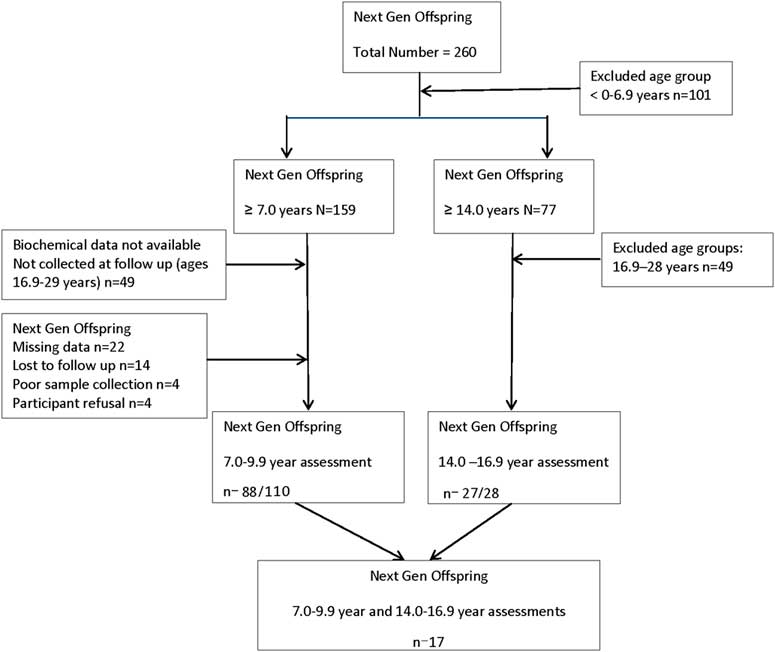
The Next Generation birth cohort (the Next Gen cohort) initiated in 2008 is currently the largest prospective birth cohort of offspring (n=260) in Canada born to mothers and fathers diagnosed in childhood (<18 years) with T2D (Fig. 1). The cohort consists of Manitoba children of First Nation heritage who were born to a parent diagnosed with childhood onset T2D who reside in Manitoba. The diagnosis of T2D in both the parent and the offspring was determined by the clinical pediatric diabetes team using the Diabetes Canada (CDA) criteria, negative antibody testing and associated clinical findings (acanthosis nigricans and overweight/obesity, family history and member of high risk ethnic group). 18
The Next Generation offspring included and excluded from analysis.

Recruitment and retention
Young women and men were recruited during their last clinical visit at age 18 years from the pediatric diabetes team or at the time of pregnancy through the pediatric clinic or the adult diabetes in pregnancy clinic. Young adults recruited who were not pregnant or partners of pregnant women at the time of enrollment were followed via their adult care providers to identify pregnancies amongst participants. Participants were contacted every 6 months after enrollment to monitor their ongoing engagement with the healthcare system for follow-up of their T2D, to update family history and medical histories and to inquire about pregnancy. Retention of the expectant parents or parents and offspring within the Next Generation cohort is supported by longstanding research staff, and clinical and research outreach visits to communities, including community town hall forums to share results to date and support offspring screening. To date, we have retained 82% of the Next Generation cohort overall and 90% of those recruited in the last 5 years.
Clinical assessments
Data were collected annually from the Next Generation participants and includes height, weight and head circumference (until the age of 1), and urine albumin: creatinine ratios from ages 1–7 years. Height and weight were measured using a standard scale and stadiometer (for children ⩾2 years) and an infant board and scale to measure infants<2 years lying. In 2013, additional annual variables were added to the study for children aged 7 years and up, including waist circumference and blood pressure, using an automated cuff. Body mass index (BMI) z-score was calculated (weight (kg)/height2 (m)) using the sex- and age-adjusted BMI cut-points established by the Centers for Disease Control and Prevention (CDC) in 2000 (https://www.cdc.gov/growthcharts/zscore.htm).Reference Kuczmarski, Ogden and Grummar-Strawn 19 BMI groups were defined as normal weight (BMI z-score ⩾−1.64<1.04); overweight (BMI z-score ⩾1.04<1.64); and obese (BMI z-score ⩾1.64).
Samples collected
Urine samples are collected annually from 12 months to 16 years of age to assess for albuminuria. Random urine samples are collected and refrigerated up to 4 h before transfer to Diagnostic Services of Manitoba (DSM) where they are analyzed in the clinical biochemistry laboratory. Venipuncture was done annually starting at age 7 for the offspring. If an assessment was missed the assessment was done with the next annual visit. DNA for HNF1α was collected (at time of first venipuncture) in an EDTA tube and processed by the clinical molecular diagnostics lab of the Winnipeg Health Sciences Centre. In addition, samples were analyzed by the clinical biochemistry service of DSM for HbA1c collected as whole blood in an EDTA tube, aspartate transaminase (AST)/alanine transaminase (ALT)/gamma glutamyl transferase collected in a Heparin plasma separator tube, fasting lipid profile (total cholesterol, low-density lipoprotein, high-density lipoprotein, triglycerides) collected (at time of first venipuncture) in a heparin plasma separator tube, and adiponectin and leptin collected in a serum separator tube. All samples were kept refrigerated (except HbA1c which remained at room temperature) for up to 4 h before laboratory transfer and sample analysis. Other testing included a 75 g oral glucose tolerance test (OGTT) (annually after age 7 years) with baseline glucose, insulin and c-peptide levels and 2 h collection for glucose, insulin and c-peptide. The OGTT samples were collected in lithium heparin tubes, left to sit for at least 30 min to allow clotting, and at 1000 g for 15 min for serum separation. Separated samples were sent to the clinical diagnostics lab of Manitoba (DSM) for analysis.
Biochemical and genetic assessments
Starting at the age of 7 years (7.0–7.5 year range), participants have an HbA1c and OGTT measured every second year. The assessment visits are booked to occur within 6 months of the participant’s birthday. Testing for the HNF1α G319S polymorphism is done at age 7 years. Serum inflammatory markers, lipoprotein profile, ALT, AST, urea and creatinine, and DNA extraction and storage for future epigenetic and analysis is performed at ages 7 years and 18 years. If the participant develops T2D between the ages of 7 years and 18 years they have reached the primary outcome of the study (T2D) and they no longer undergo annual 75 g OGTT testing. Following T2D diagnosis, they are followed only with clinical laboratory testing (HbA1c, AST/ALT and fasting lipid profile).
Ethics and knowledge translation
This study protocol has received annual approval by the Research Ethics Board at the University of Manitoba (Ethics no. HS16516 [H2013:227]) in accordance with the Declaration of Helsinki. In planning the original protocol, broad consultation was achieved with community stakeholders, the Centre for Aboriginal Health Research at the University of Manitoba, and the Manitoba First Nation Diabetes Committee of the Assembly of Manitoba Chiefs. Ongoing collaboration and input from our partners within Nanaandawewigamig (previously known as the First Nation Health and Social Secretariat of Manitoba) continue to inform data collection and interpretation. Annual reports were distributed to the partner organizations listed above and to participating communities using public media and written copies. Individual participants receive a copy of all test results for their primary healthcare team and any diagnostic biochemistry is communicated directly to the parents, to the pediatric endocrinologists at the Diabetes Education Resource for Children and Adolescents (DER-CA), to the community nursing stations and health centers.
Data analysis
χ2 Tests were conducted to compare categorical characteristics and assume independent observations. Continuous characteristics reported with a mean were compared using repeated-measures ANOVA that accounted for the subjects that had more than one visit. Continuous characteristics reported with a median were first fit using the Friedman test, a non-parametric version of repeated-measures ANOVA. When the Friedman test did not have a singular covariance matrix, a Kruskal–Wallis test was used instead. A cross-sectional analysis of anthropometric and biochemical cardiometabolic risk factors of offspring at two separate age groups (7.0–9.9 years and 14.0–16.9 years) are presented (Fig. 1).
Results
Demographics
General description of the Next Gen Cohort
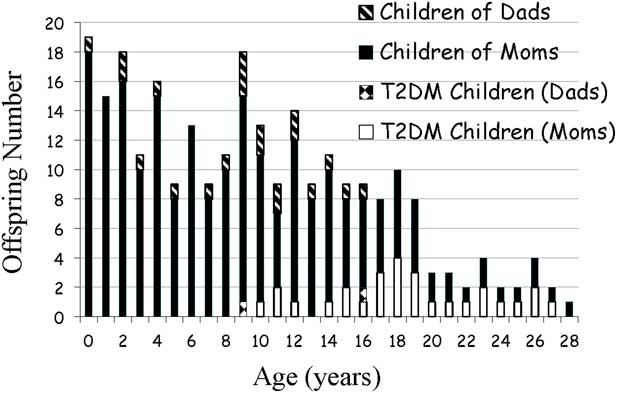
The cohort includes 260 children between the ages of 0–28 years. Of these, 239 (92%) are the offspring of a mother with childhood onset T2D and 8% are offspring of fathers with childhood onset T2D. To date, out of 260, 31 (11.9%) of the entire cohort and out of 239, 29 (12.1%) of offspring born to mothers with T2D have developed T2D (Fig. 2). Overweight and obesity was found to be significantly associated with the development of childhood onset T2D in the offspring [OR 1.7 (95% CI 1.1, 2.5)].
The Next Generation birth cohort offspring by age and type 2 diabetes (T2DM) status.
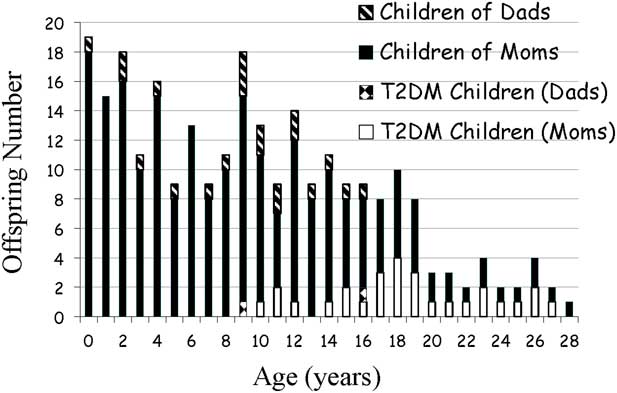
Of those children 10 years of age or greater (n=124), 29 (23.3%) have developed T2D, and in post-pubertal adolescents (16 years and older n=49) 22 (44.9%) have developed T2D. Those who developed T2D the mean age at diagnosis was 11.4 years, and they were more likely to be female (18/29, 62%).
Description of offspring at 7–9.9 years of age and 14–16.9 years of age
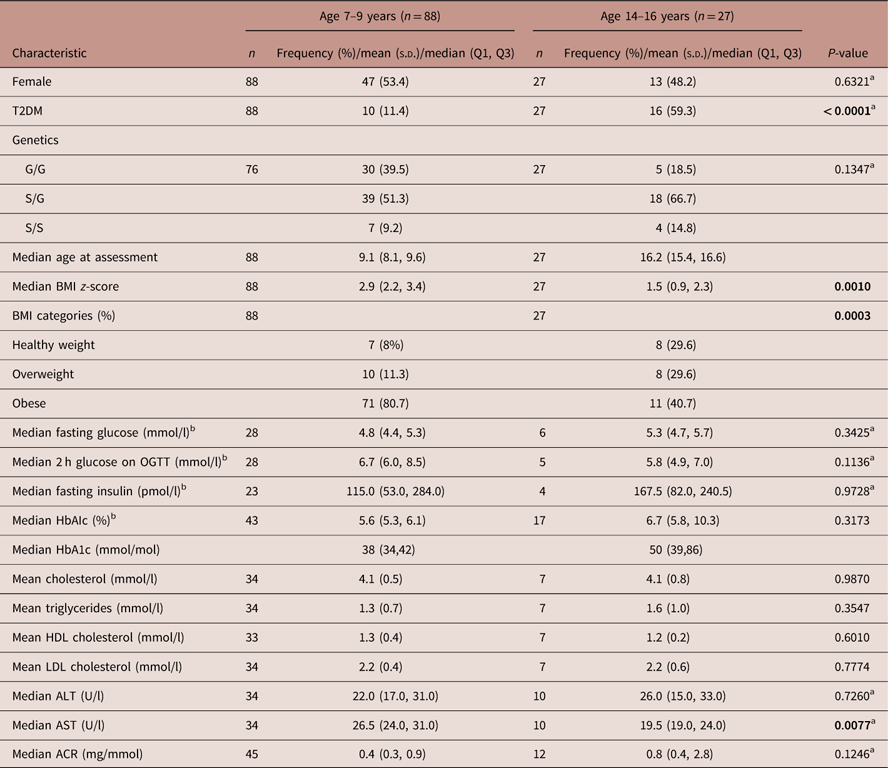
The last available assessment between ages 7 years and 9.9 years and between 14 years and 16.9 years were analyzed. In total 17 individuals had data available for all variables at both time points and were included in both age analyses. There are 88 children (47 female; 41 male) ages 7.0–9.9 years (median age: 9.1), and 27 adolescents (13 female; 14 male) ages 14.0–16.9 years (median age: 16.0) in the Next Gen Cohort. See Table 1 for a description of the cohort at these two age periods.
Mean, median or frequency of the characteristics by age group

T2DM, type 2 diabetes mellitus; G/G, wildtype HNF1α polymorphism; G/S, heterozygous for HNF1α polymorphism; S/S, homozygous for the HNF1α polymorphism; BMI, body mass index; BP, blood pressure; OGTT 75 g oral glucose tolerance test; HDL, high-density lipoprotein; LDL, low-density lipoprotein; HbA1c, hemoglobin A1c; ALT, alanine aminotransferase; AST,- aspartate aminotransferase; ACR, urine albumin to creatinine ratio.
Bold indicates all significant results of P values.
a Dependence between age groups could not be taken into account due to the small number of observations.
b Excludes individuals who have developed diabetes.
Children aged 7.0–9.9 years had a median BMI z-score significantly higher than that of the children 14–16.9 years of age (2.9 v. 1.5, respectively, P=0.001). In the group of offspring 7.0–9.9 years (n=88) 8.0% were normal weight, 11.3% were overweight and 80.7% were obese. In the group of offspring 14.0–16.9 years (n=27) 29.6% were normal weight, 29.6% were overweight and 40.7% were obese. Ten of the 88 children 7–9.9 years of age were diagnosed with T2D (11.4%) v. 16 of the 27 adolescents 14–16.9 years (59.3%). In offspring who had not yet developed diabetes there was no difference in the fasting or 2 h post OGTT, or fasting insulin levels between the two age groups. Similarly fasting lipid profiles did not differ between ages 7–9 years and 14–16 years (Table 1). Older adolescents without diabetes have a higher HbA1c than their younger counterparts although this is not significant. Median AST was significantly higher in the younger age group compared with the older adolescents.
Description of offspring by HNF1α status
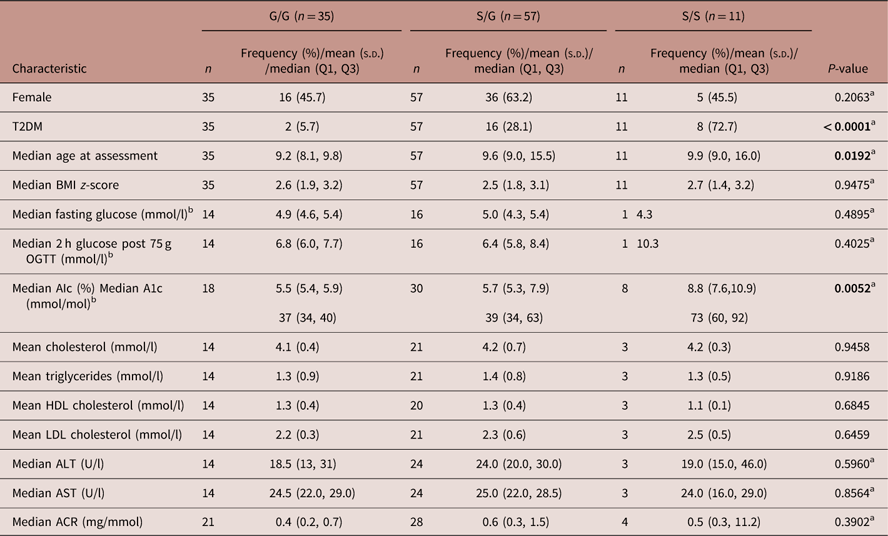
Overall 34% of the cross-sectional cohort carries the wild-type genotype for HNF1α (GG), 55% are heterozygous carriers of one copy of the S allele (GS) and 11% are homozygous for the S allele (SS). Of the 30 participants who have developed T2D, 24 (80%) harbored at least one allele (Table 2). Eight participants (26.7%) had two copies of the allele (S/S), 16 (53.3%) had one copy of the allele (S/G) and two (6.7%) had no copies of the allele (G/G). 100% of the participants possessing the polymorphism are of self-declared Oji-Cree heritage. Furthermore, median HbA1c increased for each HNF1α allele [G/G=5.5% (37 mmol/mol); S/G=5.7% (39 mmol/mol); SS=8.8% (73 mmol/mol)] (Table 2). There was no significant difference identified between HNF1α groups (GG v. GS v. SS) in sex, BMI z-score, fasting lipid profile or hepatocellular enzymes.
Mean, median or frequency of the characteristics by HNF1α genotype

T2DM, type 2 diabetes mellitus; G/G, wildtype HNF1α polymorphism; G/S, heterozygous for HNF1α polymorphism; S/S, homozygous for the HNF1α polymorphism; BMI, body mass index; BP, blood pressure; OGTT, 75 g oral glucose tolerance test; HDL, high-density lipoprotein; LDL, low-density lipoprotein; HbA1c, hemoglobin A1c; ALT, alanine aminotransferase; AST, aspartate aminotransferase; ACR, urine albumin to creatinine ratio.
Bold indicates all significant results of P values.
a Dependence between age groups could not be taken into account due to the small number of observations.
b Excludes individuals who have developed diabetes.
Discussion
We describe a cohort of children at extremely high risk for the development of childhood onset T2D. We are not aware of any other reports describing a group of children at such high risk of childhood onset T2D. As expected, children in the cohort who have developed T2D were more likely to be older and female. Increasing age, both within pediatric and adult populations is a well-recognized risk factor. Though a female predominance in childhood T2D has been consistently described in many populationsReference Amed, Islam, Sutherland and Reimer 20 , Reference Matyka 21 the underlying basis for the sex discrepancy remains unknown. In all children, puberty is associated with a significant decrease in insulin sensitivityReference Houde, Ruchat and Allard 24 and girls typically enter puberty at an earlier age than boys.Reference del Rosario, Ossowski and Knowler 25 Thus, it is possible that the earlier development of puberty in females may play a role in the early peripubertal development of T2D though this remains to be confirmed. In addition, differences in body habitus and adiposity between the sexes may underlay this sex discrepancy.
To date, the vast majority of the Next Gen Cohort are offspring of mothers with childhood onset T2D. Our cohort started to recruit the offspring of young men with childhood onset T2D in 2010 and thus their offspring make up only a small proportion of the cohort and are distributed among the younger children. We predict that the future overall rate of childhood onset T2D will be lower in the offspring of the fathers. In a study from Mexico, offspring of mothers with diabetes demonstrated more metabolic abnormalities than offspring of fathers with diabetes (hypertension, dyslipidemia, obesity) at age 14–15 years. However, type of parental diabetes and timing of their diabetes in relationship to the gestation of the offspring was not described and none of the offspring in this study had developed T2D.Reference Linares Segovia, Gutierrez Tinoco, Izquierdo Arrizon, Guizar Mendoza and Amador Licona 22 In a study from the Pima Indian population, the risk for the development of T2D was significantly higher in siblings born after the mother developed T2D compared with their siblings born before the mother developed diabetes. In contrast, the risk for the development of diabetes in the offspring born before or after the father developed T2D did not differ.Reference Dabelea, Hanson and Lindsay 5
These studies suggest the diabetic environment in utero confers a specific risk to the development of childhood onset T2D. Recent publications provide evidence that maternal hyperglycemia in pregnancy governs obesity risk in offspring and is associated with reduced methylation at loci involved in adipocyte biology and weight regulation.Reference Ruchat, Hivert and Bouchard 23 , Reference Houde, Ruchat and Allard 24 There is also evidence to suggest that intra-uterine exposure to gestational diabetes results in epigenetic modification of genes that predispose offspring to T2D.Reference del Rosario, Ossowski and Knowler 25 , Reference Quilter, Cooper and Cliffe 26 We predict that the rate of childhood onset T2D will be lower in Next Gen offspring of fathers compared to mothers with childhood onset T2D. Longer-term follow-up of the cohort and the recruitment of more offspring of fathers will be necessary in order to confirm or refute this prediction.
As in other reported studies of in utero exposure to diabetes, obesity was found to be significantly associated with the development of childhood onset T2D in the offspring [OR 1.7 (95% CI 1.1, 2.5)].Reference O’Connor, Evans and Burda 27 , Reference Dabelea and Harrod 28 Overall the prevalence of overweight and obesity in the Next Generation Cohort ⩾2 years was very high (89%). Interestingly, the median BMI z-score was higher in the 7–9 year olds compared with the 14–16 year age group despite the higher rates of T2D in the older adolescents. In part, these results may be explained by the increased risk of T2D with age (in particular with pubertal onset) with high rates of offspring overweight and obesity throughout childhood into adolescents. Recent literature supports early adiposity (7 years) as a risk factor for later development of T2DReference Bjerregaard, Jensen and Angquist 29 with persistence of adiposity from childhood into adolescence predisposing the highest T2D risk. A proportion of overweight children (7–9 years) who changed to the normal weight category in adolescence (adolescence) may not have the same protection from cardiometabolic risk as has been reported due to their unique genetic risk (HNF1α) and the impact of in utero exposure to T2D. Indeed we have previously reported that children who harbor the HNF1α polymorphism develop diabetes at a lower BMI z-score than those who do not.Reference Charison, Wicklow, Dean and Sellers 30 This finding in our cohort may suggest that early programming including the impact of early life adiposity may play an important role in the later development of T2D regardless of the degree or duration of obesity. This finding is novel in our cohort of offspring exposed in utero to pre-gestational T2D and suggests that early life interventions which impact growth trajectory and adiposity in infancy have potential to significantly impact future T2D risk.
Similar to mean BMI z-score, mean AST was significantly higher in the younger age group compared with the older age group. We have shown previously that hepatic steatosis is independently associated with T2D in childhoodReference Wicklow, Wittmeier and MacIntosh 31 and that within the normal ranges of AST values in the upper quintile are associated with MRI-derived measures of NAFLD.Reference Saad, Wicklow and Wittmeier 32 We hypothesize that abnormal lipid metabolism resulting in increased adiposity and lipid storage may result in NAFLD which predisposes children to develop T2D.
The contribution of the HNF1α variant to the development of T2D in the Next Gen Cohort appears to be significant. 24 of 26 children in the Next Gen Cohort who have developed T2D carry at least one copy of this variant. Currently, within the population of children with T2D followed in our clinical program, 37.1% of First Nation Oji-Cree children with T2D carry one or two copies of this polymorphism (unpublished data). The higher prevalence seen in the Next Gen Cohort likely reflects in part the over representation of parents (particularly mothers) of Oji-Cree heritage as they were amongst the first children who developed T2D in Manitoba. In addition, as the oldest parents in the cohort are likely to be of Oji-Cree heritage they are most likely to have the oldest children in our cohort which in itself increases the risk of T2D. As the clinical population of children with T2D in Manitoba expands we anticipate the recruitment of larger numbers of participants who do not carry this variant. We anticipate that this will help clarify the relative influence of the variant on the development of youth-onset T2D in our cohort.
The influence of environment on epigenetic modification may explain the additional risk for T2D in children exposed to T2D in utero. Genes that regulate β-cell mass and/or function are differentially methylated in adults who develop T2D compared with adults who do not have T2D.Reference Volkmar, Dedeurwaerder and Cunha 33 , Reference Strawbridge, Dupuis and Prokopenko 34 Altered DNA methylation profiles in offspring exposed to maternal diabetes (either gestational or pre-gestational T2D) have been found to persist to age 13 years and associate with glucose and lipid metabolism.Reference Chen, Piaggi and Trautig 35 Although a number of studies support epigenetic changes as the biologic pathway linking exposure to maternal diabetes in utero and increased risk of childhood onset T2D, significant gaps in our understanding exist. There are currently no epigenetic studies documenting methylation patterns at birth or in infancy and none have looked at the association with childhood glucose and lipid metabolism (early stages of disease). Although the observational data are compelling, the intergenerational risk and the molecular mechanisms underlying the propensity for T2D in children exposed in utero remain poorly understood.
Strengths of the Next Gen cohort include the prospective nature of data collection in offspring born to mothers and fathers who were diagnosed in childhood (and before childbearing) with T2D. We also have a large number of offspring who have developed T2D which allows us sufficient numbers to look at early life risk factors for the later development of disease. We acknowledge that it is not possible to generalize our experience/results to other populations at risk for childhood onset T2D given that our cohort is exclusively individuals of First Nation descent. However, the rates of T2D in our cohort are the highest ever reported and by their nature suggest the importance of developmental origins in the pathophysiology of diabetes in this population.
In summary, the Next Gen Cohort, a birth cohort composed of First Nation offspring of a parent with childhood onset T2D, are at very high risk for the development of childhood onset T2D. We have demonstrated that following this cohort is feasible. The cohort provides opportunities to gain insight and understanding into the risks associated with the intra-uterine environment and early life exposures. The establishment and careful phenotyping of the cohort also provides the framework for intervention studies aimed to prevent or delay the onset of T2D in this high risk population.
Financial Support
This cohort study has been supported by grants from the Lawson Foundation and the Children’s Hospital Research Institute of Manitoba.
Conflicts of Interest
None.
Acknowledgments
The authors would like to acknowledge all the families and communities who have given their time and efforts to this study. The authors also like to acknowledge the vision and leadership of Dr Heather Dean; the nurses in the obstetrical outpatient departments and on the labor and delivery wards for their study support and assistance with data collection. We also acknowledge Jen Schneider who was the long-time research coordinator of this project. Finally we would like to thank our community advisors for the DREAM (Diabetes Envisioned and Accomplished in Manitoba) Research Group, and our First Nations community-based partners working within the health centers and nursing stations for their valuable feedback and insightful perspectives and interpretation of the data. The study would not have been possible without the collaboration of the staff of the community health centers, nursing stations and the itinerant community physicians from the Northern Medical Unit. The authors thank Catherine MacDonald for her ongoing administrative support to the project.