Phoebe Apperson Hearst (1842–1919) was very rich. In 1891 she inherited an estate valued at $18–20 million (tax free) from her husband George, who had made shrewd investments, first in silver and then in gold and copper mining. Phoebe, who had an astute business sense, refused to relinquish the power that accompanied her inheritance to male administrators.Footnote 1 Instead she became, over the next twenty-eight years, a one-woman independent philanthropic foundation, dispensing more than $21 million to charitable causes.Footnote 2
Throughout her life Hearst kept alive the memory of her humble origins in rural Missouri and her limited education barely past the eighth grade, using her fortune to provide opportunities for others that she herself had lacked. When she died in 1919, the press called her “California's greatest woman” and featured page after page of tributes from around the country. Pallbearers at her funeral service in San Francisco's elegant Grace (Episcopal) Cathedral on Nob Hill included the governor, the mayor, one of California's senators, and the presidents of the University of California and Stanford.
Although music constituted a small part of Hearst's philanthropy, it appears as a consistent and important strand throughout her life. She supported individual artists and performing ensembles, staged elaborate private musicales, funded performing spaces, patronized renowned singers and instrumentalists, and provided musical performances for young people and the general public.
Hearst's generous gifts hardly exhausted the fortune she continued to accrue after George's death. During her lifetime, she not only built luxurious estates for herself, but also underwrote—at times reluctantly—the growing newspaper empire of her son William Randolph. In her will, she bequeathed more than enough money to Will to continue his opulent lifestyle, publish his newspapers, build his famous castle in San Simeon, and fund his Cosmopolitan Pictures filmmaking enterprise.Footnote 3
Hearst reserved her most copious outlays for education. She was a prime mover in the budding kindergarten movement, subsidizing schools in San Francisco, Washington D.C., and Lead, South Dakota. She financed the National Cathedral School in Washington for girls grades 4 through 12,Footnote 4 was a founder of the Congress of Mothers (which became the Parent Teacher Association or PTA), and established the first scholarships for women at the University of California, Berkeley, the only campus in existence during her lifetime. Hearst built two buildings at UC (one specifically for women), helped establish the anthropology department and its museum, purchased collections of rare books and portraits, funded scholarly travel and lectures, and much more. In 1897 Governor James Budd appointed Hearst to the UC Board of Regents. She was its first female member.
Hearst's attitudes about the role of music—and particularly opera—in society demonstrate her ambivalent responses to the rapidly changing social structure of her time, and especially to the attenuation of rigid class distinctions. She never hid her attraction to opera's glittering spectacle, one source of its frequent branding as an elitist art. Nor did she have any hesitation about spending thousands of dollars to mount lavish home musicales. But at the same time she was devoted to music's role as an essential component in a liberal education, both in the university curriculum and in the civic realm. Hearst's numerous and varied efforts rarely served as public displays of wealth. Rather, she viewed them as enrichment of the local cultural climate. Music, for Hearst, was not an optional activity, but an integral part of the human experience.
Unlike some other well-known female philanthropists of her time, Phoebe Hearst did not focus her attention on a single cause, whether it be building art collections (e.g., Isabella Stewart Gardner, Arabella Huntington, Abby Aldridge Rockefeller, Gertrude Vanderbilt Whitney), or commissioning new music (Elizabeth Sprague Coolidge).Footnote 5 Instead Hearst spread her wealth widely among diverse areas of personal interest. Her outlays often directly aided the local communities in which she lived or held property and were frequently directed to people she had come to know personally. For this reason, perhaps, her dispersed legacy has not remained as visible as that of others who founded museums or established foundations. In addition, she deliberately maintained a low profile. It is thus all the more urgent for us to examine the contributions of patrons such as Hearst, who substantially affected music's place in early twentieth-century American life but whose role in this process has been eclipsed by those with more public faces.
Caught Between Two Worlds: Phoebe Hearst and the Changing Role of Female Patronage in the Early Twentieth Century
Music, in Hearst's time, was a safe locus for women's philanthropy.Footnote 6 The arts in general, in fact, fell squarely into the female provenance, as women were widely considered the natural purveyors of culture. In this view, the arts constituted a potent force for leveling the economic and social playing field by “raising up the masses” through the cultivation of the “finer things” in life. Support for music and art by wealthy women in the Gilded Age supplemented and reinforced the work of female benevolent organizations, which aided the poor physically through improved housing and health care. The arts, in turn, could nourish them spiritually, intellectually, and emotionally.
Such benevolent institutions began to proliferate in the post–Civil War era and were most effective when women appeared, at least, to operate within their traditionally separate sphere. At the same time, the work of these organizations facilitated a blurring of male and female dominions. In the realm of health care, for example, women could make a mark in the public arena by raising money and approaching politicians and businessmen without, as Mary Ann Irwin puts it, “jeopardizing their middle-class claims to gentility, domesticity, and femininity.”Footnote 7 The charitable organizations thus became women's first inroad to public politics, for their members could help to redistribute local wealth and resources “according to their . . . feminine vision of personal and communal responsibility.”Footnote 8
Patronage of the arts functioned in a similar manner. As an area traditionally associated with women, disbursement of funds in support of music and the visual arts functioned in part as a vehicle by which women could influence the public face of their communities without being seen as overstepping the constraints of their restricted domain.
Hearst supported not only the benevolent associations and the arts, but also the numerous women's clubs that arose at the end of the century. These clubs actively promoted female education outside the academy through lectures and discussion programs. Many of them regularly included musical performances in their meetings.Footnote 9 Such was the case with San Francisco's Century Club, founded in 1888 primarily by female alumnae of the University of California. Hearst—with her eighth-grade education—was the club's first president. Its weekly meetings alternated presentations on art and literature, “practical questions of the day,” science and education, social entertainment, and music. One Wednesday per month was devoted to musical recitals, usually featuring local talent. Surviving programs and lists of activities in the Hearst archive document twenty-five musical presentations from 1889 to 1915.Footnote 10 Representing the Century Club as a delegate to the first national meeting of the General Federation of Women's Clubs in 1890, Hearst was unanimously elected the federation's treasurer.Footnote 11
Hearst also established a settlement house in Berkeley, which aided immigrant families and at the same time provided opportunities for some UC students to develop teaching skills.Footnote 12 Settlement houses typically offered musical instruction and Berkeley's was no exception. Established in 1900, the West Berkeley College Settlement provided practical training for about 250 youngsters. Its skill-based classes included carpentry, gymnastics, sewing, etc., as well as instruction in violin and mandolin. About fifty UC students assisted.Footnote 13
Efforts of this type, however, also show Hearst's Janus-like ambivalence between the old separate spheres model and the New Woman movement of the early twentieth century. While establishing scholarships for women, promoting continuing education through women's study clubs, and contributing to the National Association of Collegiate Alumnae, she also founded Hearst Domestic Industries, an organization that helped UC's female students develop financial independence by cultivating traditional skills such as sewing and needlework. The women sold their work to defray living expenses. To add intellectual stimulation to the project, Hearst hired someone to read to the women while they labored.Footnote 14
Hearst's wealth, as well as her independence as a single woman, allowed her to transcend old models. Yet at the same time she was conditioned, and to a degree constrained, by them. Her scholarships at UC, for instance, were awarded primarily on the basis of need, but secondarily on the “noble character and high aims” of the recipients.Footnote 15 Hearst rarely spoke publicly about her philanthropy (or anything else, for that matter), maintaining a stereotypically quiet female demeanor for which she was repeatedly praised. “She was a silent force for public and private advancement,” read an editorial in the San Francisco Examiner three days after her death, “and her influence was all the more powerful because it radiated so silently from the center of her own wisdom, goodness and selflessness.”Footnote 16 Even on the Board of Regents, Hearst was reticent. “Her life expressed itself in action rather than words,” recalled Regent Charles A. Ramm.Footnote 17
Hearst's attitude toward suffrage reveals the same ambivalence. Although she sympathized with the cause, and privately gave funds to the movement, she objected to what she considered its aggressive tactics. On 28 August 1911, two months before California's men voted on women's suffrage, Hearst wrote to Florence Wattles in response to a request that she publicly endorse the movement: “I feel that the day when woman will vote is sure to come but I have always held myself apart from the organizations that were working for suffrage because the methods did not appeal to me. . . . For that reason I do not wish to allow my name to be used as you suggest.”Footnote 18
A month later Ella C. Bennett, a delegate to the Woman Suffrage City Election Committee in San Francisco, wrote to Hearst asking if she could help raise the $300 needed to defray campaign expenses (equivalent to approximately $7,200 in 2016). Hearst's secretary scrawled in shorthand at the end of this letter an indication to send $150, noting that it was “a good cause for everyone.” A thank-you letter from Bennett confirms that Hearst did send the donation, but also reaffirms Hearst's refusal to publicize her name.Footnote 19 Six days before the election, however, Hearst changed her mind. At a rally on 5 October 1911 at the 4,600-seat Dreamland Rink, which was packed with supporters who overflowed onto the street, a telegram was read at the climactic end to the proceedings: “Mrs. Phebe [sic] Hearst expressed her desire to be included among the active workers for equal suffrage.”Footnote 20 Four days later Metropolitan Opera singer Lillian Nordica, an artist Hearst had supported as early at 1895, appeared in San Francisco's Union Square in an appeal for passage of the suffrage amendment. “I hope and pray that the men of this glorious State of California will set the example to their brothers in the East,” said Nordica, who then sang “America” and the “Star Spangled Banner.”Footnote 21 The vote took place on 11 October 1911. The San Francisco Chronicle set up an information-conveying center at the thousand-seat Scottish Rite Hall to which only women, with or without escorts, could come. Nordica was present. Hearst was not. The city of San Francisco, a politically conservative stronghold in this era, defeated the amendment, but it carried statewide by a slim margin: 50.7 percent to 49.3 percent.Footnote 22 By 1915 Hearst was allowing the use of her name on suffrage literature, and the following year she was elected (in absentia) to serve on the Executive Committee of the California branch of the National Woman's Party.Footnote 23
Several commentators have called Hearst a woman of contradictions who felt compelled to maintain a delicate balance between the old separate spheres model on the one hand and advocacy for women's education and political rights on the other. But Hearst herself, I believe, would have resisted such reductive binary polarizations. Rather, she was savvy enough to realize that in this era of dramatically changing roles for women, she could best serve her progressive goals by publicly planting one foot firmly in the past. By acting strongly but quietly and by overtly supporting both traditional and emerging female role models, she could promote women's educational opportunities while averting critical anti-feminist rhetoric. In this way, Hearst could discreetly dispense her money where she felt it would do the most good. Her support of music follows that effective philosophy, which one admirer at the time of her death aptly called “practical idealism.”Footnote 24
Hearst's Early Opera Experiences
Phoebe Apperson was born on 3 December 1842 in Franklin County, Missouri. She and her family were neighbors of the Hearsts, who were the wealthiest residents of Meramec Township. The Hearsts owned forty-one slaves; the Appersons owned none.Footnote 25 As in her dealings with the suffrage movement, Phoebe Hearst sidestepped political controversy about race but at the same time promoted educational opportunities for African American children and teachers. She did not engage in racist rhetoric, but neither did she overtly challenge the segregated policies of the era. One of her three kindergartens in Washington D.C. was designated for African American children, and she founded a training school specifically for black teachers.Footnote 26
In 1850 George Hearst (1820–91), who was twenty-two years older than Phoebe, went to California to seek his fortune in the Gold Rush. He finally hit pay dirt in 1859 through investment in the Ophir Silver Mine near Virginia City, Nevada. (Later called the Comstock Lode, the mine eventually yielded more than $400 million in ore.)Footnote 27 By the time George returned home in 1860 to visit his dying mother, he and his partners had netted $91,000 (equivalent to about $3.5 million today).Footnote 28 George and Phoebe married on 15 June 1862 and almost immediately left for cosmopolitan San Francisco, where they arrived on 6 November.Footnote 29 Their only child, William Randolph, was born on 29 April 1863.
George and Phoebe were separated for a good part of their married life. He traveled frequently to his mining enterprises in the Sierras, Montana, South Dakota, and elsewhere. She traveled frequently to Europe, several times with Will. Although she begged George to join her, he never did; at the same time, he generously funded her extended travels and her acquisition of art treasures.
Neither George nor Phoebe had much formal education. George attended school for about two years and, even though he eventually became one of California's two senators, his letters to Phoebe are barely literate. Phoebe, in contrast, continually sought to educate herself. During her early years in Missouri, she walked three-and-a-half miles to reach a one-room schoolhouse. After completing the eighth grade, she had an additional year or so of training at the Steeleville Academy operated by the Cumberland Presbyterian Church.Footnote 30 She was then hired as tutor and governess for the daughters of the James family in Phelps County, where she continued her education in a rather haphazard manner. It was here, for example, where she first began to learn French.
It's not clear when Phoebe Hearst heard her first opera, but it certainly was within her first three years in San Francisco. On 2 July 1865, she wrote to her former nanny Eliza Pike: “There was a splendid opera troupe at the ‘Academy of Music.’ We went six or eight nights (not in succession), saw the best operas. I enjoyed it very much.”Footnote 31 This Academy of Music was a new opera house opened by Thomas Maguire only one year previously. A rather shady operator who eventually built twelve theaters throughout California, Maguire opened his first establishment in San Francisco in 1850.Footnote 32 Hearst may have attended some performances at his second venture, Maguire's Opera House on Washington Street, but her letter to Pike refers to a much more elegant venue: the Academy of Music on Pine, inaugurated in 1864.Footnote 33 During the month before Hearst's letter to Pike, Maguire's Italian Opera Troupe performed six different operas there: Verdi's La Traviata, Nabucco, and Un Ballo in Maschera; Rossini's Barber of Seville; Donizetti's Lucrezia Borgia; and Flotow's Martha. If Hearst indeed went six to eight times, she may have seen them all.
Hearst's training in music was hardly extensive, but she did develop some skill on the piano before moving to California. Cora M. Older notes that when George returned to Missouri in 1860, he found a young woman astonishingly cultured considering her rural upbringing. “Though she had been brought up in the log-cabin country she could play the piano,” wrote Older. “She stammered French. She was eager to learn. She used to hold a book in her left hand and churn with her right.”Footnote 34 Older cites no source for this information, but it likely came from Will. Kathryn Hearst similarly writes that Phoebe learned “proper French and piano—two disciplines she enjoyed throughout her life” while she served as governess in the James home.Footnote 35 Hearst's interest in the piano is also reinforced by an inventory documenting the furnishings of her elegant home on Chestnut and Leavenworth Streets on San Francisco's Russian Hill. Listed in the inventory are a “Debain piano” (built by the Paris instrument maker, Alexandre-François Debain, 1809–77) and “12 boxes of music.” The inventory is undated, but the Hearsts only lived in this house from 1864 to 1866, precisely the years in which she attended operas at Maguire's Academy.Footnote 36
Once she experienced opera in San Francisco, Phoebe Hearst was hooked. In 1873–74 she took an eighteen-month trip to Europe with ten-year-old Will in tow. Everywhere she went, she attended operas.
In June Hearst went to London's Covent Garden several times, where she saw Christina Nilsson, Zelia Trebelli-Bettini, and Adelina Patti.Footnote 37 On 21 June she attended a special performance there sponsored by the Queen in honor of the visit of the Shah of Persia.Footnote 38 The performance was apparently a collage: Adelina Patti sang the shadow scene, “Ombre légère,” from Meyerbeer's Dinorah, and the Canadian soprano Emma Albani sang the mad scene from Thomas's Hamlet and selections from Gounod's Faust. The Shah recounted the event in his diary: “They had sent expressly to Paris and had called from thence Patti,” he wrote. “She sang most exquisitely. She accepted a fabulous sum of money, and came to London. There was another also, Albani by name, from Canada in America, who sang extremely well.”Footnote 39
In August Hearst attended concerts and operas in Dresden. September found her enjoying an opera and two concerts in Vienna and then two operas in Munich. By November she and Will were in Milan, where they saw Bellini's Sonnambula, which she said was “good but not as good as London.” In December they heard concerts and operas in Florence, and early in 1874 they went to Paris, which offered similarly enticing fare.Footnote 40
Hearst never tired of attending operas. In later years she frequented the Metropolitan Opera whenever she was in New York and bought tickets for many friends as well. And at least twice she went to Bayreuth: in 1889 she saw Tristan and Parsifal; in 1908 she apparently saw the entire Ring cycle.Footnote 41
Washington D.C. and Lead, South Dakota: 1886–96
In 1886 George Hearst was elected as a U.S. senator by the California state legislature.Footnote 42 He and Phoebe moved to Washington where they purchased, and then thoroughly remodeled, a mansion at 1400 New Hampshire Avenue, NW. Phoebe easily integrated into Washington's high society; her receptions and parties became renowned. After George died she maintained this residence until 1902, when it was sold to the Italian Embassy. She also took two more trips to Europe (May–December 1892 and spring 1895). On the first occasion, she was present at an invitation-only opera production in Seville attended by the Queen.Footnote 43 On the second, she appeared at the lavish wedding of the Duchess of Marlborough and Lord William Beresford on 30 April 1895 and met Queen Victoria on 8 May. Her calendar records a London visit filled with musical activities and provides early evidence of her interest in supporting female composers. Included in her agenda were performances of music by Mary Grant Carmichael and Cécile Chaminade: “May 21: visit to the Royal Mews, concert; May 28: concert at Bridgewater House; June 2: music and tea at Mrs. Carmichael; June 7: concert of Mlle. Chaminade.”Footnote 44
Perhaps the most extravagant musical events Hearst ever presented took place in Washington shortly before this 1895 trip. On 19 February approximately two hundred guests came to her home to honor Florence Bayard, daughter of the U.S. Ambassador to Great Britain and later an active suffragist and chair of the Delaware Branch of the National Woman's Party.Footnote 45 Hearst hired two renowned singers who were on tour with the Metropolitan Opera, Lillian Nordica and Pol Plançon. Both had sung in Lohengrin in Baltimore the night before and were scheduled to repeat the performance in Washington on the twenty-first. But neither was on the roster for 19 February, allowing Hearst to hire them for this special private event.Footnote 46 She followed this opening gambit by an even more extraordinary musicale a week later, also honoring Bayard. On 26 February, Hearst presented a “rococo concert” evoking the 1770s. Guests and musicians all came dressed in eighteenth-century costumes. She hired Anton Seidl (conductor with the Metropolitan Opera and the New York Philharmonic), a twenty-piece orchestra, soprano Lillian Blauvelt, pianist and composer Henry Holden Huss, and others. According to the Washington Post, the piano had been built in Salzburg in 1760 and played by Haydn.Footnote 47 The press described the event in excruciating detail. An article even appeared in the Chicago Herald accusing Hearst of elitist extravagance. In a rare public statement, she responded angrily to the editor, “The inference . . . that the requisite costumes were so costly as to preclude the attendance of none but millionaires and the statement that the Musicale involved an expense of the considerable sum of $15,000 are both far from the truth. . . . Its cost was . . . not nearly as much as the sum mentioned in your paper.”Footnote 48
George and Phoebe gave away a great deal of money during their time in Washington. According to Cora Older (admittedly a biased source), George delighted in responding generously to the “begging letters.”Footnote 49 After his death in February 1891, Phoebe, now in control of the fortune, increased the philanthropy and directed it to her own ends. In September of that year she gave $1,500 to the University of California to establish five $300 scholarships for women, an amount sufficient for them to study without assuming outside employment. The following year she increased the number of scholarships to eight. (These $300 scholarships continue to the present day. The recipients are playfully known as Phoebes.) From 1891 to 1896 Hearst also donated $17,000 to build a sea wall to protect Mount Vernon; established her three kindergartens in Washington; offered $175,000 to build the National Cathedral School; began her settlement house in Berkeley; and funded free libraries or reading rooms in Anaconda, Montana, and Lead, South Dakota, sites of lucrative mines she now owned.Footnote 50
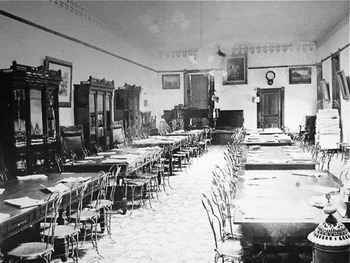
Lead (pronounced Leed) is the seat of the Homestake Mine, the largest gold mine in North America. The town already had a thousand-seat auditorium (traditionally called an opera house) in its Miners’ Union Hall when Hearst first visited her lucrative property in August 1894. She decided to open a free library on the building's top floor, to which she donated not only books and furnishings, but also a new Steinway parlor grand piano, which was shipped from the east coast and arrived in February 1895 (Figure 2).Footnote 51 Her donation carried with it a call for semimonthly musicales as part of her plan for general civic education. Librarian-pianist-singer Mary Jane Palethorpe Ferrie (1865–1946) began presenting these concerts in January 1895, even before the new piano arrived.Footnote 52 The Lead Evening Call records eight performances in the first half of that year, featuring local talent: vocalists, pianists, guitarists, a small orchestra (probably a dance band), and a local youth band, which may have been organized as a response to Hearst's gift.Footnote 53 Lead's citizens enthusiastically embraced Hearst's attempts at community “uplift.” According to newspaper reports, the library, which could accommodate an audience of a hundred, was packed and numerous people were repeatedly turned away. There were so many interested auditors, in fact, that for the later concerts, Ferrie gave first priority to those who had not previously attended. Whether the musicales ceased after June 1895 or the newspaper simply stopped reporting them is unclear, but no further citations appear in the paper during Ferrie's term as librarian, which ended in June 1896. The piano was eventually moved into the kindergarten facility (which Hearst also subsidized). The kindergarten room also served as the meeting space for a Ladies Auxiliary, whose semimonthly meetings included musical performances (thanks, no doubt, to Mary Ferrie). As with other links between benevolent societies and musical philanthropy, the Auxiliary used music to help needy miners: a benefit concert in 1911, for instance, raised $200.50 for a destitute family; the husband, with a broken back, was on death's door; the wife was caring for five children.Footnote 54 Hearst, for her part, does not appear to have resented the disbanding of the musicales. She continued to actively encourage Lead's cultural life, maintained an active correspondence with Mary Ferrie (later married to mine superintendent T.J. Grier), and later funded a thousand-seat opera house that opened in 1914.
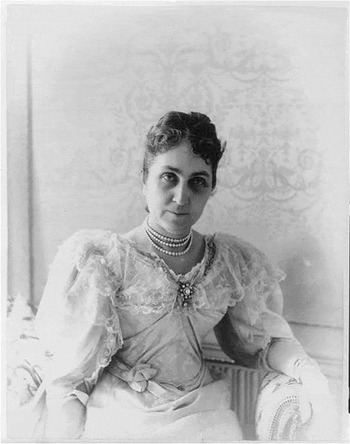
Phoebe Hearst in 1895. Photograph by Frances Benjamin Johnston. Library of Congress, Prints & Photographs Division (reproduction number LC-USZ62-70333). See http://www.loc.gov/pictures/item/2001704044/.

Hearst Free Library and Reading Room in the Miners Union building, Lead, South Dakota. The library opened on 25 December 1894 and hosted musicales for at least the next six months. Phoebe Hearst funded the building, furnishings, artworks, books, and the new Steinway piano seen at the far end of the room on the small stage. Courtesy of the Historic Homestake Opera House; Homestake Mining Company.

Although the grandiose events in Washington and Europe may seem at odds with the unpretentious library concerts in Lead and the $300 scholarships at UC, Hearst herself would likely not have seen them as contradictory. Kathleen McCarthy, among others, links the typical grand tour by wealthy women (“a necessary badge of social acceptability”) to their philanthropic work, as these women “did their best to reproduce cultural bastions of the Old World on American soil.”Footnote 55 Hearst could import from her European ventures both physical and non-physical cultural artifacts, presenting them to Washington society in one form and to the miners’ families in Lead in another. In the process, she also satisfied her own needs, enjoying the pleasure she derived from her grand affairs and from the expressions of appreciation she received from those who benefited from her outreach.
The Pleasanton Hacienda and Hearst Hall, University of California
In 1896 Hearst moved back to northern California, into a newly built fifty-room mansion on a 2,000-acre estate in Pleasanton (about thirty-five miles southeast of Berkeley), which she called the Hacienda del Pozo de Verona after a fifteenth-century well-head she and Will had brought back from Italy. The sumptuous new quarters gave her the opportunity, over the next two decades, to extend a hospitable hand to the community. In 1898, for example, Hearst hosted the entire graduating class from UC. In May 1912, she housed and fed 350 YWCA women who camped out on the Hacienda grounds for their annual ten-day conference after the location they had booked burned down. Hearst equipped the site with seventy-three tents; installed electric wiring, pipes for running water, and sanitary drains; patronized local farmers for food supplies; and frantically sent her staff to buy as many umbrellas as they could locate when it unexpectedly rained. The next year, Hearst helped fund a permanent retreat for YWCA women in Monterey (called Asilomar), designed by Julia Morgan.Footnote 56 (Morgan was later the architect for Hearst Castle.)
Phoebe Hearst entertained numerous visitors at the Hacienda, many of whom spent weekends there as her guests. Musical dignitaries visiting San Francisco often found their way to her estate. In 1903, for example, she hosted a dinner for composer Pietro Mascagni and his wife. In 1911 she welcomed Marian MacDowell, who had embarked on a lecture tour to promote the establishment of the MacDowell Colony.Footnote 57 Mascagni and MacDowell were but two of the many well-known musicians Hearst encountered through her influential position in San Francisco society. In 1915, for example, as honorary president of the Woman's Board of the Panama-Pacific Exposition, she met with Amy Beach on 22 May and Camille Saint-Saëns on 3 June. Both had been commissioned to write music for the fair: Beach the Panama Hymn and Saint-Saëns the grandiose Hail California for chorus, orchestra, and band.Footnote 58
Hearst's visitors to the Hacienda were frequently treated to performances in her elegant music room. Margaret Calder Hayes (class of 1917) spent a weekend there with her husband during World War I. Atypically, there were only fifteen–twenty invitees for dinner that night. After the meal “a guest arrived who was also a professional pianist being befriended by Mrs. Hearst. He played Chopin and Mozart until 10 o'clock, when Mrs. Hearst arose, bowed graciously, said goodnight, [and] wished us all happy dreams.”Footnote 59 Tales like this one document Hearst's habit of arranging music for small gatherings, providing local musicians with small jobs that helped them earn extra income and gain performance experience.
In 1896, the year Hearst moved into the Hacienda, she wrote to the UC Board of Regents offering to sponsor an architectural competition to develop a comprehensive building plan for the campus.Footnote 60 Headed by architect Bernard Maybeck (who was virtually unknown at the time), the competition assumed international proportions. The selection committee reviewed 105 anonymous applications in Antwerp in 1899 and then invited the finalists to Berkeley to assay the site. As the competition advanced, Hearst moved temporarily into a home on Piedmont Avenue to be near the campus activities, and she had Maybeck design an adjoining building, which was used for receptions for the visiting jurors and university and government officials.Footnote 61 Hearst planned, however, to dedicate this building to the women students and have it moved onto campus after the competition was completed. Indeed, the new building, Hearst Hall, served for years as a center for women, both before and after its physical relocation. Opened in time for the fall semester 1899, it hosted musical performances and art displays, included a gymnasium and study spaces, and served as a facility for social events.Footnote 62
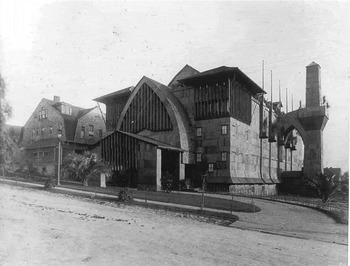
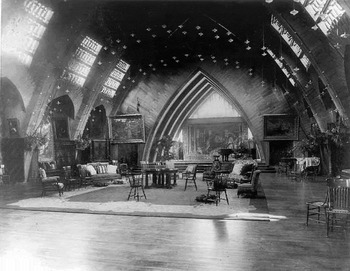
Hearst Hall (Figure 3) was a unique and striking space, a “bold concept that employed laminated arches and diaphragms to create sections of the building as independent, movable, and easily re-assembled units.”Footnote 63 The design featured twelve wooden arches that rose fifty-four feet above the ground floor. The stunning room that hosted the musical performances (Figure 4) contained a stage and a grand piano and could seat nine hundred.
Hearst Hall in Berkeley before its move onto campus. It opened in fall 1899 and hosted Hearst's series of musicales from 1900 to at least 1903. On the left is the house Hearst lived in ca. 1899–1901. http://pe.berkeley.edu/history/facilities.php. Courtesy of the Bancroft Library, University of California, Berkeley.

Hearst Hall interior, downstairs: the social area, where the musicales were held. Courtesy of the Bancroft Library, University of California, Berkeley.

In January 1900 Hearst inaugurated the new building with a series of nine formal musicales, presented weekly from 21 January to 18 March. Groups of students received printed invitations to which they were expected to respond. Hearst encouraged faculty and community members to attend as well—and many did. Sometimes she presented excellent local talent. But if renowned performers—especially opera singers—were resident in San Francisco, she brought them to her series. In March 1900, for example, soprano Johanna Gadski, baritone David Bispham, and conductor/pianist Walter Damrosch presented a two-week-long series of concerts and lectures in San Francisco illustrating Wagner's operas. Hearst brought Bispham to Berkeley on 11 March and Gadski on 18 March. They performed lieder, opera arias, and English songs, and both included pieces by Damrosch: Bispham sang “Danny Deever,” which he had premiered in Philadelphia in 1897; Gadski sang “Sick Child” and “My Wife.”Footnote 64 Hearst was at the time president of the San Francisco Symphony Society (SFSS), an organization dedicated to establishing an ongoing professional orchestra in the city. In this role, she funded a bonus event in San Francisco to augment the trio's dozen local appearances. On 20 March Damrosch conducted the SFSS orchestra with both singers in the 4,000-seat Grand Opera House. Reviewers greeted the concert with enthusiasm, although they speculated that Hearst would have to make up a financial deficit. Perhaps as a consolation prize to English violinist Henry Holmes, the regular conductor of the SFSS, Hearst also brought his string quartet to Berkeley, where they performed on the same musicale series.
In 1901 Hearst Hall was moved onto campus and officially turned over to UC. Student Muriel Eastman, who spoke at the dedication ceremony on 9 February, linked the arts with “character,” and although she underscored the importance of female education in general, she also sounded the familiar trope that women shouldered the responsibility for culturing their communities. “Whatever else a woman may be,” said Eastman, “if she is to live up to her high calling as a woman, she must be cultured, and she must get this culture in college if she does not have it when she enters. Culture must color her feeling for art, for books, for music, and, most of all, for character. . . . We girls are responsible for this atmosphere of culture in college—for creating this feeling for the best that is thought and known in the world. Hearst Hall will help us create this atmosphere.”Footnote 65 Eastman's words could well have served as Phoebe Hearst's own credo.
Thereafter, Hearst moved back into her Pleasanton mansion, but she continued the musicales at least through 1903, making a point of appearing at them and greeting the students personally. Her attention to the students through these local musical events is particularly noteworthy because during these same years Hearst also continued to live part-time in Washington, where she presented occasional musical evenings on a much grander scale. (One, on 16 February 1901, featured Fritz Kreisler.)Footnote 66 For several UC musicales, Hearst hired singers from the Metropolitan Opera, which visited San Francisco in 1900, 1901, 1905, and 1906 (the last visit cut short by the disastrous 18 April earthquake and fire).Footnote 67 In November 1901 Hearst brought three operatic programs to Berkeley. In the first, Damrosch talked about Parsifal, still largely unfamiliar to U.S. audiences, as its first fully staged production outside of Germany would not take place until 1903. Illustrating the opera at the piano, Damrosch directed his groundbreaking talk specifically to students of music history. The second musicale featured Bispham again, this time with contralto Ernestine Schumann-Heink. At the third, soprano Suzanne Adams performed with baritone Antonio Scotti.Footnote 68
Among the most renowned artists to appear on the Hearst musicale series was Edward MacDowell, who presented a series of concerts in San Francisco in 1903 and came to Berkeley on 18 January as part of Hearst's six-concert series. He played many of his own piano works and accompanied a contralto in five of his songs.Footnote 69
The students for the most part recognized the extraordinary educational opportunity Hearst was providing for them. Years later Eleanor Stanley Smallwood recalled the “rare privilege” she enjoyed. “Only a few of the students could have afforded to buy tickets for grand opera or concerts where these artists could be heard,” she wrote. “I am afraid that many of the students were ignorant of even the names of some of the performers, for most students had neither the time nor the money to follow great musical events.”Footnote 70
Some students, however, exhibited less than admirable behavior. In February 1900, student body president Fred Dorety castigated his classmates. Only about half of them had responded to Hearst's invitations. Some sent regrets but attended anyway. At the first concert in 1900, designed for frosh, many seniors appeared. But what hurt Hearst the most, said Dorety, was that some invitees had disrespectfully given away “their cards to other students and even to outsiders who have made use of them. . . . Worse yet, a certain student boasted to a friend of Mrs. Hearst that he had six times thus cheated his way into the receptions and concerts and had each time, as he expressed it, ‘got a feed.’”Footnote 71
The problem didn't end there. During the following year's series, a “small-sized scandal” broke out when a large number of bogus tickets were discovered after the Bispham–Schumann-Heink recital.Footnote 72 (Hearst had invited half the students—about 1,100 people—to this concert and the other half to the Adams–Scotti performance the following week.) At the same time, this little scandal highlights the attraction of these concerts to the undergraduate population.
These minor problems, however, are far outweighed by the number of letters of appreciation Hearst received from students and faculty alike. On 2 February 1900, for example, Alexandra Adler noted the effect of the musicales not only on her education but also on her self-esteem. “The unaccustomed interest that you, dear Madam, and [UC] President [Benjamin Ide] Wheeler are taking in the student body, is causing us to take renewed interest and pride in ourselves,”Footnote 73 she wrote. Hearst scrawled on this letter: “Many such letters come to me and I feel that the young people really do appreciate the good music every Sunday afternoon.” Good music in this context of course reflects a common perception of the time that concert attendance and exposure to the classical repertoire could help mold productive citizens. The recitals were just one of Hearst's efforts to use music in service of this “elevating” goal.
To students who responded, Hearst was not only pleased, but also exceptionally generous. One woman regretted not being able to attend because she lived far away, taught at night school, and was obligated to prepare Sunday dinners for her family. Hearst jotted on this letter an instruction to her secretary about how to respond: “I hope you will be able to come and meet me at one of my musicals,” she wrote, “and wish you would allow me to send someone to cook the dinner once or twice. Deserves great credit for her brave struggle and care of others.”Footnote 74 Whether Hearst ever sent a cook to Ms. Walcott's family is not recorded here.
Hearst Hall not only provided a locale for programs of music and lectures, but also housed a state-of-the-art gymnasium on its upper floor, as well as eating facilities where the women could meet for lunches and teas. (Hearst funded tea and sandwiches for seven- to eight-hundred women every afternoon at 5.)Footnote 75 It also offered quiet rooms where they could read and study. The linkage of music and sport in the same facility characterized other Hearst projects as well. The opera house she later built in Lead, South Dakota, for example, was part of a structure offering recreational spaces, including a large swimming pool. Hearst's philosophy might have been simply to cultivate both body and mind, but it also suggests a more all-encompassing creed that dates back as far as Plato, who linked music and gymnastics as the two essential activities that moderated the soul and created an orderly and harmonious nature.Footnote 76 Hearst's sentiments ran along the same lines. Both exercising the body and cultivating the mind were, to her, essential components of molding character.
In 1922 Hearst Hall burned down (oily rags near the stage led to spontaneous combustion). Phoebe Hearst was no longer alive, but son William responded immediately, offering to erect a new, fireproof building.Footnote 77 The present Hearst Gymnasium opened in 1927, but the old balance between culture and sport was lost. The new building is simply the women's gym.
Hearst's Musical Support for Individuals
Almost anyone in San Francisco wishing to raise money for educational projects in general, and cultural events in particular, contacted Phoebe Hearst. Her surviving incoming general correspondence fills twenty-seven boxes (forty-six full reels of microfilm) at the Hearst archive at UC Berkeley's Bancroft Library. And the correspondence is only a small part of its holdings. Another fifty-three boxes contain business papers, programs, clippings, household files, club materials, and much more.Footnote 78 Furthermore, this enormous cache of documents represents only a small portion of those left at the time of Hearst's death. Her secretary Adele Brooks sorted through twelve trunks of papers and tossed out three-quarters of them.Footnote 79 Because Hearst had secretaries reply to most of her letters, many of them are annotated with the date on which they were answered and a fair proportion contain Hearst's notes about how to respond.
Hundreds of surviving letters ask Hearst to endorse various projects. Among the four-hundred-plus letters I discovered regarding music, more than sixty ask for direct support: inviting her to concerts, soliciting patronage, requesting in-person auditions, seeking help in securing engagements, or simply begging for money. In 1912, sixty-two-year-old composer Richard Lucchesi asked for a loan of $2,000 (ca. $48,000 in 2016) to have his opera Marquise de Pompadour mounted in New York.Footnote 80 Composer/pianist Ashley Pettis also sought a loan, in this case to study in Europe.Footnote 81 One of the most outrageous letters came from singer W. A. MacDonald. “Possessing rare temperament, dramatic and sympathetic tones, magnetism and other excellent qualifications,” he wrote,
I have returned from the studies with [many teachers, whom he names]. . ., each one . . . assuring me that the possibilities of the strong natural baritone voice that I own were limitless. . .. Supposing I have this wonderful treasure, untrained, and supposing I am now working at office work seven nights a week, and supposing I know what I could do with my voice if I had the chance and supposing it takes years of study, and I am compelled by circumstances to work hard with no time for studying, can you blame me for writing to you, one of the Grand Women of California to ask what is there existing to help one like myself if proven worthy.
The letter continues at length in the same vein. Over MacDonald's signature, Hearst wrote simply, “Impossible.” But even this letter received an answer.Footnote 82
Hearst did not honor the requests from Pettis, Lucchesi, or many others (although she did buy five tickets to Lucchesi's fund-raising concert in Los Angeles), saving her support for those she knew and respected, or at least those recommended by trusted sources. Her most frequent response to concert invitations was to order about a half dozen tickets, even if she did not plan to attend. Some artists used the ploy of sending her tickets in advance; she would usually send payment.
Hearst was especially responsive to women who showed talent and initiative. One example is composer Cecil Cowles (1893–1968), who wrote to Hearst about a recital of original compositions on 22 November 1910. Hearst sent $5 (equivalent to ca. $120 in 2016) even though she didn't know Cowles, who later moved to New York and composed songs, piano works, a piano concerto, and even an opera.Footnote 83
Over the years, Hearst supported several young female performers for European music training. Most of them did not become professional musicians, but Hearst apparently felt that spending a year or two in Europe honing their musical and foreign language skills was part of a sophisticated education. In a rare explanation of her aims, she expounded to the mother of one of them her objectives—which were only in part practical. More important to Hearst were character development and personal fulfillment. These sentiments took root long before George's death and prior to Hearst's proactive advocacy in support of women's education. On 17 August 1886, she wrote to the mother of Ada Butterfield (1860–1936):
I believe that leaving out any consideration as to the motives that prompt one to work, the training and influence coming from well directed effort to learn a business are calculated to strengthen the character, ennoble the life, [and] benefit society as well as the individual.
The best life results come from training young people in the direction of their tastes and worthy predilections, and it seems to me that if a daughter greatly desired to fit herself for a special vocation, it would be an indication of how I should plan for her. . . .
Ada's natural ability and enthusiasm, partly directed into channels of useful productive occupation, would make her a happier girl, and the times of her home-staying would be fuller of cheer to you all.Footnote 84
Hearst supported Butterfield's study in Germany and France for about three years, starting in March 1890. Ada played the guitar (which she continued to study in Europe), began taking voice lessons, and attended operas (including the Bayreuth festival in 1891). In fall 1893 Butterfield met William Carey Jones (1854–1923), founder and first director of the School of Jurisprudence at UC, who proposed marriage to her.Footnote 85 Butterfield, in Paris at the time, was more-than-a-little torn about giving up her European sojourn. In fact, she had become so closely tied to Hearst that she even feared Phoebe's anger at her engagement. On 13 February, she wrote Hearst a soul-searching letter, quoted here only in small part:
I consider now, I have forfeited the right to remain in Europe, but do not feel that I have done anything to lose the love and respect of my dearest friend, my benefactress, my guardian angel for many years, and therefore hope and trust that my home can still be with you, until I become the wife of this good man. . . .
My dear friend, should I not join you in Washington, and thus cut off this expense in keeping me in Paris? . . . Can I not be a comfort to you in some way? . . . But, oh! you do not feel Ada is unworthy of further consideration? No, you would not think that, and in all of our prospective arrangements you have never said [“]do this or that, Ada,[”] with the condition that you will never marry. No, my dear ‘Phebe’ friend has no such arbitrary elements in her nature. . . .
[Prof. Jones] feels that I am making a sacrifice in accepting a man of his modest means, although he understands I am penniless, and have nothing whatever in the world but that which your love has given me. . . .
My dear friend will you not write me little letter and tell me you do not consider me a traitress [sic], an ingrate, but that I have your wishes to do as my heart dictates. . . . I have conflicting emotions: love for a worthy man, who wishes to make me his wife, love and gratitude for a dear woman who has bestowed abundant love and kindness upon me.Footnote 86
Phoebe apparently reassured Ada, who married Jones and remained in close touch with Hearst for many years thereafter.
As Caroll Smith-Rosenberg demonstrates after widespread examination of women's diaries and correspondence during the nineteenth century, such avowals of love between women were common, a direct outgrowth of rigid gender-role separation and the emotional segregation of the sexes. Single-sex female networks with institutionalized social conventions and rituals helped women develop a sense of security and self-esteem. In fact, notes Smith-Rosenberg, nineteenth-century U.S. society did not place taboos on close female relationships, but rather recognized them as socially beneficial. She argues that heterosexual, rather than homosocial ties were the ones inhibited by society.Footnote 87 We will likely never be able to ascertain the exact relationship between Hearst and Butterfield (or any of her other female protégés), but it is clear that Hearst herself needed such close female companionship. Throughout her life, young women resided at her various homes and benefited both financially and emotionally from her generosity.
At the same time, Hearst occasionally withdrew support if the recipient did not make the best use of her philanthropy. A particularly well-documented case is that of Gladys Worden, whom Hearst supported for more than two years for voice study in Paris beginning in the summer 1900. Fifteen months after her arrival, Worden requested an extension, which Hearst granted. Apparently Worden made little progress, however. In 1905, now back in the San Francisco area, she again requested support from Hearst, who agreed to a meeting but instructed the secretary to respond “that I cannot aid her in her plans for future study. This is positive and final.” When Worden persisted, Hearst annotated her next letter angrily:
Send a typewritten letter. Use very plain language. Instead of dreaming, she should go to work to help herself and family. Do something useful. . . . She is not artistic. . . . When I think of all the worthy people who have suffered and still suffer for the ordinary necessaries of life and she complains of not having gained a place in the musical world. The truth is she has not the ability to do the things she constantly expresses a wish to do.
When Worden contacted Hearst again in 1908, Hearst wrote to her secretary: “This incapable is still alive. I will not write to her.”Footnote 88
One woman Hearst supported for years was Janet Peck, whose mother had befriended Hearst on the ship that originally carried her to San Francisco in 1862. Peck's voluminous correspondence is preserved in the Hearst archive, and some of Hearst's responses are saved at the Huntington Library. Hearst also unstintingly supported Janet's brother—the painter Orrin Peck, one of Will's closest friends—and their sister Helen.Footnote 89
Peck traveled to Europe several times at Hearst's expense and finally settled permanently in London at the turn of the century. For a time in 1885 she studied at the Munich conservatory and eventually achieved enough success as a singer to be cast in the title role of Gounod's Mireille in Mühlhausen for three performances in April 1911.Footnote 90 In Munich and London Peck took advantage of an extraordinary range of musical offerings and met members of the musical society. Among her close acquaintances was pianist Sara Carr, sister of composer Mary Grant Carmichael. Carr had moved to London from San Francisco in the 1890s. She was also a recipient of Phoebe Hearst's generosity both for herself and her son (who pursued art studies in Paris).Footnote 91
Among the most musically successful individuals Hearst supported were violinists Sigmund Beel (1863–1953) and Hother Wismer (1872–1946), and bass Putnam Griswold (1875–1914)—all of whom had San Francisco connections. Beel was a prominent Bay Area violinist; Hearst funded his European training, primarily in London, beginning in 1897. The Hearst papers contain more than eighty letters from Beel reporting on his studies and performances from 1897 to 1910. After Beel returned to San Francisco in 1910, he formed the Beel string quartet, which performed widely in the city and at Hearst's Pleasanton estate.Footnote 92 Three years later Beel became concertmaster of the Los Angeles Symphony (not the Philharmonic, founded a decade later).
Wismer, who came to the United States from Denmark with his family in 1883, also had a respectable performance career. Hearst supported him for three years in the 1890s for study in Berlin. “Oft times when I stand here in my studio and play Bach Sonatas or a work of Beethoven or Mendelssohn,” he wrote to her in 1912, “I think of the splendid years I spent in Berlin in 1894–1897; precious memories inspire me and fill me with . . . feelings of deepest gratitude to you who bestowed this great gift upon me.”Footnote 93 Wismer returned to Europe several years later to study with Eugène Ysaÿe and then came back to San Francisco,Footnote 94 where he joined the symphony as a violist in 1919. He performed on one of Hearst's UC musicales in 1900 and twice played for the Century Club. He later moved to Los Angeles and became a studio musician.Footnote 95
Perhaps the most successful artist for whom Hearst provided training funds was Putnam Griswold, whom she supported from 1900 to 1913. Several sources locate his birthplace in Minnesota, but Griswold himself claimed to be a California native and his New York Times obituary says he was born in Oakland. In any case, Griswold obtained his early voice training in San Francisco beginning in 1897 and three years later moved to London to study at the Royal College of Music. His operatic debut took place at Covent Garden in 1901. In 1904 Griswold attracted strong reviews for his performance as Gurnemanz in Henry Savage's English language production of Parsifal, and the following year he joined the Berlin opera for six seasons. He began singing with the Metropolitan Opera in 1911 (first as Hagen in Götterdämmerung, for which he received an excellent review by Richard Aldrich).Footnote 96 Griswold's career appeared to be on a fast track when he died suddenly in February 1914 from a burst appendix. Hearst supported him consistently, even in tough times. In a letter in 1905, he described a disastrous first audition in Berlin and begged her to continue her funding—which she did.Footnote 97 On 4 May 1912, he appeared at one of Hearst's private musicales at her Pleasanton estate. Either she paid him handsomely for this performance or he felt a deep debt to her (or both), because he canceled a scheduled appearance in London and instead traveled to California from Atlanta after completing a tour with the Met. He stayed for two weeks as her houseguest.
These home musicales served three purposes: on a personal level, Hearst could hear the music she loved; on the societal level, she could add to the education of her community; and perhaps most importantly, on the professional level she could patronize budding musicians whose careers could benefit from concert exposure and the generous remuneration she provided. Occasionally Hearst presented massive musicales of the type she had given in Washington in 1895. A particularly noteworthy one took place on 14 March 1914 a month after Griswold died. The Examiner carried a full report on the program, and the entire invitation list (with indications of who would attend) survives in her archive.Footnote 98 If this list is to be believed, 259 of the most prominent members of San Francisco society enjoyed an unusual performance by singer Yvonne de Treville, who appeared in different costumes for the three sections of her unusual program. For the eighteenth-century opening, she dressed as the notorious and licentious singer and swordswoman Mlle. de Maupin;Footnote 99 for the nineteenth-century section, she dressed as Jenny Lind. In the final portion, which included music from the twentieth century, De Treville appeared in an elegant contemporary gown and sang two works by female composers written or arranged for her: Mary Carr Moore's “My Garden” and Eva Dell’ Acqua's “Chanson Provençale.”Footnote 100
Information on how much Hearst paid her artists is scarce, but at least one letter documents her extraordinary generosity. On 2 June 1915, singer Augette Fôret presented a program at Hearst's estate for two hundred graduates of San Francisco's Lux School. Fôret thanked Hearst for the $200 payment (equivalent to ca. $4,700 in 2016).Footnote 101 Hearst's financial support of the Lux School, an industrial training institution for girls—like her funding of the West Berkeley Settlement House—illustrates her efforts to support vocational, as well as university, education, where appropriate. It also demonstrates her propensity to assist causes backed by friends: The Lux School was founded in 1894 by Miranda Lux, who, along with Hearst, was an early supporter of the San Francisco kindergarten movement.Footnote 102
Support for Musical Organizations
Hearst's name appears on a musical patronage list as early as 1883: in this case, as one of 363 guarantors for a weeklong San Francisco residency of the Theodore Thomas Orchestra (7–13 June). Among the soloists during the seven concerts was soprano Emma Thursby, with whom Hearst later maintained contact based on their mutual interest in the Baha'i faith. (Hearst's involvement was temporary and did not seem to affect her dedication to Protestantism.)
During the last quarter of the nineteenth century, several ad hoc organizations attempted to establish an ongoing, professional orchestra in the city.Footnote 103 The most promising endeavor involved conductor Fritz Scheel, who came to San Francisco for the 1894 Midwinter Exposition, bringing with him fifty musicians from the previous year's world's fair in Chicago. In February 1894 Scheel started a concert series with an orchestra of sixty that was so successful that a Metropolitan Music Society formed the following year. The San Francisco Symphony Society (SFSS) organized in 1897 and Scheel presented concerts under its sponsorship for three years. When he moved to Philadelphia in 1899 (where he subsequently founded the Philadelphia Orchestra), a group of patrons led by Phoebe Hearst tried to keep the SFSS alive. On 11 January 1900, Hearst was elected to its Board of Directors. Beginning a week later, the society presented five concerts conducted by Henry Holmes “under the auspices of Mrs. Phoebe A. Hearst” at the Grand Opera House.Footnote 104 The SFSS limped along for the next two years, under the able direction of Paul Steindorff in 1901 and Frederick Zeck in 1902. The following year, Hearst served as its president; she contributed $1,000 to bring Scheel back for a concert series in August and September 1903. Although the Scheel concerts were successful, Hearst was apparently soured by the experience. In 1907—well after the SFSS had disintegrated but prior to the establishment of the San Francisco Symphony in 1911—Hearst received a letter from Walter Handel Thorley, a British conductor and educator who had lived in San Francisco from 1901 to 1906. Thorley inquired about local conducting opportunities. On his letter, Hearst jotted a note directing her secretary's response: “Absent from California for three years. Resigned from Symphony concert Society, etc. Shall never again identify myself with the work. Give a small account of what I did for the work and the failure of others to give material aid.”Footnote 105
Indeed, Hearst had left San Francisco by this time, taking a trip around the world in 1903–4 and then moving to Paris in 1905, where she lived in a twenty-room flat until the summer of 1907.Footnote 106 In 1904, before moving to France, she suddenly—and with no explanation—curtailed many of her charitable contributions including those to UC, the Berkeley Settlement House, Hearst Domestic Industries, and the YWCA.Footnote 107 But at the same time, she forgave a debt (admittedly a small one) from the UC Women's Choral Society. Hearst had loaned the Society $288 (ca. $8,000 today), and the women were struggling to pay it back. When Society president Pearl M. Dewing sent $60 in fall 1904, Hearst instructed her secretary: “Please send a very nice letter to Miss Dewing. Acknowledge receipt of check and say that I wish them to accept the remainder. That is—I do not want the Society to pay me. I appreciate the effort they have made, etc.”Footnote 108
The press had a field day speculating on the cause of Hearst's change of heart: financial setbacks, large expenses supporting Will's unsuccessful presidential campaign, or simply impositions on her generous nature by various charitable organizations. Ultimately, the reporters came up with no satisfactory explanation. Secretary Adele Brooks says abstrusely, “There were financial conditions . . . in America that made it necessary for her to make some change in the arrangements she had made for continuation of her work for the University.”Footnote 109 One of these “financial conditions”—more a slap in the face at Hearst than a serious burden—might have been the embezzlement of funds by William A. McKowen, secretary of the UC Board of Regents. According to reports in the Chronicle, McKowen stole approximately $50,000, a portion of which had come directly from Hearst in support of the anthropology department.Footnote 110 McKowen eventually pleaded guilty and was sentenced to 6 years 11 months in San Quentin prison.
When Hearst finally returned to the Bay Area in 1907, her pique seems to have passed, and she resumed her philanthropy, including many donations in support of music. A few diverse examples from the period 1910–14 illustrate her interests. She subscribed for associate memberships in the Berkeley Musical Association and the Berkeley Oratorio Society. She took interest in the San Francisco Musical Club (her archive contains assorted program bulletins for three years). She eagerly agreed to have her name used as a “patroness” for the UC Orchestra and Glee Club. She supported the McIntyre Trio, which included violinist Constance Edson Seeger, first wife of Charles Seeger (who was chair of the UC Music Department). She contributed to the New Era League, which established the San Francisco People's Philharmonic, an orchestra that targeted lower income patrons by presenting concerts at ticket prices well below those of the San Francisco Symphony. (In 1916 the Friends of Music Association, which maintained the People's Philharmonic, asked Hearst to become president, but she declined.)Footnote 111 She also expressed interest in a music conservatory begun by John Manning.Footnote 112
Opera projects naturally attracted Hearst's attention. Ettore Patrizi, publisher of the Italian newspaper L'Italia, urged her in 1912 to contribute $100–$500 to support Mario Lambardi's touring Pacific Grand Opera Company. Hearst sent $200. Her reluctance to commit more rested on her hesitation about artistic quality. “I certainly agree with you in desiring for San Francisco a permanent annual opera season,” she wrote, “and if this company proves itself able to give us good opera for a season each year we will be most grateful and willing to aid as much as possible by subscribing for seats. But I know nothing about this company, and have no assurance of the real character of the work that will be done, and, because of this uncertainty, I do not feel that I can make a large advance subscription.”Footnote 113
Hearst was clearly torn by her decision. On the one hand, as a seasoned opera aficionado who had witnessed the best the operatic world had to offer, she was reluctant to invest in amateur productions. And according to Alfred Metzger, editor of the Pacific Coast Musical Review, Lambardi's productions in the years following the 1906 quake had left much to be desired.Footnote 114 On the other hand, Lambardi recruited his orchestra locally, and therefore Hearst's patronage directly benefited Bay Area musicians. Perhaps adding to her hesitation was the prospect of a permanent opera company in San Francisco, as opposed to itinerant troupes such as Lambardi's. Such a major development seemed more promising in 1912 than ever before, as funds had been raised to replace the Grand Opera House, destroyed by fire in 1906. (This project, described below, did not ultimately come to fruition until well after Hearst's death.)
Hearst was also a reluctant contributor to a new effort to establish a permanent orchestra in the city, spearheaded this time by the San Francisco Musical Association, an organization that had been formed in 1909. The Association's funding plan projected securing pledges of $100/year for five years from three hundred guarantors. Perhaps recalling her earlier unsuccessful efforts in the symphonic realm, Hearst did not sign on until the eleventh hour. Her name appears as number 221 on the list of final donors in the Association's minutes of 9 November 1911.Footnote 115 The San Francisco Symphony's first concert took place only a month later, on 8 December.Footnote 116
These descriptions of individual and institutional support demonstrate both the breadth and, in some ways, the idiosyncratic nature of Hearst's allocations, ranging from a broad-based enhancement of civic culture to what some might derisively (though unjustifiably) label an old-fashioned finishing school. But as we have already seen from Hearst's relation with Ada Butterfield, the issue of support for women's European study was far more complex than simply preening cultivated society matrons. As with her donation of Hearst Hall to UC, Hearst saw her assistance to these women as both potential career support and an enhancement of their self-esteem and intellectual development. These outlays must also, at least in part, have brought personal satisfaction to Hearst, who could relieve her longing for the daughter she wanted but never produced through close relations with a variety of intelligent, ambitious young women. Her funding for male musicians, on the other hand, was often linked to musical organizations such as the SFSS. The two aims are not as opposed as one might initially assume. Hearst was always attentive to individuals who could contribute in meaningful ways to the enrichment of local culture. That some of the men she supported developed more successful musical careers than the women may reflect less on Hearst's priorities than on the professional opportunities available to women in this era. Indeed, Hearst was not in a position to easily predict which of her musical protégés would make his or her mark on the wider musical community; nor could she singlehandedly transform their professional ambitions into reality. She therefore chose to support a host of talented performers, relying on personal connections and recommendations from those she trusted.
Opera Houses (San Francisco and Lead) and an Opera School
Once the San Francisco Symphony was on the road to success, the Musical Association turned to the task of replacing the 4,000-seat Grand Opera House that had burned down in the fires following the 1906 quake. The Association struck a deal with the city to donate the land, and then raised $764,000 in pledges, enough to erect the building. In 1912 the Association's minutes boasted that a new opera house was “practically assured.”Footnote 117 Unfortunately, however, their optimism turned out to be decidedly premature.
Phoebe Hearst eagerly joined the ranks of those who hoped to open the new hall in time for the 1915 Panama-Pacific Exposition: she subscribed for a box at $15,000 (ca. $350,000 in 2016 dollars). The project, however, fell prey to familiar charges of elitism. Although care had been taken to assure accessibility to lower-income patrons, class divisions were glaringly evident; subscribers, for instance, were promised that they would retain their rights to seats in perpetuity and could pass the privilege to their descendants. Mayor James Rolph, under considerable political pressure, vetoed the arrangement.Footnote 118
Supporters continued to press the cause, however, and by 1915 plans emerged to couple the proposed new building with an opera school associated with the University of California. A series of letters from businessman Bernard P. Miller document Hearst's encouragement of this effort. She provided Miller with $100/month for a year as he drummed up support throughout the state, and she promised that if he obtained enough pledges, she would donate $10,000 (nearly a quarter million in 2016). At the end of the year, Miller had obtained endorsements from many wealthy Californians, including banker William Crocker (son of railroad magnate Charles Crocker), various politicians and UC officials, and newspaper publishers Charles De Young (Chronicle) and Harry Chandler (Los Angeles Times). The Chronicle heralded plans for “The California School of Opera,” which would provide training in all aspects of the art.Footnote 119 “We have the voices; we have the money, and we want opera to be a constant recreation, not, as it is to-day, the casual, foreign-made, distraction of a few weeks every now and then,” wrote critic Redfern Mason, one of the most perceptive voices on the local music scene.Footnote 120 UC President Benjamin Ide Wheeler chaired an organizational meeting at the luxurious Palace Hotel on 9 November 1916, called at Hearst's behest. The assembled group set up a committee to organize the fundraising effort; by the following year it was exploring purchase of a suitable site (the current location of Davies Symphony Hall). In September 1919 the group took out an option on the land and a new opera house with an associated Academy of Music run by UC seemed close at hand. By this time Phoebe Hearst was dead, her dream of a new elegant venue and her vision of San Francisco as a national leader in the training of young opera singers unfulfilled. The auditorium itself remained mired in politics for more than another decade. War Memorial Opera House, the first municipally owned operatic venue in the country, finally opened in 1932, and Hearst's dream of an opera school finally came about in the 1950s with the San Francisco Opera's Merola training program.
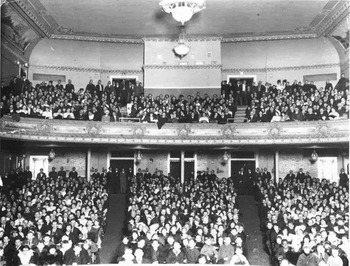
Although San Francisco's operatic ambitions were stymied during Hearst's lifetime, she did subsidize a more modest performing hall: the Homestake Opera House in Lead, South Dakota (see Figure 5). The building, which ultimately cost $250,000, was apparently proposed to Hearst by Homestake Mine superintendent Thomas Grier (by then married to Lead's librarian-pianist, Mary J. Ferrie).Footnote 121 In summer 1911 Thomas and Mary Grier visited Hearst at her Pleasanton estate. A few months later, on 13 November, the mining company, under Hearst's authority, officially announced the gift of the building, which the company presented three years later.Footnote 122 The Homestake Opera House and Recreation Center opened on 31 August 1914 with a performance by the traveling English-language Sheehan Opera Company, which presented scenes from Il Trovatore, Martha, and The Bohemian Girl. The eleven-hundred-seat theater was sold out and a matinee had to be added to accommodate the overflow demand.Footnote 123 The building subsequently became a central focus for cultural and social activities, its auditorium hosting everything from opera productions to boxing matches.
An overflow crowd at the Homestake Opera House in Lead, South Dakota: undated photo from the hall's early years. Courtesy of the Historic Homestake Opera House; Homestake Mining Company.

Assessing Hearst as a Music Patron
No one can accuse Phoebe Hearst of denying herself the pleasures of life. She hosted lavish events at her various mansions and even built a castle called Wyntoon in the wilderness in northern California. In this out-of-the-way locale, she anticipated installing a double-manual pipe organ at a cost of $11,875. Her papers include detailed specifications: one manual would activate a player organ, the other would be a regular keyboard. (The instrument was apparently never built.) Furthermore, Hearst constantly traveled around the country and to Europe, where she indulged her musical appetite.
In view of her seemingly endless travels, building projects, and charitable activities, Hearst's attention to the minute details of her voluminous correspondence and to small disbursements of funds is remarkable. Up to the end of her life, she made most of her philanthropic decisions herself, giving as much attention to letters about upcoming local recitals as to those proposing major buildings or institutions. From even a cursory glance at the letters Adele Brooks saved, it is clear that Hearst read every one. “As long as I can see,” she said, “I shall read my own letters.”Footnote 124
Hearst's philanthropy had begun with individuals: establishing kindergartens, supporting poor families in Washington, providing warm lunches for factory girls through the YWCA.Footnote 125 As the size of her disbursements grew, she kept that original impetus in mind. She spent hours in bookstores selecting the specific volumes to send to the Lead and Anaconda Free Libraries, and each December she sent gifts to the employees of her mines, to friends and acquaintances, and to the teachers in her kindergartens. The Hearst correspondence is filled with thank you letters acknowledging presents that she tailored to the tastes of the recipients.
Did she, then, have an overall plan for her philanthropy? It seems not, although she clearly made decisions in the area of music based on whether the contribution would support her dual goals of education and civic enhancement.
Hearst rarely initiated projects herself. Even her support of the kindergarten movement and the PTA, in which she became a major player on the national scene, resulted from suggestions by others (Sarah Cooper and Alice Birney). There were exceptions of course, among them the UC architectural competition, women's college scholarships, and Hearst Hall and its musicales. More often, though, Hearst responded to “asks.” Might her disbursements, as effective as they were, have been more influential had she employed a staff to create an overall vision? Perhaps, but she would then have had to relinquish personal supervision of them, which she was unwilling to do.
Remaining single (despite several rumors over the years that she was about to remarry) also allowed Hearst to maintain control of her fortune. As Kathleen McCarthy reminds us, most women striving for successful careers in this era were reliant on male patrons, helpers, or promoters.Footnote 126 Hearst, on the other hand, could exercise her considerable power without consultation.
In fact, Hearst was incredibly adept at filling traditionally male shoes without being accused of un-feminine behavior. She carefully walked this tightrope by exercising astute business management and influencing politics and education while maintaining the veneer of conventional femininity—for instance, through her participation in women's clubs, her establishment of Hearst Domestic Industries, her behavioral expectations at her musicales, the character traits she required of her scholarship recipients, and most visibly, the distance she maintained from the tactics used by the suffrage movement.
Hearst also protected herself by hiring, shortly after George's death, a cousin, Edward Hardy Clark, to manage many of her mining and real estate dealings. He remained with her the rest of her life. It was a brilliant move in this era of rapidly changing roles for women. Hearst could run her businesses and manage her properties with an iron fist, but through a male intermediary who never had problems with her gender. Hiring Clark kept her in control but provided a shield for, and a rebuttal to, any doubters about a woman handling “men's” affairs.
As more and more women entered U.S. universities, the justification of college degrees for them became a hot topic of debate. Some argued that the education would make them better mothers or better housekeepers; others suggested that women should be prepared to earn a living if they became widowed. A 1915 New York Evening Sun article describing Hearst's support for the University of California expressed a common sexist view of the time: The university, noted the author, educates a “great number of girls . . . —thousands of them that are to be intelligent mothers of the future, able to direct their sons and use well the new powers that women are to possess.”Footnote 127 Hearst would not have argued with the practical goals of educating women, but she would certainly have rejected the Sun’s prioritization of sons over daughters. Her ultimate aims in enhancing women's education in general, and promoting their musical training in particular, however, were far more intangible: to enhance the quality of life, to develop enlightened critics of art and literature, and to mold more productive citizens. She was not alone, of course, in touting the personal and communal benefits of artistic training. Charles Seeger, for example, espoused a similar idea about music's role in society in a 1912 talk at the “grand orchestra concert” that initiated the San Francisco People's Philharmonic. Seeger advocated “music as a preventative of crime, a stimulator of intelligence, and a force for character development.” “Good music, taught to children,” he said, “will cause the child to control his or her emotions. . . . He will feel, think and act in harmony with his surroundings.”Footnote 128 Social engineering also characterized the settlement movement. The theoretical framing of social organicism prevalent at the time mandated checking and reversing the “antisocial tendencies of the poor” by sharing the “highest life” with those less fortunate.Footnote 129
Carol Roland makes a similar point in assessing the motives of wealthy contributors to the California kindergarten movement. Roland sees their generosity as both an attempt to improve the lives of poor children and a way for rich women to affirm their wealth and keep the rapidly changing social structure in check. “Humanitarian motivations and the desire to find ways to control the poor and immigrant exist together in continual tension,” she argues.Footnote 130 Hearst, who funded kindergartens in three cities, bought a building to house those in San Francisco, and contributed more than $80,000 to the cause, was among the movement's most enthusiastic supporters. Examination of her work only partially reinforces Roland's thesis, however. As one of the wealthiest women in the country, Hearst had no need to “affirm her wealth” or prove her social status. At the same time, her emphasis on character development in the dispensing of her UC scholarships suggests that she might have agreed with Sarah Cooper, the founder of the San Francisco movement, who asserted that it was better to start kindergartens and industrial schools than have the young grow up “to form Jacobin clubs and revolutionary brigades.”Footnote 131
Hearst's support of music certainly involves a measure of channeling the artistic tastes of the broader population. But at the same time, it would be wrong to cast her motives in such stark and, I would argue, overly simplistic terms. In funding musical causes, Hearst could satisfy manifold objectives: enhance the local cultural environment through artistic offerings, educate the young, enrich higher education offerings, support struggling artists, reinforce women's traditional role as the bearers of culture, encourage female artists and composers, and, perhaps most important of all, bring pleasure to performers, audiences, and, not least of all, herself.
Phoebe Hearst never felt the need to apologize for her wealth. And only rarely was she criticized for extravagance. In fact, the 1915 Sun article concluded that her most important gift to UC required “neither deep education nor great wealth, only kindness of heart, unselfish devotion to young people and understanding of their needs. Thousands in our day of wealth give money. But how many in old age give themselves, their energy, their comfort, as did Mrs. Hearst?”Footnote 132
Of course, the monetary contributions helped a great deal. But Hearst herself modestly reinforced the sentiments expressed by the Sun’s author in a 1916 interview for The New American Woman: “Occasionally someone has honored me by saying complimentary things in the press regarding the few things I have been able to accomplish for others,” she said, “but I have kept no record and have never made a public statement regarding my life or its accomplishments. If it has been given to me to help solve problems for others, to make life fuller or easier for some, to stimulate others to more earnest effort and to assist them in that effort, I am grateful, for the giving has been a pleasure, and the thought and effort have been repaid a hundred fold by many of those it has been my privilege to assist.”Footnote 133