1. Introduction
The literary language (wenyan 文言) of modern Chinese literature during the Late Qing and the first half of the Early Republican period (1833–1930) was strongly dependent on the grammar and vocabulary of Classical Chinese, spanning from the pre-Qin era (before 221 bce) through to the Wei-Jin period (220–420). However, it was significantly influenced by the introduction of translations of foreign works of science and fiction, and the necessity of accommodating their neologisms, stylistic innovations and new syntax and morphology (polysyllabism) within the target language (Gunn Reference Gunn1991: 36; Masini Reference Masini1993: 113, 122; Chen Reference Chen, Gottlied and Chen2001: 49). Many of these structural innovations entailed the unconscious appropriation of linguistic resources and mechanisms that existed within the literary language tradition, but whose usage was never required by the strict constraints of classical literary forms (Gunn Reference Gunn1991: 40). Many of these changes were achieved in the context of contact with Western (and Japanese) languages through the numerous bulk of translations that influenced the literary world, a phenomenon called “Europeanized Chinese grammar” (Ouhua yufa 歐化語法), although the full extent of this influence is still a matter of debate.Footnote 1 One of the most interesting places to study the interaction between traditional syntactic categories and innovations derived from Europeanized prose is in the huge amount of translated fiction produced in the last few decades before the official institutionalization of vernacular Chinese (baihua 白話) in 1920, a period during which literary Chinese remained prevalent in fiction writing.
This article concentrates on the undocumented use of zaìshì 在勢 as an established translation of the adverbial prepositional clause “under these circumstances”. This expression lacked the flexibility of its English language counterpart, which can be positioned in different places within a sentence, and relied on a strict modal verb structure and an unspecified subject. Although the voice has been described before in late Republican newspapers (Brandt Reference Brandt1939: 211), its origin remains unexplained. It gained acceptance during the first two decades of the twentieth century through the translations of Lin Shu 林紓 (1852–1924), who appears to have been the first writer to employ it.
In order to ascertain the adverbial use of zaìshì in modern Chinese literature, a complete survey of the totality of modern Chinese literature during this period would be a desideratum. However, current estimates of different works of translated and original fiction between 1840 and 1920 amount to 5,933, excluding essays and poetry (Tarumoto Reference Tarumoto2024: 8606), the vast majority of which include secondary works that are not available in electronic form, are no longer accessible for research or whose whereabouts remain unknown. In order to address this issue effectively and produce data that hold statistical significance, I have compiled a representative digital corpus of texts from this period which includes the complete works of 110 Chinese writers and translators of foreign literature, comprising 23,626 individual works.Footnote 2 The term zaìshì appears prominently for the first time in the works of Lin Shu, a native of Fuzhou 福州 in Fujian 福建 and an alleged follower of the Tongcheng School 桐城派. To explore this further, and given that new constructions in written Chinese based on the grammar and vocabulary of native topolects have been documented by Gunn (Reference Gunn1991: 190–4) and Masini (Reference Masini1993: 117), this corpus also considers the complete works of 16 other Fujianese translators, as well as four representative members of the Tongcheng School.Footnote 3 The discussion below shows no evidence of any regional influence.
Section 2 starts with a discussion of the different uses and evolution of zaìshì in ancient and medieval sources as a verb (“to hold power”) or a nominalized verb (“one who holds power”), as well as other usages, typically delimited within a strategic or political context, related to similar ideas of personal authority and power. For these medieval sources, I have relied on the textual data available at Xueheng Data 學衡數據, which includes a searchable digital copy of the Four Branches of Literature Collection 四部叢刊, the Complete Books in the Four Treasuries 四庫全書, the Daoist Canon of the Zhengtong Era 正統道藏, the Chinese Buddhist Canon or Taishō Tripitaka 大正新脩大藏經 and the Supplementary Buddhist Canonor Zokuzōkyō 續藏經 (2018).
2. Ancient and medieval sources
The concept of shì 勢 (OC *ŋ̊et-s, MC syejH) is a rather ambivalent one in Chinese thought; it has been translated as “position”, “circumstances”, “potential” or “power” (Jullien Reference Julien and Lloyd1995: 12). The term is considered to be an exoactive form of OC *ŋ̊et 設, “set up” (Schuessler Reference Schuessler2007: 571; Baxter and Sagart Reference Baxter and Sagart2014: 29), and it is commonly used in military texts to refer to the “setting” of the battlefield as a playground where strategic advantages and disadvantages are taken into consideration by a general, as well as to the “situational power” with which he can manipulate this setting to his advantage (Rand Reference Rand2017: 177 n. 27; Goldin Reference Goldin2020: 157). For present purposes, I will adopt Goldin’s translation “situational power” when the philosophical character of the text requires it.
(1) 故善戰者, 求之於勢, 不責於人。故能擇人而任勢。任勢者, 其戰人也, 如轉木石。木石之性, 安則靜, 危則動, 方則止, 圓則行。故善戰人之勢, 如轉圓石於千仞之山者。
Thus one who is adept at battle seeks [victory] in situational power; he does not demand it of his men. He is thus able to select men and exploit the situational power. He who exploits the situational power sends his men into battle like rolling logs and boulders. It is the nature of logs and boulders that on flat ground, they are stationary, but on steep ground, they roll; the square in shape tends to stop but the round tends to roll. Thus, the situational power of those who are adept at battle can be likened to rolling round boulders down a steep ravine thousands of feet high. (Sunzi A5/4/27–29; Sunzi Reference Ames1993: 120–1; Goldin Reference Goldin2020: 157)Footnote 4
In classical sources, zaìshì works either as a nominal phrase (NP) or as a prepositional phrase (PP). Both cases are documented in early pre-Han sources. A survey of medieval uses suggests that, despite the differences in grammar between NP and PP, PP zaìshì is always semantically related to (1).
2.1. The locus classicus for the compound zaìshì is contained in the Classic of Rites 禮記, where it is accompanied by the nominalizer -zhě 者, thus forming a nominal phrase. Although written without its semantic component lì 力 (“power”) as OC *[t]ip 執 (MC tsyip, “grasp”), this is glossed by Lu Deming 陸德明 (556–627) as an alternative form of OC *ŋ̊et-s, MC syejH 勢 (Kong Reference Kong and Yuan1980: 21.771):
(2) 禹、湯、文、武、成王、周公, 由此其選也。此六君子者, 未有不謹於禮者也。以著其義, 以考其信, 著有過, 刑仁講讓, 示民有常。如有不由此者, 在執者去, 眾以爲殃。埶, 埶位也。[…] 埶音世, 本亦作勢。
Yu, Tang, Wen, Wu, King Cheng and the Duke of Zhou thus obtained their distinction. Of these six great men, each one was very attentive to the rules of propriety. It is through these that they displayed the righteousness and realized the sincerity [of the people], exposed their errors, exemplified benevolence, and discussed courtesy, showing the people the constant virtues. Those who did not follow this course were driven away by those who held power, and everybody regarded [the former] as ruinous. By “power”, it is meant a powerful position. “Power” is pronounced syejH, and syejH 勢 is sometimes written like this. (Liji 9.1/59/30–32; Kong Reference Kong and Yuan1980: 21.771; translation adapted from Legge Reference Legge1885: 366–7)
As an NP with the meaning “those who hold power”, zaìshì is a hapax legomenon in pre-Han literature, but it is found in numerous medieval works that derive meaning from this passage, as their use of the nominalizer - zhě suggests:
(3) 自君子之在勢者觀之, 使爲善者不得職而無以成名, 則中材何以勉焉?
From the perspective of a gentleman who holds power, if those who do good deeds are not appointed for an official position and cannot make a name for themselves, how would those of medium talent even make an effort?Footnote 5
(4) 一時在勢者争出氣力引挈之。
At the same time, those who hold power strive to use their strength to lead them.Footnote 6
More commonly, the NP zaìshì also appears in medieval and pre-modern sources without a nominalizer in similar political or strategic contexts, sometimes functioning as an adjective:
(5) 識者知公非苟爲徳, 是謂民風化之所自, 迹近而體遠者, 盖其初仕已達於從政。秩滿還都, 不過執政之門。在勢有弗恱, 累月不召, 乃差監永豐倉。
Those who understand know that he [Cai Wenzhong 蔡文忠, fl. 1015] was not only virtuous, but the source of the morality of the people, close in appearance yet far in substance; he was indeed already involved in politics since his first official position. Upon the expiration of his term in office he returned to the capital, but was unable to get through the functionaries. Those who hold power were not pleased, and for many months did not summon him, and dispatched him to supervise the Yongfeng granary.Footnote 7
(6) 勢盛則衆鼓而從之, 勢去則相率而去。其所懐去就者, 固在勢也。
If he thrives in power, inspired crowds will follow him, whereas if power wanes, they will leave one after the other. He who cherishes these fluctuations is certainly powerful/[one who] holds power.Footnote 8
(7) 在勢處顯之人, 力足以變置白黒。
The strength of men who hold power and dwell in wealth is enough to turn white into black.Footnote 9
(8) 先王之治天下, 使賢者皆當路在勢。
When the former kings governed the world, all the virtuous were placed in government and held power.Footnote 10
In other cases, the political meaning of NP zaìshì is not immediately clear without further context, as is the case with the following verses:
(9) 慨彼下泉, 澤而不川。再實者木, 栽或以覆, 在勢則然。
Sighting at these underground springs, moistened yet unflowing. The trunk of a doubly solid tree will suffer and thus be destroyed. It is the use of force that makes this happen.Footnote 11
Here the poet sighs at the underground springs, a metaphor for a benevolent ruler and imperial order tracing its origins to the Classic of Poetry (153/66/19; Williams Reference Williams2015: 108 n. 9). The opening and the coda are reminiscent of a philosophical discussion in Mencius, where the “damming and channeling” of flowing water is compared to the use of force upon human nature.Footnote 12 The second stanza is a reference to a passage from the Huainanzi on the proper understanding of gain and loss in governance and military offensive:
(10) 夫再實之木根必傷, 掘藏之家必有殃。以言大利而反爲害也。張武教智伯奪韓、魏之地而擒於晉陽, 申叔時教莊王封陳氏之後而霸天下。
The trunk of a tree that is doubly solid will certainly be harmed; the family that dig up graves [to rob them] will certainly suffer disaster. These speak of great benefits that conversely become harm. Zhang Wu instructed Earl Zhi to wrest away the territory of Hann and Wei, and [Earl Zhi] was taken at Jinyang. Shenshu Shi instructed King Zhuang [of Chu] to enfeoff the descendants of the Chen clan, and [King Zhuang] became hegemon (Huainanzi 18/187/5–6; Major et al. Reference Major2010: 723).
2.2. A second use of zaìshì as a prepositional phrase occurs in the Heguanzi 鶡冠子, where it is written with the phonetic component OC *ŋ̊et-s, MC syejH 埶, usually glossed with the homophone and homonym OC *ŋ̊et-s, MC syejH 勢:Footnote 13
(11) 天不能使人, 人不能使天, 因物之然, 而窮達存焉, 之二也, 在權在埶。在權, 故生財有過富, 在埶, 故用兵有過勝。
Heaven cannot compel men, men cannot compel Heaven. Adapt to things’ suchness, failure and success are stored in it. These two derive from expedience and from dynamics. From expedience in production of materials you will have super-abundance of wealth. From dynamics in the use of arms you will have super-abundance of victories. (Heguanzi 14/20/17–18; Wells Reference Wells2013: 187)
Wells’s rendering of this passage introduces the phrasal verb “to derive from” as a translation of the coverb zaì, lit. “to be in” or “to depend on”. All cases of PP zaìshì can be translated as “depend(ing) on the situation”, but it should be noted that these cases are always circumscribed to the philosophical/militaristic meaning in (1), and were never used in the modern and more general sense of “circumstances”. Consider the syntax of the following illustrative examples:Footnote 14
(12) 是知立國之安危在勢,任事之濟否在人。勢苟安則異類同心也, 勢苟危則舟中敵國也。
this know establish-state SUB safety-danger COVB situation, appointment-position SUB achievement-blockage COVB people. situation CNJ safe CNJ different-type-same-heart PAR, situation CNJ dangerous CNJ ship-inside-enemy-state PAR
From this we know that the safety and danger of establishing a state is in/depend on the situational power, whereas the achievement or blockage of an official position is on the people. If the situation is safe, people from different backgrounds will follow the same path, whereas if the situation is dangerous, even those in the same boat will become enemies of the state.Footnote 15
(13) 貴賤之分不在勢之窮達, 而在行之美惡也。
noble-lowly SUB distinction NEG COVB power SUB failure-success, CNJ COVB action SUB goodness-wickedness PAR
The distinction between the noble and the lowly is not in/does not depend on the failure or success of one’s situational power, but in the goodness or wickedness of one’s own actions.Footnote 16
(14) 而栗腹以摧, 騎劫以走, 是不在勢之強弱也。
CNJ NAME PREP-demise, NAME PREP-defeat, PRN NEG COVB power SUB strength-weakness PAR
However, the demise of Li Fu and the defeat of Qi Jie is not in/does not depend on the strength or weakness of their situational power.Footnote 17
The constructions in (12)–(14) follow an identical pattern where a pair of opposite nouns is connected to shì 勢 by the use of the coverb zài 在, either directly (N1-N2-COVB-shì) or indirectly through the adnominalizer zhī 之, in which case the sentence requires the final particle yě 也 (shì-COVB-SUB-N1-N2-PAR). In this regard, medieval uses of PP zaìshì show an interesting lack of innovation, for they adhere closely to the syntax in (11), as follows:
(15) 因物之然, 而窮達存焉, 之二也, 在權在埶。
adapt things SUB suchness, CNJ failure-success store PRN-LOC, SUB two PAR, COVB expedience COVB power
Adapt to things’ suchness, failure and success are stored in it. These two depend on expedience and depend on situational power. (Heguanzi 14/20/17–18; tr. adapted from Wells Reference Wells2013: 187)
It is clear from the examples (12)–(14) that the coverb zaì functions as an independent element, a coverb that can take a different object (COVB-OBJ 在行) and that can be modified by a negative adverb (NEG-COVB-OBJ 不在勢). All cases of PP in medieval sources follow this pattern, and are easily identifiable because they are always paired with another COVB-OBJ where the coverb takes a different object:
(16) 然秦得其勢, 而不免於滅亡, 蓋治天下在徳不在勢。
CNJ NAME obtain POSS power, CNJ NEG escape PREP destruction, CNJ govern Heaven-under COVB virtue NEG COVB power
Although the State of Qin had obtained its situational power, it did not escape destruction, for governing the world depends on virtue, not on situational power.Footnote 18
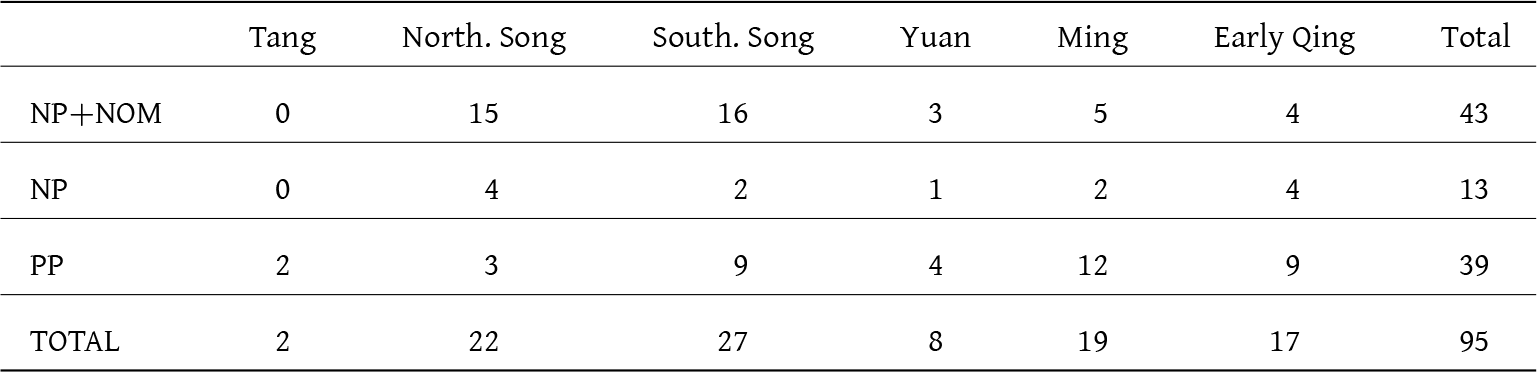
Although the meaning of PP zaìshì in these contexts is different from the NP zaìshì in (2)–(9), it is interesting to note that the background of (12)–(14) and (16) is similarly related to the strategic and philosophical framework enunciated in (1). Whereas the usages documented in section 2.1 were particularly common during the Song period, prepositional instances such as those in section 2.2 became more frequent during the Ming and mid-Qing dynasties, showing a tendency to abandon the former (Table 1).
Distribution of NP and PP usages of zaìshì between the Tang and early Qing dynasty (618–1800). Data based on Xueheng (2018).

2.3. Finally, there is an isolated example of false zaìshì that occurs within a PP.
(17) [户]部尚書光禄大夫莒國公唐儉, 門資斗食, 器劣缾筲, 在勢爲優, 唯聞酒德, 席賓常滿。
[revenues] minister splendid-happiness grand-master NAME-state duke NAME, family low-income-official, vessels inferior bottle-bucket, COVB situation-MORPH be superior-MORPH, only famous drinking-etiquette, seat guest always full.
Tang Jian, Minister of [Revenues], Grand Master of Splendid Happiness, and Duke of the Ju State, was from a family of low-income officials and owned very inferior vessels; he excelled only in his famous drinking etiquette, and his seats were always full with guests.Footnote 19
In (17), shì 勢 must be understood as a preposed morpheme that has been separated from yōu 優, with which it forms the noun yōushì 優勢, “superiority”. This structure, where a Chinese disyllabic word composed of two separate units of meaning (AB) is broken apart and preposed by a coverb (zài B wèi A, 在B爲A), has a similar precedent with a subordinate clause in a famous line in the pre-Han text Xunzi:
(18) 可以爲堯禹, 可以爲桀跖, 可以爲工匠, 可以爲農賈, 在埶注錯習俗之所積耳。
can be NAME-NAME, can be NAME-NAME, can be workman-artisan, can be farmer-merchant, COVB situation-MORPH concentrate-arrangement habits-customs SUB-SUO accumulated effect-MORPH PAR
Whether a man can become a Yao or Yu or be a Jie or Robber Zhi, whether he becomes a workman or artisan, a farmer or merchant, lies entirely with the accumulated effect of circumstances, with what they concentrate on in laying their plans, and on the influence of habits and customs. (Xunzi 4/15/10–11; Knoblock Reference Knoblock1988: 191–2)Footnote 20
In this example zaìshì is not an independent PP, but a preposition followed by the verb jīshì 積勢, “accumulate situational power”, which has been nominalized by the relative pronoun suǒ 所. As in (17), the disyllabic verb has been split and preposed to an NP introduced by suǒ, which in turn has its own subordinate clause, “with what they concentrate on in laying their plans, and on the influence of habits and customs” (Xunzi 4/15/10–11; Knoblock Reference Knoblock1988: 191–2).
3. Late Qing and Early Republican sources
The aforestudied usages of zaìshì were known to late Qing scholars. For instance, Zeng Guofan 曾國藩 (1811–72) and Liang Qichao 梁啓超 (1873–1929) quoted (8) and (18) in their respective works (Zeng 1874 [Reference Zeng1846]: 2a, Reference Zeng1876: 1.47b; Liang Reference Liang1905: 158). As noted in section 1, my research on Late Qing and Early Republican sources has been conducted on a digital corpus that includes the complete works of 110 Chinese writers and translators of foreign literature who were active between 1840 and 1920. Works published by these authors in the remaining years of their lives up to the 1960s, when Hu Shi died, have also been considered. These works include texts in vernacular Chinese, which began to appear as early as 1916 and overlap with literary Chinese publications, as many authors wrote in both forms during the years following the rise of vernacular writing and its implementation in educational institutions on 15 March 1920.Footnote 21 The earliest usages of zaìshì as a preposed deontic adverb, and in a context clearly different from section 2, appears in Lin Shu’s translations of Western literature between 1904 and 1908. Within this short period of time, zaìshì was used in no less than 108 instances, thus surpassing the totality of the NP and PP usages recorded in medieval and pre-modern sources. I have found no instance of a similar usage by other authors prior to 1908.
3.1. Although the meaning of zaìshì in these translations is not always clearly defined, comparison with the original text shows that there are no elements in the original sentences that could account for the restricted meanings represented by the NP and PP structures in section 2. In some cases, zaìshì translates an element of the sentence that corresponds to a circumstantial adverb in the original, such as “hitherto” in example (19) below. There are more concrete instances where the original English text has the exact expression “under such circumstances”, as illustrated in (20). On several occasions, however, zaìshì behaves as a transitional expression (conjuctive adverb) with no direct correspondence to any identifiable element in the original sentence. Such instances, e.g. the one represented in (21), are not uncommon, given that early Chinese translations did not prioritize literal translation.
(19) 此次爾我同爭一愛力克。在勢以君爲占勝著, 然後此誰屬, 則在其人之福命。
[This time, you and I have fought against each other for Eric. Under these circumstances/At this point you have overcome me, but next time fate shall decide who he belongs to.] (Lin Reference Lin1904: 58a)Footnote 22
Thou art strong and fair, and hitherto thou hast overcome me. But I am also fair, and, if I find space to strike in, I also have a show of strength. Pray thou that I find not space, Gudruda. Now is Eric thine. Perchance one day he may be mine. It lies in the lap of the Norns. (Haggard Reference Haggard1891: 109)
(20) 普魯士兵, 雖人人趣義殺敵, 然以三月新集之卒, 欲以盡復其舊觀, 在勢亦莫可恃, 此時雖整兵趣利俾瑟, 明知非法之敵, 特欲唆動撤克遜人心, 令之叛法。
[The Prussian army, although their intention was to kill the enemy, had only three months to finish reorganizing, as they wished to restore fully their former appearance. Under these circumstances there was also nothing to rely on, and even though the organized troops had now moved to Lützen, they were obviously not the enemies of the French. They specially desired to incite the hearts of the Saxons, to make them betray France.] (Lin Reference Lin1905a: 3.342)
the Prussians, unanimous as their patriotism was, had had only three months to re-organize their establishments. Under such circumstances, the advance of the allies beyond the Elbe, could only have proceeded from their ardent wish to stimulate the spirit of insurrection in the kingdom of Saxony, and the neighbouring states. (Lockhart Reference Lockhart1829: 2.175)
(21) 請爾先平心靜氣, 聽我垂死之言, 後再審決未晚。吾奄奄氣息僅屬, 不能當爾峻責也。爾須知在勢可以終身勿宣, 誰則知吾秘者。
[Please, you should relax first, and listen to my dying words, after which you won’t be too late to judge. For they belong only to my last breath, which cannot bear your harsh reproach. You must know that, under these circumstances, I could have gone my whole life without making it public, and nobody will then know my secret.] (Lin Reference Lin1905b: 2.127)
I pray you to listen before you judge, and at present spare your reproaches, for believe me, Joan, I am not fit to bear them. Remember that I need have told you nothing of this; the secret might have been buried in my grave – . (Haggard Reference Haggard1895: 378).
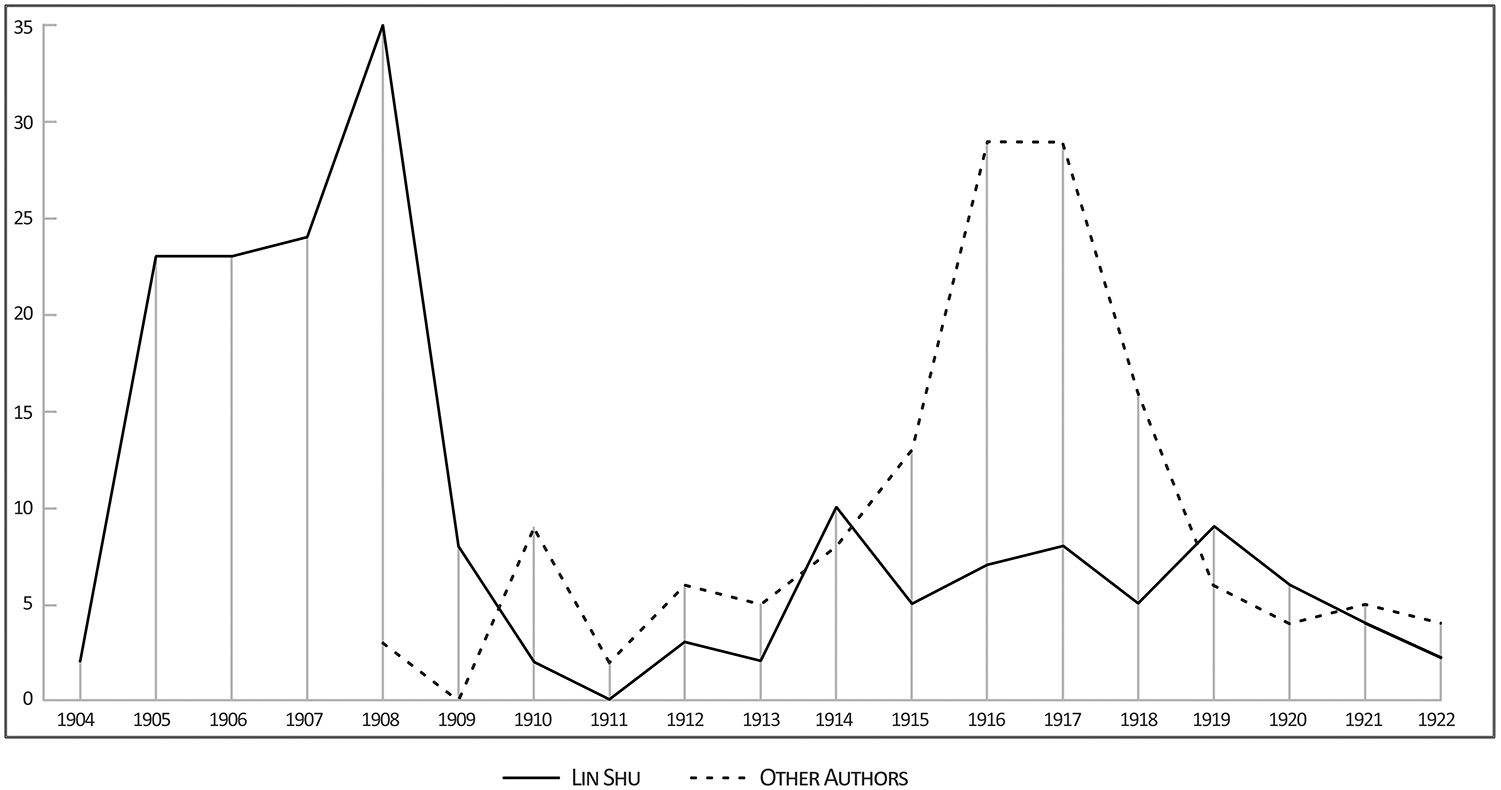
It is only after 1908 that other authors started using a preposed form of zaìshì as a deontic adverb (a modifier that establishes its own ancillary modal claim; see Anand and Brasoveanu Reference Anand and Brasoveanu2010: 33). Among the examined 110 writers and translators, only 39 authors have employed this construction, with a total of 139 instances between 1908 and 1922, all in works written exclusively in Classical Chinese. The number is surprisingly low, especially during the second decade, considering that there are 179 instances in Lin Shu alone, and that most authors were active both before and after Lin Shu’s translations (see Figure 1).Footnote 23
Distribution of adverbial zaìshì in Late Qing and Early Republican literature.

In the majority of cases, these instances emulate the syntax employed by Lin Shu: zaìshì heads a punctuated prepositional clause (separated from the rest of the sentence by the classical punctuation symbol quandian 圈點), with an unspecified subject and modified by a deontic modal verb indicating possibility or obligation.
(22) 此間十英里以內無醫士。况吾觀世子面色, 知其在六七小時中。決不能行動, 卽延得醫士, 亦於事奚濟, 而今晨思德之行。在勢不得不延緩。
[Within ten miles there was no doctor. Moreover, looking at the prince’s countenance, I knew that he would definitely not be able to move for six or seven hours. Even if a doctor was sent it would also not help to take him to Strelsau this morning. Under these circumstances, it will have to be delayed.] (Gan and Zhu Reference Gan and Bingxun1912a: 23)
There’s none within ten miles, and a thousand doctors wouldn’t take him to Strelsau to-day. I know the look of it. He’ll not move for six or seven hours yet. (Hope Reference Hope1894: 48)
(23) 詎小舢未放, 浪層層上衝, 在勢似不能維持至五分鍾, 水手呼船上被水者。
[If the small boat was not set free, beaten by wave after wave, under these circumstances, it seemed that it could not last for five minutes. The sailors shouted that the boat was taking in water.] (Leng Reference Leng1913: 6)
Les plus croyants dans le miséricorde divine n’espéraint pas, tant la mer était grosse, que le canot pût tenir cinq minutes. Les marins placés dans les haubans crièrent même deux fois que la canot faisait eau. (Dumas Reference Dumas, père1852: 113)
3.2. Before examining the origins of the term, it will be useful to consider its syntactic and grammatical features in Late Qing and Early Republican literary texts, vis-à-vis previously studied medieval uses. To this end, in (20)–(21) and (24)–(29) I have given the first attestation of every syntactic variation found in Lin Shu’s translations, followed in (30)–(35) by the first instance found in a different author. Preference has been given to translations of Western literature as they facilitate a more accurate comparison.
(24) 當爾日相遇, 原無必死之心, 以彼詪詪, 在勢不能不爾。若吾不彼殺, 則亦無反國之期。
[On that day we met, the intention was not necessarily to have [her] dead; it was because of her violence, that under these circumstances I could not but do that. If I had not killed her, then I would have no chance to return to my country.] (Lin Reference Lin1905c: 1.85)
I did not come to murder her as you may have thought, but she forced me to it to save myself, since had I not done so, I should never have lived to return to Spain. (Haggard Reference Haggard1892: 91)
(25) 時司丟阿忒方退居藩服, 法人乃僞作司丟阿忒之書, 與聖雅各王室, 言英國責言法人, 宜以正統歸諸魯意氏, 然聖雅各何爲久僭王位, 在勢亦當歸舊君矣。
[At that time, the House of Stuart had retreated to the farthest state, so the French forged a letter from the Stuarts to the royal household at St. James, in which it was said that Britain had offended the French, and that if it was necessary to restore the legitimate family of Louis, then the St. James’s could not usurp the throne any longer; under these circumstances it was also necessary to restore the old monarch] (Lin Reference Lin1905a: 2.135)
In the meantime the French government put forth, by way of commentary on Lord Grenville’s state paper, a pretended letter from the unfortunate heir of the House of Stuart to George III. demanding from him the throne of England, which, now that the principle of legitimacy seemed to be recognised at St. James’s, there could (said the pasquinade) be no fair pretext for refusing. (Lockhart Reference Lockhart1829: 200)
(26) 如彼之溷我, 復念我苟侵入其界, 非糜爛吾軀, 萬無拔身之日, 無論不能自脫, 在勢亦萬不能近, 並無術足以自救。
[I was thus confused by the returning thoughts of [what would happen] if I intrude into their realm, for as long as my body was not torn apart, there would be no day when I would not have to escape, not to say that I would not be able to deliver myself; if under these circumstances I never come closer [to them], it also would not be enough to save myself.] (Lin Reference Lin1905d: 2.38)
I never so much as troubled myself to consider what I should do with myself when I came thither; what would become of me, if I fell into the Hands of the Savages; or how I should escape from them, if they attempted me; no, nor so much as how it was possible for me to reach the Coast, and not be attempted by some or other of them, without any Possibility of delivering myself; and if I should not fall into their Hands, what I should do for Provision, or wither I should bend my Course. (Defoe Reference Defoe1719: 233–34)
(27) 迦茵嗒然俯首行, 胸中紛裂, 不復能忍, 然猶有一分欣幸, 自謂此身已充看護之役, 在勢必不能遺我。
[Joan went, bending her head in frustration, with such a turmoil piercing through her heart that she could no longer bear, but still had a little delight; she told herself that she was already serving as his nurse, and under these circumstances [they] definitely could not dispose of her] (Lin Reference Lin1905b: 1.79)
So Joan went, humbly enough, suffering a sharper misery than she had dreamed that her heart could hold, and yet vaguely happy through her wretchedness. “At least,” she thought to herself, with a flash of defiant feeling, “I am his nurse, and they can’t send me away from him yet, because he won’t let them.” (Haggard Reference Haggard1895: 100)
(28) 女公子之意如何?我見其人近來與我至落漠, 在勢固宜其如是。
[What do you think is the wish of your daughter? I see that she has been recently cold to me, under these circumstances it surely may be appropriate to do so.] (Lin Reference Lin1905b: 2.112)
“But do you think that it is her wish, Mr. Levinger? I fancy that her manner has been a little cold to me of late, perhaps with justice.” (Haggard Reference Haggard1895: 359)
(29) 余別後獨行獨寢,腦中時時思及吾友屋中景狀。似此陳舊法律堆中, 乃有鮮明之玫瑰花, 移根於此, 在勢殊爲枘鑿。
[After bidding farewell, I walked and lay down alone, mulling over and over in my mind about the scene at my friend’s chamber. It appeared as if within these piled-up old chambers there were still bright roses, transplanted therein, which under these circumstances seemed quite discordant.] (Lin Reference Lin1914: 2.124)
Altogether, it was a scene I could not help dwelling on with pleasure, for a long time after I got back and had wished Traddles good night. If I had beheld a thousand roses blowing in a top set of chambers, in that withered Gray’s Inn, they could not have brightened it half so much. (Dickens Reference Dickens1850: 589)
Consider the following parallel syntactic developments in other authors:
(30) 于思于思者, 蓋不能蓬勃如故, 然已約略可觀, 遂赴巴黎, 謁老友喬治。相見後, 在勢不能不造作謊語以欺予老友。
[My dense beard was not as luxuriant as before, but was already quite significant when I arrived in Paris and visited my old friend George. Having met in person, under these circumstances I could not but make up some falsehoods with which to deceive my old friend.] (Gan and Zhu Reference Gan and Bingxun1912b: 130)
I let my moustache and imperial grow again; and as hair comes quickly on my face, they were respectable, though not luxuriant, by the time that I landed myself in Paris and called on my friend George Featherly. My interview with him was chiefly remarkable for the number of unwilling but necessary falsehoods that I told. (Hope Reference Hope1894: 298–9)
(31) 在勢當日益親密。
[Under these circumstances our acquaintance must increase day by day.] (Xue Reference Xue1910: 2.104)
I have a strong presentiment that we shall become intimately acquainted (Dickens Reference Dickens1857: 268).
(32) 然略一審視, 卽足知死者着傷殊重, 在勢萬不能救。
[However, a brief examination was enough to know that the victim was seriously injured, and under these circumstances it was impossible to save him.] (Cheng Reference Cheng1916: 12.31)
One glance at the victim was enough to show the healer that his presence could be dispensed with. The man had been horribly injured. (Doyle Reference Doyle1915: 42)
(33) 若徒步行者, 則水漬之身, 見者必且疑駭。以吾度之。在勢必不能遠颺, 特吾今職在監守, 若無瓜代之人, 弗能擅離。
[If he is on foot, then his body will be dripping, and anyone who sees him will surely be surprised. That’s according to my estimate. Under these circumstances I definitely cannot leave, especially since I am on duty, and without anybody to replace me, I cannot leave without authorization.] (Cheng Reference Cheng1916: 12.35)
If he goes by road with his legs all dripping, it’s odds that someone will notice him. Anyhow, I can’t leave here myself until I am relieved. (Doyle Reference Doyle1915: 48)
(34) 自彼行後, 我以債家之劫制。在勢固不能閉門謝客。
After she left, I was threatened by creditors. Under these circumstances, I surely could not refuse any visitors. (Bao Reference Bao1915: 6)
(35) 予頗欲尼之弗往,渠儂亦依依不忍別。奈校務旁午, 在勢殊不能偷此一日之閒。不得已。
[I was eager to stop her from departing; she was also reluctant to part. But due to the school duties, under these/her circumstances it was not possible to steal even a little moment of leisure from this day. It must be.] (Zhou Reference Zhou1915: 24)
I hesitated long to let her go; she, too, was loath to part from me. But it must be. Solange was prone to be an object of unpleasant inquiries. (Dumas Reference Dumas, père1909: 627)Footnote 24
These examples show a syntactic and grammatical dependency on the patterns employed by Lin Shu in his translations. Figure 1 exemplifies this tendency, with an increase in the use of preposed zaìshì in other authors between 1908 and 1918, a period that corresponds to the rise and fall of Lin’s reputation and popularity.Footnote 25 Imitation of Lin’s phraseology was not uncommon, and there were indeed serious (and malicious) attempts to replicate and impersonate his style.Footnote 26 From these examples emerges a clear syntactic structure of parallel elements that are consistently repeated across texts: zaìshì may be followed, in this order, by either an adverb of degree (ADD: shàng 尚, shū 殊, wàn 萬, wànwàn 萬萬, yì 亦, yóu 尤) or an adverb of certainty (ADC: bì 必, cháng 常, gù 固, jué 決), a negative adverb (NEG: bù 不, fēi 非, fěi 匪, fú 弗, mò 莫, wèi 未, wú 無) and, finally, by a deontic modal auxiliary verb (DMV: dāng 當, dé 得, kě 可, néng 能, xū 須, yí 宜, yīng 應) preposed to the predicate. With the exception of fěi 匪, a loan for fēi 非 and an allofam of fú 弗, all these words first appear embedded in zaìshì structures in Lin Shu’s translations between 1904 and 1909. This sequence can be illustrated with the following pattern:
zaìshì + (SUBJ) + ({ADD, ADC}) + (NEG) + DMV + VP
The use of a deontic modal auxiliary verb is expected, since modal adverbs and modal auxiliaries are commonly paired in Chinese, and a deontic adverb can never be followed by a non-deontic (i.e. epistemic) auxiliary verb (Tsai Reference Tsai and Shlonsky2015: 277). As such, only the DMV and the VP are strictly mandatory, whereas the subject remains unspecified in almost all cases. Instances where the VP is transposed are unusual, but when they occur, the nominalizer zhě 者 attaches to the transposed VP:
(36) 佛羅前云藥死之者, 在勢萬所不能, 蓋彼每飲必令三侍者更嘗之。
[The Pharaoh once said that killing her with poison, under these circumstances is something that cannot be done [= killing her with poison], given that everything she drinks is ordered to be tasted by three attendants.] (Lin Reference Yun1905e: 2.45)
It cannot be done by poison, for every drop she drinks and every morsel that shall touch her lips is strictly tasted by three separate tasters, who cannot be suborned. (Haggard Reference Haggard1889: 122)
(37) 脫我去者, 吾營中僅副官, 吾等又任事日淺。在勢不能, 且吾兩人相處日久, 亦不忍遽分離。
[If I get away, my battalion would only have subalterns, and we have only assumed the post for a short time. Under these circumstances I cannot [get away], and we both have been together for so long that I also cannot bear a sudden separation.] (Yun Reference Yun1916: 1–3)
In my battalion there are only subalterns left in a good many companies. Besides, apart from that, you and I have been too long together to think of separating now. (Nemirovich-Danchenko Reference Nemirovich-Danchenko1915: 364)
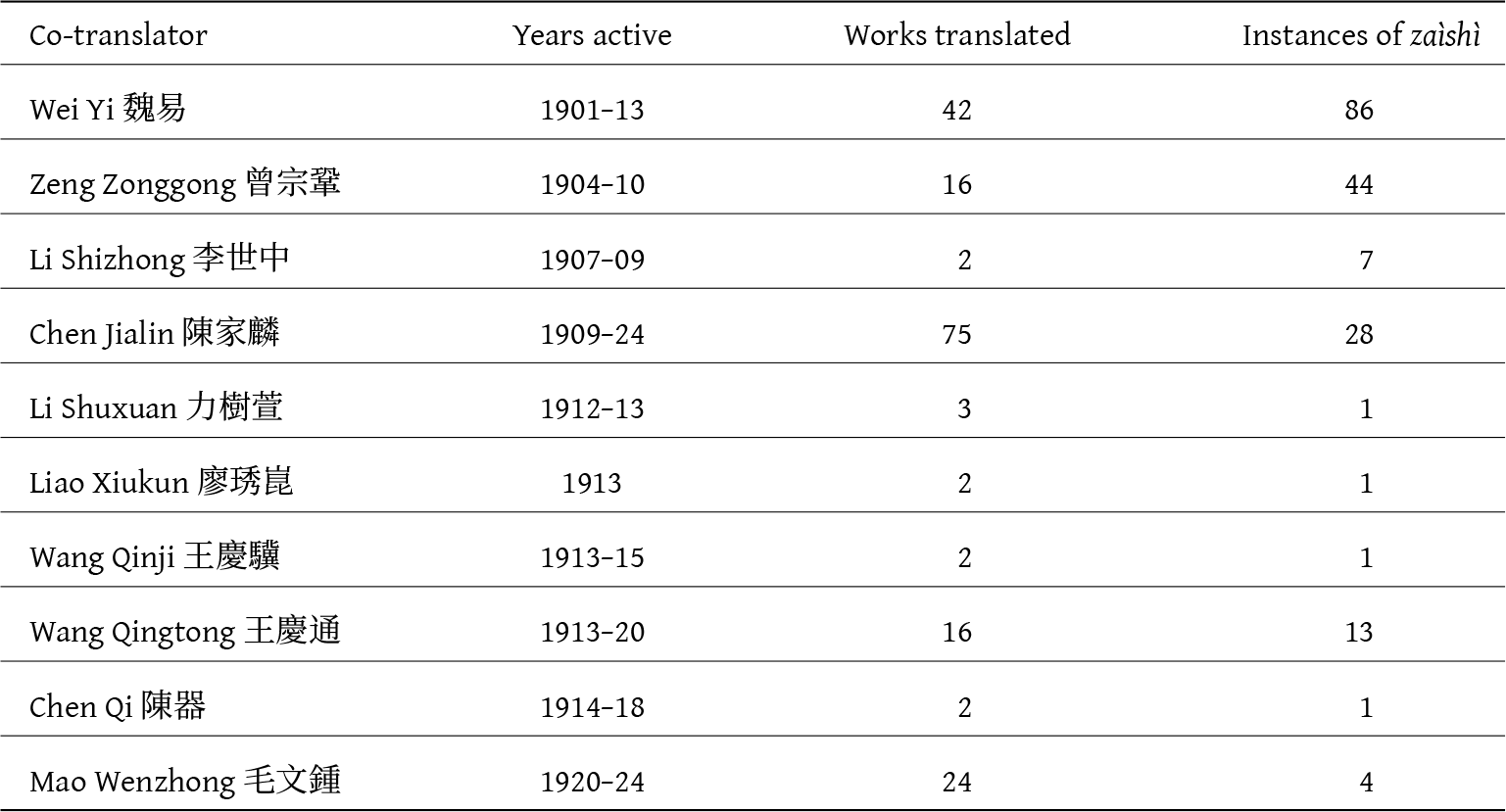
3.3. Although it is not possible to confirm unequivocally that a preposed form of zaìshì did not exist before 1904, the correlation observed between Lin Shu’s usages in translations of Western literature and Late Qing and Early Republican instances in other authors, both in terms of syntax and semantics, strongly suggests that the term may have been potentially coined by Lin Shu. The expression does not occur in the materials from Fujianese translators considered in the collected corpus, and its absence from other digitally available Fujianese materials indicates that we are not dealing with a dialectal form. The term is also not present in the works of Tongcheng scholars, with whom Lin Shu has been traditionally associated.Footnote 27 Likewise, distribution across co-translators – Chinese translators who knew Western languages and aided Lin Shu in his translations – is inconclusive (Table 2), and allocation of these instances seems to conform to a year-based pattern (such as in Figure 1) rather than being influenced by the collaborators involved in the translation work.
Distribution of preposed zaìshì in Lin Shu’s collaborators.

4. A proposed etymology for zaìshì
There is some evidence to support the idea that the pattern [zaìshì + (SUBJ) + ({ADD, ADC}) + (NEG) + DMV + VP] originally had a precedent in similar constructions that were not introduced by the coverb (or preposition) zaì. Instances attested in ancient Han sources, as well as in the corpus indexed in Xueheng (2018), show a high recurrence of shì followed by an adverb of degree or certainty and a deontic modal verb, with or without an adverb of negation. In these cases, the general meaning of shì is identical to (1) and can be interpreted as “situation” or “situational power”. Consider the following illustrative examples:
(38) 且王之地有盡, 而秦之求無已。以有盡之地而給無已之求, 其勢必無趙矣。
Moreover, Your Majesty’s territories can be exhausted, but Ch’in’s demands will never end. To meet endless demands with exhaustible territory [this situation] is certain to mean the end of Chao (Xinxu 9.10/53/2–3; Shiji 76.2373; Nienhauser Reference Nienhauser and William2021: 377).
(39) 守者彌怠而葬器如故, 其勢固不安矣。
Those who protect his grave may become more lax, but the buried goods are there as they always were, and this fact [i.e., situation] assures that the dead cannot remain in peaceful repose. (Lüshi chunqiu 10.2/49/11–12; Knoblock and Riegel [Reference Knoblock and Riegel2000: 229–30])Footnote 28
Similar examples with the common idiom shì gù bù 勢固不 + {DMV, VB}, frequently used in pre-modern times,Footnote 29 can be found in writers and translators contemporary to Lin Shu. In the example below, for instance, the translator has rephrased the English verb “call upon” in the first sentence into this common deontic idiom that expresses certainty:
(40) 新者愈衆, 彼非自用其權衡焉,勢固不可。由是遇一物而不知其名,則據其外之形似, 以類之於所前知之某物。
[As novelties increase in numbers, the situation is such that they certainly could not not use their own standard on them. Since they ignore the name of the object they encountered, they rely on its external similarities to compare it to some object that they knew before.] (Yan Reference Yan1905: 2.15r)
new objects are continually presenting themselves to men, women, and children, which they are called upon to class proprio motu. They, accordingly, do this on no other principle than that of superficial similarity, giving to each new object the name of that familiar object, the idea of which it most readily recalls, or which, on a cursory inspection, it seems to them most to resemble. (Mill Reference Mill1843: 1.47–8)
As we have seen in (12)–(14), PP zaìshì was semantically restrictive but syntactically unconstrained: its meaning was limited to the strategic and philosophical framework enunciated in example (1), but it could be embedded within a more flexible structure that did not require adverbs of degree or certainty followed by a deontic modal verb, as is the case in (20)–(37). Additionally, the independent status of zaì in a PP as a coverb followed by a coverb-object made it possible to be modified by an adverb.Footnote 30 On the other hand, the shì structures in (38)–(40) are syntactically restrictive but semantically unconstrained, with the possibility of being used with the more general meaning of “circumstances”. The deontic form of zaìshì used/coined by Lin Shu seems to have been developed from common idiomatic expressions such as those in (38)–(40), but incorporating some of the features of the PP zaìshì to accommodate Western categories of grammatical structure, which are less restrictive as they do not necessarily rely on the repetition of classical patterns found in canonical literature. In this sense, the deontic form of zaìshì could be considered an example of “Europeanized Chinese grammar” (Ouhua yufa 歐化語法), where traditional syntactic forms were reinterpreted or adapted under the influence of Western grammatical structures.
5. Conclusion
Gunn (Reference Gunn1991: 40) has noted that many new constructions developed during the Late Qing and Early Republican period, especially within the field of literary translation, were in fact “an extension or an appropriation of resources already available” in Classical Chinese that were “not previously employed” or “had never, for one reason or another, exploited”. Some of these constructions included clause transpositions in the form of anastrophe and apposition, as we have seen in (40), as well as more complicated patterns that, despite their apparent innovation, still relied to some extent on classical idioms and structures. I have shown that traditional PP zaìshì constructions, as well as idiomatic patterns such as shì gù bù + {DMV, VB} could account for the sudden transformation of zaìshì into a deontic adverb. The particular requirement of a translation to convey with precise language the spirit of the source text compels translators to formulate innovative strategies to handle complex structures and stretch the target language beyond its conventional narrative forms. It is, therefore, unsurprising that hitherto unseen forms, such as the deontic adverb zaìshì used/coined by Lin Shu, would first emerge from literary translations rather than original writing.
Competing interests
The author declares none.
Abbreviations
- OC
Old Chinese
- MC
Middle Chinese
- SBCK
Four Branches of Literature Collection, First Series 四部叢刊初編, 2,100 vols (Shanghai: The Commercial Press, 1919–22).
- SKQS
Imperially Commissioned Complete Books in the Four Treasuries 欽定四庫全書, 1,500 vols (Taipei: The Commercial Press, 1983–86)