Introduction
Obstructive sleep apnoea (OSA) is a reversible breathing disorder characterised by obstruction of the airway during sleep resulting in intermittent hypoxia and repeated arousals. The major risk factor for OSA is obesity, and OSA can be contributed to by the use of sedating medications. Untreated OSA results in non-restorative sleep and is associated with increased cardiometabolic risk, decrements in cognitive capacity, poorer occupational performance, daytime somnolence and depressive symptoms (Patil et al., Reference Patil, Schneider, Schwartz and Smith2007).
OSA is likely to be highly prevalent in people with schizophrenia given the high rates of obesity in this population (Galletly et al., Reference Galletly, Foley, Waterreus, Watts, Castle, Mcgrath, Mackinnon and Morgan2012). We conducted a systematic review of existing literature examining rates of OSA in cohorts of people with schizophrenia and identified 4 previous studies that reported OSA prevalence of between 19% and 57% (Myles et al., Reference Myles, Myles, Antic, Adams, Chandratilleke, Liu, Mercer, Vakulin, Vincent and Wittert2016), which is substantially higher than that seen in general population studies including a landmark 2015 study that reported rates of severe OSA of 15% in men aged 40–60 years and 1% in women aged 40–60 (Heinzer et al., Reference Heinzer, Vat, Marques-Vidal, Marti-Soler, Andries, Tobback, Mooser, Preisig, Malhotra and Waeber2015). However, no previous literature reports the prevalence of OSA in unselected cohorts of people with schizophrenia using gold-standard diagnostic methods. Similarly, only one previous study examined the diagnostic performance of general population OSA screening tools in this cohort, and this study was confounded by a heterogeneity of diagnoses with a cohort with ‘mental illness’, 48% of which had a diagnosis of schizophrenia or schizoaffective disorder (Anderson et al., Reference Anderson, Waton, Armstrong, Watkinson and Mackin2012). The results of this study suggest that OSA screening tools perform poorly in people with schizophrenia and comorbid OSA. Optimal identification of OSA in people with schizophrenia is an unmet clinical need and requires further clarification given the availability of effective treatment that may modify cardiovascular risk, which remains the main determinant of premature mortality in people with schizophrenia (Laursen et al., Reference Laursen, Munk-Olsen and Vestergaard2012).
The impact of untreated OSA on cognitive performance and psychiatric disease symptoms in people with schizophrenia also requires further clarification. People with schizophrenia consistently perform 1.5 standard deviations below population means in standardised cognitive assessments (Keefe et al., Reference Keefe, Harvey, Goldberg, Gold, Walker, Kennel and Hawkins2008). Disease-related cognitive decrements are generally treatment resistant to antipsychotic medications and are associated with poorer functional and social recovery (Fett et al., Reference Fett, Viechtbauer, Dominguez, Penn, Van Os and Krabbendam2011). Untreated OSA has a well-established association with impaired cognitive function and poorer occupational performance (Patil et al., Reference Patil, Schneider, Schwartz and Smith2007) which is reversible with continuous positive airway pressure (CPAP) treatment (Matthews and Aloia, Reference Matthews and Aloia2011). As such it is possible that co-morbid OSA may worsen negative and cognitive symptoms in people with schizophrenia. This association has not been previously investigated and if demonstrated may offer a novel means to modify treatment-resistant symptoms and improve functional recovery.
We conducted a prospective pilot cohort study to determine the prevalence of OSA in an unselected group of community patients with schizophrenia prescribed clozapine. Our aims were to determine whether diagnosis of OSA was associated with anthropometric measures, psychiatric symptoms, medication use and cognitive performance. Further, we aimed to ascertain whether the existing OSA screening tools were useful in predicting OSA in people with schizophrenia.
Methods
Population
Subjects were recruited from a clozapine outpatient clinic with 104 registered patients in Adelaide, South Australia. The ‘clozapine clinic’ provides weekly and monthly reviews of people with treatment-resistant schizophrenia or schizoaffective disorder taking clozapine. Inclusion criteria included males and females aged 18–64 years, a current clinical diagnosis of schizophrenia or schizoaffective disorder and currently prescribed clozapine. Exclusion criteria included inability to provide informed consent and a diagnosis of sleep disordered breathing, as defined by a partial or complete cessation of breathing occurring many times throughout the night, resulting in daytime sleepiness or fatigue that interferes with a person’s ability to function. Every patient registered in the clinic between January 2014 and March 2016 was approached to participate in the study. Ethics approval was provided by The Central Adelaide Local Health Network Human Research Ethics Committee. All participants gave written informed consent.
Measures
Baseline demographic and anthropometric data were recorded including age, sex, medical history, prescribed medications, height, weight, waist and neck circumference, body mass index (BMI) and blood pressure. Abdominal obesity was defined as a waist circumference ≥ 94 cm for men and ≥80 cm for women. Hypertension was diagnosed if the person had a systolic blood pressure ≥ 130 mmHg and/or a diastolic pressure ≥ 85 mmHg. Psychopathological measures included the Positive and Negative Symptoms Scale (PANSS) (Kay et al., Reference Kay, Fiszbein and Opler1987), Montgomery Asperger’s Depression Rating Scale (MADRS) (Williams and Kobak, Reference Williams and Kobak2008) and Personal and Social Performance scale (PSP) (Morosini et al., Reference Morosini, Magliano, Brambilla, Ugolini and Pioli2000). Standardised cognitive assessment was undertaken using the Brief Assessment of Cognition for Schizophrenia (BACS) (Keefe et al., Reference Keefe, Harvey, Goldberg, Gold, Walker, Kennel and Hawkins2008). Subjective sleep quality was assessed with the Pittsburg Sleep Quality Inventory (PSQI) (Buysse et al., Reference Buysse, Reynolds, Monk, Berman and Kupfer1989), subjective daytime sleepiness with the Epworth Sleepiness Scale (ESS), severity of insomnia with Insomnia Severity Index (ISI) (Morin et al., Reference Morin, Belleville, Belanger and Ivers2011) and sleep-related quality of life with Functional Outcomes of Sleep Questionnaire (FOSQ) (Weaver et al., Reference Weaver, Laizner, Evans, Maislin, Chugh, Lyon, Smith, Schwartz, Redline, Pack and Dinges1997). Patients were assessed with standard OSA screening questionnaires including the OSA50 (Chai-Coetzer et al., Reference Chai-Coetzer, Antic, Rowland, Catcheside, Esterman, Reed, Williams, Dunn and Mcevoy2011) and the STOP-BANG questionnaire (Ong et al., Reference Ong, Raudha, Fook-Chong, Lew and Hsu2010).
Following recruitment and baseline measures, subjects underwent at-home multichannel polysomnography (PSG) using an Embletta X100 (Natus Medical Inc, USA) or Somte (Compumedics, Australia) portable sleep recorder administered in the participants home. PSG data were manually scored using the 2007 AASM alternate criteria to obtain an apnoea-hypopnoea index (AHI) (Iber et al., Reference Iber, Ancoli-Israel, Chesson and Quan2007). A diagnosis of OSA was determined as an AHI > 10 events/hr and categorised as moderate if AHI was 20.1–30 or severe if AHI was >30 (Ruehland et al., Reference Ruehland, Rochford, O’donoghue, Pierce, Singh and Thornton2009).
Statistical Methods
Statistical analyses were performed using SPSS 24 (IBM, New York). Univariate analysis was performed using chi-squared tests, independent samples t-tests for parametric data, Mann-Whitney U tests for non-parametric data and Pearson’s test for linear correlation. Logistic regression was performed to determine the predictive value of diagnostic screening tests and diagnosis of severe OSA (AHI > 30). A p-value of <0.05 was considered the threshold for statistical significance.
Results
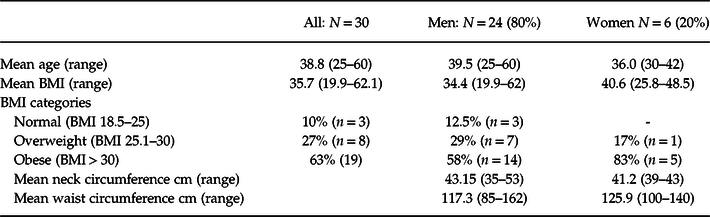
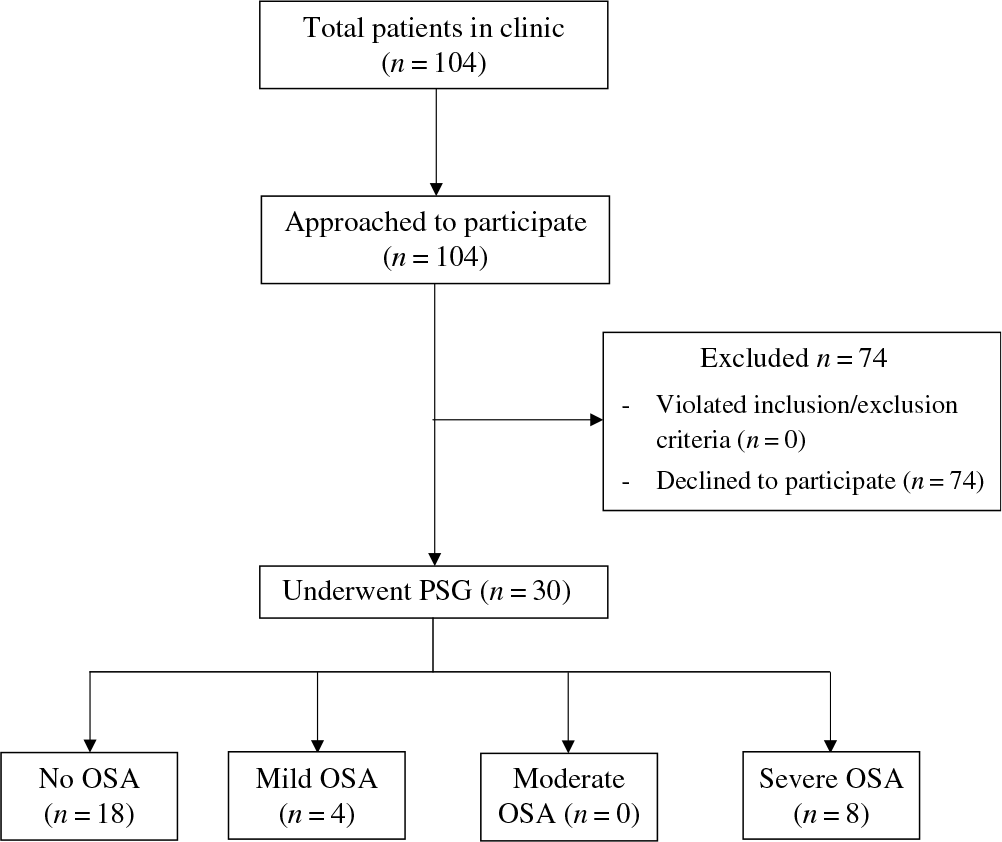
Hundred and four patients enrolled in the clozapine clinic were approached for inclusion. Thirty patients undertook study measures (see diagram 1). The other 74 patients satisfied inclusion criteria but did not give their consent to participate in the research project. No participants had previously been assessed for OSA using PSG. All patients tolerated PSG and provided diagnostic quality sleep studies, one patient repeated the study due to an equipment error. The demographic and anthropometric data of the 30 patients are presented in Table 1. The majority of the sample was overweight (27% BMI 25–30) or obese (63% BMI > 30). Ninety percent of subjects either lived alone or had no bed partner to corroborate the presence or absence of snoring or apnoeas. Seventy-seven percent of participants were prescribed clozapine as their only antipsychotic medication, 20% one additional antipsychotic medication and 3% two additional antipsychotic medications. Twenty-seven percent of participants were prescribed clozapine as their only psychotropic medication, 43% were prescribed one additional psychotropic medication and 30% were prescribed two or more additional psychotropic medications.
Demographic and anthropometric data

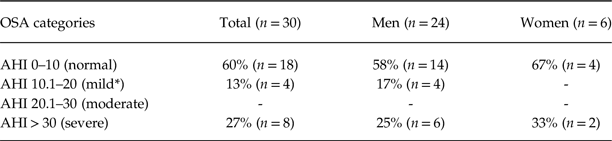
OSA defined as an AHI > 10 was present in 12 patients or 40% (95% CI = [23, 59]) of the cohort. The cohort mean AHI was 21.1 (SD 35) with a range of 0–134 (see Table 2).
PSG data

* The DSM 5 (APA 2013) and AASM (Ruehland et al., Reference Ruehland, Rochford, O’donoghue, Pierce, Singh and Thornton2009) classify mild OSA from an AHI > 5; however, Australian guidelines use AHI > 10. If we had used the international standard of AHI > 5, there may have been greater ‘mild OSA’ diagnoses.
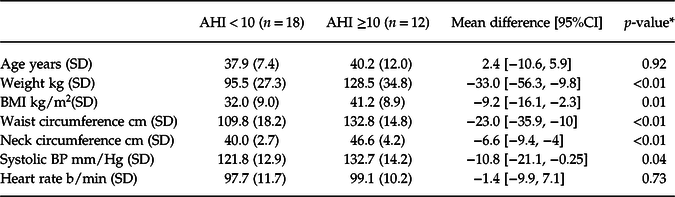
Diagnosis of OSA (AHI > 10) was significantly associated with higher weight, BMI, waist circumference, neck circumference and systolic blood pressure. Diagnosis of OSA was not significantly associated with age or heart rate (see Table 3). Dose of clozapine was not significantly associated with diagnosis of OSA (mean dose AHI < 10 406 mg, mean dose AHI ≥ 10 399 mg, p = 0.91).
AHI associations with mean anthropometric measures

* Independent sample t-test.
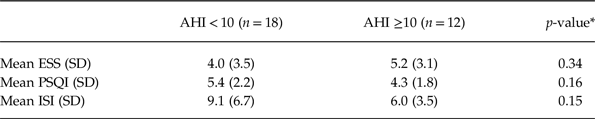
Mean ESS, PSQI and ISI scores for the entire cohort were 4.4 (SD = 3.3), 5.0 (SD = 2.0) and 7.9 (SD = 6.1), respectively. There was no detectable difference between mean ESS, PSQI and ISI scores in those with AHI ≥10 and those with AHI < 10 (see Table 4). Ninety-three percent of the cohort (28 subjects) had ESS scores within the normal range (score <10) and of the two subjects with elevated ESS (score ≥10) one was diagnosed with OSA. Sixty-three percent of the cohort (19 subjects) had PSQI scores within the normal range (score <5), of the 11 subjects with an elevated PSQI (score ≥5), two (18%) were diagnosed with OSA. Eighty-three percent of the cohort (25 subjects) had ISI scores within the normal range (score <15) and of the five subjects with an elevated ISI (score ≥15) one (20%) was diagnosed with OSA. There was no association found between sleep quality measures and AHI scores. Total ESS did not correlate with total AHI (r = 0.07, p = 0.73), global PSQI did not correlate with total AHI (r = 0.27, p = 0.15), nor did total ISI scores (r = 0.19, p = 0.32).
Associations between OSA and mean symptom severity scores

* Mann-Whitney U test.
The OSA50 score (using a cut-off score of ≥5) correctly classified six subjects with OSA and eleven subjects without OSA. Sensitivity of OSA50 was 50%, specificity was 61% (positive predictive value), PPV was 46% and negative predictive value (NPV) was 64%. The STOP-BANG score (using a cut-off score of ≥3) correctly classified eleven subjects with OSA and five subjects without OSA. Sensitivity of STOP-BANG was 92%, specificity 28%, PPV was 46% and NPV was 83%. In a logistic regression for predicting severe OSA (AHI > 30), there was no detectable association with OSA50 total score and outcome (p = 0.26) and only a low discriminatory ability (ROC-AUC = 0.62). In contrast, the association with Stop-Bang total score was weakly detectable (p = 0.02) and had moderately higher discriminatory value (ROC-AUC = 0.77) (see Figure 1).
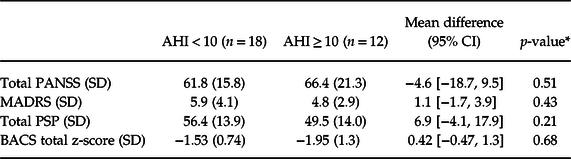
There were no significant associations between diagnosis of OSA and measures of psychopathology using the total PANSS, MADRS and PSP, nor was there a significant association between diagnosis of OSA and mean BACS z-score (see Table 5).
Consort diagram.

Associations between OSA and mean psychopathology and cognitive scores

* Mann-Whitney U test.
Discussion
This pilot study indicates that OSA is highly prevalent in stable community-dwelling people with schizophrenia, occurring at a rate of approximately 40%. These rates are substantially higher than those seen in the general population (Heinzer et al., Reference Heinzer, Vat, Marques-Vidal, Marti-Soler, Andries, Tobback, Mooser, Preisig, Malhotra and Waeber2015) reflecting the excess of obesity seen in our cohort and populations with major mental illness more generally (Galletly et al., Reference Galletly, Foley, Waterreus, Watts, Castle, Mcgrath, Mackinnon and Morgan2012). Diagnosis of OSA was significantly associated with weight, BMI and neck circumference indicating these are clinically relevant predictors of OSA similar to general populations. Our results align with estimates reported in previous literature of between 19% and 57% (Myles et al., Reference Myles, Myles, Antic, Adams, Chandratilleke, Liu, Mercer, Vakulin, Vincent and Wittert2016), however, are comparatively more robust due to our use of an unselected cohort, a cohort that contains only people with schizophrenia and diagnostic methods that have not been used in prior studies.
Despite the high incidence of OSA in our pilot study, sleep symptom scores were not substantially increased. The ESS and PSQI, which are validated in general populations as measures of sleep symptom severity (Buysse et al., Reference Buysse, Reynolds, Monk, Berman and Kupfer1989; Johns, Reference Johns1991), were within the normal range in the majority of people diagnosed with OSA, were not significantly higher in people with OSA and did not correlate with AHI. These findings are similar to previous literature (Anderson et al., Reference Anderson, Waton, Armstrong, Watkinson and Mackin2012) and suggest that the ESS and PSQI should not be used as a means of identifying patients with schizophrenia at high risk of sleep-disordered breathing. The current Australian assessment for rebatable PSGs requires an above threshold score on the ESS. Given the high prevalence of OSA in this population, we suggest that this should not be a restriction for people with schizophrenia.
Similarly, population screening tools performed poorly for the identification of OSA in our cohort. The STOP-BANG and OSA-50 scores have reasonable sensitivity and specificity in primary care populations (Ong et al., Reference Ong, Raudha, Fook-Chong, Lew and Hsu2010; Chai-Coetzer et al., Reference Chai-Coetzer, Antic, Rowland, Catcheside, Esterman, Reed, Williams, Dunn and Mcevoy2011) and are useful as a means of identifying patients at risk of OSA requiring further diagnostic assessment. However, neither have been validated in people with major mental illness. In our cohort, the OSA-50 demonstrated a sensitivity of 50% and specificity of 61%, whilst the STOP-BANG demonstrated a sensitivity of 92% and specificity of 28%, which is lower than that demonstrated in a general population validation cohort (Ong et al., Reference Ong, Raudha, Fook-Chong, Lew and Hsu2010). This lack of diagnostic accuracy may reflect the scores’ reliance on observed sleep symptoms, which are likely to be under-recognised in our cohort given 90% of subjects lacked a bed partner. The superior sensitivity of the STOP-BANG questionnaire reflects this scores’ reliance on anthropometric measurements such as weight, waist circumference, neck circumference and blood pressure. As such, the STOP-BANG is a preferable tool for the identification of OSA in people with schizophrenia at the expense of a high false-positive rate given the ubiquitous burden of obesity in this population that makes the majority of patients high risk.
We were unable to demonstrate a significant association between OSA and psychopathology scores or standardised measures of cognition in our cohort. OSA is known to be associated with poorer occupational performance, cognitive decrements and depression in general populations (Patil et al., Reference Patil, Schneider, Schwartz and Smith2007), which are reversible with CPAP treatment (Sánchez et al., Reference Sánchez, Martínez, Miró, Bardwell and Buela-Casal2009; Pan et al., Reference Pan, Deng, Xu, Liu and Liu2015). It is plausible, due to the high prevalence of sleep disordered breathing in this population, that co-morbid OSA could contribute to or worsen negative symptoms of schizophrenia in some people. Unfortunately, our study is insufficiently powered to detect a difference in psychopathology or cognitive measures. Future research in larger samples are required to definitively explore this possible association given treatment of OSA may potentially modify overlapping cognitive decrements which tend to be treatment resistant and correlate with functional outcomes.
Whilst our study is the first to report prevalence of OSA in an unselected community cohort of people with schizophrenia using gold-standard diagnostic measures, there are a number of limitations to our analysis that warrant discussion. Firstly, our data are derived from a pilot cohort study, and the sample size was underpowered to detect a significant association for a number of outcomes. This is a limitation of the literature more broadly, with the largest previous cohort reporting OSA prevalence in people with schizophrenia having a sample size of 24 (Anderson et al., Reference Anderson, Waton, Armstrong, Watkinson and Mackin2012). Further research is required in larger cohorts to examine whether OSA is associated with poorer psychopathological and cognitive outcomes. Similarly, due to our sample size, we were unable to perform meaningful multivariable analysis. Further evaluation of factors predictive of OSA in people with schizophrenia would be valuable to develop specific screening tools given the poor performance of existing tools we report here. Secondly, our cohort existed entirely of people exposed to clozapine which is associated with the highest risk of obesity compared to other antipsychotic agents. Given OSA in people with schizophrenia is primarily driven by obesity (Myles et al., Reference Myles, Vincent, Myles, Adams, Chandratilleke, Liu, Mercer, Vakulin, Wittert and Galletly2018) and that clozapine use has previously been demonstrated to be associated with risk of OSA (Alam et al., Reference Alam, Chengappa and Ghinassi2012), our results may be biased to a higher prevalence of OSA compared to people with schizophrenia more generally. Thirdly, our data are observational and does not determine whether treatment of OSA co-morbid with schizophrenia improves cognitive measures, psychopathological outcomes, quality of life outcomes or cardiovascular risk factors. However, in an extension of this pilot study, we monitored the response to CPAP and found CPAP improved obesity and cognition when used in people with schizophrenia and severe OSA (published elsewhere) (Myles et al., Reference Myles, Myles, Coetzer, Adams, Chandratilleke, Liu, Mercer, Vakulin, Vincent, Wittert and Galletly2019). Given the high prevalence of OSA in our pilot study and because CPAP treatment modifies these outcomes in general populations, further intervention studies are required to determine whether OSA treatment has any role in improving outcomes in this population.
This study indicates that OSA is highly prevalent in people with schizophrenia and is likely to be substantially under-recognised given that no subject diagnosed with OSA in our cohort had previously undergone diagnostic assessment for OSA. These results suggest that OSA screening and diagnostic assessment should form part of routine metabolic evaluation in people with schizophrenia –given subjects are able to tolerate PSG assessment and effective treatment exists. Our results also suggest that general population sleep symptom tools and diagnostic screening questionnaires are unlikely to reliably identify people at risk and that obesity and increased neck circumference remain the best predictors of OSA in this population. Further research in larger samples is required to determine more accurate predictors of OSA in this population and the impact of co-morbid OSA on cognitive and psychopathological outcomes in people with schizophrenia.
Financial Support
This work was supported by the New Investigator Grant from the Royal Australian and New Zealand College of Psychiatry, awarded to Dr Hannah Myles.
Conflict of interest
Gary Wittert and Robert Adams have received research funding from ResMed foundation. All other authors report no relevant conflict of interest.
Ethical Standards
The authors assert that all procedures contributing to this work comply with the ethical standards of the relevant national and institutional committee on human experimentation with the Helsinki Declaration of 1975, as revised in 2008.