To better understand bilingual children’s language abilities, research often investigates which features of oral language might be related across the children’s two languages and which features might be related within languages (Genesee, Paradis, & Crago, Reference Genesee, Paradis and Crago2004). Narrative research on bilingual children has focused on the relations across and within languages between two levels of their narrative production: macrostructure (i.e., overall story organization and content) and microstructure (i.e., specific linguistic level features) to describe whether narrative abilities support one another. Understanding narrative relations is important because narrative production is a well-known predictor of children’s literacy outcomes and overall academic achievement (e.g., Feagans & Appelbaum, Reference Feagans and Appelbaum1986; Griffin, Hemphill, Camp, & Wolf, Reference Griffin, Hemphill, Camp and Wolf2004; Gutiérrez-Clellen, Reference Gutiérrez-Clellen1998; Miller et al., Reference Miller, Heilmann, Nockerts, Iglesias, Fabiano and Francis2006; Tabors, Snow, & Dickinson, Reference Tabors, Snow, Dickinson, Dickinson and Tabors2001). Despite the consistently cited importance of narrative production, few studies have involved Spanish–English bilingual children in the preschool years. More research is needed given that children of Latino heritage now make up approximately 25% of the total child population of the mainland United States and a majority come from homes where Spanish is spoken (Krogstad & Gonzalez-Barrera, Reference Krogstad and Gonzalez-Barrera2015; Murphey, Guzman, & Torres, Reference Murphey, Guzman and Torres2014). Because achievement gaps exist between Latino children and their monolingual English-speaking peers (Murphey et al., Reference Murphey, Guzman and Torres2014), it is critical to examine preschool narrative performance in this growing group of children. Further research can aid speech–language clinicians and educators in better serving Spanish–English bilingual preschoolers to promote more positive language and literacy outcomes. To meet the need for further research, this study examined cross-language macrostructure and within-language microstructure relations in two groups of bilingual children: those who are Spanish dominant and those who have balanced language abilities.
It is theorized that throughout bilingual children’s development, certain features of their oral language can and do support one another across languages (Cummins, Reference Cummins1979; Dixon et al., Reference Dixon, Zhao, Shin, Wu, Su, Burgess-Brigham and Snow2012). This idea has been tested in several domains including children’s production of narrative macrostructure and microstructure. It is proposed that bilingual children’s ability to produce macrostructure features is shared across their languages because macrostructure is the underlying structure, or organization, of a story (Berman & Slobin, Reference Berman and Slobin1994; Hughes, McGillivray, & Schmidek, Reference Hughes, McGillivray and Schmidek1997; Mandler & Johnson, Reference Mandler and Johnson1977). Narrative macrostructure is often measured by the inclusion of story grammar components such as an introduction and a resolution, and may also be measured by the child’s ability to sequence a coherent story and convey characters’ actions related to a goal (e.g., Hughes et al., Reference Hughes, McGillivray and Schmidek1997). Microstructure includes utterance-level measures of grammatical productivity and complexity and lexical content (Heilmann, Miller, Nockerts, & Dunaway, Reference Heilmann, Miller, Nockerts and Dunaway2010; Hughes et al., Reference Hughes, McGillivray and Schmidek1997). Research suggests that for bilinguals, microstructure abilities are more language specific than macrostructure because vocabulary and grammar are highly related to one another within languages but are weakly related across languages (e.g., Kohnert, Kan, & Conboy, Reference Kohnert, Kan and Conboy2010; Simon-Cereijido & Gutiérrez-Clellen, Reference Simon-Cereijido and Gutiérrez-Clellen2009). In addition, research on bilingual children’s narratives suggests that microstructure forms support the production of macrostructure features within languages (Iluz-Cohen & Walters, Reference Iluz-Cohen and Walters2012; Lucero, Reference Lucero2015).
Much of the research on Spanish–English bilingual children’s narrative macrostructure and microstructure production has focused on the school-age years. More information is needed concerning the narrative production of Spanish–English bilingual preschoolers because the preschool years are an important time when children begin to sequence ideas and events to form narratives (Berman & Slobin, Reference Berman and Slobin1994; Peterson & McCabe, Reference Peterson and McCabe1983). Furthermore, the preschool years are a critical time to promote more positive academic outcomes for Spanish–English bilingual children (Espinosa, Reference Espinosa2013). Therefore, this study extends the understanding of bilingual children’s narrative skills through a focus on Spanish–English preschool-age children. Specifically, this study investigates whether narrative macrostructure is related across languages (Spanish macrostructure ←→ English macrostructure) and whether macrostructure is related to microstructure within languages (Spanish microstructure → Spanish macrostructure; English microstructure → English macrostructure) to determine whether these narrative levels support one another during this early stage of narrative development.
Potential cross- and within-language relations may be complicated by the fact that many bilingual preschoolers possess varying language abilities in both English and Spanish when their narrative development begins (Hammer et al., Reference Hammer, Hoff, Uchikoshi, Gillanders, Castro and Sandilos2014; Mathematica Policy Research Institute, 2013). Therefore, in this study, the term bilingual encompasses a range of children who have acquired varying abilities in their two languages. This includes children who are dominant in one language, and children with relatively balanced dual-language abilities (Bialystok, Reference Bialystok2001). Previous studies suggest that language dominance may impact the strength of cross- and within-language narrative relations (e.g., Kang, Reference Kang2012; Montanari, Reference Montanari2004; Viberg, Reference Viberg, Verhoeven and Strömqvist2001), although this idea has yet to be tested. Therefore, this study also investigated whether language dominance impacted narrative relations.
Narrative macrostructure production across languages
Narrative macrostructure is recognized as one area of oral language that is accessible across bilingual children’s languages. It is theorized that the ability to produce a well-formed narrative is not necessarily a skill that is specific to one language because macrostructure development taps into general cognitive processes, which are somewhat independent from linguistic development (e.g., Kupersmitt & Berman, Reference Kupersmitt, Berman, Verhoeven and Strömqvist2001; Stein & Albro, Reference Stein, Albro and Bamberg1997; Trabasso, Stein, Rodkin, Park Munger, & Baughn, Reference Trabasso, Stein, Rodkin, Park Munger and Baughn1992; Westby, Van Dongen, & Maggart, Reference Westby, Van Dongen and Maggart1989). Therefore, when bilingual children acquire specific macrostructure features in one language, they should be able to use those features to tell stories in their other language (Pearson, Reference Pearson, Oller and Eilers2002). For example, a bilingual child’s ability to state a conflict resolution, a common story component, in one language should support stating resolutions in the other language. To test whether macrostructure is shared across languages in Spanish–English bilingual children, Pearson (Reference Pearson, Oller and Eilers2002) investigated the narrative production of second and fifth graders and found that macrostructure scores were highly related across the two languages.
Research on Spanish–English school-age children may not generalize to preschoolers because narrative abilities vary considerably by age as the ability to produce macrostructure features emerges during the preschool years (Berman, Reference Berman1988; Berman & Slobin, Reference Berman and Slobin1994; Hudson & Shapiro, Reference Hudson, Shapiro, McCabe and Peterson1991; Peterson & McCabe, Reference Peterson and McCabe1983). The Spanish–English bilingual children studied by Pearson (Reference Pearson, Oller and Eilers2002) likely produced narratives with better developed macrostructure features than would be found in preschoolers due to more experience listening to and telling stories, and more experience producing macrostructure in both of their two languages. Lending support to the idea that cross-language associations may not be found in younger bilinguals are the findings of Roch, Florit, and Levorato (Reference Roch, Florit and Levorato2016), who examined the narratives of two age groups of Italian–English bilingual children. Positive associations were found between Italian and English macrostructure scores for the older children, ranging in age from 6 to 7 years. No cross-language associations were found for children in the younger group, who were 5 to 6 years old. The authors speculated that the younger children might not yet be able to distribute certain resources across their two languages. Similarly, Squires et al. (Reference Squires, Lugo-Neris, Peña, Bedore, Bohman and Gillam2014) found cross-language macrostructure associations when Spanish–English bilingual children were in first grade, but no associations were found in kindergarten.
Yet, the cross-language studies that included preschool-age children produced inconsistent results. A lack of cross-language influence was observed in three studies of bilingual children ranging from 4 to 6 years of age who spoke different language pairs, including Kang (Reference Kang2012) when examining the associations between macrostructure scores of Korean–English bilinguals; by Kapalková, Polišenská, Marková, and Fenton (Reference Kapalková, Polišenská, Marková and Fenton2016) when examining mean Swedish and English macrostructure scores; and by Fiestas and Peña (Reference Fiestas and Peña2004) when examining individual macrostructure features produced in Spanish and in English. Other studies of 4- to 6-year-old bilinguals, however, found cross-language macrostructure relations using correlations (e.g., Rodina, Reference Rodina2017) or found equivalence between macrostructure scores when examining means (e.g., Altman, Armon-Lotem, Fichman, & Walters, Reference Altman, Armon-Lotem, Fichman and Walters2016; Kunnari, Välimaa, & Laukkanen-Nevala, Reference Kunnari, Välimaa and Laukkanen-Nevala2016; Méndez, Perry, Holt, Bian, & Fafulas, Reference Méndez, Perry, Holt, Bian and Fafulas2018). Although these studies have contributed to our understanding of macrostructure production in young bilingual children, the mixed findings and methodological differences prompt the need for additional studies at an early stage in narrative development. Furthermore, studies are needed that account for microstructure abilities that may influence macrostructure at an early age. Currently, there is a lack of information as to whether bilingual preschoolers’ ability to produce macrostructure features in one language supports macrostructure production in the other language after accounting for microstructure skills within languages.
The within-language relations of macrostructure and microstructure
In addition to potential cross-language relations between narrative macrostructure, it is hypothesized that preschool-age bilingual children’s narratives will demonstrate strong within-language relations between microstructure and macrostructure. That is, children’s Spanish microstructure abilities will be related to their Spanish macrostructure and English microstructure will be related to English macrostructure. Research on children of various age groups has demonstrated that narrative macrostructure development is supported by microstructure development (e.g., Berman & Slobin, Reference Berman and Slobin1994; Peterson & McCabe, Reference Peterson and McCabe1983, Reference Peterson, McCabe, McCabe and Peterson1991). Narrative organization and advancement of the storyline have been found to be related to the use of grammatical and lexical forms such as verb tense, verbs of motion, prepositional phrases, connective devices, and relative clauses, as well as overall vocabulary size in various languages (e.g., Berman & Slobin, Reference Berman and Slobin1994; Dasinger & Toupin, Reference Dasinger, Toupin, Berman and Slobin1994; Jisa & Kern, Reference Jisa and Kern1995, Shapiro & Hudson, Reference Shapiro and Hudson1991). For example, narrative organization is aided by lexical items (e.g., because and then) to explain characters’ motivations and connect story events (Shapiro & Hudson, Reference Shapiro and Hudson1991). Because microstructure forms support macrostructure production, strong associations are observed between the two levels of narrative analysis (Heilmann, Miller, Nockerts, et al., Reference Heilmann, Miller, Nockerts and Dunaway2010). When studying 5- to 7-year-old English monolingual children, Heilmann, Miller, Nockerts, et al. found that macrostructure performance was correlated with the microstructure measures of mean length of utterance (MLU), grammatical complexity (measured by subordination index), and number of different words (NDW), but only NDW was a unique predictor of macrostructure. The authors speculated that at a young age, children rely mainly on their vocabulary knowledge to express macrostructure functions.
Evidence suggests that bilingual children develop the ability to map microstructure forms onto macrostructure functions within each of their languages, similar to monolingual children (Álvarez, Reference Álvarez2003; Dart, Reference Dart1992). Although no equivalent research on Spanish–English bilingual preschoolers exists, three studies examined the within-language relations between macrostructure and microstructure in the narratives of school-age bilingual children (ages 5–7). Two of the studies involved children whose languages were typologically different (Iluz-Cohen & Walters, Reference Iluz-Cohen and Walters2012; Kang, Reference Kang2012), whereas the third study by Lucero (Reference Lucero2015) focused on Spanish–English bilinguals. The results of each study demonstrated associations between microstructure features (i.e., number of function words, type-token ratio, NDW, and MLU) and macrostructure within each language. For example, Lucero found that NDW was a unique predictor of macrostructure within each language and English MLU and subordination index (SI) uniquely predicted English macrostructure. Similarly, Iluz-Cohen and Walters (Reference Iluz-Cohen and Walters2012) found a strong correlation between the two levels of narrative analysis in Hebrew and in English. These studies of school-age children support the potential for similar within-language relations during the preschool years. However, few studies have examined both cross-language macrostructure relations and within-language microstructure to macrostructure relations.
At present, two studies have examined cross-language macrostructure associations concurrent with associations between microstructure and macrostructure in the narratives of young bilinguals, but their findings differ. Kang (Reference Kang2012) examined 5- to 6-year-old Korean–English bilinguals and found that English microstructure measures predicted children’s production of English macrostructure; however, children’s production of Korean macrostructure was not a significant predictor of English macrostructure when controlling for English narrative microstructure measures. Contrary to Kang’s findings, Rezzonico et al. (Reference Rezzonico, Goldberg, Mak, Yap, Milburn, Belletti and Girolametto2016) examined 4- to 5-year-old Cantonese–English bilingual children and found that Cantonese macrostructure did predict English macrostructure after controlling for English microstructure measures. The mixed findings may be due, in part, to differences in the participants’ language dominance, a possibility that is discussed below.
Language dominance and cross- and within-language narrative relations
Language dominance refers to the relationship between bilingual children’s abilities in their two languages (Birdsong, Reference Birdsong2014; Treffers-Daller, Reference Treffers-Daller2011). Two types of dominance are typically discussed. Bilingual children can either have stronger/dominant language skills in one language in comparison to the other or have relatively balanced/equal skills in both languages (Silva-Corvalán & Treffers-Daller, Reference Silva-Corvalán, Treffers-Daller, Silva-Corvalán and Treffers-Daller2016). These differences in dominance can result in differences in children’s skills in their two languages. Although it is hypothesized that certain narrative language abilities support one another across and within languages, the amount of support may differ based on characteristics of the children. Therefore, examining groups based on whether children are Spanish dominant or possess balanced language abilities may illuminate whether the strength of cross- (i.e., macrostructure to macrostructure) and within-language (i.e., microstructure to macrostructure) narrative relations differ.
Cross-language macrostructure relations may be stronger for children with balanced dominance than for children who are dominant in one language. Even though narrative macrostructure is considered one area of oral language that is shared between languages, Viberg (Reference Viberg, Verhoeven and Strömqvist2001) proposed that children need to attain a threshold of proficiency in their second language before this skill is shared between languages. Viberg noted that Finnish–Swedish bilingual school-age children told stories in both languages with similar macrostructure elements except for the small number of children who had weaker linguistic abilities in Swedish. Therefore, children with balanced language abilities may have met the necessary ability levels in both languages for cross-language relations to occur. In contrast, children who are dominant in one language may lack the necessary vocabulary and grammatical skills in their weaker language to support the use of macrostructure features in that language, even if they have previously acquired these features in their stronger language. This idea is supported by the work of Kang (Reference Kang2012) and Rezzonico et al. (Reference Rezzonico, Goldberg, Mak, Yap, Milburn, Belletti and Girolametto2016) discussed above. The children in Kang’s (Reference Kang2012) study were reported to have stronger Korean abilities, so they may not have developed the linguistic skills needed in English to convey more advanced macrostructure features previously acquired in Korean; as such, there was no cross-language association. The children in Rezzonico et al. (Reference Rezzonico, Goldberg, Mak, Yap, Milburn, Belletti and Girolametto2016) were reported to have balanced abilities based on their vocabulary scores, which may be why significant cross-language macrostructure relations were found even after accounting for microstructure.
Conversely, children who are dominant in one language may demonstrate stronger within-language relations between macrostructure and microstructure in the narratives of their weaker language as compared to children with balanced abilities. Like the children in Kang’s study, the children may be reliant on linguistic forms to convey macrostructure features in their weaker language. At present, one study has examined the narratives of young Spanish–English bilingual children who possessed stronger Spanish than English abilities. Montanari (Reference Montanari2004) found that three kindergarten children’s English narratives were highly dependent on their use of English microstructure features. Limited vocabulary and a narrow range of syntactic structures in English resulted in limited inclusion of macrostructure components such as a problem and a resolution, and a lack of overall coherence of their English stories. Yet, the children’s Spanish narratives suggested that they had developed adequate narrative macrostructure. Montanari’s small sample limits generalization but demonstrates the need for additional studies with a larger number of Spanish–English bilingual children.
These cross-study comparisons and interpretations that dominance impacted narrative relations must be interpreted with caution. Specifically, language dominance and proficiency were quantified differently by investigators (i.e., parent report of exposure vs. direct assessments) or were not reported, and children with different dominance profiles were not compared within the same study. One study to date by Hao, Bedore, Sheng, and Peña (Reference Hao, Bedore, Sheng and Peña2018) lends strong support for the need to conduct additional studies that compare differing groups of bilingual children. The Mandarin–English bilingual children in their study had greater exposure to English than Mandarin and scored higher on English narrative measures. Only the group of children with high Mandarin vocabulary scores demonstrated cross-language macrostructure relations, consistent with the idea of Viberg (Reference Viberg, Verhoeven and Strömqvist2001). Therefore, further work is needed comparing children who are dominant in one language and children who have balanced abilities within the same study.
Purpose of the study
The preschool years mark an important time when narrative abilities emerge. Despite the critical nature of this age, little research has examined both cross- and within-languages relations to narrative macrostructure during the preschool years for Spanish–English bilingual children. Furthermore, the research that did include preschool-age children is inconclusive, and few studies have considered children’s language dominance, evidencing the need for additional studies. Therefore, the purpose of this study was to investigate the cross-language (macrostructure to macrostructure) and within-language (microstructure to macrostructure) relations to narrative macrostructure in two groups of Spanish–English bilingual preschool children: those with balanced language abilities and those who are Spanish dominant.
The first question investigated both the cross-language relation between English macrostructure and Spanish macrostructure and the within-language relations of microstructure to macrostructure, specifically: (a) is English macrostructure production predicted by English microstructure features and Spanish macrostructure, and (b) is Spanish macrostructure production predicted by Spanish microstructure features and English macrostructure? It was hypothesized that cross-language associations between English macrostructure and Spanish macrostructure would be observed as well as within-language relations between microstructure and macrostructure for both languages, consistent with previous research on Spanish–English bilingual school-age children (e.g., Lucero, Reference Lucero2015; Pearson, Reference Pearson, Oller and Eilers2002).
The second question addressed whether two groups of children, those with balanced language abilities and those who were Spanish dominant, differed on the strength of the previously mentioned cross- and within-language relations. Groups were defined based on the children’s performance on a standardized language battery given in English and Spanish. It was hypothesized that children with balanced abilities would demonstrate stronger cross-language relations between their English and Spanish macrostructure than the Spanish-dominant children (e.g., Hao et al., Reference Hao, Bedore, Sheng and Peña2018; Viberg, Reference Viberg, Verhoeven and Strömqvist2001). It was also hypothesized that the Spanish-dominant children would demonstrate stronger within-language relations between English macrostructure and English microstructure than children who had balanced abilities (Montanari, Reference Montanari2004).
Method
Participants
Participants included 200 children recruited for a larger language, self-regulation, and literacy project. Sixty-two percent of the children were recruited from Head Start programs in Florida, and the other 38% were recruited from early childhood preschool programs serving children from low-income backgrounds in New York. All children had at least one parent of Latino descent. There were 95 boys and 105 girls. The mean age was 54.65 months (SD = 4.04) with a range of 37 to 63 months. Ninety-five percent of the children were born within the mainland United States. Children were all in full-day preschool classrooms where English was the primary language of instruction.
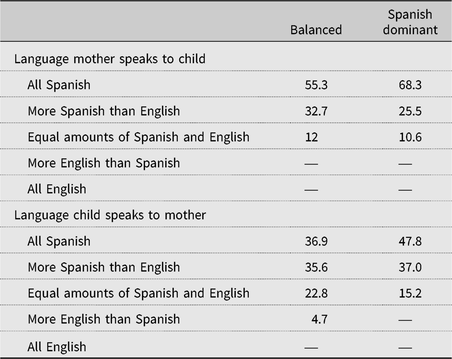
To be included in the larger study, children had to be exposed to Spanish at home from birth by a family member such as a parent or grandparent (N = 400). Children were typically developing, meaning there were no parent or teacher concerns about development, and they were not currently being served by an individualized education plan. To participate in this study, children had to have stronger Spanish skills than English skills (i.e., Spanish dominant, n = 48) or have balanced abilities in Spanish and English (i.e., balanced, n = 152). Information about the children’s exposure to and usage of each language is reported in Table 1. Mothers reported which language(s) they used with their child and which language(s) their child used when speaking to them: all Spanish, more Spanish than English, equal Spanish and English, more English than Spanish, and all English.
Children’s language exposure and usage expressed as a percentage

Determination of language dominance groups
Children’s scores on standardized tests were used to determine the language dominance groups. Various methods have been used to operationalize dominance, including parent and teacher report, length of exposure to each language, and comparing performance on standardized language assessments given in both languages (Silva-Corvalán & Treffers-Daller, Reference Silva-Corvalán, Treffers-Daller, Silva-Corvalán and Treffers-Daller2016). Standardized tests can provide an objective measure that potentially captures the influence of multiple factors that influence dual-language acquisition. Vocabulary and oral comprehension were assessed in Spanish and English using the expressive vocabulary and sentence structure subtests of the Clinical Evaluation of Language Fundamentals—Preschool-2 (CELF-P2; Wiig, Secord, & Semel, Reference Wiig, Secord and Semel2004) and the CELF Preschool—2 Spanish (Wiig, Secord, & Semel, Reference Wiig, Secord and Semel2009). Although the CELF Preschool assessments were not designed specifically to determine dominance, the Spanish version was designed to parallel the English version, allowing the researchers to examine Spanish and English abilities relative to one another. The English and Spanish subtests follow similar formats, but are not direct translations of one another. The expressive vocabulary subtest measures the ability to label pictures of people, objects, and actions. Each item is worth a maximum of 2 points, earned by stating the exact response listed in the examiner’s manual. One point is earned if the child states a related response. Points were awarded only if the responses were produced in the target language. Spanish dialect differences were taken into consideration when scoring the Spanish version. The sentence structure subtest measures the ability to understand spoken sentences that increase in length and complexity. Children point to the picture that corresponds to the spoken sentence.
The CELF Preschool subtests in English and Spanish generate scaled scores that are derived from the total raw scores and have a mean of 10 and a standard deviation of 3. To determine the groups, first the expressive vocabulary and sentence structure scaled scores were summed and averaged for English (M = 5.02, SD = 2.54) and Spanish (M = 7.12, SD = 2.89). Then the English average was subtracted from the Spanish average to create a variable for the difference in averages. The mean of the “difference in averages” variable was determined (M = 2.09, SD = 3.74). Finally, children who fell 1 SD or more above the mean were classified as Spanish dominant (average difference scores from 5.83 to 11.50), children who fell 1 SD or more below the mean were classified English dominant (average difference scores from –8.50 to –1.65), and children who fell within 1 SD of the mean were classified as having balanced abilities (average difference scores from –1.64 to 5.82). Similar methods have been utilized with samples of bilingual children and adults (Bedore, Peña, Gillam, & Ho, Reference Bedore, Peña, Gillam and Ho2010; Iluz-Cohen & Armon-Lotem, Reference Iluz-Cohen and Armon-Lotem2013; Rolla San Francisco, Carlo, August, & Snow, Reference Rolla San Francisco, Carlo, August and Snow2006; Rosselli et al., Reference Rosselli, Ardila, Santisi, Arecco, Salvatierra, Conde and Lenis2002).
Selection of children for the current study
Children were selected for the current study in several stages. First, children from the larger study for whom language dominance could not be calculated (n = 33) were eliminated. Second, although three groups were created in the analyses, only two groups were used in the current study: children with balanced language abilities and Spanish-dominant children. English-dominant children were unable to produce Spanish narratives of sufficient length for analyses (n = 63). The final sample (N = 200) was determined by listwise deletion, meaning that children in the Spanish-dominant (n = 48) and balanced (n = 152) groups had to produce a usable narrative in both languages. To be considered usable, a narrative had to have at least four complete and intelligible utterances spoken in the target language and >55% utterances spoken in the target language (Heilmann et al., Reference Heilmann, Miller, Iglesias, Fabiano-Smith, Nockerts and Andriacchi2008).
A one-way analysis of variance confirmed there was no significant difference between the two dominance groups’ average age in months (balanced = 54.74; Spanish-dominant = 54.33), F (1, 198) = 0.375, p = .541. An examination of the cross-tabulation confirmed there was no significant difference in the proportion of children in either dominance group by location (FL vs. NY), χ2 (1) = 0.067, p = .795.
Procedures
Data collectors, fluent in the language of testing, administered the standardized language tests and elicited narrative samples in both English and Spanish. Data collectors were trained in assessment procedures by a certified speech-language pathologist. Assessments occurred in the children’s schools outside the classroom in a quiet area designated for assessment. Testing for each language occurred on separate days, about a week apart, and was counterbalanced.
Narratives were elicited using wordless picture books by Mercer Mayer. Children were asked to tell the story in A Boy, a Dog, a Frog, and a Friend (Mayer & Mayer, Reference Mayer and Mayer1971) for their English narrative and the story in One Frog too Many (Mayer, Reference Mayer1975) for their Spanish narrative. Two books were used to avoid a practice effect. The books were chosen due to their similarities. They contain the same main characters, the same number of pages, and a conflict between characters at the beginning of the story that prompts the characters’ subsequent actions. Data collectors were only permitted to use open-ended prompts (e.g., “Oh look, what happened?”) or restate the child’s previous utterance. All narratives were video or audio recorded and stored on a secure server for later transcription and analyses.
Analyses of the narrative samples
Narrative transcription
The narratives were transcribed using the conventions of the Systematic Analysis of Language Transcripts (SALT) software (Miller & Iglesias, Reference Miller and Iglesias2012) by graduate and undergraduate students who were fluent in the language they were assigned to transcribe. The students were trained and supervised by two doctoral students who were also certified speech-language pathologists. Utterances were segmented into communication units (C-unit), which contain an independent clause and its modifiers (Loban, Reference Loban1976).
Reliability
Three levels of accuracy checks were implemented for morpheme coding and utterance segmentation. First, after each sample was initially transcribed and coded, a different student transcriber listened to each sample while checking the transcript for accuracy of morpheme codes and utterance segmentation. Any discrepancies were noted. Second, each transcript was reviewed by a supervising doctoral student who was fluent in the language of the narrative and a certified speech-language pathologist. Any discrepancies were usually resolved at this level. The final level of accuracy check was completed by the second author, also a certified speech-language pathologist, who resolved any final discrepancies.
In addition to the accuracy checks, word-level interrater reliability was conducted for a randomly selected 20% of the narrative transcripts in both English and Spanish. Each narrative was re-transcribed by a different student transcriber who was not the original transcriber or second checker. Word-by-word reliability was 82% for English and 80% for Spanish. Any discrepancies in wording were resolved through consensus with the two transcribers and the supervising doctoral students.
Microstructure
Measures of vocabulary and grammar were calculated from each child’s Spanish and English narrative transcripts using SALT software. Each measure was calculated from the complete and intelligible utterances from each transcript. Utterances that were incomplete, unintelligible, nonverbal, or a rote social phrase (e.g., “thank you”) were excluded.
Vocabulary
NDW is a measure of lexical diversity and is calculated by counting the number of unique words (word roots without inflections) used in the narrative language sample (Miller, Reference Miller1981). NDW was used because it provides a comparable measure in both languages (Gutiérrez-Clellen, Restrepo, Bedore, Peña, & Anderson, Reference Gutiérrez-Clellen, Restrepo, Bedore, Peña and Anderson2000; Miller et al., Reference Miller, Heilmann, Nockerts, Iglesias, Fabiano and Francis2006). In addition to NDW, the number of total words (NTW) in each transcript was calculated by summing the total number of free morphemes in each transcript. NTW and NDW for each language were calculated using words only in the target language. This means that English NTW and NDW were calculated from only the English words in an English transcript and Spanish NTW and NDW were calculated from only the Spanish words in a Spanish transcript.
Grammar
Grammatical measures of mean length of utterance in words (MLU-w) and SI were calculated. When calculating MLU-w and SI, code mixed utterances were excluded if these utterances would change the MLU-w for that specific utterance. For example, in an English transcript, “He’s catching the palo” was included because the child produced a lexical switch that would not change MLU-w if “stick” were said instead of “palo.” Conversely, the utterance “And turtle no va” was excluded because it consists of four words. If the child had spoken the utterance all in English, it would have been five words, “And turtle does not go.” In a Spanish transcript, “Aquí está éste hat y zapatos” (Here is this hat and shoes) was included because the child made a lexical switch and it would not have changed the MLU-w if the child said “sombrero” instead of “hat.” Conversely, the utterance “No estuvieron no one” (There was no one there) was excluded because the MLU-w differed from “No estuvo nadie” or “Nadie estuvo” in Spanish.
MLU-w is a measure of grammatical productivity. It is calculated by dividing the total number of words by the total number of complete and intelligible utterances within a language sample to determine the average number of words per utterance. MLU-w was used because it provides a comparable measure of average utterance length in both languages (Gutiérrez-Clellen et al., Reference Gutiérrez-Clellen, Restrepo, Bedore, Peña and Anderson2000; Miller et al., Reference Miller, Heilmann, Nockerts, Iglesias, Fabiano and Francis2006).
SI is a measure of clausal density and is the average number of clauses per C-unit (Scott, Reference Scott1988; Strong, Reference Strong1998). The number of clauses per C-unit was determined by student SI coders who were trained and supervised by a certified speech-language pathologist and were fluent in the language of transcription. Utterances with an omission of a subject or a main verb were assigned an SI code of 0. In English, a clause with an omitted subject was always assigned an SI code of 0; however, Spanish allows for the omission of a pronoun with a subject implied in the verb (Gutiérrez-Clellen, Reference Gutiérrez-Clellen1998; Silliman, Bahr, Brea, Hnath-Chisolm, & Mahecha, Reference Silliman, Bahr, Brea, Hnath-Chisolm and Mahecha2002). For English, an utterance missing a subject, such as “Only go like this,” was assigned an SI code of 0. In Spanish, the utterance “Y no tiene zapatos” was assigned an SI code of 1, because the subject was introduced in the previous utterance. SI was calculated by summing the number of total clauses produced by the child (including main and subordinate clauses) and dividing by the total number of complete and intelligible utterances.
Reliability
To ensure reliability between the SI coders, 20% of the narrative transcripts in English and Spanish were randomly selected and were recoded by a second student SI coder. SI reliability was 95% for English and Spanish.
Macrostructure
The narrative scoring scheme (NSS) is an index of narrative organization designed to be a developmentally sensitive measure for children ranging from preschool through fourth grade (Heilmann, Miller, & Nockerts, Reference Heilmann, Miller and Nockerts2010). The NSS was used as a measure of macrostructure in several studies using diverse samples of children including bilinguals (Bajaj, Reference Bajaj2007; Finestack, Palmer, & Abbeduto, Reference Finestack, Palmer and Abbeduto2012; King, Dockrell, & Stuart, Reference King, Dockrell and Stuart2014; Lucero, Reference Lucero2015; Miller et al., Reference Miller, Heilmann, Nockerts, Iglesias, Fabiano and Francis2006; Zhang, Anderson, & Nguyen-Jahiel, Reference Zhang, Anderson and Nguyen-Jahiel2013). The NSS has seven components, including three for story grammar: introduction, conflict resolution, and conclusion; two for literate language: mental states and character development; and two for cohesion: referencing and cohesion (Heilmann, Miller, Nockerts, et al., Reference Heilmann, Miller, Nockerts and Dunaway2010). For each transcript, the seven narrative macrostructure components were scored on a scale from 0 (poor) to 5 (proficient) by trained undergraduate students who were fluent in the language of the transcript. The students were systematically trained by the first author and were given an NSS coding manual containing explicit examples of the scoring criteria as well as the scoring rubrics provided by SALT Software. A transcript received a score of all zeros based on guidelines outlined in Heilmann, Miller, Nockerts, et al. (Reference Heilmann, Miller, Nockerts and Dunaway2010): (a) the child omitted a large portion of the story not due to examiner or recording errors, (b) the child told the story entirely in nontarget language, or (c) the child used only gestures, noises, or repetitions of the examiner’s utterances. The seven scores were summed to create the total NSS score which can range from 0 to 35. In the current sample, internal consistencies for both English (α = .889) and Spanish (α = .811) were high.
Reliability
Twenty percent of the transcripts in both English and Spanish were randomly selected to ensure interrater reliability for NSS coding. A second student, also systematically trained on the NSS scoring system, recoded each of these transcripts. To ensure accuracy between the coders, percent exact and adjacent agreements were calculated. Adjacent agreement was defined as coder judgments within 1 point of each other (e.g., Gorman, Bingham, Fiestas, & Terry, Reference Gorman, Bingham, Fiestas and Terry2016). For English, exact agreement was 78% and adjacent agreement was 97%. For Spanish, exact agreement was 75% and adjacent agreement was 98%.
Results
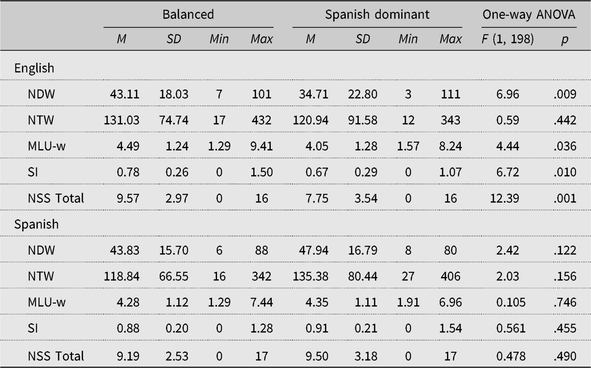
All analyses were conducted using the SPSS statistics program Version 23.0 for Mac (IBM Corp., 2015). No floor effects were noted for the microstructure (NDW, MLU-w, and SI) and macrostructure (NSS) variables. Two children with high English MLU-w were flagged as possible outliers, but results with the cases both included and excluded revealed there was no justification for the elimination of these transcripts. Descriptive statistics are displayed by group in Table 2 along with a series of one-way analyses of variance that confirmed significant differences between the groups’ English narrative production but not Spanish narrative production.
Descriptive statistics for microstructure and macrostructure measures

Note: ANOVA, analysis of variance. NDW, number of different words. NTW, number of total words. MLU-w, mean length of utterance in words. SI, subordination index. NSS, narrative scoring scheme.
Separate means were also calculated for each aspect of the NSS: story grammar, literate language, and cohesion. On average, the children’s use of English story grammar (M = 3.38, SD = 1.26), literate language (M = 2.82, SD = 1.25), and cohesion (M = 2.79, SD = 1.33) were all in the immature range (Heilmann, Miller, Nockerts, et al., Reference Heilmann, Miller, Nockerts and Dunaway2010). Similar results were found for Spanish. Children’s use of Spanish story grammar features (M = 3.46, SD = 0.99), literate language (M = 3.23, SD = 1.20), and cohesion (M =2.59, SD = 0.94) were also all in the immature range.
Correlations
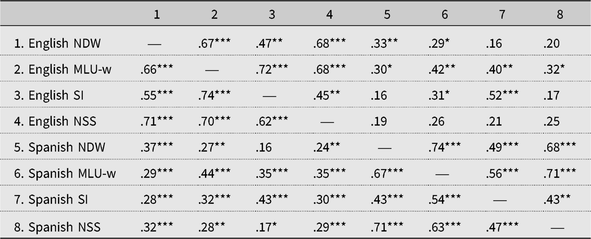
Pearson correlations were calculated for each group and are displayed in Table 3. Cross-language correlations between English and Spanish NSS were small for each group. The cross-language correlation for the balanced group was significant (r = .29, p < .001), whereas for the Spanish-dominant group, the correlation was nonsignificant (r = .25, p = .087). English microstructure measures were moderately to highly correlated with English NSS for both groups (rs ranged from .45 to .71). Spanish microstructure measures were moderately to highly correlated with Spanish NSS for both groups (rs ranged from .43 to .71).
Pearson correlations

Note: The lower diagonal displays correlations for the balanced group. The upper diagonal displays correlations for the Spanish-dominant group. NDW, number of different words. MLU-w, mean length of utterance in words. SI, subordination index. NSS, narrative scoring scheme. *p < .05. **p < .01. ***p < .001.
Multiple regressions
To answer the first research question, two multiple regression models were completed with English and Spanish macrostructure (i.e., total NSS score) as the dependent variables. The first model examined whether macrostructure (NSS) in one language was a significant predictor of macrostructure in the other language before controlling for within-language microstructure variables. In the second model, within-language microstructure variables (i.e., NDW, MLU-w, and SI) were added. In both models, age was controlled because narrative microstructure and macrostructure have been found to improve as children mature from ages 3 to 5 (e.g., Applebee, Reference Applebee1978; Botvin & Sutton-Smith, Reference Botvin and Sutton-Smith1977; Trabasso & Rodkin, Reference Trabasso, Rodkin, Berman and Slobin1994). In the second model, NTW was controlled because NDW may be contingent on the length of the narrative sample (Heilmann, Miller, Nockerts, et al., Reference Heilmann, Miller, Nockerts and Dunaway2010; Simon-Cereijido & Gutiérrez-Clellen, Reference Simon-Cereijido and Gutiérrez-Clellen2009). All continuous predictor and control variables were centered on their means to reduce the potential for multicollinearity in the regression models between the interactions and their component variables. (Aiken & West, Reference Aiken and West1991; Dearing & Hamilton, Reference Dearing and Hamilton2006).
To answer the second research question regarding whether the cross- (macrostructure to macrostructure) and within-language (microstructure to macrostructure) relations differ significantly between the two groups of children, two separate regressions for each outcome variable were completed using language group as a moderator variable. The inclusion of group as a moderator determined whether dominance changed the strength of the relation between Spanish and English macrostructure and whether dominance changed the strength of the relation between microstructure measures and macrostructure within languages. Interaction terms were created by multiplying each centered predictor variable and language group. Language group membership was dummy coded (0 = balanced, 1 = Spanish dominant). Four interaction terms were created for the English macrostructure analysis (i.e., Group × Spanish NSS, Group × English NDW, Group × English MLU-w, and Group × English SI). Similarly, four interaction terms were created for the Spanish macrostructure analysis (Group × English NSS, Group × Spanish NDW, Group × Spanish MLU-w, and Group × Spanish SI). The models for each question will first be discussed for English followed by the results of each question for Spanish.
English macrostructure
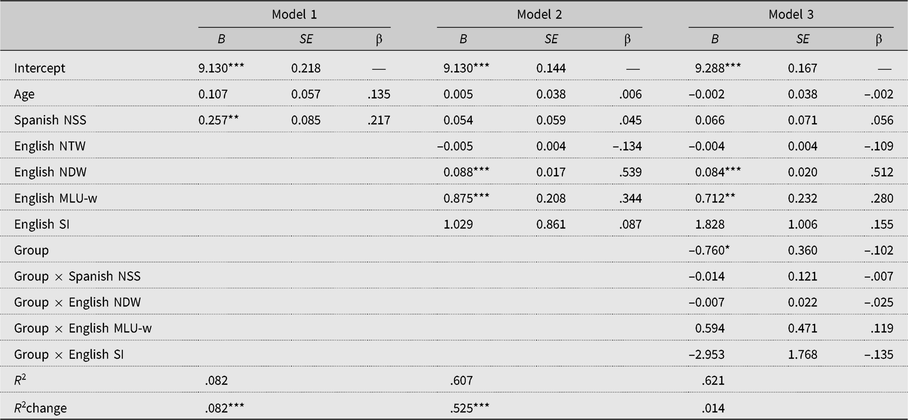
The regression models for English NSS are displayed in Table 4. In the first model, age (β = .135, p = .059) and Spanish NSS (β = .217, p = .003) explained a significant 8.2% of the variance in English NSS, F (2, 197) = 8.82, p < .001. In the second model, English microstructure measures explained an additional 52.5% of the variance in English NSS, ΔF (4, 193) = 64.42, p < .001. English NDW (β = .539, p < .001) and English MLU-w (β = .344, p < .001) were significant predictors of English NSS. Age (β = .006, p = .897), English NTW (β = –.134, p = .192), English SI (β = .087, p = .234), and Spanish NSS (β = .045, p = .365) were nonsignificant. When English microstructure variables were included, Spanish NSS was no longer a significant predictor of English NSS. Therefore, children’s English macrostructure scores were predicted by higher English lexical diversity and longer English sentences and not by Spanish macrostructure.
Regressions for English narrative scoring scheme

Note: NSS, narrative scoring scheme. NTW, number of total words. NDW, number of different words. MLU-w, mean length of utterance in words. SI, subordination index. *p < .05. **p < .01.***p < .001.
Next, the main effect of group and interactions by group were tested. The results are displayed in Table 4 as the third model. The interactions of Group × Spanish NSS (β = –.007, p = .909), Group × English NDW (β = –.025, p = .745), Group × English MLU-w (β = .119, p = .209), and Group × English SI (β = –.135, p = .097) predicted an additional, nonsignificant 1.4% of the variance in English NSS, ΔF (5, 188) = 1.39, p = .229. Therefore, the cross- and within-language relations to English macrostructure were not moderated by dominance.
Spanish macrostructure
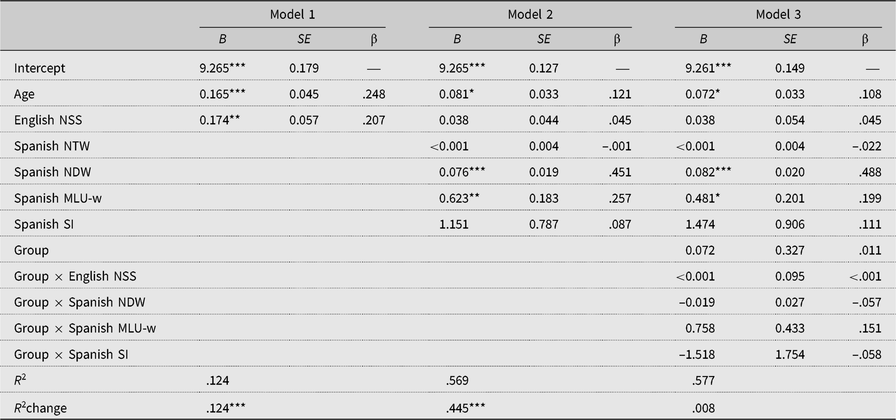
The regression models for Spanish NSS are displayed in Table 5. In the first model, age (β = .248, p < .001) and English NSS (β = .207, p = .003) explained a significant 12.4% of the variance in Spanish NSS, F (4, 193) = 64.42, p < .001. In the second model, Spanish microstructure measures explained an additional 44.5% of the variance in Spanish NSS, ΔF (4, 193) = 49.88, p < .001. Age (β = .121, p = .015), Spanish NDW (β = .451, p < .001), and Spanish MLU-w (β = .257, p = .001) were significant predictors of Spanish NSS. Spanish NTW (β = –.001, p = .995), Spanish SI (β = .087, p = .145), and English NSS (β = .045, p = .393) were nonsignificant. Therefore, children’s Spanish macrostructure scores were predicted by age, Spanish lexical diversity, and Spanish grammatical productivity and not by English macrostructure.
Regressions for Spanish narrative scoring scheme

Note: NSS, narrative scoring scheme. NTW, number of total words. NDW, number of different words. MLU-w, mean length of utterance in words. SI, subordination index. *p < .05. **p < .01. ***p < .001.
Next, the main effect of group and interaction effects by group were tested. The results are displayed in Table 5 as the third model. The interactions of Group × Spanish NSS (β = < .001, p = .997), Group × English NDW (β = –.057, p = .489), Group × English MLU-w (β = .151, p = .082), and Group × English SI (β = –.058, p = .388) predicted an additional, nonsignificant 0.8% of the variance in Spanish NSS, ΔF (5, 188) = 0.69, p = .628. Therefore, the cross- and within-language relations to Spanish macrostructure were not moderated by language dominance.
Discussion
The purpose of the study was to examine the cross- and within-language relations to the macrostructure in Spanish–English bilingual preschoolers’ narratives and to examine whether dominance moderated these relations. Bilingual children’s narrative macrostructure and microstructure relations have received considerable attention in the research literature to better understand whether features of bilingual children’s language support one another in development. However, few studies focused specifically on Spanish–English bilingual preschoolers, who are a growing group of children in US schools. Overall, there is little understanding of Spanish–English bilingual preschoolers’ production of narrative macrostructure and microstructure, which sets the stage for later narrative organization and literacy skills. Therefore, this study represents an important step in understanding bilingual narrative development during the preschool years. This study contributes to the growing body of literature concerning narrative production skills of young bilingual children, which informs researchers and speech-language clinicians as to whether narrative macrostructure and microstructure support one another throughout childhood. Specifically, the first question addressed the simultaneous relations of cross-language macrostructure and within-language microstructure to macrostructure abilities in English and Spanish. The second question addressed whether the children’s language dominance altered the strength of these relations.
The regression results for the first question demonstrated that after controlling for microstructure features within each language, cross-language relations were no longer evident between Spanish macrostructure and English macrostructure, which was contrary to the hypothesis. Positive relations between macrostructure and microstructure were observed within both languages as hypothesized. Children who had better linguistic skills, including more diverse vocabulary (NDW) and a higher number of words per utterance (MLU-w) in one language generated better organized and higher quality narratives in that language. Of note, the results were the same for English and Spanish in that lexical diversity and the average number of words per utterance were unique predictors of macrostructure within each language. However, clausal density (SI) was not predictive of macrostructure scores within each language. The strong relations between macrostructure and microstructure within languages during preschool are partially consistent with previous studies on older monolingual and bilingual children (e.g., Heilmann, Miller, Nockerts, et al., Reference Heilmann, Miller, Nockerts and Dunaway2010; Iluz-Cohen & Walters, Reference Iluz-Cohen and Walters2012; Kang, Reference Kang2012; Lucero, Reference Lucero2015).
The regression results for the second question were contrary to the hypothesis. The balanced and Spanish-dominant groups’ cross-language relations between English and Spanish macrostructure scores did not differ, nor did the within-language relations between macrostructure and microstructure performance. Even though the balanced group had significantly higher English narrative macrostructure and microstructure scores, on average, than the Spanish-dominant group, both groups had similar Spanish narrative abilities, and both groups scored in the low range of the NSS in both languages on average. Both groups of preschool-age children may not have developed their use of macrostructure and microstructure features sufficiently for cross-language macrostructure relations to occur. Dominance may impact narrative relations in a group of children with higher narrative proficiency overall. The children in the balanced group may not yet have sufficiently developed the linguistic and macrostructure abilities needed to reach the requisite threshold proposed by Viberg (Reference Viberg, Verhoeven and Strömqvist2001) for macrostructure to be shared across languages. Both groups of children were similarly reliant on within-language microstructure features to convey their stories. Because language dominance differences were not observed, the cross- and within-language relations for the full sample will now be discussed in detail.
Narrative macrostructure and microstructure relations within languages
Consistent with the hypothesis that microstructure production supports macrostructure production, children’s macrostructure scores were uniquely predicted by lexical diversity (NDW) and average words per utterance (MLU-w) within each language. The finding that NDW was related to macrostructure is consistent with Heilmann, Miller, Nockerts, et al. (Reference Heilmann, Miller, Nockerts and Dunaway2010) and Lucero (Reference Lucero2015), who examined school-age children’s NSS scores in relation to microstructure abilities like those used in the present study. The results of the current study provide evidence that the important relationship between lexical diversity and narrative macrostructure extends to Spanish–English bilingual preschoolers. Children with better developed vocabulary produce richer macrostructure features than children with less developed vocabulary. For example, children with larger vocabularies, who are able to provide more detailed descriptions of characters using adjectives, are awarded more points for character development on the NSS. The connection between vocabulary and macrostructure is evident when examining individual children’s narrative productions. Some children produced narratives of limited length, such as a Spanish-dominant child who received an English NDW score of 3. Although the child with a low NDW produced a usable narrative for analysis, their limited use of vocabulary constrained the production of macrostructure features, thus earning an NSS score of 0.
The finding that utterance length was related to macrostructure within languages is inconsistent with previous research, which is possibly due to how MLU was operationalized. Heilmann, Miller, Nockerts, et al. (Reference Heilmann, Miller, Nockerts and Dunaway2010) found that MLU measured in morphemes was not related to monolingual children’s macrostructure scores after controlling for lexical diversity. In Lucero’s (Reference Lucero2015) study of bilingual first- and second-grade children, Spanish MLU in words was not related to Spanish macrostructure. Yet, Lucero found that English MLU in words was related to English macrostructure, which is consistent with the current study findings. Utterance length may no longer be related to home-language macrostructure during the school-age years, yet continues to be important for macrostructure production in the instructional language. The current study’s finding that lexical diversity and words per utterance were both unique predictors of macrostructure within both languages is inconsistent with Heilmann, Miller, Nockerts, et al.’s (Reference Heilmann, Miller, Nockerts and Dunaway2010) proposal of a unique relationship between narrative organization and lexical diversity before children become literate. Perhaps the relation of utterance length to macrostructure is important for Spanish–English bilingual preschoolers who are developing their English narrative abilities while continuing to develop narrative abilities in their home language. At this young age, the children were more reliant on utterance length rather than complexity to organize their stories in either language.
The finding that clausal density was not a unique predictor of macrostructure in either language is consistent with Heilmann, Miller, Nockerts, et al. (Reference Heilmann, Miller, Nockerts and Dunaway2010). It may be that the children’s clause production was not sufficiently complex to impact macrostructure. On average, the preschoolers in the current study used few complex clauses in English (M = 0.76) and in Spanish (M = 0.89). The use of complex clauses allows the narrator to express more advanced macrostructure features and narrative organization. Specifically, clausal complexity can impact NSS scoring in several ways. First, children can use subordinate clauses to provide further information about characters (Gummersall & Strong, Reference Gummersall and Strong1999; Gutiérrez-Clellen & Hofstetter, Reference Gutiérrez-Clellen and Hofstetter1994) and provide dialogue, which increases their NSS score for character development. For example, children provided information about characters’ states that advanced the storyline, such as “And the frog see that the turtle is down” and “Then the boy said, I have an idea.” Second, subordinate clauses provide information about the sequence of story events (Gutiérrez-Clellen & Hofstetter, Reference Gutiérrez-Clellen and Hofstetter1994), which in turn increases a child’s overall cohesion score on the NSS. For example, a child who said, “Then he was getting his rope before he’s gonna go fishing” provided information about the sequence of the character’s actions. Third, children can use causal subordination using subordinating conjunctions such as “because” to advance the storyline. For example, a child who said, “Then the turtle it was happy because she found a stick to get fish” increased his or her NSS score for mental states by providing a reason why a character felt an emotion to help advance the plot of their story. Although a majority of the children used mostly simple sentences in their narratives, the use of complex sentences was emerging.
Cross-language relations between English macrostructure and Spanish macrostructure
Macrostructure scores were modestly related across languages, but these relations were no longer evident when within-language microstructure was controlled. Although researchers have proposed that the ability to produce macrostructure features is shared across languages (e.g., Pearson, Reference Pearson, Oller and Eilers2002), this study demonstrates that macrostructure’s cross-language influence may not occur at all points in development in all bilingual populations. During the preschool years, macrostructure may be a more language-specific ability than previously thought. As noted, on average, macrostructure scores were in the immature range of the NSS in English and Spanish, indicating that the children’s stories were more focused on describing specific characters and actions on each page rather than relating the overall story sequence and relationships between actions (e.g., Berman, Reference Berman1988; Botvin & Sutton-Smith, Reference Botvin and Sutton-Smith1977). This is evident in the children’s low average scores on the story grammar and cohesion elements of the NSS. Children who logically sequence all events that are critical for advancing the story will receive higher NSS scores than children who spend more time describing minor events with unclear transitions. Although the production of grammatical forms and lexical items needed to describe narrative events emerges as early as 3 years of age, it appears that the preschoolers in this study were still mastering the ability to coordinate various story grammar components and relate them in a cohesive manner (Berman & Slobin, Reference Berman and Slobin1994; Jisa & Kern, Reference Jisa and Kern1995). Thus, these children may need to further develop their macrostructure and microstructure skills within their two languages before unique cross-language macrostructure relations occur. Therefore, the results lend support to Roch et al.’s (Reference Roch, Florit and Levorato2016) and Viberg’s (Reference Viberg, Verhoeven and Strömqvist2001) proposals that as bilingual children gain experience and proficiency with both languages, they are better able to use macrostructure features between their languages.
The results are consistent with Kang (Reference Kang2012) but contrast with Rezzonico et al. (Reference Rezzonico, Goldberg, Mak, Yap, Milburn, Belletti and Girolametto2016). Similar to the current study, Kang found that Korean macrostructure was not related to Korean–English bilingual children’s English macrostructure when microstructure abilities were controlled. English microstructure abilities (i.e., lexical diversity and narrative length) were related to English macrostructure. However, Rezzonico et al. (Reference Rezzonico, Goldberg, Mak, Yap, Milburn, Belletti and Girolametto2016) found cross-language relations after controlling for microstructure production. Because differences in participants’ dominance do not appear to be the reason for the discrepancies among the findings, three explanations are proposed. First, it is possible that the children in Rezzonico et al.’s study had better developed macrostructure abilities than the children in the present study, which allowed for the cross-language influence to remain. However, it is difficult to compare scores across studies, because each study used a different measure of macrostructure. Second, differences may be due to differ scoring systems. Rezzonico et al. used a macrostructure measure that contained only story grammar items, whereas the NSS and Kang’s measure include other global narrative features. Third, across the three studies, it appears that all children were exposed predominately to their first language at home and to English later when they entered school; therefore, the mixed findings may be related to the social and cultural contexts in which the children learned to tell stories.
Limitations and future directions
Several limitations should be noted. The primary limitation is that an English-dominant group could not be examined to determine whether similar cross- and within-language relations would be observed for this group. This is because the majority of children in the English-dominant were not able to produce a narrative in Spanish. Second, additional demographic information, such as parent education levels, children’s timing of exposure to each language, and dialect, was not available for all participants. The larger study attempted to collect this information from the parents using a questionnaire available in both languages. Just over half (55%) of the parents returned the questionnaire despite multiple attempts to contact the families. Third, specific types of narrative activities and the amount of narrative support provided at home and at school were unknown. Similar home or school contexts may have been responsible for the absence of group differences. Fourth and finally, the research literature on bilingual children has yet to establish an agreed upon method for determining language dominance. In this study, dominance was operationalized by relative performance on standardized measures, which captured the children’s relative proficiency on the specific tasks administered. At the time of data collection, the CELF-Preschool tests were one of the few standardized batteries available for Spanish–English speaking children in this age range. The children’s dominance classifications may have varied depending on the language domains assessed and the methods used to determine dominance (e.g., Bedore et al., Reference Bedore, Peña, Summers, Boerger, Resendiz, Greene and Gillam2012).
Several additional directions arose for further research. Longitudinal studies are needed to address the within-language relations of microstructure to macrostructure as children develop. Due to its cross-sectional nature, this study was not designed to test whether macrostructure and microstructure develop in parallel or if one level drives development in the other. Future studies could address how these two narrative levels interact with and support one another over time. Regarding the cross-language relation between English and Spanish macrostructure, future studies could address the language proficiency needed for this relation to occur. Cross-language relations and group differences may have been found among preschoolers with better developed macrostructure production in both languages. Due to differences in methodology, future studies of bilingual children could address the impact of differing scoring systems on cross-language macrostructure relations. Future studies could also examine whether home and school contexts for narrative learning impact macrostructure and microstructure relations.
Educational and clinical implications
One goal in examining cross- and within-language relations is to inform educational programs and interventions for bilingual children; therefore, this study has implications for speech-language clinicians and educators. Assessment of narrative performance is especially important for revealing many aspects of language development for children from linguistically diverse backgrounds, because storytelling is a naturalistic task that is universal among cultures (Bedore et al., Reference Bedore, Peña, Gillam and Ho2010; Cleave, Girolametto, Chen, & Johnson, Reference Cleave, Girolametto, Chen and Johnson2010; Westby et al., Reference Westby, Van Dongen and Maggart1989). In addition, storytelling tasks are routinely utilized within the classroom and therapy sessions to foster language and literacy development (Crais & Lorch, Reference Crais and Lorch1994; Curenton, Reference Curenton2006).
The results have two implications for assessment. First, the results lend further support to the importance of collecting narrative samples in both languages. Due to the lack of a unique cross-language association between macrostructure during preschool, it is possible that children may demonstrate macrostructure features in one language and not the other. Assessing narratives in both languages uncovers which macrostructure features preschool children have in one language that could support development of that feature in the other language. Second, because lexical diversity and utterance length were highly related to narrative macrostructure within languages, microstructure level analyses should be conducted, which could serve as a foundation for improving narrative quality.
The results also have implications for intervention. First, this study underscores the potential benefits of including activities that promote linguistic skills when teaching narrative structure (e.g., Heilmann, Miller, Nockerts, et al., Reference Heilmann, Miller, Nockerts and Dunaway2010; Lucero, Reference Lucero2015). It may not be sufficient to simply focus on building general vocabulary and utterance length during preschool, but clinicians and teachers may need to consider placing special focus on specific vocabulary and grammatical forms that will support macrostructure development within both languages. For example, clinicians could target cohesion words such as “then” or “because” that connect narrative events or target prepositional phrases to describe the locations of characters and objects. Second, preschool-age children who are acquiring two languages may need exposure to and have opportunities to engage in rich storytelling experiences in both languages. High-quality narrative exposure in English and in Spanish can promote preschool children’s knowledge of linguistic features that support macrostructure development in these early years. Therefore, professionals can help support Spanish and English narrative skills at home and in school. Professionals should inform parents of the benefits of engaging in storytelling experiences with their children.
Conclusion
The findings revealed that Spanish–English bilingual preschoolers’ production of narrative macrostructure features in each language were strongly associated with narrative microstructure within that language. However, after controlling for narrative microstructure, narrative macrostructure scores across languages were unrelated. Language dominance did not impact these relations. The findings of the current study confirm previous research underscoring the important role of vocabulary for macrostructure production and extend this finding to preschool-age children acquiring Spanish and English. Furthermore, this study highlights the additional important contribution of utterance length within both languages to narrative macrostructure production during the preschool years. The absence of unique cross-language macrostructure relations and the absence of differences between dominance groups point to the general level of immaturity observed in the children’s narrative production. The results support the need for clinicians to gather narrative information in both languages, provide opportunities for high-quality narrative exposure in both languages, and identify linguistic features that will enhance narrative organization and quality.
Acknowledgments
This research was supported in part by the National Institutes of Health/National Institute of Child Health and Human Development Grant U01-HD-060296 awarded to the second author. The authors wish to thank the parents and their children who participated in the project, along with the school staff who provided the necessary support for data collection. In addition, we would like to thank the research assistants from the Language and Literacy in Diverse Contexts Lab: Elizabeth Brophy, Dr. Lauren M. Cycyk, Annora Dirsa, Carolina Echeverri, Nadine Graham, Taylor Kaminsky, Carly McColgan, and Alexander Tucci.