Introduction
Polycystic ovary syndrome (PCOS) is a very common disease found among women of reproductive age. The prevalence of the disease varies depending on studies and ethnicity of the sample groups, but can be as high as 26%. The first record of this disease goes back to 1721 in Italy. Symptoms of PCOS are similar to symptoms of many other diseases, such as the appearance of acne, hair loss and fatigue, this characteristic makes the diagnosis of the disease more complicated (Wild, Reference Wild2002). One of the main and distinguishable symptoms is the appearance of cysts in the ovaries. Other symptoms can be irregular or prolonged periods, pelvic pain, rapid weight gain and growth of unwanted hair (Insler and Lunenfeld, Reference Insler and Lunenfeld1990). Gaining weight can lead to obesity in many of the patients with PCOS and can cause other difficulties such as cardiac problems as well as diabetes (Goodarzi et al., Reference Goodarzi, Dumesic, Chazenbalk and Azziz2011). Therefore, having a healthy diet and exercising regularly can help these patients and make their lives much easier.
PCOS, as in other common complex diseases, is related to both genetics and environmental factors such as lifestyle, diet and lack of exercises (Khan et al., Reference Khan, Ullah and Basit2019). PCOS is categorized as an endocrine disease, meaning that abnormalities in the formation and level of hormones will lead to the disorder. These abnormalities usually lead to problems in ovulation, causing infertility among women (Qiao and Feng, Reference Qiao and Feng2010). Androgens, insulin and progesterone are the main hormones affected by these abnormalities (Dunaif and Fauser, Reference Dunaif and Fauser2013). An elevated level of androgens was observed among patients with PCOS. Insulin imbalance also has been correlated with an increased risk of diabetes for patients PCOS and, finally, one of the main symptoms of the disease is an irregular menstrual cycle due to changes in the levels of progesterone in women (Insler and Lunenfeld, Reference Insler and Lunenfeld1990).
The AKT signalling pathway mainly functions in cell growth and proliferation. The two main components of the pathway are mTORC1 and mTORC2 protein complexes that are categorized as protein kinases (Hanash, Reference Hanash2003). Biological pathways usually work together and mTORc is not an exception to this case. This pathway is closely related to other pathways such as the Ras signalling pathway, in which the AKT gene is activated and leads to phosphorylation of the TSC2 gene and finally activation of mTORC1 (Crino et al., Reference Crino, Nathanson and Henske2006).
The focus of this study was on the genetic side of the syndrome and the expression levels of genes in the AKT pathway in correlation with PCOS. Therefore, this study aimed to investigate the expression levels of IRS1, IRS2, AKT1, AKT2 in human meiosis II stage oocytes obtained from patients with polycystic ovaries (PCO) and from a control group with no diagnosis of PCOS.
Materials and methods
This project was funded by the Near East University, SAG-2019-1-038. Ethical approval was granted by the Near East University Institutional Review Board (YDU/2019/75–920). The samples were collected from the Near East University Hospital IVF Clinic. In total, 13 oocytes were collected and categorized into two groups. The first group included seven meiosis II stage oocytes obtained from patients diagnosed with PCOS and six meiosis II stage oocytes were obtained from patients undergoing routine in vitro fertilization (IVF) with no signs of PCOS. The demographic details of the patients, including age, race and body mass index (BMI), were recorded. Patients were aged between 20 and 30 years and had a normal BMI; non-obese patients were selected for this study.
In vitro fertilization
The IVF procedure was performed as described previously (Al-Omar et al., Reference Al-Omar, Ozbakir and Tulay2020). Briefly, ultrasound screening was performed on the third day of the menstrual cycle to estimate the antral follicle count. Criteria were set as follicles of 2–9 mm in size as the accepted range and any follicles greater than 10 mm were excluded. Follicle stimulating hormone (FSH) was given as the first stage of stimulation and the patients were followed up by ultrasound check-ups starting from day 4 to observe the growth rate of follicles. Collection of oocytes was performed 35 h into ovulation induction using beta-human chorionic gonadotropin hormone.
Expression analysis
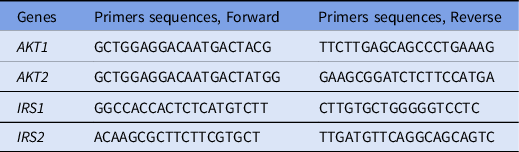
RNA extraction was the first step following oocyte collection. Norgen’s purification kit was used for the extraction (Norgen’s RNA/DNA Purification Kit, Norgen, Canada). Samples were assayed using a NanoDrop spectrophotometer for the extracted RNA to estimate the quality and purity of each sample. cDNA was reverse transcribed using Norgen’s transcript first strand synthesis kit following the manufacturer’s protocol. Four genes (Table 1) were selected and the expression levels were evaluated using real-time PCR. The ΔΔCt method was set as the comparative method of study and ACTB was used as the housekeeping gene for normalization. Statistical analyses were performed using GraphPad prism software; analysis of variance (ANOVA) and Student’s t-test analysis were performed.
Sequences of primers

Results
This study investigated the expression levels of genes involved in the AKT pathway in human oocytes obtained from female donors with or without PCOs. Human oocytes at the meiosis II stage were collected from patients attending the Near East University IVF Center. The samples were divided into two groups of oocytes obtained from patients with PCOs and the control oocytes obtained from patients with no PCOs. In both groups, the individuals were matched for age and BMI. The total numbers of oocytes were correlated in each group and the number of meiosis II stage oocytes did not show a significant difference (P > 0.05).
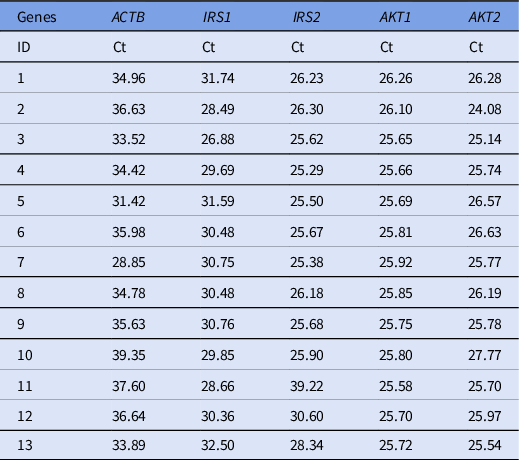
The expression levels of a total of four genes and the housekeeping gene were evaluated. All the selected genes involved in the AKT pathway, IRS1, IRS2, AKT1 and AKT2, were shown to be expressed in the human meiosis II stage oocytes, respectively. Real-time PCR was used to quantify the level of expression of four genes in addition to the housekeeping gene from a total of 13 oocyte samples. Detected Ct values of genes are summarized in Table 2.
Mean Ct values of target and housekeeping genes

For statistical investigation 2−ΔΔCt values for each gene were calculated and these 2−ΔΔCt values were used to investigate the significance of the expression levels of each gene in oocytes obtained from PCO patients and the oocytes obtained from the patients with no PCOs, respectively. Calculation of the P-value for each gene can estimate the significance of the results and the correlation between the expression levels of the genes and PCOS. No significant difference in the levels of gene expression was observed between the human meiosis II stage oocytes obtained from the PCO and the non-PCO patients, respectively (P > 0.05).
Discussion
The aetiology of PCOS as a complex disease is still unknown, but can be categorized as causing hormonal abnormalities, mainly in androgens. Some studies have focussed on the genetic side of the disease and have tried to find the correlated genes and pathways leading to the disorder. In this study, the aim was to evaluate the correlation of the expression levels of genes involved in the AKT signalling pathway (IRS1, IRS2, AKT1 and AKT2) in human meiosis II stage oocytes in patients with PCOs.
Two main hormones that increase the risk of PCOS are androgens and insulin. Phosphorylation of the IRS1 gene was investigated using rat models and showed a relationship between testosterone and insulin levels associated with PCOS. Furthermore, IRS1 has been reported to regulate insulin resistance among PCOS patients (Allemand et al., Reference Allemand, Irving, Asmann, Klaus, Tatpati, Coddington and Nair2009). In this study, the expression levels of both IRS1 and IRS2 were evaluated in human oocytes obtained from PCO and non-PCO patients, respectively. The expression pattern did not show any significant variation between both groups. One of the other candidate genes that can be involved in the development of PCOS is the AKT2 gene through the role in the AKT pathway and glucose metabolism may lead to the regulation of insulin resistance in the patients. Previously published studies have reported a change in the expression pattern of Akt2 in rat models of PCOS upon administration of Rhizoma Curculiginis, a Chinese medicine (Liu et al., Reference Liu, Liu, Li, Xiu, Zhang and Ai2021). Furthermore, another Chinese medicine, Rhizoma Coptidis, was shown to have a high affinity to bind to the receptors for Akt1 and Akt2 (Duan et al., Reference Duan, Jin, An, Zhang, Zhao, Zhou, Duan, Zhang, Liu and Lian2021). This may indicate that both Akt1 and Akt2 are involved in drug metabolism in PCOS. Although, the expression levels of both AKT1 and AKT2 did not show any significant change in human oocytes obtained from PCO and the non-PCO patients, it is a possibility that when drugs are administrated to these patients, the expression patters would show differences. Furthermore, it is a possibility that the expression patterns of these genes would be altered in different tissues, such as ovarian tissues or cumulus cells.
One of the limitations of this study is the small number of oocytes analyzed. However, obtaining human meiosis stage II oocytes is extremely difficult. Therefore, this study proves to be crucial to understanding the oogenesis process and oocyte maturation in humans. One of the other limitations to this study is the lack of measurement of the hormonal levels. As these patients were undergoing IVF treatment in the clinics, the hormonal levels were not tested.
In conclusion, to our knowledge, this is the first study investigating the gene expression patterns of AKT pathway in human oocytes. This study proves to be important in forming a basis for future studies. Future studies include the investigation of expression levels of other genes involved in the AKT pathway, as well as the analysis of other genes that are involved in steroidogenesis and hormonal regulation pathways.
Conflict of interest
The authors have no conflicts of interest.