Introduction
Cognitive behaviour therapies (CBTs) have, through several trials, been demonstrated to reduce symptoms in patients with irritable bowel syndrome (IBS) (Greene & Blanchard, Reference Greene and Blanchard1994; Payne & Blanchard, Reference Payne and Blanchard1995; van Dulmen et al. Reference van Dulmen, Fennis and Bleijenberg1996; Blanchard et al. Reference Blanchard, Lackner, Sanders, Krasner, Keefer, Payne, Gudleski, Katz, Rowell, Sykes, Kuhn, Gusmano, Carosella, Firth and Dulgar-Tulloch2007), as well as improve subjective measures such as global well-being and health-related quality of life (Drossman et al. Reference Drossman, Toner, Whitehead, Diamant, Dalton, Duncan, Emmott, Proffitt, Akman, Frusciante, Le, Meyer, Bradshaw, Mikula, Morris, Blackman, Hu, Jia, Li, Koch and Bangdiwala2003). However, why or how CBT works still remains unanswered. In process research it is argued that simply knowing that there has been an improvement from point A to point B is not enough – it is also crucial to understand how individuals change from point A to point B. Understanding the mechanisms of change could help optimize treatments to render more robust effect sizes, and help those who do not respond adequately to CBT, and could also contribute to proper implementation of the treatments in clinical practice. The study of mediators is often a first step to understand the mechanisms of change. Mediation is a hypothesized causal chain in which one independent variable X affects a mediating variable Y, which, in turn, affects the outcome variable Z (Kazdin, Reference Kazdin2007).
IBS patients present with significantly more depression and anxiety than healthy controls (Henningsen et al. Reference Henningsen, Zimmermann and Sattel2003) and patients with other medical conditions (Naliboff, Reference Naliboff2007). Previous trials with psychological treatments for IBS have accordingly often attributed the effect of treatment to reduction in psychological distress (Boyce et al. Reference Boyce, Gilchrist, Talley and Rose2000; Drossman et al. Reference Drossman, Camilleri, Mayer and Whitehead2002; Lackner et al. Reference Lackner, Jaccard, Krasner, Katz, Gudleski and Blanchard2007). Improvements in health-related quality of life in IBS patients have, for instance, been found to correlate with reduction of psychological distress following psychotherapy (Creed and Barsky, Reference Creed and Barsky2004). Conversely, a critical review of CBT treatments for somatization and symptom syndromes found physical symptoms to be more responsive to change than psychological distress (Kroenke & Swindle, Reference Kroenke and Swindle2000). These findings question the conventional assumption that CBT improves gastrointestinal (GI) symptoms by reducing co-morbid psychological distress.
Cognitive therapy was found to be superior to symptom monitoring in one study (Greene & Blanchard, Reference Greene and Blanchard1994) and waiting list control and a self-help support group in another (Payne & Blanchard, Reference Payne and Blanchard1995). The cognitive therapy was, in both studies, primarily focused on bringing about cognitive changes in the patients through identification and modification of cognitive errors. Thought diaries correspondingly showed a significant increase in positive thoughts and decrease in negative thoughts during both treatments and cognitive change and GI symptoms were significantly correlated in one of the studies. The authors concluded that the association between changes in cognitions and GI symptoms most likely were reciprocal and circular (Greene & Blanchard, Reference Greene and Blanchard1994; Payne & Blanchard, Reference Payne and Blanchard1995). However, this assumption is not supported by appropriate analyses and, although a recent study found cognitive beliefs (catastrophizing) to partly mediate the relationship between depression and pain (Lackner & Quigley, Reference Lackner and Quigley2005), the association between changes in cognitions and GI symptoms is still unclear.
Looking through the literature, we found only one previous study that investigated mediators of treatment outcome in IBS patients (Lackner et al. Reference Lackner, Jaccard, Krasner, Katz, Gudleski and Blanchard2007). The aim of that study was to investigate and challenge conventional wisdom, that psychological distress is the mediator of symptom relief. The treatment involved was group-CBT, which focused on identifying and challenging negative thinking patterns and promoted problem solving to enhance better coping with stressors associated with symptom flare-ups (Lackner et al. Reference Lackner, Jaccard, Krasner, Katz, Gudleski and Blanchard2007). The results strengthened the evidence for the idea that CBT exerts a direct effect on GI symptoms independent of its effects on psychological distress and health-related quality of life, in other words, no mediation. These findings challenge the notion that improvement in IBS symptoms after psychological treatment results from reduction in co-morbid psychological distress (Lackner et al. Reference Lackner, Jaccard, Krasner, Katz, Gudleski and Blanchard2007).
The rationale for giving CBT to IBS patients derives from a cognitive behavioural model, which assumes that physiological, cognitive, behavioural and emotional responses are interdependent and that cognitive and behavioural responses are key in maintaining aspects of the disorder, for example, symptoms and disability. It further follows that changes in cognitions, behaviour or both may result in reduced symptoms and improved quality of life (Kennedy et al. Reference Kennedy, Jones, Darnley, Seed, Wessely and Chalder2005). Based on these assumptions we hypothesized that change in unhelpful cognitions about IBS and unhelpful IBS-related behaviour would mediate changes in symptom severity, anxiety and work and social adjustment. This is in accordance with methodological recommendations that potential mediators should be guided by theory (Johansson & Høglend, Reference Johansson and Høglend2007). We investigated these hypothesized mediators in a randomized controlled trial comparing CBT and mebeverine with mebeverine alone for IBS (Kennedy et al. Reference Kennedy, Jones, Darnley, Seed, Wessely and Chalder2005). CBT and mebeverine were found to be superior to mebeverine alone up until 6 months after treatment ended. We applied path analysis, which aims to provide estimates of the magnitude and significance of hypothesized causal connections between sets of variables. A causal model, represented as a path diagram, tests whether the data fit the proposed model or not. If the data pattern themselves in a way that is consistent with the model, increased confidence in the causal model is obtained. If the data do not pattern themselves in the predicted fashion, the causal model is rejected.
Based on a review of CBT component analysis studies, it was concluded that the assumption that changes in cognition mediate change in CBT currently lacks empirical support (Longmore & Worrell, Reference Longmore and Worrell2007). The CBT in this study was designed to change cognitions and behaviour in IBS patients. Our aim with this analysis was therefore to test the theoretical model of CBT and investigate whether change in cognitions and/or behaviour did, in fact, mediate the change in GI symptoms, anxiety and work and social adjustment.
Method
Design
This study is a secondary analysis of a randomized controlled trial comparing CBT and mebeverine with mebeverine alone.
Sample and procedure
Patients diagnosed with IBS aged 16–50 years were recruited from 10 general practices in London. Altogether, 334 patients were referred to the study; 235 consented to participate and those still symptomatic (moderate to severe IBS symptoms) after 2 weeks of general practitioner care and 4 weeks of mebeverine hydrochloride (275 mg three times per day) were included in the trial (Kennedy et al. Reference Kennedy, Jones, Darnley, Seed, Wessely and Chalder2005). One patient did not attend the assessment visit and, of those attending, 88 did not proceed to the second assessment, leaving 149 patients included and randomized in the trial. Participants were randomized to receive six sessions of CBT in addition to mebeverine (72 patients) or continue with mebeverine alone (77 patients). The patients were followed up with questionnaires immediately after treatment ended (visit 4: 1.5 months after randomization) and these data were used in the mediational analyses of the current paper. The patients were also followed up after 3, 6 and 12 months.
Treatments
Four general practice nurses were recruited and trained to deliver CBT as described in a manual written for the study (Kennedy et al. Reference Kennedy, Chalder, McCrone, Darnley, Knapp, Jones and Wessely2006). Therapy consisted of six 50-min sessions at weekly intervals of face-to-face contact and was based on Lang's three systems model. The model explains how cognitive, behavioural and emotional or physiological responses are linked and how changes in one system may cause a change in another. Therapy included education about the nature of IBS from a functional perspective, behavioural techniques aimed at improving bowel habits, then cognitive techniques to address unhelpful thoughts related to the syndrome and finally techniques to reduce symptom focusing, manage stress and prevent relapse. The aim of the treatment was to improve participants' coping with day-to-day life. Both treatment groups continued to take 270 mg mebeverine three times daily. Four nurses were treating the patients.
Measures
The Symptom Severity Scale (SSS)
The SSS is an IBS-specific instrument that is sensitive to change over time. It includes an assessment of the impact of IBS on general well-being and has satisfactory reliability in secondary care. Maximum score on the scale is 500 and patients may be considered to have mild IBS (75–174), moderate IBS (175–299) or severe IBS (300–500). Scores <75 indicate normal bowel function. Healthy controls scored <75 in a validation study (Francis et al. Reference Francis, Morris and Whorwell1997).
Work and Social Adjustment Scale (WSAS)
Patients rated the impact of IBS on their ability to carry out day-to-day tasks. These tasks were divided into work, home management, social leisure activities and family and relationships. The total score ranged from 0 to 40, with higher scores indicating more disability. Reliability and validity analyses from two studies found the scale to be both a reliable and valid measure of impaired functioning (Mundt et al. Reference Mundt, Marks, Shear and Greist2002).
Cognitive Scale for Functional Bowel Disorders
This scale was designed to specifically assess cognitions of particular relevance to patients with functional bowel disorders (FBD), with items based on content from thought diaries of a sample of FBD patients. The scale consists of 25 items with scores ranging from 25 to 175. It has been found to be a valid and reliable scale that can be used as an outcome measure in evaluating the efficacy of interventions for FBD (Toner et al. Reference Toner, Stuckless, Ali, Downie, Emmott and Akman1998).
Behaviour Scale for IBS (IBS-BRQ)
This is a new questionnaire designed and validated by the researchers. It allows assessment of changes in specific coping behaviours used by patients with IBS. The scale has 28 items, each with a Likert scale from 1 (never) to 7 (always), indicating how persistently the particular behaviour is carried out. The scale includes avoidance behaviour, such as: ‘I avoid certain social situations (e.g. restaurants) because of my IBS’ and toilet behaviour such as: ‘After opening my bowels I check my stool for abnormalities’. The total score, calculated by summing the responses to the 28 items, ranges from 28 to 196. The scale was found to be both reliable and valid (Reme et al. Reference Reme, Darnley, Kennedy and Chalder2010).
Statistical analysis
We conducted a multi-level modelling analysis based on intention to treat on follow-up assessments of behavioural and cognitive questionnaire scores. We included time (follow-up assessments at 1.5, 3, 6 and 12 months) and treatment group and the interaction between time and group as fixed categorical variables in the model. Baseline scores of visit 1 were included as a covariate and subject ID as a random factor to account for the repeated measurements over time. In order to account for potential therapists effects, we included ‘therapist’ as an additional fixed factor in the model. In each model the effect of treatment with CBT is presented as an estimated difference between the means of the scores for the two treatment groups.
We performed a path analysis to assess possible mediating effects (Baron & Kenny, Reference Baron and Kenny1986; MacKinnon & Luecken, Reference MacKinnon and Luecken2008). Mediation is a hypothesized causal chain in which one independent variable X affects a mediating variable Y, which, in turn, affects the outcome variable Z. If the intervening mediator Y explains the correlation between X and Z, we have a full mediational model. If X still has an effect on Z after including the mediator Y in the model, the model is consistent with partial mediation. According to Kraemer et al. (Reference Kraemer, Wilson, Fairburn and Agras2002), a mediational relationship exists if: (1) the proposed mediator correlates with treatment assignment; (2) the mediator has either a main or interactive effect on outcome; (3) changes in the mediator variable precede changes in the dependent variable. Because we did not find a therapist effect in the previous multi-level modelling analysis, therapist was not included as an additional factor.
For each of the three outcome variables (symptom severity, WSAS and anxiety), we compared full and partial mediation process for two proposed pathways (treatment group→ behaviour→ cognition→ outcome and (treatment group→ cognition→ behaviour→ outcome). To assess the different models we used Akaike's Information Criterion (AIC) model selection (Burnham & Anderson, Reference Burnham and Anderson2002), which attempts to select a parsimonious model that best explains the data with a minimum number of estimated parameters. The preferred model is the one with the lowest AIC value. AIC model fit indices are independent of sample size and differences in AIC of <2 suggest that the model with the larger AIC should be considered along with the best model (Burnham & Anderson, Reference Burnham and Anderson2002). In addition, we present the Browne–Cudeck criteria (Browne & Cudeck, Reference Browne and Cudeck1989), which operates in the same manner as the AIC but imposes greater penalty for model complexity.
The goodness of fit of the models was further assessed by performing a test for lack of fit using the χ2 goodness of fit statistic, which compares the hypothesized model against the saturated model (i.e. a multiple regression model). A good model should not be a significant model. In addition, we assessed the comparative fit index (CFI) and the root mean square error of approximation (RMSEA), which is recommended by Fan et al. (Reference Fan, Thomson and Wang1999) and Kline (Reference Kline2005) for smaller sample sizes. Support for good fit of a target model is obtained if the RMSEA value is <0.05 and CFI is >0.95.
Because of the small sample size we used the difference score approach to longitudinal mediation (MacKinnon et al. Reference MacKinnon, Fairchild and Fritz2007) by calculating the change from baseline to 1.5 months follow-up (visit 4). For the outcome variable we controlled for baseline differences. The change score approach is valid if the reliability of the measures is high and correlations between baseline and 1.5 follow-up measures of a variable are not large (MacKinnon et al. Reference MacKinnon, Fairchild and Fritz2007). The final best models were rerun as covariance mediation models and parameter estimates changed only marginally, which confirmed the validity of our models. The change scores of the two putative mediators, behaviour and cognition, and the outcome variable were derived from the same time period and therefore simultaneous changes in those variables cannot be ruled out.
The final best models are presented as path diagrams with standardized regression coefficients. We used bootstrap resampling methods to establish biased corrected bootstrap confidence intervals and statistical significance tests of direct, indirect and total (=direct+indirect effect) for each variable in a model.
Multi-level modelling analyses were performed with Stata version 10.0 (StataCorp., 2007), and Amos 7.0 (Arbuckle, Reference Arbuckle2006) was used for path analysis.
Results
Of 334 referred patients, 149 were included in the trial and randomized to mebeverine (n=77) or mebeverine plus cognitive behavioural therapy (n=72). Data from one participant in the mebeverine-only group were lost and could not be retrieved. Most of the patients were women (82%), mean age was 33.8 (s.d.=8.6) years and the majority were white British (65%). Full details of response rates and differences between responders and non-responders are reported elsewhere (Kennedy et al. Reference Kennedy, Jones, Darnley, Seed, Wessely and Chalder2005). The addition of CBT to mebeverine treatment had a beneficial effect on symptom severity and work and social adjustment, although the effect declined over time, with neither measure showing a significant effect by 12 months after therapy. For full details of the results of main outcomes, see Kennedy et al. (Reference Kennedy, Jones, Darnley, Seed, Wessely and Chalder2005).
Multi-level model analysis
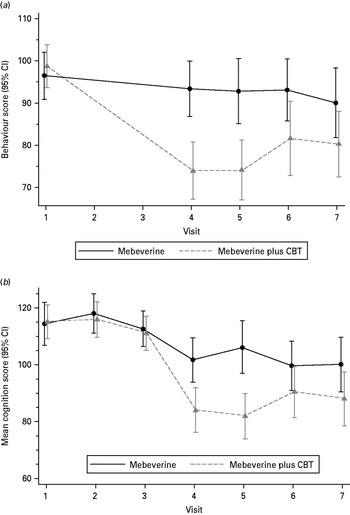
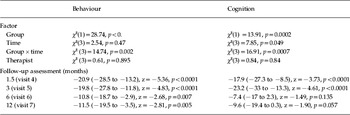
Fig. 1 shows the mean behavioural and cognitive questionnaire scores over time. The results of the multi-level model analyses indicated that there was a significant interaction between treatment and time for the behavioural and cognitive questionnaires scores (Table 1). The addition of CBT to mebeverine hydrochloride had a beneficial effect on behavioural scores at each follow-up visit. The effect declined after visit 5 but remained significant. Mebeverine plus CBT had a similar beneficial effect on cognitive scores. However, the effect of mebeverine plus CBT treatment was not significant after visit 5.
Mean scores [95% confidence intervals (CI)] on (a) Behavioural scale and (b) Cognitive scale for 148 patients separated by treatment [standard treatment (control) and standard treatment and cognitive behaviour treatment (CBT)].

Treatment effect estimates of adding cognitive behaviour therapy to drug treatment with mebeverine for patients with irritable bowel syndrome

For each measure the results of a multi-level modelling analysis are presented. Values for follow-up assessments are differences in means (95% confidence intervals) and Wald z test statistics. Larger negative values indicate greater treatment effects of cognitive behaviour therapy.
Comparisons of completers and drop-outs at visit 4
Altogether, 70 (92%) patients of the CBT group and 58 (81%) of the control group attended the 1.5 months follow-up (visit 4). There were no age differences between attendees and non-attendees within the whole sample or within each treatment group. There were no significant differences in baseline (visit 1) assessment scores within the whole sample or within each treatment group between patients who attended visit 4 and patients who missed visit 4. Therefore, there was little evidence for a non-random drop-out pattern, which could bias the mediational analyses.
Mediational analysis
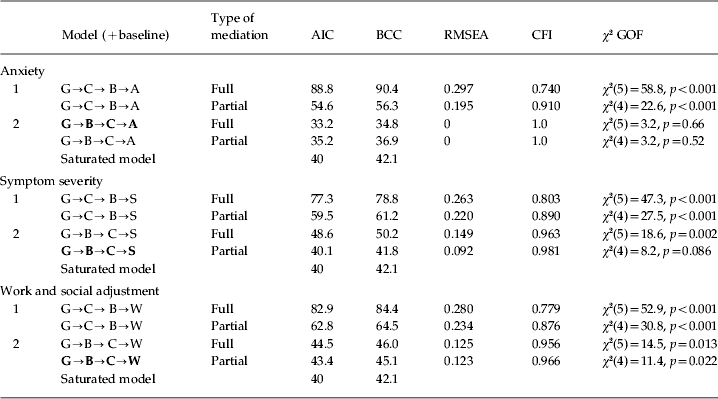
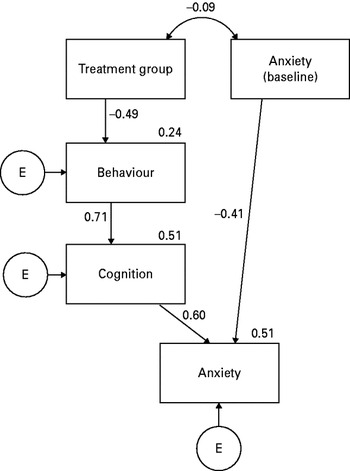
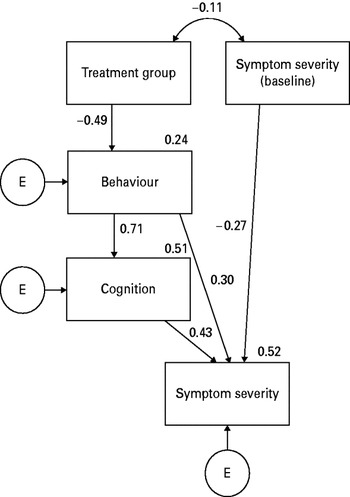
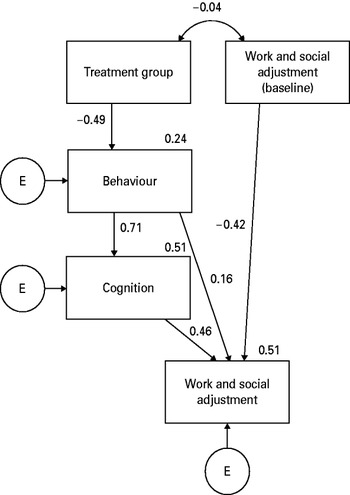
The mediational analysis revealed that the path ‘treatment→ behaviour→ cognition→ outcome’, with cognition as a mediator between behaviour and outcome, explained the data better than behaviour as a mediator between cognition and all three outcome variables (Table 2). For all three outcome variables the differences in AIC were large (≫2) compared to the path model, where behaviour mediated cognition and therefore there was more support for cognition as a mediator for behaviour than for behaviour as a mediator. A full mediation model was selected as the best model for anxiety. A partial mediation model with a direct effect of behaviour on outcome was selected as the best model for symptom severity and work and social adjustment. However, the full model of work and social adjustment fits the data almost as well as the partial model.
Mediation analysis of anxiety, total symptom score and work and social adjustment scores with (1) treatment group (G), (2) cognition (C) and (3) behaviour (B) (+ baseline of outcome variable)
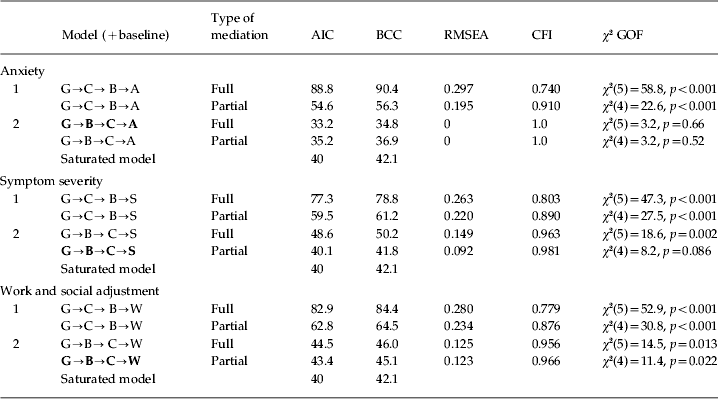
AIC, Akaike's Information Criterion; BCC, Brown–Cudeck criteria; RMSEA, root mean square error of approximation; CFI, comparative fit index; GOF, goodness of fit.
In all models the addition of CBT to mebeverine reduced behavioural response scores more than mebeverine without CBT. Greater changes in behaviour were positively associated with changes in cognition scores. Changes in cognition again were positively associated with changes in outcome scores.
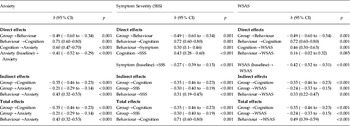
Fit indices were only satisfactory for the anxiety and symptom severity path models (Table 2). However, with the exception of the direct effect of behaviour on WSAS, all direct, indirect and total effects were significant for all three selected path models (Table 3).
Best mediation models: standardized regression coefficients [95% bootstrap confidence intervals (CI)] and bootstrap p values for significance tests for direct, indirect and total effects for the mediation models for anxiety, symptom severity and work and social adjustment (WSAS)

A comparison of the final path models within each treatment group showed that the direct and indirect effects are slightly smaller in the control group compared to the treatment group but they were still statistically significant.
Figs 2–4 show the best model with standardized regression coefficients for anxiety, SSS and WSAS. Single-headed arrows reflect hypothesized relationships between variables. Standardized regression coefficients are shown next to each path. Furthermore, a double-headed arrow represents covariation between two variables. The correlation coefficient is shown next to this path. The explained variance of endogenous variables is on the top right on the rectangle. Circles represent error terms.
Best model for anxiety. Full mediation model with cognition as mediator. Single headed arrows reflect hypothesized relationships between variables. Standardized regression coefficients are shown next to each path. A double-headed arrow represents covariation between two variables. The correlation coefficient is shown next to the path. The explained variance of endogenous variables is on the top right on the rectangle. Circles represent error terms.

Best model for symptom severity. Partial mediation model with cognition as mediator.

Best model for work and social adjustment. Partial mediation model with cognition as mediator.

Discussion
In this study we wanted to test the theoretical foundation of the CBT-model for IBS, namely, that change in cognitions, behaviour or both may result in reduced IBS symptoms, anxiety and improved function. As expected, a reduction in negative cognitions and maladaptive behaviour was seen in the patients receiving CBT treatment. In accordance with our hypotheses, the results further suggest that IBS-related cognitions and behaviour are mediators of change for IBS patients given CBT and mebeverine hydrochloride in primary care. The mediational path for all three outcomes went through change in behaviour, then change in cognitions before the change in the outcomes. The path models for symptom severity (SSS) and work and social adjustment (WSAS) showed partial mediation, which means that behaviour is also directly involved in the change in these two outcomes. For anxiety, full mediation was found, which indicates that changes in behaviour and cognitions occur before anxiety is reduced in the patients. The analyses of model fits revealed best fit for the anxiety model and hence provide increased confidence in the causal model of anxiety.
Lackner et al. (Reference Lackner, Jaccard, Krasner, Katz, Gudleski and Blanchard2007) tested the common-sense hypothesis that psychological distress mediated the reduction of symptoms following CBT. They found no evidence of mediation. We tested the theoretical assumption underlying CBT, namely, that changes in cognition and behaviour mediates reduction in symptoms and function following CBT. In relation to symptom and work and social adjustment change we showed partial mediation. Somewhat surprisingly, we found support for full mediation in that both change in behavioural coping and cognition mediated the relationship between treatment and change in anxiety. The results strengthen the validity of a CBT model, where both behaviour and cognitions are considered crucial for treatment change. The results imply that the behavioural part of CBT may be particularly important in the treatment of IBS and future treatments may therefore consider strengthening this part of the therapy. However, as behavioural change was the initial focus of therapy moving on to cognitive change, it may reflect the order in which things were done in this study.
The results also take us a step further towards an understanding of mechanisms in CBT treatments for IBS. Knowing more about why or how treatment works is important in several ways. Clinically it is important to find out what components of the treatment cause the changes in order to enhance and elaborate those parts further. Theoretically, it is important to investigate whether the theoretical foundation being used is coherent and valid. In this case, the results strengthen the validity of our theoretical model by finding support for a mediational path between behaviour, cognitions and treatment outcomes as opposed to a reciprocal association suggested by others (Greene & Blanchard, Reference Greene and Blanchard1994; Payne & Blanchard, Reference Payne and Blanchard1995).
A previous report of mediators in psychodynamic interpersonal therapy suggests that changes in health-related quality of life were partially mediated by changes in psychological parameters (Creed et al. Reference Creed, Guthrie, Ratcliffe, Fernandes, Rigby, Tomenson, Read and Thompson2005). However, neither cognitions nor IBS-related behaviour were assessed and investigated as potential mediators in this report. This is also true for the research that found no mediation and therefore concluded that CBT exerted a direct effect on GI symptoms (Drossman et al. Reference Drossman, Toner, Whitehead, Diamant, Dalton, Duncan, Emmott, Proffitt, Akman, Frusciante, Le, Meyer, Bradshaw, Mikula, Morris, Blackman, Hu, Jia, Li, Koch and Bangdiwala2003; Lackner et al. Reference Lackner, Jaccard, Krasner, Katz, Gudleski and Blanchard2007). Mediational studies of CBT for other disorders, such as depression (Driessen & Hollon, Reference Driessen and Hollon2010; Warmerdam et al. Reference Warmerdam, van Straten, Jongsma, Twisk and Cuijpers2010) and chronic pain (Turner et al. Reference Turner, Holtzman and Mancl2007), have found cognitions to be the mediator of change. However, none of them measured change in behaviour. An implication of our findings therefore is to highlight the importance of including measures of behavioural coping in future treatment trials of IBS and also, possibly, other disorders.
The analytic approach that both we and Lackner et al. (Reference Lackner, Jaccard, Krasner, Katz, Gudleski and Blanchard2007) applied carries an important limitation, namely, that mediation was examined using simultaneously assessed outcomes. In order to establish a causal relation or mediator of change, the mediator must precede the outcome in time (Kazdin, Reference Kazdin2007). Because there were no changes between visits 4 and 5 we were not able to test a causal relationship. The timeline is a methodological problem of many psychiatric studies and, without demonstrating that the proposed mediator invariably comes before symptom change, conclusions about mediation are in question (Kazdin, Reference Kazdin2007). Future studies should therefore assess, on multiple occasions during treatment, both symptoms and proposed mediator(s) in order to establish with more certainty the presence of cognitions and behaviour as mediators of change in CBT treatments. Furthermore, experiments in which the proposed mediator is altered or varied across groups would be preferable. The strengths of the study are the reasonable sample size and the well-defined treatments.
Conclusions
In conclusion, changes in behaviour and cognitions seem to mediate the change in CBT given to IBS patients. The results strengthen the validity of a theoretical model of CBT by confirming the interaction of cognitive, emotional and behavioural factors in IBS. The results further emphasize the importance of including behavioural and cognitive components in future treatments of IBS patients.
Acknowledgements
We gratefully thank the nurses who conducted the treatment, the patients who participated in the study, as well as doctors and staff at participating general practices. The study was funded by a grant from the NHS Health Technology Assessment Programme. T. Chalder acknowledges financial support from the Department of Health via the National Institute for Health Research (NIHR) Specialist Biomedical Research Centre for Mental Health award to South London and Maudsley NHS Foundation Trust (SLaM) and the Institute of Psychiatry at King's College London.
Declaration of Interest
None.