Introduction
Death anxiety, a term that has been used to refer to the fear of death and dying (An et al., Reference An, Lo and Hales2018), is increasingly recognized as a common form of distress in individuals with oncological disease. Studies suggest that up to half of the cancer patients report death anxiety at some point during their treatment (Gonen et al., Reference Gonen, Kaymak and Cankurtaran2012; Neel et al., Reference Neel, Lo and Rydall2015), and many cite death and dying when asked to discuss topics of concern (Adelbratt and Strang, Reference Adelbratt and Strang2000; Grossman et al., Reference Grossman, Brooker and Michael2018). It is not surprising that thoughts of mortality are provoked following a diagnosis of cancer; however, a preoccupation with the fear of death is associated with decreased quality of life, medical nonadherence, and poorer health outcomes (DiMatteo et al., Reference DiMatteo, Lepper and Croghan2000; Pelletier et al., Reference Pelletier, Verhoef and Khatri2002; Randazzo et al., Reference Randazzo, McSherry and Herndon2017; Shi et al., Reference Shi, Lamba and Zheng2018). The prevalence of death anxiety has only recently begun to be examined in patients with primary brain tumors (PBTs). As medical advancements strive to prolong life for brain cancer patients, an increased clinical interest in death anxiety and its determinants become exceedingly important.
Patients with PBT may be particularly vulnerable to experience death anxiety. These patients frequently suffer disabling physical and neurological deficits, are presented with limited treatment options, and have an overall poor prognosis. Indeed, brain cancer exceeds most other cancers in Years of Potential Life Lost (YPLL), where the average YPLL for brain tumor patients is 20 years (Rouse et al., Reference Rouse, Gittleman and Ostrom2016); accordingly, a diagnosis of glioblastoma multiforme — which is the most common type of malignant brain tumor — has a median overall survival rate of only 15 months (National Brain Tumor Society, 2020). Thus, death may be exceedingly salient in this cancer population compared to others, especially given the rapid rate of physical and cognitive decline due to the critical location of the tumor and its treatments. While there is reason to expect death anxiety that may manifest differently in this population, research has often omitted brain tumor patients from death anxiety research: a recent systematic review (Loughan et al., Reference Loughan, Lanoye and Aslanzadeh2019) showed that there is an eightfold under-representation of brain tumor patients in the existential and death-related distress literature in oncology, relative to the rate of disease in the USA (American Cancer Society, 2021). Thus, a closer look of death anxiety in this population is warranted.
Recently, we identified death anxiety as an area of concern for the majority (81%) of patients with PBT (Loughan et al., Reference Loughan, Aslanzadeh and Brechbiel2020); however, formal investigation of this construct is lacking, given this analysis utilized only a screening tool (Death Distress Scale; Abdel-Khalek, Reference Abdel-Khalek2011). Two comprehensive measures for detecting fears surrounding death and dying are the Templer Death Anxiety Scale (DAS; Templer, Reference Templer1970) and the Death and Dying Distress Scale (DADDS; Lo et al., Reference Lo, Hales and Zimmermann2011; Krause et al., Reference Krause, Rydall and Hales2015). The DAS is arguably the most used and researched measure available but was developed to assess thanatophobia broadly and for the general population, not advanced cancer patients (Templer, Reference Templer1970). More recently, the DADDS was created to target death anxiety in advanced or metastatic cancer (Lo et al., Reference Lo, Hales and Zimmermann2011), with a focuses more on the dying process, lost time and opportunities, and the impact of dying on other people, which may be more applicable to advanced cancer patients than general fear about death. While the psychometric properties of both scales have been examined in oncology samples (Royal and Elahi, Reference Royal and Elahi2011; Krause et al., Reference Krause, Rydall and Hales2015), it is unclear which measure is best suited for assessing death anxiety in PBT. Thus, an examination of the psychometric properties of these two comprehensive measures in this sample is not only warranted but will also provide a clearer picture of the prevalence and determinants of death anxiety in neuro-oncology.
In understanding the determinants of death anxiety in the general oncology literature, research has considered demographic, disease-specific, and psychological variables. Though mixed, preliminary findings suggest: (1) women and younger patients tend to experience higher levels of death-related distress (Shinn et al., Reference Shinn, Taylor and Kilgore2009; Postolică et al., Reference Postolică, Enea and Dafinoiu2019); (2) a history of anxiety or depression may predispose one to death-related distress (Gonen et al., Reference Gonen, Kaymak and Cankurtaran2012); and (3) disease-specific variables, such as recency of diagnosis and aggressiveness of cancer stage, may also increase one's risk (Cella and Tross, Reference Cella and Tross1987; Sharif et al., Reference Sharif, Lehto and Nia2018). Extant research has not yet considered how demographic, disease-specific, or psychological variables may contribute to death anxiety in patients with PBT.
The present study used data from two cross-sectional investigations to examine death anxiety in patients with PBT. Specifically, psychometric properties of two commonly used death anxiety measures: the DAS and DADDS were examined. We hypothesized that the DADDS would have better utility for patients with PBT, as its items focus on concerns specific to advanced disease. Next, to develop a nuanced understanding of how patients with PBT experience death anxiety, cut-scores and item-level endorsements were explored. We hypothesized that patients with PBT would experience higher death anxiety than that reported in other non-CNS cancers, given the common physician and neurological deficits experienced, the limited treatment options available, and the overall poor prognosis of PBT. Lastly, we explored potential determinants of death anxiety in patients with PBT from the measure determined to be the most psychometrically sound (DAS or DADDS). Potential determinants included demographic, disease-specific, and psychological variables. No predictions were made regarding the determinants, as this is benchmark data and the first to examine death anxiety in neuro-oncology.
Methods
Design and study populations
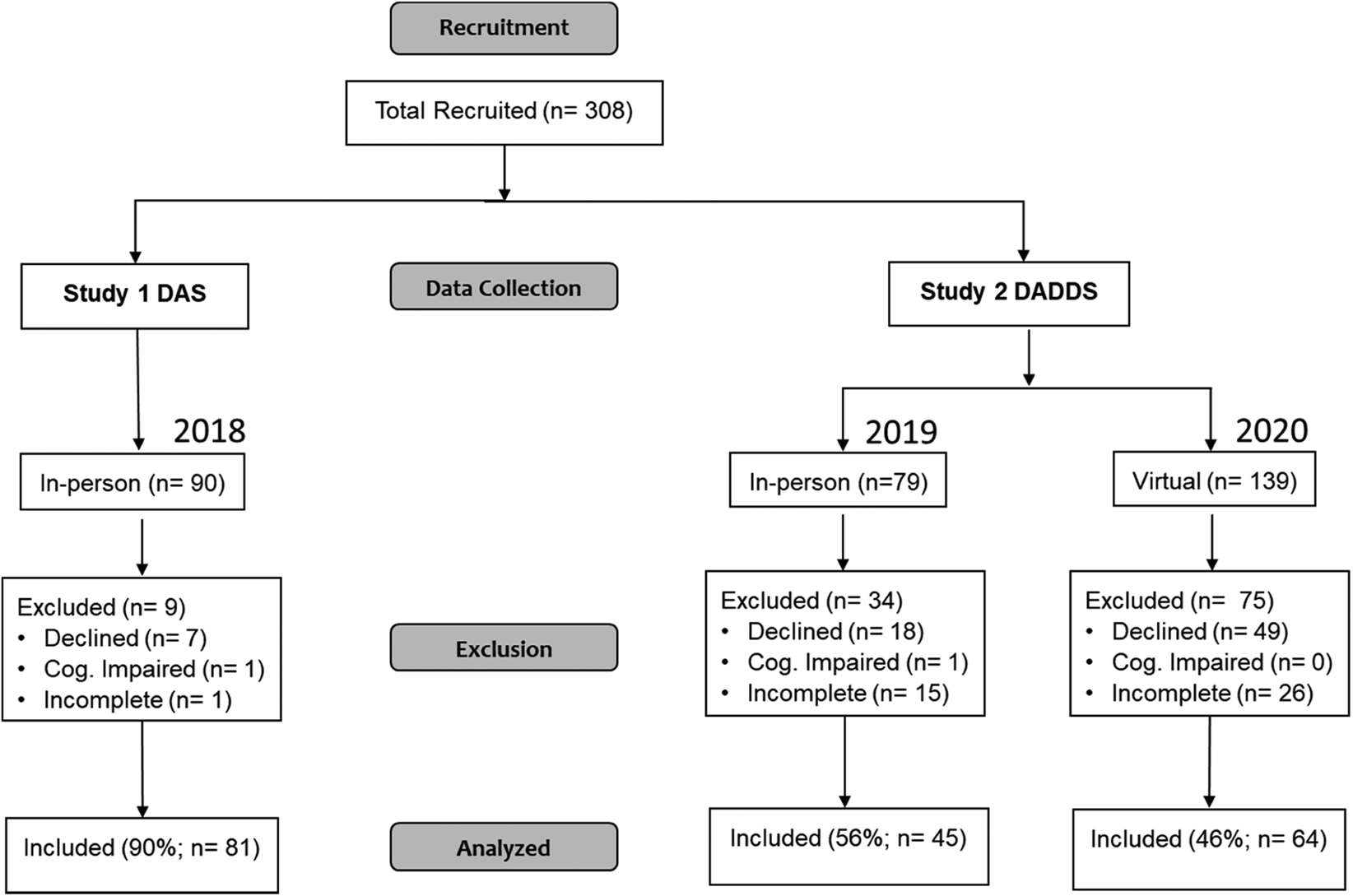
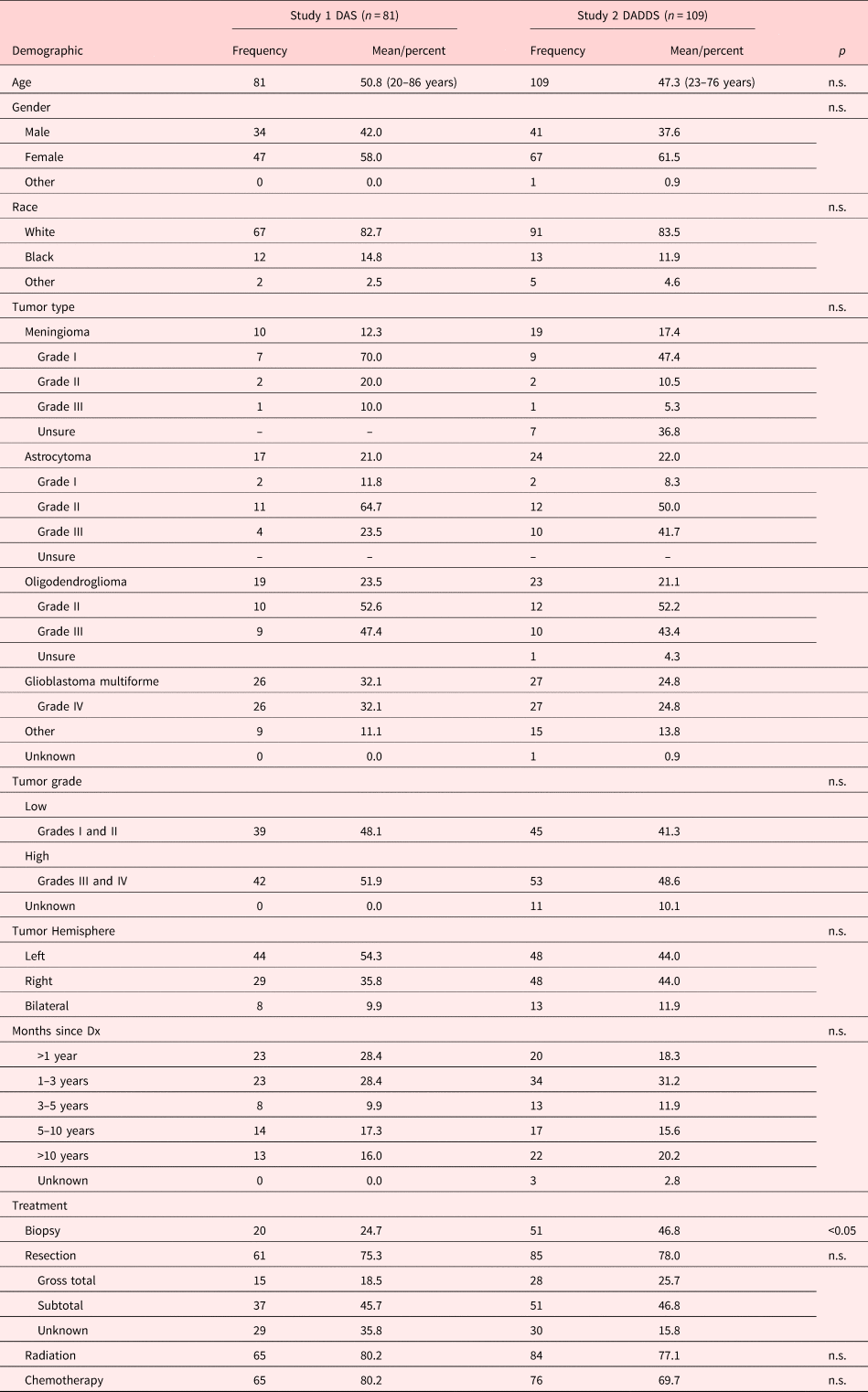
Cross-sectional data were collected in both studies. Data were collected over three consecutive funded summer research fellowships (July–September 2018, 2019, 2020). In Study 1, data were collected in-person during routine neuro-oncology clinic visits at an urban National Cancer Institute-designated cancer center (2018). PBT patients were recruited, screened, and consented by a trained research assistant. Participants were offered to complete the study survey's via iPad or paper. In Study 2, participants were initially recruited, screened, and consented in the same manner (2019), but following the COVID-19 safety regulations, recruitment shifted to a virtual format (2020). Recruitment in Study 2 was thus expanded to include national support groups via online listservs and social media platforms. A recruitment flyer was posted on these platforms with an associated link, if interested. Screening questions were completed online via a confidential database (REDCap) to determine eligibility. If found to be eligible, a full consent document followed. This document was signed electronically, with a required (Yes/No) indication of understanding the survey was for research purposes, the risks/benefits to participating, and that participation was voluntary. Once signed, consented participants were routed to the questionnaires electronically via REDCap. Ethical approval was granted from the institutional review board (HM20013477). Inclusion criteria for both studies were as follows: (1) age 18 or older, (2) PBT diagnosis, and (3) literate in English. For in-person participants, demographic and medical variables were extracted from medical records following informed consent. For virtual participants, demographic and medical variables were self-reported. See Figure 1 for a flow chart describing study recruitment, exclusion, and final enrollment for both Study 1 and Study 2. Table 1 provides full demographic and medical information for both studies. The two study groups were comparable across all demographic variables. More patients in Study 2 underwent biopsy than in Study 1 (X 2 = 13.00, p < 05); the two study groups were comparable across all other disease-specific variables.
Flow chart describing study recruitment, exclusion, and final enrollment of Study 1 and Study 2.

Demographics of primary brain tumor samples for Study 1 and Study 2

Dx, diagnosis.
Measures
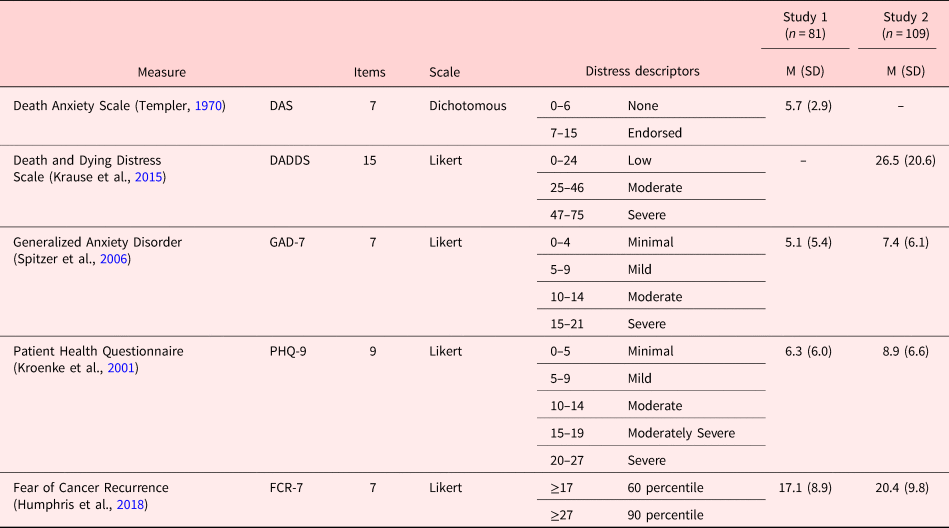
All study measures are described in Table 2.
Distress in primary brain tumor samples for Study 1 and Study 2

Statistical analyses
Data analyses were conducted using SPSS version 27. The psychometric properties of the DAS were assessed via construct validity, internal consistency, and concurrent validity. For data to be suitable for factor analysis, the Kaiser–Meyer–Olkin (KMO) statistic should be above 0.7, and the results of Bartlett's test should be non-significant (Hutcheson and Sofroniou, Reference Hutcheson and Sofroniou1999; Tabachnick and Fidell, Reference Tabachnick and Fidell2012). An exploratory factor analysis (EFA) with principal axis factoring using a promax rotation assuming no a priori factor structure was conducted to determine the scale's unique factor structure, if appropriate. Internal consistency was assessed via Cronbach's α and item-total correlations. Finally, concurrent validity was assessed by conducting bivariate correlations with the following measures: Patient Health Questionnaire (PHQ-9), Generalized Anxiety Disorder (GAD-7), and Fear of Cancer Recurrence (FCR-7). Next, to quantitatively measure distress in this sample, descriptive analyses were run using identified cut values for all psychological variables (Table 2). Rates of item-level endorsement were also calculated to qualitatively examine the DAS
Results
Psychometric properties and prevalence rates
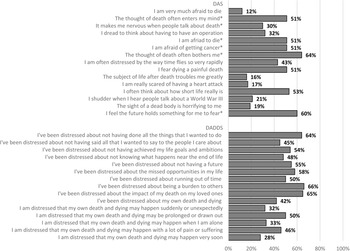
The Bartlett's test for the DAS was significant (X 2 = 236.82, df = 105, p < 0.001), and the KMO statistic was 0.65, indicating that the DAS was not suitable for factor analysis. As a result, no EFA was performed. Internal consistency for the DAS was poor (Cronbach's α = 0.65), with item-total correlations ranging from 0.28 to 0.67. Bivariate correlations revealed significant positive correlations between the DAS and the PHQ-9 (r = 0.40), GAD-7 (r = 0.53), and FCR-7 (r = 0.53, p < 0.001). Of the 81 patients, 35% (n = 28) experienced moderate-to-severe symptoms of death anxiety on the DAS. Only two patients (2.5%) denied experiencing any symptoms of death anxiety using the DAS. See Table 2 for descriptive analyses of distress and Figure 2 for item-level endorsement of DAS.
Item-level endorsement for DAS (n = 81) and DADDS (n = 109) in patients with primary brain tumor.

Statistical analyses
Data analyses were conducted using SPSS version 27. The psychometric properties of the DADDS were assessed using the same methods as described above in Study 1. Descriptive analyses of distress levels were run, and item-level endorsements were also calculated for the DADDS. Next, to examine the impact of demographic, disease-specific, and psychological variables on death anxiety, a binary variable was derived using the DADDS; specifically, we compared those who were categorized to have low death anxiety (i.e., a score of 0–24; n = 57) to those who were categorized to have moderate-to-severe death anxiety (i.e., a score of 25–75; n = 52). Three multivariable binary logistic regression models were run using a backward elimination procedure. The first regression investigated demographic variables as predictors (age, gender, and ethnicity), the second regression investigated disease-specific variables as predictors (months since diagnosis, tumor grade, hemisphere of tumor, and treatment history of biopsy, resection, radiation, or chemotherapy), and the last regression investigated psychological variables as predictors (PHQ-9, GAD-7, and FCR-7). Significance was set at the p-value of <0.05 level.
Results
Psychometric properties and prevalence rates
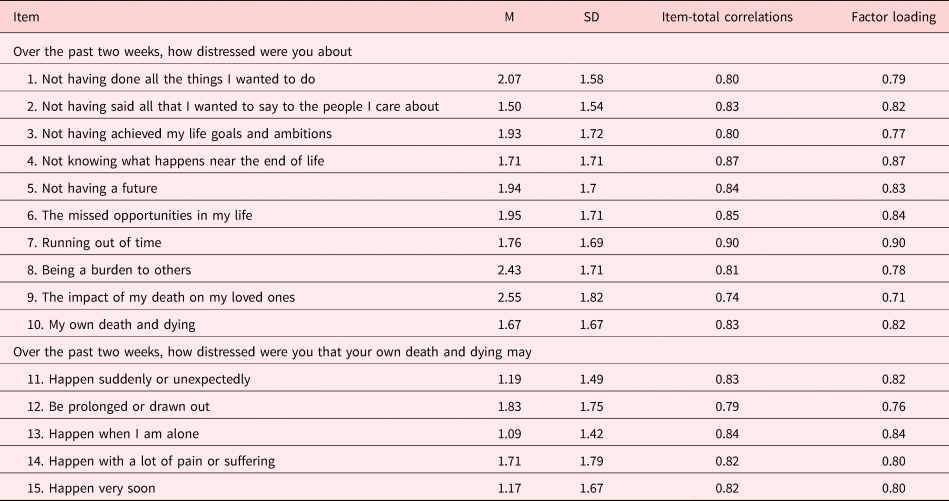
KMO (0.93) and Bartlett's (X 2 = 1,666.07, df = 105, p < 0.001) tests for the DADDS suggested that the data were suitable for factor analysis. An EFA produced a scree plot which revealed the presence of a single factor accounting for 68.16% of the items’ cumulative variance. Individual item loadings were high, ranging from 0.71 to 0.90, indicating that all items assessed a similar construct. Communalities, or the percent of each variable's variance explained by the single factor, ranged from 0.50 to 0.82. Psychometric properties of the DADDS are presented in Table 3. Cronbach's α for the DADDS was high (0.97), suggesting excellent internal consistency. Item-total correlations were similarly strong, ranging from 0.74 to 0.90. Bivariate correlations revealed significant positive correlations between the DADDS and the PHQ-9 (r = 0.56), GAD-7 (r = 0.65), and FCR-7 (r = 0.65, p < 0.001). Of the 109 patients, 48% (n = 52) experienced moderate-to-severe death anxiety on the DADDS. Twelve patients (11%) denied all symptoms. See Table 2 for descriptive analyses of distress and Figure 2 for item-level endorsement of DADDS.
Psychometric properties of the DADDS (n = 109)

Determinants of death anxiety
Determinants of death anxiety were run using the DADDS, given its superior psychometric properties. In the first regression model, no demographic variables (age, gender, and ethnicity) were significantly predictive of death anxiety (p > 0.05). In the second regression model, no disease-specific variables (months since diagnosis, tumor grade, hemisphere of tumor, and treatment history of biopsy, resection, radiation, or chemotherapy) were significantly predictive of death anxiety (p > 0.05). In the final regression model, there was a significant effect of generalized anxiety symptoms (GAD-7; X 2 = 14.25, p < 0.05, OR 1.22, 95% CI: 1.09−1.38) and fear of recurrence [FCR-7; X 2 = 4.55, p < 0.05, odds ratios (OR) 1.08, 95% CI: 1.00−1.16] on death anxiety. This was reinforced by examining the adjusted OR, which indicated that for each one-unit increase in GAD-7, when holding FCR-7 constant, the likelihood of experiencing death anxiety increases about 22%. Similarly, for each one-unit increase in FCR-7, when holding GAD-7 constant, the likelihood of experiencing death anxiety increases about 8%. Symptoms of depression (PHQ-9) were not predictors of death anxiety (p > 0.05). The area under the curve for this model was 0.85 (95% CI: 0.76, 0.92), indicating excellent discrimination between the low vs. moderate-to-severe death anxiety groups; the sensitivity of the model was 75%, and the specificity of the model was 86%. The overall misclassification rate for the model was 19%. Assessing the goodness of fit, the Hosmer–Lemeshow goodness-of-fit test indicated a good model fit (X 2 = 14.93, df = 8, p = 0.06).
Discussion
We have presented an early psychometric portrait of two comprehensive death anxiety measures, the DAS and the DADDS, in patients with PBT. The DADDS was shown to have excellent internal reliability, good concurrent validity, and its items assess a single dimension of distress related to death and dying. However, while concurrent validity was also adequate for the DAS, both its construct validity and internal reliability were poor. This contrasts with the current literature, which suggests that the DAS is psychometrically sound for terminally ill cancer patients (Royal and Elahi, Reference Royal and Elahi2011). One possible explanation for this difference is the version of the DAS used; the DAS can be administered with either dichotomous or Likert scale formats. Our study utilized the original true-false format, whereas previous research utilized a Likert scale (Royal and Elahi, Reference Royal and Elahi2011). Perhaps, using the dichotomous scale impacted the psychometric finding and thus comparisons with previous literature.
When examining specific items on the DAS, 50–64% endorsed questions, such as “I am afraid to die” and “The thought of death bothers me,” which are similar to questions found on the DADDS (e.g., “I am distressed about my own death and dying”). However, some items on the DAS, such as “The sight of a dead body is horrifying to me,” “I shudder when I hear people talking about a World War III,” and “I am really scared of having a heart attack,” were denied by most participants (79–83%) and, unsurprisingly, may be less relevant following diagnosis and treatment of brain cancer. Self-report measures for assessing death anxiety, such as the DAS, have historically been validated in healthy populations (Templer, Reference Templer1970; Dickstein, Reference Dickstein1972; Conte et al., Reference Conte, Weiner and Plutchik1982), whose fears may not be the same as those facing a terminal diagnosis. Over the past decade, the DADDS was created to specifically assess death-related anxiety in advanced cancer and other advanced disease populations, making it more relevant to patients with PBT who face the threat of brain cancer and, with it, impending mortality. The DADDS proved to be more psychometrically sound than the DAS in this PBT sample, which aligned with our hypothesis.
Prevalence of death anxiety
Nearly half of patients with PBT (48%) experienced moderate-to-severe death anxiety on the DADDS, suggesting that many are experiencing considerable distress related to death and dying following diagnosis. Moreover, patients with PBT appear to have greater death anxiety than other advanced cancer populations (32%) (Neel et al., Reference Neel, Lo and Rydall2015). The certainty of disease progression and clinical deterioration (Fine et al., Reference Fine, Dear and Loeffler1993; Fox et al., Reference Fox, Lyon and Farace2007), neurological dysfunction (Osoba et al., Reference Osoba, Aaronson and Muller1997), and physical and functional decline (Giovagnoli et al., Reference Giovagnoli, Silvani and Colombo2005; Janda et al., Reference Janda, Steginga and Dunn2008) have all been proposed as explanations for the increased death-related distress and the reduced quality of life in this population. However, variability across studies, the measures used, and the timing of the assessments have made it difficult to interpret and draw comparisons between advanced cancer groups. Nevertheless, the preliminary evidence of high levels of death anxiety in PBT supports the notion that this is a population in need of monitoring and continued investigation.
Upon further inspection, item-level endorsement of the DADDS revealed that up to two-thirds (66%) endorsed concern on one or more items related to death and dying. Most commonly endorsed items included “being a burden to others” and the “impact of their death on their loved ones.” Interestingly, it appears that patients with PBT are more concerned with “others” distress than their own. It is well known that caregivers in general report high levels of stress, poor physical and emotional health, as well as career sacrifices, monetary losses, and workplace discrimination (DesRoches et al., Reference DesRoches, Blendon and Young2002). Caregivers of brain cancer patients face additional challenges posed by the neurocognitive and neurobehavioral effects of the tumor on the patient (Sherwood et al., Reference Sherwood, Given and Given2006). Sherwood et al. (Reference Sherwood, Given and Given2004) have described a brain tumor caregiver stress response model, which begins immediately after initial diagnosis, in which psychological well-being depends on a balance between care demands and personal resources. The brain tumor disease trajectory may be a dyadic experience and including caregivers in psycho-oncology services may be important for improving patient quality of life. This is an opportunity for future inquiry. Another interesting finding was the high endorsement rate of items pertaining to the “loss of time and opportunities” on the DADDS. This could reflect the well-documented effect of disease burden — particularly cognitive decline, motor impairments, and fatigue — on the functional capacity of many PBT patients. This represents experiencing symptoms related to the loss of life and living rather than directly to the dying process and warrants consideration in the development of interventions and psychotherapies targeting brain tumor patients and their psychosocial needs.
Determinants of death anxiety
Contrary to non-CNS cancers (Cella and Tross, Reference Cella and Tross1987; Shinn et al., Reference Shinn, Taylor and Kilgore2009; Sharif et al., Reference Sharif, Lehto and Nia2018; Postolică et al., Reference Postolică, Enea and Dafinoiu2019), death anxiety was not influenced by demographic or medical characteristics in our sample of PBT patients. This may be due to the overriding effects of certain tumor progression, the paucity of therapeutic treatment options, and the overall poor prognosis of brain tumors. These factors may make the experience of death anxiety robust across age, gender, tumor characteristics, treatment received, and time since diagnosis. A similar effect has been noted in metastatic cancer, in which the typical female preponderance of depression is eliminated by the effects of the disease (Miller et al., Reference Miller, Lo and Gagliese2011; Shapiro et al., Reference Shapiro, Mah and de Vries2020).
There was an observed relationship in the present study between death anxiety and more general emotional distress, with both generalized anxiety and fear of recurrence heightening the risk of death anxiety. Generalized anxiety shares similar qualities of death anxiety, such as feelings of uneasiness, worry, or restlessness; fear of cancer recurrence also shares features with death anxiety, including disease-specific fears, and worry about the future (Abdel-Khalek, Reference Abdel-Khalek2005). This contrasts with depression, in which symptoms of sadness and anhedonia (American Psychiatric Association, 2013) may overlap less with death anxiety and may explain why they are not independently associated with death anxiety in our sample. It should be noted, however, that generalized anxiety and fear of recurrence did not perfectly predict death anxiety, compatible with similar previous findings indicating that death-related distress is indeed a related yet distinct construct (Loughan et al., Reference Loughan, Aslanzadeh and Brechbiel2020).
Study limitations
Given this is the first study of its kind in neuro-oncology, it is not without limitations. First, the findings may have been limited by self-selection, as one's level of distress may affect one's willingness to participate. During recruitment, participants were warned that the topic might be distressing and were told that they could withdraw at any point. It is possible that this caution contributed to the decision of those with the highest levels of death-related distress to either not participate (n = 74 across both studies) or to not complete the surveys (n = 42 across both studies). It is also probable, given the nature of a busy neuro-oncology clinic and/or stacked appointments, that some of the occurrences of incomplete data were the result of clinic interruptions or patient fatigue. While the hybrid recruitment method (i.e., in-person and virtual) due to COVID-19 was not optimal and may limit the comparisons between study groups, it allowed for a broader range of participant involvement, potentially capturing more patients seeking support (e.g., those from support groups, listservs, and social media platforms) than the typical convenience sample of a local neuro-oncology clinic. Finally, the cross-sectional design prevents us from understanding the potential longitudinal trajectory of death anxiety in patients with PBT. For example, it is unclear whether heightened general anxiety or fear of recurrence at diagnosis predicts later death anxiety. Also, it could be that the current treatment phase (e.g., concurrent radiation and chemotherapy, adjuvant chemotherapy, or no longer on treatment) and/or the progression of disease could be important predictors of death anxiety, yet this was not assessed in the current study.
Conclusions
The DADDS is more psychometrically sound than the DAS in PBT patients. Using the DADDS, 66% of PBT patients endorsed at least one symptom of distress about death and dying, with 48% experiencing moderate-severe death anxiety. Psychological variables, including generalized anxiety and fear of recurrence, had a significant positive effect on death anxiety, but no demographic or medical variables were shown to be specifically associated with death anxiety. These findings support a call for routine screening and monitoring of death anxiety in all PBT patients. Unfortunately, the treatment of death anxiety by healthcare providers in neuro-oncology is a current unmet need. Despite its poor psychometric qualities in this PBT sample, less than one-third of participants endorsed “nervousness when talking about death” on the DAS. This suggests that although PBT patients may be fearful of their own mortality, the majority may be amenable to talking about their death-related distress. Certain psychotherapeutic interventions, such as Managing Cancer and Living Meaningfully (CALM) (Rodin et al., Reference Rodin, Lo and Rydall2018), have been shown to relieve death anxiety in patients with advanced disease (Rodin et al., Reference Rodin, Lo and Rydall2018). This may be an effective approach in patients with PBT, but this treatment has not yet been specifically evaluated in neuro-oncology. Future research priorities in this area include longitudinally assessing death anxiety and examining the effectiveness of therapeutic interventions to reduce PBT patients’ death anxiety.
Acknowledgments
We thank all our patients and also thank our research assistants Mariya Husain, Laurel Kovalchick, and Kyra Parker for their contributions to this project.
Funding
This work was funded by Virginia Commonwealth University, School of Medicine — Medical Student Dean's Summer Fellowship Award. The project described was supported by CTSA award no. KL2TR002648 from the National Center for Advancing Translational Sciences. Its contents are solely the responsibility of the authors and do not necessarily represent the official views of the National Institutes of Health.
Conflict of interest
There are no conflicts of interest.