In thinking about how art mediates cultural frontiers, it can be instructive to return to earlier moments of intercultural encounter. Working in the intellectual tradition of postcolonial theory, modern scholars tend to look to how visual representation in the eighteenth and nineteenth centuries facilitated and legitimized the dominance of Europe over colonial territory and people. However, the value of such scholarship can be undermined when assumptions about the comprehensiveness of colonial culture interfere with an ability to see the complexity of historical forms of representation and the numerous contexts which shaped their significance.
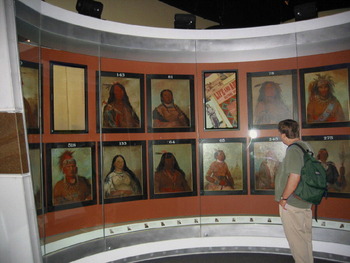
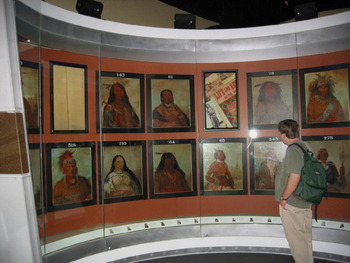
Since Robert Berkhofer's groundbreaking study The White Man's Indian, scholars have seen depictions of Native North Americans as stereotypes imposed on Indian people to serve the needs of dominant culture.Footnote 1 Scholars have teased out different categories of representation – noble savage, bloodthirsty brute, ethnographic curiosity, drunken or wanton social deviant, etc. – as they related to changing Euro-American ideas. An example of this kind of critique can be found in Our Peoples, an exhibit at the National Museum of the American Indian (NMAI) in Washington, DC. Curators Jolene Rickard and Paul Chaat Smith designed the installation to speak back to the narrow and inaccurate ways Indian people have been portrayed in popular culture in Native voices. The exhibition arrays community-produced installations recounting their histories around a central vein of cases offering types of evidence of colonial violence, including artfully arranged displays of gold, bibles, and guns. Close to the entrance of Our Peoples is a small side gallery showing seventeen paintings by the early nineteenth-century artist George Catlin, adding visual representation to the categories of violence imposed on people (Figure 1). Catlin traveled in the trans-Mississippi West in the 1830s to make paintings of Native peoples and scenes of daily life and the surrounding landscape that he subsequently exhibited in the US and Europe. Interspersed among Catlin's images are three digital screens from which a narrator explains the work around him. He says, “Catlin not only drew, he declared himself an authority over, his subjects. In a time of slow communications, his ideas about them were profoundly influential.”Footnote 2
Catlin installation, Our Peoples exhibition, National Museum of the American Indian, Smithsonian Institution, Washington, DC (photograph by the author).
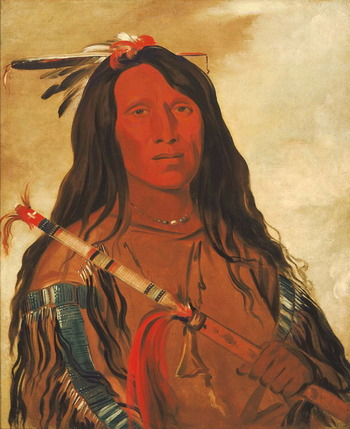
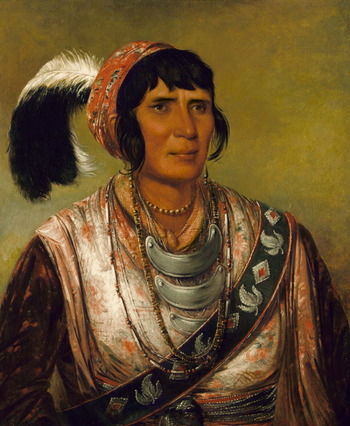
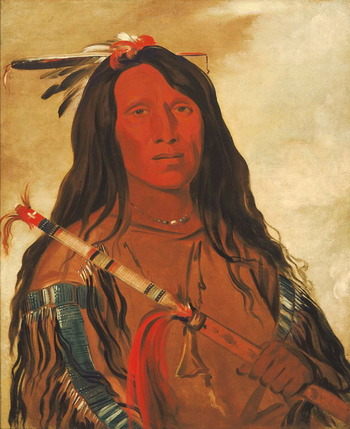
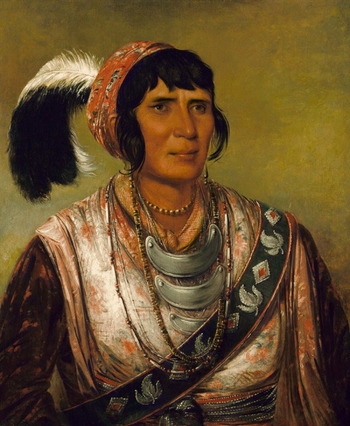
Scholars have shown how Catlin's work helped construct the stereotypical image of Indian people drawn from the masculine martial culture of the Great Plains that was later spread through Wild West shows and Western movies.Footnote 3 The Catlin images on view at the NMAI demonstrate this connection. For example, the portrait at the upper left of the array illustrated in Figure 1, Né-hee-ó-ee-wóo-tis, Wolf on the Hill, Chief of the Tribe (1832), shows the Cheyenne leader in deerskin clothing adorned with feathers, quillwork and scalplocks (Figure 2). A key aspect of the Plains stereotype is the suggestion that the heroic aspects of Native culture depend upon the continuation of precontact modes of life, and, despite the fact that Catlin's encounter with Wolf on the Hill was brokered by a fur trader, he does not give any indication in the picture of the chief's interactions with Euro-American society. Catlin's writings actually criticized the negative impact that exposure to European American traders and government officials had, and some of his paintings, such as the well-known portrait of the Assiniboine diplomat Wi-Jun-Jon, use the adoption of Euro-American dress as a means of signaling the moral decay of a sitter, leading critics to identify his project exclusively with romantic primitivism.Footnote 4 However, without denying the contributions of such tropes of the noble savage to Native deterritorialization, I am concerned that this kind of analysis can unintentionally perpetuate the silencing of Native voices and keep them at a distance from history. At the NMAI, Catlin's work is set up as a foil against which twenty-first-century Indian people speak back, telling their own stories. But treating the earlier pictures as pure objectification denies the potential for Catlin's sitters to speak for themselves. While the painter certainly imposed his own values on the project, the works yield a great deal of information about how Indian people living through a time of dramatic change in the relationship between Americans and Indians made choices regarding self-presentation which reveal their own perspectives. Take as a case in point the portrait of the Seminole leader Osceola, an image which defies the characterization of Catlin as exclusively interested in a “Wild West” stereotype (Figure 3). Catlin's letters record the fact that Osceola took care to present himself in his finest clothes for his sitting, noting that he donned the same costume again when taking leave of officers and chiefs before he died.Footnote 5 It incorporates both materials and forms that would have been familiar to European American viewers from their own wardrobes, including a tailored shirt and scarf made from printed cloth. The outfit is made up of items Seminoles acquired in the deerskin trade, initially a mutually beneficial alliance between Native southeasterners and European settlers, and represents an intercultural uniform of diplomacy and exchange, clearly signifying Osceola's mastery of the codes of this cultural sphere.Footnote 6
George Catlin, Né-hee-ó-ee-wóo-tis, Wolf on the Hill, Chief of the Tribe, 1832, oil on canvas, 29×24 in (73.7×60.9 cm) Smithsonian American Art Museum, Gift of Mrs. Joseph Harrison Jr., 1985.66.143.
George Catlin, Os-Ce-O-La, The Black Drink, a Warrior of Great Distinction, oil on canvas, 1838. Smithsonian American Art Museum, Gift of Mrs. Joseph Harrison Jr., 1985.66.301.
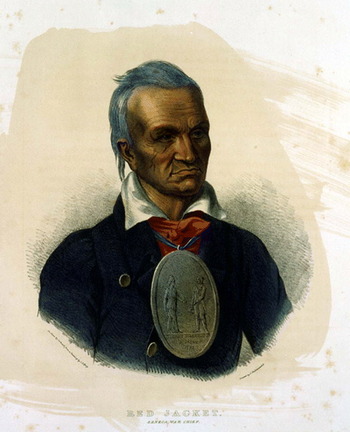
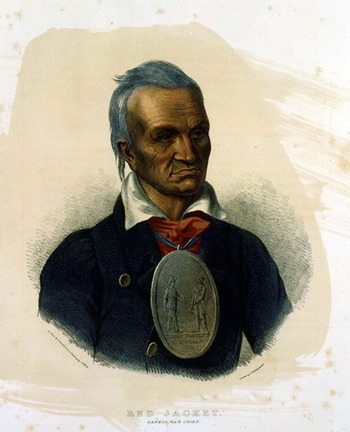
How, then, are we to view images of Indian people produced during the early years of American continental expansion? Might we be able to re-create a sense of the significance of these works for their original Native and non-Native viewers? Along with other scholars, I have come to see representations of specific Indian people from the colonial period and early republic as records, and indeed forms, of intercultural negotiation whose investigation can shed light on the broader context of Native–non-Native relations. This essay discusses a collection of such works by one of Catlin's contemporaries, Charles Bird King, which were publicly displayed in Washington, DC in the 1820s and 1830s (Figure 4). As I will argue, these works offer a record of intercultural exchange during a watershed time in US–Native relations. Essential to my investigation is identifying these works as portraiture, a genre in which, as Richard Brilliant has explained, “the viewer confronts the purposeful relationship between the original, who presents himself or herself in the world, and the portrait, as a subsequent representation of that person.”Footnote 7 I relate indigenous negotiated self-representation to sovereignty, a concept that refers to political self-determination but also to more personal choices of how to make decisions and determine meaning, and I connect the rise of the current attitude toward these representations as generic stereotypes to the erosion of indigenous sovereignty in the nineteenth century.
Red Jacket, Seneca War Chief, after Charles Bird King. Hand-colored lithograph, 1837–44. Smithsonian American Art Museum, museum purchase, 1985.66.153, 293.
In this work, I find common ground with Stephanie Pratt, whose exploration of the complexity of British eighteenth-century representations of Indian people argues for “a construction of race in European visual culture [that] was not inevitably or solely a process of imposing a set of European values on another culture without resistance” and instead seeks out visual expressions of what Richard White has termed “the Middle ground” – a site of intercultural contact and exchange which, while not without conflict, required participants to become familiar enough with the values and reasoning of their interlocutors to use them to achieve their own ends.Footnote 8
King's work is routinely referred to as an “Indian gallery,” a term which entered common parlance through its use by Catlin. As Martha Sandweiss has described them, Indian galleries “presented to viewers a thrilling sort of encounter with the exotic cultures of the far West.”Footnote 9 But King's paintings do not conform well to this model. A large number of the Native diplomats who journeyed to Washington in the 1820s belonged to tribes who had a long history of intercultural contact and had adopted modes of formal self-presentation that foregrounded the importance of textiles and clothing in this intercultural trade. Restricted almost entirely to depictions of Native leaders from east of the Mississippi involved in negotiations with the United States government and often known to non-Indian viewers through accounts in the press, Thomas McKenney's gallery fits a type of portrait gallery then popular in American cities known as a pantheon. Identifying the gallery this way marks it as a modern space where cultures interacted in mutually understood terms related to forms of cultural and economic exchange and political negotiation that characterized Indian–White relations through the early nineteenth century. Under the Jackson administration, Supreme Court decisions and the implementation of the Removal Policy transformed the status of indigenous people from subjects of autonomous nations with treaty-based relationships with the United States to “domestic, dependent nations” increasingly understood through the conceptual logic of ethnicity. This change eroded the intercultural significance of King's portraits, transforming the collection into an “Indian gallery,” notable primarily for its ability to illustrate the exotic alterity of Native Americans. By relating the evolving significance of this collection of portraits for both Native and non-Native audiences, I hope not only to enrich our understanding of the cultural meaning of these pictures but also to inspire some thoughtfulness about the assumptions with which cultural and art historians approach the historic representation of colonized peoples.
MCKENNEY'S GALLERY
In 1821, Thomas McKenney, then United States Superintendent of Indian Trade, asked local portrait painter Charles Bird King to paint some Native visitors to the capitol. King was a Rhode Island native who trained in New York before relocating to London for seven years, where he roomed with Thomas Sully and studied with Benjamin West. King had initially sought a career in Philadelphia but, perhaps in search of a less competitive milieu, relocated to Washington, DC in 1816. There he solidified his reputation as a portraitist, with sitters drawing from the political and social elites. King and McKenney may have met through political connections – both were members of the circle around the South Carolina politician John C. Calhoun and both benefited from his patronage. When McKenney became first Superintendent of Indian Affairs under a reorganization of US–Native exchange in 1824, he began to hire King regularly to make portraits of Native diplomats, which he displayed in his office. The project lasted steadily until 1837, with some additional commissions up until 1842, and the resulting gallery comprised 143 works by King, plus copies made for the sitters and some for his own use.Footnote 10 At times, the Indian gallery was supplemented with work by other artists, as in 1826–27, when King copied James Otto Lewis's portraits of Native diplomats engaged in negotiations with the government in the Great Lakes, and in 1837, when the number of delegations exceeded King's ability to capture all of the likenesses, and he hired his friend and pupil George Cooke to produce some. King was paid fairly for his work, twenty dollars for a bust and twenty-seven dollars for a full-length portrait, yielding him around $3,500 in total. The work was on display in McKenney's offices in the War Office Building until the late 1840s, when it was transferred, ending up as part of the original collections of the Smithsonian Institution. The paintings were destroyed in the fire that attacked the museum in 1865, but several copies made by King and by Philadelphia painter Henry Inman survive.
King's paintings are best known through McKenney's co-authored publication, The History of the Indian Tribes of North America, a three-volume work with lithographic copies of the portraits accompanied by brief biographical sketches of each sitter composed by McKenney and his collaborator, jurist James Hall.Footnote 11 While the reproductions reached a greater audience than the paintings could, it appears that the decision to have the paintings reproduced came only after the gallery was established. The motivation for hiring King is unknown, but it likely relates to McKenney's desire to create a record of the character of the individuals with whom he interacted in order to counter assertions of Native savagery. McKenney's sympathy for Indian people built on his own values, and in his personal papers and the texts he supplied for the History he praised those in whom he saw “civilized” behavior, often linking it to transcultural experiences such as a Euro-American education, evangelization, or even intermarriage.
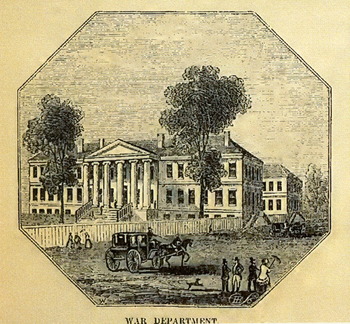
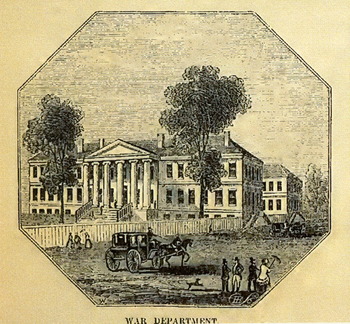
Without the texts, which were written long after most paintings were made, viewers would have responded to King's work in terms of the information provided by the pictures and the context in which they were seen. The two-story neoclassical War Office Building in which they hung was next to the White House, accessible to the highest levels of the executive branch on a regular basis (Figure 5). The portraits were hung on the walls above two display cases containing artifacts in McKenney's office, which was on the second floor to the right of the portico. Visitors to the capital city were invited to come and see what has been called an “immensely popular” display, which garnered praise from the likes of Frances Trollope, who found the gallery of “great interest.”Footnote 12 Native delegations to Washington for audiences with the President were particularly encouraged to spend time looking at the portraits. Herman Viola quotes an observer stating that when a group of Sac and Fox warriors were brought to the gallery after a conversation with President Jackson, “they expressed more surprise and pleasure at the portraits than anything else that was shown them in Washington, recognizing many of them.”Footnote 13
War Department, from “Public Buildings in Washington,” Gleason's Pictorial Drawing-Room Companion, 6, 8 (11 March 1854), 152.
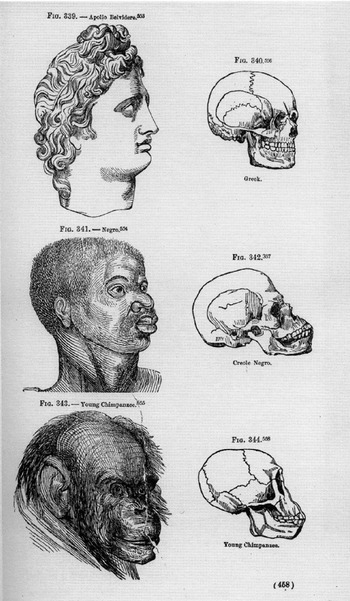
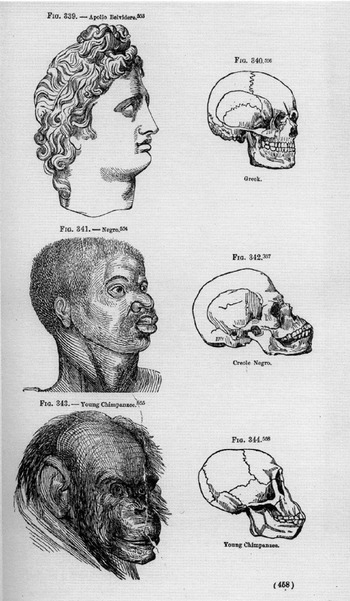
Such comments suggest that King's pictures were recognized as portraits at the time by both Indians and non-Indians. This claim departs from conventional wisdom, which interprets the pictures as inherently distinct from portraiture in their commitment to create a generalized picture of a racial “other.” For example, Richard Brilliant dismisses King's pictures as generic: “splendid as the … images are, however, from a present perspective the portraits exhibit a very narrow range of physiognomic variation; they conform to a limited repertoire of types, particularized by details of ethnic costume and hair treatment.”Footnote 14 This characterization is repeated in many later accounts, which suggest that a generalization of features shows disregard for the sitter. John Ewers, for example, argues that King had only varying degrees of success in meeting what he saw as the primary goal of portraiture, which was an accurate likeness, a claim he makes in part by pointing out that the faces of the same sitter look different in portraits by King and Catlin.Footnote 15 Yet the generalization of a sitter's features in portraiture of this time is hardly limited to representations of Indian people. In his Discourses on Art, British Royal Academy president Joshua Reynolds denigrated painters who strived merely to imitate nature and encouraged even portrait painters to endow their subjects with something of the ideal.Footnote 16 Rochelle Venuto has argued that McKenney's tendency to refer to the pictures in his gallery as “heads” is an act of disembodiment that supports pseudoscientific discourses of the time that linked appearance, and particularly head size and shape, to emerging racial hierarchies. She singles out Samuel George Morton's 1839 book Crania Americana, which compared the skulls of a variety of Native Americans, linking their size to the intelligence of the race as a whole, and used this information to support racial hierarchies.Footnote 17 However, the term “heads” was a common term for portrait busts in the nineteenth century. Moreover, craniology was not exclusively devoted to the study of Native Americans. Nor was it the only discourse linking the measurement and assessment of the head to the process of discerning a person's character. Morton's project was linked to the practices of physiognomy and phrenology, which were applied to members of a variety of ethnic groups and historical figures in an effort to reveal their characters (Figure 6). As Charles Colbert has demonstrated, the discipline of reading heads was a pervasive practice for both artists and their audiences in nineteenth-century America, building on the theories of physiognomy developed a century earlier by the Swiss scholar Johann Kaspar Lavater.Footnote 18 The demand for theories of how to interpret character from appearance can be attributed to contemporary cultural shifts such as urbanization and industrialization that caused people to seek systems whereby they could assess the character of the strangers they encountered with increasing frequency. Viewers sought other clues to a stranger's character and accomplishment derived by the spread of global trade. As T. H. Breen has argued, American colonists of the eighteenth century judged portraits by their ability to record the sense of identity fashioned by the sitters through the self-conscious use of consumer goods, in particular imported cloth, which was intimately linked to codes of class and status.Footnote 19 Viewers in the early republic would have relied on these habits of decoding in their search for signs of identity and character in King's work, as the sitters for the paintings would have likely been aware.
Craniological illustration from Josiah C. Nott and George R. Glidden, Types of Mankind: Or, Ethnological Researches, Based upon the Ancient Monuments, Paintings, Sculptures, and Crania of Races, and upon Their Natural, Geographical, Philological and Biblical History (Philadelphia: Lippincott Gramoo & Co., 1855), 458.
Joanne Barker has claimed that “despite the problems of translation, indigenous peoples learned that how they represented themselves in international affairs mattered in consequential ways to how they were related to and what rights they were perceived to be claiming.”Footnote 20 As Breen reminds us, paramount in this was the use of clothing to communicate identity and position. Natives involved in the fur and deerskin trades developed new clothing styles which reflected their roles as cultural interlocutors, often wearing items associated with each culture, with the sachem, or person with the greatest authority to negotiate with non-Indians, wearing the most completely European attire, often consisting of a shirt, breeches, and shoes and stockings, as Timothy Shannon has demonstrated.Footnote 21 Looking closely at King's portraits reveals signs of honor and accomplishment, such as collars, headdresses, ceremonial regalia, and peace medals which would have signaled the wearer's experience and authority. Portraits reveal that in some cases the materials obtained through trade have been fashioned in ways that update and refine older codes of tribal dress associated with authority; in others self-presentation is more allied with that of non-Indians. This variety is matched by clearly recognizable regional tastes, such as bead- and ribbonwork in the Great Lakes and turbans in the South.
PORTRAITURE AND COSMOPOLITAN INDIGENEITY
Sitting for portraits built on self-presentation skills developed in intercultural negotiation. By the time King began his work for McKenney, indigenous culture brokers had been sitting for portraits for over a century, tracing back to a visit by four Haudenosaunee youths to the court of Queen Anne in 1710. “The Four Indian Kings,” as they were called, were the subjects of numerous visual representations, some of which were engraved and sent back to the colonies, for presentation to both Anglo-American and Indigenous audiences. Subsequently, many Indian diplomats journeying to London, and later to Philadelphia, New York, and Washington, had sat for portraits, frequently coming home with miniature or printed copies which could be seen by others.
Many of King's sitters had come to Washington because they were masters of contemporary codes of behavior and appearance, and they used these to present themselves as equals in negotiation with representatives of the federal government. In several cases, they hailed from communities with long-standing histories of cultural interaction and had adopted many fashions current in the Atlantic world. Some scholars of the history of Native American representation have identified the Euro-American dress in King's portraits as a sign of McKenney's belief that Indian people could be assimilated into white society. Julie Schimmel has described his gallery as representing “a race that could perhaps be persuaded by rational argument as well as the formidable presence of the United States government to abandon tribal tradition for a more civilized life-style.”Footnote 22 Venuto has explained that, while less radically violent than other manifestations of vanishing-race ideology, this attitude supported the disappearance of Indian culture, seen in this case as an inevitable by-product of the Native path toward civilization.Footnote 23 However, I would argue that it is important to see this adoption of the appearance of modern sophistication not as a sign of assimilation but, rather, as an assertion of Native people's implication in modern, cosmopolitan notions of taste and consumption. To deny these individuals credit for self-fashioning is, I would argue, a denial of their sovereignty – both personal sovereignty and tribal sovereignty – as it insists on keeping Native identity at a distance from contemporary economic, social, and political history.
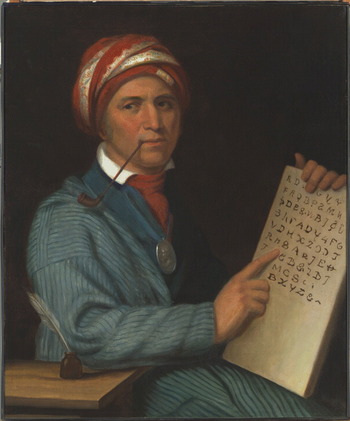
King appears to have recognized the significance of different sitters’ modes of self-presentation and, on occasion, made formal choices designed to reinforce a sense of individual character. A good example of this can be found in King's portrait of the Cherokee cultural leader Sequoyah, whose pose, attire and accoutrements give a palpable sense of the man (Figure 7). Careful description is helpful in teasing this out. Sequoyah's clothing is carefully drawn. He wears a white shirt with a red cloth at the neck. On top of these is a dark blue vest topped by a loose jacket of striped blue material. The jacket is relatively untailored, having a simple drop shoulder and no cuffs. There are no buttons showing, suggesting that the jacket closes with a sash. There is a similarly casual appearance to Sequoyah's headgear, a cloth wrap twisted around his head, obscuring any sign of hair underneath. The cloth is red with stripes of white, the latter patterned in several colors in a design that appears to have been woven in. The face beneath this turban is delicately hewn. Sequoyah appears to be a mature man, with hints of grey in his eyebrows and near his temples. There is a tinge of sadness in his expression, particularly the way he gazes off to his extreme right, but he is in no way infirm – his cheeks have a healthy pink glow, his posture is erect and his gesture assertive. Despite the fact that the painting shows only the top of his body, Sequoyah is given a great deal of bodily presence. He holds up a piece of paper inscribed with symbols, the quill by his right elbow ready to be picked up so he can fill the rest of page. The long clay pipe sticking out of his mouth signals the active working of lungs and the visceral pleasures attending the use of tobacco.
Henry Inman, Sequoyah, Native American Statesman, c.1830. After a painting by Charles Bird King. Oil on canvas. National Portrait Gallery, Smithsonian Institution, Washington, DC/Art Resource, NY.
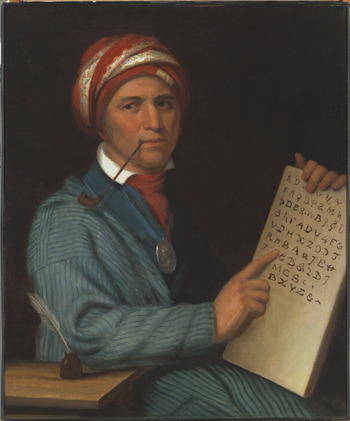
If physiognomy marks this picture as the portrait of an individual, two final aspects of the painting point to his specific identity as Sequoyah. The first is the medal hanging around his neck which, while often identified as a peace medal, may in fact be the silver medal awarded to him in 1824 by the Cherokee national council, though it could also have been given him by the United States government. The inspiration for the Cherokee nation medal is the object in Sequoyah's hands, the eighty-six (later eighty-five)-character syllabary of the Cherokee language. Sequoyah, who had worked as a silversmith and later as a blacksmith, developed this syllabary, supposedly in response to a conversation in which some peers linked the power of writing with the superior strength of European American culture. McKenney's text for the Sequoyah plate in The History of Indian Tribes describes this invention and praises Sequoyah as the “Cadmus of his race,” perpetuating an association with the Greek hero thought to have introduced the Phoenician alphabet.Footnote 24
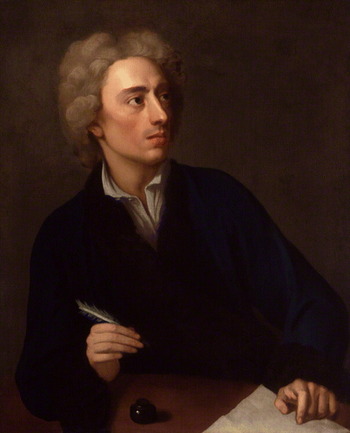
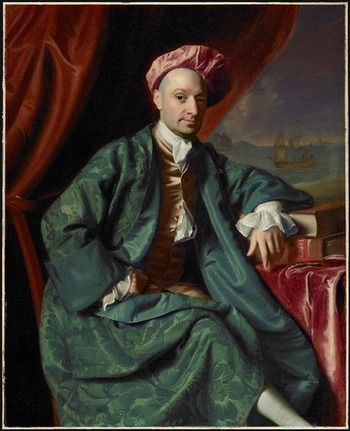
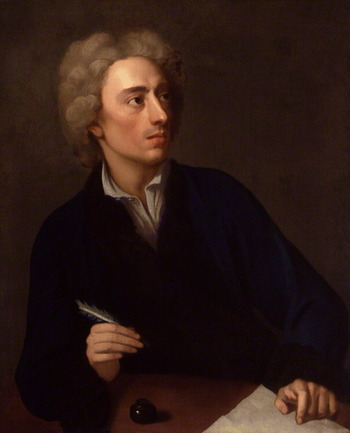
The combination of a relaxed or casual appearance and the emphasis on writing in the depiction of Sequoyah is another sign of identity, marshaling an established transatlantic iconography of refined literary life. This can be seen in a comparison to a portrait of Alexander Pope, one of several of the celebrated English poet that circulated widely in printed form (Figure 8). Most significant here is the table at the left side of the picture, which supports an inkwell with a pen sticking out of it. Gwendolyn Shaw has argued that prints of Pope and other literary heroes were utilized by artists in their depiction of American writers, particularly writers whose ethnic background might undermine the credibility of their capacity for scholarship.Footnote 25 Pope's identity is communicated not only by the tools of his trade, but also by his attire, a roomy dressing gown not dissimilar to Sequoyah's. Another portrait shows Pope in a loose skullcap, a form of headgear that would have been worn by gentlemen at home when they removed their wigs, adding to the relaxed and spontaneous sense of creativity of the image. This costume had clearly made its way to the American colonies in the eighteenth century, as is demonstrated by the similar, if more luxurious, costume in John Singleton Copley's well-known likeness of Nicholas Boylston (Figure 9). That the portrait of Sequoyah conforms so well to the image of a European literary man of leisure should not lead us to see it as a portrait that denies his Native identity or argues for his assimilation to whiteness, however. Instead it should challenge us to think about what Native identity is, and how it can manifest in the visual field, paying more attention to what we actually see rather than to what later visual paradigms have trained us to expect.
Studio of Michael Dahl, Alexander Pope, c.1727, oil on canvas, © National Portrait Gallery, London.
John Singleton Copley, Nicholas Boylston, 1767, oil on canvas, Harvard University Portrait Collection, bequest of Ward Nicholas Boylston to Harvard College, 1828, H90.

These portraits demonstrate the new emphasis on ease and familiarity that accompanied the development of middle-class taste in the late colonial period, ideas that would not have been lost on Cherokees, who had a long history of exposure to and exchange with Anglo-Americans. They also demonstrate the degree to which the emerging notion of refinement was embedded in the exchanges that developed within the British colonial world. As Branden Fortune has explained, Boylston's robe takes its form from a garment worn in India; the Boston merchant's appearance speaks to a cosmopolitan modernity that extends well beyond his immediate social milieu.Footnote 26 This context can be extended to include Indian people, who were sophisticated consumers of trade goods produced not only in the United States but also abroad. This situation is something McKenney understood only too well, as in his early position as Superintendent of Indian Trade he frequently had to deal with his contractors' insistence that the Natives would only accept foreign textiles in payment of the annuities guaranteed by treaties with the United States government. Interestingly, McKenney included exotic as well as utilitarian goods in the barrels he shipped to traders on the Indian frontier, feeling confident that items such as a Chinese silk robe would find a willing purchaser.Footnote 27
While some viewers might have read Sequoyah's demonstration of taste as a mark of assimilation, Indian people could have seen it as an assertion of their own modernization. Certainly Sequoya, who devised his syllabary to support Cherokee cultural development without the sacrifice of language, who was involved in negotiations as a representative of a sovereign Cherokee nation with the US government, and who eventually fled to Mexico with Cherokees who resisted US control, would not have thought of himself as assimilated. Significantly, an early article on Sequoyah's syllabary published by the Cherokee Phoenix in the Cherokee language reads his features as a sign of Sequoyah's Indianness. It notes that “Mr. Guess [Sequoyah's English name] is in appearance and habits, a full Cherokee,” and goes on to say this is the case even “though his grandfather on his father's side was a white man.”Footnote 28 Aspects of the costume worn by Sequoyah, such as the turban, have even come to be considered “traditional” Cherokee dress, honoring the leadership provided by cultural interlocutors at this time.
A WASHINGTON PANTHEON
If King's paintings invited viewers to see them as portraits, what about the display of the works? There are no extant views of McKenney's gallery but consideration of contemporary exhibitionary modes suggests this public installation resembled a “pantheon,” or gallery of notables. The American pantheon builds on an older strain of public representation rooted in antiquity and perpetuated through the establishment of galleries of leading citizens in early modern republics in Italy and the Netherlands. These galleries were generally set up in governmental buildings, libraries, and other venues thought to contribute to the shaping of character. By the late eighteenth century, the studying of the heads of exemplary men was a widespread practice supported by collections of paintings, busts, prints, and medals. An important model for Americans was James Granger, who had a collection of some 14,000 portrait prints. In 1769 Granger published A Biographical History of England, which offered brief biographies of over three hundred of the subjects and included space for collectors to paste in their own prints next to these entries.Footnote 29
In America, the creation of pantheons was an essential aspect of early nation building, and helped establish the United States as a legitimate and exceptional nation with military, political, and intellectual heroes. Branden Fortune's important study of public portrait galleries in the early republic notes that inclusion in these American “pantheons” required one to be not merely famous, but praiseworthy.Footnote 30 Fortune singles out several collections for discussion, including that assembled by Thomas Jefferson at Monticello; Charles Willson Peale's portrait gallery; the Philadelphia collection of paintings of Joseph Delaplaine, which were issued as a set of engravings as well; and the likenesses displayed in New York's City Hall produced on commission by John Trumbull, John Vanderlyn, and others. She also identifies John Trumbull's painting of the signers of the Declaration of Independence as a pantheon. Significantly for Fortune, each of these displays was purposely assembled by civic leaders and installed in a public venue associated with promoting the health and virtue of the republic. Jefferson entertained important political and intellectual leaders from the United States and abroad at Monticello, Peale relocated his museum and portrait gallery to the second floor of Independence Hall in Philadelphia in 1802, and the other collections were in public buildings. Importantly, the individuals represented in these collections included not just political leaders, but also philosophers, military leaders and intellectual and scientific leaders who were thought to offer models for Republican behavior.
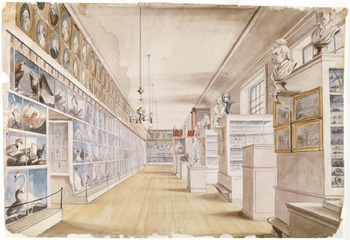
Of these examples, Charles Willson Peale's gallery, which opened to the public in 1782, is the best known (Figure 10). Peale swore “never to paint the Portrait of a bad man, as none but the virtuous deserve to be remembered.”Footnote 31 Displayed along the top of the walls of the “long room,” his portrait gallery provided a crowning edifice to the natural-history specimens arrayed below, implicitly arguing for man's power over other orders of creation.Footnote 32 In the tradition of Granger, the biographies of the individuals depicted could be found in Peale's museum catalog, and admirers would be able to find engraved copies of many of the images available for further contemplation at home. This pantheon tradition continued well into the century, as can be seen by the work of photographer Mathew Brady, who enticed leading citizens to sit for his camera so that he could display their images in his “Gallery of Illustrious Americans,” also issuing them as prints accompanied by biographical sketches in an 1850 volume of the same name. That this was the format chosen by McKenney and Hall for their publication as well suggests that we should also see it as part of this tradition of printed pantheons. Texts built on the ability to read visual signs of character discussed above, turning this information to educational purpose; for example, the entry for the image of Millard Fillmore argued that it provided an “instructive lesson for the young men of America” and “shows how much can be achieved in the face of the sternest obstacles by intellectual power well directed.”Footnote 33
Charles Willson Peale, The Long Room, Interior of Front Room in Peale's Museum, 1822, watercolor over graphite on paper, Detroit Institute of Arts, USA, Founders Society purchase, Director's Discretionary Fund/the Bridgeman Art Library.

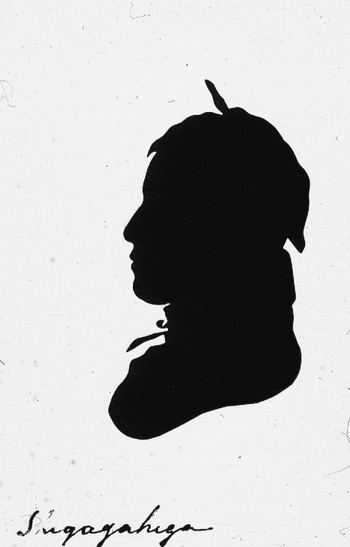
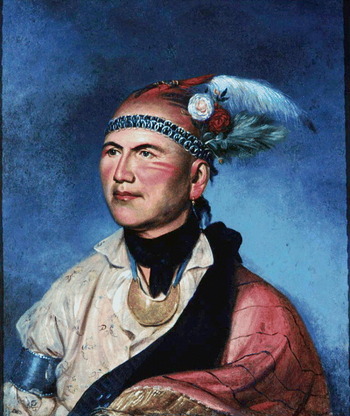
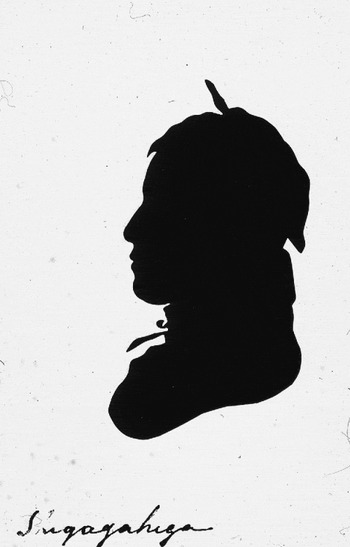
Fortune claims that Indian people and others from “the lowest realms of American society” were not deemed “public figures” worthy of inclusion in these pantheons, but in fact Native leaders were included in two of the collections she studies. At Monticello, Jefferson displayed the silhouettes of eleven Osage, Missouri, Kansa, Pawnee, Iowa and Sioux emissaries who visited Monticello in 1806 as part of a group making a diplomatic tour (Figure 11). Today four of these hang in the library, opposite silhouettes of physician Anthony Fothergill and the French diplomat Edmond Charles Edouard Genet. The Native likenesses were made at the Peale Museum using the physiognotrace, and it may thus not be surprising that the other pantheon which included a representation of a Native American is Peale's. Included in this group after its creation in 1797 is a portrait of the Mohawk cultural leader Joseph Brant, who led troops for the British in the Seven Years War and the Revolution and who had visited London twice to negotiate with the crown (Figure 12).
Charles Willson Peale or Moses Williams, Shegagahega, paper silhouette, 1806, Manuscript 7129, National Anthropological Archives, Smithsonian Institution.
Charles Willson Peale, Joseph Brant/Thayandanegea, from life, 1797, oil on canvas, Independent National Historical Park, Philadelphia, PA.

The significance of portraits within the pantheons resulted from the collective labor of painters, sitters, and viewers. Including portraits of Natives alongside those of Euro-American worthies suggests the potential for viewers to regard the sitters highly. And while there was widespread American disregard for Indian people in general, indigenous military and political leaders gained notoriety and admiration during the Revolution and early republic, with their names, military accomplishments, and, on occasion, speeches recorded in books and newspapers, just as the deeds of other members of pantheons were. Contemporary descriptions suggest that viewers brought the same expectations to McKenney's gallery. Secretary of War James Barbour recalled McKenney promoting his gallery as “preserving the likenesses of some of the most distinguished among this most extraordinary race of people.”Footnote 34 Barbour's approval of hiring King, an accomplished painter who had gained distinction for his likenesses of leading politicians, to be commissioned for the work further connects this gallery with the pantheon tradition. That indigenous viewers could have recognized not only the value of portraiture but also the importance of a portrait gallery is underscored by Timothy Sweet's observation that
men were usually gratified that their images were thus preserved and publicized … One writer describing the Winnebago delegation in 1850 remarked that “nothing pleased them so much as to tell them that their likenesses were in the War Department, and that their fame was spread through the world.”Footnote 35
FROM PANTHEON TO INDIAN GALLERY
Even as King's portraits were being made, however, changes in US Indian policy were undermining the identity of McKenney's gallery. McKenney began the project when US–Native relations were still considered as being between nations. The designation of Indian tribes as sovereign entities traces back to the origins of American Indian policy shaped by Henry Knox for George Washington. Following the precedent of earlier interactions between tribes and European governments, Knox's proposal called for respect for Native land tenancy within existing treaty boundaries and the continuation of treaty making as the appropriate means of international negotiation, giving Congress the sole right to regulate commerce with Indian tribes. Importantly, treaties could be made exclusively with the federal government, reinforcing the understanding that “the independent nations and tribes of Indians ought to be considered as foreign nations, not as the subjects of any particular states.”Footnote 36
The goal of this policy was the eventual privatization of Indian lands, and his measures also included the encouragement of missionaries and vocational trading schools on Indian lands and provisions that in exchange for federal “‘management,’ ‘assistance,’ ‘benevolence,’ and ‘enlightenment,’ the Indians were to cede, from time to time, such land that they were not cultivating.”Footnote 37 This attitude drew on the increasing imbalance of military and economic power that put indigenous peoples at a disadvantage in intercultural negotiations. In his work for the War Department, McKenney upheld Knox's commitment to maintaining Native sovereignty while pursuing the goal of gradually solidifying Native ties to the US that he felt would lead to their “inevitable” absorption into American society. However, Andrew Jackson overturned the commitment to sustaining existing treaty boundaries and instituted a policy of relocating tribes to other territory in the West. The same period saw Justice Marshall's signal “Cherokee” decisions which, while upholding the sovereignty of Indian tribes, advanced a new definition of their political status as “domestic, dependent nations” with different and fewer rights than foreign nations, and described tribes' relationship with the US as that of a “ward” with its guardian.Footnote 38 McKenney gave his endorsement to relocating tribal peoples off traditional lands but only with tribes' agreement; he claimed that his insistence that “the Indian was, in his intellectual and moral structure, our equal” lost him his job in 1830.Footnote 39
McKenney's dismissal from the War Department did not bring the end of his gallery – the portraits remained on display. However, the developments in US–Native relations increased the sense of historical distance and cultural difference between Indians and non-Indians and inevitably impacted the ideas Euro-American viewers brought to King's paintings. By the early 1830s, the gallery could no longer function as a pantheon. The development of Indian galleries dedicated to celebrating the exoticism of the vanishing race in the middle of that decade created a new category into which King's work was slotted. When the gallery was relocated to the brand-new Smithsonian Institution, where it was eventually joined by works by Catlin and others, it was even easier to see King's paintings as ethnographic projections rather than portraits. In this context they became the kind of evidence of colonial violence singled out in the NMAI exhibition discussed at the beginning of this piece rather than products of an intercultural negotiation.
THE ERASURE OF THE CULTURAL FRONTIER
However, changes in US policy did not alter the indigenous understanding of Native sovereignty. Native diplomats continued to present themselves as representatives of sovereign nations with an active role to play in contemporary history and to use self-presentation as a means of communicating their character and status. This was the case, for example, with the Sac and Fox leader Black Hawk, who saw his journey east in 1837 at the conclusion of his rebellion as an opportunity for negotiation as a defeated leader of a foreign state while the federal government saw him as a prisoner with no bargaining power.Footnote 40 As I argued at the beginning of this essay, even some of the Native leaders who sat for George Catlin appear to have understood themselves to be engaged in an act of diplomatic self-fashioning that reinforced their sovereign agency.
Joanne Barker has argued that during the Removal period, indigeneity was purposefully redefined as a racial rather than a political identity. As she writes, “the ethnicization of indigenous peoples has been a political strategy of the nation-state to erase the sovereign from the indigenous.”Footnote 41 In treating works of art created under the rubric of sovereignty as documents of ethnicity, even if one does so to critique racial ideology, art historians unwittingly reinforce this strategy. More careful work is needed if we want to see cultural frontiers for what they are – spaces of engagement and exchange.
The Cree/Metis artist and scholar Gerald McMaster has said that the “powerful reflexive critiques” within art history “advance only a partial understanding” of other histories because they turn attention to existing categories of analysis.Footnote 42 Similarly, producing “other” histories to exist alongside a mainstream story is insufficient to effect change. McMaster encourages developing a critical vision that can encompass the intersections and divergences of the concerns of multiple constituencies. I would argue that McMaster's riparian metaphor can be reconfigured as a frontier, not so much standing between cultures as rather providing a ground for encounter and exchange. Scholars seeking a richer art history need to look at objects created during encounters not only for signs of the colonial domination but also for records of intercultural negotiation.
The NMAI describes the goals of “Our Peoples” thus:
In the struggle for survival, nearly every Native community wrestled with the impact of deadly new diseases and weaponry, the weakening of traditional spirituality, and the seizure of homelands by invading governments. But the story of these last five centuries is not entirely a story of destruction. It is also about how Native people intentionally and strategically kept their cultures alive.Footnote 43
By identifying McKenney's gallery as a pantheon in which Indian people's assertions of identity and status were communicated across cultural lines, I argue that these portraits might be seen not merely as cultural erasure but also as examples of Native people's intentions and strategies. Regaining the richness of such objects not only deepens our understanding of the past, but also allows for a more nuanced exploration of the cultural interactions of the present.