INTRODUCTION
The abundance and distribution of a species throughout its geographic range are influenced by several ecological processes (Brown, Reference Brown1995; Gaston, Reference Gaston2003, Reference Gaston2009; Sagarin et al., Reference Sagarin, Gaines and Gaylord2006) including rates of reproductive output and recruitment success affecting demography (Hyder et al., Reference Hyder, Aberg, Johnson and Hawkins2001), habitat quality and availability (Keith et al., Reference Keith, Herbert, Norton, Hawkins and Newton2011), dispersal (Gaines et al., Reference Gaines, Lester, Eckert, Kinlan, Sagarin, Gaylord, Roy and Witman2009), competition with other species (Poloczanska et al., Reference Poloczanska, Hawkins, Southward and Burrows2008), plus predation including human harvesting (Fenberg & Rivadeneira, Reference Fenberg and Rivadeneira2011). Differences in climate and hence environmental regime experienced will also influence survival, growth and reproduction of individuals and hence population processes (see Mieszkowska et al., Reference Mieszkowska, Kendall, Hawkins, Leaper, Williamson, Hardman-Mountford and Southward2006, Reference Mieszkowska, Hawkins, Burrows and Kendall2007; Moore et al., Reference Moore, Thompson and Hawkins2011). At geographic range limits, population viability can be determined by physical barriers to dispersal (Gaines et al., Reference Gaines, Gaylord, Gerber, Hastings and Kinlan2007; Lasky et al., Reference Lasky, Jetz and Keitt2011), habitat quality (Herbert et al., Reference Herbert, Hawkins, Sheader and Southward2003; Herbert & Hawkins, Reference Herbert and Hawkins2006), biological interactions such as competition (Poloczanska et al., Reference Poloczanska, Hawkins, Southward and Burrows2008) and predation (Sanford, Reference Sanford2002).
Little is known about how the above mechanisms differentially affect species in different parts of their range (e.g. equatorward and poleward limits vs. the centre) and how they relate to abundance and population structure across the range (Fenberg & Rivadeneira, Reference Fenberg and Rivadeneira2011). The abundance and range limits of species may be reflected in population structure, life history and genetic traits (see Gilman, Reference Gilman2005, Reference Gilman2006; Gaston, Reference Gaston2009; Herbert et al., Reference Herbert, Southward, Clarke, Sheader and Hawkins2009; Dawson et al., Reference Dawson, Grosberg, Stuart and Sanford2010; Rivadeneira et al., Reference Rivadeneira, Hernaez, Baeza, Boltana, Cifuentes, Correa, Cuevas, Valle, Hinojosa, Ulrich, Valdivia, Vásquez, Zander and Thiel2010). Low abundances near range limits reflect recruitment limitation, potentially caused by Allee effects or habitat availability (Zacherl et al., Reference Zacherl, Gaines and Lonhart2003; Gilman, Reference Gilman2006; Sexton et al., Reference Sexton, Mcintyre, Angert and Rice2009) or poor larval supply due to hydrographic factors (Gaines et al., Reference Gaines, Gaylord, Gerber, Hastings and Kinlan2007). In exploited species such as limpets, these patterns might be masked by the impact of size-selective human predation (Fenberg & Roy, Reference Fenberg and Roy2012).
Theoretical models predict excesses of the first sex for species with sequential sex change (Charnov, Reference Charnov1982; Frank & Swingland, Reference Frank and Swingland1988; Charnov & Bull, Reference Charnov and Bull1989a, Reference Charnov and Bullb). From sex-allocation theory, protandry (sequential sex change from male to female) is evolutionarily stable if female fertility increases with age faster than male fertility (Charnov & Bull, Reference Charnov and Bull1989b). Protandry is widespread in patellid limpets of the genera Patella, Cymbula (Orton, Reference Orton1919, Reference Orton1928, Reference Orton1946; Bacci, Reference Bacci1955, Reference Bacci1975; Dodd, Reference Dodd1956; Orton et al., Reference Orton, Southward and Dodd1956; Montalenti, Reference Montalenti and Buzzati-Travesso1958; Branch, Reference Branch1974; Frenkiel, Reference Frenkiel1975; Espinosa et al., Reference Espinosa, Rivera-Ingraham and García-Gómez2009; Rivera-Ingraham et al., Reference Rivera-Ingraham, Espinosa and García-Gómez2011) and Lottia (Lindberg & Wright, Reference Lindberg and Wright1985; Wright, Reference Wright1989; Fenberg & Roy, Reference Fenberg and Roy2012). In most studies protandry has been inferred from analysis of size-frequency data of single populations showing that females predominate in larger size-classes, although repeated biopsies of the same individual have tracked sex change in Lottia gigantea (Gray in G. B. Sowerby I, 1834) (Wright & Lindberg, Reference Wright and Lindberg1979, Reference Wright and Lindberg1982), Patella vulgata (Linnaeus, 1758) (Le Quesne & Hawkins, Reference Le Quesne and Hawkins2006) and Patella ferruginea (Gmelin, 1791) (Espinosa et al., Reference Espinosa, Rivera-Ingraham and García-Gómez2009; Guallart et al., Reference Guallart, Calvo, Acevedo and Templado2013). Little work has been done on variation between populations, especially on a geographic scale including their range edges (but see work on calyptraeids by Collin (Reference Collin2006) and on P. ferruginea by Rivera-Ingraham et al. (Reference Rivera-Ingraham, Espinosa and García-Gómez2011), showing considerable variation in sex ratio).
Previous studies have confirmed that size and time of sex change is sensitive to a range of factors (Munday et al., Reference Munday, Buston and Warner2006). These include: immediate social environment in limpets (Warner et al., Reference Warner, Fisch and Standish1996; Collin et al., Reference Collin, Mclellan, Gruber and Bailey-Jourdain2005), snails (Chen et al., Reference Chen, Yang and Soong2004), shrimp (Baeza & Bauer, Reference Baeza and Bauer2004) and many species of fish (Shapiro, Reference Shapiro, Potts and Wooton1984; Warner, Reference Warner1984; Ross, Reference Ross1990; Kuwamura & Nakashima, Reference Kuwamura and Nakashima1998); size of an individual relative to others in the social group (Warner & Swearer, Reference Warner and Swearer1991; Warner et al., Reference Warner, Fisch and Standish1996; Buston, Reference Buston2003); sex ratio of the social group (Shapiro, Reference Shapiro, Potts and Wooton1984; Munday, Reference Munday2002; Collin et al., Reference Collin, Mclellan, Gruber and Bailey-Jourdain2005) and local density (Wright, Reference Wright1989; Lutenesky, Reference Lutenesky1994).
Our overall aim was to investigate proportions of different sexes (as an indicator of protandry) in different size classes across multiple populations in the British Isles and Portugal. Specifically we compared the protandric P. vulgata at its southern range limit in Portugal, with populations at the centre of their distribution in the British Isles. Conversely, Patella depressa (Pennant, 1777) which is considered non-protandric in the UK (Dodd, Reference Dodd1956; Orton & Southward, Reference Orton and Southward1961) was compared at its northern limit in the British Isles with populations at the centre of the range in Portugal. The Portuguese and English coasts respectively provide a sharp gradient of abundance of P. vulgata approaching its equatorward limits and P. depressa approaching one of its poleward range edges in the English Channel (Fischer-Piette, Reference Fischer-Piette1935; Crisp & Southward, Reference Crisp and Southward1958; Fischer-Piette & Gaillard, Reference Fischer-Piette and Gaillard1959; Southward et al., Reference Southward, Hawkins and Burrows1995; Boaventura et al., Reference Boaventura, Ré, Cancela da Fonseca and Hawkins2002b). Our survey was intended to explore the following alternative hypotheses:
1. The increasingly sub-optimal environment at range edges leads to slower growth and hence delayed promotion from male to female. Sub-optimal conditions could be due to the environment or increased competition from congeneric species (see Boaventura et al., Reference Boaventura, Fonseca and Hawkins2002a) at the centre of their range (i.e. P. depressa in Portugal, P. vulgata in the British Isles). The consequences of this hypothesis being correct would be that Allee effects due to the absence of females could be important in setting range limits. This assumes that interspecific competition is stronger than intraspecific competition.
2. Relaxation of resource limitation resulting from reduced intraspecific competition at lower density (see Boaventura et al., Reference Boaventura, Cancela da Fonseca and Hawkins2003) will allow earlier promotion from males to females resulting in more females at lower densities (i.e. sex change is density dependent). Thus we explored relationships between limpet density (single and both species) and sex ratio.
3. At range edges recruitment is intermittent and in protandric species this leads to older, large animals which are female. This could lead to Allee effects due to fewer males and hence potential sperm limitation.
In addition we wanted to confirm that P. depressa does not exhibit protandry further south in its range. Without manipulative experiments it is impossible to unambiguously test these alternative hypotheses. However, the patterns observed should provide further inference enabling hypotheses (1) to (3) to be ruled likely or unlikely.
MATERIALS AND METHODS
Geographic distributions and basic biology of study species
The two limpet species, Patella vulgata and Patella depressa are found in both the British Isles and Portugal. Patella vulgata occurs from the Arctic Circle near Tromsø in Norway to its southern biogeographic limit in southern Portugal (reviewed in Southward et al., Reference Southward, Hawkins and Burrows1995). Patella vulgata is also present throughout Britain and Ireland (Southward et al., Reference Southward, Hawkins and Burrows1995) and is considered a protandric species (Orton et al., Reference Orton, Southward and Dodd1956), confirmed by repeated sampling of the same individuals (Le Quesne & Hawkins, Reference Le Quesne and Hawkins2006).
Patella depressa is restricted to the south and west coasts of Britain, with its northern biogeographic limit reached in North Wales, on Anglesey (Bowman & Lewis, Reference Bowman and Lewis1986; Southward et al., Reference Southward, Hawkins and Burrows1995; Kendall et al., Reference Kendall, Burrows, Southward and Hawkins2004). A single specimen was recently found on the Isle of Man (Hawkins unpublished observation). Eastern limits in the English Channel were the Isle of Wight, probably set by habitat availability, exposure and hydrography influencing larval supply (Crisp & Southward, Reference Crisp and Southward1958; Lewis, Reference Lewis1964, Reference Lewis1986; Keith et al., Reference Keith, Herbert, Norton, Hawkins and Newton2011). Recently a small range extension has occurred on the sea defences at Hayling Island and Elmer near Bognor Regis (Hawkins, pers. comm.; Mieszkowska et al., Reference Mieszkowska, Kendall, Hawkins, Leaper, Williamson, Hardman-Mountford and Southward2006; Keith et al., Reference Keith, Herbert, Norton, Hawkins and Newton2011). Patella depressa is absent from Ireland (Southward & Crisp, Reference Southward and Crisp1954). In France, P. depressa does not occur beyond Cap de la Hague. They extend south to Senegal, West Africa (Southward et al., Reference Southward, Hawkins and Burrows1995). Patella depressa has been considered a gonochoristic species in the UK (Dodd, Reference Dodd1956; Orton & Southward, Reference Orton and Southward1961) but some size frequency data suggest the possibility of protandry on the Basque coast (Peña-Othaiz, Reference Peña-Othaiz1996).
Study sites
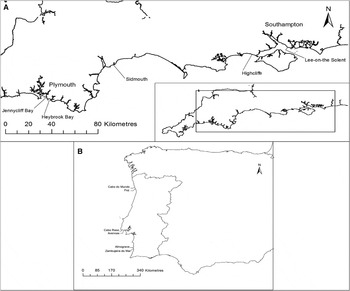
The study was made on the south coast of England and in Portugal from September to November 2012 (Figure 1) when the Patella spp. were reproductively active enabling sex determination. Sites were chosen up to the range edge of the species in both England and Portugal.
(A) Map showing the south coastline of England and relative position of the five study site locations. Inset map shows the position of sites in the south of England. (B) Map showing the coastline of Portugal and relative position of the six study site locations.

Data collection
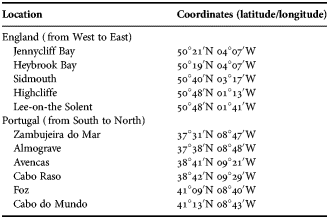
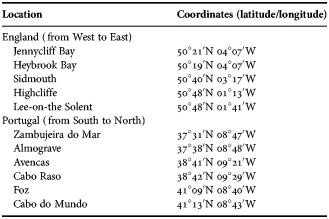
At each site in England and Portugal, 250 limpets were collected using 0.5 × 0.5 m quadrats from the mean tide level (the spatial coordinates for each site are presented in Table 1). In England, Jennycliff and Heybrook Bay, being respectively a moderately sheltered and a moderately exposed site, were compared to assess local differences. Data for Highcliffe were duplicated on different groynes (Highcliffe 1 and Highcliffe 2) in order to check spatial variability in the collected data.
Location names of sampled sites and geographic coordinates.
SIZE-FREQUENCY DISTRIBUTIONS AND SEX RATIOS
In the laboratory the collected limpets were separated by species, their maximum length measured and dissected to identify sex and stage of reproductive activity. Cumulative size-frequency data were plotted by species and visually compared. Kolmogorov–Smirnov tests (Sokal & Rohlf, Reference Sokal and Rohlf1998) were performed on size distributions of males and females for each species from the sites in England and Portugal.
The overall proportion of females at each sampled site was calculated as the (number of females)/(number of males + number of females). It was expected that the protandric Patella vulgata would show a male biased sex ratio in contrast to gonochoristic Patella depressa that should have equal proportions of males and females.
STATISTICAL ANALYSIS: MALE/FEMALE SIZES
A two-factor split-plot design was used to test the hypothesis that in potentially protandric species males were smaller than females on average in body size, measured as length. The model was applied to species from England and Portugal separately. The design had two levels of the fixed Sex factor (Sx), at each level of a random Site factor (St, with six levels for England and Portugal for P. vulgata; with five levels for England and six for Portugal for P. depressa). Replicate random quadrats (Qt, 50 for England and Portugal for P. vulgata; 26 for England and 58 for Portugal for P. depressa) were nested in each level of St. This design was analysed with the General Linear Model (GLM) model: Y = Sx|Qt′ (St′), where a prime represents a random factor, vertical line means ‘crossed with’ and parentheses mean ‘nested in’. For each species and by location the models were the following: P. vulgata from England and Portugal: Y = Sx2|Qt50′(St6′); P. depressa from England: Y = Sx2|Qt26′(St5′); P. depressa from Portugal: Y = Sx2|Qt58′ (St6′). During all analyses a visual inspection of the residuals was performed to check for the underlying assumptions of normality and homoscedasticity.
Additionally the smallest male and female individuals for each sampled population were calculated as the lowest 2.5% quantile for each size-frequency data and compared with a two-sample permutation test.
SEX RATIOS AND DENSITY OF SINGLE SPECIES AND ALL PATELLA SPP. COMBINED
The density of limpets by site was calculated as the number of individuals per quadrat and data were presented for each species (to explore possible intraspecific competition) and total species (to explore possible interspecific competition). Sex change was expected to be enhanced by low densities therefore the proportion of females was plotted against species density (intraspecific) and total species density (interspecific).
SEX RATIO VARIATION WITH LATITUDE
For each species a global binary logistic regression of sex vs. site (St, two factor level) and location (L, four level factor) was run to investigate the influence of latitude on the sex ratio. Sites ranged northwards from Portugal (Alentejo, Zambujeira do Mar and Almograve sites; Cascais, Avencas and Cabo Raso sites; Porto, Foz and Cabo do Mundo sites) to Plymouth, Jennycliff and Heybrook Bay sites on the south coast of England.
RESULTS
Size-frequency distributions and sex ratios
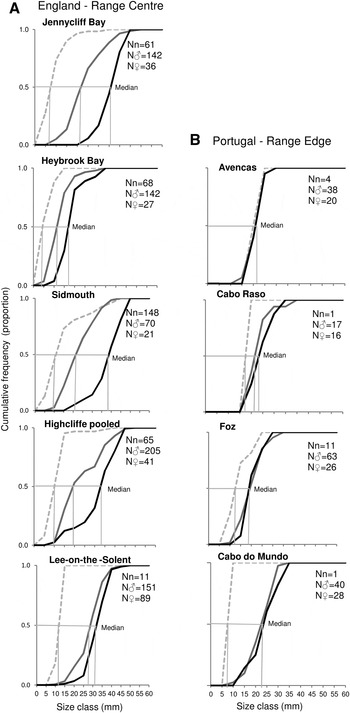
Size-frequency distributions for Patella vulgata (see Figure 2) along the English Channel accorded with the predictions of protandry, since larger individuals were predominantly female, although some large males were found. Size-frequency distributions of P. vulgata from Portugal did not show this pattern (see Figure 2). Cumulative size frequency data indicated that recruitment, assessed by the number of juveniles encountered, was also more pronounced in England than in Portugal, except for the artificial stone groyne at Lee-on-the-Solent which lacked suitable limpet nursery areas such as rockpools.
Cumulative size frequencies for P. vulgata neuters (grey broken line), males (grey line) and females (black line) from range centre sample sites in (A) the south of England (Jennycliff Bay, Heybrook Bay, Sidmouth, Highcliffe (note: data from Highcliffe were pooled) and Lee-on-the-Solent) and from range edge sample sites in (B) Portugal (Avencas, Cabo Raso, Foz and Cabo do Mundo). Median size and abundance (N) of neuters (n), males (♂) and females (♀) are also indicated.

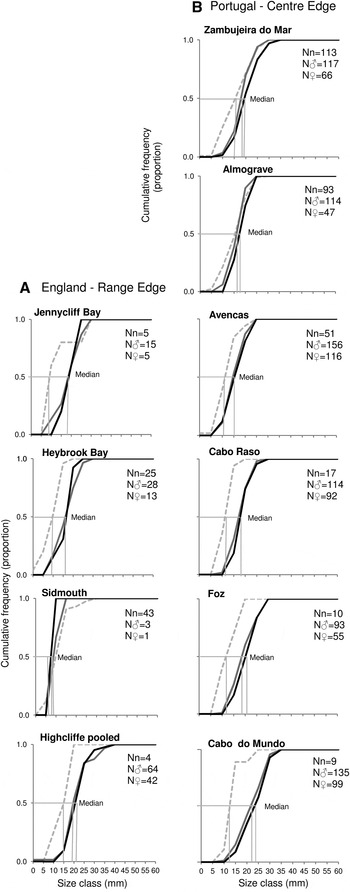
Patella depressa both in England and Portugal showed sexes interspersed in most of the size-classes suggesting a gonochoristic life history (see Figure 3).
Cumulative size frequencies for P. depressa neuters (grey broken line), males (grey line) and females (black line) from range edge sample sites in (A) the south of England (Jennycliff Bay, Heybrook Bay, Sidmouth and Highcliffe (note: data from Highcliffe were pooled)) and from range centre sample sites in (B) Portugal (Zambujeira do Mar, Almograve, Avencas, Cabo Raso, Foz and Cabo do Mundo). Median size and abundance (N) of neuters (n), males (♂) and females (♀) are also indicated.

The Kolmogorov–Smirnov tests indicated that for P. vulgata from England male and female size distributions differed from each other (P < 0.05) (Figure 2). For this species the cumulative frequency curves also showed that the median size of immature neuters was smaller than the median size of males and these median sizes were smaller than the median sizes of females. For P. vulgata from Portugal and P. depressa from both England and Portugal, male and female distributions did not differ from each other (P > 0.05) (Figures 2 & 3). The cumulative frequency curves also showed that the median sizes of males were equal or very similar to the median sizes of females.
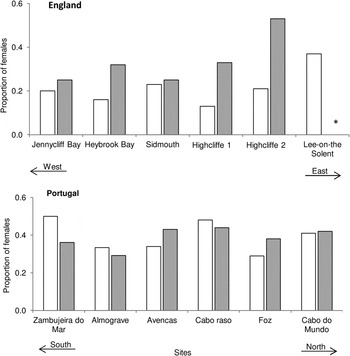
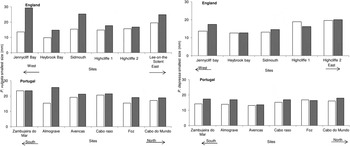
The proportion of females varied considerably between sites and between species (Figure 4). However, P. vulgata from England showed lower proportions of females than in Portugal which was confirmed by a two-sample permutation test (P = 0.009, N = 6 sites per sample). For P. depressa from England and Portugal no differences were detected on a two-sample permutation test for the proportion of females (P = 0.238, N = 5 sites per sample).
Proportion of females of P. vulgata (clear bars) and P. depressa (grey bars), from the sample sites in the south of England (250 animals were collected from N = 5–12 quadrats per site) (* P. depressa absent) and Portugal (250 animals were collected from N = 4–17 quadrats per site).

Male/female sizes
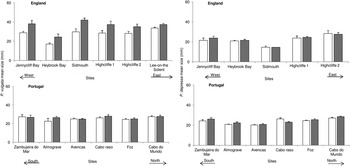
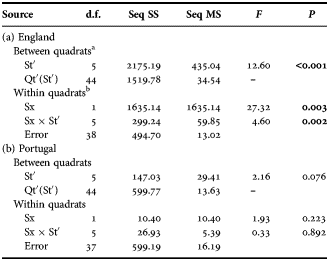
In southern England P. vulgata females were larger than males as also shown by the cumulative frequency curves and Kolmogorov–Smirnov tests (Figure 5). The GLM analysis of P. vulgata mean body size revealed a significant sex × site interaction (Table 2: F 5, 38 = 4.60, P = 0.002) and main effects of sex and site (Table 2: F 1, 5 = 27.32, P = 0.003, and F 5, 44 = 12.60, P < 0.001 respectively). The overall smaller size of males than females therefore had a site-dependent magnitude of difference. For P. vulgata from Portugal (Figure 5, Table 2) the GLM detected no differences by sex or by site.
Mean sizes (mm) (+SE) of P. vulgata and P. depressa males (clear bars) and females (grey bars) from the sample sites in the south of England (250 animals were collected from N = 5–12 quadrats per site) and Portugal (250 animals were collected from N = 4–17 quadrats per site).

Patella vulgata GLM on mean size (mm) by sex (Sx) and site (St́) in sample quadrats (Qt́) in the south of England (a) and Portugal (b). Terms with P < 0.05 are in bold.
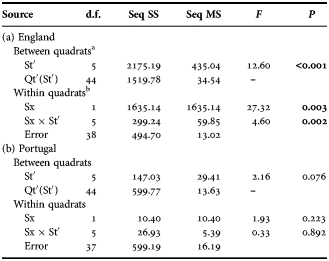
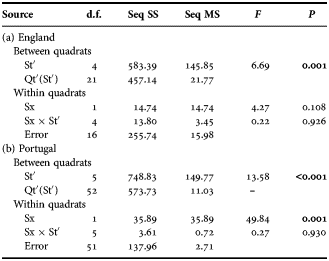
a Sources of variation measured from replicate quadrats.
b Sources of variation measured from replicate individuals within quadrats.
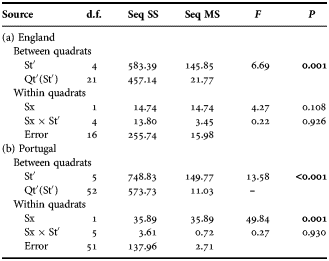
For P. depressa from England differences were only detected by site (Figure 5, Table 3: F 4, 21 = 6.69, P = 0.001) while for P. depressa from Portugal differences were detected by sex (Figure 5, Table 3: F 1, 5 = 49.84, P = 0.001) and site (Figure 5, Table 3: F 5, 52 = 13.58, P < 0.001). This difference in mean sizes by sex could be indicative of some protandry occurring in P. depressa populations from Portugal.
Patella depressa GLM on mean size (mm) by sex (Sx) and site (St́) in sample quadrats (Qt́) in the south of England (a) and Portugal (b). Terms with P < 0.05 are in bold.
In the southern England, males of P. vulgata were smaller than the females (Figure 6). This was confirmed by a two-sample permutation test for the smallest sizes of males and females (P = 0.042, N = 6 sites per sample). For P. vulgata from Portugal (Figure 6) no differences were detected on a two-sample permutation test for the smallest sizes of males and females (P = 0.091, N = 6 sites per sample).
Smallest sizes (mm) of P. vulgata and P. depressa males (clear bars) and females (grey bars) from the sample sites in the south of England (250 animals were collected from N = 5–12 quadrats per site) and Portugal (250 animals were collected from n = 4–17 quadrats per site).

For P. depressa from England and Portugal (Figure 6) no differences were detected on a two-sample permutation test for the smallest sizes of males and females (P = 0.778 and P = 0.082, N = 5 and N = 6 sites per sample respectively).
Sex ratios and densities of single species and all Patella spp. combined
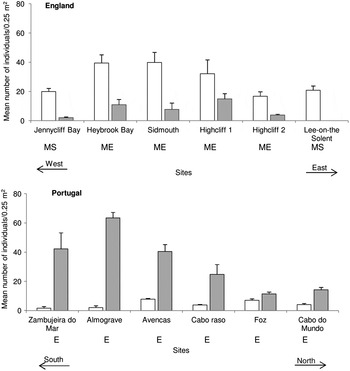
Densities of P. vulgata were higher in England than in Portugal while P. depressa had higher densities in Portugal than in England (Figure 7). In England, P. vulgata showed greater variability in densities. The moderately exposed site at Heybrook Bay had higher numbers of individuals of both P. vulgata and P. depressa than the moderately sheltered site at Jennycliff Bay.
Density (mean number of individuals/0.25 m2) (+SE) of P. vulgata (clear bars), P. depressa (grey bars) from the sample sites in the south of England (N = 5–12 quadrats per site) and Portugal (N = 4–17 quadrats per site). MS, ME and E refer to moderately sheltered, moderately exposed and exposed sites, respectively.

In England, the total density of Patella spp. was higher on the more exposed sites (Figure 7). The low density at Lee-on-the-Solent probably reflected the lack of nursery grounds such as pools and crevices (Bowman & Lewis, Reference Bowman and Lewis1977) on an artificial structure (see Moschella et al., Reference Moschella, Abbiati, Åberg, Airoldi, Anderson, Bacchiocchi, Bulleri, Dinesen, Frost, Gacia, Granhag, Jonsson, Satta, Sundelöf, Thompson and Hawkins2005; Firth et al., Reference Firth, Thompson, White, Schofield, Skov, Hoggart, Jackson, Knights and Hawkins2013). In Portugal, the density of Patella spp. was higher on southern than northern sites (Figure 7).
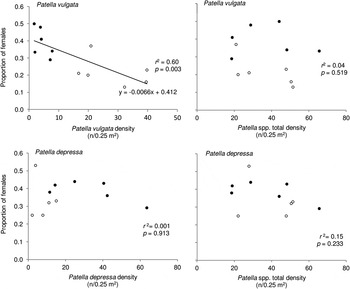
The pooled data from England and Portugal indicated that the proportion of females decreased with increasing density of P. vulgata, but not with increasing density of all Patella spp. (Figure 8, top left: r2 = 0.60, F 1,10 = 15.14, P = 0.003 and Figure 8, top right: r 2 = 0.04, F 1,10 = 0.45, P = 0.519 respectively). The proportion of females of P. depressa, in contrast, showed no relationship with density of P. depressa alone, nor all Patella spp. combined (Figure 8, bottom left: r2 = 0.001, F 1,9 = 0.01, P = 0.913 and Figure 8, bottom right: r2 = 0.15, F 1,9 = 1.64, P = 0.233 respectively).
Patella vulgata proportion of females by P. vulgata density and by Patella spp. density (number of individuals/0.25 m2) (top graphs) and P. depressa proportion of females by P. depressa density and by Patella spp. density (bottom graphs) for the sample sites in the south of England (○) and Portugal (•).

Sex ratio variation with latitude
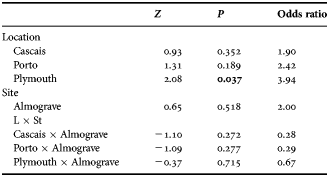
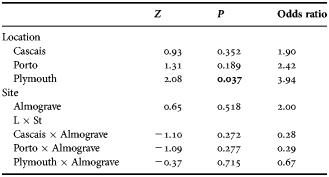
For P. vulgata, the odds of being male decreased with decreasing latitude, reaching a maximum value of 3.94 in Plymouth relative to Alentejo in southern Portugal (Table 4: Z = 2.08, P = 0.037). For P. depressa in contrast, the odds ratios show no trend with latitude (|Z| < 1.62, P > 0.1 for all comparisons; table not presented).
Patella vulgata global binary logistic regression of sex vs. site (two factor level with Zambujeira do Mar site from Alentejo as reference) and location (four factor level with Alentejo (Zambujeira do Mar and Almograve sites) as reference). Terms with P < 0.05 are in bold.
DISCUSSION
Protandry
Our survey indicated that protandry appears to be occurring in Patella vulgata from the southern English coast, but not in Patella depressa. There were, however, indications of the possibility of some protandry occurring also for P. depressa from Portugal: female mean sizes were larger than male mean sizes (Peña-Othaiz, Reference Peña-Othaiz1996). Interestingly sex ratios of P. vulgata in Portugal were less male biased than in England.
There is strong indirect evidence of the occurrence of protandry in P. vulgata populations from the south of England: females predominated in larger size-classes; cumulative frequency distributions of males and females were different; sex ratios were biased towards the first sex and smallest sizes of males were smaller than the smallest sizes of females. For P. vulgata populations from Portugal no such patterns were found: females were interspersed across most size-classes; cumulative frequency distributions of males and females did not differ; the proportion of females was higher than in England and smallest sizes of males and females did not differ.
The above observations raise the possibility that P. vulgata from Portugal were not protandric. The observed patterns could, however, be most simply explained as the result of low recruitment occurring in Portugal, generating populations with larger older females with few smaller males. As a consequence of poor recruitment these populations had low densities. An alternative explanation would be that due to low intraspecific competition, there is a higher incidence of males changing sex at smaller sizes. This would result in a higher proportion of females at low limpet densities (Figure 8). Previous studies on P. vulgata from England and Scotland indicated that sex ratios varied between populations (Das & Seshappa, Reference Das and Seshappa1948; Ballantine, Reference Ballantine1961; Blackmore, Reference Blackmore1969; Lewis & Bowman, Reference Lewis and Bowman1975; Baxter, Reference Baxter1983). The sex ratios found ranged from male biased (Ballantine, Reference Ballantine1961; Baxter, Reference Baxter1983) to numbers of males and females approximately equal (Das & Seshappa, Reference Das and Seshappa1948; Lewis & Bowman, Reference Lewis and Bowman1975). In all populations the majority of small, mature individuals were male and the number of females increased with size. In Portugal, a predominance of females was found in P. vulgata samples from the northern and central coast (Ribeiro et al., Reference Ribeiro, Xavier, Santos and Hawkins2009) while previous studies had mentioned male-biased sex ratios (Guerra & Gaudêncio, Reference Guerra and Gaudêncio1986; Castro, Reference Castro2004). In any case, the density especially of new recruits of P. vulgata seems to have more influence in determining female numbers suggesting that sex change could be density dependent (Figure 8), either due to direct food limitation (Hoagland, Reference Hoagland1978) or cues from conspecifics (Collin et al., Reference Collin, Mclellan, Gruber and Bailey-Jourdain2005; Collin, Reference Collin2006). Indeed, Rivera-Ingraham et al. (Reference Rivera-Ingraham, Espinosa and García-Gómez2011) found that size at sex change was correlated with density of larger individuals: scarcity of larger individuals promoted sex change at smaller sizes.
Low densities lead to an earlier promotion from males to females in Lottia gigantea with individuals being more likely to change sex in artificially lowered densities (Wright, Reference Wright1989). Wright's (Reference Wright1989) field survey found that at low densities females occurred at younger ages. In a recent study, L. gigantea individuals from harvested populations changed sex at smaller sizes and grew at slower rates compared with individuals from protected populations (Fenberg & Roy, Reference Fenberg and Roy2012). A similar mechanism was described for Patella ferruginea: individuals in populations with low density of larger individuals switched to female at smaller sizes (Rivera-Ingraham et al., Reference Rivera-Ingraham, Espinosa and García-Gómez2011; Guallart et al., Reference Guallart, Calvo, Acevedo and Templado2013). Such sex-change plasticity seems also to be occurring in P. vulgata when subjected to exploitation (Borges, Reference Borges2013; Borges et al., in submission).
Patella depressa both from England and Portugal exhibited patterns expected of a gonochoristic species: females were interspersed across most size-classes; cumulative frequency distributions of males and females and smallest sizes of males and females were similar. These results were partially corroborated by the GLM on body size: for P. depressa from England no differences in mean size between sexes was detected; while in Portugal size differed slightly by sex, which could be indicative of some protandry occurring in populations from Portugal. The plots of mean size and smallest size also suggest that for P. depressa from Portugal males were generally slightly smaller than females (Figures 5 & 6). This could be due to differential growth or mortality between males and females rather than protandry or low recruitment. A predominance of males in P. depressa from Portugal was mentioned in previous studies (Guerra & Gaudêncio, Reference Guerra and Gaudêncio1986; Castro, Reference Castro2004; Ribeiro et al., Reference Ribeiro, Xavier, Santos and Hawkins2009), although some data exist on equal numbers of males and females (Brazão et al., Reference Brazão, Boaventura, Morais, Narciso and Ré2003). In fact, Boaventura et al. (Reference Boaventura, Cancela da Fonseca and Hawkins2003) suggested that the higher percentages of males found in increased P. depressa density treatments could possibly be explained by a suppression of protandry due to competition. Thus the possibility of some protandry occurring in this species remains (see also Peña-Othaiz, Reference Peña-Othaiz1996).
The variability encountered in sex ratios in other studies emphasizes that protandry should not be inferred solely from those data and it should be taken into consideration that there are partially sex-changing animals, where a proportion of the ‘second’ sex mature directly from the juvenile (early maturers), having never passed through the ‘first sex’ (Allsop, Reference Allsop2003). Studies should combine different analyses such as male/female distributions comparisons, microscopy, manipulative experiments and direct observation of individuals (see Wright & Lindberg, Reference Wright and Lindberg1979, Reference Wright and Lindberg1982; Le Quesne & Hawkins, Reference Le Quesne and Hawkins2006).
Geographic range edges
The distributions and relative abundances of P. vulgata and P. depressa were in accordance with the known range limits for these species. Patella vulgata was more abundant in the south of England and P. depressa was more abundant in Portugal.
In Portugal, P. vulgata densities increased from south to north while P. depressa numbers decreased. This accorded with the known distribution of both species: P. vulgata is a boreal cold temperature species; P. depressa is a southern warm water species (e.g. Southward et al., Reference Southward, Hawkins and Burrows1995 for review).
The test of sex ratio variation with latitude suggested that distorted sex ratios of P. vulgata might be involved in setting the species southern range limit, since the likelihood of being male decreased with latitude from Plymouth (southern England) through Alentejo (southern Portugal). Hypotheses (2) and (3) could explain the higher proportions of females in populations from Portugal since resource relaxation due to lower intraspecific competition would allow higher rates of promotion of males to females; alternatively intermittent and low recruitment leave populations with few males and older larger females. In England, P. vulgata is at the centre of its range and sex change is probably occurring given the male-biased sex ratio found across those populations. A male-biased sex ratio has been observed for several protandric limpets (e.g. Crepidula spp.; Collin, Reference Collin2006). If skewness in sex at lower latitudes compromises the species' reproductive success then Allee effects due to the reduction of the numbers of males could be occurring (e.g., Boukal & Berec, Reference Boukal and Berec2002; Kent et al., Reference Kent, Hawkins and Doncaster2003; Walker et al., Reference Walker, Thibaut and Mccormick2010; Lee et al., Reference Lee, Saether and Engen2011). This scarcity of males in free-spawners will result in reduced numbers of male gametes with low probability of contact with eggs. High sperm concentrations are known to be important in P. vulgata (Hodgson et al., Reference Hodgson, Le Quesne, Hawkins and Bishop2007). Patella depressa showed no tendency of change in sex ratio with latitude, therefore sex ratios possibly do not influence the species northern limit as it is known as not protandric in England.
Concluding comments
Of the three original hypotheses, hypothesis 1 (delayed promotion to females at range edges) can be rejected. There are indications that hypothesis 2 (promotion from male to female is density dependent) may apply to P. vulgata; but the observed correlation could be due to differences in the age structure due to limited recruitment at range edges. Parallel experimental work (Borges, Reference Borges2013; Borges et al., submitted) also supports this hypothesis. Hypothesis 3 (recruitment is intermittent at range edges) seems to be occurring in P. vulgata leading to limited numbers of males. This does not apply to gonochoristic species such as P. depressa at its range edge in the British Isles. Since we found some slight indirect evidence for the possibility of P. depressa being protandric in Portugal, it could be the case that this species has a variable life history depending on environmental and demographic constraints.
ACKNOWLEDGEMENTS
We acknowledge the University of Southampton and the Marine Biological Association of the United Kingdom for the support given during fieldwork and samples sorting in the laboratory. We thank the ‘Departamento de Gestão de Áreas Classificadas do Sul’ from the ‘Parque Natural do Sudoeste Alentejano e Costa Vicentina’ in Portugal for the permit to collect Patella spp. from Almograve and Zambujeira do Mar. We thank two anonymous reviewers that provided valuable input on an earlier draft.
FINANCIAL SUPPORT
Financial support was provided by the University of Southampton and the Marine Biological Association of the United Kingdom.