Going back at least to Zvi Grilliches’ studies of hybrid corn adoption, economists have attempted to understand the diffusion of technological innovations as the aggregate outcome of individuals’ calculations of the costs and benefits of adopting the new technology. Case studies of new technology diffusion have focused both on firms’ decisions to adopt efficiency-enhancing innovations to their production processes based on cost considerations, and consumers’ decisions to adopt new products based on utility considerations.Footnote 1 This article examines the interesting case of the diffusion of air conditioning, which for its early adopters combined features of process and product innovations. These early adopters were retailers of goods and services, such as owners of movie theaters and department stores, who installed “commercial comfort” air conditioning systems in hopes of attracting more customers. Thus, like a process innovation, the diffusion of air conditioning was chiefly driven by the decisions of firms. The technology itself, however, mainly altered the service a firm produced rather than its production process, so that the impact of the technology on consumer utility was a major factor affecting its spread, an impact which could be very different in different retail sectors.
The crucial role of commercial applications in the diffusion of air conditioning has been documented by Gail Cooper and Marsha Ackermann.Footnote 2 I add to these accounts by offering a more quantitative picture, using a previously unexploited data source: A 1940 survey by the Edison Electric Institute (EEI) of over 180 electric utilities that solicited information on air conditioning installations in the utilities’ service areas. I also draw on information reported in trade journals of the period. This evidence indicates that the early spread of commercial air conditioning was uneven, varying both geographically and across industry. For example, by the eve of World War II, the majority of movie theaters and over a third of chain drug store outlets were air conditioned, while air conditioning was still rare in grocery stores and beauty shops. By the 1950s the prevalence of air conditioning had increased in all these lines of business, but the interindustry differentials remained.
I offer an interpretation of these patterns grounded in economic logic: The geographic markets and lines of business in which air conditioning was adopted earliest and spread the fastest were the ones in which the benefits of adopting air conditioning were highest relative to the costs. In keeping with this interpretation, regressions using the EEI data show that as of 1940 commercial air conditioning was more prevalent in markets with lower electricity rates, more affluent and educated consumers, and lower interest rates. The retail sectors that were the earliest and most enthusiastic adopters of air conditioning were often those in which air conditioning would have been expected to significantly boost revenues due to the nature of the good or service sold. Several of the early adopting sectors were plagued with significant summer declines in demand that became smaller during the period of air conditioning's diffusion.
Historical Overview
In the first two decades of the twentieth century, Stuart Cramer and Willis Carrier patented devices to control indoor temperature and humidity and sold their “air conditioning” systems to firms that worked with humidity-sensitive materials, including textiles, tobacco, and gunpowder.Footnote 3 These sorts of applications, designed to improve the efficiency of production processes, were dubbed “process” air conditioning, to distinguish them from “comfort” air conditioning, which was designed to control indoor climates for the sake of human comfort. Comfort air conditioning for the residential market would not begin to become important until the late 1950s.Footnote 4 However, the market for commercial comfort air conditioning systems—such as those purchased by owners of stores or restaurants to attract more customers—soon eclipsed the process air conditioning market.Footnote 5 By 1940 almost 90 percent of the nation's air conditioning capacity was devoted to commercial comfort air conditioning.Footnote 6
Movie theaters provided the first large market for comfort air conditioning. Crowded theaters became intolerably uncomfortable as outside temperatures rose, and theater owners were eager to try products that promised to fill more seats during the slow summer season. During the twenties and early 1930s, air conditioning became the norm in the nation's larger movie theaters. In Chicago, for example, 149 of 256 movie theaters had air conditioning systems in 1936, cooling about 75 percent of Chicago's theater seats.Footnote 7
Department stores provided another early market for comfort air conditioning. As Ackermann notes, a visit to a department store in the 1920s was “not a chore, but an entertainment event.” Shopping was less entertaining if the store was sweltering, and department store sales plummeted in July and August.Footnote 8 J. L. Hudson's in Detroit was the first store to install air conditioning in 1925, and department stores in Boston and Manhattan soon followed suit.
During the 1930s other branches of retailing followed the lead of the department stores. In 1939 the trade journal Chain Store Age surveyed over 300 retail chains operating tens of thousands of outlets. The highest percentage of air conditioned outlets was reported by the drug store/soda fountain chains, at 29.7 percent. This was followed by restaurants at 21.3 percent, and shoe and apparel chains in the mid-teens. Overall, 9 percent of the chain outlets were air conditioned, a figure that would rise to 10.5 percent on the eve of World War II.Footnote 9
The postwar period saw a boom in commercial air conditioning. The chains surveyed by Chain Store Age in 1949 reported that 18.5 percent of their stores were air conditioned, and by 1954 the figure was up to 35 percent.Footnote 10 Office buildings and hotels became important new customers for the air conditioning industry. Periodic surveys of major office buildings in the United States and Canada reported air conditioning in 10 percent of sample buildings in 1941, 16 percent in 1951, and 30 percent by 1955.Footnote 11 The air conditioning of hotels followed a similar pattern. As of 1937 only 0.5 percent of the rooms of larger hotels nationwide were air conditioned, and only 10 percent of their public spaces.Footnote 12 A boom in the construction of new hotels in the 1950s fueled the spread of hotel air conditioning, and by the early 1960s over 60 percent of all hotels and motels had at least some air conditioning.Footnote 13
Economic Framework
Consider a model in which firms in a retail industry are operating in a zero profit, monopolistically competitive equilibrium. A new technology is introduced with the potential to increase revenue by enhancing the value to consumers of the industry's product.Footnote 14 If this revenue increase exceeds the cost of adopting the technology, firms in the industry will adopt it. In the long run, there will be increased demand for the industry's product, entry of additional firms, and a new zero-profit equilibrium. However, there is also a medium-run equilibrium in which all incumbent firms have adopted the technology and are earning quasi-rents, but new firms have not yet entered. I hypothesize that markets and retail sectors in which these quasi-rents were likely to have been higher will be those in which air conditioning was adopted earlier.
To be more specific, we should expect to see early adoption and diffusion of air conditioning in retail industries and in markets in which the expected increase in demand due to the adoption of air conditioning was likely to be higher, and the cost of the technology lower. The demand boost that retailers could have expected following the adoption of air conditioning would have varied across lines of business and geographic markets in ways related to observable features of those businesses and markets. First, the consumption of many types of goods requires the consumer to spend time in the retail establishment, time which could be unpleasant on hot days. The more time typically spent on site consuming what the retailer offered, the more air conditioning would have improved the value to consumers of that offering. Second, if the good or service was a frequently purchased necessity, consumers could not avoid spending unpleasant time in the hot retail establishment. If it was easy for consumers to postpone purchase or substitute a less unpleasant consumption experience, retailers would see demand declines during hot periods. This was a more serious problem for a retailer if the product he offered was perishable, such as a seat at a showing of a movie. Holding these factors equal, the potential benefit from adopting air conditioning would be greater in hotter climates. Finally, the model indicates that any given increase in demand brought about by air conditioning would have a larger impact on profits in businesses with higher fixed costs, and those in more densely populated markets.
On the cost side, the most prominent observable correlate of the cost of adopting air conditioning was the cost of electricity, which, according to trade publications from the period, represented at least 40 percent of the total operating cost of air conditioning. A higher interest rate would have made it more costly to finance the initial installation of a system. If we assume that there were economies of scale in the initial cost of installing air conditioning, as suggested by the contemporary literature, while operating cost was linear in square feet, then the cost of air conditioning per unit of sales would have been declining with establishment size.Footnote 15
Narrative evidence from the time suggests a straightforward characterization of the process by which air conditioning diffused through various industries after initial adoption. Pioneers adopted air conditioning in an attempt to boost profits, creating pressure for others serving the same market to adopt. For example, in 1937 a specialist on the retail drug field wrote this of the coming of air conditioning to drug stores:
The druggist is reasonably quick and willing to respond to any devices which will increase his business. He is accustomed to lively competition, for not only does he vie with other drug stores—and there are always plenty of them—but he competes with restaurants through his soda fountain and general stores with much of his other merchandise. His interest then, in air conditioning as a weapon to fight competition, build his business, add customers, and boost sales volume is genuine ….
The trend in air conditioning in the drug field shows … that the first installations are made by large chain store units, followed later by large local chains, then large independent stores, working down gradually towards the small neighborhood retailer …. ”Footnote 16
The same themes are repeated in descriptions of the adoption of air conditioning in other lines of business:
With so much capital invested in their theaters, exhibitors could not afford a drop in attendance during the summer. Air conditioning would draw in crowds and so defeat the traditional summer downturn … The appearance of air conditioning in a theater belonging to a national chain could spark its rapid adoption at a local level, fueled by the intense rivalry of exhibitors.Footnote 17
There have been many instances in which the installation of air conditioning in one hotel in a community has forced other hotels in the same city to do likewise; in fact, every time we made another air conditioning installation in one particular hotel we were operating, our principal competitor duplicated it…. Footnote 18
Of course, accounts from an air conditioning industry trade journal would be expected to exaggerate the business benefits of installing the industry's product, but it seems likely that they have some factual basis.
Geographical Variation in Air Conditioning Prevalence
The model just described provides a basis for regression analysis explaining differences in the prevalence of commercial air conditioning across geographic markets in the United States at the end of the 1939. The air conditioning prevalence data come from a survey conducted by the Edison Electric Institute (EEI), a trade organization for privately owned electric utilities. In 1940 EEI surveyed utilities concerning the air conditioning installations in their service areas. Respondents were asked to classify commercial installations by the type of business making the installation. Over 180 utilities answered the 1940 survey, providing information on number of installations and horsepower installed. I approximated the 1939 service area for most of the utilities in the EEI survey, and then matched Census and Federal Power Commission (FPC) data to utilities on the basis of these approximate service areas.Footnote 19 The result is a data set with 132 observations, with which regressions can be estimated of the relationship between the installed air conditioning horsepower in 1939 for certain types of businesses in an area and the demographic and economic characteristics of that area. The utilities in the regression sample served areas that included 66 million people, about one-half of the U.S. population at the time, and 70 percent of those 66 million lived in urban areas, compared to 56.6 percent of the U.S. population. The sample covers all climate zones of the contiguous United States, and this broad geographical coverage also contributes to variation in the electricity rate variable, which has a coefficient of variation of 20 percent.Footnote 20
Although commercial air conditioning began to appear in the 1920s, it remained a novelty outside of movie theaters until the mid to late 1930s. Starting in 1934 EEI conducted several smaller air conditioning surveys, and for 16 of the utilities included in the 1940 EEI survey, one can construct consistent times series for the amount of commercial air conditioning going back to 1935. At the end of 1935 there were 2,322 commercial air conditioning systems installed in these areas. The number of systems had increased by a factor of 2.5 by the end of 1937, and from then until the end of 1939 the number increased another 77 percent, such that there was one system for every 20 retail establishments.Footnote 21 The expansion from 1935 to 1940 implies that air conditioning in the United States went from being something rarely encountered by consumers to an economically significant though still somewhat unusual feature of the retail scene. Thus, while the cross-section regressions reveal the characteristics of markets in which more commercial air conditioning was installed as of 1940, they also identify the characteristics of markets in which commercial air conditioning spread most quickly in the early years of its diffusion.
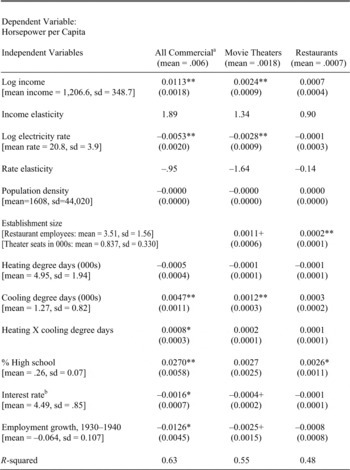
Column 1 of Table 1 reports the results of a regression in which the dependent variable is horsepower per capita, defined as air conditioning horsepower installed by all commercial retail establishments in the utility's service area at the close of 1940, divided by the service area's 1940 population.Footnote 22 Several independent variables are included in the analysis. The natural log of the median value of family wage and salary income for families in which all earners are wage and salary workers, calculated from the 1940 Census public use microdata, is included to control for the effect of consumer income on the derived demand for commercial air conditioning.Footnote 23 The log of the electricity rate (an average of 1935 and 1937 commercial electricity rates for the utility) based on data from the FPC, measures the power cost of air conditioning.Footnote 24 The bank lending rate in the service area in 1940, based on Howard Bodenhorn's data, reflects the capital cost of installation.Footnote 25 Population density from the 1940 Census measures the thickness of the market in the area. The area's average annual number of heating and cooling degree days measures the severity of an area's winters and summers, respectively. An interaction term between the heating and cooling days is included to examine whether the impact of summer heat on the demand for air conditioning was greater in climates with colder winters.Footnote 26 The percentage of those over 25 in the service area who graduated from high school helps capture differences in permanent income and schooling-related tastes across service areas. The rate of employment growth between 1930 and 1940 controls for possible bias due to correlation between the rate of economic growth in a utility's service area and its electricity rate. Finally, dummies are added for the four census regions to capture cost of living differences and other regional factors.
The results of this regression in Table 1 indicate that places with hotter summers had significantly more commercial air conditioning installed as of 1940. Other things equal, a one-standard-deviation increase in summer heat is associated with about a one standard deviation increase in air conditioning horsepower per capita. The estimates imply that if Chicago had the climate of St. Louis, it would have had 30 percent more commercial air conditioning horsepower at the end of 1939 than it actually did.
FACTORS AFFECTING DIFFERENCES ACROSS GEOGRAPHIC MARKETS IN THE PREVALENCE OF COMMERCIAL AIR CONDITIONING, 1940

+ Statistically significant at the 10 percent level.
* Statistically significant at the 5 percent level.
** Statistically significant at the 1 percent level.
a Includes horsepower reported for the categories barber and beauty shops, funeral homes, hotels, recreation, clubs, restaurants, department stores, drug stores, miscellaneous stores, movie theaters, and other commercial.
bFor state in which majority of the utility's customers live.
Notes:
Sample consists of 132 utility service areas. All regressions also include dummies for census regions. Robust standard errors are in parentheses under coefficient estimates.
Sources:
Electricity rates for a billing demand of 3 kilowatts and a monthly consumption level of 375 kWh in 1935 and 1937 are taken from Federal Power Commission (1936, 1937). Average bank lending rates by state are from Bodenhorn, “More Perfect Union.” Median family wage and salary income for families in which all earners are wage and salary workers, calculated from the 1940 Census public using microdata aggregated to the state economic area (Ruggles et. al., Integrated Pubic Use Microdata Series). The 1940 Employment Growth, Percentage of High School Graduates, and Population Density are from the 1940 Census. For utilities serving one city, annual average heating and cooling degree day values for the weather station closest to that city are taken from the National Oceanic and Atmospheric Administration, Annual Degree Days to Selected Bases (http://hurricane.ncdc.noaa.gov/climatenormals/clim81_supp/CLIM81_Sup_02.dat). Utilities serving larger areas were assigned weighted averages of degree days values for substate “climate divisions” as reported in the National Oceanic and Atmospheric Administration, Divisional Normals and Standard Deviations of Temperature, Precipitation, and Heating and Cooling Degree Days, 1971–2000, accessed at http://cdo.ncdc.noaa.gov/climatenormals/clim85/CLIM85_HDD03.pdf. See the text for the method of imputing establishment size. Further details on variable construction are in Biddle, “Early Decades.”
Retailers installed more air conditioning in areas with higher family incomes and more educated residents, with an implied income elasticity of 1.89. Differences across areas in the electricity rate were significantly associated with differences in installed horsepower, with an implied elasticity of −0.95. Given that electricity made up only about half of the operating cost of air conditioning, this suggests considerable cost sensitivity on the part of retailers contemplating the decision to adopt. The bank lending rate is also negatively related to installed horsepower. The amount of air conditioning in a market was not significantly related to the population density of the market.
The net benefit of installing air conditioning would have been greater for larger retail establishments, implying that other things equal, areas in which the average retail establishment was larger would have had more commercial air conditioning. Because of the heterogeneity of firm types included in the aggregate commercial retail category, no establishment size variable was included in the column 1 regression. The final two columns of Table 1 report results of regressions for horsepower per capita in movie theaters and restaurants, business types for which meaningful establishment size variables can be constructed. Establishment size is measured by employees per establishment in the restaurant regressions, and seats per theater in the movie theater regression.Footnote 27 The coefficient on establishment size is statistically significant in both regressions, indicating that a one-standard-deviation increase in the size of the average theater is associated with a 20 percent increase in theater air conditioning, while a one-standard-deviation increase in restaurant size is associated with a 45 percent increase in restaurant air conditioning.
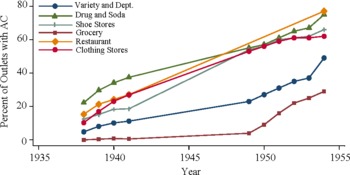
PREVALENCE OF AIR CONDITIONING IN VARIOUS TYPES OF RETAIL CHAINS

The regressions results are thus consistent with the view that several key determinants of where air conditioning was more or less prevalent at the close of the thirties are logically linked to the profit maximizing decisions of firms in the commercial sector. However, concerns with possible omitted variables make it unwise to give a causal interpretation to the estimated coefficients in the Table 1 regressions.Footnote 28
Differences Across Retail Industries in the Early Adoption of Air Conditioning
By all accounts, the motion picture exhibition industry was the first to embrace comfort air conditioning as a means to higher profits, and the first in which adoption of air conditioning approached saturation levels. Some evidence on the timing of adoption in other retail and service industries is presented in Figure 1, which shows the growth in the percentage of chain store outlets with air conditioning in a number of retail lines, based on surveys conducted by Chain Store Age between 1938 and 1954. In the late 1930s drug store/soda fountain chains were the most eager adopters of air conditioning, while there was almost no air conditioning in grocery stores. Clothing stores, shoe stores, and restaurants were more likely to have air conditioning than department and variety stores, a group which includes everything from small 5 & 10 cent outlets to major urban department stores. While the prevalence of air conditioning increased considerably over the period for all these types of chains, there were no significant changes in the ordering from most air conditioned type to least. In the prewar years, Chain Store Age also reported figures for an “other” category, which included automotive accessory and hardware stores, confectionary stores, and retail bakeries, and the percentage of these outlets air conditioned was close to that of grocery outlets. In 1954 the magazine reported that 14 percent of the outlets of automobile accessory or hardware chains were air conditioned, which was about half the level reported for grocery stores.
Based on Figure 1 and the narrative evidence discussed earlier, it appears that after the movie theaters, the order in which different retail sectors adopted air conditioning corresponds to the ranking of sectors in air conditioning prevalence as of 1940. Drug stores air conditioned first, followed by restaurants and department stores/variety stores, followed by grocery stores, then hardware stores, auto parts stores, and most other types of retail stores and service providers not separately counted in the EEI or Chain Store Age surveys.Footnote 29 This ordering is consistent with the argument that time necessarily spent in the retail establishment by the consumer and the potential for seasonal swings in demand were important factors in retailers’ decisions to adopt air conditioning. Movie theaters adopted first because watching a movie required spending a long period of time in a crowded room, and the quality of this consumption experience declined rapidly as the outdoor temperature rose. Seasonality was an issue because the consumer could easily shift the timing of a visit and in the summer had many other alternatives. Such large seasonal swings in demand could be particularly problematic for urban exhibitors, for whom other considerations favored the building of large theaters, making fixed costs high. According to Ackerman, air conditioning completely eliminated the summer drop in sales, and may have turned summer into the peak season for movie theaters.Footnote 30
For similar reasons, the potential benefit to restaurants of air conditioning was large. Eating a meal in a restaurant requires time as well as money, a restaurant meal can be easily postponed by the consumer who can eat at home (or have a picnic in the summer), and restaurant seats, like theater seats, are highly perishable goods from the seller's point of view. Drug store/soda fountains may have benefited even more than restaurants from air conditioning, in part because of a difference between drug stores and restaurants in the nature of the food service. One enters a restaurant with the intention of purchasing a meal. When one enters a drug store, there is no required fixed expenditure on food items, but if the interior is pleasant the customer may linger:
In air conditioned drug stores, the fountain trade seems to benefit first and to the greatest extent …. (W)here a soft drink was ordered before, a sandwich luncheon with a malted milk replaces it. The peak luncheon load, formerly from 11:30 to 1:30, extends, after the store is air conditioned, from 11 to 3. Footnote 31
Verda Jensen noted that the drug store/soda fountain actually combined the functions of a restaurant and a retail store, so derived a second sort of benefit from air conditioning:
Customers drop in the store to purchase something, find the cool interior such a relief that they linger to shop around …. (They) are in a better humor, more receptive and in no hurry to leave the store. They listen to many a sales solicitation they would have walked out on before.Footnote 32
Like drug stores, department and variety stores stocked many goods that were not necessities, and retailers well understood that shoppers bought more when they spent more time in the store. Clothing and shoe stores also stood to benefit from air conditioning, as the customer had to spend time in the store trying on potential purchases. On the other hand, owners of grocery, hardware, and auto parts stores were late adopters of air conditioning because grocers sold necessities and visits could not be long postponed, while visits to hardware and auto parts stores were also usually motivated by a particular need, and browsing was not an important phenomenon.
An objective measure of the extent to which air conditioning might have stimulated a profitable boost to demand in a particular retail sector is provided by the seasonal patterns of sales in that sector before and during the period that air conditioning was being adopted. An analysis of monthly retail sales time series shows that in the period 1919–1928, prior to the introduction of air conditioning, department store sales were typically about 24 percent below average during July and August. As air conditioning diffused, however, this summer sales decline fell to only about 14 percent by the 1952–1959 period. Shoe stores also follow this pattern, with an average summer decline of 13 percent in the pre-air conditioning years, but only 9 percent by the 1950s. A short monthly sales series for women's apparel stores shows a sharp July-August sales decrease in the late 1940s that diminishes by a statistically significant 1 percentage point per year over the next decade. Variety store owners faced a hot weather sales drop, but it did not decline during the period of diffusion of air conditioning. Grocery stores did not experience sales drops in the summer months during the 1919–1951 period, consistent with the characteristics of grocery store demand discussed above. However, the data for restaurants and drug stores show only small summer sales declines in the pre-air conditioning period.Footnote 33
Accounting for the Rising Prevalence of Commercial Air Conditioning, 1935–1954
Underlying the differences across geographic areas and types of retail business in the prevalence of air conditioning at various points in time was a significant general increase in the use of air commercial conditioning between 1935 and 1955. By the end of the period, air conditioning was becoming common in retail industries that earlier had made little or no use of it. One factor that might have contributed to this general growth was a decline over time in the cost of air conditioning. Although the cost of installing air conditioning did not decline, operating costs in 1982–1984 dollars halved from over 12 cents per kilowatt hour in the late 1930s to about 6 cents in the early 1950s.Footnote 34 As electricity cost represented at least 40 percent of the total operating cost of air conditioning, one can conservatively estimate that this electricity rate decline led to a 25 percent fall in operating costs.
If the electricity rate elasticity estimated in column 1 of Table 1 measures the causal impact of changes in electricity rates on the demand for commercial air conditioning, the substantial decline in electricity rates between 1939 and 1954 was likely an important factor driving the growth of commercial air conditioning over the same period. As noted above, the percentage of all chain store outlets air conditioned rose from 8.2 percent to 35 percent between 1939 and 1954. Assuming an electricity rate elasticity of −1, the fall in electricity rates over that period arguably explained 6.5 percentage points of that increase.Footnote 35
Consumer incomes were also rising over the period, as were education levels, both trends that the regressions results suggest would have increased the derived demand for commercial air conditioning. For example, real disposable personal income per capita rose about 30 percent between 1940 and 1945, and about another 10 percent between 1945 and 1955. If the income elasticity of 1.89 in Table 1 is a causal estimate, these increases alone could explain over 7 percentage points of the increase in chain store air conditioning.Footnote 36
Calculations of this sort are very speculative, as they rely on causal interpretations of the cross-section regression results, and implicitly assume that the changes over time in electricity rates and incomes were exogenous to increasing air conditioning prevalence during the period considered. They are best viewed as the basis of tentative hypotheses about the forces behind the spread of air conditioning in the United States, worth testing further should better data become available.
SUMMARY AND CONCLUSIONS
For the first four decades of the air conditioning industry in the United States, the story of the diffusion of air conditioning was largely the story of its gradual adoption by firms in the retail and service sectors. It was an uneven diffusion, both geographically and with respect to business type. This article has offered a quantitative account of this uneven diffusion, viewed through an interpretive framework that emphasizes the role of the costs and potential benefits to retail firms of installing an air conditioning system.
On the cost side, air conditioning adoption seems to have been sensitive to the electricity rate and the interest rate, and a large decline in electricity rates from the mid-1930s to the mid-1950s likely explains a significant share of the growth in air conditioning within and across lines of business over this period. On the demand side, higher incomes and education levels were associated with more commercial air conditioning in the 1930s, raising the possibility that increasing income and education levels over the next two decades might also have helped to drive the general increase in the use of commercial air conditioning. Evidence was presented that several retail sectors in which air conditioning was adopted early were plagued by summer sales declines in the early twentieth century, so that air conditioning provided an attractive means of boosting and smoothing demand.
Understanding the when and where of commercial air conditioning is a first step towards understanding the ultimate economic consequences of air conditioning technology for American economic development. It is reasonable to suppose that increased labor productivity might have been one of the effects of the air conditioning of America in the twentieth century. However, given that most air conditioning in the United States up to 1960 was commercial comfort air conditioning, it would seem that the major impact of the technology during this period was to make certain consumption activities more pleasant than they had been before, increasing consumer surplus rather than raising physical output per worker in any obviously measureable way.