Diagnosis of Clostridium difficile infection (CDI) requires the presence of diarrhea, defined as 3 or more unformed stools in a 24-hour period, or other symptoms and signs of CDI and positive confirmatory laboratory tests.Reference Cohen, Gerding and Johnson 1 In practice, however, CDI tests are often ordered for patients without clinically significant diarrhea or with clear alternative explanations for diarrhea.Reference Dubberke, Han and Bobo 2 , Reference Kundrapu, Jury, Sitzlar, Sunkesula, Sethi and Donskey 3 For example, Dubberke et alReference Dubberke, Han and Bobo 2 reported that 36% of patients with orders for CDI testing did not meet criteria for diarrhea and 19% had received laxatives in the 2 days prior to stool collection. Such testing of patients not meeting clinical criteria for CDI testing may result in false-positive diagnoses of CDI due to detection of asymptomatic carriers of toxigenic C. difficile, particularly if sensitive nucleic acid amplification tests are used.Reference Dubberke, Han and Bobo 2 Testing of patients not meeting clinical criteria for CDI testing could have adverse consequences for patients if unnecessary CDI treatment is prescribed and for healthcare facilities if CDI rates are inflated. However, such inappropriate testing could also potentially be beneficial if it leads to isolation of asymptomatic carriers or patients with mild CDI who pose a significant transmission risk. Here, we determined the proportion of CDI cases in our facility not meeting clinical criteria for CDI testing and tested the hypothesis that these patients present a significant risk for shedding of spores.
METHODS
The Cleveland Veterans Affairs Medical Center’s Institutional Review Board approved the study protocol. We conducted a 1-year prospective study of all inpatients in the hospital or affiliated long-term care facility with initial diagnoses of CDI based on positive polymerase chain reaction assays for toxin B genes from unformed stool, including healthcare facility–associated, healthcare facility–onset cases as well as community-associated, healthcare facility–onset cases.Reference McDonald, Coignard and Dubberke 4 Community-onset cases were excluded because these patients were not available for culture collection or interviews.
During the study period, testing for CDI was performed using an enzyme immunoassay for glutamate dehydrogenase (Wampole C. diff Chek-60; Inverness Medical) as an initial screen with positive tests being confirmed with a commercial polymerase chain reaction assay (Xpert C. difficile; Cepheid). The microbiology laboratory rejected formed stool specimens. Medical record review and patient interviews were conducted to assess symptoms of and risk factors for CDI. CDI testing was categorized as not meeting clinical criteria for testing if patients did not meet criteria for diarrhea (defined as 3 or more unformed stools within 24 hours) or if diarrhea was present but with an alternative cause (eg, laxatives) in the absence of prior antibiotic exposure. For patients available for culture collection, specimens from skin (chest, abdomen, arm, and hand) and environmental surfaces (bed rail, bedside table, telephone, and call button) were cultured to assess shedding of spores as previously described.Reference Sethi, Al-Nassir, Nerandzic, Bobulsky and Donskey 5 Bivariate analyses were used to compare characteristics of CDI patients who met or did not meet clinical criteria for testing. The Fisher exact test was used to compare the frequencies of skin and/or environmental contamination for CDI cases meeting or not meeting criteria for testing.
RESULTS
Of 134 inpatients with initial diagnoses of CDI based on positive polymerase chain reaction assays for toxin B genes, 30 (22%) did not meet clinical criteria for CDI testing on the basis of absence of diarrhea (n=14) or diarrhea attributable to another cause without prior antibiotic exposure (n=16), including 23 (21%) of 112 healthcare facility-associated, healthcare facility–onset cases and 7 (32%) of 22 community-associated but healthcare facility–onset cases. Of the 14 patients who did not meet criteria for testing on the basis of absence of diarrhea, 5 (36%) denied having unformed stool and 9 (64%) had unformed stool but less than 3 unformed stools per day.
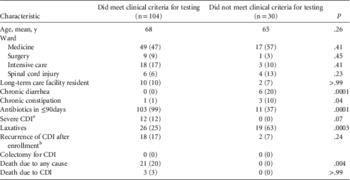
Table 1 shows a comparison of the characteristics and outcomes of initial CDI diagnoses according to whether the cases met clinical criteria for testing. CDI cases not meeting clinical criteria for testing were significantly more likely to have chronic diarrhea or constipation and to have received laxatives, but less likely to have received antibiotic treatment in the past 90 days. None of the CDI cases not meeting clinical criteria for testing met criteria for severe CDI.Reference Cohen, Gerding and Johnson 1
Characteristics and Outcomes for 134 Patients With Initial Laboratory Diagnoses of Clostridium difficile Infection (CDI), According to Whether Patients Met Clinical Criteria for Testing

NOTE. Data are no. (%) of patients, unless otherwise indicated. CDI testing was categorized as not meeting clinical criteria for testing if patients did not meet criteria for diarrhea (defined as 3 or more unformed stools within 24 hours) or if diarrhea was present but with an alternative cause (eg, laxatives) in the absence of prior antibiotic exposure.
a Suspected severe CDI associated with leukocytosis with a white blood cell count of ≥15,000 cells/mL or a serum creatinine level of 1.5 times the premorbid level.
b Recurrence was defined as CDI occurring less than 8 weeks after the onset of a previous episode, provided that the symptoms from the earlier episode resolved with or without therapy.
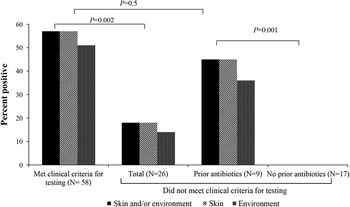
As shown in Figure 1, CDI patients meeting clinical criteria for testing were significantly more likely to have skin and/or environmental contamination than CDI patients not meeting criteria for testing. Within the group not meeting clinical criteria for testing, those with no prior antibiotic exposure within 90 days were significantly less likely to have skin and/or environmental contamination than those with prior antibiotic exposure.
Frequency of shedding of Clostridium difficile spores in patients with initial laboratory diagnoses of Clostridium difficile infection (CDI), according to whether patients met clinical criteria for testing.

DISCUSSION
Asymptomatic carriage of toxigenic C. difficile and noninfectious diarrhea are common in healthcare facilities.Reference Dubberke, Han and Bobo 2 , Reference Donskey, Kundrapu and Deshpande 6 Thus, it is plausible that asymptomatic carriers with noninfectious diarrhea could account for a significant proportion of healthcare-associated CDI cases. Using a relatively stringent definition of “testing that did not meet clinical criteria” (eg, diarrhea attributed to alternative explanations such as laxatives only if there was no recent antibiotic exposure), we found that 22% of initial CDI cases in our facility did not meet clinical criteria for testing. We know that the patients had unformed stools because our laboratory rejects formed stool specimens. Although some cases not meeting clinical criteria for testing may have had mild CDI, it is likely that most were asymptomatic carriers of toxigenic C. difficile with diarrhea due to noninfectious causes. None of the patients not meeting clinical criteria for testing had severe CDI and none died or underwent colectomy.
In comparison with CDI cases meeting clinical criteria for testing, those diagnosed with CDI but not meeting clinical criteria for testing were significantly less likely to have skin and/or environmental spore shedding. However, none of the CDI cases not meeting criteria for testing with no antibiotic exposure within 90 days had skin or environmental shedding of spores. CDI cases not meeting clinical criteria for testing but with prior antibiotic exposure were as likely to have skin and/or environmental shedding as those CDI cases meeting clinical criteria for testing. This finding suggests that in the absence of recent antibiotic therapy, the intestinal microbiota may limit overgrowth of C. difficile and reduce skin and environmental shedding, even in the presence of diarrhea.
Our study has some limitations. The study was conducted in 1 hospital with a predominantly male population. Diagnostic testing did not include an assay for C. difficile toxin. It has been proposed that testing algorithms that include assays for C. difficile toxin may be useful to distinguish true CDI cases from “fecal excretors” with no detectable toxin in stool.Reference Planche, Davies and Coen 7 , Reference Biswas, Patel, Otter, van Kleef and Goldenberg 8 However, many laboratories in the United States now use standalone nucleic acid amplification tests for diagnosis of CDI. Thus, in the absence of toxin testing, our findings suggest that there is a need for efforts to reduce testing of patients not meeting clinical criteria for CDI testing.Reference Kundrapu, Jury, Sitzlar, Sunkesula, Sethi and Donskey 3 , Reference Peterson and Robicsek 9 In particular, reducing testing of patients with diarrhea but with no recent antibiotic exposure might be of benefit given our finding that patients with no recent antibiotic exposure were unlikely to shed spores. Finally, spores on skin and in the environment have been shown to be an important source for acquisition on hands of healthcare personnelReference Sethi, Al-Nassir, Nerandzic, Bobulsky and Donskey 5 , Reference Donskey, Kundrapu and Deshpande 6 , Reference Kundrapu, Sunkesula, Jury, Sitzlar and Donskey 10 and therefore are likely to be an important source for transmission. However, additional studies are needed to determine whether patients not meeting clinical criteria for CDI but with skin and/or environmental shedding are an important source of transmission.
ACKNOWLEDGMENTS
Financial support. Department of Veterans Affairs.
Potential conflicts of interest. C.J.D. reports that he is a consultant for Cubist and has received research grants from Cubist, Clorox, EcoLab, and AvidBiotics. All other authors report no conflicts of interest relevant to this article.