





Introduction
Studying the origins of political trust has a long tradition in the social sciences, driven by the influential role that political trust plays in social trust, voter turnout, campaign participation, and citizen compliance (Grönlund and Setälä Reference Grönlund and Setälä2007; Levi and Stoker Reference Levi and Stoker2000; Marien and Hooghe Reference Marien and Hooghe2011; Sønderskov and Dinesen Reference Sønderskov and Dinesen2016). While a predominant view holds that trust originates from informed, rational reasoning, a growing body of work emphasizes that trust is based on both cognitive and emotional foundations (e.g., Dunn and Schweitzer Reference Dunn and Schweitzer2005; Finucane, Alhakami, Slovic et al. Reference Finucane, Alhakami, Slovic and Johnson2000; Hassing Nielsen and Mønster Reference Hassing Nielsen and Mønster2026; Lahno Reference Lahno2020; Lee, Dirks, and Campagna Reference Lee, Dirks and Campagna2023; Lewis and Weigert Reference Lewis and Weigert1985; Lodge and Taber Reference Lodge and Taber2013; McAllister Reference McAllister1995; Midden and Huijts Reference Midden and Huijts2009; Myers and Tingley Reference Myers and Tingley2016; Theiss-Morse and Barton Reference Theiss-Morse and Barton2017). Yet, empirical evidence on the affective processes underlying political trust remains scarce. And understanding these affective processes is important not only for theoretical reasons but also because emotions serve as a vehicle through which, for instance, media coverage of politicians can influence public attitudes toward government (Gabriel, Maier, Masch et al. Reference Gabriel, Maier, Masch and Renner2023). Studying emotions has gained further urgency in an era of affective polarization, where partisan divisions are increasingly driven by mutual dislike between party supporters rather than policy disagreements (Iyengar, Lelkes, Levendusky et al. Reference Iyengar, Lelkes, Levendusky, Malhotra and Westwood2019), and where negative partisanship may amplify the emotional content of political evaluations, including trust judgments (Abramowitz and Webster Reference Abramowitz and Webster2016). We examine two research questions: First, to what extent do individual trust judgments include affective components? Second, is the presence of affective components related to the strength of trust scores?
In pursuing these questions, our study aims to make several contributions. First, we contribute empirical evidence on the affective dimension of trust judgments, complementing the established cognitive perspective. We achieve this with the help of a survey where we first ask one of the most commonly used political trust questions (i.e., the biennial American National Election Studies (ANES) survey since 1964) and subsequently collect data on the response process using an open-ended probing question.Footnote 1 With this probing question, we ask respondents to describe (using their own words) how they came to their rating in the beforehand political trust question. These open-ended answers provide us with details on the answer process for the previous closed-ended decision, from which we can extract the extent and nature of affective components. In order to measure the affective component in these probing answers, we understand affect as ‘an umbrella term that is used to refer to both emotions and moods’ (Lee, Dirks, and Campagna Reference Lee, Dirks and Campagna2023: 549) and measure sentiment (a simple negative versus positive feeling) as well as emotion (a more complex and multi-dimensional state of feeling).
Second, while recent studies have examined how externally triggered emotions such as fear and anger influence political trust, particularly in crisis contexts (e.g., Erhardt, Freitag, Filsinger et al. Reference Erhardt, Freitag, Filsinger and Wamsler2021; Meer, Steenvoorden, and Ouattara Reference Meer, Steenvoorden and Ouattara2023; Vasilopoulos, Mcavay, Brouard et al. Reference Vasilopoulos, Mcavay, Brouard and Foucault2023), less is known about whether affect manifests within the trust judgment process itself – that is, whether the reasoning people articulate when explaining their trust scores contains affective content. Earlier work on interpersonal trust has demonstrated that emotional states shape trusting behavior (e.g., Dunn and Schweitzer Reference Dunn and Schweitzer2005; Lee, Dirks, and Campagna Reference Lee, Dirks and Campagna2023; Myers and Tingley Reference Myers and Tingley2016), yet extending these findings to political trust remains an important task (Theiss-Morse and Barton Reference Theiss-Morse and Barton2017: 160). Our study addresses this gap by directly analyzing the affective content of open-ended survey responses about political trust. This objective is promising given that ‘politics’ is considered a profoundly emotional subject (Marcus Reference Marcus2003).
Third, we want to make methodological contributions. The existing body of work on the determinants of political trust (for an overview, see Schoon and Cheng Reference Schoon and Cheng2011) predominantly relied on closed-ended survey questions and subsequent regression-based analyses. In our study, we engage in direct inquiry, where we directly ask respondents to articulate reasons for their expressed level of political trust. For (political) trust items, probing has been carried out only a few times (Knudsen, Dahlberg, Iversen et al. Reference Knudsen, Dahlberg, Iversen, Johannesson and Nygaard2021; Newman and Fletcher Reference Newman and Fletcher2017; Sturgis and Smith Reference Sturgis and Smith2010; Uslaner Reference Uslaner2002; Winsvold, Haugsgjerd, Saglie et al. Reference Winsvold, Haugsgjerd, Saglie and Bock Segaard2023), and thus, we want to contribute to this scarce literature.
Additionally, we instruct our participants to articulate their open-ended responses via speech input, requiring them to record their answers using their device’s microphone within our web survey. Previous research has indicated that spoken responses tend to be more detailed, spontaneous, and intuitive, and that they show more extreme answers in terms of sentiment (Gavras, Höhne, Blom et al. Reference Gavras, Höhne, Blom and Schoen2022). Our objective is to explore if audio responses offer insights into a respondent’s emotional state. In addition to analyzing the audio recordings from our respondents, we also transcribe these and analyze the transcriptions. By employing this multimodal approach to evaluate emotions in open-ended text responses, we hope to deliver a more complete picture of different aspects of emotions in such answers. The two approaches are achieved with state-of-the-art models for text and audio classification, where we leverage deep-learning methods (i.e., SpeechBrain) (Ravanelli, Parcollet, Plantinga et al. Reference Ravanelli, Parcollet, Plantinga, Rouhe, Cornell, Lugosch and Subakan2021) and other transformer-based models (i.e., BERT and GPT-3.5).
In conclusion, this study’s primary interest lies in uncovering affect-driven motivators for political trust that influence respondents’ trust ratings. We expect that a significant share of respondents, when providing trust ratings in surveys, employ judgment processes involving affective rationales.
Theory, empirical evidence, and hypotheses
We define political trust as ‘a global affective orientation toward government, one that reflects citizens’ feelings about government performance, processes, and probity, as well as their partisan biases in a polarized era’ (Hetherington and Rudolph Reference Hetherington and Rudolph2022: 356). This definition underscores that trust is not purely cognitive but inherently involves affective orientations – a premise central to our study. It also highlights the role of partisanship, which occupies a distinctive position in trust formation: neither a strictly rational heuristic nor a purely affective response, partisanship functions as a hybrid factor that filters how citizens evaluate government. In the polarized U.S. context of our study, we account for this by including party preference as a covariate in our analyses.
‘Cognition-based’ and ‘affect-based’ trust
An influential tradition in trust research holds that trust originates from informed and rational judgments. This ‘cognitive-based’ approach to trust, in essence, suggests that individuals base their trust judgments on purposeful and thoughtful evaluations of objects that primarily take a cognitive form (Hooghe, Marien, and de Vroome Reference Hooghe, Marien and de Vroome2012; Metzger and Flanagin Reference Metzger and Flanagin2013). For example, for political trust, trustors would increase or decrease their trust based on knowledge and information they have about a political entity, from which they then derive predictions about the trustee’s future trustworthiness.Footnote 2 Lahno (Reference Lahno2020) traces this cognitive definition of trust back to the 1980s and describes how this notion has found its way into contemporary trust research by the predominance of using dilemma games to measure (i.e., interpersonal) trusting behavior. Trust games typify situations of individual rational decision-making (Lahno Reference Lahno2020), and the key explanation of trusting behavior in these game-theoretical accounts is often achieved by assumptions of rational choice theory, where ‘the human agent will choose his actions rationally in the light of […] aims’ (Lahno Reference Lahno2020: 148). In sum, a cognitive-based understanding of trust aligns with the notion that trust judgments are made upon the basis of risk calculations and rational choice-making processes (Coleman Reference Coleman1994; Hardin Reference Hardin2002; Levi and Stoker Reference Levi and Stoker2000).
However, in addition to this cognitive-based form of trust, others have suggested that there is another, a so-called ‘affect-based’ type of trust, and various authors have long emphasized that trust includes both emotional and cognitive dimensions (e.g., Dunn and Schweitzer Reference Dunn and Schweitzer2005; Finucane, Alhakami, Slovic et al. Reference Finucane, Alhakami, Slovic and Johnson2000; Lahno Reference Lahno2020; Lee, Dirks, and Campagna Reference Lee, Dirks and Campagna2023; Lewis and Weigert Reference Lewis and Weigert1985; McAllister Reference McAllister1995; Midden and Huijts Reference Midden and Huijts2009; Myers and Tingley Reference Myers and Tingley2016; Robbins Reference Robbins2016; Theiss-Morse and Barton Reference Theiss-Morse and Barton2017). Grimmelikhuijsen, for instance, describes that ‘a decision to trust a government organization may […] not always be conscious and/or rational’ (Grimmelikhuijsen Reference Grimmelikhuijsen2012: 57). In affect-based trust, the basis for trust (or distrust) lies in emotional ties (McAllister Reference McAllister1995) and is further grounded in an individual’s attributions concerning the motives for the trustee’s behavior (McAllister Reference McAllister1995: 29). This conceptualization of trust seems to specify emotion and affect as a core part of the construct itself (Lee, Dirks, and Campagna Reference Lee, Dirks and Campagna2023), consistent with the definition of political trust introduced above (Hetherington and Rudolph Reference Hetherington and Rudolph2022). Bertsou (Reference Bertsou2019b, Reference Bertsou2019a) further argues that political distrust should be understood as a distinct concept rather than merely the absence of trust, involving its own affective and evaluative processes. This distinction is relevant because the emotions elicited during trust evaluations may differ qualitatively depending on whether respondents are expressing trust or distrust. It is also important to note that trust relationships can be horizontal (between individuals) or vertical (between citizens and institutions). Our study focuses on a single vertical trust judgment – trust in the federal government – which means that the affective content we detect reflects citizens’ orientations toward a specific institutional object rather than generalized interpersonal trust. Importantly, we do not assume that cognitive and affective routes to trust are mutually exclusive; rather, they likely co-occur, and open-ended survey answers may contain both cognitive reasoning and affective content simultaneously.
Before reviewing the empirical evidence, it is useful to clarify key terms. Affect is an umbrella term encompassing both moods and emotions (Lee, Dirks, and Campagna Reference Lee, Dirks and Campagna2023: 549). A mood (or sentiment) captures only valence – whether an affective state is positive, negative, or neutral – and tends to be diffuse and longer-lasting. Emotions, by contrast, are shorter in duration, more intense, and directed at specific objects or events (Dunn and Schweitzer Reference Dunn and Schweitzer2005: 737). Importantly, emotions arise from cognitive evaluations of situations, which is why different emotions can have distinct effects on attitudes and behavior (Smith and Ellsworth Reference Smith and Ellsworth1985).
Two major theoretical frameworks predict how specific emotions influence political attitudes, including trust. First, Affective Intelligence Theory (AIT) (Marcus, Neuman, and MacKuen Reference Marcus, Russell Neuman and MacKuen2000; Marcus, Valentino, Vasilopoulos et al. Reference Marcus, Valentino, Vasilopoulos and Foucault2019) distinguishes between the disposition system, which generates enthusiasm when habitual routines succeed, and the surveillance system, which triggers anxiety in response to novel threats and prompts deliberative information-seeking. Anger, by contrast, arises when identifiable actors are held responsible for threats, reinforcing reliance on existing dispositions rather than deliberation (Vasilopoulos, Marcus, Valentino et al. Reference Vasilopoulos, Marcus, Valentino and Foucault2019). AIT thus predicts that anxiety and anger have qualitatively different effects on political judgment. For trust specifically, enthusiasm should reinforce positive orientations toward government, anxiety may prompt reassessment of prior trust levels, and anger should strengthen reliance on existing dispositions – potentially deepening distrust among those already skeptical of government.
Second, Cognitive Appraisal Theory (e.g., Smith and Ellsworth Reference Smith and Ellsworth1985) holds that specific emotions emerge from how individuals evaluate situations along dimensions such as certainty, control, and responsibility attribution. In the trust literature, this has generated competing predictions: control appraisals suggest that anger (an other-person-control emotion) most strongly diminishes trust (Dunn and Schweitzer Reference Dunn and Schweitzer2005), while certainty appraisals predict that low-certainty emotions such as anxiety have the largest negative effect (Myers and Tingley Reference Myers and Tingley2016). Our study is, furthermore, closely inspired by Lodge and Taber’s (Reference Lodge and Taber2013) concept of ‘hot cognition.’ Their central claim is that political concepts (e.g., a party, a politician, a policy) are instantly and without intentional control tagged with an affective valence – classified as good or bad – based on prior associations stored in long-term memory (Lodge and Taber Reference Lodge and Taber2013: 44). This allows the brain ‘to use affect as real-time information to promote quick, efficient, spontaneous responses’ (Lodge and Taber Reference Lodge and Taber2013: 48). Applied to trust, hot cognition implies that when respondents evaluate how much they trust government, affective associations are activated automatically alongside deliberate reasoning, and these associations may shape the resulting judgment.
Previous empirical evidence and hypotheses
Various studies have examined the influence of emotions on trust (for an overview see Lee, Dirks, and Campagna Reference Lee, Dirks and Campagna2023), yet this literature has predominantly focused on interpersonal rather than political trust (cf. Grimmelikhuijsen Reference Grimmelikhuijsen2012; Theiss-Morse and Barton Reference Theiss-Morse and Barton2017). Theiss-Morse and Barton (Reference Theiss-Morse and Barton2017), for example, lament that the vast majority of previous research on political trust takes a cognitive approach, stressing that ‘ignoring emotions is detrimental to our efforts to get a full understanding of political trust’ (Theiss-Morse and Barton Reference Theiss-Morse and Barton2017: 160). However, recent studies have begun to address this gap. Drawing on AIT and Cognitive Appraisal Theory, Erhardt, Freitag, Filsinger et al. (Reference Erhardt, Freitag, Filsinger and Wamsler2021) show that fear and anger had divergent effects on trust in government during the COVID-19 pandemic, with fear increasing trust (a rally-round-the-flag effect) and anger decreasing it. Similarly, Meer, Steenvoorden, and Ouattara (Reference Meer, Steenvoorden and Ouattara2023) find that fear of infection was a key micro-level mechanism behind the COVID-19 rally effect on political trust. Vasilopoulos, Mcavay, Brouard et al. (Reference Vasilopoulos, Mcavay, Brouard and Foucault2023) demonstrate that emotions shaped both governmental trust and support for restricting civil liberties during the pandemic, while Albertson and Gadarian (Reference Albertson and Gadarian2015) provide a broader account of how anxiety influences democratic citizenship and political attitudes.
Building on these findings, we now review the interpersonal trust literature in more detail, as it provides the theoretical basis for our hypotheses. Dunn and Schweitzer (Reference Dunn and Schweitzer2005) explore the influence of emotions on interpersonal trust using survey experiments. They find that moods with positive valence increase trust, while moods with negative valence decrease it, consistent with the ‘affect-as-information’ model (Schwarz and Clore Reference Schwarz, Clore, Fiedler and Forgas1991) in which people attribute their current mood to the judgment they are evaluating (Dunn and Schweitzer Reference Dunn and Schweitzer2005: 737). Beyond valence, they find that happy participants were more trusting than sad participants, and sad participants were more trusting than angry participants. Through the lens of Cognitive Appraisal Theory, they explain these differences by the ‘cognitive nature’ of the respective emotion: anger, driven by ‘other-person control’ – attributing responsibility to others – has a larger negative effect on trust than sadness, which involves less other-person control (Dunn and Schweitzer Reference Dunn and Schweitzer2005: 738). Happiness, as an emotion of weak control appraisals, has a positive effect on trust.Footnote 3 Other empirical accounts argue for ‘certainty appraisals’ instead of ‘control appraisals’ as the key dimension (e.g., Albertson and Gadarian Reference Albertson and Gadarian2015; Myers and Tingley Reference Myers and Tingley2016). Myers and Tingley (Reference Myers and Tingley2016) find that negative emotions decrease trust only when they make people feel less certain about their current situation (e.g., anxiety). In contrast to Dunn and Schweitzer, they find no significant effect of anger – a high-certainty emotion – on trusting behavior. They argue that irrespective of other-person control, emotions with high certainty should have little impact on trust compared to emotions of low certainty such as anxiety. The authors note that differences in measurement approaches (survey items vs. trust games) may partly explain the divergent findings across studies.
In sum, both AIT and Cognitive Appraisal Theory generate predictions about distinct effects of specific emotions on trust, though they differ in which appraisal dimensions they emphasize (see above). What unites these accounts is the distinction between an emotion’s valence (i.e., sentiment) and the discrete emotion itself, each of which may independently shape trust judgments. Drawing on these theoretical accounts, we analyze both sentiment (valence) and discrete emotions in open-ended trust responses, providing a multi-dimensional assessment of their affective content. Our first hypothesis follows directly from the affect-based trust literature reviewed above:
H1: Open-ended survey answers to the question about the reasons for respondents’ trust include both non-neutral sentiment (H1a) and emotional language (H1b).
In our second hypothesis, we aim to explore the link between these affective rationales and actual trust ratings. In line with previous research that investigated the impact of emotions on trust using survey items, we adopt an approach that acknowledges the valence (i.e., positive or negative) of an emotion as well as its ‘cognitive nature’. In particular, following Dunn and Schweitzer (Reference Dunn and Schweitzer2005), we assume that both sadness and anger, due to their negative valence, have a negative effect on political trust. However, due to the idea that anger is an emotion characterized by other-person control, again following Dunn and Schweitzer (Reference Dunn and Schweitzer2005), we assume that the effect of anger on trust is larger than that of sadness.Footnote 4 Happiness, due to its positive valence, should have a positive effect on trust. This expectation is also consistent with AIT, where enthusiasm (the closest analogue to happiness in our four-category taxonomy) reinforces positive orientations. We note, however, that our emotion categories (happy, sad, angry, neutral) do not fully map onto AIT’s core emotions (enthusiasm, anxiety, anger), particularly lacking a measure of anxiety/fear. This limits a direct test of AIT’s predictions but does not preclude testing its disposition system and anger predictions.
H2: The sentiment or emotion expressed in an open-ended survey answer is correlated with the closed-ended trust score. Specifically, we expect sentiment of positive valence to increase trust and sentiment of negative valence to decrease trust (H2a). Further on, we expect the emotion of happiness to increase trust, anger to decrease trust and sadness, according to its negative valence to also decrease trust (H2b).
Methods
Data and questionnaire
The survey was conducted from September 6 to October 27, 2023.Footnote 5 The sample for our study was drawn with quotas aligned with 2015 U.S. Census Bureau estimates for gender, age, and ethnicity. Out of 35,153 eligible participants, we collected data from 1,431 individuals. Among them, 155 were screened out due to non-completion. Consequently, the final sample size of this study comprises 1,276 respondents who successfully completed the survey, resulting in a break-off rate of 11% (American Association for Public Opinion Research (AAPOR) 2016; Callegaro and DiSogra Reference Callegaro and DiSogra2008).
Since this study faced challenges in obtaining sufficient participants in the oldest age category (58+), we continued collecting additional data, only allowing for participants aged 58 and above to participate in our study, without imposing additional quotas (i.e., gender, ethnicity).Footnote 6 We collected another n = 202 (n = 216 participants, n = 14 break-off) observations, excluding four responses from participants who reported technical issues with our survey, resulting in a final sample size of n = 1,478.
Participants were recruited through the recruitment platform Prolific (Palan and Schitter Reference Palan and Schitter2018). According to Prolific’s ethical payment principles, individuals were compensated with an average wage of 12$/hr.Footnote 7 Depending on their speed, their wage may vary. The average time to complete the questionnaire was 7.5 minutes (median = 5.7).
The topic of the survey was ‘Politics and Trust’. After a brief trial question where respondents could practice using the voice recording tool, we asked one of the most commonly used closed-ended survey questions about political trust (i.e., the biennial ANES survey since 1964; Citrin and Stoker Reference Citrin and Stoker2018):
‘How often can you trust the federal government in Washington to do what is right?’
Never – Some of the time – About half of the time – Most of the time – Always – Don’t Know
On the next questionnaire page, respondents received an open-ended follow-up question where we also repeated the question wording and the previously given answer, for example:
‘The previous question was: “How often can you trust the federal government in Washington to do what is right?.” Your answer was: ‘About half of the time’. In your own words, please explain why you selected this answer’.
This strategy of using open-ended category-selection probing questions and the particular wording of the probe aims at offering respondents an opportunity to openly reflect upon their answer process and ideally uncover reasons for their previous closed-ended decision. The aim of this question was to uncover thought processes and associations that the respondents had while answering the closed-ended questions, from which we could then derive the sentiment and emotionality. In prior political trust research, open-ended questions have been used to explore nuances of political trust scores. For instance, Brosius, Hameleers, and van der Meer (Reference Brosius, Hameleers and van der Meer2022) utilized these questions to identify sources respondents consider trustworthy without biasing responses with preset options. In our study, we are interested in finding what respondents associate with the previous (closed-ended) question on political trust. Specifically, we seek to assess whether the question elicited any intense emotions or affect that impacted their initial rating (‘affect-as-information’). For instance, the mere question topic of ‘politics’ might provoke such reactions (Marcus Reference Marcus2003).
Respondents could skip the open-ended question, but they couldn’t go back to previous questions. In total, we collected 491 open-ended voice responses that we can analyze.Footnote 8 This corresponds to a response rate of 33% to the audio open-ended question. A self-selection analysis comparing respondents who provided open-ended answers with those who did not reveals no substantively meaningful differences across 11 key variables (see Online Appendix, Section A1). The tool used to record voice answers is SurveyVoice (Svoice) (Höhne, Gavras, and Daniel Qureshi Reference Höhne, Gavras and Daniel Qureshi2021). The recorded answers were automatically transcribed using Whisper from OpenAI (Radford, Kim, Xu et al. Reference Radford, Kim, Xu, Brockman, McLeavey and Sutskever2022).
Analytical strategy
We analyze the open-ended answers in terms of whether and to what extent they exhibit affective components, including sentiment as well as emotions. Our multimodal design matches each analytical task to the modality where it can be most reliably performed: we use transcribed text for sentiment analysis, because valence classification (positive/negative/neutral) can be achieved with high accuracy from text alone using established Natural Language Processing (NLP) models; we use the original audio recordings for emotion detection, because discrete emotion recognition benefits substantially from paralinguistic cues (intonation, pitch, volume, pauses) that are lost in transcription (Lu, Cao, Zhang et al. Reference Lu, Cao, Zhang, Chiu and Fan2019). As a cross-modality robustness check, we also present text-based emotion results using the NRC word-emotion lexicon in the Online Appendix (Section A4.2). Put differently, we not only use traditional text-based methods for Sentiment Recognition but also Speech Emotion Recognition (SER). Both tasks have the objective of taking as input a spoken or written sentence and, as output, a classification of the expressed sentiment or emotion, such as neutral, negative, positive, happy, sad, and more.
Figure 1 illustrates the various steps in our workflow and the different approaches chosen to detect sentiment and emotions.
Methods for Sentiment and Emotion Analysis in the context of our Analytical Strategy.
Note: Our Appendix additionally shows results where emotions were classified with transcribed documents using the NRC word-emotion lexicon (Section A4.2). Section A3.2 shows findings for a sentiment classification based on the transcribed documents using different dictionary approaches (AFINN and VADER).
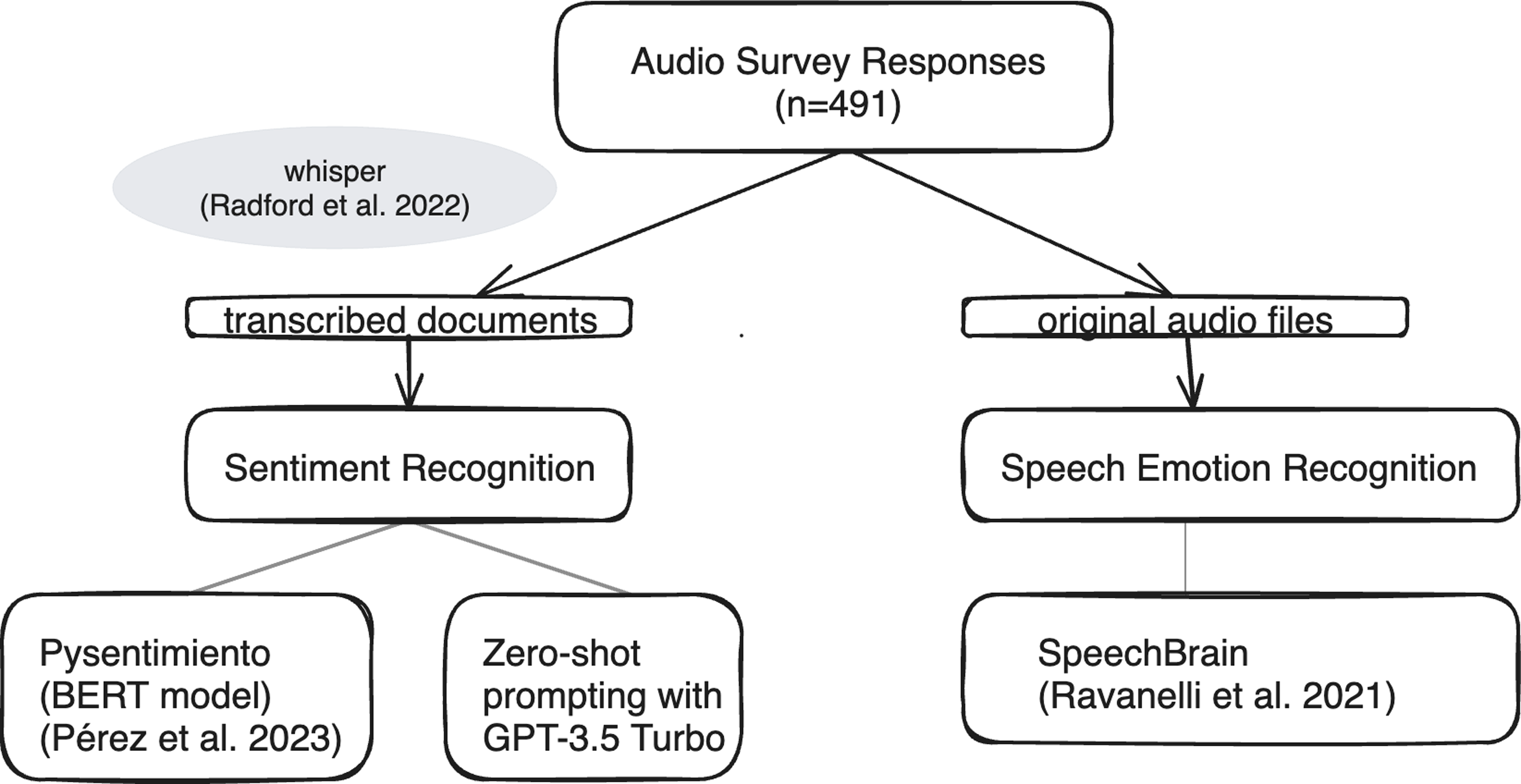
Below, we describe in detail how these different steps depicted in Figure 1 are achieved.
Sentiment analysis
We start by analyzing the sentiment of the survey responses, classifying them into positive, negative, or neutral tones. In this study, we are exploring two approaches for this task; the first one is pysentimiento, a fine-tuned BERT model, and the second approach is zero-shot prompting with GPT-3.5. While both approaches constitute a deep-learning architecture, they, for example, differ with regard to whether they are fine-tuned, that is, specifically trained for the sentiment task or not.
BERT (Bidirectional Encoder Representations from Transformers) (Devlin, Chang, Lee et al. Reference Devlin, Chang, Lee and Toutanova2018) is a language model with weights that contain contextual word representations (i.e., word embeddings), and these weights can be fine-tuned for diverse natural language processing tasks. Fine-tuning is the process of ‘refining’ a pre-trained model on a smaller task-specific dataset to learn a specific downstream task (e.g., sentiment classification). Nowadays, several pre-trained BERT models are available (Chiorrini, Diamantini, Mircol et al. Reference Chiorrini, Diamantini, Mircoli and Potena2021), and in this study, we are using a fine-tuned BERT model called pysentimiento (Pérez, Rajngewerc, Giudic et al. Reference Pérez, Rajngewerc, Giudici, Furman, Luque, Alonso Alemany and Martínez2023). Pysentimiento is built on top of Hugging Face’s Transformers library (Wolf, Debut, Sanh et al. Reference Wolf, Debut, Sanh, Chaumond, Delangue, Moi and Cistac2019) and represents a Python multilingual toolkit for social NLP tasks. Pysentimiento’s models for Sentiment and Emotion Analysis, developed by Pérez, Rajngewerc, Giudici et al. (Reference Pérez, Rajngewerc, Giudici, Furman, Luque, Alonso Alemany and Martínez2023), are deployed on the Hugging Face hub and can be easily accessed through the library. In particular, in our study, we are using the available sentiment model, which uses BERTweet (a RoBERTa model trained on English tweets) as its base model and was further trained with a dataset that contains 61,900 tweets annotated for polarity detection (SemEval 2017 Task 4 Subtask 1; see Pérez, Rajngewerc, Giudici et al. Reference Pérez, Rajngewerc, Giudici, Furman, Luque, Alonso Alemany and Martínez2023 for details).
Our second approach to detect sentiment in the survey responses does not depend on fine-tuning but instead leverages the power of language models via zero-shot prompting. In general, prompting is a modern classification approach that came into being through the emergence of large language models such as GPT-3. Prompting can be further dissected into zero-shot or few-shot prompting. Both approaches were shown to match or even exceed the performance of typical human coders for a variety of classification tasks (Burnham Reference Burnham2023; Rytting, Sorensen, Argyle et al. Reference Rytting, Sorensen, Argyle, Busby, Fulda, Gubler and Wingate2023). Zero-shot prompting is an approach that makes use of the ‘instructions contained in prompts without any training data’ (Chae and Davidson Reference Chae and Davidson2026: 3). Similarly, to sentiment dictionaries, zero-shot prompting ‘requires no training data and minimal programming to implement’ (Burnham Reference Burnham2023: 2); however, ‘[u]nlike sentiment dictionaries, it produces results comparable to, and sometimes better than, supervised classification’ (Burnham Reference Burnham2023: 2).
In our study, we are going to pursue zero-shot prompting with GPT-3.5-turbo, the successor to GPT-3, which, to date, is one of the largest existing language models (Brown, Mann, Ryder et al. Reference Brown, Mann, Ryder, Subbiah, Kaplan, Dhariwal, Neelakantan, Shyam, Sastry, Askell, Agarwal, Herbert-Voss, Krueger, Henighan, Child, Ramesh, Ziegler, Wu, Winter, Hesse, Chen, Sigler, Litwin, Gray, Chess, Clark, Berner, McCandlish, Radford, Sutskever and Amodei2020).Footnote 9 To achieve the classification of survey responses with GPT without providing human-annotated examples, we needed to provide the model with a specific prompt. Here, our goal was to provide a very clear and straightforward prompt that returns a single token (i.e., positive, negative, neutral) to detect the nature of associations in its most standard form: positive, negative, or neutral. Our prompt reads as follows (see Section A5 for more details on our prompt engineering):
‘Classify the sentiment of the following open-ended survey answer into neutral, negative or positive. Text: i Sentiment:’,
where i is the survey response. We deliberately kept the prompt simple and did not provide GPT with an explicit definition of sentiment. Recent evidence suggests that large language models perform reliably on standard sentiment classification without elaborate prompting (Burnham Reference Burnham2023; Ziems, Held, Shaikh et al. Reference Ziems, Held, Shaikh, Chen, Zhang and Yang2023), and we validated our GPT classifications against a human-labeled subset, finding high agreement (see Section A3.1).
With both the BERT and the GPT approaches described above, we chose to pursue deep learning-based models due to the finding that other, more traditional and more simple approaches (i.e., dictionary approaches) exhibited very low accuracy in our sample. Historically, the analysis of sentiment in survey responses was achieved with theory-based dictionaries of affectively scored words (Mossholder, Settoon, Harris et al. Reference Mossholder, Settoon, Harris and Armenakis1995). Results, where we applied such dictionary methods to our data alongside a discussion of issues and challenges, can be found in Section A3.2.
Emotion analysis
The detection of emotions can be understood as a more difficult endeavor compared to sentiment analysis, ‘given the greater variety of classes and the more subtle differences between them’ (Chiorrini, Diamantini, Mircoli et al. Reference Chiorrini, Diamantini, Mircoli and Potena2021: 1). Automatic emotion recognition is a young research area, but we already know that recognizing emotions from text is challenging (for an overview of transformer models for emotion recognition from text, see Adoma, Henry, and Chen Reference Adoma, Henry and Chen2020; Kratzwald, Ilic, Kraus et al. Reference Kratzwald, Ilic, Kraus, Feuerriegel and Prendinger2018; and Nandwani and Verma Reference Nandwani and Verma2021, as well as Section A4.2 for an analysis with the EmoLex Dictionary) because it is stripped of all paralinguistic and acoustic features. We can assume that the inclusion of paralinguistic features such as intonation, pitch, volume, pauses, and also laughter or breathing noises (Lu, Cao, Zhang et al. Reference Lu, Cao, Zhang, Chiu and Fan2019) can be very helpful in recognizing emotional states in speech. This is why, in our study, for the task of emotion recognition, we are going to use methods from the field of Speech Emotion Recognition.
SER can be subordinated to the field of Automated Emotion Recognition and is a part of other disciplines such as Neurocomputing (Lope and Graña Reference Lope and Graña2023) and Affective Computing (Atmaja, Sasou, and Akagi Reference Atmaja, Sasou and Akagi2022; Madanian, Chen, Adeleye et al. Reference Madanian, Chen, Adeleye, Templeton, Poellabauer, Parry and Schneider2023). Speech Emotion Recognition can include traditional machine learning (for example, logistic regression) (Madanian, Chen, Adeleye et al. Reference Madanian, Chen, Adeleye, Templeton, Poellabauer, Parry and Schneider2023), but nowadays a large corpus of SER applications makes use of deep-learning architectures (Lope and Graña Reference Lope and Graña2023; Singh and Goel Reference Singh and Goel2022).
To achieve emotion detection in our survey answers, our study follows this trend of utilizing deep learning, and in particular, we utilize SpeechBrain (Ravanelli, Parcollet, Plantinga et al., Reference Ravanelli, Parcollet, Plantinga, Rouhe, Cornell, Lugosch and Subakan2021). SpeechBrain is an open-source deep learning toolkit built upon PyTorch specifically designed for speech and audio processing tasks. In general, SpeechBrain provides a comprehensive set of pre-built tools (‘recipes’) and models tailored for various speech-related tasks, including Speech Emotion Recognition.
For emotion detection, Wang, Boumadane, and Heba (Reference Wang, Boumadane and Heba2021) pre-trained a model that is based on the wav2vec 2.0 architecture. Wav2vec 2.0 (Baevski, Zhou, Mohamed et al. Reference Baevski, Zhou, Mohamed and Auli2020) was originally proposed for Automatic Speech Recognition but is nowadays also frequently used for speech emotion recognition (Chen and Rudnicky Reference Chen and Rudnicky2023; Pepino, Riera, and Ferrer Reference Pepino, Riera and Ferrer2021; Wang, Boumadane, and Heba Reference Wang, Boumadane and Heba2021). By training a wav2vec 2.0 model with data from the Interactive Emotional Dyadic Motion Capture (IEMOCAP) dataset, the authors achieve state-of-the-art results for different tasks.Footnote 10 For example, for the task of SER using the IEMOCAP public emotion recognition dataset, they achieved a weighted (averaged on 5 different seeds) accuracy rate of 79.58% across multiple emotions (model ‘PF-hbt-large’)Footnote 11 . Similar performances for fine-tuned wav2vec 2.0 models for SER can be found in Chen and Rudnicky (Reference Chen and Rudnicky2023) (e.g., 74.3% unweighted accuracy for a wav2vec 2.0 model fine-tuned using a P-TAPT method). Wang, Boumadane, and Heba (Reference Wang, Boumadane and Heba2021) open-sourced their code within the SpeechBrain framework, which allows for easy implementation for researchers without extensive training resources.
SpeechBrain’s recipe for Speech Emotion Recognition classifies utterances into four emotions: anger, happiness, sadness, and neutrality (Wang, Boumadane, and Heba Reference Wang, Boumadane and Heba2021: 4). This decision of including four emotions is frequently found in SER research utilizing the IEMOCAP database and aims at ensuring consistency and comparability across other studies on the same database (Fayek, Lech, and Cavedon Reference Fayek, Lech and Cavedon2017). It is important to note that this four-category taxonomy does not fully align with the emotion categories central to political science theories. Most notably, it lacks fear and anxiety, two emotions that play a foundational role in Affective Intelligence Theory (e.g., Marcus Reference Marcus2003) and that have been shown to have distinct effects on political trust (Albertson and Gadarian Reference Albertson and Gadarian2015; Meer, Steenvoorden, and Ouattara Reference Meer, Steenvoorden and Ouattara2023). Under AIT, fear and anger generate opposing predictions for political attitudes, making the absence of a fear category a limitation that should be kept in mind when interpreting our emotion results. In general, research that includes data on linguistic and acoustic as well as paralinguistic features is still in its infancy. We are not aware of any studies that use the SpeechBrain emotion classifier, and social science research that takes advantage of such detailed language characteristics is not yet widespread. Noteworthy exceptions and applications lie within the field of political science (Dietrich, Hayes, and O’brien Reference Dietrich, Hayes and O’brien2019; Rittmann Reference Rittmann2024).Footnote 12
Our hypotheses will be investigated as follows. For our first hypothesis (H1) (‘Respondents, when requested to give reasons for their level of trust, include non-neutral sentiment (H1a) as well as emotional language (H1b) in their answers.’), we will examine the open-ended responses to determine which types of sentiment and emotion they include. As described above, sentiment will be measured with three categories (positive, negative, and neutral), and emotions will be measured with four categories (anger, happiness, sadness, and neutrality).
Our second hypothesis (H2), that the type of sentiment (H2a) or emotion (H2b) expressed in an open-ended survey answer impacts the closed-ended trust score, is analyzed by predicting the quantitative closed-ended measure of political trust with our sentiment and emotion variables. For this, we will use regression analysis and show findings both for bivariate models and multivariate models in which we control for age, education, socio-economic status, and party preference.
Results
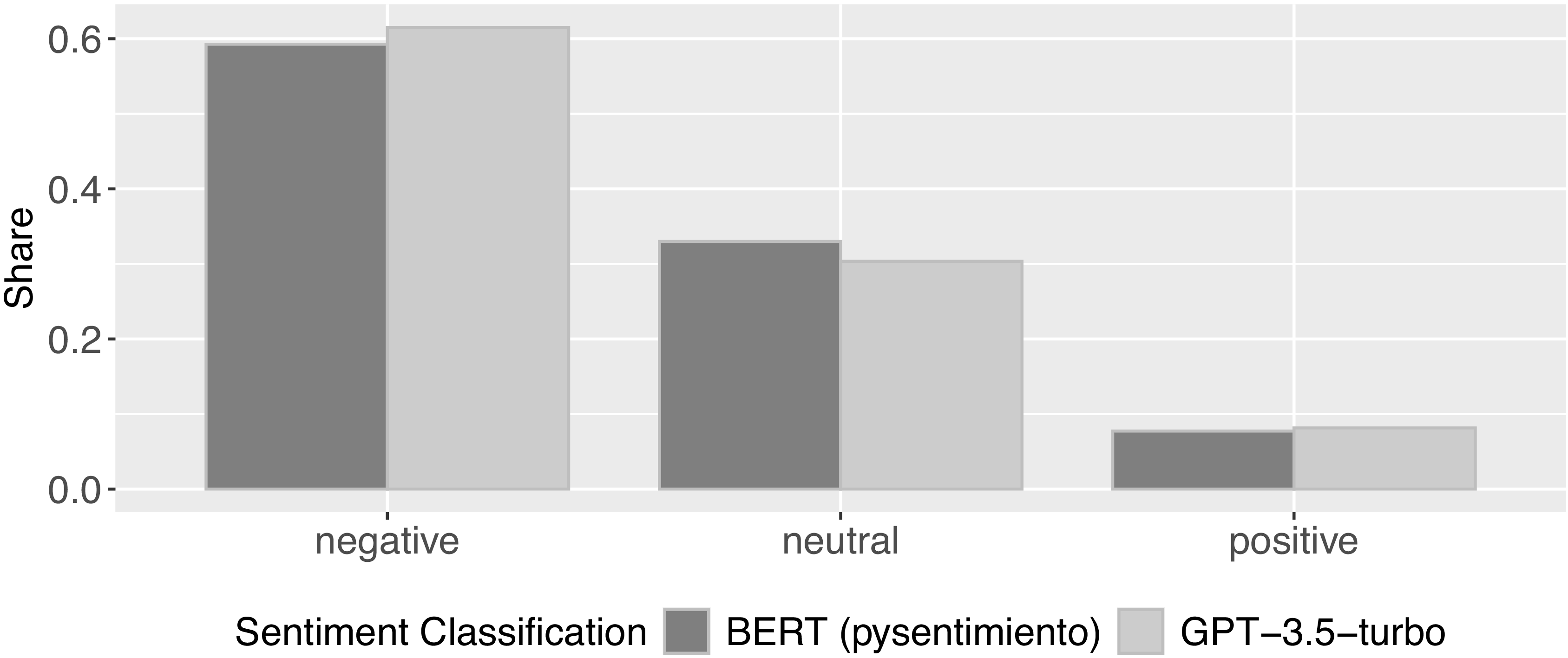
We start by presenting the results regarding the sentiment in the open-ended answers. Figure 2 illustrates the distributions over the three sentiment categories by classification approach. In sum, both classifiers result in a notable portion of open-ended answers with negative sentiment. From our total of 491 observations, the two classifiers classify between 59% (BERT) and 62% (GPT) as negative and only between 30% (GPT) and 33% (BERT) as neutral. The share of positive associations in the survey responses is small for both classifiers (8% for GPT and BERT).
Sentiment Classification with three categories by classifier (BERT vs. GPT).
Note: n = 491 open-ended answers. BERT represents findings from sentiment analysis achieved with pysentimiento (Pérez, Rajngewerc, Giudic et al. Reference Pérez, Rajngewerc, Giudici, Furman, Luque, Alonso Alemany and Martínez2023), and GPT represents findings from zero-shot prompting with GPT-3.5-turbo.
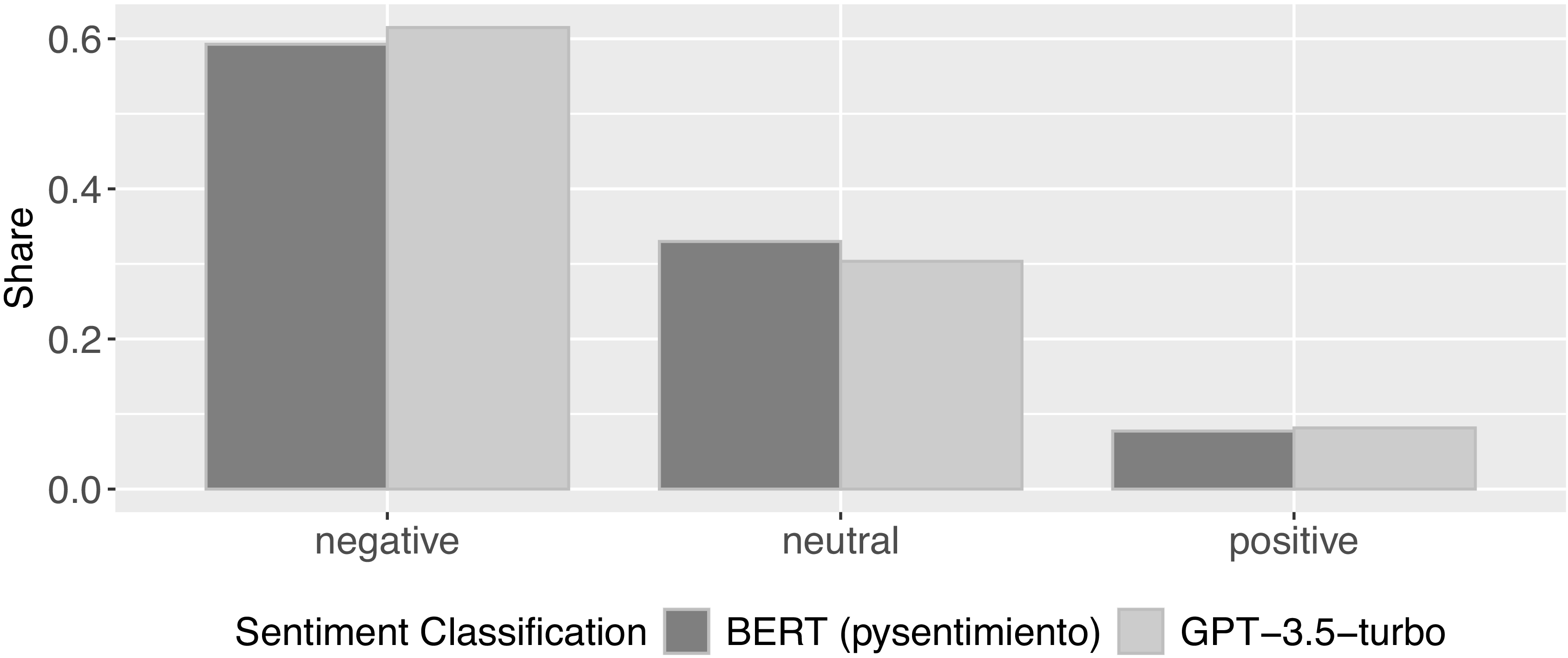
To illustrate who expresses different types of affect, the Online Appendix (Section A2) presents sentiment and emotion distributions by party preference, age group, and education level. Importantly, both classifiers result in similar results and exhibit a degree of agreement of 79%. Section A3.1 depicts the confusion matrix of both classifiers and further demonstrates how they differ in terms of accuracy when we compare their results to a human-labeled subset of the data. Here, the GPT classifiers exhibited a slightly improved accuracy compared to the BERT classifier.
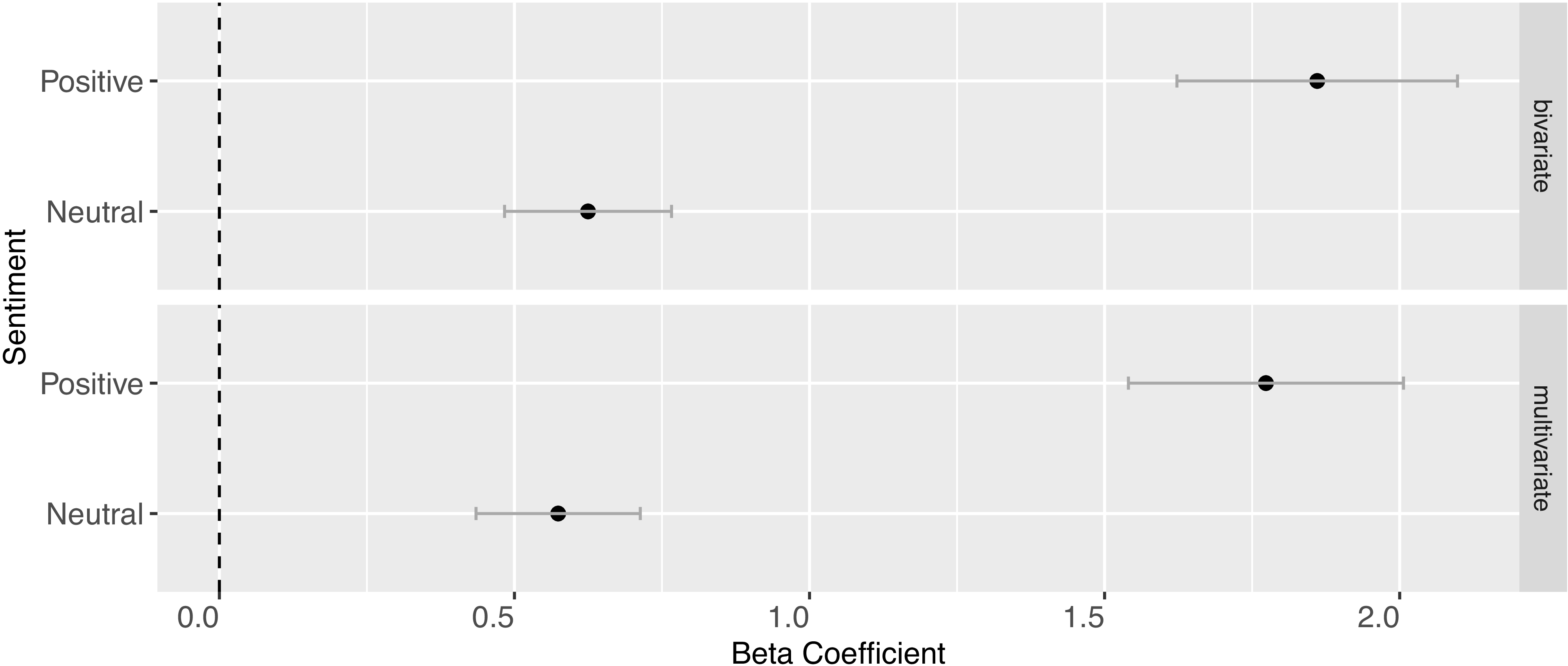
Next, we examine this sentiment variability and its impact on actual trust scores. For this, we conducted regression analysis, including both bivariate and multivariate models. Bivariate analysis examines the direct effect of sentiment on political trust, while multivariate analysis adjusts for potential confounding factors (age, education, socio-economic status, and party preference), enhancing the robustness of our findings. We include party preference because partisanship may confound the emotion-trust relationship: during the Biden presidency, opposition-party supporters (Republicans) may simultaneously express more negative affect and report lower trust, making it essential to rule out that our findings are merely a partisan artifact. Figure 3 illustrates the results from these regression models.
Linear model of sentiment and a five-category trust score (bi- and multivariate).
Note: The data for the sentiment classification displayed here stems from the GPT-based classification. Corresponding tables showing the regression coefficients, as well as respective findings for the BERT classification, and results from an ordered logit model can be found in Section A3.3.
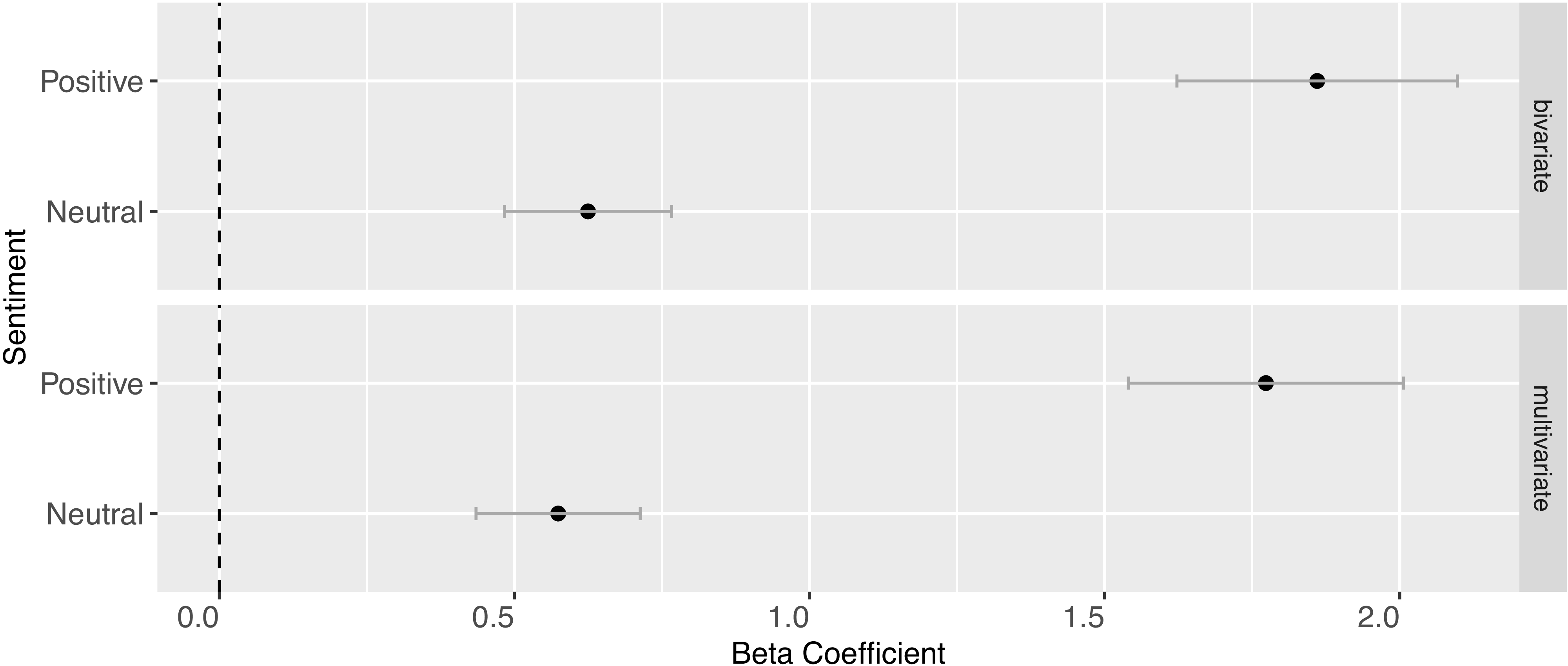
For computing the above-displayed coefficients, we designated the ‘negative’ sentiment as the reference category, and consequently, Figure 3 illustrates that irrespective of model specification, an increase in positive sentiment is associated with an increase in political trust (beta_positive = 1.8, p < 0.001, and beta_neutral = 0.57, p < 0.001 in the multivariate setting). This finding gives support for H2a, suggesting that the nature of associations measured by sentiment in a survey response is correlated with trust scores. This effect is robust to the inclusion of age, education, socio-economic status, and party preference as covariates.
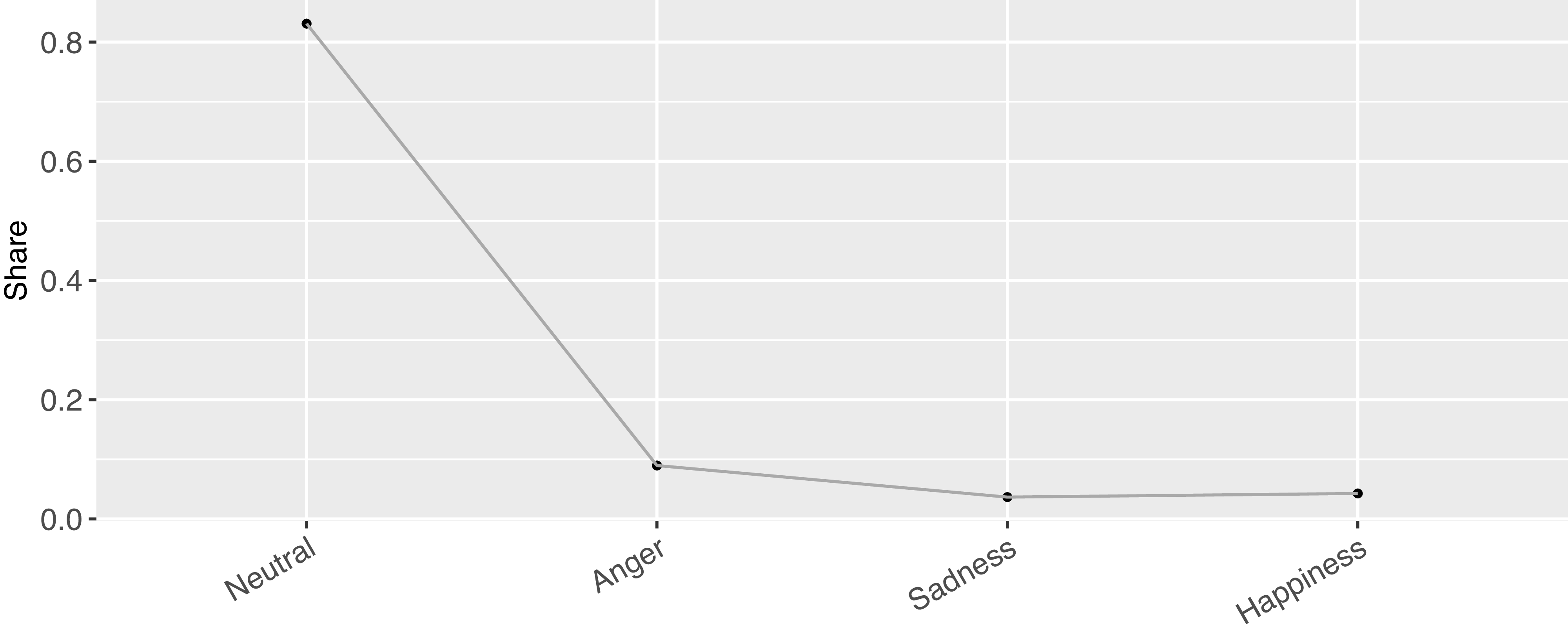
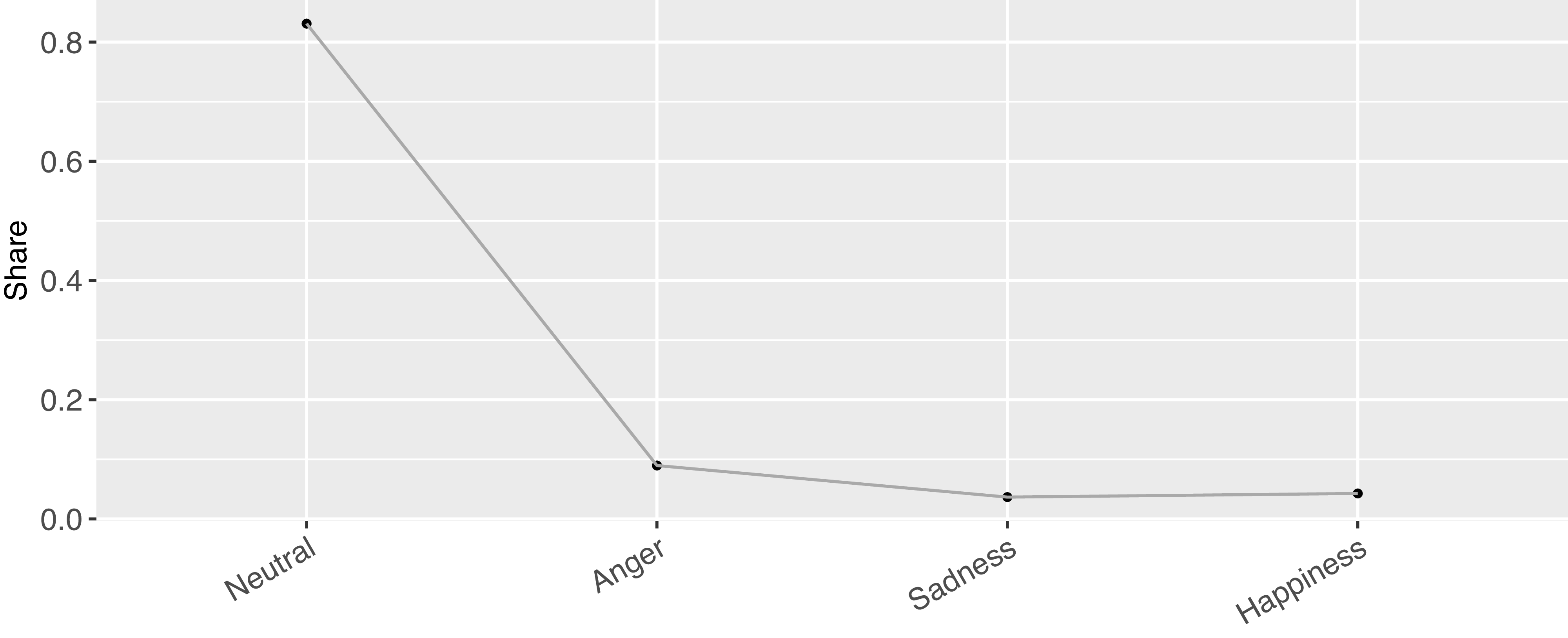
We continue with our findings for the presence of emotions in the survey answers. Figure 4 displays emotion classification results obtained through audio-based analysis using SpeechBrain. In sum, Figure 4 demonstrates that the majority of open-ended responses do not contain explicit affective speech characteristics and are characterized by a neutral emotional tone, which does not support H1b, and thus indicates that there is no significant share of emotions in our survey answers.
Emotion classification obtained from SpeechBrain.
Note: Analysis of n = 491 open-ended answers. Number of observations for each emotion category: 408 (neutral), 44 (angry), 18 (sad), 21 (happy).
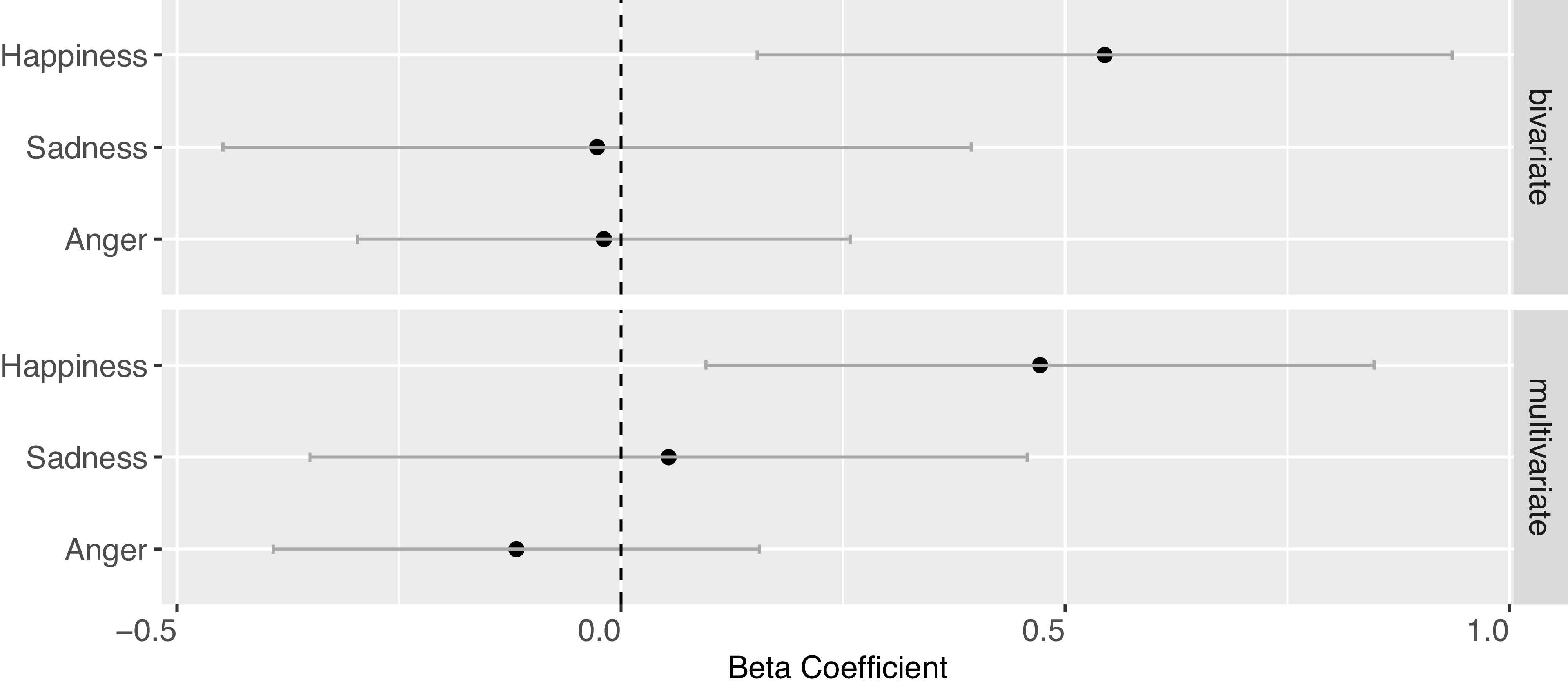
We continue with a regression analysis to examine the impact of emotion categories on trust scores. Figure 5 shows findings from this linear regression (bi- and multivariate) where the ‘neutral’ emotion category was used as the reference category.
Linear model of emotion and a five-category trust score (bi- and multivariate).
Note: The data for the emotion classification displayed in this figure stems from the SpeechBrain classification. Corresponding tables showing the regression coefficients can be found in Section A4.1.
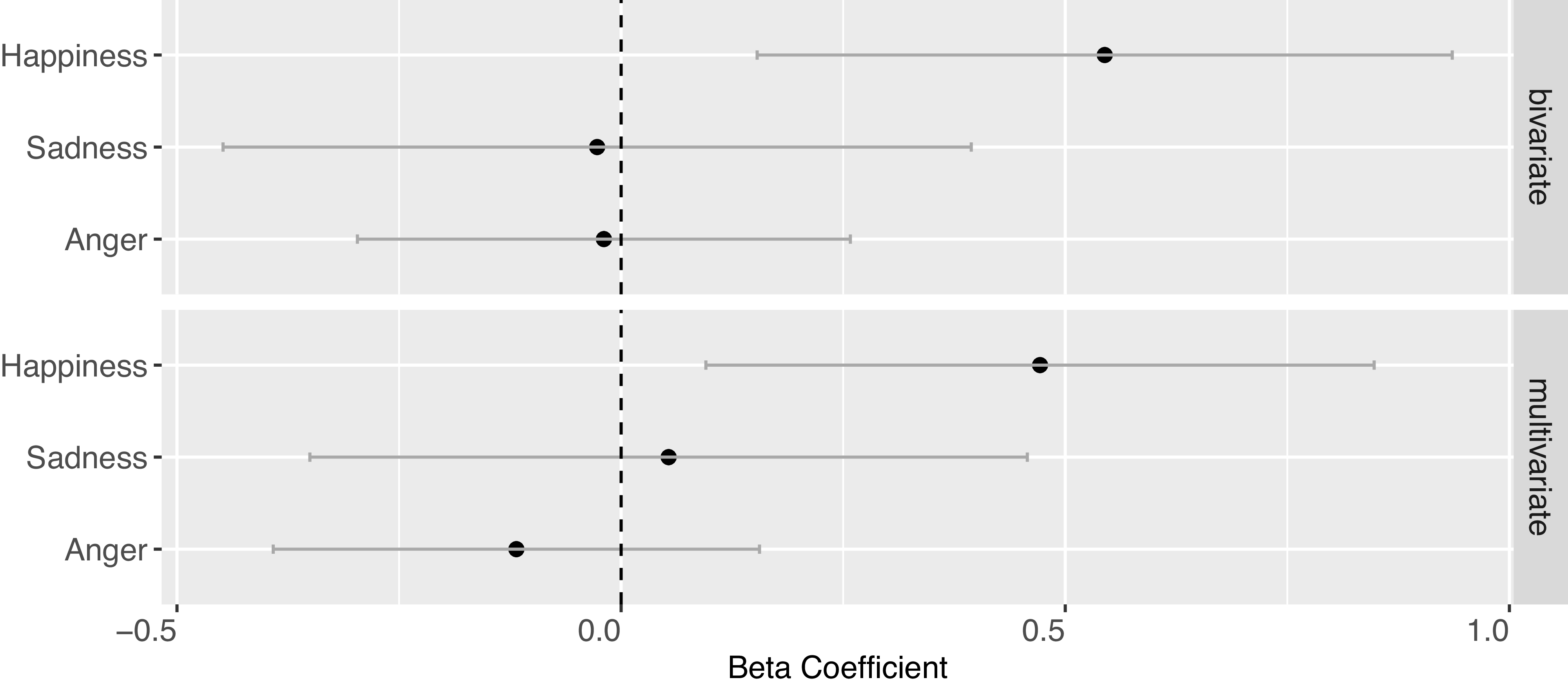
Figure 5 shows that irrespective of covariate specification, a positive emotion of happiness positively influences trust (for example, beta_happiness = 0.47, p = 0.01 in the multivariate setting). This effect is robust to the inclusion of age, education, socio-economic status, and party preference as covariates. The effect of negative emotions such as sadness and anger is negative; however, it is not significant (beta_sadness = 0.053, p > 0.01, beta_anger = −0.12, p > 0.01 in the multivariate setting, beta_anger = −0.019, p > 0.01 in the bivariate setting).
These findings are partly in line with our hypothesis H2b stating that the nature of associations measured by emotions in a survey response has an impact on trust scores; however, we were only able to find a significant and meaningful effect for the positive emotion in our sample. As a robustness check, we re-estimated all models, including binary indicators for responses collected after the announcement of impeachment proceedings against President Biden (September 12, 2023) and after the start of the Hamas–Israel war (October 7, 2023). The main coefficients remain substantively unchanged, and neither period indicator is statistically significant (see Online Appendix, Section A7).
Discussion and conclusion
Our study provides novel empirical evidence that, in addition to rational reasoning and risk calculation (Coleman Reference Coleman1994; Hardin Reference Hardin2002; Levi and Stoker Reference Levi and Stoker2000), political trust judgments contain a significant affective component. While a growing number of studies have begun to examine the affective foundations of political trust (e.g., Erhardt, Freitag, Filsinger et al. Reference Erhardt, Freitag, Filsinger and Wamsler2021; Meer, Steenvoorden, and Ouattara Reference Meer, Steenvoorden and Ouattara2023; Vasilopoulos, Mcavay, Brouard et al. Reference Vasilopoulos, Mcavay, Brouard and Foucault2023), this line of research still requires further empirical investigation (Theiss-Morse and Barton Reference Theiss-Morse and Barton2017: 167). Building on the idea that there is an ‘affective route’ to trust (Grimmelikhuijsen Reference Grimmelikhuijsen2012: 56) and drawing on the ‘hot cognition’ framework of Lodge and Taber (Reference Lodge and Taber2013), we used open-ended voice response probing and multimodal analysis (text-based sentiment and audio-based emotion recognition) to directly observe affect as it manifests within the trust evaluation process. Our text-based sentiment analysis revealed a predominantly negative affective profile: 59–62% of responses carried negative sentiment, compared to only 8% positive sentiment (see Figure 2). This sentiment strongly predicted trust scores, with positive sentiment increasing and negative sentiment decreasing political trust (see Figure 3). The audio-based emotion analysis, by contrast, detected explicit emotional expression in only 17% of responses (see Figure 4). Among the detected emotions, happiness had a positive effect on trust, but sadness and anger showed no significant effects, contradicting our expectation.
The divergence between the sentiment and emotion results is itself informative and can be attributed to four factors. First, a modality difference: sentiment was measured from transcribed text while emotion was measured from audio signals, and respondents may express affect through word choice without corresponding vocal cues. Words like ‘lovely’ and ‘awesome’ inherently carry stronger emotions compared to more generic terms like ‘person’ and ‘day’ (Yoon, Byun, and Jung Reference Yoon, Byun and Jung2018). Second, the survey context may suppress emotional paralinguistics while still permitting affectively charged language – the requirement to speak into a smartphone, especially in potentially uncomfortable settings, may not be the most effective way to elicit emotionally charged paralinguistics (Dunn and Schweitzer Reference Dunn and Schweitzer2005; Marcus Reference Marcus2003). Third, a training data mismatch: SpeechBrain was trained on acted emotional speech in dyadic conversations (Busso, Bulut, Lee et al. Reference Busso, Bulut, Lee, Kazemzadeh, Mower, Kim, Chang, Lee and Narayanan2008), a register that differs substantially from naturalistic survey responses. Fourth, the taxonomic limitations of a four-category model mean that the ‘neutral’ label likely absorbs a heterogeneous mix of genuinely neutral responses and responses carrying emotions not covered by the model, such as frustration, disgust, disappointment, or fear, which may be particularly relevant in the context of political distrust (Bertsou Reference Bertsou2019b). The fact that our text-based sentiment analysis detects clear affective content (62% negative sentiment) in the very same responses that SpeechBrain classifies as emotionally ‘neutral’ supports this interpretation. Rather than undermining our findings, this pattern suggests that in survey contexts, affect is expressed primarily through lexical choices rather than vocal paralinguistics. The null effect of anger also warrants discussion. From an AIT perspective, anger may reinforce existing dispositions rather than uniformly decreasing trust (Marcus, Neuman, and MacKuen Reference Marcus, Russell Neuman and MacKuen2000). In a heterogeneous sample containing both trusting and distrusting respondents, anger could deepen distrust among the skeptical while reinforcing positive orientations among the trusting, attenuating the average effect.
Our findings carry implications for several areas of research. For political trust research, we provide direct empirical evidence that people’s real-time trust evaluations contain significant affective content. While prior studies have examined how externally triggered or self-reported emotions influence political trust (e.g., Erhardt, Freitag, Filsinger et al. Reference Erhardt, Freitag, Filsinger and Wamsler2021; Meer, Steenvoorden, and Ouattara Reference Meer, Steenvoorden and Ouattara2023; Vasilopoulos, Mcavay, Brouard et al. Reference Vasilopoulos, Mcavay, Brouard and Foucault2023), our approach is distinct in that we observe affect as it manifests within the trust evaluation process itself, through open-ended response probing. The predominantly negative sentiment we detect also aligns with the well-documented decline in political trust in the U.S. and with arguments about the asymmetry between trust and distrust (Bertsou Reference Bertsou2019b). Indeed, given that 59–62% of responses carry negative sentiment in the context of a single vertical trust judgment on the federal government, our findings may be capturing the emotional basis of political distrust as much as of trust. Bertsou (Reference Bertsou2019b) argues that distrust involves active negative orientations rather than a mere absence of positive ones, and the anger and negative language we detect in open-ended responses are consistent with this characterization. For survey methodology, the discrepancy between our sentiment and emotion results suggests that in formal survey contexts, respondents express affect primarily through lexical choices rather than vocal paralinguistics, which has implications for how surveys should be designed to capture emotional content. For computational social science, we demonstrate the feasibility of applying NLP and Speech Emotion Recognition tools to open-ended survey responses while identifying important limitations, in particular the misalignment between SER emotion taxonomies and political science theories.
Several limitations should be acknowledged. Our study does not establish a causal relationship between emotions and trust – the affect we detect in open-ended responses could be a consequence of the trust judgment rather than a cause. Relatedly, we lack a baseline measure of respondents’ emotional state prior to the trust evaluation. We therefore cannot disentangle whether the affect we detect was elicited by the trust question itself, reflects a pre-existing mood that respondents brought into the survey, or captures a stable affective disposition. Nor does our design allow us to compare the relative contributions of cognition and emotion to trust formation, since our open-ended responses likely contain both cognitive reasoning and affective content simultaneously.
Furthermore, our study faced a relatively small response rate for the open-ended audio question (33%). We deliberately chose not to make the voice response mandatory in order to avoid coerced or low-quality answers that could introduce noise into the data. Forcing respondents to record audio in potentially uncomfortable settings may have led to perfunctory or artificial responses, undermining the ecological validity of the emotional expressions we aimed to capture. However, a self-selection analysis (see Online Appendix, Section A1) comparing respondents and non-respondents across 11 key variables shows no substantively meaningful differences: only socio-economic status reached statistical significance, with a negligible effect size, and most importantly, no trust variables differed between the groups.
Finally, we adopted a ‘discrete-emotions approach’ (Hassing Nielsen and Mønster Reference Hassing Nielsen and Mønster2026) to analyze emotions, assuming uniform responses to specific emotions among individuals, whereas prior studies have demonstrated the existence of diverse ‘affective styles’ that influence how individuals manage particular emotions (Hassing Nielsen and Mønster Reference Hassing Nielsen and Mønster2026). The discrete emotion results are further limited by the available SER tools, as discussed above.
These limitations point to several avenues for future research. First, future studies could include a baseline mood measure (e.g., the PANAS scale) before the trust question to disentangle the mechanisms through which affect enters the trust evaluation. Second, exploring alternative probing wordings that aim at more general descriptions of experiences and associations related to politics (for example, ‘how have you felt about politics lately?’) could potentially yield a stronger presence of emotions in answers. Third, strategies to increase participation with the voice response format (e.g., incentives, improved user experience, or requiring a minimum time on the recording page) would enrich the depth and generalizability of findings. Fourth, exploring diverse ‘affective styles’ concerning political trust measures, as suggested by Hassing Nielsen and Mønster (Reference Hassing Nielsen and Mønster2026), represents a promising avenue. Lastly, future work should leverage multimodal models that simultaneously use both audio and text data for emotion recognition (Li, Tang, Zhao et al. Reference Li, Tang, Zhao and Zhu2022; Yoon, Byun, and Jung Reference Yoon, Byun and Jung2018). In particular, future work should explore SER models trained on emotion taxonomies that align with social science theories – for instance, including fear, anxiety, or enthusiasm as categories – or pursue fine-tuning existing models on politically relevant speech data. As political scientists increasingly adopt computational methods for emotion recognition, closer interdisciplinary collaboration between computational and social scientists on the design of emotion taxonomies becomes essential.
Supplementary material
The supplementary material for this article can be found at https://doi.org/10.1017/S1475676526101728.



 Open access

